UPSC Personality Test Preparation 2026: Common Mistakes to Avoid | Best UPSC Coaching in Mumbai | The Prayas India
Introduction
Clearing the UPSC Civil Services Examination is a long process that demands consistency across Prelims, Mains and finally the Personality Test. While candidates often spend months refining their knowledge and answer-writing skills for the written stages, the UPSC Personality Test requires a different kind of preparation. It is not simply another examination in which a candidate has to demonstrate how much information they can remember. It is an assessment of personality, judgement, awareness, communication, balance of thought and the ability to respond intelligently under pressure.
This difference makes Personality Test preparation particularly important. A candidate who has performed strongly in Mains can still lose valuable marks by approaching the interview like a conventional question-and-answer examination. Similarly, a candidate who is not naturally extroverted does not need to transform their personality to perform well. What matters is learning how to present one’s genuine personality with clarity, confidence and maturity.
For UPSC aspirants preparing in Mumbai, structured guidance can make this final stage more focused. The right UPSC coaching in Mumbai can help candidates identify weaknesses, practise realistic interview situations, analyse their responses and develop a more composed approach to the board interaction.
The purpose of this article is to examine the most common mistakes candidates make while preparing for the UPSC Personality Test and explain how to replace them with a more practical preparation strategy.
Understanding the UPSC Personality Test Before You Prepare
The first mistake many candidates make is beginning interview preparation without understanding what the Personality Test is actually trying to assess.
The interview is not designed merely to check whether a candidate can reproduce facts. The board may discuss current affairs, the candidate’s educational background, work experience, hobbies, home state, district, optional subject, achievements, interests and issues mentioned in the Detailed Application Form. However, the discussion can move in unexpected directions.
A candidate may be asked a straightforward factual question, followed by a question that requires judgement. The board may then challenge the candidate’s opinion or present a hypothetical administrative situation.
This means preparation should not be limited to collecting possible questions and memorising answers.
The candidate needs to develop the ability to:
- Understand a question before answering it.
- Think logically under pressure.
- Present an opinion without becoming rigid.
- Accept when they do not know something.
- Explain complex issues in simple language.
- Consider multiple perspectives.
- Remain composed when challenged.
- Connect knowledge with practical administration.
The Personality Test should therefore be approached as a process of personality refinement and communication practice, not as a script-learning exercise.
Mistake 1: Treating the Interview Like Another Written Examination
One of the most common mistakes is preparing for the Personality Test by simply reading more and more factual material.
Current affairs are certainly important, but an interview is not conducted through multiple-choice questions. Knowing ten facts about an issue is less useful if you cannot explain its implications or discuss it calmly.
For example, if the board asks about a major government policy, simply stating its objectives may not be enough. You may be asked about implementation challenges, unintended consequences, the perspective of a particular stakeholder or how you would address a problem as an administrator.
Therefore, every major topic should be studied from multiple dimensions.
A useful preparation framework is:
Issue → Background → Stakeholders → Benefits → Concerns → Administrative Challenges → Possible Solutions
This encourages analytical thinking rather than factual memorisation.
Mistake 2: Memorising Model Answers
Model answers can provide direction, but memorising them word-for-word can make an interview response sound artificial.
UPSC boards interact with candidates rather than evaluating rehearsed speeches. If you memorise an answer and the board asks a slightly different question, you may struggle to adapt.
There is also a greater risk of sounding overly polished or disconnected from your actual personality.
Instead of memorising complete answers, prepare answer frameworks.
For example, if you are asked for your opinion on an issue, you can structure your response around:
- Your understanding of the issue
- Your balanced assessment
- The key concern or challenge
- A practical way forward
This gives you structure without forcing you to reproduce a predetermined paragraph.
Mistake 3: Ignoring the Detailed Application Form
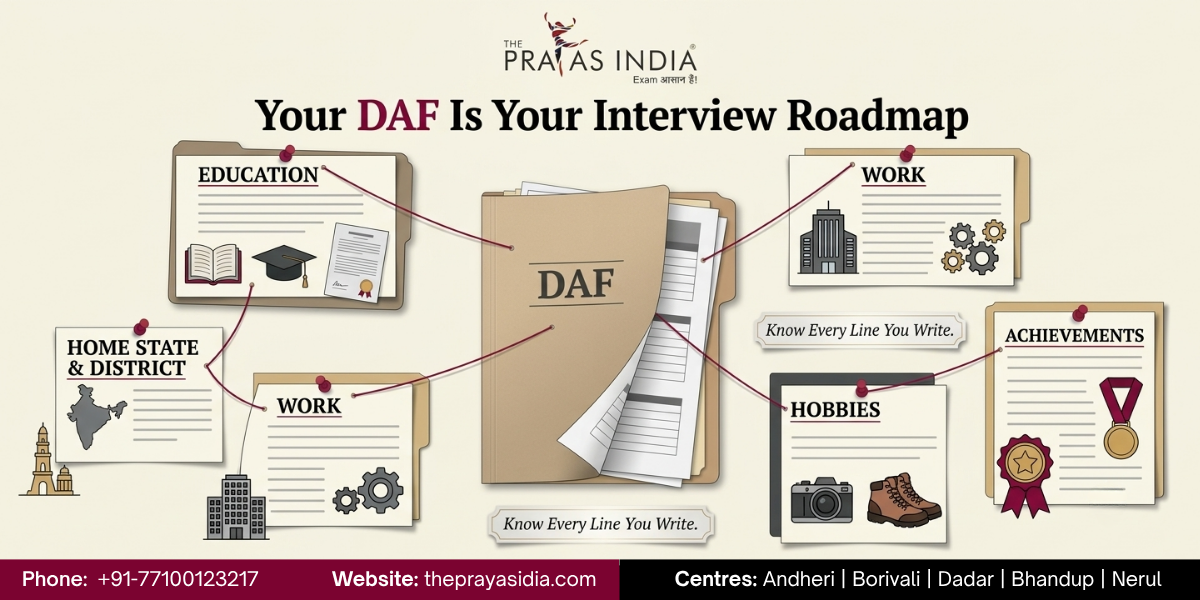
The Detailed Application Form, commonly referred to as the DAF, deserves serious attention because it can become one of the most important sources of interview questions.
Candidates sometimes spend enormous amounts of time studying national and international affairs while giving insufficient attention to information they themselves have submitted.
Your DAF can provide several possible discussion areas, including:
- Educational qualifications
- University or college
- Subject specialisation
- Employment history
- Hobbies
- Extracurricular activities
- Achievements
- Home state
- Home district
- Service preferences
- Optional subject
- Areas of interest
Every word in your DAF should be treated as potentially discussable.
This does not mean preparing hundreds of scripted questions. Instead, identify the likely dimensions of each entry and understand them deeply enough to discuss them naturally.
Mistake 4: Preparing Only National-Level Current Affairs
UPSC Personality Test preparation requires awareness of current affairs, but limiting your preparation to major national headlines is another common error.
The board can explore issues connected to your state, district, educational background, profession, hobbies or areas of interest. A candidate from Mumbai, for instance, should be able to discuss relevant urban issues, infrastructure challenges, local governance, public transport, housing, environmental concerns and other important developments affecting the region.
This does not mean reading every local newspaper from cover to cover. It means developing contextual awareness.
For each important current issue, ask yourself:
Why is this important?
Who is affected?
What are the competing perspectives?
What is the administrative challenge?
What could be a practical solution?
This style of preparation helps transform current affairs into interview-ready understanding.
Mistake 5: Trying to Have an Opinion on Everything
Balanced awareness is valuable. Pretending to have a strong opinion about every subject is not.
Candidates sometimes believe that an interview requires them to provide an immediate and confident opinion on every question. This can lead to unnecessarily rigid responses.
A mature candidate should be able to say that an issue has multiple dimensions.
For example, instead of making an extreme statement, you can acknowledge the benefits of a policy while discussing its implementation concerns. This demonstrates the ability to evaluate an issue rather than simply taking a side.
Civil services require decision-making in situations where competing interests often exist. Therefore, the ability to recognise complexity can be more valuable than displaying artificial certainty.
Mistake 6: Being Afraid to Say “I Don’t Know”
There is nothing wrong with admitting that you do not know the answer to a question.
In fact, attempting to manufacture an answer can create a much bigger problem. An incorrect guess may invite further questions, and once a candidate starts defending an answer they know is weak, their composure can deteriorate.
A simple and respectful response such as “I am sorry, Sir/Ma’am, I am not aware of that” is far better than inventing information.
Of course, candidates should not use “I don’t know” as a defensive response to every challenging question. The objective is to distinguish between genuine lack of knowledge and a question that simply requires a few seconds of thought.
Take a moment. Think. Answer if you can. Admit uncertainty when necessary.
Mistake 7: Overthinking Every Possible Question
The internet contains countless lists of expected UPSC interview questions. Trying to prepare answers to all of them can become counterproductive.
The Personality Test has too many possible directions for exhaustive question prediction to work.
Instead, prepare themes and dimensions.
If your hobby is photography, for example, you should understand not only photography terminology but also why you enjoy it, how the hobby developed, what its social or technological dimensions are and what broader discussions could emerge from it.
The objective is to build enough depth around your profile that you can handle variations of questions rather than memorising one answer for one expected question.
Mistake 8: Giving Extremely Long Answers
Candidates sometimes believe that speaking more demonstrates greater knowledge.
In reality, unnecessarily long answers can create additional opportunities for confusion, factual errors and follow-up questions.
A strong interview answer should be:
Relevant → Clear → Structured → Balanced → Concise
This does not mean every answer should be one sentence. Some questions require explanation. The important point is that every sentence should contribute something useful.
If the board asks a direct question, begin with a direct answer. Add context only when it helps.
Mistake 9: Speaking Too Fast
Nervousness can significantly affect speaking speed.
A candidate may know the answer but deliver it so quickly that the response becomes difficult to follow. Speaking too fast can also make the candidate appear anxious.
Practice deliberate pauses.
Before answering a difficult question, take a brief moment to organise your thoughts. Speak at a comfortable pace and allow important points to land naturally.
This is particularly important during mock interviews because candidates often discover that their speaking speed changes dramatically when they are under pressure.
Mistake 10: Trying to Sound Overly Sophisticated
UPSC candidates sometimes use complicated vocabulary because they believe sophisticated language will create a better impression.
The Personality Test is not an English-language performance competition.
If a simple sentence communicates your point more clearly, use it.
For example, instead of using multiple technical terms to explain a governance issue, explain the concept in language that an ordinary citizen could understand.
Administrators communicate with people from different educational, social and professional backgrounds. Clarity is therefore more valuable than unnecessarily complicated language.
Mistake 11: Being Too Casual or Too Formal
The ideal interview demeanour lies between extreme informality and artificial formality.
Candidates should be respectful and professional without becoming robotic.
Avoid:
- Excessive hand movements
- Constant smiling without context
- Overly casual expressions
- Interrupting the board
- Excessive nodding
- Artificially deep voice modulation
- Memorised introductions
At the same time, do not sit rigidly as if you are afraid to move.
The objective is to appear comfortable, attentive and respectful.
Mistake 12: Neglecting Body Language
Communication is not limited to words.
Posture, eye contact, facial expression and listening behaviour can influence how your response is perceived.
Good interview body language generally involves:
- Sitting comfortably upright
- Maintaining natural eye contact
- Listening carefully
- Avoiding unnecessary movements
- Keeping facial expressions appropriate
- Showing attentiveness when the board speaks
Candidates should not attempt to manufacture every gesture. Over-controlling body language can itself look unnatural.
The best approach is to practise enough that calm behaviour becomes automatic.

Mistake 13: Taking Challenging Questions Personally
The board may disagree with your answer or challenge your assumptions.
This should not be interpreted as a personal attack.
The purpose of such questioning can be to understand how you respond when your position is tested.
If the board challenges your opinion, do not become defensive. Reconsider the point and respond respectfully.
A useful approach is:
Acknowledge → Reconsider → Clarify → Respond
You can say that you understand the board’s perspective and then explain your position more carefully.
The ability to revise an argument when presented with a valid counterpoint can demonstrate intellectual maturity.
Mistake 14: Giving Extreme Opinions
Administrative decision-making often involves balancing different interests.
Therefore, extremely rigid statements can create unnecessary difficulty.
Instead of saying that a policy is entirely good or entirely bad, analyse the circumstances.
For example, a policy may have strong objectives but face implementation problems. A reform may create economic opportunities while also creating transitional difficulties for some groups.
Balanced answers do not mean avoiding opinions. They mean supporting opinions with reasoning and acknowledging legitimate concerns.
Mistake 15: Ignoring Your Home State and District
Your hometown or district is one of the most natural areas from which interview questions can emerge.
Candidates should know the basic administrative, economic, social and geographical characteristics of their region.
Depending on your background, you may need to understand:
- Major economic activities
- Important geographical features
- Local industries
- Agricultural patterns
- Infrastructure
- Education and health indicators
- Major social issues
- Important government initiatives
- Local environmental challenges
- Significant historical or cultural features
Do not simply memorise statistics. Understand what those statistics mean.
If your district has a particular development challenge, think like an administrator: What is causing it? Who are the stakeholders? What interventions could help?
Mistake 16: Ignoring Your Optional Subject After Mains
Candidates sometimes stop studying their optional subject after completing Mains.
However, questions related to your optional subject may appear during the Personality Test.
You do not necessarily need to revisit the entire syllabus at the same intensity as Mains preparation. Instead, revise the core concepts, important debates and areas that connect your optional subject with contemporary issues.
You should also be comfortable explaining why you selected that subject if the board asks.
Mistake 17: Treating Hobbies as Decoration on the DAF
If you mention a hobby, be prepared to discuss it.
A hobby should not simply be selected because it sounds impressive.
If you genuinely enjoy reading, for instance, the board may ask what you read, which authors you follow, what you have read recently or what you learned from a particular book.
Similarly, sports, music, travelling, photography, writing, cooking or other interests can lead to detailed conversations.
The safest approach is authenticity.
Choose to discuss genuine interests and develop reasonable depth around them.
Mistake 18: Not Practising Under Pressure
Reading interview tips can improve awareness, but it cannot replace speaking practice.
The biggest gap many candidates experience is between knowing an answer mentally and communicating it clearly under pressure.
Mock interviews can expose issues that self-study cannot easily reveal.
For example, you may discover that:
- You take too long to answer simple questions.
- You repeatedly use filler words.
- Your answers lack structure.
- You become defensive when challenged.
- Your body language changes under pressure.
- You struggle to explain familiar topics simply.
These are skills that improve through practice and feedback.
Building a Practical UPSC Personality Test Preparation Plan
Once the major mistakes are identified, preparation becomes much more manageable when divided into specific areas.
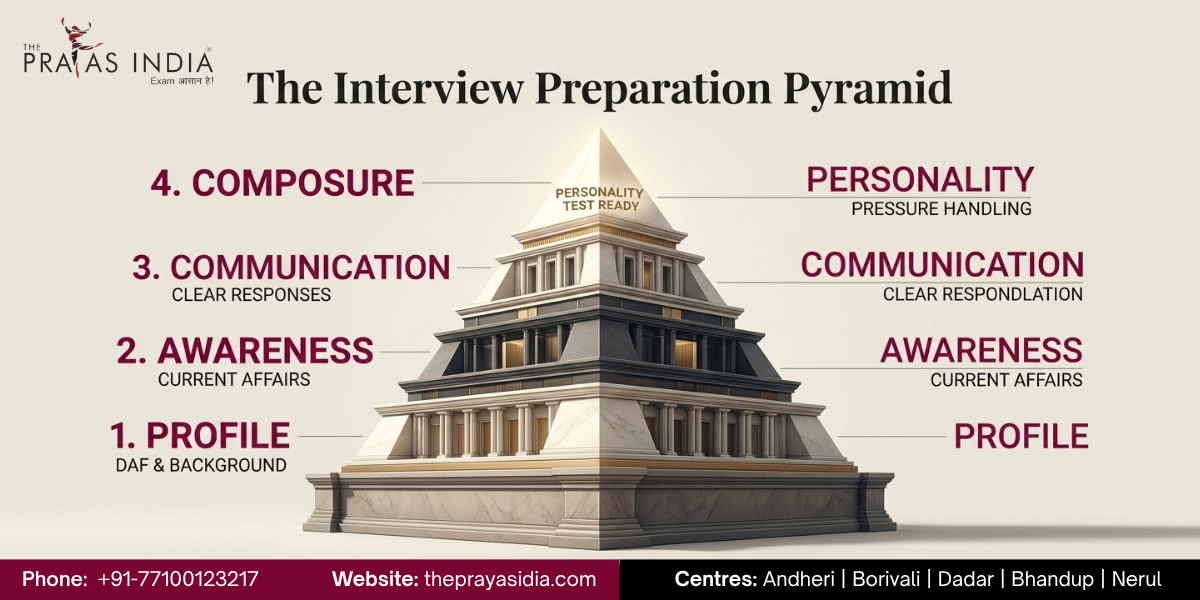
A practical interview preparation plan can have five interconnected components.
1. DAF Preparation
Begin by analysing every important entry in your DAF. Create a broad question bank based on your education, hometown, hobbies, work experience, achievements and other relevant details.
Do not write scripted answers for everything. Instead, prepare background information and possible dimensions of discussion.
2. Current Affairs
Follow current affairs consistently, but prepare them analytically.
For important issues, understand the background, stakeholders, challenges and possible solutions. Practise expressing your understanding in two or three minutes rather than writing long notes.
3. Communication Practice
Spend time speaking aloud.
You can discuss a current issue, explain a concept or answer a potential interview question while recording yourself. Reviewing these recordings can reveal unnecessary pauses, repetitive phrases and unclear explanations.
4. Mock Interviews
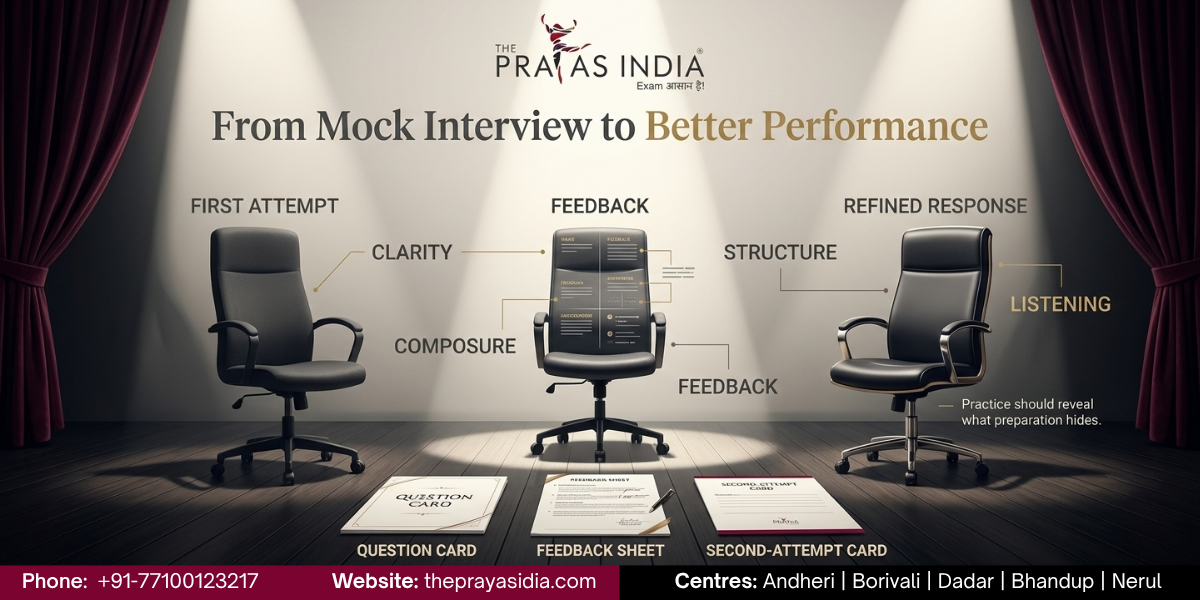
Mock interviews should be used as diagnostic tools.
The purpose is not simply to obtain a score. The real value comes from understanding what went wrong and implementing the feedback in subsequent practice.
5. Personality Refinement
Work on composure, listening, balanced thinking and clarity.
Do not attempt to create a completely new personality. Instead, remove habits that interfere with your natural communication.
How to Answer Questions You Don’t Fully Understand
Sometimes a question may be unclear.
Instead of immediately guessing, you can politely ask the board to repeat or clarify the question.
For example:
“Sir/Ma’am, if I understand the question correctly, you are asking about…”
This gives you an opportunity to confirm your interpretation and organise your response.
There is nothing inherently wrong with asking for clarification. It can be better than answering a question the board did not actually ask.
How to Handle Questions on Controversial Issues
UPSC interviews can involve subjects where reasonable people hold different opinions.
The objective should not be to avoid controversial topics. Instead, learn to discuss them objectively.
A useful structure is:
Context → Multiple perspectives → Your assessment → Practical way forward
Avoid personal attacks, extreme language or sweeping generalisations.
Remember that an administrative officer may need to work with people who hold views different from their own. Demonstrating the ability to engage with disagreement respectfully is therefore important.
How to Handle Questions About Personal Weaknesses
If the board asks about a weakness, avoid giving a completely artificial answer disguised as a strength.
For example, saying “I am a perfectionist” without explaining its practical implications can sound rehearsed.
Instead, identify a genuine but manageable area for improvement and explain what you are doing about it.
The emphasis should be on self-awareness and corrective action.
How to Prepare for Questions About Your Career Choice
Candidates may be asked why they want to join the civil services.
This question should be answered honestly.
Avoid relying entirely on generic statements about serving society unless they genuinely reflect your motivation. Think about your academic background, professional experiences, exposure to public issues and the aspects of public administration that attract you.
A strong answer does not need to sound dramatic. It needs to sound authentic and thoughtful.
Why Mock Interview Feedback Matters
One of the biggest advantages of structured interview preparation is access to external feedback.
Candidates often cannot accurately identify their own communication habits. What feels natural to you may appear unclear to someone listening from the outside.
A good mock interview should therefore provide more than a score.
Feedback should ideally cover:
- Content quality
- Answer structure
- Communication
- Confidence
- Body language
- Listening
- Handling pressure
- Balanced thinking
- DAF-related preparation
- Areas requiring improvement
Repeated practice with meaningful feedback can gradually make the interview environment less unfamiliar.
Choosing the Right UPSC Coaching in Mumbai for Personality Test Preparation
Candidates looking for the best UPSC coaching in Mumbai should evaluate an institute’s Personality Test programme separately from its Prelims and Mains offerings.
Interview preparation has different requirements. An institute may have strong classroom teaching for the written examination, but candidates should also assess the quality of its interview-specific support.
Look for a preparation environment that provides:
- Experienced interview mentors
- DAF-based preparation
- Current-affairs discussions
- Mock interview sessions
- Individual feedback
- Multiple practice opportunities
- Guidance on communication and presentation
- Support for state, district, education and hobby-related preparation
- Realistic board-style questioning
The most important factor is whether the programme helps you understand how to improve, rather than simply telling you whether an answer was right or wrong.
The Prayas India and UPSC Personality Test Preparation
The final stage of the UPSC journey requires a preparation approach that is different from conventional classroom learning. The focus shifts from completing a syllabus to developing confidence, judgement, communication and the ability to think under pressure.
For aspirants seeking UPSC coaching in Mumbai, The Prayas India can provide a structured environment for interview-oriented preparation, including profile-based discussions, mock interview practice and feedback-driven improvement.
The objective should not be to manufacture an artificial interview personality. Instead, preparation should help candidates present their genuine personality more effectively while improving their awareness, communication and analytical approach.
Candidates considering admission can evaluate the programme based on faculty guidance, mock-interview methodology, feedback quality and the extent to which preparation is personalised to their profile.
A 30-Day UPSC Personality Test Preparation Framework
Candidates entering the final month can divide preparation into focused phases.
Days 1–10: Profile and Foundation
Spend the first phase understanding your DAF thoroughly. Revise your educational background, hometown, district, hobbies, optional subject and work experience.
Alongside this, begin systematic current-affairs revision.
Days 11–20: Application and Practice
Shift more time towards speaking practice and mock interviews.
Discuss important current issues aloud. Practise answering questions related to your profile and work on areas highlighted during mock sessions.
Days 21–25: Weakness Correction
At this stage, do not simply accumulate more questions.
Review your previous mock interviews and identify recurring problems. If you are speaking too quickly, work specifically on pacing. If your answers lack structure, practise structured responses. If you become defensive under pressure, practise handling opposing viewpoints.
Days 26–30: Consolidation
The final days should focus on confidence and consolidation rather than panic-driven preparation.
Revise important current issues, profile-related topics and your personal notes. Continue light mock practice but avoid exhausting yourself with excessive interviews.
A calm and rested candidate is better positioned to demonstrate their actual personality.
What Candidates Should Do on the Day of the Interview
Preparation does not end when you enter the interview venue.
Arrive with sufficient time so that you are not already stressed before the interaction begins.
Dress professionally and comfortably. Carry the required documents and follow the instructions provided by the relevant authorities.
Most importantly, do not spend the waiting period trying to memorise hundreds of last-minute facts.
Use the time to stay calm.
Before entering the room, remind yourself that you are not expected to know everything.
You are expected to demonstrate how you think, communicate and respond.
Final Checklist Before the UPSC Personality Test
Before appearing for the interview, ask yourself:
- Have I analysed every major section of my DAF?
- Can I discuss my hometown and district intelligently?
- Can I explain my educational background clearly?
- Am I comfortable discussing my hobbies?
- Have I revised important current affairs?
- Can I discuss controversial issues without becoming rigid?
- Can I admit when I do not know something?
- Can I answer directly without unnecessarily extending my response?
- Have I practised speaking under pressure?
- Have I analysed my mock interview feedback?
- Can I maintain composure when challenged?
- Am I presenting my genuine personality rather than a memorised version?
If the answer to most of these questions is yes, your preparation is moving in the right direction.
Final Takeaway
The UPSC Personality Test should not be approached with the mindset that you need to become someone else before entering the interview room.
You do not need to sound artificially sophisticated. You do not need to memorise hundreds of model answers. You do not need to have an opinion on every issue. And you certainly do not need to pretend that you know something when you do not.
What you need is awareness, composure, clarity, balanced judgement and honest communication.
The most effective preparation therefore focuses on understanding your own profile, following current affairs intelligently, practising realistic questions, improving communication and learning from feedback.
For candidates preparing in Mumbai, choosing the right UPSC coaching in Mumbai can add structure to this process. A good interview programme should not simply conduct one mock interview and provide a score. It should help identify your specific weaknesses and give you a practical path to improve them.
The Personality Test is the final interaction in a demanding journey. Treat it neither as a memory test nor as a performance where you have to act like someone else.
Treat it as an opportunity to demonstrate the qualities that can make you a thoughtful, balanced and responsible civil servant.
With the right preparation strategy, consistent practice and meaningful feedback, you can enter the UPSC Personality Test with greater confidence and, more importantly, with the ability to let your real personality come through.
Contact Us
- Call Now: +91-77100 13217
- Website: theprayasindia.com
- Centres: Andheri | Borivali | Dadar | Nerul | Bhandup
FAQs
1. How should I start preparing for the UPSC Personality Test?
Begin with your DAF. Analyse every major detail related to your education, hometown, district, hobbies, work experience, achievements and optional subject. Then combine profile preparation with current-affairs revision and mock interview practice.
2. Is UPSC interview preparation different from Mains preparation?
Yes. Mains preparation focuses heavily on written analytical expression, while the Personality Test evaluates communication, awareness, judgement, personality, balance and responses under interaction.
3. How important is the DAF for the UPSC interview?
The DAF is extremely important because many interview discussions can revolve around the candidate's background and information provided in the form. Candidates should be able to discuss their DAF entries naturally and in reasonable depth.
4. Should I memorise answers for UPSC interview questions?
No. Memorising complete answers can make your responses sound artificial and can make it difficult to adapt when the board changes the question. Prepare concepts, themes and answer frameworks instead.
5. What should I do if I don't know an answer in the UPSC interview?
Be honest. If you genuinely do not know the answer, politely acknowledge it instead of guessing or inventing information.
6. How many mock interviews should I take?
There is no universally ideal number. Quality and feedback matter more than quantity. Take enough mock interviews to identify recurring weaknesses, implement feedback and become comfortable with the interview environment.
7. Should I prepare my hobbies for the UPSC Personality Test?
Yes. Any hobby mentioned in your DAF can become a discussion area. Prepare enough background to explain why you enjoy the hobby and discuss relevant developments or broader aspects connected to it.
8. How should I prepare current affairs for the UPSC interview?
Focus on understanding rather than memorising. For major issues, examine the background, stakeholders, benefits, concerns, implementation challenges and possible solutions.
9. Can introverted candidates perform well in the UPSC Personality Test?
Yes. The interview is not a competition in extroversion. Candidates should focus on clear communication, attentive listening, composure and thoughtful responses rather than trying to imitate an outgoing personality.
10. What qualities should I look for in UPSC coaching in Mumbai?
Look for experienced mentors, DAF-based preparation, realistic mock interviews, individual feedback, current-affairs discussions and a structured system for correcting communication and interview weaknesses.
11. Is body language important in the UPSC interview?
Body language forms part of overall communication. Natural eye contact, attentive listening, comfortable posture and controlled gestures can help you appear composed and confident.
12. How can I avoid getting nervous during the UPSC interview?
Nervousness is normal. Regular mock interviews, speaking practice, preparation of your DAF and familiarity with interview-style questioning can make the experience less unfamiliar and improve your composure.
13. Should I prepare questions about my hometown and district?
Absolutely. Your home state, city and district can be important areas of discussion. Understand their geography, economy, administration, social issues, development challenges and significant current developments.
14. Can coaching improve my UPSC Personality Test performance?
Structured coaching can help by providing realistic practice, external feedback and profile-based preparation. However, the candidate's own practice, self-awareness and willingness to implement feedback remain essential.