UPSC CSE Preparation for Repeaters: How to Improve Your Strategy After a Failed Attempt
Failing to clear the UPSC Civil Services Examination after investing months or even years of preparation can be difficult to process. But for a repeater, the previous attempt also provides something extremely valuable: evidence.
A first-time aspirant often begins with assumptions about what works. A repeater has actual experience of the examination. You have seen the pressure of Prelims, the demand of the question paper, the importance of revision, the challenge of time management and, if you appeared for Mains, the reality of writing multiple papers under strict time constraints.
The question, therefore, is not simply, “How many more hours should I study?”
The more useful question is:
“What exactly went wrong in my previous attempt, and what needs to change before the next one?”
This distinction can completely change a repeater’s preparation strategy.
If your previous attempt failed because of inadequate revision, reading another set of books may not solve the problem. If you missed the Prelims cutoff because of poor question selection or insufficient mock practice, simply increasing your study hours may not address the actual weakness. If Mains answer writing was the problem, spending another year only reading GS material may leave the same gap unresolved.
UPSC itself provides previous question papers for Civil Services Preliminary and Main examinations, including GS papers, Essay and optional papers. These papers should be treated as important diagnostic material rather than something to solve only at the end of preparation.
For a repeater, the goal should be strategic improvement, not repetition of the previous preparation cycle.
Why Repeaters Should Not Prepare Exactly Like First-Time Aspirants
A repeater already has exposure to the UPSC syllabus, standard books, current affairs, PYQs and examination environment. That changes the starting point.
This does not mean that everything from the previous attempt was correct. In fact, the biggest danger for repeaters is assuming that because they have studied the syllabus once, they are automatically better prepared for the next attempt.
A repeater can spend another year repeating the same routine:
Read → Make Notes → Watch Lectures → Read Again → Collect Current Affairs → Take a Few Tests → Repeat.
The amount of effort may be enormous, but the underlying problems may remain unchanged.
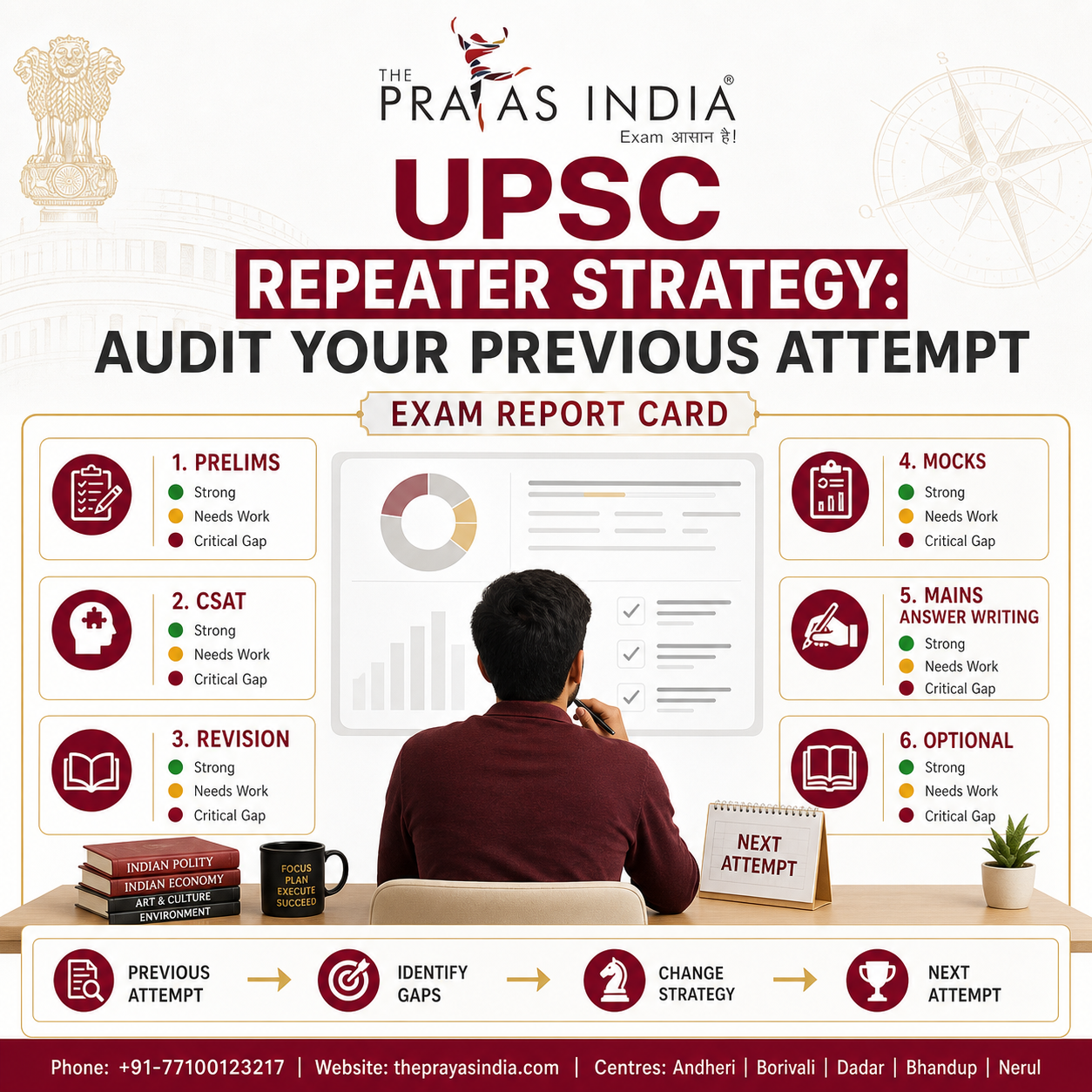
The next attempt should therefore begin with an attempt audit.
Instead of immediately purchasing new books or creating a new timetable, first reconstruct the previous attempt and identify where the preparation broke down.
Step 1: Conduct a Detailed Attempt Analysis
Your previous attempt should become a case study.
Do not analyse it only emotionally as “I could not clear UPSC.”
Break it into measurable components.
Ask:
- Did I clear Prelims or miss the cutoff?
- If I missed Prelims, how far was my performance from the required level?
- Was GS Paper I the main problem?
- Was CSAT a concern?
- Did I complete enough full-length mocks?
- Did I analyse my mock tests properly?
- How much did I revise?
- Did I repeatedly forget information that I had already studied?
- Were my current affairs integrated with static subjects?
- If I reached Mains, did I complete the papers within the prescribed time?
- Did I write enough answers before Mains?
- Was my answer writing evaluated by someone competent?
- Did I have a consistent structure for GS answers?
- Was Essay preparation systematic?
- Was my optional sufficiently prepared?
- Did I complete optional PYQs and answer writing?
- Did I have a realistic timetable?
- How many hours were actually productive?
- Which subjects consumed disproportionate time?
- Did I change resources repeatedly?
- Did I follow a test schedule consistently?
The purpose is not to criticise yourself.
It is to identify specific preparation gaps.
Knowledge Gap or Revision Gap?
This is one of the most important questions a repeater should answer.
Suppose you studied Polity thoroughly but could not recall important provisions during the examination. That does not necessarily mean your Polity preparation was inadequate.
You may have had a revision problem rather than a knowledge problem.
Similarly, if you had read Environment multiple times but continued making mistakes in related questions, you need to determine whether the problem was conceptual understanding, factual retention, question interpretation or revision.
This distinction matters because the solution changes.
If the problem was knowledge
You may need:
- Better conceptual resources
- Focused lectures
- Standard sources
- Better note-making
- More PYQ-based learning
- Clarification of difficult topics
If the problem was revision
You may need:
- Multiple revision cycles
- Shorter revision notes
- Active recall
- PYQ-based revision
- Spaced revision
- Regular testing
Reading another 500 pages will not necessarily solve a revision problem.
A repeater should therefore ask:
“Do I need to learn this again, or do I need to remember what I already learned?”
That single question can prevent months of unnecessary repetition.
Step 2: Reassess Your Prelims Strategy
Prelims is not simply a test of how many books you have completed.
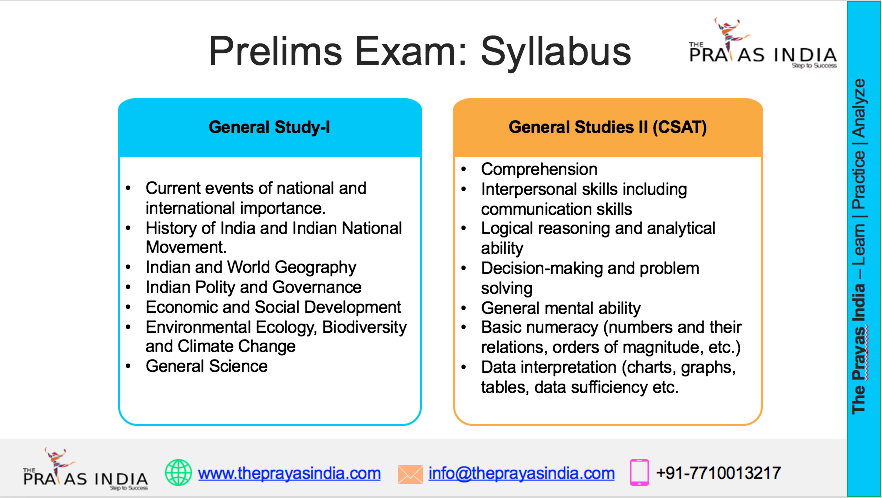
The 2025 official UPSC Civil Services Preliminary syllabus, for example, describes General Studies Paper I around areas such as current events, history, geography, polity and governance, economic and social development, environment and general science. Paper II includes comprehension, logical reasoning, decision-making, basic numeracy and data interpretation, and is a qualifying paper with a minimum qualifying threshold of 33%. Candidates must appear in both papers.
The exact requirements should always be checked against the latest official notification applicable to your attempt.
For a repeater, the important point is to examine how you performed against these demands.
Ask yourself:
Was my preparation broad enough?
You may have studied some subjects deeply while leaving others vulnerable.
Was my revision sufficient?
Knowing a topic once is not enough when the examination requires recall under pressure.
Did I solve enough PYQs?
The previous-year papers should help you understand how concepts are converted into questions.
Did I take enough full-length tests?
Topic tests cannot completely reproduce the decision-making pressure of an actual Prelims paper.
Did I analyse those tests?
This is crucial.
A mock score by itself tells you very little. Your mistakes, time allocation, guessing behaviour and question-selection patterns are much more useful.
Step 3: Stop Treating Mock Tests as Just Scorecards
A repeater who has already taken several mocks should be particularly careful here.
If you take 30 tests but do not systematically analyse them, you may simply repeat the same mistakes 30 times.
After every full-length Prelims mock, classify your mistakes.
Category 1: Knowledge mistake
You did not know the relevant information.
Category 2: Conceptual mistake
You misunderstood the underlying concept.
Category 3: Recall mistake
You had studied it but could not retrieve it during the test.
Category 4: Interpretation mistake
You misunderstood what the question was asking.
Category 5: Elimination mistake
You had partial knowledge but failed to use the options effectively.
Category 6: Decision-making mistake
You spent too much time on a question or took an unnecessary risk.
Category 7: Silly mistake
You knew the answer but marked incorrectly.
This classification is more useful than simply writing “score: 82” in a notebook.
Over several tests, patterns begin to emerge.
If most mistakes are knowledge-related, revise your content strategy.
If most are recall-related, increase revision and active recall.
If many are decision-making errors, focus on test temperament and question selection.
If your scores are inconsistent, analyse whether your attempt strategy changes significantly from one paper to another.
Step 4: Reassess Your CSAT Preparation
CSAT is another area that repeaters should evaluate honestly.
Because Paper II is qualifying, some aspirants assume that minimal preparation will be enough. That assumption can become risky if comprehension, numeracy, reasoning or time management is weak.
The official UPSC syllabus includes comprehension, interpersonal and communication-related skills, logical reasoning, analytical ability, decision-making, problem-solving, general mental ability, basic numeracy and data interpretation in Paper II.
If CSAT was comfortable for you, it may require maintenance rather than disproportionate preparation.
If it was close to becoming a problem, however, you should not postpone it until the final weeks.
A repeater should examine:
- Previous CSAT performance
- Comprehension accuracy
- Numeracy fundamentals
- Reasoning ability
- Time taken per section
- Full-length CSAT practice
- Number of tests attempted
- Whether mistakes were conceptual or time-related
The goal is to make CSAT a controlled component of your preparation, rather than a last-minute risk.
Step 5: Evaluate Whether Your Current Affairs Were Actually Integrated
Many aspirants consume current affairs every day but struggle to use them effectively in the examination.
The issue may not be the amount of current affairs studied.
It may be the lack of integration.
For example, reading a news article about a constitutional issue separately from Polity creates one kind of knowledge. Connecting that development with constitutional provisions, Supreme Court judgments, governance issues, federalism or relevant GS themes creates much more usable preparation.
Similarly, economic news can be connected with:
- Inflation
- Monetary policy
- Fiscal policy
- Growth
- Employment
- External sector
- Financial inclusion
Environmental developments can be connected with:
- Climate change
- Biodiversity
- International conventions
- Conservation
- Environmental governance
For a repeater, the objective should gradually move from collecting current affairs to converting current affairs into examination-ready understanding.
Step 6: Rebuild Your Revision System
A common repeater problem is that the candidate has already read most of the syllabus but still feels underprepared.
This usually happens when preparation is heavily input-driven.
The candidate keeps reading but does not create enough opportunities for retrieval.
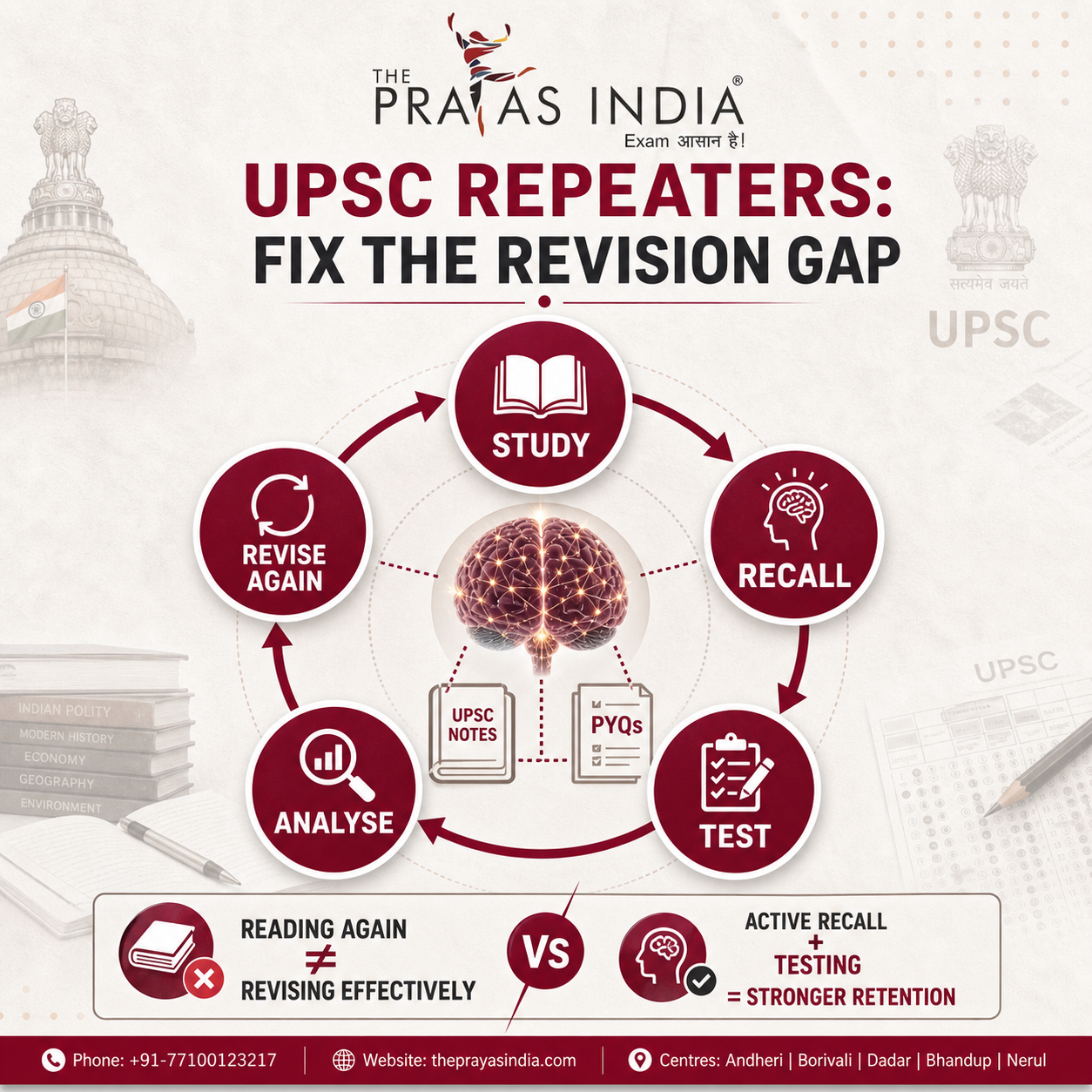
A better revision cycle is:
Study → Close the Source → Recall → Test → Identify Gaps → Revise → Retest
This is very different from simply reading the same chapter repeatedly.
Your revision system can contain:
- Short revision notes
- PYQs
- Topic-wise quizzes
- Flashcards where useful
- Active recall
- Error notebooks
- Weekly revision blocks
- Full-length tests
- Repeated revision of vulnerable areas
The aim is to make information retrievable under examination conditions.
Step 7: Analyse Your Mains Preparation Differently
If you reached Mains but could not achieve the desired outcome, your analysis needs to go deeper than simply counting how many books you completed.
Mains is designed to assess depth of understanding, analysis and the ability to provide relevant and meaningful answers. The official syllabus also emphasises the need for relevant, meaningful and succinct responses in the General Studies papers.
Therefore, ask yourself:
- Did I complete the syllabus?
- Did I revise it sufficiently?
- Did I practise answer writing regularly?
- Did I write answers within the prescribed time?
- Did someone evaluate my answers?
- Was the feedback specific?
- Did I actually implement the feedback?
- Could I generate relevant examples?
- Did I use data, constitutional provisions, case studies and reports appropriately?
- Did I understand the demand of the question?
- Did my answers have a clear introduction, body and conclusion?
- Could I complete the paper?
- Did I leave questions because of time?
- Was my Essay preparation systematic?
These questions can reveal a very different problem from “I need to study more.”
Step 8: Do Not Confuse Answer Writing with Answer Practice
Writing ten answers in a notebook does not automatically mean that your answer writing has improved.
The critical component is feedback.
Suppose your answers consistently have:
- Weak introductions
- Generic conclusions
- Limited examples
- Poor question demand analysis
- Excessive repetition
- Weak structure
- Poor time management
You may continue writing answers for months without correcting these issues unless someone identifies them.
That is why a repeater should consider answer writing as a cycle:
Write → Evaluate → Receive Feedback → Rewrite/Correct → Apply → Retest
Evaluation becomes particularly important when the candidate has already completed one or more attempts.
You do not necessarily need more pages of notes.
You may need better feedback on how you are converting your knowledge into marks-oriented answers.
Step 9: Reassess Your Optional Subject
Optional preparation deserves its own audit.
Ask:
Did I choose the optional because it genuinely suited my preparation profile?
Did I complete the syllabus?
Did I understand the previous-year questions?
Did I practise enough optional answers?
Were my answers evaluated?
Did I revise multiple times?
Did I have concise notes for final revision?
Was my optional preparation competing with GS for time?
The UPSC previous-question-paper repository provides optional papers across subjects and years, making PYQ analysis an important part of optional preparation.
If your optional was reasonably strong, the next strategy may involve maintaining and refining it rather than completely rebuilding it.
If it was consistently weak, however, a serious reassessment may be necessary.
Do not change an optional simply because someone else scored well in another subject.
The decision should come from your own preparation experience, performance, syllabus comfort, resources, evaluation quality and ability to improve.
Step 10: Integrate Prelims and Mains Instead of Preparing in Isolation
A repeater has one major advantage: there is usually a larger base of familiarity with the syllabus.
Use that advantage.
Instead of thinking:
Prelims first → Mains later
build an integrated preparation model.
For example, while studying Polity for Prelims, also develop:
- Constitutional understanding
- Governance examples
- Supreme Court judgments
- Relevant current affairs
- Mains themes
- Potential answer frameworks
While studying Economy, connect concepts with current developments.
While studying Environment, connect static concepts with contemporary environmental issues.
This does not mean writing Mains answers every time you read a chapter.
It means developing the habit of seeing the same topic through both objective and descriptive examination requirements.
Step 11: Test Time Management Before the Actual Examination
A surprising number of aspirants discover their time-management problems inside the examination hall.
That is too late.
Time management should be tested during preparation.
For Prelims, test:
- How long you spend on difficult questions
- How many questions you attempt
- How you use elimination
- Whether you change answers unnecessarily
- Whether you lose time in one subject
For Mains, test:
- Time per answer
- Time lost between questions
- Speed of introduction and conclusion writing
- Ability to complete all required answers
- Essay time allocation
- Optional paper completion
Your strategy should be tested repeatedly until it becomes comfortable.
The official UPSC previous-paper repository provides actual papers that can be used to simulate examination conditions rather than relying only on generic practice material.
Step 12: Build a Strategy Around Your Actual Weaknesses
After analysing your previous attempt, create a gap-to-action table.
| Previous Problem | What It May Indicate | Next Preparation Action |
|---|---|---|
| Forgot studied topics | Revision gap | More active recall + revision cycles |
| Low mock accuracy | Concept/interpretation issue | Topic analysis + targeted practice |
| Good knowledge but low mock score | Test strategy issue | More timed tests + question selection |
| CSAT near qualifying threshold | CSAT risk | Regular CSAT practice |
| Poor Mains completion | Time-management issue | Timed answer-writing sessions |
| Generic answers | Writing/evaluation gap | Structured answer practice + feedback |
| Weak optional | Content/writing gap | Optional-specific revision + evaluation |
| Current affairs felt disconnected | Integration problem | Link current affairs with static GS |
| Too many resources | Strategy problem | Consolidate sources |
| Inconsistent preparation | Accountability problem | Fixed targets + progress tracking |
This is where a repeater’s preparation becomes genuinely personalised.
The next attempt should not be Attempt 2 of the same strategy.
It should be a new strategy built from the evidence of Attempt 1.
What Repeaters Should Stop Doing
Stop collecting resources
A larger library does not automatically mean stronger preparation.
Stop changing teachers repeatedly
If a resource is working, give it enough time to produce results.
Stop taking mocks without analysis
The score is only the beginning of the analysis.
Stop postponing answer writing
Writing ability needs repeated practice and feedback.
Stop treating revision as rereading
Active recall and testing should become part of revision.
Stop ignoring CSAT because it is qualifying
Qualifying status does not eliminate the need to prepare if it is a personal weakness.
Stop comparing your preparation with someone else’s timetable
Your strategy should reflect your own gaps.
Stop assuming that another attempt automatically means improvement
An additional attempt provides value only when your preparation system improves.
How Mentorship Can Help a UPSC Repeater
Mentorship is not about someone studying on your behalf.
Its practical value lies in diagnosis, accountability and correction.
A serious mentorship system can help a repeater ask:
- Is my current study plan realistic?
- Am I spending too much time on one subject?
- Have I revised enough?
- Are my mock scores improving for the right reasons?
- What mistakes are recurring?
- Is my answer writing actually improving?
- Is my optional on track?
- Am I integrating current affairs with static subjects?
- When should I shift from learning to testing?
- What should I prioritise in the next four weeks?
For a first-time aspirant, the major challenge may be figuring out the syllabus.
For a repeater, the challenge is often figuring out why the previous strategy did not produce the required result.
That is precisely where structured mentorship and regular evaluation can add value.
A Practical Repeater Preparation Framework
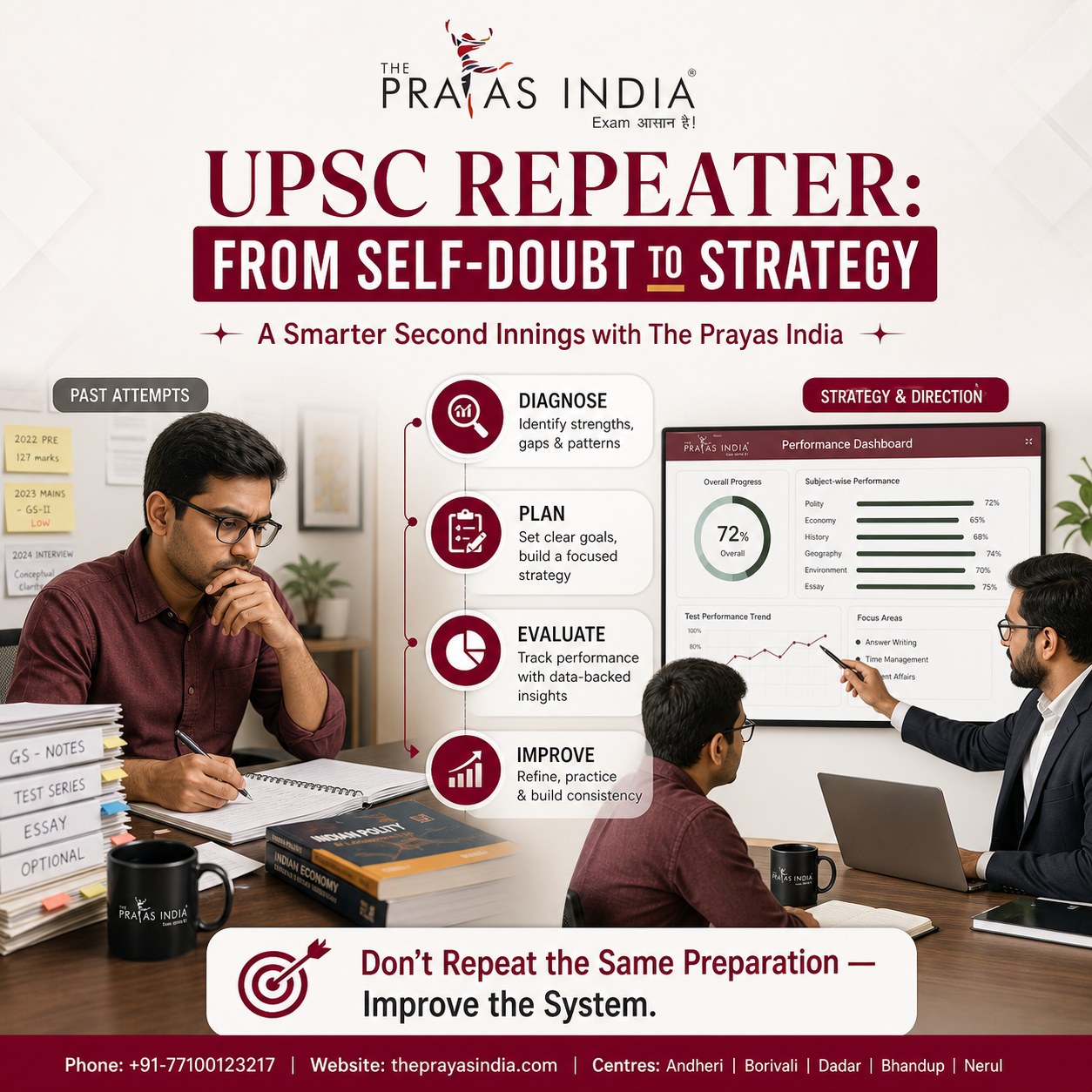
Once your attempt analysis is complete, divide your preparation into four broad phases.
Phase 1: Repair
Fix the weaknesses identified from the previous attempt.
This could mean rebuilding one subject, strengthening CSAT, improving optional preparation or correcting basic conceptual gaps.
Phase 2: Consolidate
Reduce resources and consolidate your notes.
The objective is to create a smaller, more revision-friendly knowledge base.
Phase 3: Test
Increase PYQs, sectional tests, full-length mocks and answer writing.
Your preparation should increasingly be measured through performance.
Phase 4: Refine
Use test results to improve:
- Accuracy
- Recall
- Speed
- Question selection
- Answer structure
- Time management
- Revision priorities
This phase should continue until the examination.
How to Decide Whether You Need Structured Coaching Again
A repeater may hesitate to join coaching after an unsuccessful attempt, especially if they have already spent significant time studying independently.
The decision should not be based simply on whether you joined coaching before.
Instead, ask what you actually lacked.
If your previous preparation suffered because of:
- Lack of a structured plan
- Inconsistent testing
- Poor answer evaluation
- No regular mentorship
- Difficulty identifying weak areas
- Unclear revision strategy
- Lack of accountability
- Too many resources
- Difficulty integrating Prelims and Mains
then a structured programme may address gaps that self-study alone did not resolve.
However, do not enrol merely because a coaching advertisement promises results.
Before joining, ask about:
Faculty quality, test-series structure, answer evaluation, mentorship, doubt resolution, study material, revision strategy, batch schedule and how individual performance is tracked.
The right programme should complement your previous experience rather than asking you to blindly start over.
Why The Prayas India Can Be Considered by UPSC Repeaters
For a repeater, joining a programme should ideally mean gaining a stronger preparation system rather than simply attending more lectures.
The Prayas India can position its UPSC support around the areas that matter to repeaters: structured preparation, faculty guidance, test practice, evaluation, mentorship and a more organised approach to revision and performance improvement.
The most important conversation to have before enrolling is therefore not simply “Which batch should I join?”
It is:
“Based on my previous attempt, what exactly should I change in my preparation?”
A course or mentorship programme becomes more useful when it can help you answer that question.
If you have already attempted UPSC CSE, you bring valuable examination experience with you. The next step is to convert that experience into a better strategy.

Final Takeaway: Your Previous Attempt Should Become Your Preparation Blueprint
A failed UPSC attempt does not automatically tell you that you need to study more.
It tells you that something in the previous preparation, examination strategy or execution needs closer examination.
For some aspirants, the central issue may be knowledge.
For others, it may be revision.
For another candidate, the problem may have been mock-test analysis, CSAT preparation, current-affairs integration, answer writing, optional preparation or time management.
That is why repeaters should resist the temptation to simply restart the same syllabus with a new timetable.
Instead:
Analyse the previous attempt.
Identify the actual gap.
Remove unnecessary resources.
Build a focused revision system.
Practise PYQs and tests.
Get answer writing evaluated.
Track performance regularly.
Refine the strategy based on evidence.
UPSC’s official repository makes previous Preliminary and Main question papers available, including GS, Essay and optional papers, giving aspirants a reliable base for analysing the actual examination rather than preparing only from generic material.
For a serious repeater, the next attempt should therefore not be about proving that you can work harder.
It should be about proving that you can prepare differently where your previous strategy was weak.
If you are unsure where your previous preparation went wrong, this is a good point to seek structured guidance rather than spending another preparation cycle repeating the same process. A focused mentorship or test-series programme can help you convert your previous attempt into a more organised plan, with regular evaluation and targeted improvement.
Your previous attempt is not just a result. It is data. Use it to build a better preparation strategy for the next one.
The official UPSC pages confirm that the Commission publishes the Civil Services Preliminary and Main examination papers, including the 2026 papers, so the article’s emphasis on PYQ-based diagnosis is grounded in the actual examination material.
Frequently Asked Questions (FAQs)
1. How should UPSC repeaters analyse their previous attempt?
Start by reviewing your Prelims, CSAT, Mains, optional, revision, mock-test and answer-writing performance. Identify whether the main issue was lack of knowledge, insufficient revision, poor accuracy, weak time management, inadequate practice or ineffective exam strategy.
2. Should I change my UPSC strategy after a failed attempt?
A repeater should not automatically change everything. First identify what worked and what did not in the previous attempt. The next strategy should be based on evidence from your preparation, mock performance and exam experience rather than simply starting again from scratch.
3. How can I improve my UPSC Prelims preparation as a repeater?
Focus on revision quality, previous-year questions, mock tests, elimination techniques, accuracy and time management. Revisit the topics where you repeatedly made mistakes instead of spending equal time on every subject.
4. Is CSAT important for UPSC repeaters?
Yes. Candidates should assess their actual CSAT performance from the previous attempt and determine whether comprehension, reasoning, numeracy, speed or question selection created difficulty. Regular timed practice can help address the specific weakness.
5. How important is mock-test analysis for UPSC repeaters?
Mock analysis is useful because the score alone does not explain why performance is weak. Categorising mistakes into knowledge gaps, revision gaps, conceptual errors, calculation mistakes, misreading and poor time management can make subsequent practice more targeted.
6. Should UPSC repeaters join an answer-writing programme?
It can be useful when a candidate struggles with structure, content selection, relevance, time management or presentation. Regular evaluation and feedback can help identify issues that may not be obvious through self-practice alone.
7. Should I change my UPSC optional subject after one failed attempt?
Changing an optional should be a carefully considered decision. Review your previous preparation, answer-writing performance, marks, interest, availability of study material and the amount of preparation already completed before making a change.
8. How can mentorship help UPSC repeaters?
A structured mentorship system can help a repeater analyse the previous attempt, prioritise weak areas, organise revision, review test performance and maintain a more accountable preparation schedule. The value depends on how specific and consistent the guidance is.
9. Can I prepare for UPSC Prelims and Mains together as a repeater?
Yes. A balanced approach can help prevent the preparation cycle from becoming completely Prelims-focused or Mains-focused. The emphasis can change according to the stage of the examination while maintaining continuity in answer writing, current affairs and revision.
10. Is coaching necessary for UPSC repeaters?
Coaching is not compulsory for every repeater. However, candidates who have struggled with strategy, evaluation, revision planning, mock-test analysis or maintaining consistency may find structured guidance, test series and mentorship useful.
11. How can I get structured guidance for my next UPSC attempt?
Candidates can explore structured UPSC preparation options that combine teaching, revision support, test practice, answer evaluation and mentorship. The right format should depend on the gaps identified from the previous attempt.
Don’t Repeat the Same UPSC Strategy — Improve It
A previous UPSC attempt gives you valuable preparation experience. The next step is to identify where your strategy fell short and build a more focused plan around your actual gaps in Prelims, CSAT, Mains answer writing, optional preparation, revision and test performance.
UPSC CSE Admissions Open
Explore structured preparation, test series and personalised mentorship designed to help you analyse performance, identify gaps and improve your preparation strategy.
Our Centres
Andheri | Borivali | Dadar | Bhandup | Nerul
If your previous attempt did not go as planned, speak with our team to understand the right UPSC preparation, mentorship or test-series option for your next attempt.