How to Read Newspapers for UPSC Current Affairs: A Complete Guide for Beginners
Target audience: UPSC Civil Services aspirants in Borivali and nearby Mumbai localities.
Is article mein newspaper-reading strategy ko practical tareeke se explain kiya gaya hai—kya padhna hai, kya skip karna hai, notes kaise banane hain aur current affairs ko Prelims aur Mains se kaise connect karna hai.
Introduction
For many UPSC aspirants, reading the newspaper is one of the first habits they adopt after deciding to prepare for the Civil Services Examination. However, it can also become one of the most confusing parts of preparation. Beginners often spend two to three hours reading every page, underline large portions of articles and collect lengthy notes without understanding which information is actually relevant to the examination.
The real challenge is not reading a newspaper from beginning to end. It is learning how to identify important developments, understand their background, connect them with the UPSC syllabus and retain the information for Prelims and Mains.
A newspaper is useful because it helps aspirants understand government policies, constitutional developments, international relations, economic issues, environmental concerns and social challenges. These subjects overlap with different areas of the UPSC Civil Services Examination.
This guide explains how to read newspapers for UPSC current affairs in a structured and time-efficient manner. It covers newspaper selection, important sections, reading techniques, note-making, revision, answer-writing connections and a practical daily timetable. Whether you are beginning your preparation in Borivali, Dahisar, Kandivali or another part of Mumbai, the same method can help you build a consistent newspaper-reading routine.
Why Is Newspaper Reading Important for UPSC Preparation?
Newspaper reading is not a separate examination subject. It is a method of understanding current developments and connecting them with the static subjects in the UPSC syllabus.
For example:
- A Supreme Court judgment may help you understand Fundamental Rights, judicial review and the separation of powers.
- A new government scheme may connect with social justice, welfare administration and inclusive development.
- A report on inflation may help you understand monetary policy, fiscal policy and the Indian economy.
- An international agreement may be relevant to India’s foreign policy and international relations.
- A report on forest conservation may connect with biodiversity, environmental governance and sustainable development.
This is why newspaper reading should be linked with the syllabus rather than treated as an independent daily activity.
How newspaper reading supports different stages of UPSC
| Examination stage | How newspaper reading helps |
|---|---|
| Prelims | Builds awareness of important events, institutions, schemes, reports and factual developments |
| Mains GS Paper I | Provides examples related to society, geography, history and social issues |
| Mains GS Paper II | Supports preparation for polity, governance, social justice and international relations |
| Mains GS Paper III | Helps with economy, agriculture, environment, science and technology, security |
| Mains GS Paper IV | Provides examples of ethical dilemmas, public administration and governance |
| Essay | Supplies contemporary examples, arguments and multiple perspectives |
The objective is not to memorise every newspaper article. It is to develop the ability to understand an issue, examine its significance and use relevant information in an examination answer.
Which Newspaper Should UPSC Aspirants Read?
One of the most common beginner questions is which newspaper is best for UPSC preparation.
Aspirants generally consider established English-language newspapers such as The Hindu and The Indian Express. Both publish national news, editorials, explainers and coverage of important public issues.
Useful for detailed reporting, editorials, policy developments and national issues.
Useful for explainers, investigative reporting, editorials and contextual analysis.
Should you read both newspapers?
For most beginners, reading one good newspaper consistently is more practical than attempting to cover multiple newspapers every day.
You can follow this approach:
- Select one newspaper based on readability and availability.
- Read it consistently at a fixed time.
- Refer to another newspaper only when you need additional context or a different perspective.
- Avoid collecting the same information from multiple sources.
The quality of your understanding matters more than the number of newspapers you read.
What about Hindi-medium aspirants?
Hindi-medium aspirants can select a reliable Hindi newspaper and use official government sources, standard books and suitable explanatory resources to understand important issues. The essential requirement is syllabus-oriented reading, not the language of the newspaper.
Which Newspaper Sections Should You Read for UPSC?
This is one of the most important parts of newspaper preparation. Beginners frequently waste time because they do not distinguish examination-relevant news from routine reporting.
A useful method is to classify newspaper content into three categories: must read, read selectively and generally skip.
| Newspaper section | What to focus on | Priority |
|---|---|---|
| National news | Parliament, constitutional bodies, important judgments, policies | High |
| Government policies | Schemes, legislation, governance reforms | High |
| International news | India’s relations, conflicts, treaties, international organisations | High |
| Economy | Inflation, RBI, banking, trade, taxation, budget | High |
| Environment | Climate change, biodiversity, conservation, pollution | High |
| Science and technology | Space, biotechnology, AI, health technology | Selective |
| Editorials | Arguments, challenges, solutions and different perspectives | High |
| Explained articles | Background and implications of important developments | High |
| Sports | Major developments with wider national or international significance | Low |
| Entertainment | Routine celebrity and film news | Skip |
| Political statements | Routine allegations, speeches and party criticism | Generally skip |
| Local crime reports | Routine incidents without wider policy significance | Generally skip |
National News and Polity
Read developments related to:
- Parliament and legislative processes.
- Constitutional amendments and important constitutional provisions.
- Supreme Court and High Court judgments with wider legal or constitutional significance.
- Election Commission and other constitutional bodies.
- Federal relations between the Union and states.
- Fundamental Rights and Directive Principles.
- Important government legislation and governance reforms.
For example, if a newspaper reports an important judgment related to freedom of speech, do not simply note the headline. Understand the constitutional provision, the issue before the court, the reasoning and the broader implications.
Government Schemes and Policies
Government schemes are relevant to governance, social justice and the economy.
While reading about a scheme, identify:
- The ministry responsible.
- Its main objective.
- The target beneficiaries.
- The key implementation mechanism.
- The problem it aims to address.
- Implementation challenges, where reported.
Avoid memorising every announcement or minor scheme detail. Focus on the larger policy objective and its relevance to the syllabus.
International Relations
Do not read every international headline with equal attention.
Prioritise developments involving:
- India’s neighbouring countries.
- India’s major strategic and economic partners.
- International organisations such as the UN, WTO and IMF.
- Regional groupings and multilateral forums.
- Important international agreements.
- Issues affecting India’s security, trade and diplomacy.
Try to understand why an international development matters to India rather than memorising the event alone.
Economy
Important topics include inflation, GDP, fiscal deficit, monetary policy, taxation, employment, banking, exports, imports, agriculture and financial inclusion.
If you read a report about inflation, for example, understand:
- What inflation means.
- Which index is being discussed.
- What factors may be influencing prices.
- How inflation affects households and businesses.
- What policy measures may be relevant.
Connect such developments with the basic concepts in your economy textbook.
Environment and Science & Technology
For environment, focus on biodiversity, protected areas, climate change, pollution, conservation programmes and international environmental agreements.
For science and technology, prioritise developments with wider applications or public significance, such as space missions, biotechnology, artificial intelligence, cybersecurity and public health technology.
Avoid spending excessive time on technical product launches or scientific details that have little connection with the syllabus.
Editorials and Explained Articles
Editorials are particularly useful for Mains preparation because they help you understand arguments, competing viewpoints and possible solutions.
While reading an editorial, identify:
- The central issue being discussed.
- The background and reasons behind the issue.
- The arguments supporting the subject.
- The concerns, limitations or opposing viewpoints.
- The possible solutions and way forward.
For example, an editorial on urban flooding can help you understand urban planning, drainage infrastructure, municipal governance, climate resilience and disaster management.
Do not copy the editorial into your notebook. Extract its key arguments and rewrite them in your own words.
The Syllabus-Based Newspaper Reading Method
The most effective way to read a newspaper for UPSC is to keep the syllabus beside you.
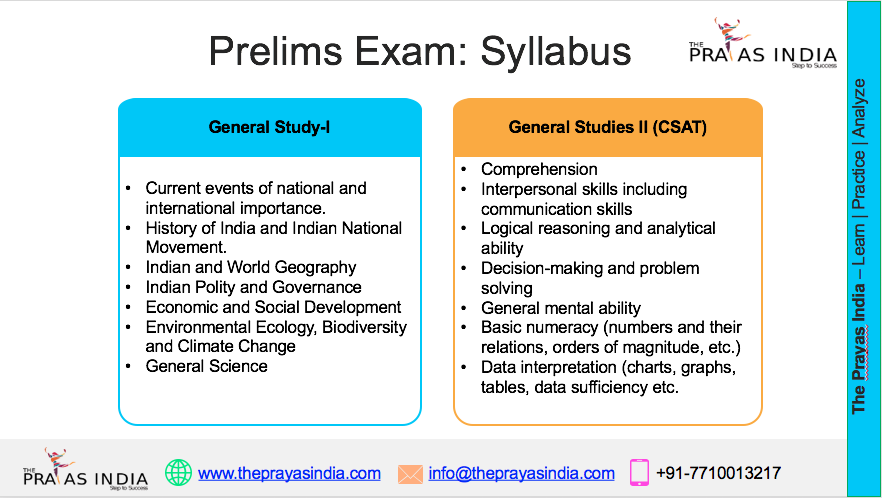
The UPSC Civil Services Examination syllabus explicitly includes current events of national and international importance in Prelims General Studies Paper I. Mains General Studies papers also cover areas such as governance, social justice, international relations, economy, environment, technology and security.
This means that a newspaper article becomes useful when you can connect it with a relevant syllabus topic.
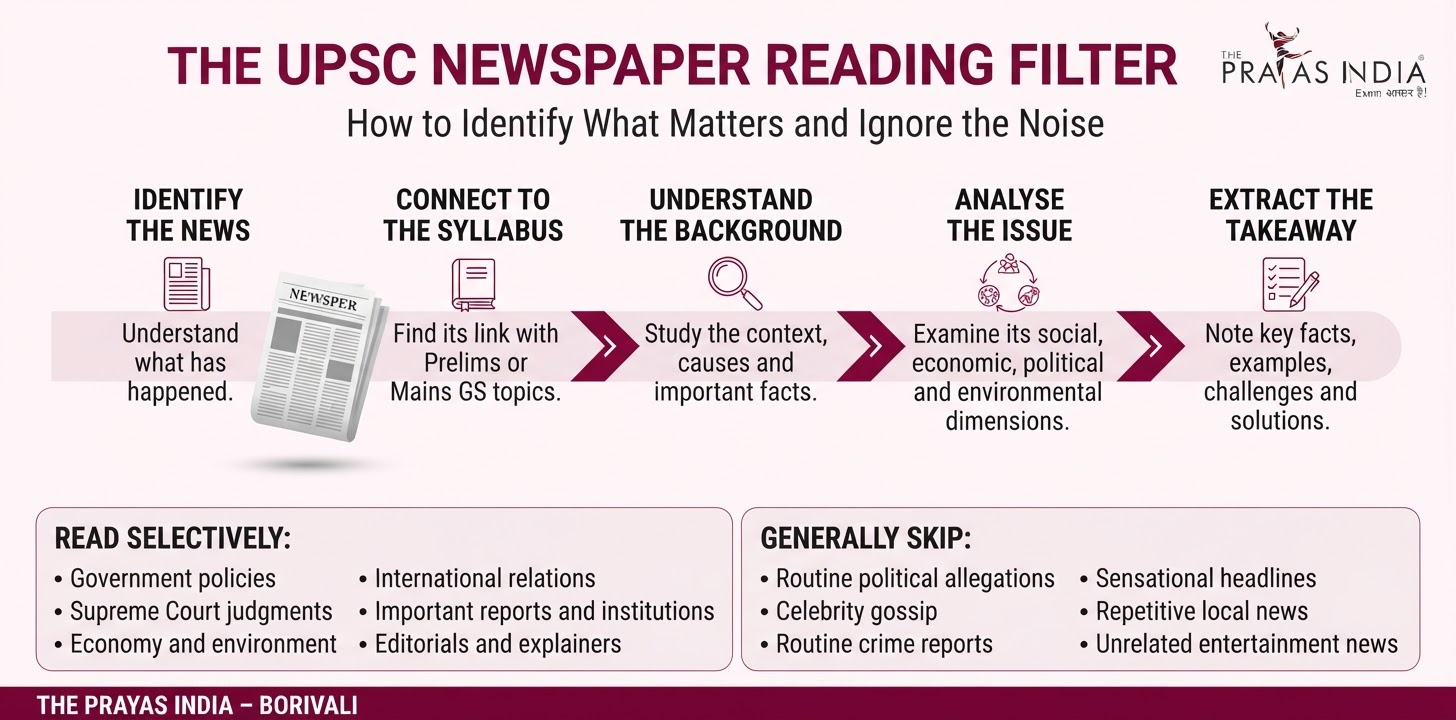
Step 1: Identify the main issue
Read the headline and first few paragraphs. Understand what has happened and why the issue is being reported.
Step 2: Find its syllabus connection
Ask yourself:
- Is it related to Indian Polity?
- Does it concern governance or public administration?
- Is it connected with the Indian economy?
- Does it involve international relations?
- Is there an environmental or scientific dimension?
- Can it be used in a Mains answer or essay?
If you cannot identify a meaningful syllabus connection, the article may not deserve detailed notes.
Step 3: Understand the background
Many newspaper reports refer to developments that have taken place over several years. Read enough background to understand the issue, but do not spend excessive time researching every detail.
Step 4: Examine different dimensions
A good UPSC aspirant should avoid looking at an issue from only one angle.
For example, consider a government policy. Examine its:
- Constitutional and legal basis.
- Economic implications.
- Social impact.
- Administrative challenges.
- Environmental consequences, where relevant.
- Implementation and accountability mechanisms.
Step 5: Identify the way forward
Think about practical improvements, institutional reforms, better implementation or possible policy solutions.
This habit gradually improves your analytical thinking and Mains answer-writing ability.
How to Make Effective Newspaper Notes for UPSC
Reading an article once is not enough. You need a method to preserve useful information so that it can be revised later.
However, making notes from every article is a common mistake. It creates unnecessary material and makes revision difficult.
The purpose of newspaper notes is to capture information that adds value to your existing preparation.
Follow a Simple Note-Making Format
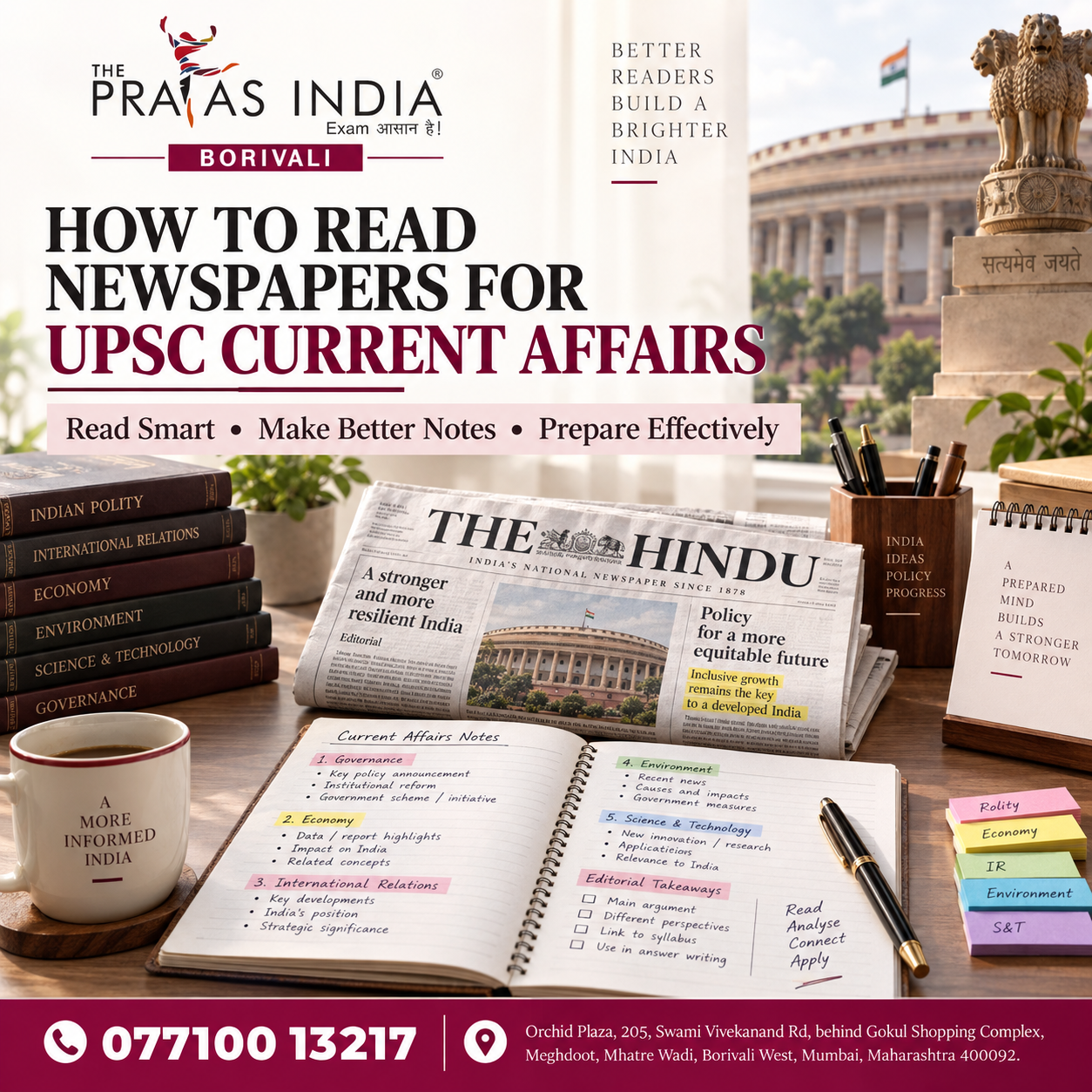
Use the following structure for important current-affairs issues:
| Note component | What to write |
|---|---|
| Topic | Name of the issue |
| Syllabus link | Relevant GS paper and subject |
| Background | Why the issue has emerged |
| Key facts | Important data, institutions or developments |
| Significance | Why the issue matters |
| Challenges | Major concerns and limitations |
| Way forward | Practical solutions |
| Static connection | Relevant textbook or syllabus concept |
Example of UPSC Newspaper Notes
Suppose you read an article about urban flooding in Indian cities.
Your notes may look like this:
Topic: Urban Flooding
Syllabus connection: Disaster management, urbanisation, governance and climate change.
Background: Urban flooding may be influenced by intense rainfall, inadequate drainage, encroachment on natural water channels and unplanned urban development.
Key dimensions:
- Poor stormwater drainage.
- Loss of wetlands and natural water bodies.
- Inadequate urban planning.
- Coordination challenges among civic authorities.
- Increasing exposure to extreme rainfall events.
Way forward:
- Improve urban drainage systems.
- Protect wetlands and natural water bodies.
- Strengthen urban planning and enforcement.
- Improve early-warning systems.
- Coordinate disaster-management and municipal agencies.
This is more useful than copying several paragraphs from the original newspaper article.
Digital Notes vs Handwritten Notes
Both methods can work. Select the one that makes revision easier.
| Digital notes | Handwritten notes |
|---|---|
| Easy to search and update | Useful for concise summaries |
| Convenient for organising topics | Encourages active rewriting |
| Can include source links | Can be revised without a device |
| Suitable for large collections | Can become bulky over time |
You can also use a combination: digital notes for organising monthly current affairs and handwritten one-page summaries for important topics.
The important point is consistency. Avoid changing your note-making system every few weeks.
How to Read an Editorial for UPSC Mains
Editorials should not be treated as model answers that you need to memorise. They are better understood as material for developing arguments and analytical ability.
Use the following five-part method.
1. Identify the central argument
Understand what the writer is trying to communicate. Do not get distracted by complicated vocabulary.
2. Understand the issue’s background
Identify the constitutional, economic, historical or social context wherever relevant.
3. Note both sides of the debate
For example, an article on artificial intelligence in governance may discuss improved efficiency as well as concerns about privacy, accountability and algorithmic bias.
4. Extract useful examples
Look for examples of policies, institutions, court judgments, administrative practices and international experiences that can support your arguments.
5. Write a balanced conclusion
Think about practical solutions that consider different stakeholders and long-term public interest.
Example: Editorial on Judicial Pendency
Instead of copying the editorial, prepare a short analysis:
- Issue: Delay in disposal of court cases.
- Causes: Vacancies, procedural delays, infrastructure constraints and case-management challenges.
- Impact: Delayed justice, increased costs and reduced public confidence.
- Possible measures: Better court infrastructure, judicial appointments, technology-enabled case management and procedural reforms.
- Syllabus connection: Judiciary, access to justice, rule of law and governance.
This approach is useful for GS Paper II and essay preparation.
How Much Time Should You Spend Reading the Newspaper?
Beginners often spend too much time on newspapers because they try to understand every unfamiliar topic in detail.
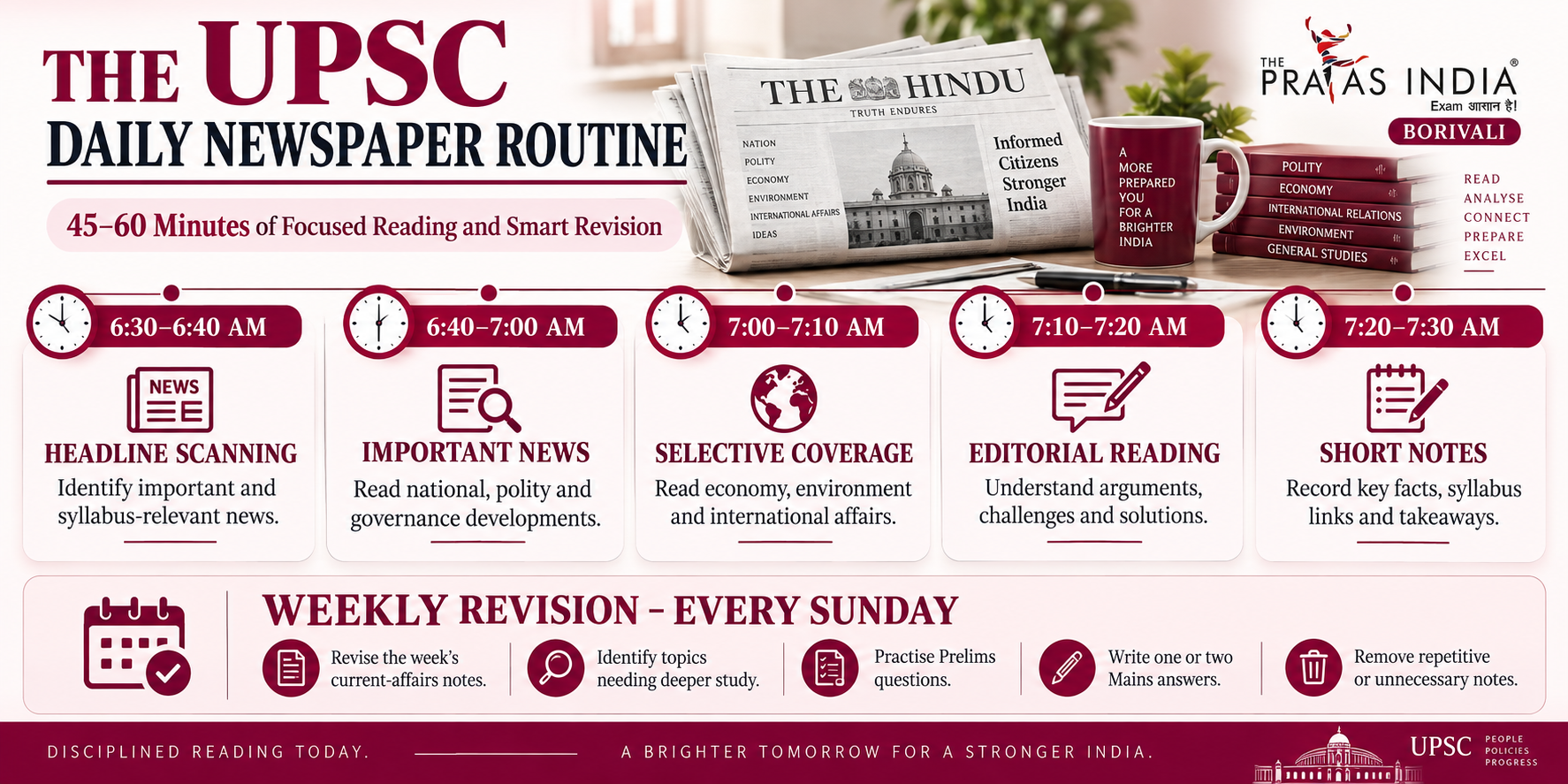
A reasonable starting target is approximately 45–60 minutes per day. The exact duration will depend on your reading speed and preparation stage.
A practical time distribution could be:
| Activity | Suggested time |
|---|---|
| Scan headlines and identify relevant news | 5–10 minutes |
| Read important news reports | 15–20 minutes |
| Read one or two relevant editorials/explainers | 10–15 minutes |
| Make short notes | 10 minutes |
| Revise previous notes | 5 minutes |
| Total | 45–60 minutes |
If you are a beginner, it may initially take longer. Focus on improving your filtering ability rather than forcing yourself to finish within a strict time limit.
Daily Newspaper Reading Timetable for UPSC Aspirants
A fixed routine makes newspaper reading more manageable, especially when you are also studying Polity, History, Geography, Economy and other static subjects.
Here is a sample morning routine:
| Time | Activity |
|---|---|
| 6:30–6:40 AM | Scan headlines and identify relevant topics |
| 6:40–7:00 AM | Read national, polity and governance news |
| 7:00–7:10 AM | Read economy, environment and international developments |
| 7:10–7:20 AM | Read one relevant editorial or explainer |
| 7:20–7:30 AM | Prepare short notes and syllabus connections |
This is only a sample schedule. Adjust it according to your college, work and coaching timings.
Weekly Current Affairs Revision
Daily reading should be supported by weekly revision.
- Monday to Saturday: Read relevant news and prepare short notes.
- Sunday: Revise the week’s notes.
- Identify topics that require additional background study.
- Practise a few Prelims-style questions.
- Select one or two topics for Mains answer-writing practice.
Do not allow daily notes to accumulate without revision.
How to Connect Newspaper Reading with Prelims Preparation
Newspaper reading should support your static preparation and objective-question practice.
For Prelims, focus on:
- Important constitutional and statutory bodies.
- Government schemes and their implementing ministries.
- National and international organisations.
- Reports, indices and significant publications.
- Important environmental conventions and species in the news.
- Science and technology developments with wider relevance.
- Important geographical locations and places in the news.
However, do not assume that every newspaper fact will become a Prelims question.
For example, if you read about a new environmental initiative, understand the relevant institution, environmental concept and geographical context. Use the official source for factual verification rather than depending only on the newspaper report.
You can also use UPSC’s official previous-question-paper archive to understand how topics are framed and to practise applying your knowledge.
How to Connect Newspaper Reading with Mains Answer Writing
Mains preparation requires more than knowing what happened. You need to understand why an issue matters, what challenges it creates and what can be done about it.
Try to convert important newspaper topics into short answer-writing exercises.
For example:
Newspaper topic: Urban air pollution.
Possible Mains dimensions:
- Causes of air pollution.
- Health and economic consequences.
- Role of urban local bodies.
- Regulatory and institutional challenges.
- Public transport and clean-energy solutions.
- Citizen participation and behavioural changes.
A useful answer structure is:
- Introduction: Define the issue or provide relevant context.
- Body: Explain causes, implications and challenges.
- Analysis: Present different dimensions and examples.
- Way forward: Suggest realistic and balanced solutions.
- Conclusion: End with a constructive, forward-looking statement.
Do not try to write a full answer for every article. Select important topics that have a clear connection with the syllabus.
Reliable Sources to Supplement Newspaper Reading
A newspaper provides reporting and analysis, but some information should be checked against primary or authoritative sources.
| Source | How it can help |
|---|---|
| UPSC official notification | Check the examination notice and syllabus |
| Press Information Bureau (PIB) | Verify government announcements and official releases |
| PRS Legislative Research | Understand Bills, Parliament and policy developments |
| UPSC previous question papers | Practise and understand question framing |
The Press Information Bureau is the Government of India’s official agency for disseminating information about government policies, programmes and initiatives. It can be useful for checking the details of official announcements.
PRS Legislative Research publishes legislative briefs and policy reviews that can help aspirants understand Bills and parliamentary developments.
Use these resources selectively. Do not turn newspaper reading into an exercise of browsing ten websites every morning.
Common Newspaper Reading Mistakes UPSC Aspirants Should Avoid
Even serious aspirants can lose valuable preparation time by following an inefficient newspaper-reading method. Watch out for these mistakes.
Mistake 1: Reading Every Article
A newspaper contains far more information than you need for the examination. Reading every report in detail reduces the time available for static subjects and revision.
What to do: Filter articles according to the UPSC syllabus and focus on important developments.
Mistake 2: Reading Multiple Newspapers Every Day
Reading two or three newspapers often results in repeated information and unnecessary note-making.
What to do: Follow one primary newspaper consistently. Refer to another source only when additional context is genuinely required.
Mistake 3: Copying Entire Articles into Notes
Long notes are difficult to revise and often contain information that is not useful for examination answers.
What to do: Summarise an issue in your own words using short headings, relevant facts and practical examples.
Mistake 4: Ignoring Static Subjects
Newspaper reading cannot replace standard books and basic conceptual study.
What to do: Connect current developments with Polity, History, Geography, Economy, Environment and other syllabus subjects.
Mistake 5: Memorising Facts Without Understanding Context
Memorising a scheme’s name or an international agreement without understanding its purpose does not build analytical ability.
What to do: Understand the background, objective, significance and implications of important developments.
Mistake 6: Not Revising Current Affairs
Daily reading without revision can lead to poor retention.
What to do: Maintain weekly and monthly revision sessions. Revisit important notes instead of continuously adding new material.
Mistake 7: Spending Too Much Time on Editorial Vocabulary
Collecting difficult English words from every editorial can distract you from the actual issue.
What to do: Focus on arguments, reasoning, examples and solutions. Note a new word only when it is genuinely useful.
Mistake 8: Depending Only on Newspaper Reading
Newspapers do not cover the entire syllabus and should not become your only source of preparation.
What to do: Combine newspaper reading with standard books, official documents, previous-year questions, revision and mock tests.
Newspaper Reading Tips for College Students and Working Professionals
Aspirants balancing UPSC preparation with college or employment may not have the flexibility to spend long hours on newspapers.
The solution is to follow a consistent, limited and structured routine.
For College Students
- Fix a regular reading time before classes or after returning from college.
- Read important national, economy, polity and editorial developments.
- Maintain short digital or handwritten notes.
- Connect important topics with your ongoing static-subject preparation.
- Use weekends for revision and answer-writing practice.
For Working Professionals
- Choose a fixed morning or evening reading slot.
- Avoid checking news notifications throughout the day.
- Read a limited number of relevant articles rather than browsing multiple websites.
- Save important articles for a scheduled reading session.
- Use one weekly session to organise and revise notes.
What if You Miss Newspaper Reading for a Day?
Do not panic or attempt to read every missed article in one sitting.
Instead:
- Scan a reliable daily or weekly current-affairs summary.
- Identify major syllabus-relevant developments.
- Verify important facts from authoritative sources.
- Add only essential points to your notes.
- Resume your regular routine.
Consistency over several months is more valuable than trying to achieve a perfect reading record every day.
How to Choose Newspaper Reading Support for UPSC Preparation in Borivali
For aspirants in Borivali, Borivali East, Mhatre Wadi, IC Colony, Gorai, Eksar, Dahisar and Kandivali, newspaper reading can be part of a broader and organised UPSC preparation routine.
The important thing is to ensure that current affairs are not studied in isolation. They should be connected with the static syllabus, classroom learning where applicable, practice questions and regular revision.
Before choosing any UPSC preparation guidance, consider asking:
- How are current affairs connected with the UPSC syllabus?
- Is there a structured approach to Prelims and Mains preparation?
- How are important issues revised?
- Are students encouraged to practise analytical answer writing?
- How are doubts and difficult newspaper topics addressed?
Students considering The Prayas India – Borivali can enquire directly about the UPSC preparation options and guidance currently available at the centre. Confirm the relevant course details, schedule and support before making an enrolment decision.
Branch details:
- THE PRAYAS INDIA – BORIVALI
- Orchid Plaza, 205, Swami Vivekanand Rd, behind Gokul Shopping Complex, Meghdoot, Mhatre Wadi, Borivali West, Mumbai, Maharashtra 400092.
- 077100 13217
Your Daily Newspaper Reading Checklist for UPSC
Use this checklist to evaluate whether your newspaper-reading session is focused and productive.
The objective is not to tick every box mechanically. It is to develop a habit of purposeful reading and regular improvement.
Conclusion
Learning how to read newspapers for UPSC current affairs is an important part of building a strong preparation strategy. However, the benefit does not come from spending several hours with a newspaper or collecting hundreds of pages of notes. It comes from understanding relevant developments, connecting them with the syllabus and revising them consistently.
Start with one reliable newspaper, follow a fixed reading schedule and focus on important national, international, economic, environmental and governance-related developments. Use editorials to develop analytical thinking, make concise notes and practise applying current affairs to Prelims and Mains questions.
For beginners, the most effective approach is to start small and improve gradually. A focused 45–60-minute newspaper-reading routine, supported by static-subject study and weekly revision, can become a sustainable part of long-term UPSC preparation.
For aspirants in Borivali and nearby areas, the same disciplined approach can help bring structure to daily preparation. The key is simple: read with the syllabus in mind, make notes with a purpose and revise with consistency.
Frequently Asked Questions
Which newspaper is best for UPSC current affairs?
The Hindu and The Indian Express are commonly preferred by UPSC aspirants. Choose one newspaper that you can understand comfortably and read consistently.
How much time should I spend reading newspapers for UPSC?
A reasonable starting target is 45–60 minutes daily. Focus on syllabus-relevant news, important editorials and concise note-making.
Should I read the newspaper before or after studying static subjects?
You can read it before or after static-subject study, depending on your schedule. Connecting current developments with static concepts improves understanding.
Should I make notes from every newspaper article?
No. Make notes only from important syllabus-related developments. Focus on background, significance, challenges, relevant facts and possible solutions.
Is reading editorials important for UPSC Mains?
Yes. Relevant editorials help develop analytical thinking, understand different perspectives and collect useful arguments and examples for Mains answers.
Can I prepare UPSC current affairs without reading a newspaper daily?
You can use reliable current-affairs resources and official sources, but you should follow a systematic method to understand important national and international developments.
How can beginners improve their newspaper-reading habit?
Start with one newspaper, follow a fixed reading schedule, focus on syllabus-relevant sections, prepare short notes and revise them every week.
Planning Your UPSC Preparation?
Build a structured preparation routine, understand the UPSC syllabus and develop a consistent approach to current affairs. Connect with The Prayas India – Borivali to enquire about the preparation options currently available.
THE PRAYAS INDIA – BORIVALI
Orchid Plaza, 205, Swami Vivekanand Rd, behind Gokul Shopping Complex, Meghdoot, Mhatre Wadi, Borivali West, Mumbai, Maharashtra 400092.
Phone: 077100 13217