How to Choose Between Civil Services and Management Careers: A Complete Guide for Students and Graduates
Choosing a career is one of the most important decisions in a student’s life. For many graduates in India, two career paths often create an interesting dilemma: Civil Services and Management. Both offer opportunities to take responsibility, solve complex problems, lead people and make a meaningful contribution to society. However, the nature of work, selection process, professional environment, lifestyle and long-term career growth can be very different.
Civil Services attract candidates who are interested in public administration, governance, policy implementation and working within government institutions. Management careers appeal to individuals who enjoy business strategy, leadership, organisational development, finance, marketing, consulting, operations and entrepreneurship.
The difficult part is that neither career is universally better. A prestigious job title or an attractive salary should not be the only reason to choose a profession. Your interests, strengths, expectations, financial circumstances and preferred working environment deserve equal consideration.
If you are confused about how to choose between Civil Services and Management careers, this guide will help you understand both options, compare their advantages and challenges, assess your personal suitability and make a more informed decision.
Understand What These Two Career Paths Actually Involve
Before comparing Civil Services and Management, understand what professionals in these fields do.
What does a Civil Services career involve?
Civil Services offer opportunities to work in public administration and government institutions. Depending on the service, cadre, posting and responsibilities, officers may be involved in administration, public welfare programmes, revenue administration, law and order, diplomacy, policy implementation and other areas of governance.
The Union Public Service Commission (UPSC) conducts the Civil Services Examination for recruitment to services such as the Indian Administrative Service (IAS), Indian Foreign Service (IFS), Indian Police Service (IPS) and other notified services.
A Civil Services career may involve:
- Implementing government policies and programmes.
- Coordinating public administration.
- Addressing local and regional administrative challenges.
- Working with government departments and public institutions.
- Supporting public welfare and development initiatives.
- Managing responsibilities that affect communities and citizens.
The work can be meaningful, but it also involves accountability, administrative pressure, transfers, public expectations and complex decision-making.
What does a Management career involve?
Management careers generally focus on planning, organising and improving the performance of businesses and other organisations.
A management graduate may work in a private company, consulting firm, financial institution, start-up, multinational organisation, public-sector enterprise or family business.
Depending on the specialisation and role, responsibilities may include:
- Developing business strategies.
- Managing teams and projects.
- Analysing financial and market information.
- Improving organisational operations.
- Understanding customer behaviour.
- Planning marketing campaigns.
- Supporting business expansion.
- Managing products, people and resources.
An MBA can provide structured management education, but it does not automatically guarantee a particular designation, salary or leadership position. Career outcomes depend on factors such as institute, specialisation, skills, experience, industry conditions and individual performance.
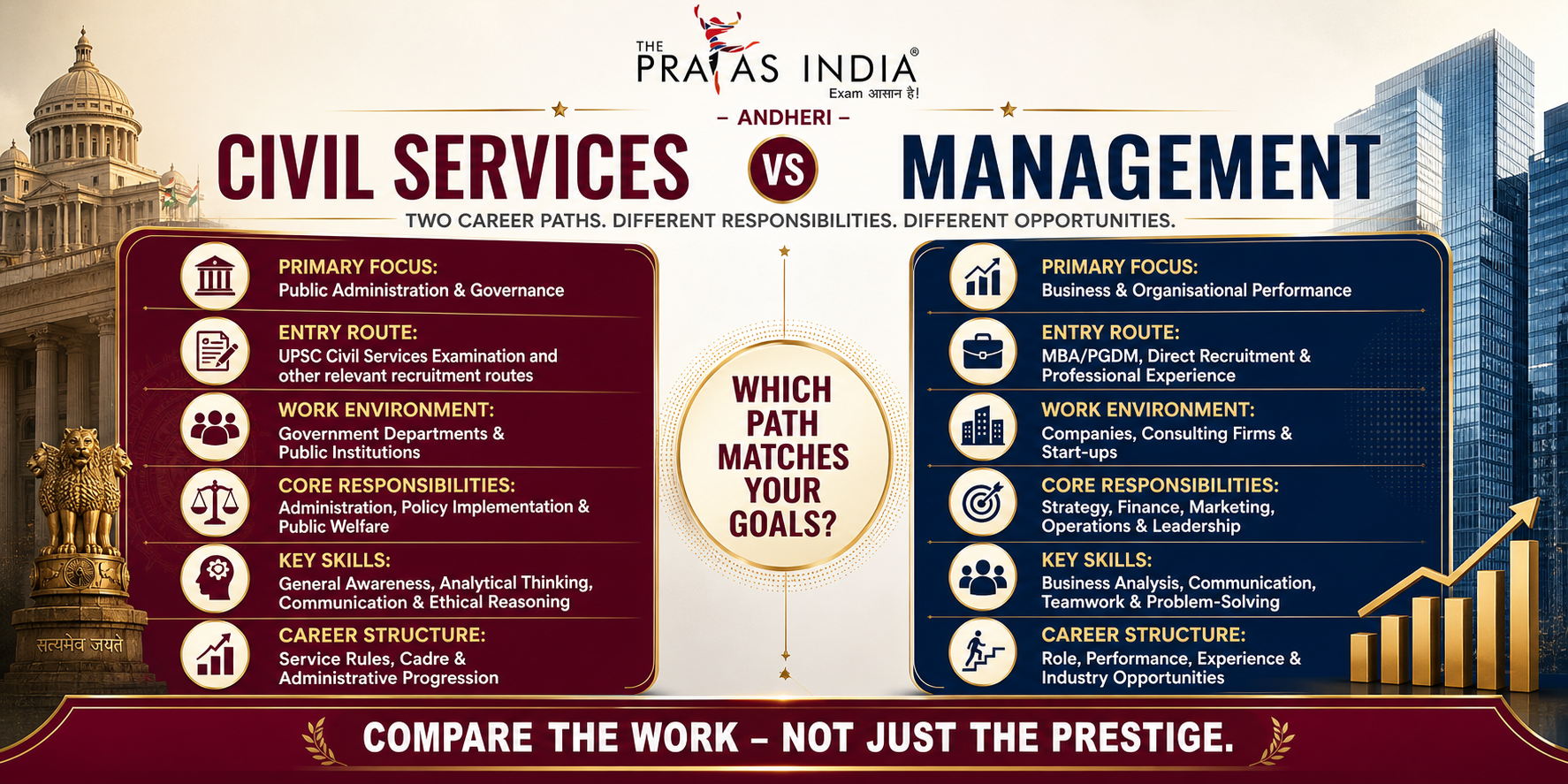
Civil Services vs Management: Understand the Major Differences
Both career paths involve leadership and decision-making, but the professional environment is different.
| Error category | Example | Improvement method |
|---|---|---|
| Conceptual error | Applying the wrong formula | Revise the underlying concept |
| Calculation error | Incorrect multiplication | Practise mental calculations |
| Reading error | Missing a condition | Underline important information |
| Formula error | Forgetting a relationship | Revise formula notes |
| Time-management error | Spending too long on one question | Practise question selection |
| Guesswork | Attempting without sufficient reasoning | Improve elimination and decision-making |
The comparison shows that these professions are built around different objectives. Civil Services primarily serve public administration, whereas management careers generally focus on organisational goals and business outcomes.
Neither should be judged using only one parameter, such as income or social recognition.
Compare Your Personal Interests Before Choosing
A career decision becomes easier when you understand what type of work genuinely interests you.
Ask yourself what motivates you on an ordinary working day, not just what attracts you about a profession from the outside.
You may find Civil Services interesting if:
- You are interested in public policy and governance.
- You enjoy understanding social, economic and political issues.
- You want to work in public administration.
- You are comfortable with structured institutional responsibilities.
- You can remain patient during a long and competitive selection process.
- You are motivated by public service and administrative responsibility.
You may find Management interesting if:
- You enjoy solving business problems.
- You are interested in markets, finance, marketing or operations.
- You like working with teams and managing projects.
- You enjoy analysing data and making business decisions.
- You are interested in organisational growth or entrepreneurship.
- You want to explore different industries and professional roles.
These are indicators, not fixed personality categories. People with similar interests can succeed in either field, and many skills overlap between the two.
Understand the Selection Process and Preparation Commitment
The route to entering Civil Services is substantially different from the route to a management career.
The Civil Services selection process
The UPSC Civil Services Examination generally consists of three stages:
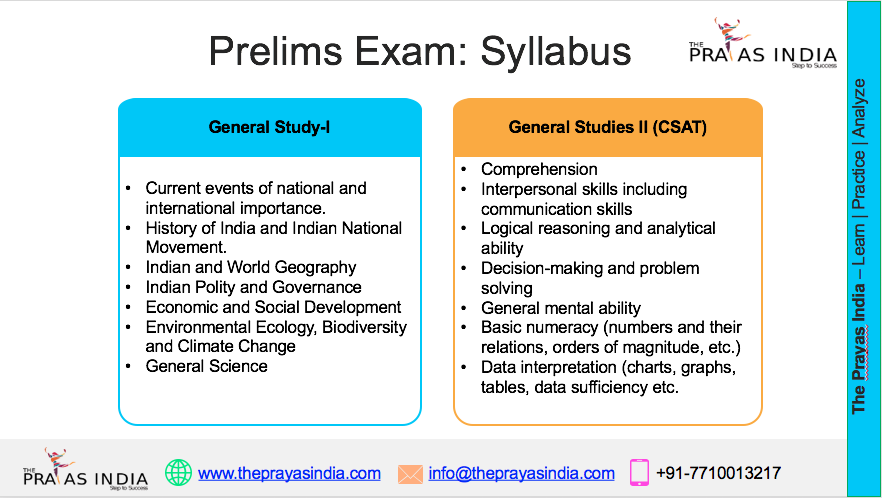
- Preliminary Examination: An objective-type screening stage consisting of General Studies Paper I and the qualifying General Studies Paper II (CSAT).
- Main Examination: A written examination comprising qualifying language papers and papers counted for merit, including the Essay, General Studies, Optional Subject and other prescribed papers.
- Personality Test: An interview stage assessing the candidate’s suitability for a career in public service.
Candidates must satisfy the eligibility conditions, age requirements, educational qualifications and other rules specified in the official notification for the relevant examination year.
Civil Services preparation requires a broad understanding of subjects such as history, geography, polity, economy, environment, science and technology, current affairs and ethics. It also demands answer-writing practice, revision, analytical thinking and consistency.
The Management admission process
For many postgraduate management programmes in India, CAT is an important entrance examination. However, it is not the only route to management education.
Depending on the institution, applicants may consider examinations such as CAT, XAT, CMAT, MAT, GMAT or other accepted entrance tests.
The admission process may include:
- Entrance examination performance.
- Academic record.
- Work experience, where applicable.
- Written assessment or essay.
- Group discussion or group exercise.
- Personal interview.
- Institute-specific selection criteria.
The exact process varies by institution and programme. Applicants should check the latest admission policy of each institute rather than assuming that all MBA colleges follow an identical selection system.
Key difference: UPSC preparation focuses on a competitive public-service recruitment examination, while management admission involves gaining entry to an educational programme through institution-specific selection criteria. A management career can also be entered through professional experience and other routes without necessarily pursuing an MBA.
Compare the Learning and Skill Requirements
Your existing strengths can help you identify which preparation path feels more suitable. However, both careers require continuous learning.
Skills useful for Civil Services
- General awareness and current-affairs understanding.
- Analytical reading.
- Structured writing and communication.
- Understanding of public policy and governance.
- Ethical reasoning.
- Decision-making under pressure.
- Ability to evaluate complex social issues.
Skills useful for Management
- Quantitative and analytical ability.
- Business communication.
- Problem-solving.
- Teamwork and leadership.
- Understanding of business fundamentals.
- Data interpretation.
- Strategic thinking and execution.
There is also considerable overlap. Communication, analytical thinking, leadership, time management and decision-making can be valuable in both professions.
A student who enjoys economics, for example, may explore public finance and economic policy through Civil Services preparation or financial analysis and business strategy through management education.
The subject may be similar, but the professional application can be different.
Consider Financial Planning and the Cost of Preparation
Financial circumstances deserve serious attention when choosing a career.
Civil Services preparation can involve expenditure on books, study material, test series, coaching where required, accommodation and living expenses. The total cost varies according to the candidate’s location, study method and preparation duration.
Management education can involve tuition fees, accommodation, living expenses and other academic costs. These vary significantly across institutes and programmes.
| Financial consideration | Civil Services preparation | Management education |
|---|---|---|
| Preparation or education cost | Depends on preparation method and duration | Depends heavily on institution and programme |
| Time before professional entry | Depends on examination performance and selection cycle | Depends on programme duration and subsequent recruitment |
| Financial planning | May need a plan for an uncertain preparation period | May require planning for tuition and related expenses |
| Career income | Governed by applicable service rules | Depends on employer, role, industry and experience |
Before committing to either option, calculate the realistic financial requirement.
For Civil Services aspirants, consider how you will support yourself during preparation and what alternative plan you will follow if selection takes longer than expected.
For MBA aspirants, compare programme fees, financing options, curriculum, placement reports and the career opportunities relevant to your goals. Do not make a decision based only on advertised highest salary figures.
Understand Lifestyle, Work Environment and Personal Expectations
Career satisfaction depends not only on the work you perform but also on how that work fits into your life.
Civil Services lifestyle
Civil servants work within government structures and may have responsibilities involving public interaction, administrative coordination, field assignments and official decision-making.
Depending on the service and posting, the job may involve:
- Transfers and location changes.
- Public-facing responsibilities.
- Administrative deadlines.
- Coordination with multiple departments.
- Situations requiring quick decisions.
- Work beyond conventional office hours in certain assignments.
The nature of the work can change considerably across services, departments and postings.
Management career lifestyle
Management professionals may work in corporate offices, consulting environments, factories, financial institutions, technology companies or start-ups.
Their working experience may include:
- Project deadlines.
- Business targets.
- Team management.
- Client interactions.
- Market and financial analysis.
- Cross-functional coordination.
- Performance reviews and organisational changes.
Work-life balance varies significantly across industries, employers, roles and seniority levels. It would be inaccurate to assume that every corporate role offers flexibility or that every government role follows a predictable schedule.
Think about the type of professional environment in which you would prefer to work over the long term.
Evaluate Long-Term Career Growth
Civil Services and Management offer different models of professional development.
Growth in Civil Services
Career progression is governed by the rules applicable to the service, cadre, seniority, performance and other administrative considerations.
Depending on the service, officers may receive opportunities for:
- Greater administrative responsibility.
- Senior departmental roles.
- Policy-related assignments.
- Specialised postings.
- Deputation opportunities, subject to applicable rules.
The nature of responsibility generally evolves with experience and the position held.
Growth in Management
Management professionals can build careers across different functions and industries.
Possible career directions include:
- Business analyst.
- Financial analyst.
- Marketing manager.
- Product manager.
- Operations manager.
- Human resources professional.
- Management consultant.
- Business development leader.
- Entrepreneur.
Progression depends on performance, experience, professional skills, organisational opportunities and market conditions.
Management professionals may also switch industries or functions, although such transitions require relevant skills and experience.
Do not compare career growth using job titles alone. Understand the responsibility, professional development, learning opportunities and long-term direction associated with the roles you are considering.
Can You Prepare for Civil Services and Management Entrance Examinations Together?
Some students consider preparing for UPSC and management entrance examinations simultaneously because they are unsure which career path to select.
This can be possible for certain candidates, but it requires realistic planning.
There may be areas of overlapping preparation, such as reading comprehension, analytical reasoning, communication and general awareness. However, the core examination requirements are different.
| Preparation area | Civil Services | Management entrance examinations |
|---|---|---|
| General Studies | Extensive preparation | Usually not a central CAT component |
| Quantitative Aptitude | Useful in selected areas and CSAT | Important in exams such as CAT |
| Reading comprehension | Important | Important in exams such as CAT |
| Logical reasoning | Useful for analytical ability | Important in management entrance tests |
| Essay and answer writing | Significant for UPSC Mains | May be included in certain institute selection processes |
| Current affairs | Important | Varies by examination and admission process |
A practical way to manage overlapping preparation
- Identify the examination that is your primary priority.
- Understand the syllabus and selection process of both pathways.
- Allocate separate study time for non-overlapping subjects.
- Avoid preparing for two major examinations without a realistic timetable.
- Evaluate your progress through relevant mock tests.
- Review your career decision at planned intervals rather than changing direction every few weeks.
For many aspirants, choosing one primary goal and maintaining a sensible alternative plan is more effective than attempting to prepare equally for everything.
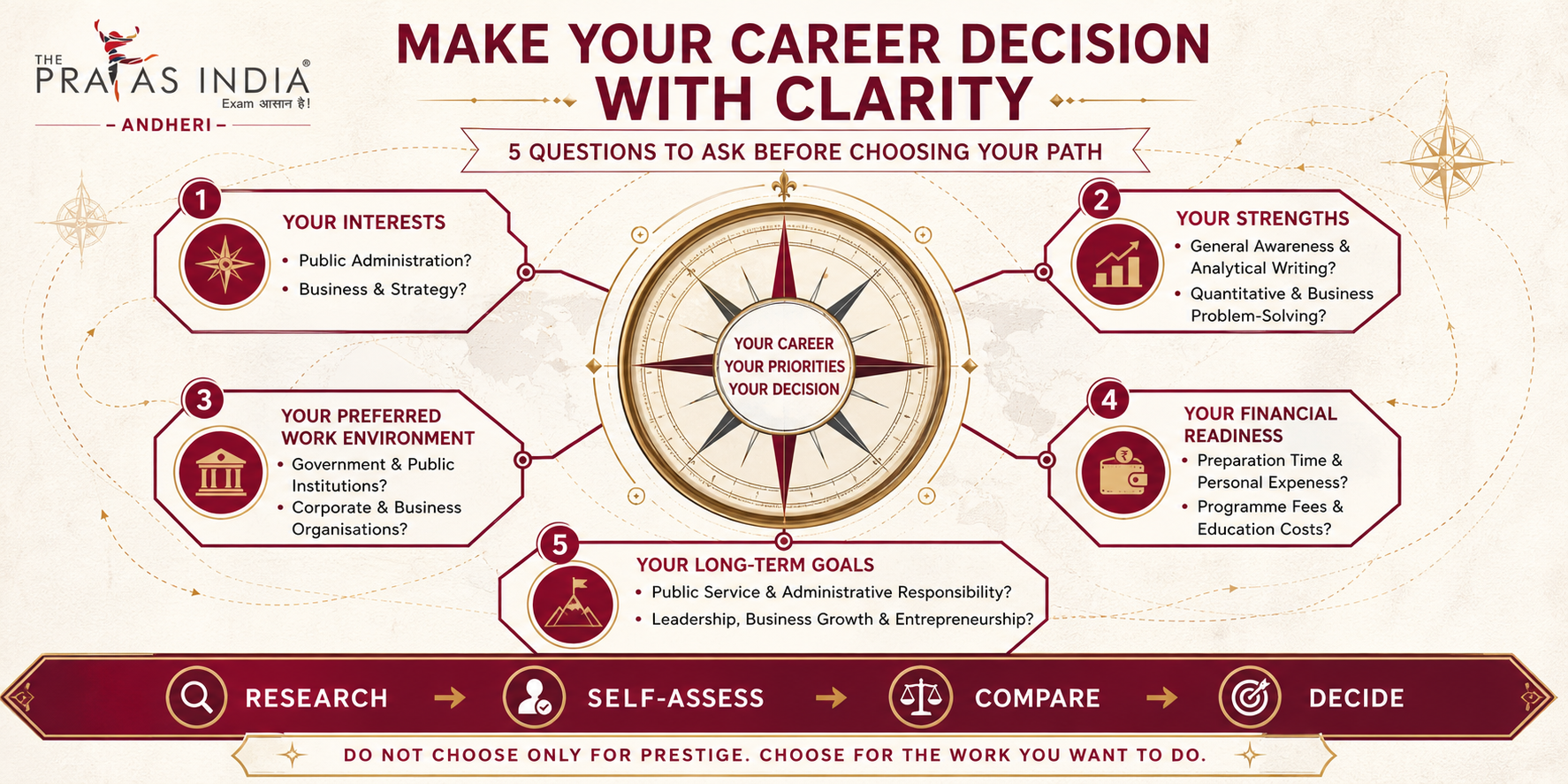
Five Questions to Ask Yourself Before Making the Decision
Instead of choosing a career because of family expectations, social pressure or the popularity of a profession, evaluate your own priorities.
Question 1: What kind of problems do I enjoy solving?
If you are interested in public administration, governance and social issues, explore Civil Services. If business performance, market opportunities and organisational challenges interest you more, explore Management.
Question 2: Which working environment suits me?
Consider whether you prefer government administration and public responsibilities or organisational and business environments.
Question 3: How much uncertainty can I manage?
Civil Services selection is highly competitive, and preparation duration can be uncertain. Management admission and recruitment also involve competition, but the available programmes and employment routes are diverse.
Question 4: What are my financial responsibilities?
Evaluate your ability to support the preparation period or finance a management programme without creating unrealistic expectations.
Question 5: What does long-term success mean to me?
Success may mean public impact, administrative responsibility, professional growth, financial independence, entrepreneurship or a combination of different goals.
Your answer should reflect your own priorities.
A Simple Career Decision Framework
Use the following framework to compare both options. Rate each factor from 1 to 5 based on your personal preferences. A higher score means that the career path is more aligned with that particular factor.
| Decision factor | Civil Services | Management |
|---|---|---|
| Interest in public administration | High alignment with public policy, governance, and societal welfare | Secondary focus, centered around corporate governance and market operations |
| Interest in business and organisations | Focus on public sector institutions and administrative frameworks | High alignment with private enterprise, commercial strategy, and startups |
| Preference for public-facing responsibilities | Direct interaction with citizens, scheme implementation, and law enforcement | Client, consumer, or stakeholder-focused commercial roles |
| Interest in corporate or entrepreneurial work | Limited direct corporate exposure during service tenure | Central to private sector career progression and business ventures |
| Comfort with the relevant selection process | Multi-stage UPSC cycle (Prelims, Mains, Interview) | CAT/management entrance exams followed by WAT/GD/PI |
| Financial readiness | Plan for potentially extended preparation and selection timelines | Budgeting for business school tuition and living expenses |
| Preferred work environment | Government offices, field postings, and public administration setups | Corporate offices, multinational firms, and dynamic business environments |
| Long-term career expectations | Public service, policy formulation, and administrative leadership | Corporate leadership, executive management, and entrepreneurial ventures |
Do not simply add the scores and select the higher number. Use the exercise to identify what matters most to you and where your expectations may be unrealistic.
For example, a student may be attracted to Civil Services because of its reputation but may have little interest in public administration. Another student may want to pursue an MBA only because of salary expectations without understanding the specialisation or industry they want to enter.
This framework helps separate genuine interest from external influence.
Common Mistakes Students Make While Choosing a Career
Choosing based only on social prestige
Both Civil Services and management qualifications may carry social recognition. However, prestige alone cannot guarantee professional satisfaction.
Better approach: Understand the everyday responsibilities of the career before making a commitment.
Comparing salaries without understanding the complete picture
Government compensation and corporate compensation follow different structures. Comparing only headline figures can create misleading expectations.
Better approach: Evaluate benefits, responsibilities, career progression, financial risk and long-term opportunities.
Following friends or family without self-assessment
A career that suits one person may not suit another.
Better approach: Discuss your options with experienced professionals, but make the final decision based on your interests and circumstances.
Underestimating the preparation commitment
Both paths require consistent effort, but the nature of preparation is different.
Better approach: Review the syllabus, entrance requirements, time commitment and financial implications before beginning.
Ignoring alternative plans
A competitive examination or management admission process may not produce the expected result on the first attempt.
Better approach: Develop a realistic alternative plan that supports your education and career development.
How to Take the Next Step with Clarity
Once you have compared both career paths, avoid remaining in the decision-making stage indefinitely. Take small, practical steps to understand what each option involves.
For Civil Services:
- Read the latest UPSC Civil Services Examination notification.
- Review the syllabus and previous question papers.
- Understand the three-stage examination process.
- Explore the responsibilities of different services.
- Speak with people who understand public administration.
- Attempt a diagnostic test to evaluate your preparation level.
For Management:
- Research MBA and PGDM programmes.
- Understand entrance examinations accepted by your shortlisted institutes.
- Explore specialisations such as finance, marketing, operations, HR and business analytics.
- Review curriculum and placement reports carefully.
- Speak with management students and working professionals.
- Attempt a diagnostic management entrance test.
If you are exploring structured preparation for competitive examinations in Mumbai, you can also enquire about relevant programmes and guidance at The Prayas India – Andheri.
The centre is located at Office 803, Time Chambers, Swami Vivekanand Road, near Paneri, Andheri West, Mumbai, Maharashtra 400058.
Contact the centre to confirm current course availability, programme details, schedules and fees before making a decision.
Conclusion
Choosing between Civil Services and Management careers is not about deciding which profession is more prestigious. It is about understanding which professional path aligns better with your interests, abilities, financial circumstances and long-term expectations.
Civil Services may appeal to individuals who are motivated by public administration, governance and responsibilities connected with public institutions. Management may be more suitable for those interested in business strategy, organisational leadership, finance, marketing, operations and entrepreneurship.
Both paths demand discipline, continuous learning, adaptability and commitment. Both can offer meaningful professional opportunities, but neither guarantees success simply because you choose it.
Take time to research the actual work, understand the selection process, assess your strengths and speak to people with relevant experience. A well-informed decision made after honest self-assessment is more valuable than choosing a career based on temporary pressure or popular opinion.
Choose a career that matches the work you want to do, the responsibilities you are prepared to accept and the future you genuinely want to build.
Frequently Asked Questions
1. Which is better: Civil Services or Management?
Neither career is universally better. Civil Services may suit individuals interested in governance and public administration, while Management may suit those interested in business, strategy, organisational leadership and entrepreneurship. The right choice depends on your interests, strengths and career expectations.
2. Can I prepare for UPSC and CAT at the same time?
It is possible to prepare for both, but the syllabi and examination requirements are different. Some skills overlap, including reading comprehension and analytical reasoning. Candidates should identify one primary goal and create a realistic timetable for the additional preparation.
3. Is an MBA necessary for a Management career?
No. An MBA or PGDM can provide structured business education and access to certain recruitment opportunities, but management careers can also be developed through relevant qualifications, professional experience, direct recruitment and entrepreneurship.
4. What are the main skills required for Civil Services?
Useful skills include general awareness, analytical thinking, reading comprehension, structured writing, communication, ethical reasoning and decision-making. Candidates also need consistency and the ability to understand complex social and administrative issues.
5. What are the main career options after an MBA?
Depending on their specialisation, skills and experience, MBA graduates may explore roles in finance, marketing, consulting, operations, human resources, product management, business analytics, business development and entrepreneurship.
6. How should I decide between UPSC preparation and an MBA?
Compare your interests, preferred work environment, financial readiness, preparation commitment and long-term goals. Review the actual responsibilities of both professions and speak with people who have relevant experience before deciding.
7. Where can I enquire about competitive examination preparation in Andheri?
You can contact The Prayas India – Andheri at 08355951603 to enquire about current programmes, course details, schedules and fees. The centre is located at Office 803, Time Chambers, Swami Vivekanand Road, near Paneri, Andheri West, Mumbai, Maharashtra 400058.
Take the Next Step Towards Your Career Goals
Looking for guidance with competitive examination preparation? Contact The Prayas India – Andheri to enquire about current programmes, course details and schedules.
THE PRAYAS INDIA – ANDHERI
Office 803, Time Chambers, Swami Vivekanand Road, near Paneri, Andheri West, Mumbai, Maharashtra 400058.
Call: +91 83559 51603
Website: theprayasindia.com