UPSC Optional Subject Selection: Factors Every Aspirant Should Consider
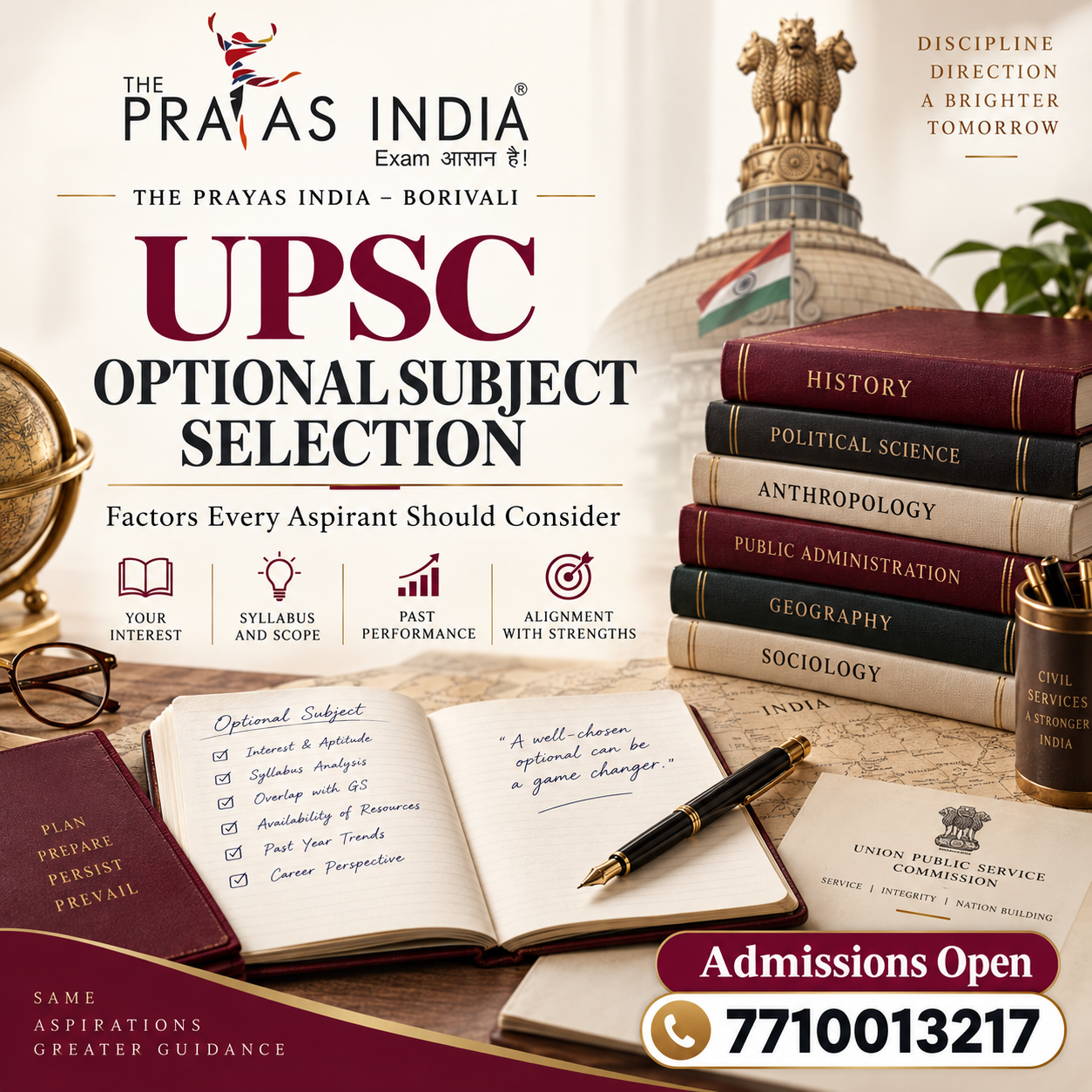
Choosing the right optional subject is one of the most important decisions in the UPSC Civil Services Examination. Your optional subject can influence your Mains preparation strategy, answer-writing practice, revision schedule and overall performance. The best choice is not necessarily the subject with the highest popularity or the one that your friends have selected. It is the subject that matches your interests, academic comfort, understanding and ability to prepare consistently.
For aspirants exploring UPSC coaching in Borivali, understanding optional subject selection early can help bring more direction to their preparation. At The Prayas India – Borivali, aspirants can seek guidance on building a structured UPSC preparation strategy, understanding the demands of Mains and approaching optional subject preparation with greater clarity.
This guide explains the key factors to consider before choosing your UPSC optional subject, common selection mistakes, and how to create a practical preparation plan.
Introduction
The UPSC Civil Services Examination tests candidates across several stages, including Prelims, Mains and the Personality Test. While Prelims assesses a broad range of subjects through objective questions, Mains requires candidates to demonstrate analytical thinking, conceptual clarity and the ability to present well-structured answers.
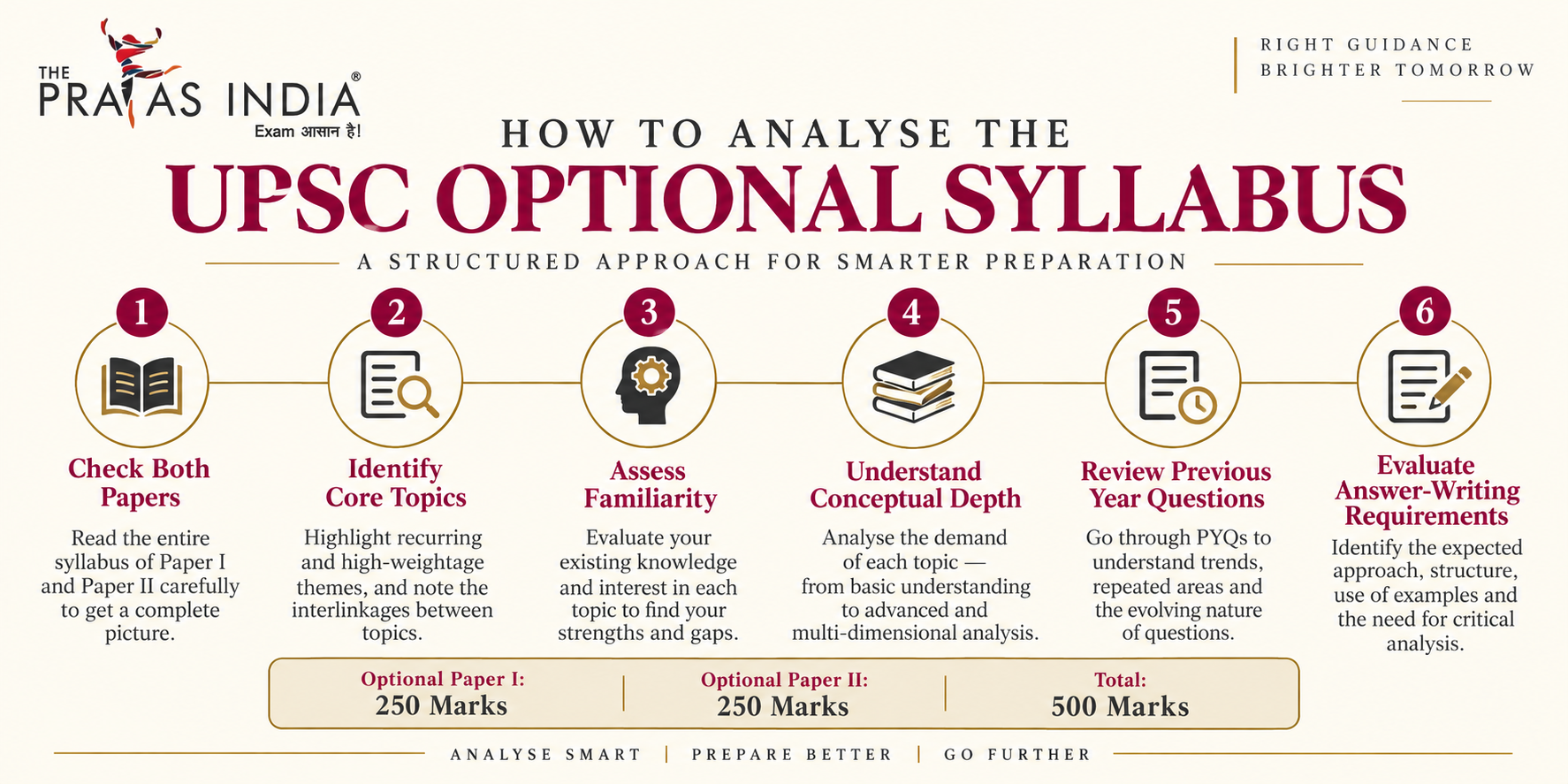
The optional subject is a significant part of the Mains examination. It consists of two papers, each carrying 250 marks, making a total of 500 marks. This gives the optional subject considerable importance in the written examination.
However, selecting an optional subject should not be treated as a shortcut to securing a high score. A subject that works well for one candidate may not be suitable for another. Your academic background, interest, available study time, access to resources and comfort with the syllabus all matter.
For students looking for the best UPSC coaching in Borivali, a sensible starting point is to understand the optional subject requirements before committing to a long-term preparation strategy.
Understand the Importance of the UPSC Optional Subject
Before comparing subjects, understand what the optional component involves.
The UPSC Mains examination includes two optional papers:
- Optional Paper I: 250 marks
- Optional Paper II: 250 marks
- Total: 500 marks
The optional subject is selected from the subjects listed in the official UPSC Civil Services Examination notification. Candidates should refer to the applicable notification and the detailed syllabus before making their final decision.
A well-chosen optional subject can help you:
- Develop deeper knowledge of a particular discipline.
- Build a consistent answer-writing approach.
- Connect concepts across different topics.
- Improve the quality of analytical answers.
- Create a more organised revision strategy.
- Maintain interest throughout an extended preparation period.
Remember that optional preparation requires more than reading textbooks. You must understand the syllabus, practise previous years’ questions, develop subject-specific analytical skills and revise regularly.
Evaluate Your Genuine Interest in the Subject
Interest is one of the most important factors in optional subject selection.
UPSC preparation is a long process. You may need several months to understand the complete optional syllabus, prepare notes, practise answers and revise important concepts. If you select a subject only because it is popular, maintaining consistency can become difficult.
Ask yourself:
- Do I genuinely enjoy reading about this subject?
- Can I study its topics repeatedly without losing interest?
- Am I comfortable understanding its concepts?
- Can I explain its ideas in my own words?
- Would I be willing to write answers on this subject regularly?
For example, an aspirant interested in social institutions, inequality, culture and social change may find Sociology engaging. Someone who enjoys understanding political systems, constitutional developments and international relations may prefer Political Science and International Relations.
Similarly, a candidate interested in historical developments may consider History, while someone who enjoys geographical concepts, maps and environmental processes may explore Geography.
The objective is not to identify the easiest subject. It is to find a subject that you can study with sustained interest.
Consider Your Academic Background
Your graduation subject can provide a useful starting point, but it should not automatically determine your UPSC optional.
An academic background may offer familiarity with concepts, terminology and foundational knowledge. This can reduce the initial learning effort.
For instance:
| Academic background | Optional subjects worth exploring |
|---|---|
| Political Science | Political Science and International Relations |
| History | History |
| Geography | Geography |
| Sociology | Sociology |
| Philosophy | Philosophy |
| Economics | Economics |
| Literature | Relevant Literature optional |
| Science and Engineering | Mathematics or relevant science and engineering subjects |
This table is only a starting point, not a recommendation that every graduate should choose their graduation subject.
A candidate who studied engineering may develop a stronger interest in Sociology or Anthropology. Similarly, a humanities graduate may discover that Geography or Mathematics suits their learning style better.
Before deciding, compare the complete optional syllabus with your existing knowledge. Identify which topics are familiar, which require additional learning and whether you are comfortable studying the subject at the required depth.
Analyse the Complete UPSC Optional Syllabus
Never select an optional subject based only on its name, reputation or recommendations from other aspirants.
Download the official syllabus and examine both papers carefully. The syllabus should become the foundation of your decision.
While analysing it, focus on:
- Syllabus length: How many broad topics and subtopics are included?
- Conceptual depth: Does the subject require detailed theoretical understanding?
- Familiarity: How many topics have you already studied?
- Interdisciplinary connections: Does the subject connect with General Studies?
- Technical requirements: Does it involve diagrams, calculations, thinkers, theories or specialised terminology?
- Answer-writing demands: What kind of explanations and analysis does the subject require?
Do not assume that a shorter syllabus is automatically easier. Some subjects have fewer topics but require considerable conceptual depth. Others may have a longer syllabus but offer a more familiar structure to a particular candidate.
Check the Availability of Study Material and Guidance
The availability of reliable study material is another practical consideration.
Before selecting a subject, find out whether you can access:
- Standard textbooks and recommended reference books.
- The official syllabus and topic-wise study resources.
- Previous years’ UPSC optional question papers.
- Reliable notes and supplementary reading material.
- Subject-specific answer-writing practice.
- Evaluation or feedback from a knowledgeable mentor.
Having too many books is not necessarily beneficial. A limited and carefully selected set of resources is usually easier to revise than an unnecessarily large collection.
You should also assess whether you can understand the subject independently or whether you would benefit from structured classroom guidance.
For aspirants comparing UPSC coaching classes in Borivali, it is useful to ask specific questions about the preparation approach, subject guidance, answer-writing practice and how optional preparation fits into the overall UPSC plan.
At The Prayas India – Borivali, aspirants can enquire about the available UPSC preparation guidance and understand how to plan their preparation. Confirm the current subject-specific facilities and course availability directly with the institute before making an enrolment decision.
Examine the Previous Years’ Question Papers
Previous years’ question papers offer a practical understanding of how UPSC tests a subject.
Reading the syllabus tells you what you need to study. Analysing question papers helps you understand how you may be expected to apply that knowledge.
Collect question papers for both optional papers and examine them topic by topic.
Look for:
- Frequently tested syllabus areas.
- Questions requiring conceptual explanations.
- Questions involving critical analysis.
- Repeated themes across different years.
- The balance between factual and analytical questions.
- The use of diagrams, examples, case studies or illustrations, where relevant.
Try writing a few answers after studying the basic concepts. This exercise can help you identify whether you understand the subject well enough to express your knowledge within the expected answer format.
Do not select an optional simply because you notice repeated questions. UPSC can test familiar topics from different perspectives, so conceptual understanding remains essential.
Understand the Overlap Between Optional and General Studies
Some optional subjects share themes with the General Studies papers. This overlap may help candidates connect their preparation and revise related concepts more efficiently.
For example:
| Optional subject | Potential connection with General Studies |
|---|---|
| Sociology | Indian Society, social issues and social change |
| Political Science and International Relations | Constitution, governance and international relations |
| Geography | Indian and world geography, environment and related issues |
| History | Indian history, culture and historical developments |
| Economics | Indian economy and economic development |
| Philosophy | Ethical concepts and philosophical thinking |
Overlap should be treated as an additional advantage, not the only selection criterion.
A subject may have significant connections with General Studies but still be unsuitable if you find its core concepts difficult or uninteresting.
The right approach is to balance interest, academic comfort, syllabus requirements and potential overlap.
Consider the Time Required to Complete the Optional
Your optional subject must fit into your overall UPSC preparation timetable.
You will need to manage:
- General Studies preparation.
- Prelims-specific preparation.
- Optional subject study.
- Essay preparation.
- Current affairs.
- Answer-writing practice.
- Revision and mock tests.
If you are starting preparation from the beginning, choosing a subject without estimating the time required can create difficulties later.
Prepare a realistic timetable based on the syllabus rather than relying on arbitrary completion targets.
For example, divide your optional syllabus into manageable sections:
| Preparation stage | Main objective |
|---|---|
| Stage 1 | Understand the syllabus and collect resources |
| Stage 2 | Complete foundational concepts |
| Stage 3 | Study advanced and remaining topics |
| Stage 4 | Prepare concise revision notes |
| Stage 5 | Practise previous years’ questions |
| Stage 6 | Attempt timed answers and mock tests |
| Stage 7 | Revise the complete syllabus |
The duration of each stage will depend on the subject, your existing knowledge and the time available before the examination.
Do Not Choose an Optional Based on Popularity or Scoring Trends
One of the most common mistakes among UPSC aspirants is selecting an optional subject because someone else has scored well in it.
You may hear statements such as:
- Sociology is easy to understand.
- Geography has good overlap with General Studies.
- Anthropology has a manageable syllabus.
- Political Science is useful for current affairs.
- Mathematics is a scoring subject.
Such opinions may reflect individual experiences, but they should not become universal selection rules.
A subject’s perceived scoring potential can change across examination cycles and depends on the candidate’s preparation, conceptual understanding and answer quality.
Instead of chasing scoring trends, focus on factors within your control:
Your understanding of the subject.
The quality of your preparation.
Your consistency in revision.
Your ability to answer questions analytically.
Your performance in practice tests.
Assess Your Comfort With the Subject’s Answer-Writing Style
Every optional subject has its own answer-writing requirements.
Some subjects require strong theoretical explanations and references to thinkers. Others may involve maps, diagrams, calculations, examples or detailed factual knowledge.
Before finalising your optional, study a few model answers and attempt some questions yourself.
Evaluate whether you can:
- Understand what the question is asking.
- Organise your answer logically.
- Clearly explain concepts.
- Include relevant examples and illustrations.
- Present arguments from multiple perspectives.
- Complete answers within the prescribed time.
For example, an answer in Political Science and International Relations may require theoretical understanding along with contemporary examples. Sociology answers may benefit from sociological thinkers, concepts and relevant examples. Geography answers may involve maps, diagrams and spatial explanations.
Your ability to communicate subject knowledge is just as important as your ability to understand it.
Take Guidance, but Make Your Own Decision
Discussions with teachers, mentors and experienced candidates can help you understand the demands of different optional subjects.
However, avoid allowing too many opinions to influence your decision. Every aspirant has a different academic background, learning style and preparation timeline.
A mentor can help you:
- Understand the official syllabus.
- Identify your academic strengths.
- Compare possible optional subjects.
- Evaluate the nature of previous years’ questions.
- Develop a realistic preparation plan.
- Identify gaps in your subject understanding.
If you are searching for the best UPSC coaching in Borivali, look beyond general promotional claims. Evaluate whether the institute’s teaching approach, preparation guidance, study environment and support system match your requirements.
The Prayas India – Borivali can be one of the institutes to explore while comparing UPSC preparation options in the area. Before enrolling, discuss your optional subject requirements and confirm the current programme details directly.
Common Mistakes to Avoid While Selecting an Optional
A thoughtful selection process can prevent unnecessary changes later.
Here are some mistakes aspirants should avoid:
Choosing only because a topper selected it
A successful candidate’s optional may not match your interests or academic strengths.
Following friends or peer groups
Your preparation needs are different. Choose independently after evaluating the subject.
Selecting based only on syllabus length
A short syllabus can still be conceptually demanding.
Ignoring previous years’ questions
Without reviewing actual questions, you may misunderstand the subject’s examination requirements.
Collecting too many books
Excessive resources can make revision difficult and create confusion.
Changing the optional repeatedly
Frequent changes can waste preparation time. Take sufficient time to evaluate a subject before finalising it.
Ignoring answer-writing practice
Reading alone is not enough. You must practise presenting your knowledge in a structured manner.
A Practical Checklist Before Finalising Your UPSC Optional
Before making your final decision, evaluate your shortlisted subjects using the following checklist.
| Selection factor | Question to ask yourself |
|---|---|
| Interest | Am I genuinely interested in this subject? |
| Background | Do I have any prior academic familiarity? |
| Syllabus | Have I understood both optional papers? |
| Resources | Can I access reliable study material? |
| Questions | Have I reviewed previous years’ papers? |
| Answer writing | Am I comfortable with the subject’s writing style? |
| Time | Can I complete and revise the syllabus realistically? |
| Guidance | Can I access suitable academic support if needed? |
| Consistency | Can I study this subject for an extended period? |
Do not make your decision based on one factor alone. Consider the overall suitability of the subject.
How The Prayas India – Borivali Can Support Your UPSC Preparation
Selecting an optional subject is one part of a much larger UPSC preparation journey. Aspirants also need a clear understanding of the examination pattern, General Studies syllabus, current affairs, answer writing and revision.
Students exploring UPSC coaching in Borivali West can consider The Prayas India as part of their institute research.
Before joining any UPSC preparation programme, aspirants should discuss their individual requirements and understand the available academic support.
You can enquire about:
- The overall UPSC preparation approach.
- Guidance for planning Mains preparation.
- Answer-writing practice and evaluation arrangements.
- Study planning and revision strategy.
- Current course structure and available batches.
- Guidance for integrating optional preparation with General Studies.
The Prayas India – Borivali is located at Orchid Plaza, behind Gokul Shopping Complex, Borivali West. Aspirants from Borivali East, Mhatre Wadi, IC Colony, Gorai, Eksar, Dahisar and Kandivali can also consider the branch while comparing nearby UPSC preparation options.
Branch Details
THE PRAYAS INDIA – BORIVALI
- Address: Orchid Plaza, 205, Swami Vivekanand Rd, behind Gokul Shopping Complex, Meghdoot, Mhatre Wadi, Borivali West, Mumbai, Maharashtra 400092.
- Phone: 077100 13217
- Website: https://theprayasindia.com/
Conclusion
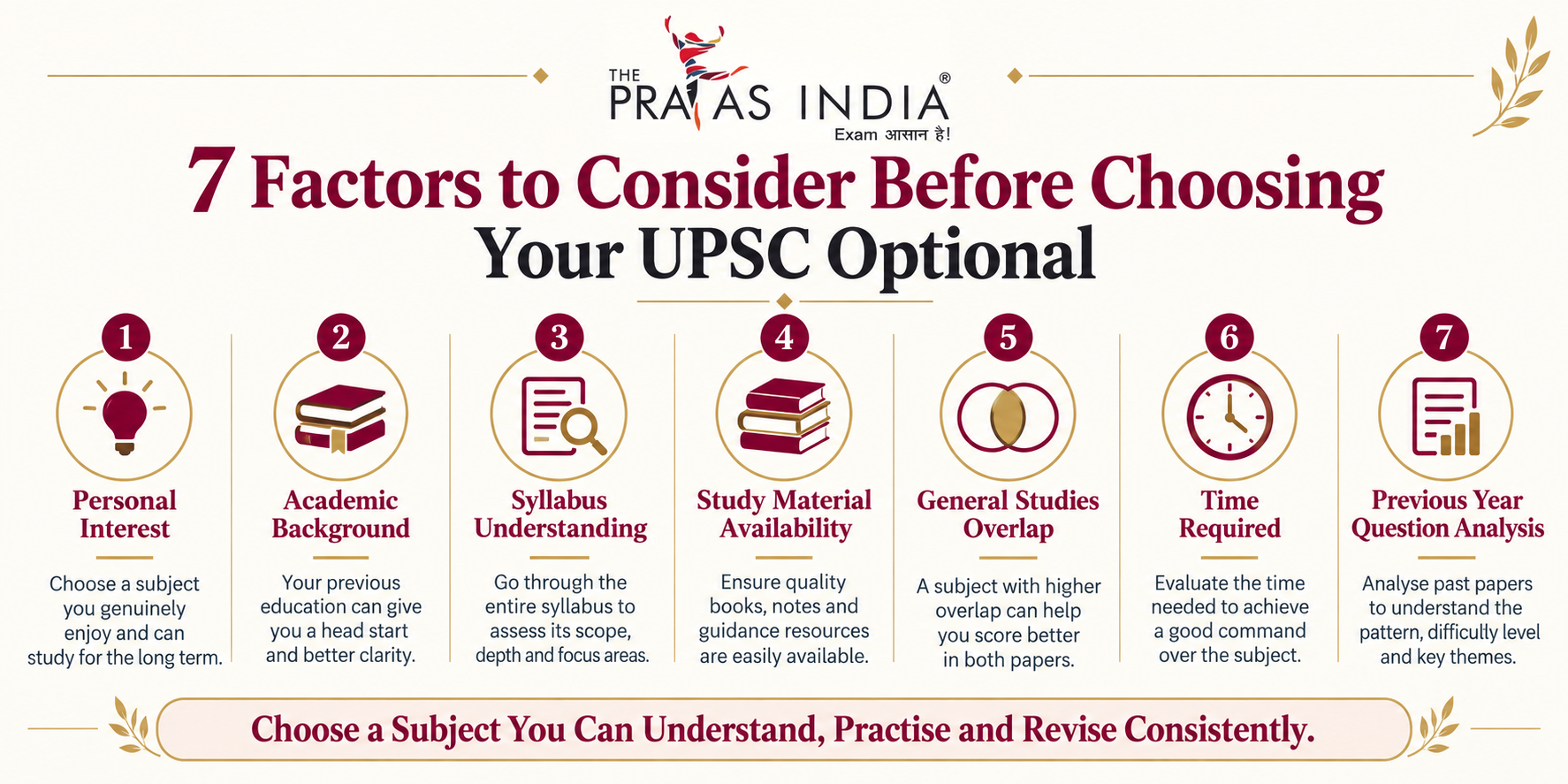
Choosing the right UPSC optional subject requires careful thought, honest self-assessment and a clear understanding of the examination requirements. Your interest, academic background, syllabus familiarity, study resources, General Studies overlap, available time and answer-writing comfort should all contribute to your decision.
Do not select a subject simply because it is popular or because another candidate has performed well in it. Instead, study the syllabus, examine previous years’ questions and attempt a few answers before making your final choice.
For aspirants exploring the best UPSC coaching in Borivali, The Prayas India – Borivali can be included in the process of comparing local preparation options. A well-planned approach, consistent study and regular revision can help you prepare more effectively for the UPSC Civil Services Examination.
Frequently Asked Questions
1. How should I choose an optional subject for UPSC?
Consider your personal interest, academic background, syllabus familiarity, study material availability, General Studies overlap, preparation time and answer-writing comfort. Review previous years’ question papers before finalising your decision.
2. Is it necessary to choose my graduation subject as my UPSC optional?
No. You can choose any optional subject permitted by UPSC, regardless of your graduation discipline. Your academic background may provide an advantage, but it is not compulsory to select the same subject.
3. How many marks does the UPSC optional subject carry?
The optional subject consists of two papers carrying 250 marks each, making a total of 500 marks in the UPSC Mains examination.
4. Which optional subject is easiest for UPSC?
There is no universally easiest optional subject. Its difficulty depends on your interest, academic background, understanding and preparation approach.
5. Should I choose an optional subject based on topper recommendations?
Topper strategies can provide useful insights, but their choices should not determine yours. Evaluate the syllabus and subject requirements according to your own strengths and interests.
6. Does the UPSC optional subject overlap with General Studies?
Some optional subjects have overlapping themes with General Studies. Sociology, Geography, History and Political Science and International Relations are examples. The extent of overlap varies by subject.
7. When should I finalise my UPSC optional subject?
Shortlist and evaluate your optional early in your preparation. Give yourself enough time to understand the syllabus, examine previous years’ questions and test your interest before committing.
8. Can I change my optional subject after submitting the UPSC application?
Check the applicable UPSC examination notification and application instructions carefully. Do not assume that an optional subject can be changed after submitting the application.
9. How can I find suitable UPSC coaching in Borivali?
Compare institutes based on their teaching approach, course structure, academic guidance, answer-writing support, study resources and location. Visit the institute and confirm current course details before enrolling.
10. Where is The Prayas India – Borivali located?
The Prayas India – Borivali is located at Orchid Plaza, 205, Swami Vivekanand Road, behind Gokul Shopping Complex, Mhatre Wadi, Borivali West, Mumbai, Maharashtra 400092.
Planning Your UPSC Mains Preparation?
Get clarity on your UPSC preparation strategy and explore the available guidance at The Prayas India – Borivali. Speak with the team to understand the current courses and optional-subject preparation options.
The Prayas India – Borivali | Orchid Plaza, 205, Swami Vivekanand Road, Borivali West, Mumbai