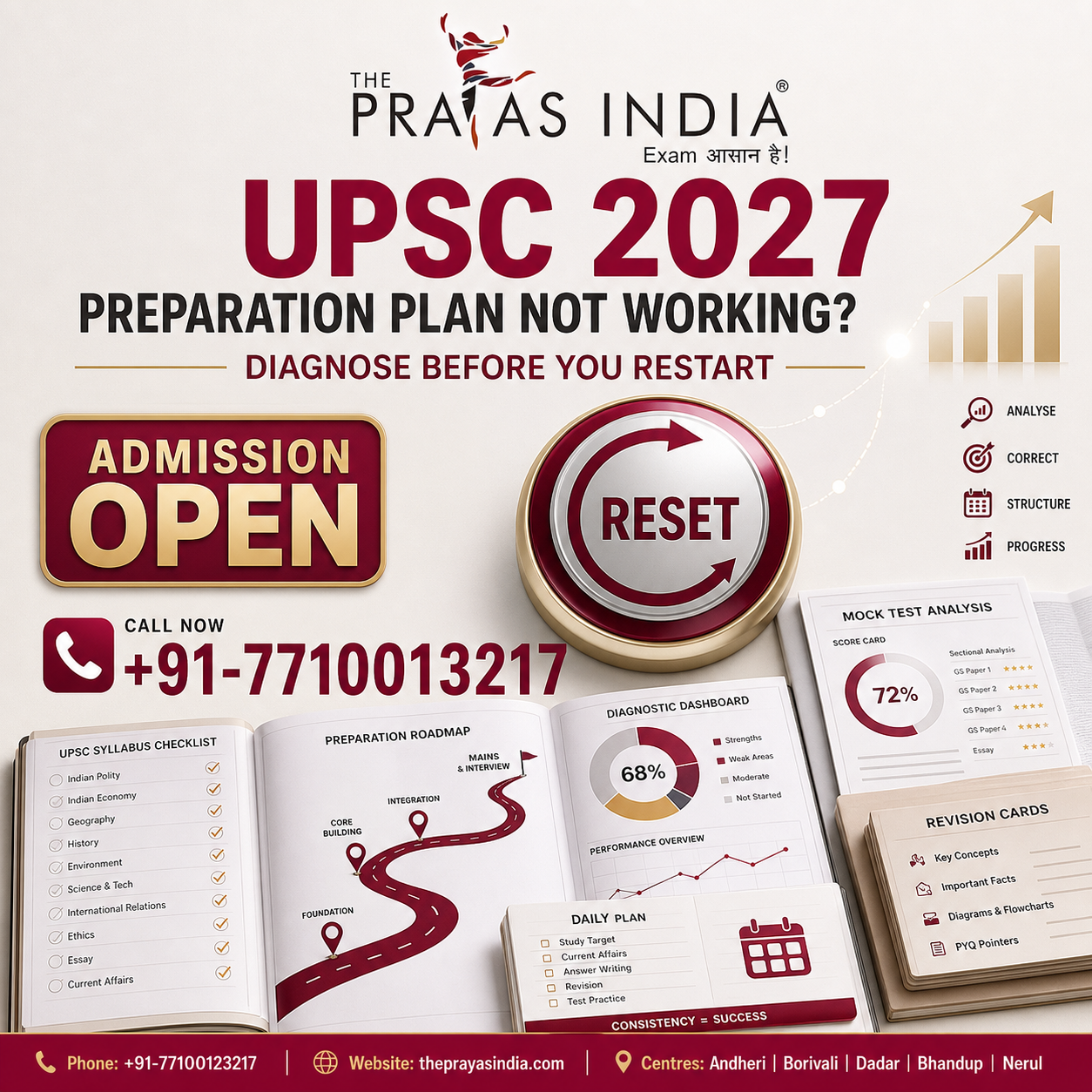
UPSC 2027 Preparation Plan Not Working? Diagnose Your Preparation Before Starting Again
Preparing for the UPSC Civil Services Examination is rarely a matter of simply studying more books, watching more lectures or increasing the number of hours spent at a desk. Many aspirants begin with genuine motivation, create an ambitious timetable, collect recommended resources and start covering the syllabus. Yet after several weeks or months, the same students may find themselves asking an uncomfortable question: “Why am I studying so much but still not feeling prepared?”
This is one of the most important questions an UPSC 2027 aspirant can ask.
A preparation plan can fail even when the student is sincere. The problem may not be a lack of effort. It could be an unrealistic timetable, poor prioritisation, excessive resources, weak conceptual foundations, inadequate revision, insufficient answer-writing practice, ineffective current-affairs integration or the absence of regular performance feedback.
The answer is not always to throw away everything and start again.
The better approach is to diagnose the preparation before rebuilding it.
For a serious UPSC 2027 aspirant, this diagnostic stage can make the difference between repeating the same preparation cycle and creating a more structured, measurable and sustainable strategy.
Important Note for UPSC 2027 Aspirants
Specific UPSC Civil Services Examination 2027 dates, notification details, application schedule, examination scheme or any other official changes should be checked against the UPSC website and the official notification when released. This article focuses on preparation strategy and diagnosis rather than assuming unannounced 2027-specific details.
Why Your UPSC Preparation Plan May Not Be Working
One of the biggest mistakes aspirants make is assuming that a low score or slow progress automatically means they are not working hard enough.
That assumption can lead to an unhealthy cycle.
A student studies for more hours → feels exhausted → completes less than planned → becomes anxious → changes the timetable → buys another resource → starts again → faces the same problem.
The cycle continues because the underlying issue has never been identified.
UPSC preparation involves multiple interconnected skills. The official examination framework includes broad areas for Prelims and Mains, while Mains evaluates not merely the amount of information a candidate remembers but the ability to understand issues, analyse them and present meaningful answers.
Therefore, preparation has to be evaluated at multiple levels.
Ask yourself:
- Do I understand what I am studying?
- Can I recall it after a few weeks?
- Can I connect different topics?
- Can I solve questions based on what I studied?
- Can I identify why I got a question wrong?
- Can I write structured answers within time?
- Am I revising systematically?
- Am I measuring progress objectively?
- Do I know which areas require improvement?
If several answers are “no”, simply increasing study hours may not solve the problem.
The Real Problem May Be Your Preparation System
A preparation system consists of much more than a timetable.
It includes:
Syllabus understanding → Resource selection → Concept building → Practice → Revision → Testing → Analysis → Correction → Repetition
If one or more of these stages is missing, preparation may look active without actually producing proportional improvement.
This is why some aspirants spend months studying but remain uncertain about their readiness.
Step 1: Stop Changing Resources Before Identifying the Problem
One of the most common reactions to poor progress is changing study material.
A student feels that a particular book is difficult, so another book is purchased.
A lecture seems complicated, so another teacher is searched for.
A test score is disappointing, so another test series is considered.
Eventually, the student has several books, multiple PDFs, saved videos, current-affairs compilations and handwritten notes—but no clear system for bringing everything together.
The issue is not necessarily the quality of the resources.
The issue is resource management.
For UPSC preparation, a limited set of carefully selected resources can be more useful than continuously expanding the resource list. Before changing your sources, ask whether you actually completed, revised and practised from the resources already being used.
If the answer is no, the problem may be execution rather than material.
Step 2: Diagnose Your Preparation Subject by Subject
“UPSC preparation is not going well” is too broad a diagnosis.
You need to identify exactly where the problem exists.
For example, a student may have reasonable conceptual understanding in Polity but struggle with revision. Another may understand Geography but find it difficult to answer analytical questions. Someone else may be comfortable with reading but struggle to convert information into Mains answers.
Instead of writing:
“My preparation is weak.”
write:
“My Polity concepts are reasonably strong, but my revision retention is weak.”
That statement is actionable.
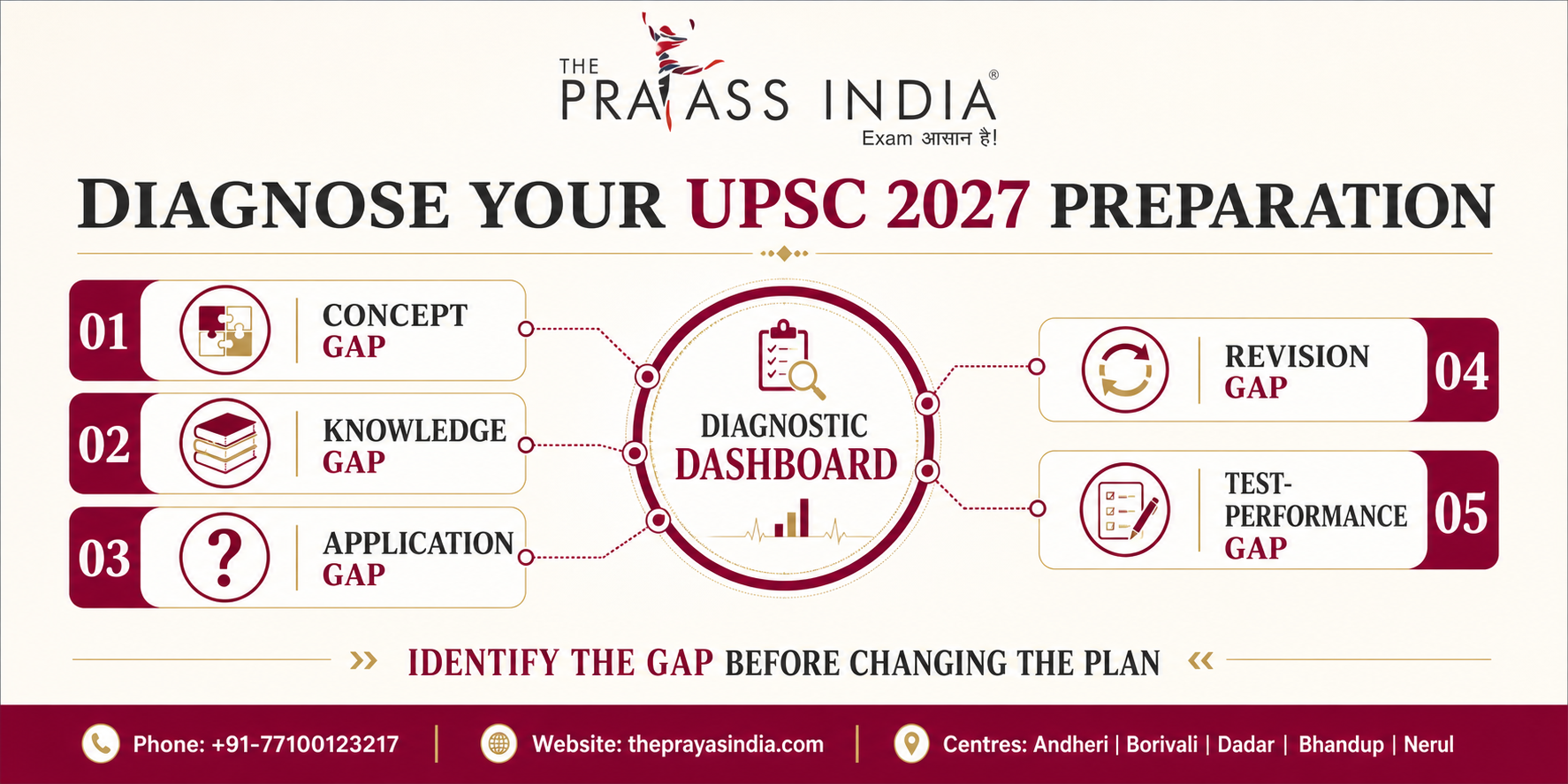
You can divide your preparation into five broad categories:
1. Concept Gap
You do not understand the underlying concept properly.
2. Knowledge Gap
You understand the topic but lack relevant facts, examples, constitutional provisions, data or supporting information.
3. Application Gap
You have studied the topic but cannot use the knowledge effectively in questions.
4. Revision Gap
You studied the material earlier but cannot recall it when required.
5. Test-Performance Gap
You know the material but struggle with elimination, interpretation, time management, answer structure or question selection.
This classification is far more useful than simply declaring that your preparation is “bad”.
Step 3: Check Whether Your Timetable Is Realistic
A timetable can look impressive on paper and still be completely impractical.
For example, planning eight hours of study does not automatically mean eight productive hours. A timetable that allocates every minute of the day to a different subject may leave no realistic space for revision, unexpected work, fatigue or difficult topics.
A useful UPSC timetable should answer three questions:
What will I study?
When will I study it?
How will I measure whether I actually completed it?
The third question is often ignored.
Instead of writing:
“Study Polity for three hours.”
write:
“Complete the selected Polity topic, solve a defined set of questions, revise previous notes and record mistakes.”
The second approach creates an output-based study system.
Study Hours Are Not the Same as Productive Hours
Aspirants sometimes compare themselves with students claiming to study ten or twelve hours every day.
This comparison can be misleading.
A student studying six focused hours with revision and testing may be progressing more effectively than someone spending ten hours switching between lectures, books and social media.
The goal should not be to maximise the number of hours.
The goal should be to maximise useful learning and measurable improvement.
Step 4: Find Out Whether You Are Studying or Actually Learning
Reading a chapter can create a feeling of completion.
But completion is not the same as retention.
Suppose you studied a topic two weeks ago. Can you explain it without opening the book?
Can you answer questions on it?
Can you connect it with related issues?
Can you use it in a Mains answer?
If not, you may have completed the reading but not completed the learning process.
This is where active learning becomes important.
After studying a topic, try to:
- Recall the major concepts without looking at your notes.
- Solve relevant questions.
- Explain the topic in your own words.
- Connect it with related topics.
- Revise it after a planned interval.
- Record recurring mistakes.
This creates a learning loop rather than a reading loop.
Step 5: Examine Your Revision System
Revision is one of the easiest areas to postpone.
The logic often sounds reasonable:
“I will finish the syllabus first and revise everything later.”
The problem is that UPSC preparation contains a large volume of interconnected information. If revision is postponed for too long, earlier learning becomes increasingly difficult to retrieve.
A better approach is to build revision into the preparation itself.
For every major topic, your system should eventually answer:
When did I first study it?
When did I revise it?
What did I forget?
What mistakes did I make?
When will I revisit it again?
Revision should therefore be treated as a recurring part of preparation rather than a final-stage activity.
Step 6: Evaluate Your Prelims Preparation Properly
Prelims preparation can expose weaknesses that normal reading does not reveal.
The official UPSC framework includes objective-type Preliminary Examination papers, with the General Studies Paper-II being qualifying under the published scheme.
But simply taking mock tests is not enough.
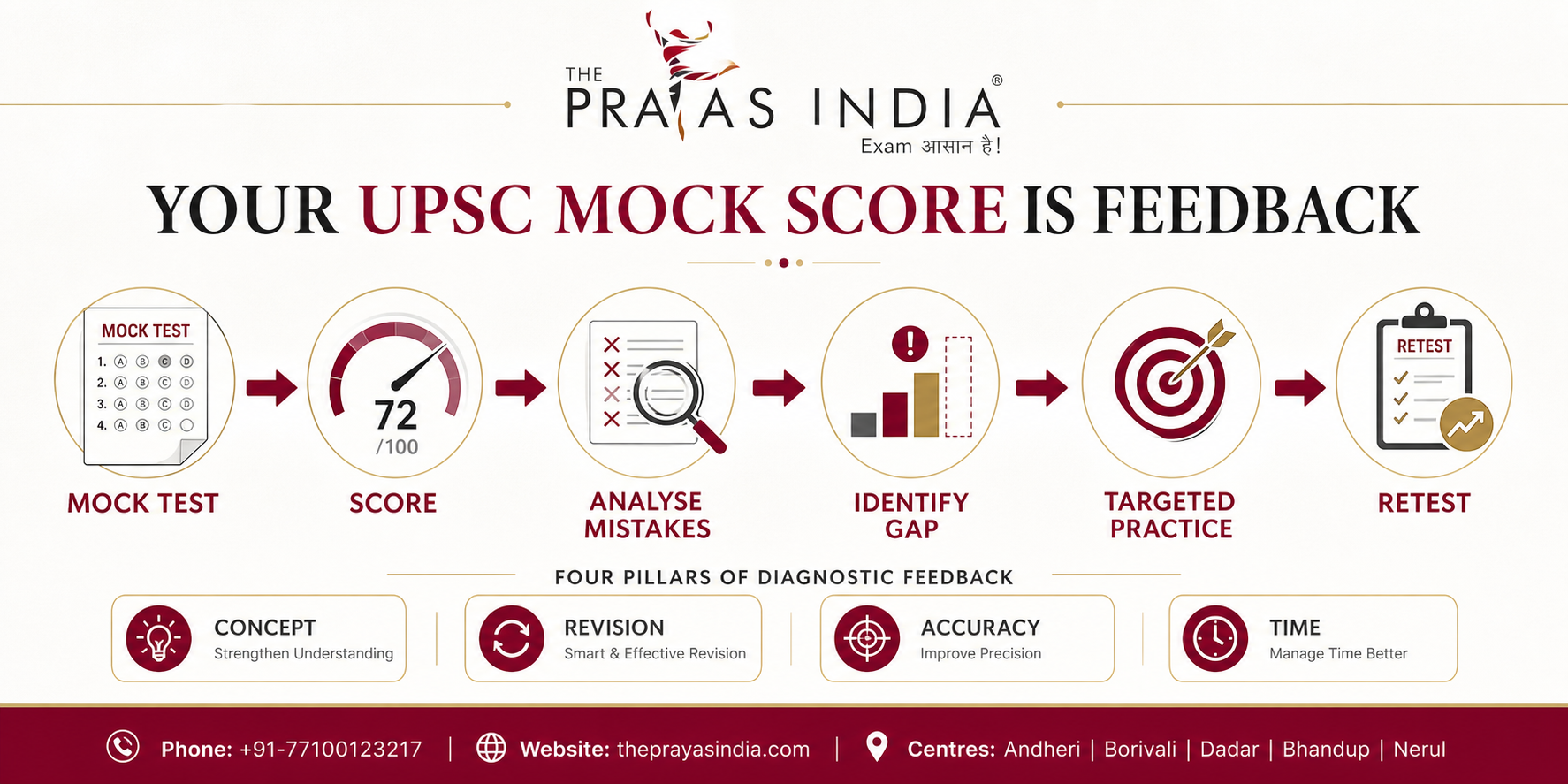
The real value comes from test analysis.
After every test, divide mistakes into categories.
Conceptual Mistakes
You did not understand the topic.
Factual Mistakes
You knew the concept but missed a specific fact or detail.
Interpretation Mistakes
You misunderstood the wording of the question or options.
Elimination Mistakes
You had partial knowledge but eliminated the wrong option.
Guessing Mistakes
You took unnecessary risks without sufficient reasoning.
Time-Management Problems
You spent too much time on selected questions.
Once mistakes are classified, your mock test becomes a diagnostic tool.
Without analysis, a mock can become just another score.
Step 7: Check Whether You Are Ignoring Mains While Preparing for Prelims
Another common problem is treating UPSC preparation as a sequence in which Mains begins only after Prelims.
The examination itself requires different capabilities at different stages. The published Mains framework emphasises depth of understanding, analysis and meaningful, succinct expression.
Therefore, aspirants should gradually develop:
- Answer-writing ability
- Issue analysis
- Structured presentation
- Examples and case studies
- Introduction and conclusion techniques
- Time management
- Regular evaluation
This does not mean a beginner should immediately spend the entire day writing answers.
It means Mains-oriented skills should become part of the broader preparation journey instead of being treated as an emergency task later.
When You Should Stop and Rebuild Your UPSC Preparation Plan
Consider reassessing your strategy if you repeatedly experience the following:
- You study regularly but cannot explain what you studied.
- Your syllabus completion keeps getting postponed.
- You repeatedly change books or teachers.
- Your revision is irregular.
- Mock scores remain stagnant.
- You do not analyse your mistakes.
- You struggle to decide what to study every morning.
- You have too many resources and no clear priority.
- You avoid answer writing because you do not feel ready.
- You cannot identify your strongest and weakest subjects.
- You feel busy throughout the day but cannot identify measurable progress.
These signs do not automatically mean that you need to start from zero.
They indicate that your preparation system deserves a serious diagnosis.
The Important Difference Between Starting Again and Starting Better
Starting again does not mean forgetting everything you have already studied.
It means retaining what is working and correcting what is not.
Suppose you have already completed basic Polity concepts but have poor revision. There is no reason to throw away the entire subject.
If your Geography understanding is good but your answer-writing practice is weak, the solution may be targeted writing practice rather than another Geography book.
If your current affairs notes are becoming unmanageable, the answer may be better integration and revision rather than another source.
This is why diagnosis should come before rebuilding.
A good reset should answer:
What should I continue?
What should I stop?
What should I change?
What should I add?
How will I measure the result?
That is a much more productive approach than simply creating another timetable.
Build Your New UPSC 2027 Preparation Plan Around the Diagnosis
Once you know why your previous plan was not producing the desired progress, the next step is not to create another complicated timetable. Your new plan should directly address the weaknesses identified during the diagnosis.
For example, if your biggest problem is conceptual clarity, allocate more time to foundation learning before increasing test volume. If your concepts are reasonably strong but retention is poor, your priority should shift towards revision and active recall. If you know the material but perform poorly in tests, more reading may not be the immediate solution; question practice, test analysis and strategy development may deserve greater attention.
This approach creates a personalised preparation cycle:
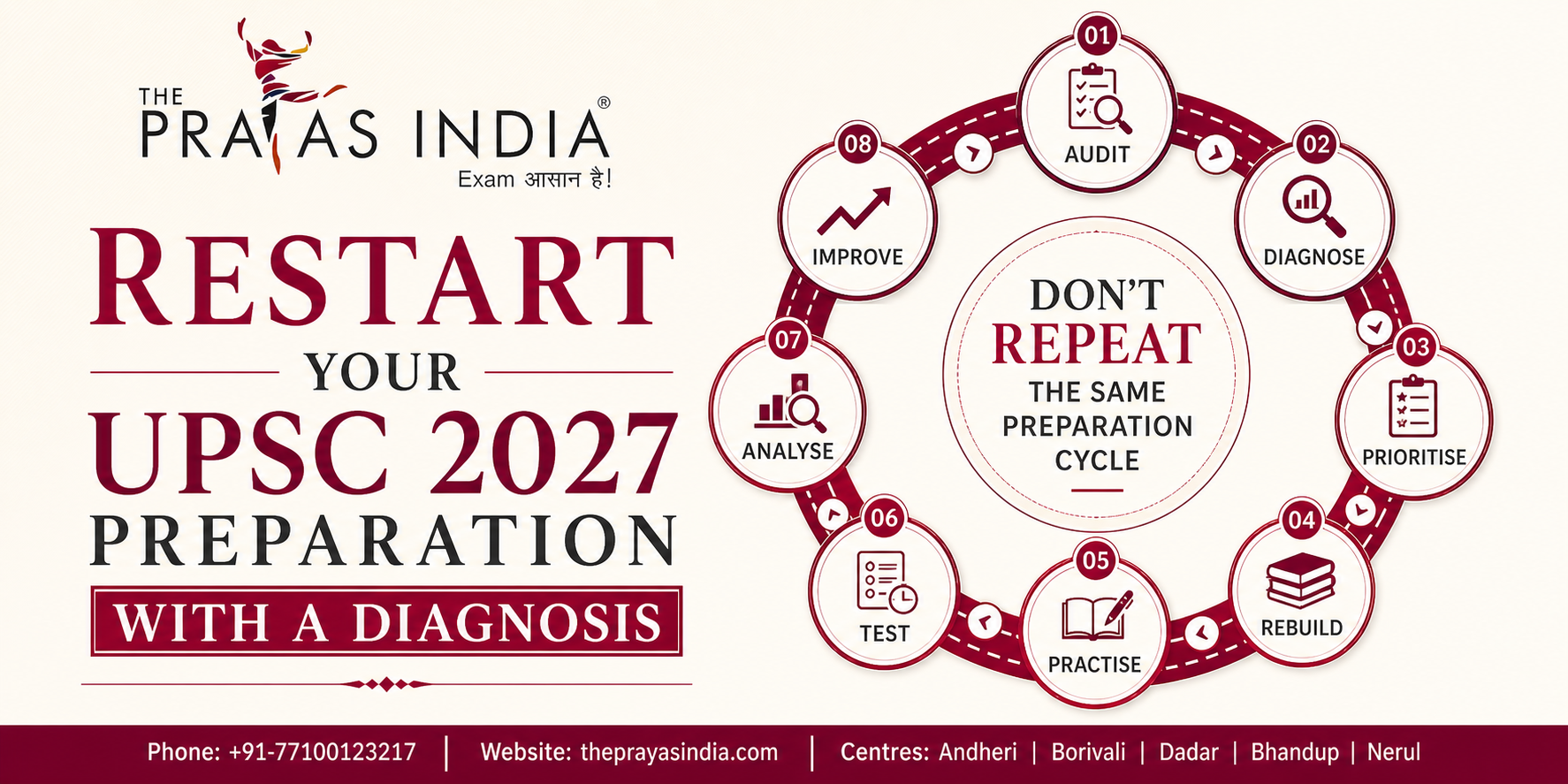
Diagnose → Prioritise → Study → Practise → Test → Analyse → Correct → Revise
The cycle should continue throughout your preparation.
Do Not Try to Fix Everything at Once
A common mistake after recognising preparation problems is attempting to correct every weakness simultaneously.
An aspirant may suddenly decide to:
- Complete the entire pending syllabus.
- Read multiple standard books.
- Start answer writing every day.
- Take frequent mock tests.
- Follow several current-affairs sources.
- Revise old notes.
- Start a new optional strategy.
- Completely change the timetable.
This creates another unsustainable routine.
Instead, identify the two or three issues that are currently affecting your preparation the most and address them systematically.
Improvement becomes easier to measure when the number of variables is controlled.
Create a Preparation System Instead of Depending on Motivation
Motivation can help you begin preparation, but a long UPSC journey requires something more dependable: a system.
A system tells you what happens even on days when motivation is low.
Your preparation system can include:
Daily: Concept learning + revision + practice
Weekly: Topic consolidation + test + performance review
Monthly: Progress assessment + backlog correction + strategy adjustment
This structure prevents preparation from becoming a collection of disconnected study sessions.
It also makes it easier to identify whether the problem is with your understanding, consistency, resources, revision or test performance.
Give Every Study Session a Clear Purpose
Instead of approaching the day with a vague goal such as “I need to study for eight hours,” create specific outcomes.
For example:
Session 1: Complete a defined Polity topic and create concise revision notes.
Session 2: Solve relevant objective questions and classify mistakes.
Session 3: Revise an older topic using active recall.
Session 4: Practise one Mains answer or analyse a model answer.
The exact number of sessions will differ from student to student. The important principle is that every session should contribute to a measurable preparation objective.
This makes it easier to evaluate your day based on output rather than hours alone.
Use Tests as Feedback, Not as a Source of Anxiety
Many aspirants delay tests because they are afraid of seeing low scores.
But avoiding tests does not improve preparation.
A test is useful precisely because it reveals what normal studying may hide.
A low score can show:
- Weak conceptual areas
- Poor recall
- Inadequate revision
- Incorrect question interpretation
- Weak elimination skills
- Poor time allocation
- Excessive guessing
The score itself is only one part of the information.
The more useful question is:
“What does this test tell me about my preparation?”
That question turns testing into a learning mechanism.
Why Mock-Test Analysis Matters More Than Collecting Test Scores
Suppose two aspirants obtain similar scores.
The first student checks the score, feels disappointed and moves on to the next test.
The second student spends time analysing every incorrect and uncertain question, identifies recurring patterns and changes the next week’s preparation accordingly.
The second student is extracting more information from the same testing activity.
A useful post-test analysis can record:
| Area | Question Type | What Went Wrong? | Corrective Action |
|---|---|---|---|
| Polity | Concept | Concept unclear | Revisit topic |
| Economy | Factual | Detail forgotten | Add to revision list |
| Environment | Elimination | Option misread | Practise elimination |
| History | Recall | Weak retention | Schedule revision |
| Mixed | Time | Too much time spent | Improve selection |
Over several tests, this record can reveal patterns that are difficult to notice from scores alone.
Build a Stronger Revision Loop
Aspirants often think revision means reading the same chapter repeatedly.
Effective revision can be more active.
After completing a topic, close the book and try to reconstruct the key information from memory.
Ask:
- What are the core concepts?
- What facts are essential?
- What are the major debates?
- What examples can I use?
- What questions could be asked?
- What did I previously forget?
- How does this topic connect with other areas?
This process helps convert passive familiarity into usable knowledge.
Your revision notes should also become progressively more concise.
The objective is not to create another giant set of notes that requires several hours to revise.
Do Not Let Current Affairs Take Over Your Entire Preparation
Current affairs are an important component of UPSC preparation, but following current events without integrating them into the syllabus can become another source of overload.
Instead of collecting everything, ask how an issue connects with your static preparation.
For example, a current issue related to Parliament can be connected with Polity.
An environmental development can be linked with Ecology and Environment.
An economic policy can be connected with the relevant concepts of the Indian economy.
A major international development can be connected with International Relations.
This creates a more integrated preparation structure and reduces the tendency to maintain completely separate piles of information.
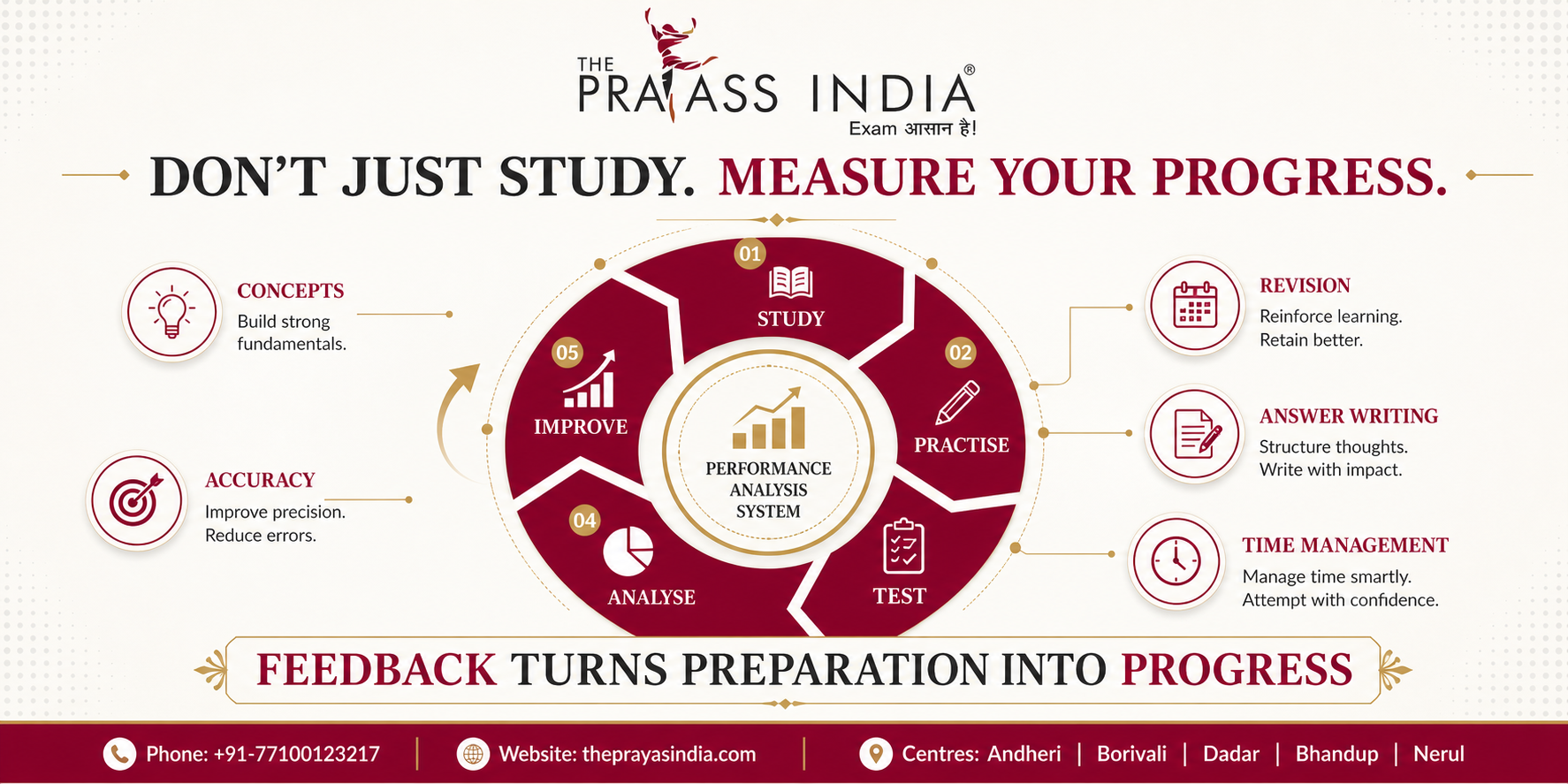
Your Preparation Needs Regular External Feedback
Self-assessment is important, but it has limitations.
An aspirant can become so familiar with their own notes and writing style that weaknesses become difficult to notice.
This is particularly relevant to Mains preparation.
A student may feel that an answer is well written because it contains several facts. However, an external evaluation may identify problems with:
- Answer structure
- Relevance
- Introduction
- Argument development
- Examples
- Balance
- Conclusion
- Time management
- Excessive repetition
Regular feedback can therefore help students identify problems earlier instead of discovering them much later in the preparation cycle.
When Structured UPSC Guidance Can Make a Difference
Not every aspirant needs the same level of external support.
Some students can independently understand the syllabus, select reliable resources, create a realistic schedule, evaluate their performance and maintain consistency.
Others find one or more of these areas difficult.
For such students, structured guidance can reduce the amount of uncertainty involved in preparation.
A well-designed preparation programme can potentially provide a framework for:
- Syllabus-oriented learning
- Conceptual foundation
- Regular practice
- Test-based assessment
- Answer-writing development
- Doubt resolution
- Revision planning
- Performance tracking
- Mentorship and strategic guidance
The important point is not simply joining a coaching programme.
The important question is whether the programme addresses the specific problems identified during your preparation diagnosis.
What to Check Before Joining UPSC Coaching for 2027
If you are considering coaching after struggling with self-study, avoid making the decision only on the basis of advertisements or promises.
Evaluate the preparation system.
Look at factors such as:
Faculty and Subject Coverage
Understand who teaches the core subjects and whether the teaching approach is suitable for your current level.
Foundation Support
If your basics are weak, check whether the programme gives sufficient attention to conceptual understanding instead of assuming prior knowledge.
Test and Evaluation System
Ask how frequently students are tested and, more importantly, how their performance is analysed.
Answer-Writing Support
For Mains-oriented preparation, understand whether students receive opportunities for writing practice and meaningful feedback.
Doubt Resolution
A student should have a clear mechanism for resolving conceptual or preparation-related doubts.
Mentorship
Ask whether students receive individual or structured guidance when they face problems with planning, revision or performance.
Revision Structure
Understand whether revision is integrated into the programme rather than being left entirely to the student.
Study Environment
For students who struggle with consistency at home, the learning environment itself can be an important consideration.
The right questions are more useful than simply asking whether an institute is “good”.
Why a Structured Classroom Environment Can Help Some UPSC Aspirants
A classroom environment can provide something that independent preparation sometimes lacks: external structure.
When the syllabus is broad, it can be difficult to decide what deserves priority every day.
A structured programme can establish a sequence:
Learn → Practise → Revise → Test → Analyse → Improve
This does not eliminate the need for individual effort. UPSC preparation still requires substantial self-study.
Instead, it can provide a framework within which self-study becomes more organised.
For students who repeatedly create plans but struggle to execute them, this distinction can be important.
The Prayas India and a More Structured Approach to UPSC 2027 Preparation
For an aspirant who has already tried self-study but feels that the preparation lacks direction, the next step can be to evaluate whether structured coaching and mentorship fit their needs.
The Prayas India focuses on creating a preparation environment where students can work through the examination journey with academic guidance, classroom learning, practice and performance-oriented preparation.
The value for an aspirant should not simply be measured by the number of lectures available.
It should be evaluated through the overall preparation ecosystem:
Concept Building + Practice + Testing + Evaluation + Revision + Guidance
Students considering UPSC 2027 preparation can use their own diagnostic assessment to determine which parts of this ecosystem they need most.
This also makes a counselling conversation more productive.
Instead of simply asking, “Which course should I join?”, an aspirant can discuss:
- Current preparation level
- Subjects already completed
- Weak areas
- Revision status
- Test performance
- Mains answer-writing experience
- Available study time
- Long-term preparation objectives
That allows the student to understand what kind of preparation structure may actually be suitable.
A Practical 30-Day Reset Plan for UPSC 2027 Aspirants
If your current preparation plan is not working, the next month can be used as a diagnostic and rebuilding period.
Week 1: Audit
Review your syllabus coverage, resources, notes, tests and revision status.
Do not add multiple new resources during this week.
Identify your biggest preparation gaps.
Week 2: Rebuild the Basics
Select the highest-priority weak areas and work on conceptual clarity.
At the same time, begin revising previously studied topics.
Week 3: Introduce More Testing
Start using questions and tests to evaluate whether your learning is translating into performance.
Analyse the mistakes instead of focusing only on marks.
Week 4: Review and Adjust
Compare your performance with the beginning of the month.
Ask:
What improved?
What remains weak?
What should receive more time next month?
Which study activities are producing results?
Which activities are consuming time without enough benefit?
This creates evidence for your next preparation decision.
What a Successful Preparation Reset Should Look Like
A successful reset does not necessarily mean completing a huge amount of new content.
It should create greater clarity.
At the end of the reset, you should ideally have:
- A realistic study schedule
- A prioritised syllabus
- A controlled resource list
- A revision mechanism
- A question-practice routine
- A test-analysis system
- A clearer understanding of your weak areas
- A method for tracking improvement
Most importantly, you should know why you are doing each major activity in your preparation plan.
That is a stronger foundation than repeatedly starting over.
Before You Restart UPSC 2027 Preparation, Ask Yourself These Questions
Before creating your next timetable, sit down and answer these questions honestly:
What exactly is not working?
Is the problem knowledge, understanding, revision, practice or execution?
Which subjects require immediate attention?
Which resources am I unnecessarily changing?
How often am I revising?
What does my latest test actually tell me?
Am I analysing my mistakes?
How am I developing Mains answer-writing ability?
Do I have someone who can objectively evaluate my preparation?
Would a structured learning and mentorship environment solve some of the problems I am currently facing?
These questions can help transform a vague feeling of being “underprepared” into a specific preparation diagnosis.
Final Thoughts: Don’t Restart Blindly — Restart With a Diagnosis
UPSC 2027 preparation does not become stronger simply because you start a new timetable.
If the previous approach failed because of poor revision, another timetable without a revision system will create the same problem.
If excessive resources caused confusion, buying more resources will not solve it.
If mock scores were stagnant because tests were not analysed, taking more tests without analysis will provide limited improvement.
And if you repeatedly struggled with planning, prioritisation and accountability, another self-created schedule may simply restart the same cycle.
The more productive approach is to pause, diagnose and rebuild.
Know what is working. Identify what is not. Correct the gaps. Measure the change.
For aspirants preparing seriously for UPSC 2027, structured guidance can be considered when independent preparation repeatedly leaves them uncertain about what to study, how to prioritise, how to evaluate performance or how to move from one stage of preparation to the next.
The objective is not to study everything.
The objective is to build a preparation system that helps you study the right things, in the right sequence, with regular practice, revision, testing and feedback.
If your current UPSC preparation plan is not working, you may not need to start from zero.
You may simply need to start again—with a better diagnosis and a more structured strategy.
Frequently Asked Questions – UPSC 2027 Preparation
Why is my UPSC 2027 preparation plan not working?
Your preparation may be affected by unrealistic scheduling, weak basics, poor revision, excessive resources, insufficient practice, ineffective test analysis or lack of consistent feedback. The first step is to identify the specific problem instead of immediately changing your entire strategy.
Should I completely restart my UPSC 2027 preparation?
Not necessarily. First identify what you have already completed successfully and which areas are creating difficulty. You can retain useful preparation and rebuild the areas that require correction.
How can I diagnose my UPSC preparation?
Review your syllabus coverage, conceptual understanding, revision, question-solving performance, mock-test mistakes, answer writing and consistency. Categorising problems into concept, knowledge, application, revision and test-performance gaps can make your diagnosis more actionable.
Why are my UPSC mock-test scores not improving?
Stagnant scores can have several causes, including conceptual gaps, poor recall, weak elimination, question-selection problems, time management or insufficient revision. Analyse your mistakes after every test instead of focusing only on the final score.
Is self-study enough for UPSC 2027?
Some aspirants are able to structure their preparation independently, while others benefit from external academic guidance. The important consideration is whether you can consistently manage syllabus coverage, resources, revision, testing, answer writing and performance evaluation.
When should I consider joining UPSC coaching for 2027?
Consider your current preparation situation rather than joining simply because others are doing so. Coaching may be worth evaluating if you repeatedly struggle with direction, conceptual clarity, consistency, test analysis, answer writing or structured mentorship.
What should I check before joining UPSC coaching?
Look at faculty, syllabus coverage, foundation support, testing, evaluation, answer-writing guidance, doubt resolution, mentorship, revision structure and the overall learning environment. Also check whether the programme matches your current preparation level.
Can structured guidance help if my UPSC preparation has been inconsistent?
A structured programme can provide a defined learning sequence, regular practice, testing and guidance. Individual self-study and consistent execution, however, remain essential parts of UPSC preparation.
Is Your UPSC 2027 Preparation Plan Not Working?
Before starting your preparation all over again, understand where you are losing time and what needs to change. Get structured UPSC preparation, academic guidance, regular practice and a focused learning environment to build your preparation with greater clarity.
Enquire Now | Get Preparation Guidance | Begin With Clarity