
Bank PO Prelims to Mains: How to Change Your Preparation Strategy | Best Bank Coaching in Mumbai | The Prayas India
Introduction
Clearing the Bank PO Prelims examination is an important milestone, but it should never be treated as the final objective. For aspirants targeting competitive banking examinations such as SBI PO, IBPS PO and other Bank PO recruitment exams, Prelims is primarily a screening stage. The real challenge begins when preparation has to shift towards Mains, where the paper demands greater depth, stronger awareness, better analytical ability and much more controlled time management.
One of the biggest mistakes candidates make after Prelims is continuing with exactly the same preparation strategy. They keep solving the same level of Quantitative Aptitude, Reasoning and English questions, continue taking routine sectional tests and postpone General Awareness preparation. By the time they realise that Mains requires a fundamentally different approach, valuable preparation time has already been lost.
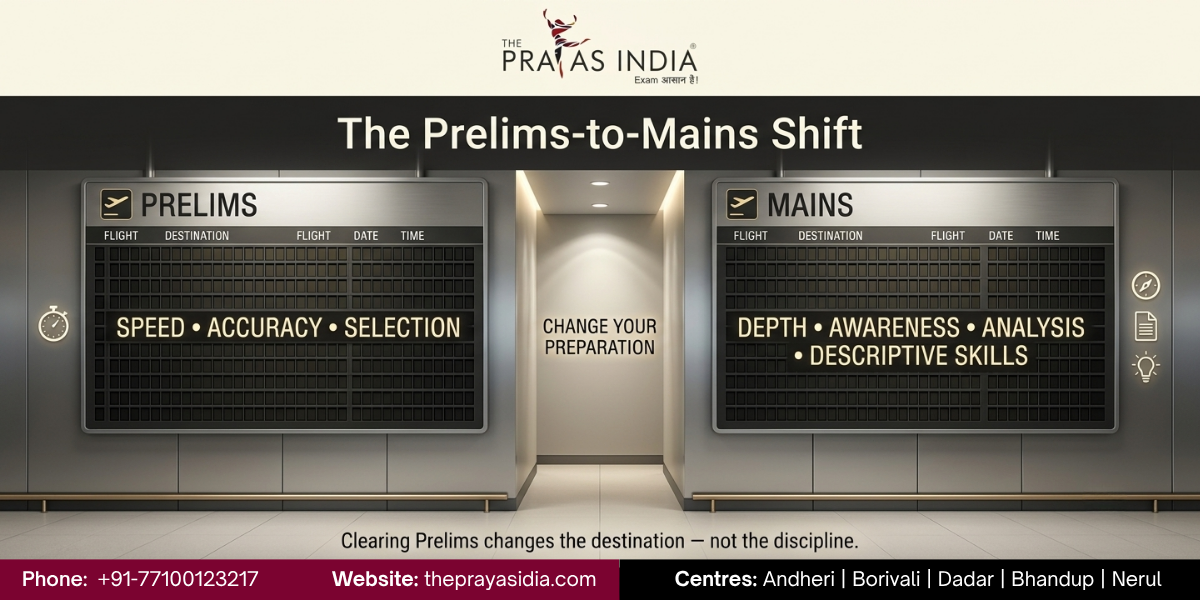
The transition from Prelims to Mains should therefore begin with a change in mindset. Prelims preparation is heavily focused on speed, accuracy and question selection, while Mains preparation requires candidates to combine these skills with depth, awareness, analytical reasoning and descriptive communication.
For aspirants looking for Bank PO coaching in Mumbai, this transition is particularly important because a structured preparation environment can help candidates identify the difference between the two stages and adjust their study plan accordingly. The Prayas India focuses on exam-oriented preparation that helps aspirants build the conceptual foundation required for competitive banking examinations while progressively developing the skills needed for the Mains stage.
Prelims and Mains Are Not the Same Examination
The first step towards changing your strategy is accepting that Prelims and Mains test different levels of preparation.
In Prelims, candidates generally work against a strict time constraint and need to identify manageable questions quickly. A strong Prelims candidate knows which questions to attempt, which ones to leave and how to prevent one difficult problem from consuming excessive time.
Mains introduces a broader challenge. Questions can involve multiple concepts, reasoning sets can require considerably more analysis, Quantitative Aptitude may demand more calculation and interpretation, and General Awareness becomes a major component of the overall preparation.
The difference can be understood simply:
- Prelims: Speed + Accuracy + Selection
- Mains: Depth + Accuracy + Analysis + Awareness + Time Management
- Prelims mindset: “How quickly can I solve this?”
- Mains mindset: “Can I understand, solve and manage this efficiently?”
This does not mean that Prelims skills become irrelevant after clearing the examination. Speed and accuracy remain essential. However, they need to be supplemented with a deeper level of preparation.
The First 48 Hours After Prelims Matter
Once the Prelims examination is over, candidates often make one of two mistakes. Some become overly relaxed because they expect to qualify, while others spend too much time discussing every question they attempted.
Neither approach is particularly useful.
If the official result has not yet been declared, candidates should use the expected difficulty level and their own performance as a basis for planning rather than waiting passively.
The objective during this transition period should be to immediately identify the areas that require upgrading for Mains.
Ask yourself:
- Which Prelims topics were comfortable for me?
- Which topics consumed excessive time?
- Where did calculation slow me down?
- Which Reasoning concepts require deeper practice?
- How strong is my General Awareness preparation?
- Have I started banking and financial awareness?
- How comfortable am I with descriptive writing?
- Can I handle longer and more complex questions?
This self-assessment provides the starting point for the new strategy.
Stop Preparing Only for Speed
Prelims training often conditions candidates to think in terms of rapid question-solving. This is useful, but Mains requires a more layered approach.
Consider Quantitative Aptitude. In Prelims, you may spend significant time solving arithmetic questions, simplification, number series or data interpretation sets. For Mains, the objective should be to strengthen your conceptual understanding while improving your ability to handle more demanding calculations and multi-step questions.
The same applies to Reasoning.
Instead of simply asking how many questions you can solve in a practice session, start examining how efficiently you can understand complicated arrangements, puzzles, logical relationships and data-based reasoning sets.
Your preparation should gradually move from:
Question familiarity → Conceptual depth → Mixed application → Timed Mains practice
This transition is particularly important because Mains questions can punish superficial preparation.
Quantitative Aptitude: Increase Depth Without Losing Speed
A common misconception is that Mains Quant preparation requires abandoning speed-based practice. That is not correct.
The better approach is to retain the speed developed during Prelims while increasing the complexity of the problems you practise.
Your Quant preparation should now include greater emphasis on:
- Data Interpretation
- Arithmetic applications
- Caselet-based questions
- Quantity-based reasoning
- Number-based problems
- Approximation and calculation efficiency
- Advanced or mixed-level problem sets
Do not completely abandon easier questions. They remain useful for maintaining calculation speed.
However, your daily practice should increasingly contain questions that force you to think rather than simply recall a familiar method.
A good Mains preparation session should therefore include a mixture of speed drills, concept revision and difficult application-based questions.
Reasoning: Move Beyond Familiar Puzzle Patterns
Reasoning can become one of the biggest differentiators in Bank PO Mains.
During Prelims, candidates often become comfortable with a few standard puzzle formats. Mains preparation should challenge this comfort zone.
The goal is not to solve every difficult puzzle you encounter. Instead, develop the ability to quickly identify the structure of a problem and decide whether the set is worth attempting.
Practise different types of arrangements and logical sets rather than repeatedly solving the same familiar pattern.
More importantly, analyse the process after solving.
Ask:
Where did I spend the most time?
Could I have represented the information differently?
Did I identify the key condition quickly?
Was there a better sequence for solving the set?
This type of analysis turns practice into skill development.
English Preparation Needs More Than Grammar
Candidates who perform well in Prelims English sometimes reduce their English preparation after qualifying because they assume the section is already under control.
That can be a mistake.
Mains-level English requires stronger comprehension, contextual understanding and the ability to interpret longer passages and complex information.
Reading should therefore become an important part of your daily routine.
Read material from reliable sources covering:
- Banking and finance
- Economy
- Business
- Technology
- Social issues
- Government policies
- International developments
The purpose is not merely to improve vocabulary. Regular reading also helps candidates become comfortable with the kind of language and contextual information that can appear in competitive examinations.
General Awareness Should Become a Daily Priority
Perhaps the biggest change between Prelims and Mains is the importance of General Awareness.
Candidates sometimes postpone General Awareness until after the Prelims result. This creates unnecessary pressure because current affairs preparation is cumulative.
Once you enter the Mains preparation phase, GA should become a daily subject rather than something you study only when you have spare time.
Focus on understanding important developments rather than collecting endless facts.
For banking examinations, candidates should pay particular attention to areas such as:
- Banking and financial awareness
- RBI-related developments
- Monetary policy
- Government schemes
- Financial institutions
- Banking terminology
- Economic developments
- Important national and international events
- Reports and indexes
- Appointments and awards
- Important business developments
The exact emphasis can vary depending on the examination, so candidates should always align their preparation with the latest official pattern and syllabus.
Do Not Ignore Banking and Financial Awareness
General Awareness for Bank PO Mains is not simply the same current-affairs preparation used for a general competitive examination.
Banking aspirants need a working understanding of the financial system.
Concepts such as monetary policy, inflation, interest rates, banking institutions, digital payments, financial inclusion, monetary tools and regulatory mechanisms should not remain unfamiliar terms.
You do not necessarily need to study them like an economics student. The objective is to understand what they mean and how they relate to current developments.
This makes your preparation more useful because current-affairs questions become easier to understand when the underlying concepts are already familiar.
Descriptive English Requires a Separate Preparation Track
Another mistake is assuming that descriptive writing will take care of itself.
It will not.
If your examination includes a descriptive component, writing practice should be introduced as a separate part of your Mains schedule.
The candidate needs to learn how to:
- Understand the topic quickly
- Organise ideas logically
- Maintain relevance
- Write with clarity
- Avoid unnecessary repetition
- Use appropriate formal language
- Complete the response within the available time
Practise writing on banking, economic, social, technological and workplace-related topics.
Do not simply write and move on. Review your responses for structure, grammar, clarity and relevance.
Mock Tests Must Change After Prelims
Taking the same type of mock test after Prelims is another strategic mistake.
Your mock-test objective must change.
During Prelims, you may primarily track:
Attempts + Accuracy + Time
For Mains, your analysis should become broader.
Track:
- Section-wise performance
- Time consumed
- Questions left unnecessarily
- Difficult sets attempted incorrectly
- Calculation errors
- Conceptual mistakes
- GA retention
- Descriptive writing performance
- Question-selection decisions
A Mains mock is not useful merely because you completed it.
The real benefit comes from analysing why your score was what it was.
Build a Mains-Level Error Log
Most candidates maintain an error notebook during preparation, but many use it only for recording wrong answers.
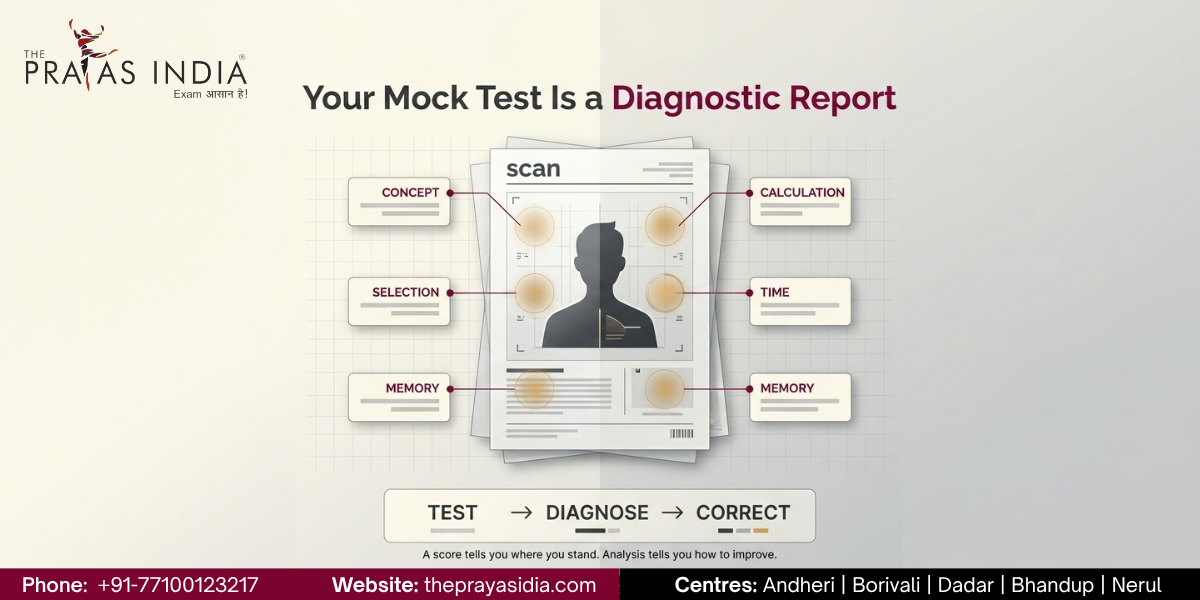
A better system categorises mistakes.
For example:
Concept Error
You did not understand the underlying method.
Calculation Error
You knew the method but made an arithmetic mistake.
Interpretation Error
You misunderstood the question.
Selection Error
You attempted a question that should have been skipped.
Time-Management Error
You spent too long on a question or set.
Memory Error
You knew the information earlier but could not recall it during the test.
This classification is valuable because different errors require different solutions.
More practice will not necessarily fix every problem. A conceptual mistake requires revision. A selection mistake requires better judgement. A calculation problem requires targeted drills.
Create a Daily Study Structure for the Mains Phase
The biggest difference between effective and ineffective Mains preparation is often not the number of hours studied but how those hours are distributed.
A candidate who spends six hours solving Quant questions while neglecting GA, English and descriptive preparation is not following a balanced Mains strategy.
Your daily plan should reflect the actual demands of the examination.
A balanced schedule can include:
- Quantitative Aptitude: Concept revision + difficult problem sets
- Reasoning: Mains-level puzzles and analytical sets
- English: Reading + comprehension + language practice
- General Awareness: Daily current affairs and banking awareness
- Descriptive: Regular writing practice where applicable
- Mock/Sectional Test: Timed examination practice
- Analysis: Review of errors and performance
The exact time allocation should depend on your strengths and weaknesses.
A candidate who is strong in Quant but weak in GA should not spend most of the day doing more Quant simply because it feels comfortable.
Preparation should attack weaknesses while maintaining strengths.
How to Balance Prelims Revision with Mains Preparation
If the Mains examination is scheduled shortly after Prelims, candidates may still need to retain some Prelims-level speed.
This does not require returning to a full Prelims routine.
Instead, use short speed-maintenance sessions.
For example, you can dedicate a limited amount of time to:
- Simplification drills
- Calculation practice
- Short Quant sets
- Basic reasoning questions
- English speed practice
The remaining preparation time should be dedicated to Mains-specific areas.
This creates a useful balance:
Maintain Prelims speed + Build Mains depth
Stop Measuring Preparation Only by Study Hours
Long study hours can create the illusion of progress.
Instead of asking, “How many hours did I study today?”, ask more useful questions:
How many weak areas did I improve?
Did I analyse yesterday’s mock?
Did I revise current affairs?
Did I practise Mains-level questions?
Did I identify a recurring mistake?
Did I improve my speed without sacrificing accuracy?
This shifts preparation from time-based studying to outcome-based studying.
The Importance of Question Selection in Bank PO Mains
Mains-level questions can be time-consuming, which makes selection extremely important.
A candidate should not enter the examination with the objective of attempting every difficult question.
The objective is to maximise the score within the available time.
During practice, develop the habit of classifying questions quickly:
Easy → Attempt
Moderate → Attempt if efficient
Time-consuming → Evaluate
Unclear or excessively difficult → Skip
This skill develops through repeated timed practice.
Mock tests should therefore be treated as opportunities to practise decision-making, not simply as score-generating exercises.
How The Prayas India Can Support Your Bank PO Preparation
For candidates searching for Bank PO coaching in Mumbai, the transition from Prelims to Mains is one of the stages where structured guidance can be particularly useful.
The Prayas India can help aspirants approach competitive bank examinations through a structured preparation framework that combines conceptual learning, practice, mock testing and performance analysis.
For a serious Bank PO aspirant, coaching should not simply provide classes. It should help answer practical questions such as:
What should I study next?
Which topics need more attention?
How difficult should my practice be?
How should I analyse my mocks?
How can I improve my question selection?
How should I manage GA and descriptive preparation alongside aptitude subjects?
A structured Bank PO coaching programme in Mumbai can provide a disciplined environment in which these aspects are addressed systematically.
Candidates considering admission should evaluate the programme based on faculty support, quality of study material, mock-test methodology, doubt-solving, performance analysis and the overall strategy provided for both Prelims and Mains.
A Practical 14-Day Prelims-to-Mains Transition Plan
If you have a limited preparation window after Prelims, the following framework can help organise your priorities.
Days 1–3: Assessment
Review your Prelims performance and identify weak areas. Start revising important banking and financial concepts and establish a current-affairs revision routine.
Days 4–7: Mains-Level Practice
Increase the difficulty of Quant and Reasoning practice. Begin solving longer and more complex sets under timed conditions.
Days 8–10: Awareness + Descriptive
Strengthen General Awareness and banking awareness. Add regular descriptive writing practice if applicable to your examination.
Days 11–12: Full-Length Mocks
Take Mains-level mock tests under realistic examination conditions. Do not interrupt the test to check answers or study material.
Days 13–14: Analysis and Consolidation
Analyse every mock carefully. Revise recurring mistakes, weak concepts and important current-affairs areas. Avoid introducing too many new topics at the last moment.
This framework can be adapted according to the actual time available before your Mains examination.
Common Mistakes to Avoid After Clearing Prelims
Several mistakes repeatedly appear during the transition period.
Waiting for the Result
If you have a reasonable expectation of qualifying, start preparing immediately. Waiting for the official result can consume valuable days.
Continuing Only Prelims-Level Practice
Prelims-level practice is useful for maintaining speed, but it cannot replace Mains-level preparation.
Ignoring General Awareness
GA cannot be built effectively through last-minute cramming alone. Consistency matters.
Taking Mocks Without Analysis
A mock without analysis is largely an assessment, not a learning exercise.
Avoiding Descriptive Practice
If descriptive writing is part of your examination, it should receive regular attention.
Over-Focusing on One Strong Subject
Comfortable subjects are enjoyable, but improvement usually comes from addressing weaker areas.
Studying Without a Priority System
Not every topic deserves equal time. Prioritise according to examination relevance, personal weakness and expected return on preparation time.
Final Strategy: Change the Way You Think, Not Just the Timetable
The transition from Bank PO Prelims to Mains is ultimately a transition in thinking.
Prelims teaches you to move quickly.
Mains asks you to think deeply while still moving efficiently.
Prelims rewards familiarity, speed and accuracy.
Mains requires those qualities along with stronger awareness, analytical reasoning, decision-making and communication.
Therefore, once Prelims is over, do not simply increase your study hours. Change the nature of your preparation.
Move from basic practice to Mains-level application. Move from solving questions to analysing performance. Move from reading current affairs to understanding them. Move from taking mocks to learning from them. Move from preparing every subject equally to prioritising according to your actual weaknesses.
And most importantly, do not wait for the result to begin this transition.
The candidates who treat the Prelims-to-Mains period seriously are the ones who give themselves the best opportunity to make the next stage count.
For aspirants looking for Bank PO coaching in Mumbai, The Prayas India offers a structured environment for candidates who want to prepare systematically for competitive banking examinations and build the skills required across both stages.
Clear Prelims. Change the strategy. Prepare for Mains with purpose.
From Prelims Speed to Mains-Level Decision Making
Once the initial transition from Prelims to Mains begins, the biggest improvement should come in the way you approach questions. Prelims preparation often trains candidates to identify familiar patterns and solve them quickly. Mains preparation requires a broader decision-making ability. You need to recognise the nature of a problem, estimate the time it may consume, assess its difficulty and decide whether solving it is worth the investment of your limited examination time.
This is why Mains preparation should include deliberate question-selection practice. While solving mocks and sectional tests, do not focus only on whether your final answer was correct. Pay attention to the decisions that led to that answer. A question that you solved correctly after spending four minutes may not necessarily be a good question to attempt in the actual examination.
Over time, your objective should be to develop an internal sense of time versus reward. Easy questions should be converted into marks quickly, moderate questions should be evaluated intelligently and extremely time-consuming questions should not automatically receive your attention simply because they appear challenging.
Develop a Section-Wise Mains Strategy
A strong overall score does not necessarily require equal performance in every section. What matters is having a realistic strategy for each section based on its characteristics and your individual strengths.
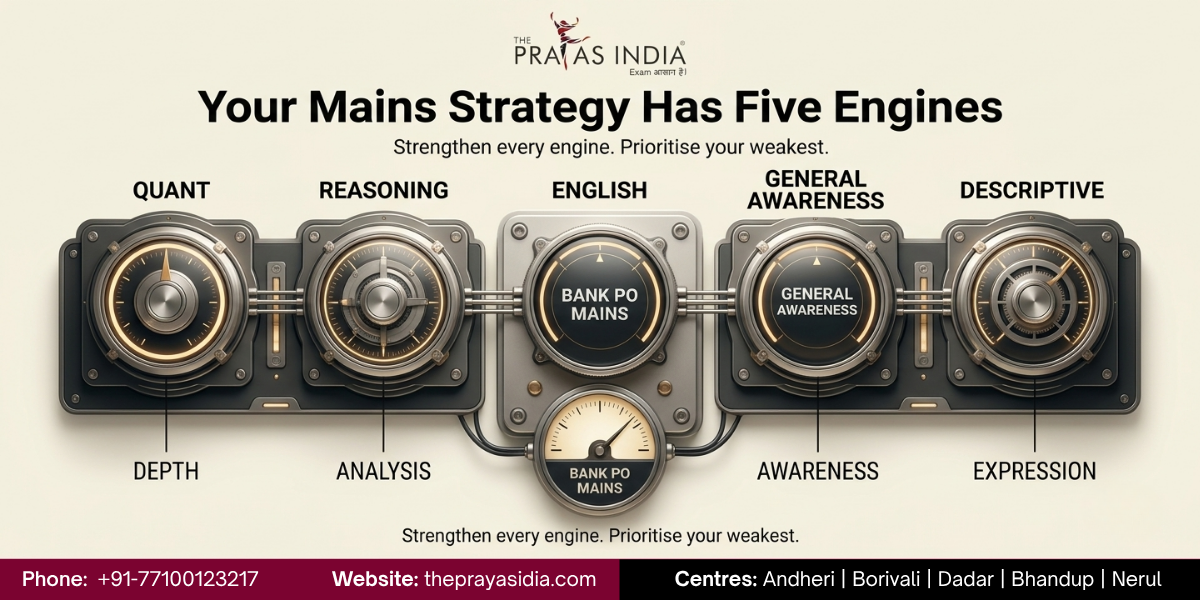
Quantitative Aptitude
Your focus should gradually move towards complex Data Interpretation, arithmetic applications and multi-step problems. Continue calculation drills, but combine them with deeper conceptual practice.
Reasoning
Give greater attention to lengthy puzzles, seating arrangements, logical reasoning and analytical sets. Practise identifying the structure of a set before investing time in solving it completely.
English
Strengthen comprehension, vocabulary in context, grammar application and reading ability. Regular reading can improve both language familiarity and awareness of contemporary topics.
General Awareness
Make current affairs and banking awareness a daily priority. Focus on understanding important developments rather than simply collecting large volumes of facts.
Descriptive Section
Where applicable, practise formal writing regularly. Focus on structure, relevance, clarity, grammar and completing the task within the allotted time.
The key is not to create a rigid timetable that looks impressive on paper. Build a routine that you can realistically follow every day until the Mains examination.
Make General Awareness a Non-Negotiable Daily Habit
General Awareness deserves a different preparation philosophy because it is difficult to build through intensive last-minute study alone.
A candidate who studies aptitude subjects every day but postpones current affairs may eventually find themselves with a large backlog that becomes difficult to revise effectively. The solution is to make GA a relatively small but consistent part of the daily schedule.
Instead of trying to read everything, identify the areas most relevant to banking examinations and revise them repeatedly.
A practical daily GA routine can include:
- Current national and international developments
- Banking and financial news
- RBI-related updates
- Government schemes and initiatives
- Important economic developments
- Reports and indexes
- Appointments and awards
- Business and financial developments
- Important banking terminology
The objective is not to memorise isolated headlines. Try to understand the context behind important developments. This makes revision easier and improves retention.
Create a Revision Cycle Instead of Revising Only Once
Many candidates read current affairs once and consider the topic completed.
Memory does not work that way.
A better approach is to revisit important information at planned intervals. For example, you may review recently studied material after a few days, revisit it again later in the week and then include it in a broader monthly revision.
This repeated exposure is particularly useful for General Awareness, where the volume of information can become overwhelming.
The same principle applies to Quant and Reasoning. If you repeatedly make mistakes in a particular topic, simply solving another mock will not automatically solve the problem. The underlying concept needs to be revisited and tested again.
Use Mock Tests as Strategy Laboratories
A Mains mock test should be treated as a controlled environment where you experiment with different strategies.
Try different approaches to section ordering, time allocation and question selection during practice. Record what works and what does not.
For example, you may discover that beginning with your strongest section helps you build confidence and save time. Another candidate may perform better by starting with a section where quick marks are available.
There is no universal sequence that works equally well for everyone.
The important point is to discover your own optimal strategy before examination day.
A good mock-analysis routine should answer four questions:
- What did I solve well?
- What did I solve incorrectly?
- Where did I waste time?
- What will I change in the next mock?
The fourth question is the one candidates most frequently ignore.
Don’t Chase Mock-Test Scores Blindly
Mock scores are useful indicators, but they should not become the sole measure of preparation.
If your score increases because you attempted more questions but your accuracy has fallen, the improvement may not be meaningful.
Similarly, a lower score in a difficult mock does not automatically indicate poor preparation.
Track trends instead:
Accuracy → Attempts → Time → Sectional balance → Recurring errors
A candidate who consistently reduces careless mistakes may be improving even before the score shows a dramatic increase.
Build a Personal Mains Score Strategy
Instead of entering the examination hoping to “attempt as much as possible,” establish a realistic score strategy based on your practice data.
Your target should be built around your strengths, weaknesses and the examination pattern.
For example, if you are exceptionally strong in English but comparatively slower in Quant, you may want to maximise your English efficiency while ensuring that Quant does not consume disproportionate time.
Similarly, if your GA preparation is strong, you should use that strength strategically rather than spending excessive practice time on areas where your performance is already stable.
Your preparation should ultimately answer:
Where will my marks come from?
That question is more useful than simply asking how many hours you should study.
Improve Calculation Speed Without Sacrificing Accuracy
Mains-level Quant can become difficult if calculations consume too much time.
However, speed should never come at the cost of accuracy.
Develop calculation efficiency through regular short drills rather than occasional marathon sessions.
Practise:
- Percentage calculations
- Fraction-decimal conversions
- Ratio comparisons
- Approximation
- Multiplication shortcuts
- Squares and cubes where relevant
- Mental arithmetic
The objective is to reduce unnecessary calculation time so that your mental bandwidth remains available for understanding the problem.
Reasoning Preparation Should Include “Set Selection”
A common problem in Mains Reasoning is spending too much time trying to solve a difficult set simply because you have already invested several minutes in it.
Practise recognising when to continue and when to move on.
During mocks, note:
How long did I take to understand the set?
How many conditions were involved?
Was there a clear starting point?
How many questions could realistically be answered from the set?
This analysis gradually develops an important Mains skill: recognising the potential return of a question set before committing your time.
Reading Can Improve More Than English
Daily reading can serve multiple purposes during Bank PO Mains preparation.
It improves comprehension, vocabulary and sentence familiarity, but it can also help candidates become more comfortable with economic and financial terminology.
Reading quality newspapers, business publications and reliable current-affairs material can expose you to concepts that appear repeatedly in banking examinations.
Do not turn reading into passive activity.
After reading an important article, ask yourself:
What is the central issue?
What caused it?
Who is affected?
What are the possible consequences?
This turns reading into analytical preparation.
Manage Preparation Fatigue After Prelims
The transition from Prelims to Mains can be mentally demanding. Candidates may already have spent months preparing and may experience a temporary drop in motivation after the first stage.
The solution is not to create an unrealistic twelve-hour timetable.
Consistency is more valuable than occasional extreme effort.
Build a routine with clear study blocks and defined outcomes. Take short breaks and protect your sleep because fatigue can directly affect concentration, calculation accuracy and mock-test performance.
A disciplined Mains routine should be sustainable until the examination rather than impressive for only three days.
What If You Have Very Little Time for Mains?
When the preparation window is short, prioritisation becomes even more important.
Do not attempt to complete every resource available online.
Identify:
- High-priority Mains topics
- Your strongest scoring areas
- Your biggest weaknesses
- Important current-affairs coverage
- Banking awareness
- Descriptive requirements
- Previous-year questions
- Quality Mains mocks
Then allocate your preparation time accordingly.
The shorter the preparation window, the more dangerous unfocused study becomes.
Previous-Year Questions Should Guide Your Preparation
Previous-year questions provide valuable insight into the type of thinking required in the examination.
They help you understand recurring concepts, difficulty levels and question structures.
Do not merely solve them and check the answers.
Analyse them for patterns.
Which concepts repeatedly appear?
Which question types require lengthy calculations?
Which Reasoning sets demand more time?
What kind of English comprehension is being tested?
Which areas of General Awareness receive attention?
This analysis can help you prioritise your preparation more intelligently.
Don’t Let Coaching Replace Self-Analysis
Joining a Bank PO coaching institute in Mumbai can provide structure, faculty guidance, study material and a disciplined environment, but coaching alone cannot determine your final performance.
A serious aspirant still needs to understand their own preparation.
After every major test, you should know:
- What improved?
- What declined?
- Which mistake repeated?
- Which topic remains weak?
- Which strategy worked?
- What should change next?
This is where guided coaching and individual effort work best together.
At The Prayas India, aspirants preparing for competitive banking examinations can benefit from a structured learning environment designed around conceptual preparation, regular practice and exam-oriented testing. For students looking for Bank PO coaching in Mumbai, the value of a coaching programme should ultimately be measured by how effectively it helps convert preparation into measurable improvement.
Build Your Preparation Around the Actual Examination
Every strategy should eventually connect back to the examination itself.
Avoid collecting resources simply because other aspirants are using them. One book, one mock platform or one current-affairs source is not automatically better because it is popular.
Too many resources can create another problem: incomplete preparation across multiple sources.
A more effective system is to choose reliable resources and revise them thoroughly.
Your preparation ecosystem should remain manageable enough that you can repeatedly revisit what you have studied.
The Final Week Before Bank PO Mains
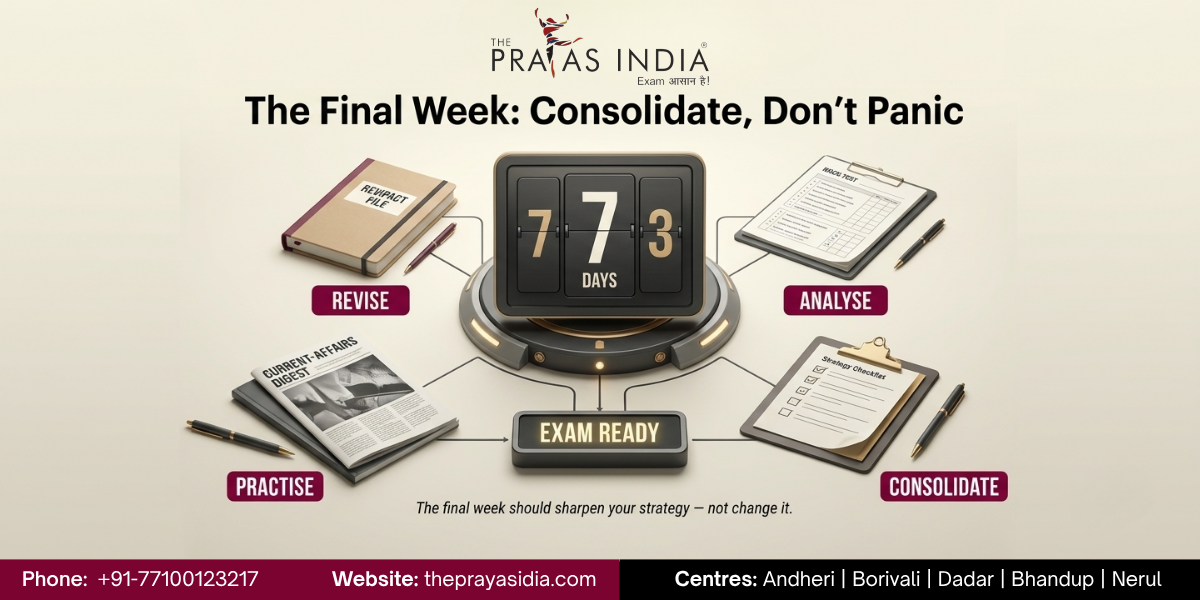
The final week should not become a period of frantic experimentation.
By this point, your examination strategy should already be tested.
Focus on:
- Revising important current affairs
- Revisiting banking awareness
- Reviewing your error log
- Taking selected full-length mocks
- Maintaining calculation speed
- Practising question selection
- Revising important concepts
- Reviewing descriptive formats where applicable
Avoid making dramatic changes to your strategy in the last few days.
The final week is about consolidation, not reinvention.
Contact Us
- Call Now: +91-77100 13217
- Website: theprayasindia.com
- Centres: Andheri | Borivali | Dadar | Nerul | Bhandup
Frequently Asked Questions
1. When should I start preparing for Bank PO Mains after Prelims?
Preparation should ideally begin immediately after Prelims if you have a reasonable expectation of qualifying. Waiting for the official result can reduce the already limited preparation window.
2. Should I completely stop Prelims preparation after the exam?
You should shift your focus towards Mains, but maintaining a small amount of speed and calculation practice can be useful. The majority of your preparation should become Mains-oriented.
3. What is the biggest difference between Bank PO Prelims and Mains preparation?
Prelims places greater emphasis on speed, accuracy and question selection. Mains requires these abilities along with greater conceptual depth, analytical reasoning, General Awareness, banking awareness and, where applicable, descriptive writing.
4. How important is General Awareness for Bank PO Mains?
General Awareness can be a significant component of Bank PO Mains preparation. Candidates should maintain consistent current-affairs and banking-awareness revision rather than leaving the subject until the last few days.
5. How many Mains mocks should I take?
There is no fixed number that works for everyone. The quality of mock analysis is more important than simply increasing the number of tests. Take enough mocks to test and refine your strategy while leaving sufficient time for revision and error correction.
6. Should I solve difficult questions during Mains preparation?
Yes, but difficult questions should be used strategically. The objective is to improve your ability to handle higher-level problems while also learning when a difficult question is not worth attempting in a time-bound examination.
7. How can I improve my Mains question-selection skills?
Practise under timed conditions and record the time spent on different questions and sets. After every mock, identify questions that consumed too much time and examine whether they should have been skipped.
8. Is descriptive writing important for Bank PO Mains?
Where the relevant Bank PO examination includes a descriptive component, candidates should prepare it separately. Regular practice can improve structure, clarity, formal writing and time management.
9. Should I join Bank PO coaching in Mumbai after clearing Prelims?
Candidates who need structured guidance, regular testing, doubt-solving and a disciplined preparation environment may benefit from coaching. The key is to choose a programme that specifically addresses the transition from Prelims to Mains.
10. How can The Prayas India help with Bank PO preparation?
The Prayas India provides structured preparation for competitive banking examinations with a focus on conceptual learning, practice, mock tests and exam-oriented guidance. Candidates should evaluate the programme based on their individual preparation requirements before taking admission.