CAT 2026 Final Revision Strategy: What to Revise in VARC, DILR and QA Before the Exam | The Prayas India
With CAT 2026 approaching, preparation enters a very different stage. By late September, many serious aspirants have already completed a substantial portion of the syllabus, attempted sectional tests, and started taking full-length mock tests. The focus now should gradually shift from learning everything new to consolidating what you already know.
This is where a well-planned CAT 2026 final revision strategy can make a significant difference. The objective is not to revise every chapter repeatedly or solve thousands of questions without a plan. Instead, aspirants should identify their high-value topics, revisit concepts that are frequently tested, analyse mock-test mistakes, strengthen weak areas, and develop a reliable approach for VARC, DILR and QA.
The final weeks before CAT should be about consolidation, practice and decision-making.
For students preparing for CAT 2026, structured guidance during this phase can also help bring consistency to revision and mock-test preparation. The Prayas India provides CAT preparation through structured learning support, helping aspirants prepare across all three sections with focused practice and test-oriented preparation.
Why Final Revision Matters for CAT 2026
CAT preparation is not simply about completing the syllabus once.
An aspirant may have studied percentages several months ago but still make calculation mistakes under time pressure. Similarly, someone who has solved numerous Reading Comprehension passages may still lose marks because of incorrect option selection.
This happens because familiarity with a topic is different from exam readiness.
Final revision helps convert previously acquired knowledge into usable exam skills.
During this phase, your preparation should increasingly answer four questions:
- What do I already know well?
- Which topics am I still getting wrong?
- Which question types consume too much time?
- What should I attempt and leave during the actual examination?
Your answers should come from mock tests, sectional tests, previous CAT questions and your own performance data, rather than from assumptions.
CAT 2026 Final Revision: What Should Your Strategy Look Like?
A productive final revision cycle can be divided into four activities:
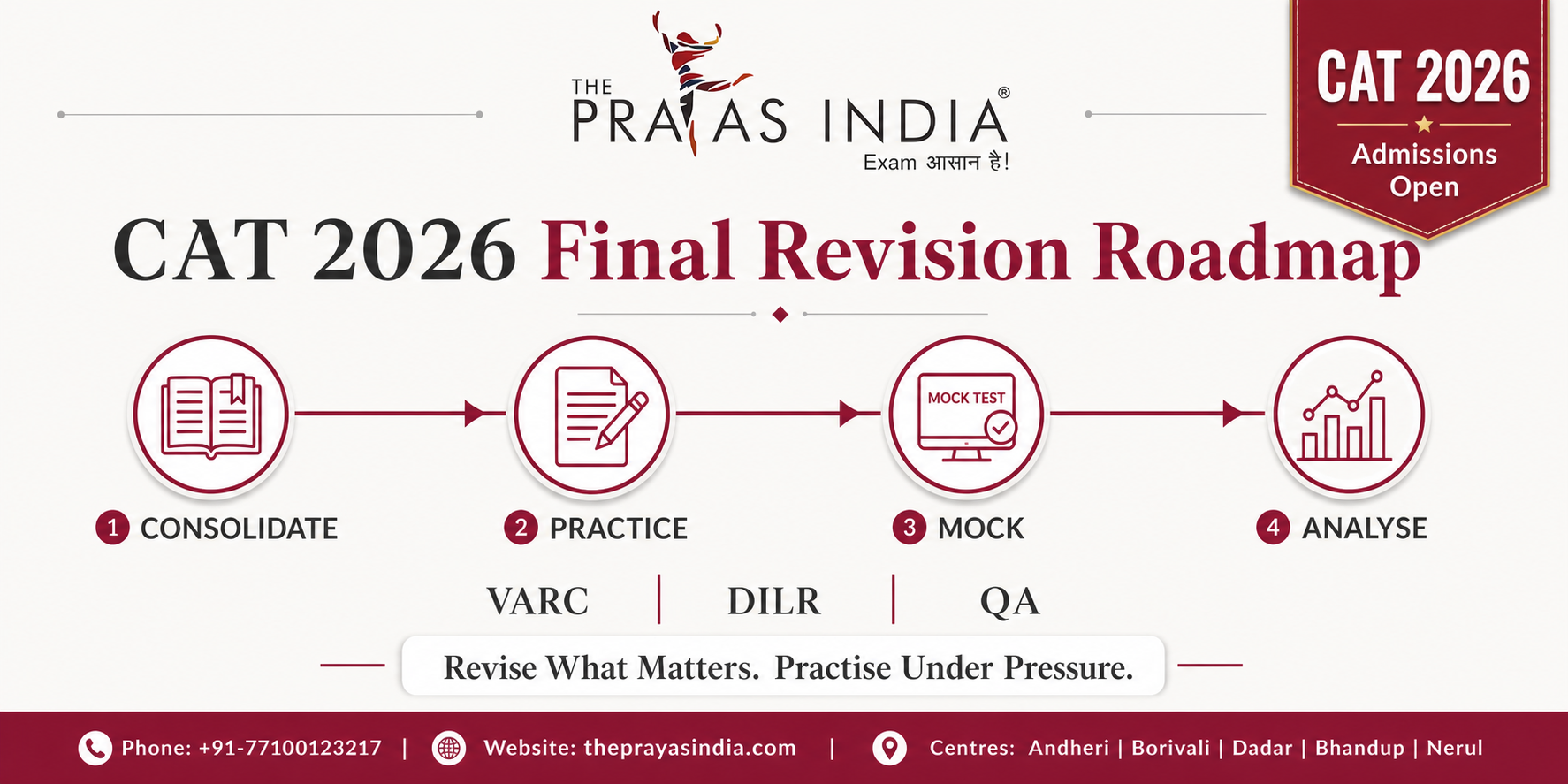
Concept Revision → Targeted Practice → Mock Tests → Performance Analysis
Instead of spending the entire day revising theory, divide your preparation between these activities.
For example, if your QA mock analysis shows repeated mistakes in Arithmetic, your revision should focus on the specific Arithmetic concepts and question types causing those errors. There is little value in spending hours revising chapters you consistently answer correctly.
Similarly, if your DILR performance is affected by difficulty identifying manageable sets, your revision should include set selection and timed practice, not just formula or concept revision.
For VARC, revision should focus less on memorising content and more on reading consistency, question interpretation and option elimination.
Final Revision Strategy for VARC
The VARC section requires a different approach from QA because there is relatively less conventional “syllabus revision.”
Your improvement depends heavily on reading ability, comprehension, reasoning and the ability to distinguish between closely worded answer choices.
1. Revise Your Reading Comprehension Approach
RC should remain an important part of your final CAT preparation.
Instead of trying to memorise topics, revise your RC-solving process.
After every passage, ask:
- Did I understand the central argument?
- Did I identify the author’s position?
- Did I distinguish the main idea from supporting information?
- Did I eliminate options using evidence from the passage?
- Did I spend too much time on a difficult question?
The objective is to make your process repeatable.
You should gradually become comfortable reading passages from different areas, including philosophy, economics, social sciences, science, history and culture.
2. Focus on Option Elimination
Many VARC questions are difficult because two options can appear plausible.
During final revision, pay particular attention to why an option is wrong, rather than simply remembering why the correct option is right.
Check whether an option:
- Makes a claim that is too broad
- Contradicts the passage
- Introduces information not supported by the passage
- Distorts the author’s argument
- Uses an extreme interpretation
- Answers a different question
This approach can improve accuracy because CAT often requires careful discrimination between closely related choices.
3. Revise Verbal Ability Patterns
For VA, continue practising question types such as:
- Para Jumbles
- Para Summary
- Odd Sentence
- Sentence Placement
The emphasis should be on identifying relationships between sentences and understanding logical flow.
For Para Jumbles, for example, look for introductory sentences, pronoun references, cause-and-effect relationships, chronological links and logical continuity.
For Para Summary, focus on identifying the central argument rather than getting distracted by supporting examples.
Final Revision Strategy for DILR
DILR is often less about memorising concepts and more about recognising the right set and executing it efficiently.
This makes the final revision phase particularly important.
You should not attempt to solve every possible type of DILR set available.
Instead, expose yourself to a broad range of set structures and develop the ability to quickly understand:
What information is given?
What is being asked?
How can the information be represented?
How many questions can potentially be solved from the set?
How much time is reasonable to spend?
Practise Different DILR Set Structures
Your final preparation should include sets involving:
- Arrangements
- Distribution
- Selection
- Games and tournaments
- Tables
- Charts
- Networks
- Venn diagrams
- Scheduling
- Routes and connections
- Logical conditions
The purpose is not to memorise formulas for every set.
Instead, practise converting information into a manageable representation.
A complicated paragraph can often become much easier once converted into a table, diagram, grid or sequence.
Develop DILR Set Selection Skills
One of the most important DILR skills is knowing which set to attempt first.
During mocks, observe:
- How long you spend scanning the section
- Which sets appear approachable initially
- Which sets become time-consuming after starting
- How many questions you eventually solve from each set
- Whether you abandon difficult sets quickly enough
Your mock-test analysis should help you develop a personal set-selection framework.
Do not assume that the easiest-looking set is always the best set. Spend a limited amount of time understanding the structure before committing significant time.
Practise DILR Under Time Pressure
Untimed DILR practice is useful during the learning stage, but final preparation must increasingly include timed solving.
Try solving sets under realistic conditions.
Afterwards, compare:
Time Taken vs Questions Correct
A set that takes 25 minutes for two correct answers may not be efficient, even if you eventually solve it successfully.
The goal is to improve both accuracy and decision-making under pressure.
Final Revision Strategy for QA
Quantitative Aptitude usually offers the most direct opportunity for structured revision because it contains identifiable concepts, formulas and question types.
However, the final phase should not mean revising every formula from every chapter.
Instead, prioritise the areas where you can realistically improve your performance.
1. Prioritise Arithmetic
Arithmetic commonly forms an important part of CAT QA preparation.
Revise concepts related to:
- Percentages
- Profit and Loss
- Ratio and Proportion
- Averages
- Mixtures and Alligation
- Time, Speed and Distance
- Time and Work
- Simple and Compound Interest
Do not stop at formula revision.
Solve representative questions and check whether you can identify the correct approach quickly.
2. Revise Algebra
Depending on your preparation and performance, revise areas such as:
- Linear equations
- Quadratic equations
- Inequalities
- Functions
- Sequences and series
- Logarithms
- Progressions
- Algebraic expressions
Focus particularly on concepts where your mock-test accuracy is inconsistent.
3. Consolidate Geometry and Number Systems
Geometry revision should cover important properties, theorems and standard approaches.
Similarly, revise core Number System concepts such as:
- Divisibility
- Remainders
- Factors
- Multiples
- HCF and LCM
- Number properties
The final stage is not the time to collect dozens of shortcuts without understanding when to apply them.
4. Build a Personal Formula Sheet
A concise formula sheet can become extremely useful during final revision.
Include only formulas and concepts that you genuinely need to revisit.
Your final revision sheet should ideally be short enough to revise regularly.
Avoid turning it into another textbook.
How to Use CAT 2026 Mock Tests During Final Revision
Mock tests should increasingly become a central component of your preparation.
But there is an important difference between taking mocks and learning from mocks.
If you take a mock, check the score and immediately move to another mock, you may miss the most valuable part of the exercise.
Your real learning often begins after the test.
Analyse Every Mock in Four Categories
After each mock, classify questions into:
Correct and Confident
These indicate areas where your preparation is relatively stable.
Correct but Time-Consuming
These require attention because excessive time can affect your overall section strategy.
Incorrect but Attemptable
These are particularly important. They may indicate conceptual gaps, calculation mistakes or poor option selection.
Unattempted but Solvable
These can reveal missed opportunities caused by poor question selection or time management.
This classification provides much more information than the overall percentile alone.
Maintain a CAT 2026 Error Log
An error log can become one of your most useful revision tools.
For every significant mistake, record:
Question → Mistake → Reason → Correct Approach → Lesson
For example, if you repeatedly make mistakes in percentage-based questions, don’t simply write “Percentages weak.”
Identify the actual problem.
Was it:
- Conceptual misunderstanding?
- Calculation error?
- Misreading?
- Incorrect assumption?
- Time pressure?
- Wrong question selection?
The more specific your error analysis becomes, the more useful your revision becomes.
Don’t Chase Every New Shortcut Before CAT 2026
As the examination approaches, aspirants are often exposed to new tricks, shortcuts, PDFs, strategy videos and last-minute predictions.
This can create unnecessary confusion.
If a method is genuinely useful and you have enough time to practise it, incorporate it gradually.
But avoid changing your entire preparation system because of a new strategy discovered a few weeks before the examination.
The final phase should primarily be about strengthening a reliable system, not continuously replacing it.
How The Prayas India Can Help With CAT 2026 Preparation
The final months before CAT can be challenging because students have to balance syllabus revision, sectional practice, mock tests, analysis and college-admission planning.
A structured coaching environment can help students organise these activities more systematically.
At The Prayas India, CAT aspirants can access structured preparation support designed around the three major CAT sections:
VARC | DILR | QA
The preparation approach can combine conceptual learning with practice, revision and test-oriented preparation so that students can track their progress rather than preparing without a defined framework.
For students who prefer classroom interaction, offline learning provides a structured study environment. Aspirants who need flexibility can consider online learning options.
If you are still looking for structured guidance for CAT 2026, exploring The Prayas India’s CAT programs can help you understand the available learning options before making an admission decision.
CAT 2026 Final Revision: A Practical Daily Structure
Aspirants should now gradually move towards a revision-heavy routine.
One possible structure is:
Session 1 — VARC
Reading comprehension practice followed by analysis of incorrect or doubtful questions.
Session 2 — QA
Concept revision followed by targeted questions from weak areas.
Session 3 — DILR
One or more timed sets, followed by detailed analysis.
Session 4 — Revision
Review formulas, error logs, important approaches and previously difficult questions.
The exact duration of each session should depend on your current strengths and weaknesses.
The important point is to ensure that every day contains some combination of learning, practice and analysis.
What to Revise in the Final Weeks Before CAT 2026
As the exam gets closer, your revision material should become increasingly compact.
VARC
Focus on:
- RC approach
- Question interpretation
- Option elimination
- Para Summary
- Para Jumbles
- Odd Sentence
- Reading consistency
DILR
Focus on:
- Set selection
- Tables and arrangements
- Distribution
- Games and tournaments
- Networks
- Charts
- Logical conditions
- Timed set practice
QA
Focus on:
- Arithmetic
- Algebra
- Geometry
- Number Systems
- Important formulas
- Frequently repeated question types
- Personal weak areas
The Final Week: Shift From Learning to Execution
The final week should not become a race to complete unfinished books and new topics.
At this stage, your preparation should increasingly resemble the conditions in which you will take CAT.
Review your:
- Mock-test strategy
- Sectional order and approach
- Question-selection process
- Time-management habits
- Calculation approach
- RC strategy
- DILR set-selection process
- QA topic priorities
- Error log
Avoid making dramatic changes based on one bad mock.
Similarly, do not become overconfident because of one excellent score.
Look at your performance across multiple tests and identify recurring patterns.
The final goal is to enter the examination with a tested and familiar strategy.
Final Checklist for CAT 2026 Aspirants
Before the examination, ask yourself:
VARC
- Can I consistently handle different RC subjects?
- Do I know how I approach difficult options?
- Am I practising enough reading?
DILR
- Can I identify manageable sets?
- Do I know when to leave a set?
- Am I comfortable representing information visually?
QA
- Are my core Arithmetic concepts strong?
- Have I revised important Algebra and Geometry concepts?
- Do I know my high-error topics?
Overall
- Am I analysing my mocks?
- Do I maintain an error log?
- Have I revised my weak areas?
- Is my exam strategy based on actual practice?
- Am I avoiding unnecessary new resources?
CAT 2026 Final Revision Strategy: The Key Takeaway
The final stage of CAT preparation is not about studying more and more material.
It is about making your existing preparation more reliable.
Revise the concepts you have already studied. Practise the question types that matter. Use mocks to test your decision-making. Analyse every significant mistake. Strengthen weak areas without abandoning your strengths.
For VARC, focus on reading, comprehension and option elimination.
For DILR, focus on set selection, logical representation and timed practice.
For QA, focus on core concepts, formulas, application and high-frequency weaknesses.
Most importantly, make your preparation increasingly exam-oriented as CAT 2026 approaches.
For aspirants who want structured guidance, systematic practice and support throughout the CAT preparation journey, The Prayas India offers CAT coaching through online and offline learning options. If you are still preparing for CAT 2026 and want a more organised approach to revision, mocks and section-wise preparation, you can explore the available CAT programs and admission options at The Prayas India.
Your final revision should not make your preparation bigger. It should make it sharper.
FAQs on CAT 2026 Final Revision Strategy
1. What should I revise for CAT 2026 in the final months?
Focus on important concepts, frequently practised question types, previous mistakes, formulas, mock-test errors and section-specific strategies. Avoid trying to cover every new resource during the final stage.
2. How should I revise VARC for CAT 2026?
Focus on regular Reading Comprehension practice, option elimination, question interpretation and Verbal Ability question types such as Para Summary, Para Jumbles and Odd Sentence. Analyse incorrect answers to understand why an option was wrong.
3. How can I prepare DILR during the final revision phase?
Practise different types of sets under timed conditions and focus on set selection, logical representation and efficient execution. Analyse which sets consume excessive time and identify patterns that help you decide which sets to attempt.
4. Which QA topics should I prioritise for CAT 2026 revision?
Prioritise the areas relevant to your preparation and mock-test performance, particularly core Arithmetic, Algebra, Geometry and Number Systems. Pay special attention to topics where you repeatedly make conceptual or calculation errors.
5. Are CAT mock tests important during final revision?
Yes. Mock tests help you evaluate your preparation under time constraints and identify weaknesses in accuracy, question selection and time management. The analysis after each mock is as important as taking the test itself.
6. How should I analyse my CAT 2026 mock tests?
Classify questions into categories such as correct and confident, correct but time-consuming, incorrect but attemptable, and unattempted but solvable. This can help you identify knowledge gaps, calculation errors, time-management issues and missed opportunities.
7. Should I learn new topics during the final CAT 2026 preparation phase?
New topics can be studied when they are important and realistically manageable, but the final phase should primarily focus on consolidation, practice and revision. Constantly changing resources or strategies can make preparation less consistent.
8. How many CAT mocks should I take before CAT 2026?
There is no universal number that works for every aspirant. The quality of mock analysis matters more than simply increasing the number of tests. Your mock frequency should allow enough time to analyse mistakes and work on the weaknesses identified.
9. How can I improve CAT 2026 accuracy?
Review your incorrect and doubtful questions, maintain an error log, practise under timed conditions and identify the reasons behind your mistakes. Improving accuracy also requires learning when not to attempt a question.
10. What is the best revision strategy for CAT 2026?
A practical approach is Concept Revision → Targeted Practice → Mock Test → Analysis → Weak-Area Revision. Repeating this cycle can help convert preparation into exam-ready skills.
11. Can I prepare for CAT 2026 through online coaching?
Yes. Online CAT coaching can provide structured classes, study resources, practice questions, mock tests and flexibility. It can be useful for students who need to balance CAT preparation with college, work or other commitments.
12. Does The Prayas India offer CAT 2026 coaching?
Yes. The Prayas India provides CAT preparation through online and offline learning options, with structured support for VARC, DILR and QA. Aspirants preparing for CAT 2026 can explore the available programs and admission options based on their preparation requirements.
Maximize Your Percentile with CAT 2026 Mentorship!
Don’t let silly mistakes or poor set selection lower your score. Connect with top MBA experts at The Prayas India to fine-tune your final revision strategy, boost mock accuracy, and master time management.
Official Website: theprayasindia.com
Visit Our Mumbai Centres: