CAT 2026 in 82 Days: Why a Crash Course May Be the Smartest Move Now | The Prayas India CAT Coaching in Mumbai
With CAT 2026 scheduled for November 29, 2026, the preparation window is now entering its most important phase. As of September 8, aspirants have approximately 82 days before the examination. At this stage, the question is no longer simply whether you should prepare for CAT. The more important question is whether your current preparation method is capable of converting the remaining weeks into measurable improvement.
For many aspirants, September marks the point where preparation starts becoming complicated. The syllabus may still have unfinished areas, mock scores may not be where they were expected to be, DILR may remain unpredictable, VARC performance may fluctuate, or Quant may have too many topics requiring revision. Some students are also starting their preparation relatively late because of college, work, placements or other competitive examinations.
This is precisely where a CAT Crash Course can become more than just another set of classes.
A well-designed crash course can provide a focused preparation structure for the final stretch: what to study, what to revise, what to practise, when to take mocks, how to analyse them and which mistakes need immediate correction. The objective is not to make the remaining 82 days feel longer. It is to make every one of those days more productive.
For aspirants looking for a CAT Crash Course in Mumbai, this is also the right time to evaluate whether joining a structured programme can help them move from scattered preparation to a more disciplined, exam-oriented approach.
82 Days Is Not Too Late — But It Is Too Late for an Unstructured Plan
The biggest mistake an aspirant can make at this stage is assuming that there is still plenty of time to prepare in the same way they did during the initial months.
The preparation priorities have changed.
Earlier, you could afford to spend substantial time learning concepts, exploring different resources and gradually building familiarity with the CAT syllabus. With only 82 days remaining, preparation needs to become much more selective. Every week should have a clear purpose, every mock should generate actionable feedback and every practice session should address a specific performance requirement.
This does not mean that an aspirant who has not completed the entire syllabus should panic. It means the preparation needs to become more strategic.
A late starter does not necessarily need to study everything that an aspirant with eight or ten months of preparation has studied. Instead, the focus should be on building sufficient command over high-value areas, improving question selection, developing sectional strategy and converting preparation into marks.
Recent CAT preparation guidance has similarly emphasised the transition from learning towards revision, mocks, analysis and execution as the examination approaches.
This is one of the strongest arguments for a crash course.
A structured programme can reduce the time an aspirant spends deciding what to do next and increase the time spent actually preparing.
The Real Cost of These 82 Days
The value of the remaining 82 days should not be measured only in hours.
It should be measured in decisions made correctly.
If an aspirant spends two weeks jumping between YouTube lectures, books, test series and different study plans, those two weeks are gone. If another aspirant takes several mocks but does not analyse the mistakes, the tests may provide scores but not meaningful improvement. If a student keeps trying to complete every difficult topic instead of becoming highly accurate in manageable areas, the preparation can become exhausting without producing proportional gains.
A crash course addresses this problem by bringing preparation into one organised framework.
Instead of asking every morning:
“Aaj CAT ke liye kya karna hai?”
the aspirant should already know:
“Aaj mujhe exactly kya revise, practise, test and improve karna hai?”
That difference becomes increasingly important as CAT approaches.
A Crash Course Is Not Just a Shorter CAT Course
The word “crash” can sometimes create the wrong impression.
A CAT Crash Course should not simply mean compressing months of lectures into a few weeks. If a programme only gives aspirants more classes without helping them understand priorities, practise effectively and analyse performance, the advantage of joining late becomes limited.
A strong crash course should instead be designed around conversion.
The preparation journey should move through a cycle:
Concept → Practice → Sectional Test → Mock → Analysis → Correction → Revision → Retest
Each stage has a specific purpose.
Concept sessions address gaps in understanding. Practice builds familiarity and speed. Sectional tests expose weaknesses under time pressure. Full-length mocks test overall strategy. Analysis identifies the reason behind lost marks. Correction prevents the same mistake from recurring. Revision strengthens retention. Retesting shows whether the correction actually worked.
This is particularly important because CAT performance is not determined only by how many concepts an aspirant knows. The examination also demands intelligent question selection, time management and the ability to remain accurate under pressure.
That is why the final preparation phase should be viewed as a performance-building phase, rather than simply a syllabus-completion phase.
The Biggest Advantage: Someone Else Has Already Structured the Journey
One of the hidden difficulties of CAT preparation is planning.
Students often underestimate how much time they spend deciding which chapter to study, which questions to solve, which mock to purchase, which YouTube video to watch and whether they should revise an old topic or start a new one.
Individually, these decisions may appear insignificant. Across 82 days, however, they can consume a considerable amount of preparation time.
A structured CAT Crash Course can remove much of this uncertainty.
Instead of creating a preparation system from scratch, the aspirant enters an existing academic structure where classes, practice, testing and revision can work together. This becomes especially useful for students who know that they need guidance but have struggled to maintain consistency through self-study.
For a working professional, this structure can be even more valuable. After an office day, spending an additional hour deciding what to study can be mentally exhausting. A defined schedule provides clarity: attend the planned class, complete the assigned practice, take the scheduled test and analyse the identified weak areas.
For a college student, the same structure can help balance academics, placements and CAT preparation.
For a repeater, it can prevent another preparation cycle from becoming a repetition of the same mistakes.
Who Can Benefit Most From a CAT Crash Course Right Now?
A crash course is not necessarily only for students who have done nothing so far. In fact, several different categories of CAT aspirants can benefit from a focused programme at this stage.
1. Aspirants Who Started Late
Some students begin serious CAT preparation only in August or September. They may have basic awareness of the syllabus but lack a structured preparation schedule.
For them, a crash course can provide a starting framework without wasting additional time designing a plan from scratch.
The objective should be selective preparation, consistent practice and rapid movement towards exam-level testing.
2. Students Who Have Completed Concepts but Lack Practice
This is a common situation.
An aspirant may have watched lectures for Quant, completed several DILR concepts and studied the basics of VARC, yet mock scores remain inconsistent.
The problem may not be a lack of knowledge. It may be the absence of sufficient timed practice and performance analysis.
A crash course can help bridge that gap by moving preparation towards sectional tests, mocks, revision and correction.
3. Students Taking Mocks but Not Improving
Taking mocks regularly does not automatically guarantee improvement.
If an aspirant takes a test, checks the percentile and immediately moves to the next test, the most valuable part of the exercise may be missing: analysis.
A proper preparation programme should teach students to identify whether lost marks came from:
- Conceptual gaps
- Careless mistakes
- Poor question selection
- Excessive time spent on difficult questions
- Weak sectional strategy
- Reading or calculation errors
- Lack of revision
The purpose of a mock is therefore not simply to produce a score. It is to provide information about what needs to change before the next test.
CAT Preparation Now Needs Three Things: Focus, Feedback and Frequency
With 82 days remaining, students need to bring three elements together.
Focus means knowing which topics and skills deserve attention.
Feedback means understanding exactly why marks are being lost.
Frequency means practising and testing often enough for improvements to become consistent.
Self-study can provide all three, but only when the student already has a strong planning system and enough discipline to follow it. For many aspirants, the problem is not motivation or intelligence. It is simply the absence of a reliable preparation structure.
This is where the value of a CAT Crash Course becomes clearer.
The aspirant does not join merely to attend classes. The purpose is to enter a system where learning, practice and performance are connected.
The Last 82 Days Should Be Divided Into Preparation Priorities
The remaining time should not be treated as one long block.
The emphasis should gradually shift.
Phase 1: September — Build the Base and Identify Gaps
The first priority should be to understand the current level of preparation.
Aspirants should identify:
- Which concepts are already strong?
- Which topics need revision?
- Which sections are consistently weak?
- How is time being distributed?
- Which mistakes are repeated?
- What is preventing mock scores from improving?
A diagnostic mock can provide a useful starting point.
The purpose is not to become obsessed with the initial percentile. It is to establish a baseline from which improvement can be measured.
Phase 2: October — Convert Knowledge Into Performance
October should increasingly become a practice-and-testing month.
The focus should move towards mixed-topic practice, sectional tests, full-length mocks and detailed analysis.
At this stage, simply completing another lecture playlist should not be considered progress unless the knowledge can be converted into correct answers under time pressure.
The preparation should increasingly resemble the examination.
Phase 3: November — Refine the Exam Strategy
As CAT gets closer, the focus should move towards revision, mock analysis, question selection and time management.
The objective is no longer to collect more and more study material.
It is to become predictable in performance.
An aspirant should know how they want to approach VARC, how they will identify DILR sets, how they will manage QA and what they will do when the paper contains unexpected difficulty.
A good crash course can help build these decisions through repeated testing and guided analysis rather than leaving students to figure everything out during the final weeks.

Why Joining Now Can Be Better Than Joining Later
A common thought among aspirants is:
“I will join a crash course later, when the exam gets closer.”
The problem is that waiting reduces the very advantage a crash course is supposed to provide.
A programme needs time to work.
Students need time to attend classes, practise, take tests, make mistakes, receive feedback, correct those mistakes and demonstrate improvement. If the course is joined too late, there may be insufficient time to complete this complete cycle.
Joining around the beginning of September provides a much more practical runway.
The aspirant still has enough time to build a structured preparation routine, identify weak areas, work on them and enter the final weeks with a tested strategy.
In other words, the goal is not to crash the preparation into the last few weeks.
The goal is to use the remaining 82 days intelligently.
The Prayas India: Turning the Remaining CAT Preparation Into a Structured Plan
For an aspirant considering a CAT Crash Course in Mumbai, the most important question should not simply be whether a coaching institute offers classes.
The more important question is whether the programme can provide the complete preparation support required at this stage.
At The Prayas India, the focus should be on helping CAT aspirants move through a structured preparation journey rather than treating classes as the entire preparation.
The right preparation ecosystem should connect:
Teaching → Practice → Testing → Analysis → Improvement
This becomes particularly important in the final phase because students do not simply need more information. They need a system that helps them use what they already know more effectively.
For a student with limited time, that distinction can make a significant difference.
A CAT Crash Course should therefore be evaluated not by the number of lectures promised, but by how effectively it helps an aspirant use the remaining preparation window.
Before You Join a CAT Crash Course, Ask These Questions
The decision to join a crash course should be practical rather than emotional.
Before taking admission, an aspirant should evaluate whether the programme provides a clear answer to these questions:
- Is there a structured plan for the remaining weeks?
- Will QA, DILR and VARC all receive adequate attention?
- Are regular sectional tests and full-length mocks included?
- Will mock performance be analysed rather than simply scored?
- Is there a mechanism for doubt resolution?
- Will weak areas be identified and addressed?
- Does the programme include revision along with new learning?
- Is the schedule realistic for college students and working professionals?
- Will the programme help develop an actual exam-day strategy?
- Can the student realistically complete the programme before CAT?
These questions shift the admission decision away from marketing claims and towards actual preparation value.
And with only 82 days remaining, that is exactly how the decision should be made.
A Crash Course Should Help You Convert Preparation Into Performance
At this stage of CAT 2026 preparation, the biggest requirement is not necessarily more study material. It is the ability to convert whatever you already know into marks under examination conditions.
An aspirant may understand percentages, algebra, arrangements, reading comprehension and other CAT concepts, but that knowledge becomes valuable only when it can be applied quickly and accurately. This is where the final preparation window becomes different from the earlier stages.
A focused CAT Crash Course should therefore bring together four things: targeted learning, intensive practice, regular testing and performance analysis.
The Prayas India’s CAT preparation approach similarly focuses on structured learning, practice, mock tests, performance analysis, doubt-solving and mentoring rather than treating classroom lectures as the entire preparation process.
For an aspirant joining in September, this structure can be particularly useful because there is little value in spending the next several weeks repeatedly deciding how to prepare. The objective should be to enter a defined system and use the remaining 82 days with maximum purpose.
Section-Wise Preparation Has to Become More Selective
A CAT Crash Course cannot treat all preparation requirements in exactly the same way. VARC, DILR and QA demand different forms of practice, and the final 82-day strategy should recognise those differences.
VARC: Build Consistency, Not Just Reading Volume
VARC performance can fluctuate considerably if preparation is irregular. Reading comprehension requires familiarity with different writing styles, the ability to identify the central argument and the discipline to eliminate options carefully.
During the crash-course phase, the emphasis should therefore be on regular RC practice, question analysis and understanding why an option is correct or incorrect.
The goal is not simply to read more passages.
It is to become better at making decisions within the time available.
DILR: Learn to Select the Right Sets
DILR can be one of the most unpredictable sections for aspirants because knowing how to solve a particular set does not automatically mean that it is the right set to attempt.
Set selection becomes critical.
A good crash-course programme should therefore expose students to different types of DILR sets and help them understand the difference between a set that looks difficult but is manageable and one that can consume excessive time without sufficient return.
Repeated timed practice is essential because this decision-making ability develops through exposure.
QA: Prioritise High-Value Improvement
For Quantitative Ability, the final 82 days should not become an attempt to master every possible advanced concept.
The smarter approach is to identify the topics that are already reasonably accessible, strengthen weak but recoverable areas and build speed through repeated practice.
An aspirant who can reliably solve familiar question types with high accuracy can often benefit more from improving those areas than from spending excessive time chasing extremely difficult questions.
This is one of the advantages of guided preparation: the student can focus on where additional effort is most likely to improve performance.
The Mock Test Is Not the Destination — Analysis Is
One of the strongest reasons to consider a CAT Crash Course at this stage is access to a structured testing-and-analysis cycle.
A mock test gives you a score.
Analysis tells you why you received that score.
Suppose two students both score 65 in a mock. One loses marks because of conceptual gaps, while the other loses marks because of poor time management and incorrect question selection. Their next preparation steps should obviously be different.
Without analysis, both may simply take another mock.
With proper analysis, each can work on the specific reason behind the lost marks.
This is why The Prayas India’s CAT preparation framework places importance on mock tests, sectional testing and performance analysis as part of the broader preparation ecosystem.

Mentorship Becomes More Valuable When Time Is Limited
When students have several months available, they can afford to experiment with different preparation methods.
With 82 days left, experimentation becomes expensive.
This is where mentorship can add significant value.
An experienced mentor can help an aspirant identify whether the immediate problem is lack of conceptual clarity, insufficient practice, poor time allocation, weak question selection or inconsistent revision. Instead of treating every low mock score as a reason to change the entire preparation strategy, students can make smaller and more targeted corrections.
The Prayas India highlights personalised mentoring, progress tracking and doubt-solving as components of its broader preparation ecosystem.
For a crash-course student, this kind of guidance can be particularly relevant because every week matters.
The goal is not to make the student dependent on a mentor. It is to help the student become increasingly capable of analysing their own performance.
Self-Study vs CAT Crash Course: The Decision Is About Structure
Self-study is absolutely possible for CAT.
The question is whether it is the most efficient option for your current preparation stage.
A disciplined aspirant with a clear study plan, reliable resources, strong self-analysis skills and consistent testing habits may be comfortable preparing independently.
But if you are repeatedly facing questions such as:
- What should I study next?
- Which topics should I prioritise?
- Why are my mock scores not improving?
- Which questions should I leave?
- How should I analyse my mocks?
- How much time should I spend on each section?
- Which mistakes am I repeatedly making?
then the problem may not be your ability to prepare.
It may be your preparation system.
A crash course can solve that particular problem by bringing learning, practice and testing into one structured framework.
| Self-Study | CAT Crash Course |
|---|---|
| You create your own schedule | Structured preparation schedule |
| You select resources | Curated learning resources |
| You analyse your own weaknesses | Guided performance analysis |
| Tests may be irregular | Regular testing framework |
| Doubt resolution is self-managed | Faculty/mentor support |
| Strategy development is largely independent | Guided exam strategy |
The right choice depends on the individual. But with only 82 days remaining, aspirants should honestly evaluate whether their current method is producing the required progress.
A Crash Course Can Also Help Prevent Preparation Overload
CAT aspirants often collect too many resources.
One book for Quant. Another for DILR. Multiple Telegram groups. YouTube playlists. Online PDFs. Different mock providers. Random question banks.
The result can be more information but less clarity.
A focused crash course can reduce this overload by giving the aspirant a defined preparation path.
Instead of asking:
“Which resource should I use today?”
the student can focus on:
“How well did I perform on today’s assigned preparation?”
That shift is important.
The final phase should be about execution, not continuously expanding the resource library.
The Right Crash Course Should Fit Different Types of CAT Aspirants
A good crash course should not assume that every student begins September from exactly the same level.
For the Late Starter
The priority is structured coverage and rapid movement towards practice and testing.
For the Partial-Syllabus Student
The focus should be on completing high-priority areas while simultaneously strengthening already covered topics.
For the Mock-Taking Student
The focus should shift towards analysis, strategy correction and consistency.
For the Repeater
The programme should help identify what went wrong in the previous attempt rather than simply repeating the same preparation cycle.
For the Working Professional
The major advantage can be structure. A defined schedule helps convert limited available hours into focused preparation.
For the College Student
A structured programme can help create boundaries around CAT preparation while balancing academic and placement commitments.
The point is simple: the same 82 days can produce very different outcomes depending on how efficiently they are used.
Joining a Crash Course Is a Decision About Time
Students often compare coaching fees before considering the value of time.
But at this stage, time itself is an important resource.
If a structured programme helps an aspirant avoid weeks of random preparation, repeated mistakes and ineffective testing, its value cannot be measured only by the number of classroom hours.
The relevant question becomes:
Will this programme help me use the remaining 82 days better than I am using them today?
That is the question every CAT aspirant should ask before enrolling.
A crash course should be considered an investment in direction, discipline, testing and performance improvement, not merely a purchase of lectures.
Why The Prayas India Can Be Considered for CAT Crash Course Preparation
For aspirants searching for CAT coaching in Mumbai, The Prayas India provides a structured CAT preparation environment with classroom and online learning options, study material, practice, sectional testing, full-length mocks, performance analysis, doubt support and mentoring.
The broader objective is to create a preparation cycle where students can:
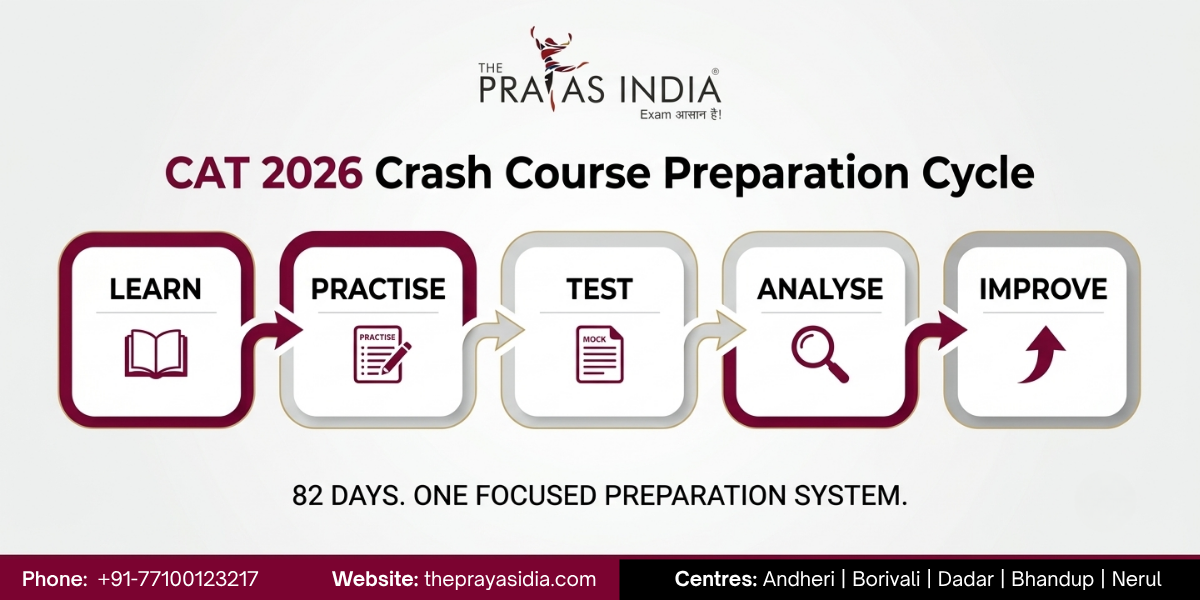
Learn → Practise → Test → Analyse → Improve
This approach is particularly relevant to a crash course because the available time is limited.
Students do not simply need additional content. They need to know what deserves attention, practise it under appropriate conditions, test themselves regularly and understand how to correct performance gaps.
The Prayas India also has CAT coaching presence across Mumbai locations including Andheri, Borivali, Dadar, Bhandup and Nerul, giving students multiple options when considering classroom-based preparation.
Your 82-Day CAT Plan Should End With Exam Readiness
The final objective of a crash course should not be “finishing the course.”
It should be being ready for CAT.
There is a significant difference.
Finishing lectures can give you a feeling of completion. Exam readiness means you can sit through a full-length mock, make intelligent decisions, manage your time, handle difficult questions without panicking and recover when a section does not go exactly as expected.
That level of readiness comes from repeated exposure.
The final weeks should therefore increasingly resemble the actual examination environment.
A practical progression can look like:
September: Build + Repair
October: Practise + Test
November: Analyse + Revise + Refine
The exact distribution will depend on the aspirant’s starting level, but the principle remains the same: the closer CAT gets, the less preparation should depend on passive learning.
The Final 82-Day Checklist
Before joining or continuing with a CAT Crash Course, an aspirant should be able to answer these questions honestly:
Preparation
- Do I have a realistic 82-day plan?
- Do I know my strongest and weakest areas?
- Am I giving regular attention to VARC, DILR and QA?
Testing
- Am I taking sectional tests?
- Am I taking full-length mocks?
- Do I analyse every important test?
Improvement
- Do I know why I lose marks?
- Am I correcting repeated mistakes?
- Is my accuracy improving?
- Is my question selection improving?
Strategy
- Do I know how I want to approach each section?
- Can I manage time under pressure?
- Can I identify when to leave a question or DILR set?
Guidance
- Do I have someone who can help me identify preparation gaps?
- Can I get doubts resolved quickly?
- Can I track my progress objectively?
If several answers are “no”, then a structured crash course deserves serious consideration.
Do Not Wait for the Final Month to Fix Your Preparation
The biggest advantage of joining a CAT Crash Course in September is not simply having more classes.
It is having more time to use the system.
If you join early enough, there is time to identify weaknesses, make mistakes, receive feedback, correct them and test again.
Waiting until November can turn the preparation into a race against the calendar.
The objective of a crash course is precisely the opposite.
It should give you a structured route through the remaining preparation window so that you reach November with fewer unanswered questions about your strategy.
Your CAT 2026 Preparation Needs a Decision Now
CAT 2026 is not far away.
With November 29 approaching, the remaining 82 days should be treated as a focused performance-building window. Whether you are a late starter, a repeater, a college student, a working professional or someone whose preparation has not progressed as expected, the most important thing now is to evaluate your current preparation honestly.
If your existing strategy is working, continue improving it.
If your preparation is scattered, your mock scores are stagnant, your syllabus is incomplete or you are struggling to decide what to prioritise, a structured CAT Crash Course may be the smarter move.
The Prayas India can provide the structured learning environment, testing framework, performance analysis, doubt support and mentoring that can help aspirants make better use of the final preparation window.
The purpose is not to promise a percentile.
The purpose is to help you prepare more systematically for the opportunity that CAT 2026 represents.
82 days can be a long time when every week has a purpose.
And the right time to build that structure is now.

Final Takeaway
A CAT Crash Course makes the most sense when an aspirant needs to turn limited time into a structured preparation process.
With 82 days remaining, the objective should no longer be to consume as much CAT content as possible. The objective should be to identify the highest-value preparation areas, practise them consistently, test performance under pressure, analyse mistakes and improve before the next test.
For some aspirants, self-study can provide this structure. For others, a guided crash course can save valuable time by providing a defined preparation path and regular performance checkpoints.
The decision should therefore be based on one simple question:
“Is my current preparation system strong enough to make the next 82 days count?”
If the answer is no, this is the time to change the system—not wait for the final few weeks.
For aspirants looking for CAT Crash Course and CAT coaching in Mumbai, The Prayas India offers a structured preparation environment designed around learning, practice, testing, analysis and improvement.
CAT 2026 is on November 29. The remaining preparation window is limited. Use it strategically.
Contact Us
- Call Now: +91-77100 13217
- Website: theprayasindia.com
- Centres: Andheri | Borivali | Dadar | Nerul | Bhandup
Frequently Asked Questions
1. Is 82 days enough to prepare for CAT 2026?
Eighty-two days is a limited but meaningful preparation window. The outcome will depend heavily on your current preparation level, consistency, ability to prioritise and quality of practice. A structured crash course can be particularly useful for aspirants who need a focused plan for the remaining weeks.
2. Who should join a CAT Crash Course?
A CAT Crash Course can be useful for late starters, students with incomplete preparation, aspirants whose mock scores are not improving, repeaters who want a different preparation strategy, working professionals and college students who need a structured schedule.
3. Can I prepare for CAT through self-study in the last 82 days?
Yes, but self-study requires strong discipline, reliable resources, regular testing and the ability to analyse your own performance. If these elements are missing, a structured crash course can provide useful direction.
4. What should a CAT Crash Course include?
A useful crash course should ideally combine targeted concept coverage, practice, sectional tests, full-length mocks, mock analysis, revision, doubt-solving and guidance on exam strategy.
5. Should I join a CAT Crash Course if I have already completed the syllabus?
Yes, if your current requirement is practice, testing and performance improvement. Students who have completed the syllabus may benefit from a programme that helps convert conceptual knowledge into exam performance.
6. Should repeat CAT aspirants join a crash course?
A repeater can benefit if the programme helps identify the reasons behind the previous attempt's performance and provides a more structured approach to testing, analysis and correction.
7. Can working professionals join a CAT Crash Course?
Yes. A structured programme can be particularly useful for working professionals because it can help them organise limited preparation time around classes, practice and tests.
8. How many CAT mocks should I take before November 29?
There is no universal number that works for every aspirant. The quality of analysis is more important than simply increasing the number of mocks. Every mock should help identify something that can be improved before the next test.
9. What if my CAT mock score is still low in September?
Do not judge your final potential from one or two mocks. Identify the source of the gap—concepts, accuracy, speed, question selection or time management—and build your next preparation cycle around that specific problem.
10. Why is mock analysis important?
Mock analysis tells you why marks were lost. It can reveal conceptual gaps, careless mistakes, inefficient methods, poor time allocation and incorrect question selection. This information makes subsequent preparation more targeted.
11. Is CAT Crash Course useful for students who have not completed the syllabus?
It can be useful when the programme follows a selective and structured approach. Instead of trying to complete every possible topic, students can focus on important areas while simultaneously building testing and exam-taking skills.
12. Why consider The Prayas India for CAT preparation in Mumbai?
The Prayas India offers structured CAT preparation with learning, practice, mock testing, performance analysis, doubt support and mentoring. Its Mumbai presence includes centres such as Andheri, Borivali, Dadar, Bhandup and Nerul.