CAT 2026 Time Management Tips to Maximise Your Score | Best CAT Coaching in Mumbai | The Prayas India
Every Minute Matters in CAT 2026
Cracking the Common Admission Test (CAT) is not just about solving difficult questions—it’s about solving the right questions within a limited time. Every year, thousands of MBA aspirants with excellent conceptual knowledge fail to achieve their target percentile simply because they struggle with time management during the exam.
CAT is designed to test your speed, accuracy, decision-making ability, and pressure handling skills. With only 120 minutes divided equally among three sections, candidates have very little room for mistakes. Spending too much time on one difficult question can affect your performance in the entire section.
The good news is that effective time management is a skill that can be developed with the right preparation strategy, regular practice, and mock test analysis.
In this article, we’ll discuss the best CAT 2026 time management tips that can help you improve speed, accuracy, and overall performance. If you’re aiming for a high percentile and looking for the Best CAT Coaching in Mumbai, these strategies, combined with expert guidance, can significantly improve your chances of success.
Why Time Management is Crucial for CAT 2026
Unlike many competitive examinations, CAT doesn’t just test your knowledge—it evaluates how efficiently you use your time under pressure.
Every section comes with a fixed time limit, meaning you cannot switch between sections or compensate for lost time later. This makes planning and execution just as important as conceptual understanding.
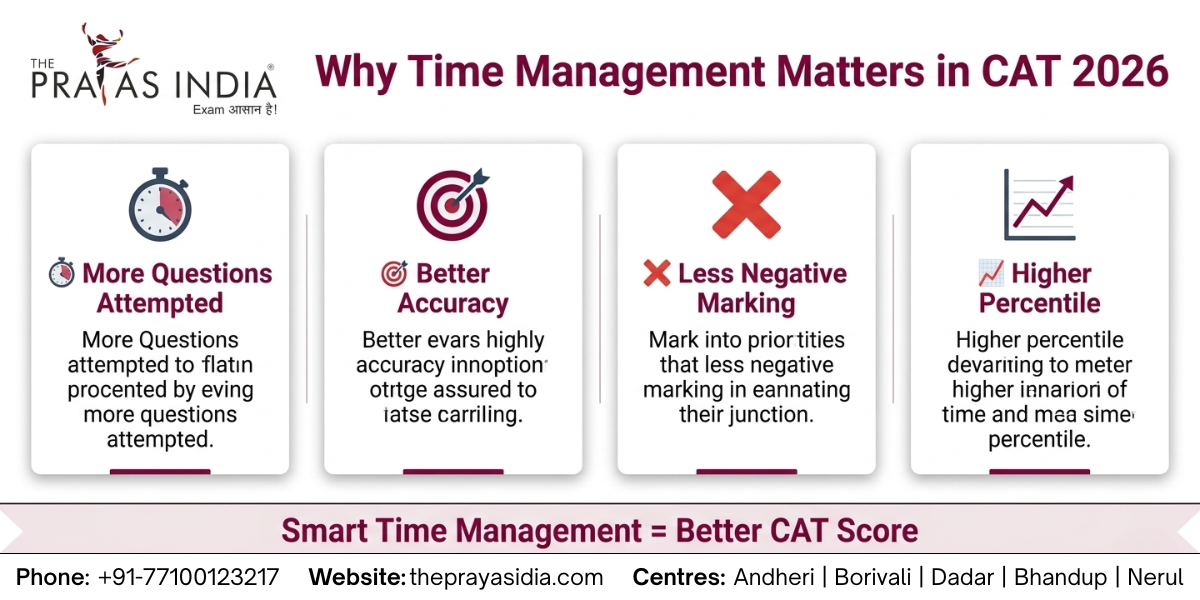
Good time management helps you:
- Attempt more questions with confidence.
- Reduce unnecessary pressure during the exam.
- Avoid getting stuck on difficult questions.
- Improve accuracy and minimize negative marking.
- Maximize your overall percentile.
Candidates who consistently score 95+ percentile often follow a disciplined time management strategy throughout their preparation, not just on exam day.
Understand the CAT Exam Structure Before Managing Time
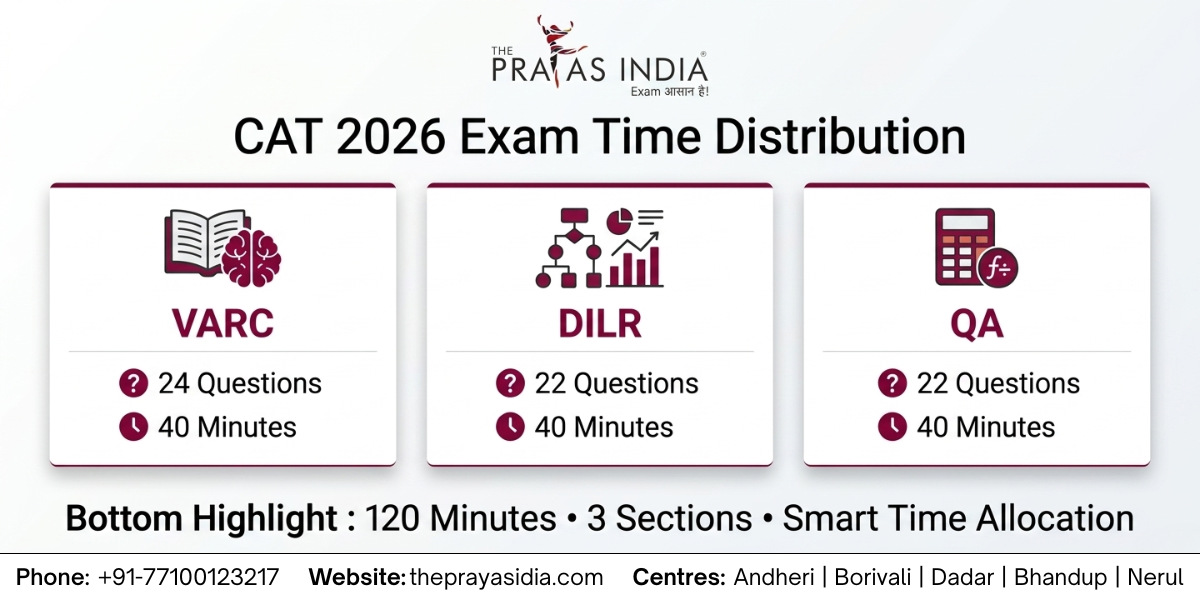
Before creating a time management strategy, you should be familiar with the structure of the examination.
| Section | Approx. Questions | Time Available |
|---|---|---|
| VARC | 24 | 40 Minutes |
| DILR | 22 | 40 Minutes |
| QA | 22 | 40 Minutes |
Since every section has a fixed duration, you must learn how to distribute your time effectively within those 40 minutes.
Time Management Tip #1: Build a Section-wise Strategy
One of the biggest mistakes CAT aspirants make is following the same approach for all three sections.
Each section demands a different mindset.
For VARC
- Begin with Reading Comprehension passages that seem easier.
- Don’t spend excessive time on one difficult passage.
- Keep Verbal Ability questions for later if required.
For DILR
- Spend the first few minutes identifying the easiest sets.
- Avoid forcing yourself to solve every set.
- Select quality sets instead of attempting more.
For QA
- Start with familiar topics.
- Skip lengthy calculations initially.
- Return to difficult questions only if time permits.
A section-wise strategy ensures that you maximize attempts without compromising accuracy.
Time Management Tip #2: Follow the 3-Round Attempt Strategy
One of the most effective techniques followed by CAT toppers is the 3-Round Strategy.
Round 1 – Easy Questions (First 12–15 Minutes)
Focus only on questions you can solve quickly and confidently.
Your objective is to build momentum and secure maximum easy marks.
Round 2 – Moderate Questions
Move to questions that require a little more thinking but are still manageable.
Avoid lengthy calculations.
Round 3 – Difficult Questions
Attempt only if sufficient time remains.
If a question seems unusually lengthy or confusing, it’s often wiser to leave it than to waste valuable minutes.
Remember, CAT rewards smart selection of questions—not attempting every question.
Time Management Tip #3: Don’t Chase Every Question
Many candidates believe that attempting all questions will automatically lead to a high percentile.
This is one of the biggest misconceptions about CAT.
A better strategy is to:
- Prioritize accuracy over quantity.
- Skip low-confidence questions.
- Avoid unnecessary guesswork.
- Focus on maximizing your score instead of your attempts.
In CAT, selecting the right questions is often more important than solving the maximum number of questions.
Time Management Tip #4: Improve Your Reading Speed
The VARC section can consume a significant portion of your time if your reading speed is slow.
Develop the habit of reading regularly from:
- Editorials
- Business magazines
- Newspapers
- Opinion articles
- Long-form essays
While reading, practice identifying the author’s tone, central idea, assumptions, and conclusions.
The faster you comprehend passages, the more time you’ll have for answering questions accurately.
Time Management Tip #5: Practice with a Stopwatch

Most aspirants solve practice questions without tracking the time, which creates a false sense of confidence.
Instead, develop the habit of solving:
- Reading Comprehension passages
- DILR sets
- Quantitative Ability questions
using a stopwatch or timer.
This helps you:
- Build speed.
- Understand your average solving time.
- Identify weak areas.
- Improve decision-making under pressure.
Gradually reducing your average solving time can make a significant difference in your overall CAT performance.
Expert Tip from The Prayas India
Time management is not something you learn a week before the exam—it is a skill developed through consistent practice, regular mock tests, and expert guidance.
At The Prayas India, students receive structured preparation plans, sectional strategies, performance analysis, and mentor feedback that help them improve both speed and accuracy. If you’re searching for the Best CAT Coaching in Mumbai, learning under experienced mentors can help you build effective time management habits from day one.
Time Management Tip #6: Analyse Every Mock Test Thoroughly
Taking mock tests is important, but analysing them is what truly improves your performance. Many CAT aspirants make the mistake of attempting one mock after another without reviewing their mistakes. As a result, they keep repeating the same errors and fail to improve their percentile.
After every mock test, spend at least 2–3 hours analysing your performance.
Focus on questions such as:
- Which section consumed the most time?
- Which questions took longer than expected?
- Which mistakes were due to calculation errors?
- Which questions should have been skipped?
- Where did you lose marks because of poor decision-making?
Maintain an error log and revise it regularly. Over time, you’ll notice recurring patterns and gradually eliminate them.
Time Management Tip #7: Set Time Limits During Daily Practice
Don’t reserve time management only for mock tests. Your daily practice sessions should also be time-bound.
For example:
| Activity | Suggested Time |
|---|---|
| Reading Comprehension Passage | 8–10 Minutes |
| One DILR Set | 10–12 Minutes |
| 10 Quant Questions | 15–18 Minutes |
| Vocabulary & Grammar Revision | 20 Minutes |
Practising under time constraints trains your mind to work efficiently and prepares you for the pressure of the actual CAT exam.
Time Management Tip #8: Learn the Art of Skipping Questions
One of the biggest differences between an average CAT aspirant and a high-percentile scorer is knowing when to skip a question.
Many candidates waste valuable time trying to solve every problem, even when it’s clear the question is unusually lengthy or difficult.
Instead:
- Skip questions that appear calculation-intensive.
- Move on if you cannot identify the approach within a minute.
- Return to difficult questions only if extra time remains.
- Prioritise questions with a higher probability of being solved correctly.
Remember, CAT rewards smart decision-making, not stubbornness.
Time Management Tip #9: Strengthen Your Weak Areas Early
Weak topics often consume more time during the examination because candidates hesitate, rethink concepts, or make repeated calculation mistakes.
Identify your weakest chapters through mock tests and sectional quizzes.
For example:
- Slow Reading Comprehension
- Complex DILR Sets
- Algebra
- Geometry
- Number System
Devote extra practice sessions to these topics. As your conceptual clarity improves, your solving speed naturally increases.
Time Management Tip #10: Develop an Exam-Day Time Strategy
No matter how well you’ve prepared, success on exam day depends on sticking to a clear plan.
Before the exam:
- Sleep well the night before.
- Reach the exam centre early.
- Avoid learning new topics at the last moment.
- Stay calm during the tutorial session.
- Begin with confidence and avoid panic if you encounter difficult questions.
During the exam:
- Keep track of the remaining time.
- Focus on accuracy rather than attempting every question.
- Avoid spending several minutes on a single problem.
- Stay mentally composed even if one section feels difficult.
A disciplined strategy often performs better than an aggressive one.
Common Time Management Mistakes to Avoid
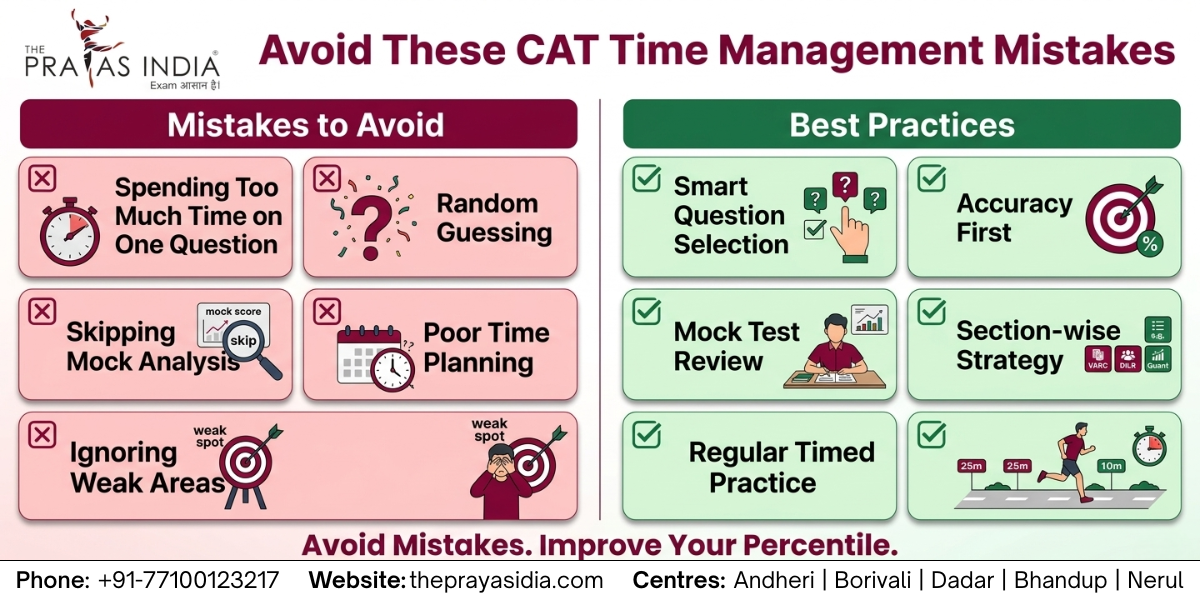
Even well-prepared candidates lose marks because of avoidable mistakes. Being aware of these errors can help you improve your overall performance.
Avoid These Mistakes
- Spending too much time on one difficult question.
- Attempting every question without a strategy.
- Ignoring sectional time management.
- Taking mock tests without analysing them.
- Guessing excessively and increasing negative marking.
- Starting preparation too late.
- Neglecting weak subjects.
- Practising without a timer.
- Not revising previously made mistakes.
- Panicking after encountering a difficult set.
Eliminating these habits can significantly improve both speed and accuracy.
A Simple 30-Day Time Management Plan for CAT 2026
If your exam is approaching, follow a structured routine during the final month.
Week 1
- Revise core concepts.
- Solve sectional tests.
- Build accuracy.
Week 2
- Attempt 2–3 full-length mock tests.
- Analyse every mock thoroughly.
- Improve weak areas.
Week 3
- Increase speed through timed practice.
- Focus on high-weightage topics.
- Revise formulas and shortcuts.
Week 4
- Take final mock tests.
- Revise error notes.
- Maintain confidence.
- Avoid learning completely new topics.
Consistency during these 30 days often makes a significant difference in the final CAT percentile.
Why Choose The Prayas India for CAT 2026 Preparation?

Time management is not just about solving questions quickly—it is about building the right habits through expert guidance and consistent practice.
At The Prayas India, students receive a structured preparation program designed to improve both speed and accuracy. Whether you’re starting your CAT journey or aiming to improve your percentile, our mentors help you create a personalized preparation strategy.
What You Get at The Prayas India
- Experienced CAT mentors
- Updated study material based on the latest CAT pattern
- Topic-wise classroom and online sessions
- Full-length CAT mock test series
- Detailed performance analysis
- One-to-one doubt-solving support
- Section-wise time management strategies
- GD, PI & MBA admission guidance
- Regular revision and practice sessions
If you’re searching for the Best CAT Coaching in Mumbai, The Prayas India offers the right learning environment, expert mentorship, and proven preparation methods to help you achieve your MBA goals.
Conclusion
Scoring well in CAT is not only about knowing the concepts—it’s about applying them efficiently within a limited time. A smart time management strategy helps you improve accuracy, reduce stress, and maximize your overall score.
Start practising with a timer, analyse every mock test, identify your weak areas, and build a disciplined study routine. These small but consistent efforts can make a significant difference on exam day.
If you’re serious about securing admission to an IIM or a leading B-school, combine these strategies with expert mentorship and structured preparation. With the right guidance and consistent practice, achieving a high CAT percentile becomes much more attainable.
Contact Us
- 📞 Call: +91-77100 13217
- 🌐 Website: https://theprayasindia.com
- 📍 Centres: Andheri | Borivali | Dadar | Nerul | Bhandup
Frequently Asked Questions (FAQs)
1. Why is time management important for CAT 2026?
Time management helps candidates attempt the right questions within the fixed sectional time limits, improving both accuracy and overall percentile.
2. How can I improve my speed for the CAT exam?
Practice daily with a timer, take regular mock tests, analyse your performance, and focus on improving weak areas.
3. How many mock tests should I take before CAT 2026?
There is no fixed number, but attempting multiple full-length mocks along with detailed analysis is recommended for effective preparation.
4. Should I attempt every question in CAT?
No. It is better to attempt questions you are confident about rather than wasting time on difficult ones or making random guesses.
5. What is the best strategy for managing time in CAT?
A section-wise approach, the 3-round attempt strategy, timed practice, and thorough mock test analysis are among the most effective techniques.
6. Can coaching help improve time management for CAT?
Yes. Expert mentors can help you develop personalized strategies, improve speed, identify mistakes, and optimize your overall preparation.
7. Which is the Best CAT Coaching in Mumbai?
The Prayas India is a trusted choice for CAT preparation, offering expert faculty, structured study plans, mock tests, performance analysis, and complete MBA admission guidance for aspiring management students.