CAT 2027 Preparation After Graduation: Should You Start Immediately?
Graduation is an important turning point for students who want to pursue an MBA. For many graduates, the next question comes almost immediately: Should I start preparing for CAT 2027 now, or should I first work for a year, explore my options, or prepare on my own?
There is no single answer that applies to every graduate. Your decision can depend on your academic background, Quantitative Ability fundamentals, reading habits, career plans, financial situation, work experience goals and how clearly you understand the MBA admission process.
However, one thing is important for almost every CAT aspirant: CAT preparation is not just about completing a syllabus. It is about gradually developing conceptual clarity, speed, accuracy, question selection, test-taking ability and the discipline to analyse mistakes.
That is why students who have recently graduated should not think only in terms of “When is the exam?” A better question is:
“When should I start building the skills required to perform well in CAT?”
For CAT 2027 aspirants, starting early can provide the time required to strengthen fundamentals before moving towards intensive mock-test preparation. It can also be particularly useful for students who are weak in mathematics, have limited reading habits, are unfamiliar with DILR or are preparing for the exam for the first time.
Important Note for CAT 2027 Aspirants
Official CAT 2027 examination-specific details should be checked against the
official CAT website once the notification and information bulletin
are released. This article uses the latest available CAT framework as a preparation
reference and focuses primarily on how graduates can plan their preparation.
Why Should Graduates Consider Starting CAT 2027 Preparation Early?
A common mistake after graduation is assuming that there is plenty of time because the examination is still some distance away. Students often postpone preparation while deciding between jobs, higher studies, competitive examinations or other career options.
The problem with waiting is that CAT preparation usually requires more than a few months of question practice.
A student may initially need several weeks or months simply to rebuild basic mathematics, improve reading comprehension, understand different DILR set structures and become comfortable with timed problem solving. After that comes higher-level practice, sectional testing, mock tests, analysis and repeated revision.
Starting early does not mean studying for CAT for several hours every day from the beginning. It means using the available time intelligently.
For example, a graduate who starts with two or three focused hours of preparation can spend the initial phase developing fundamentals. As preparation progresses, the student can gradually increase the intensity of practice and testing.
This creates a very different preparation experience from someone who begins late and has to simultaneously learn concepts, practise questions and take mocks under time pressure.
Starting Early Gives You Time to:
- Identify your weak areas before they become major problems.
- Build Quant fundamentals without rushing through concepts.
- Develop a consistent reading habit for VARC.
- Understand DILR through repeated exposure to different set structures.
- Practise CAT-level questions gradually.
- Build speed without sacrificing accuracy.
- Take sectional and full-length tests at the appropriate stage.
- Analyse mistakes and work on recurring weaknesses.
- Revise concepts multiple times.
- Make changes to your strategy before the final phase.
The objective should not be to “finish CAT preparation early.” The objective is to reach the final phase with enough conceptual and testing maturity to use mocks effectively.
Should You Start CAT Preparation Immediately After Graduation?
For many students, beginning preparation soon after graduation can be a practical option, particularly if an MBA is already a serious career goal.
But “start immediately” does not mean that you need to join a coaching programme or start taking full-length CAT mocks from the first week.
Your first step should be diagnosis.
Before creating a detailed preparation plan, understand where you currently stand.
Ask yourself:
- How comfortable am I with school-level mathematics?
- How frequently do I read long-form English content?
- Can I understand the central idea of a difficult passage?
- How comfortable am I with logical puzzles and data interpretation?
- Can I solve questions accurately under time pressure?
- Have I ever taken a CAT-level diagnostic test?
- Do I know the structure and demands of the CAT examination?
- Can I maintain a study schedule without external accountability?
The answers to these questions can help determine how much foundational work you need.
A student with strong mathematical fundamentals and good reading habits may move relatively quickly into CAT-level practice. Another student may need a longer foundation phase.
The important point is to avoid following someone else’s preparation timeline blindly.
CAT Preparation After Graduation vs Preparing During College
Final-year students and graduates often compare their situations.
A student preparing during college may have academic responsibilities, examinations, projects, internships and extracurricular commitments. A graduate may have more control over the daily schedule but may also face pressure to start earning or make an immediate career decision.
Neither situation automatically determines preparation quality.
What matters is how effectively the student uses available time.
If You Are Still in Final Year
You can begin with a moderate schedule while maintaining your graduation responsibilities. Focus on:
- Quantitative fundamentals
- Reading comprehension
- Basic DILR exposure
- CAT syllabus familiarity
- Previous CAT questions
- Consistent daily practice
This allows you to enter the post-graduation phase with some preparation already completed.
If You Have Already Graduated
You may have greater flexibility to create a structured preparation routine.
That flexibility should not turn into an unstructured schedule.
Instead of saying, “I have the entire day to study,” create fixed study blocks for:
Concept Building → Practice → Revision → Testing → Analysis
This distinction is important because simply spending more hours around study material does not necessarily mean that preparation is improving.
Does Taking a Gap After Graduation Affect CAT Preparation?
A gap after graduation is not automatically a reason to avoid CAT preparation.
Students may take time to prepare for entrance examinations, explore career options, work on professional skills, pursue internships, work part-time or prepare for multiple management entrance examinations.
However, if you are taking time specifically for CAT preparation, you should be able to explain how you used that period productively.
This is one reason why graduates should maintain a clear record of their preparation journey.
Keep track of:
- Courses or certifications completed
- Internships or projects
- Skill development
- Test preparation
- Mock-test progress
- Extracurricular activities
- Relevant achievements
- Volunteer or leadership experiences
The broader MBA admission process can involve more than the CAT score alone. Individual B-schools can have their own admission policies and may consider academic performance, work experience, diversity and other profile factors.
Therefore, while preparing for CAT 2027, graduates should think about both exam preparation and profile development.
What Should a Graduate Know Before Starting CAT 2027 Preparation?
Before purchasing multiple books, joining random Telegram groups or downloading hundreds of PDFs, understand what CAT preparation actually requires.
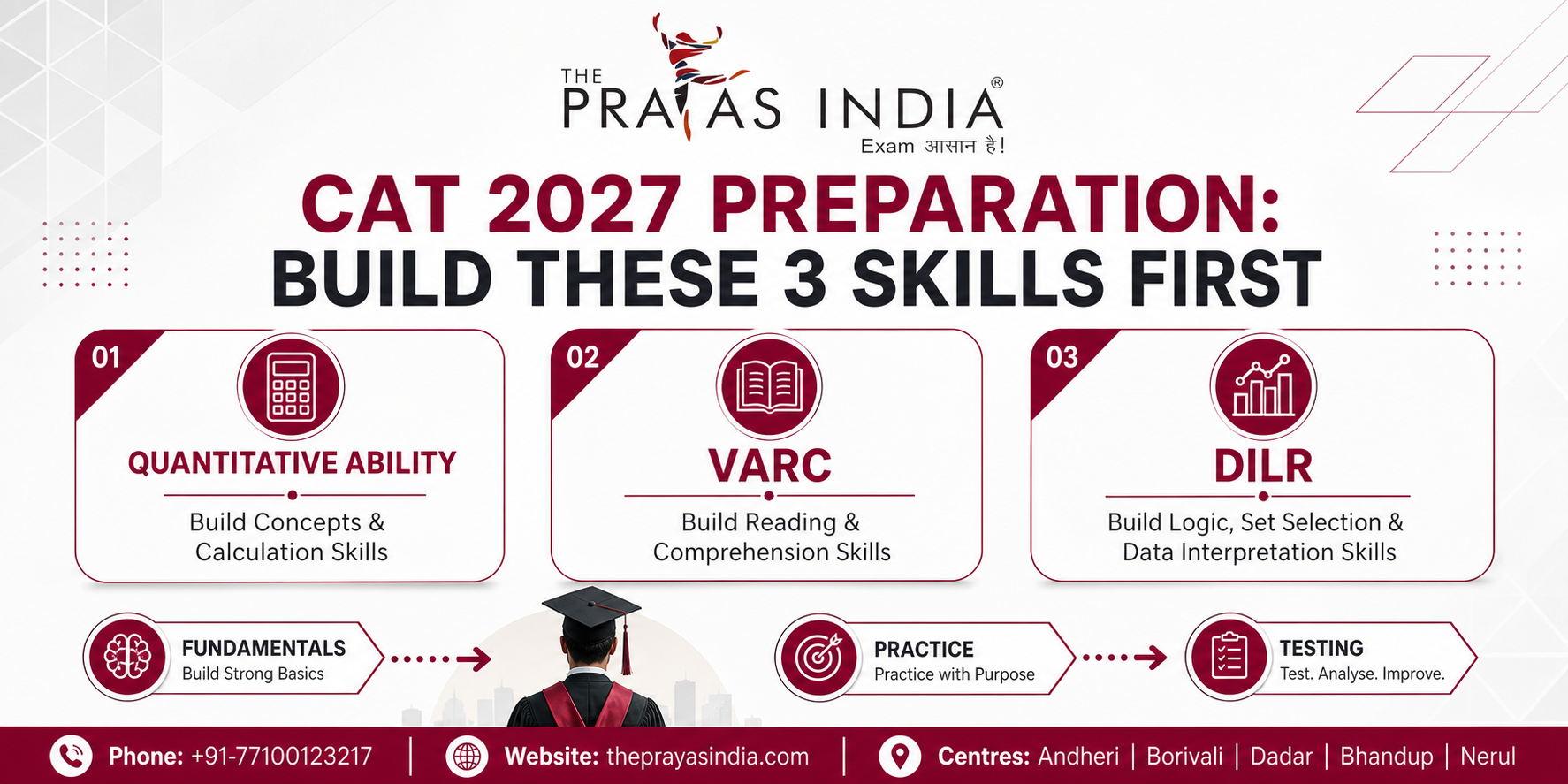
The preparation can broadly be organised around three major areas:
1. Quantitative Ability
Quant preparation is not simply about remembering formulas.
You need to understand concepts, identify patterns, select appropriate approaches and solve questions efficiently.
A graduate from a non-mathematics background may initially feel that Quant is the biggest obstacle. In many cases, the problem is not an inability to learn mathematics but a lack of recent exposure to mathematical concepts.
The solution is to rebuild fundamentals systematically rather than immediately jumping into difficult questions.
The Prayas India’s recent CAT preparation material similarly emphasises moving from fundamentals to topic tests, sectional tests and eventually full-length mocks rather than treating mocks as the first step.
2. VARC
VARC preparation requires more than memorising vocabulary.
Reading comprehension demands the ability to understand an author’s argument, identify the central idea, distinguish between strong and weak inferences and eliminate unsuitable options.
Graduates who have spent years primarily reading academic textbooks may still find CAT RC challenging because CAT passages can require a different kind of analytical reading.
Therefore, reading should become a regular part of your routine.
3. DILR
DILR can be unpredictable in the sense that the exact structure of a set cannot be assumed in advance.
The preparation therefore needs exposure to different kinds of arrangements, tables, graphs, games, selections, distributions and logical situations.
The objective is not simply to solve a fixed number of sets. You need to learn:
How to understand a set → How to structure information → How to identify the approach → How to decide whether to continue or move on.
This is why proper analysis of DILR practice is more valuable than simply counting the number of sets solved.
How Long Should a Graduate Prepare for CAT 2027?
There is no universal number of months that guarantees a particular CAT result.
A better approach is to divide preparation into phases.
Phase 1: Foundation
The first phase should focus on understanding your strengths and weaknesses and building fundamentals.
For Quant, this may involve arithmetic, algebra, geometry and other core areas.
For VARC, build a reading habit and begin structured RC practice.
For DILR, learn how to represent information and approach different set types.
At this stage, quality matters more than speed.
Phase 2: Conceptual Practice
Once the fundamentals are stable, increase the level of CAT-oriented practice.
Start solving questions that require multiple concepts, logical interpretation and careful option analysis.
Maintain an error log.
Do not simply mark a question wrong and move on.
Ask:
Why did I get it wrong?
Was it a concept problem?
A calculation error?
A reading mistake?
A poor question-selection decision?
A time-management issue?
This classification becomes extremely useful later.
Phase 3: Timed Practice
Once sufficient topics are covered, introduce timed sectional and mixed practice.
This is where you begin developing exam-oriented decision-making.
You need to learn not only how to solve a question but also:
Should I solve this question now?
How much time should I spend?
When should I leave a question?
Which questions should receive priority?
These decisions can significantly influence performance in a timed examination.
Phase 4: Mock Tests and Analysis
Mocks should not become a race to collect scores.
A mock is useful because it reveals how you behave under pressure.
After every mock, analyse:
- Questions you should have solved but missed
- Questions where you spent excessive time
- Incorrect attempts
- Questions left despite being solvable
- Section-wise time distribution
- Conceptual gaps
- Repeated errors
- Question-selection mistakes
The score tells you what happened.
Analysis helps you understand why it happened.
That difference is critical.
Is Self-Study Enough for CAT 2027 After Graduation?
Self-study can work for students who are disciplined, understand the CAT syllabus, can identify their weaknesses accurately and are comfortable creating and following their own preparation system.
But self-study also has challenges.
A graduate preparing alone may spend several weeks following the wrong resource, practise questions at the wrong difficulty level or take too many mocks without understanding why scores are not improving.
Another common problem is resource overload.
A student starts with one YouTube channel, then downloads another teacher’s notes, joins multiple groups, buys several books and eventually has more resources than time.
The issue is rarely lack of material.
The issue is usually lack of a structured system for using the material.
This is where guided preparation can become useful.
When Does Coaching Become Useful for a CAT 2027 Graduate Aspirant?
Coaching is not a substitute for individual effort.
Even the best classroom cannot prepare for CAT on behalf of a student.
However, structured coaching can provide a framework around that effort.
A graduate may find guided preparation particularly useful when:
- Quant fundamentals are weak.
- DILR approaches feel unfamiliar.
- VARC performance is inconsistent.
- There is no clear study schedule.
- The student struggles to identify quality resources.
- Mock scores are not improving despite regular attempts.
- Repeated mistakes are not being diagnosed.
- The student needs accountability.
- Doubts remain unresolved for long periods.
- The student wants regular performance feedback.
The Prayas India’s CAT-focused preparation content highlights structured practice, faculty guidance, sectional testing, full-length mocks, performance analysis and mentorship as important components of preparation.
The important question is therefore not simply:
“Should I join coaching?”
A better question is:
“What kind of preparation system will help me identify and correct my weaknesses consistently?”
How to Decide Whether You Need CAT Coaching After Graduation
Before enrolling anywhere, evaluate your current preparation honestly.
You can use a simple four-question framework.
Question 1: Do You Have a Clear Plan?
Can you explain what you will study during the next four weeks?
If your plan is simply “I will prepare Quant, VARC and DILR,” it is too broad.
A useful plan should tell you what topics you will cover, how you will practise them, when you will revise and how you will measure progress.
Question 2: Do You Have Reliable Resources?
You do not need ten teachers and twenty books.
You need a limited set of reliable resources that cover the concepts, provide appropriate practice and allow you to progress systematically.
Question 3: Can You Analyse Your Own Performance?
This is one of the biggest differences between casual preparation and serious preparation.
If you take a mock and only look at your percentile before moving to the next test, you are missing much of the learning opportunity.
Question 4: Can You Stay Consistent Without External Accountability?
Some students are highly self-disciplined.
Others start strongly but lose momentum after a few weeks.
If consistency is a recurring problem, a structured classroom or online programme can provide a timetable, deadlines, testing schedule and access to mentors or faculty.
CAT 2027 Preparation Roadmap for Graduates
A graduate starting CAT 2027 preparation can broadly follow this progression.
Step 1: Understand the CAT Framework
Start with the latest available official CAT information and understand the broad structure of the examination.
Do not build your preparation around rumours about future pattern changes.
Step 2: Take a Diagnostic Test
The purpose is not to chase a high score.
Use the test to understand your current position.
Step 3: Build Fundamentals
Strengthen the concepts that your diagnostic performance identifies as weak.
Step 4: Practise Topic-Wise
Complete a concept, practise it, review mistakes and revisit weak areas.
Step 5: Introduce Mixed Practice
CAT does not present questions in the comfortable order in which you studied them.
Mixed practice helps you identify which concept is actually required.
Step 6: Start Sectional Testing
Gradually introduce timed sectional tests once sufficient conceptual coverage is achieved.
Step 7: Move Towards Full-Length Mocks
As your preparation matures, increase the frequency of full-length mocks.
Step 8: Analyse Every Test
Maintain an error log and track recurring problems.
Step 9: Revise Strategically
Do not revise every chapter equally.
Give greater attention to areas where your accuracy, speed or confidence remains weak.
Step 10: Build Exam-Day Decision Making
Your final preparation should not only ask, “Can I solve this?”
It should also train you to answer:
“Is this worth my time?”

What If You Are a Non-Maths Graduate?
This is one of the most important questions for CAT 2027 aspirants from non-engineering and non-mathematics backgrounds.
If mathematics has not been part of your regular studies for several years, the first few weeks of Quant preparation may feel uncomfortable.
That does not mean you should avoid CAT.
It means your preparation should begin at the appropriate level.
Do not compare your first-week performance with someone who has been solving quantitative aptitude questions for months.
Start by rebuilding:
- Basic arithmetic
- Percentages
- Ratios
- Averages
- Profit and loss
- Time, speed and distance
- Time and work
- Basic algebra
- Equations
- Geometry fundamentals
Then gradually move towards CAT-level applications.
The same principle applies to students from strong mathematics backgrounds. They may need less time for fundamentals but should still work on CAT-specific question selection and efficiency.
The starting point can be different. The destination can still be the same.
What If You Are a Recent Graduate With No Work Experience?
Not having work experience does not mean you need to postpone CAT preparation.
In fact, if an MBA is your immediate career goal, this can be a useful stage to focus on entrance preparation while your academic concepts and study habits are still relatively fresh.
At the same time, do not assume that CAT preparation is the only thing that matters.
Use the period productively.
You can work on:
- Internships
- Certifications
- Communication skills
- Extracurricular activities
- Leadership experiences
- Projects
- Relevant professional exposure
- General awareness and business understanding
Different B-schools have different admission processes and selection criteria, so students should research the policies of the institutes they eventually intend to apply to rather than assuming that one CAT percentile alone determines every outcome.
What If You Are Considering a Job Before MBA?
This is another situation where there is no universal answer.
Taking a job can provide professional exposure, financial independence and work experience. Preparing immediately for CAT can allow you to focus intensely on the entrance process.
Your decision should depend on your career objectives and personal circumstances.
If you decide to work before MBA, CAT preparation becomes a time-management challenge.
A working professional may have to prepare before work, after work or during weekends. The total number of available study hours may be lower, but consistent preparation can still be meaningful.
This is why working aspirants should not copy the timetable of a full-time student.
Instead, build a realistic schedule around your actual life.
How Many Hours Should a Graduate Study for CAT 2027?
There is no magic number of study hours that guarantees a particular CAT score.
The quality of preparation matters.
A focused two-hour session can be more productive than five hours of distracted studying.
Instead of setting only an hourly target, divide your preparation into activities.
For example:
Concept Learning + Problem Solving + Reading + Revision + Test Analysis
As your preparation becomes more advanced, testing and analysis should occupy a greater share of your schedule.
A graduate preparing full-time can use longer study blocks, while someone working or pursuing another course may need shorter but consistent sessions.
The key is sustainability.
A timetable that looks impressive for five days but collapses after two weeks is not a good preparation strategy.
Why Mock Tests Should Not Be the Only Measure of Your Preparation
Many CAT aspirants become obsessed with mock-test scores.
One mock gives a good score and confidence increases.
The next mock goes badly and the student changes the entire strategy.
This creates instability.
Mock scores naturally fluctuate.
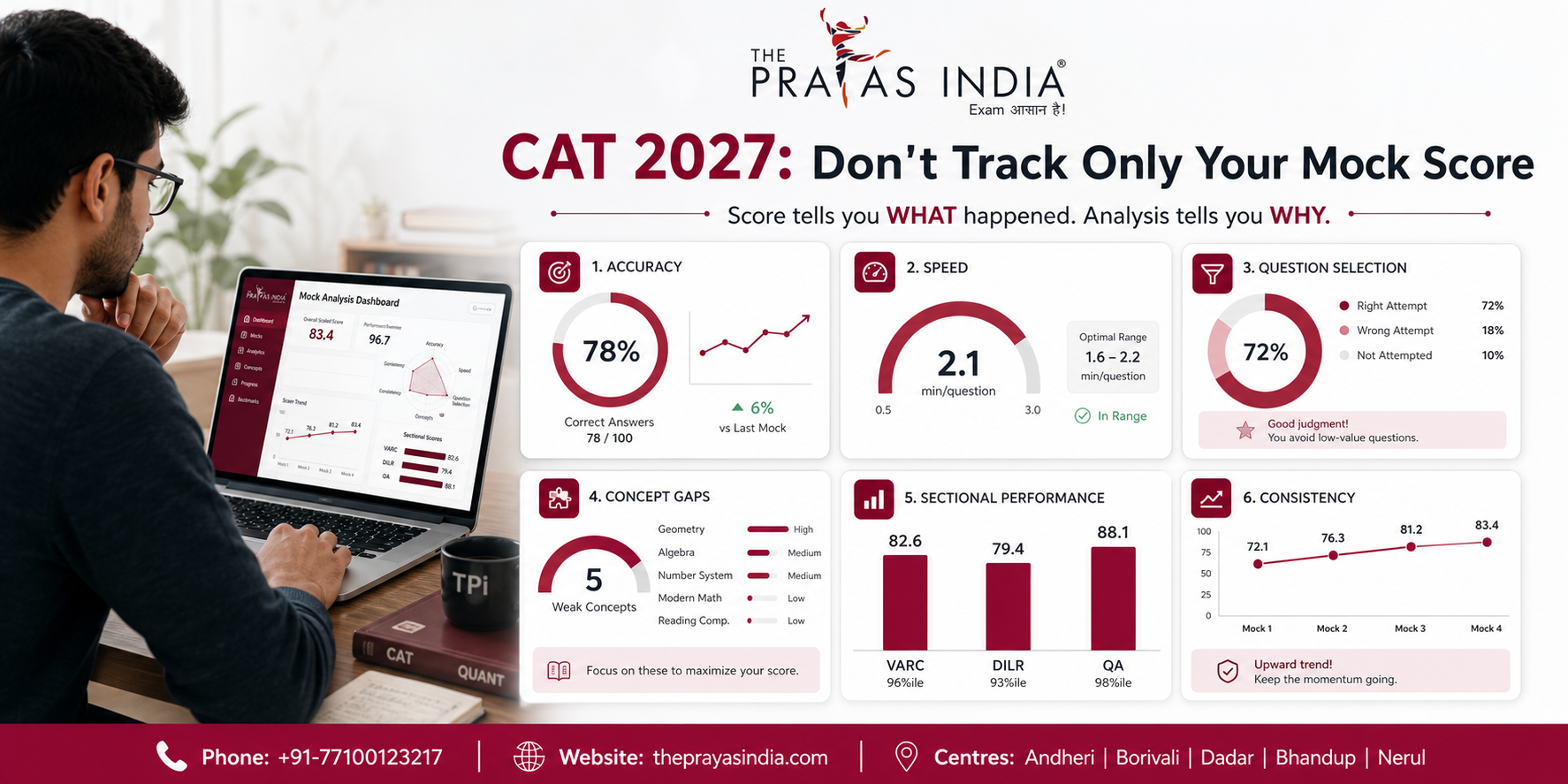
Instead of looking only at the final score, track multiple indicators:
| Area | What to Track |
|---|---|
| Accuracy | Percentage of attempted questions answered correctly |
| Speed | Average time spent on different question types |
| Selection | Ability to identify high-value questions |
| Concepts | Topics where repeated errors occur |
| VARC | RC accuracy and question-type performance |
| DILR | Set selection and completion efficiency |
| Quant | Topic-wise accuracy and solving time |
| Consistency | Performance across multiple tests |
| Analysis | Whether mistakes are actually being corrected |
This gives you a more complete picture of preparation.
How Structured Coaching Can Change the Preparation Experience
A good CAT preparation programme should not simply provide videos and question banks.
The real value of structured preparation lies in the system around the content.
A student should ideally know:
What to study → How to study → What to practise → When to test → How to analyse → What to improve next
Without this structure, students can spend months working hard without knowing whether their preparation is moving in the right direction.
For graduates who are preparing for CAT 2027 seriously, this can be particularly important because the preparation period is also a period of major career decisions.
The right guidance can help reduce unnecessary resource-hopping and create a more disciplined preparation cycle.
The Prayas India provides CAT-focused preparation support built around structured learning, practice, testing, performance analysis and mentorship. Its CAT preparation content also highlights the importance of topic-wise practice, sectional tests, full-length mocks and detailed analysis.
For Mumbai-based aspirants, The Prayas India has CAT-related preparation support across centres including Andheri, Borivali, Dadar, Bhandup and Nerul.
What Should You Do If You Are Still Confused About Joining CAT Coaching?
You do not need to make the decision based only on advertisements.
Instead, speak to the institute and ask specific questions.
Ask:
- What is the complete CAT preparation structure?
- How are Quant fundamentals handled?
- How is DILR taught?
- What kind of VARC practice is provided?
- How frequently are sectional tests conducted?
- How many full-length mocks are included?
- Is mock analysis provided?
- How are doubts handled?
- Is individual mentorship available?
- What happens if my performance remains weak in one section?
- Are classroom and online options available?
- Which centre or batch timing would suit my schedule?
- What is included in the course fee?
These questions can help you understand whether the programme actually matches your preparation needs.
Do not choose coaching simply because someone calls it the best. Choose after understanding how the system works for your specific preparation requirements.
A Practical Weekly Structure for CAT 2027 Graduates
Once your foundation is underway, a weekly structure can look like this:
Monday to Friday
Use weekdays primarily for concept building and focused practice.
For example:
Quant: Concept + practice
VARC: RC + reading
DILR: Set practice + analysis
Saturday
Use a larger block for mixed practice and sectional testing.
Sunday
Reserve time for:
- Test analysis
- Revision
- Error-log review
- Weak-topic practice
- Planning the next week
The exact timetable can be adjusted according to your level.
A beginner should not follow the same schedule as an advanced aspirant.
Common Mistakes Graduates Make While Preparing for CAT 2027
Starting With Too Many Resources
More resources can create less clarity.
Choose carefully and follow a structured progression.
Ignoring Fundamentals
Trying difficult CAT questions without understanding the basics often leads to frustration.
Taking Mocks Too Early
Mocks are useful, but their value depends on preparation maturity.
Taking Mocks Without Analysis
A test without analysis is often just another set of questions.
Changing Strategy Every Week
A bad mock does not automatically mean that your entire strategy is wrong.
Comparing Your Beginning With Someone Else’s Middle
Every aspirant starts from a different level.
Studying for Long Hours Without Measuring Progress
Time spent is not the same as learning achieved.
Ignoring Profile Building
MBA admissions can consider factors beyond the entrance-test score depending on the institute’s policy.
Waiting for the “Perfect Time” to Start
There may never be a perfect time.
A better approach is to start at a manageable level and improve gradually.
Should You Start CAT 2027 Preparation Immediately After Graduation?
If you already know that an MBA is an important part of your career plan, there is little benefit in delaying preparation simply because you are unsure about the perfect starting point.
You do not need to begin with an extreme schedule.
You do not need to solve hundreds of questions immediately.
You do not need to take full-length mocks every week from the beginning.
You need to start with a clear assessment of where you stand and build from there.
For some students, that may mean self-study with carefully selected resources.
For others, it may mean joining a structured CAT programme where faculty, mentors, tests and a defined preparation schedule provide the framework.
The important thing is to avoid losing months in uncertainty.
Your CAT 2027 Preparation Should Begin With a Decision
Graduation often creates a long list of possibilities.
Job?
MBA?
CAT?
Another entrance exam?
Work experience first?
Higher studies later?
The more options you have, the easier it becomes to postpone the decision.
If CAT 2027 is genuinely one of the paths you want to pursue, start by understanding your current level and building a realistic preparation roadmap.
And if you find that you are struggling to create that roadmap yourself, talk to an experienced CAT preparation team before committing to a preparation strategy.
A conversation about your academic background, target B-schools, strengths, weaknesses, available study time and preparation level can help you understand what kind of preparation structure may suit you.
Your MBA journey does not begin on the day of the CAT examination.
It begins when you decide to prepare seriously.

Frequently Asked Questions
CAT 2027 Preparation After Graduation
Should I start CAT 2027 preparation immediately after graduation?
If CAT 2027 is one of your serious MBA options, starting early can give you more time to build fundamentals, practise concepts, develop speed and gradually move towards mock tests.
Can I prepare for CAT 2027 without work experience?
Yes. Work experience is not required simply to begin CAT preparation. However, individual B-schools may have their own admission criteria and selection processes.
Is CAT coaching necessary after graduation?
Not necessarily. Self-study can work for disciplined students, while structured coaching can provide a planned schedule, faculty support, regular testing, mentorship, doubt resolution and performance analysis.
How should non-maths graduates prepare for CAT Quant?
Start with the fundamentals, strengthen core arithmetic and algebra concepts, practise regularly and gradually move towards CAT-level questions.
When should I start taking CAT mocks?
Begin with topic and sectional testing as your preparation develops, and gradually introduce full-length mocks once you have sufficient conceptual coverage to analyse and learn from them.
Can I prepare for CAT while working after graduation?
Yes. Working aspirants should create a realistic schedule around their job and focus on consistent study blocks, targeted practice and regular testing.
What should I check before joining CAT coaching?
Check the course structure, faculty, study material, foundation support, sectional tests, full-length mocks, mock analysis, doubt support, mentorship and batch options before making your decision.
Final Takeaway
Graduation is not merely the end of your undergraduate journey. For many students, it is the point at which the next career decision becomes more important.
If an MBA is part of your plan and CAT 2027 is an examination you are considering, you do not need to wait until the final preparation phase to begin.
Start by understanding your current level.
Build your fundamentals.
Follow a limited and reliable resource set.
Practise consistently.
Analyse your performance.
Develop test-taking skills.
And, if you find it difficult to create or maintain this system alone, explore structured guidance early rather than spending months preparing without a clear direction.
The goal is not simply to prepare more. The goal is to prepare better, with a system that helps you identify where you are today and what you need to improve next.
For aspirants who want to discuss their CAT 2027 preparation level, course structure, batch options or suitable preparation approach, speaking with The Prayas India’s CAT preparation team can be a practical next step before deciding how you want to prepare.
Start Your CAT 2027 Preparation With the Right Guidance
Graduated and planning for CAT 2027? Get guidance on your preparation strategy, course structure, batch options and the right learning approach for your MBA journey.
Admissions Open for CAT Preparation
Speak with our team to understand the right CAT 2027 preparation option for you.