CAT Daily Study Routine: How to Structure Your Preparation | Best CAT Coaching in Mumbai | The Prayas India
Preparing for CAT is not simply about studying for a large number of hours every day. The real challenge is creating a routine that gives enough attention to Quantitative Ability, VARC and DILR while also leaving sufficient time for revision, practice and mock-test analysis. Many aspirants begin their preparation with enthusiasm but struggle to maintain consistency because their daily schedule is either too ambitious or not structured around measurable goals.
A good CAT study routine should therefore be practical enough to follow for several months. It should allow you to work on your weak areas without ignoring your strengths, and it should gradually shift from concept building to timed practice and mock-based preparation as the examination approaches.
For aspirants preparing for CAT in Mumbai, structured guidance can also make the process easier by providing a defined study plan, regular practice and performance feedback. The Prayas India offers CAT preparation support for aspirants looking for a systematic approach to the examination.
Why Your CAT Preparation Needs a Daily Structure
CAT preparation covers different types of skills, and these skills do not improve in exactly the same way. Quantitative Ability requires conceptual understanding and repeated problem-solving, DILR demands logical thinking and set selection, while VARC requires reading consistency, comprehension and the ability to evaluate options carefully.
If your daily routine is not structured, it is easy to spend most of your preparation time on the section you enjoy the most. A student who likes Quant may spend several hours solving arithmetic questions while postponing reading practice. Another aspirant may spend too much time reading articles but fail to practise enough DILR sets.
A structured routine prevents this imbalance. It gives each section a defined place in your preparation while still allowing flexibility based on your performance. The purpose is not to follow a rigid timetable minute by minute, but to make sure that important preparation activities are consistently completed.
Start by Understanding Your Current Preparation Level
Before creating a daily CAT study routine, assess where you currently stand. Your schedule should depend on whether you are just beginning preparation, have already completed the basics or are in the revision and mock-test phase.
A beginner may need more time for concepts and foundational practice. An intermediate aspirant may need a greater balance between topic-wise questions and sectional tests. A candidate who has already covered most of the syllabus should spend more time on timed practice, mock tests and analysing performance.
Take a diagnostic test or review your recent sectional performance before finalising your schedule. Look beyond the overall score and identify which areas are consuming the most time and where accuracy is weakest.
For example, if your Quant concepts are reasonably strong but your solving speed is low, spending most of the day watching additional concept lectures may not be the best use of time. You may benefit more from timed problem sets and analysis of inefficient approaches.
Building a Practical CAT Daily Study Routine
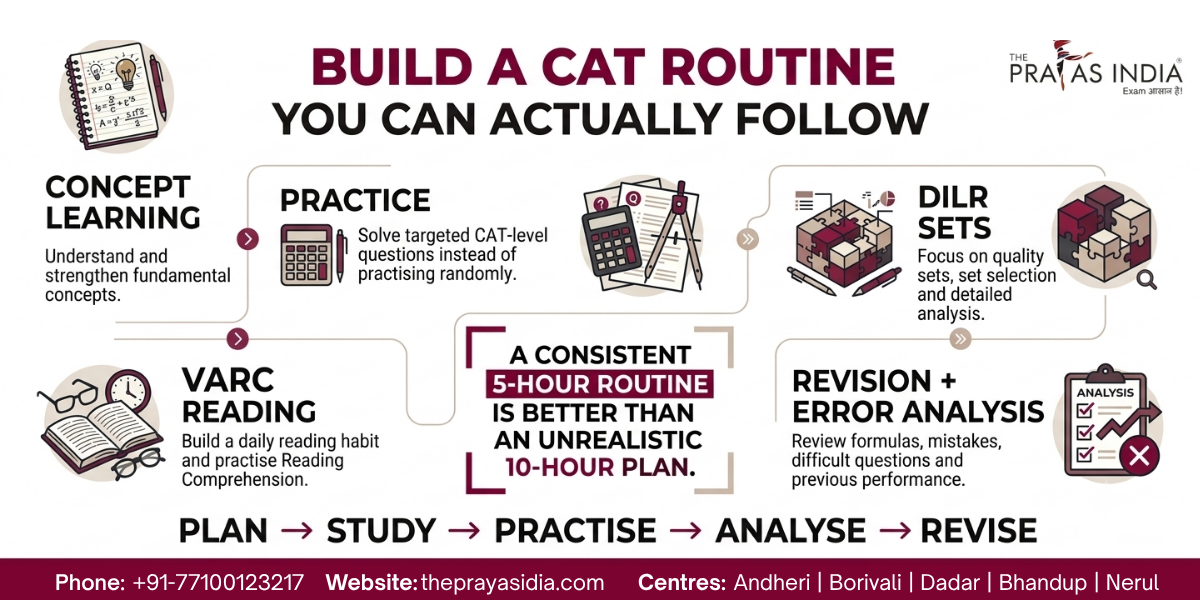
A productive CAT routine should contain several different types of work rather than one long study session. Concept learning, question practice, reading, revision and analysis all serve different purposes.
Instead of thinking, “I will study CAT for eight hours today,” divide the day into specific objectives. This makes your preparation easier to track and reduces the tendency to spend hours studying without knowing whether meaningful progress has been made.
A balanced preparation day can include:
- A dedicated VARC reading and practice session.
- A Quantitative Ability concept or problem-solving session.
- A DILR set-solving session.
- Revision of previously studied concepts.
- Analysis of mistakes made during practice.
- A short review of formulas, shortcuts or important notes.
The number of hours can vary depending on your college, job or other responsibilities. What matters more is the quality and consistency of the work completed.
Morning Session: Start With High-Value Preparation
If your schedule allows you to study in the morning, use the first substantial study session for a task that requires concentration. This could be Quantitative Ability problem-solving, a difficult DILR set or focused VARC practice.
The objective is not to automatically assign one particular section to the morning. Instead, use this period for the area where you need your strongest concentration. If you are naturally more alert in the morning, difficult conceptual work can be placed here.
For example, an aspirant struggling with Arithmetic in Quant may use the morning session to revise a concept and then solve a carefully selected set of problems. Another aspirant who is comfortable with Quant but struggles with DILR may use the same session for two or three quality sets.
The important point is to avoid passive study. Reading a chapter for several hours without solving questions may create a feeling of progress without giving you enough evidence that you can actually apply the concepts.
Build VARC Into Your Routine Every Day
VARC should not be treated as a section that can be prepared only during dedicated weekend sessions. Reading and comprehension skills develop through regular exposure, so even a relatively short daily practice session can be valuable when maintained consistently.
Read material from different areas such as essays, opinion pieces, humanities, science, economics and social issues. The purpose is not to memorise information from these articles. It is to become comfortable reading unfamiliar subjects and identifying the author’s argument, tone, assumptions and conclusions.
After reading, spend some time asking yourself what the central argument was and how the author developed it. This habit can gradually improve comprehension and make unfamiliar CAT passages less intimidating.
Alongside reading, practise CAT-style questions regularly. Pay attention not only to whether an answer is correct but also to why the other options are incorrect. This is particularly useful for Reading Comprehension because CAT questions often require careful evaluation of choices rather than simple retrieval of information.

How Much Time Should You Give to Each CAT Section?
There is no universal formula stating that every CAT aspirant should spend exactly the same number of hours on each section. Your study allocation should depend on your current strengths, weaknesses and preparation stage.
However, all three sections should receive regular attention. If one section is significantly weaker, it is reasonable to allocate additional practice time to it while maintaining the other sections through shorter but consistent sessions.
For example, an aspirant with strong Quant but weak VARC may spend more focused time on reading and RC analysis while continuing daily Quant practice to maintain proficiency. Someone struggling with DILR may prioritise set-solving without completely abandoning VARC and Quant.
The key is to avoid an extreme imbalance. CAT rewards overall performance across sections, so neglecting one area for several weeks can create problems later even if your other sections are progressing well.
DILR Requires Quality Practice, Not Just Quantity
DILR preparation can become ineffective when aspirants focus only on the number of sets they solve. Solving ten sets without analysing your approach may be less valuable than solving three carefully selected sets and understanding why you struggled with them.
When solving a DILR set, pay attention to how you approach the information. Can you identify the structure quickly? Are you creating unnecessary cases? Are you spending too much time trying to solve a set that does not appear manageable?
After completing a set, review the solution even when you solved it correctly. Look for alternative approaches and compare them with your method. Over time, this can improve both your solving efficiency and your ability to recognise manageable sets during the actual CAT.
A good daily routine should therefore include DILR analysis, not just DILR solving.
Quant Preparation Should Move From Concepts to Application
Quantitative Ability preparation is often divided into learning formulas and solving questions, but the transition between these two stages is important. Knowing a formula does not necessarily mean that you can identify when to use it.
When studying a topic, first understand the underlying concept and standard approaches. Then solve basic questions to establish familiarity before moving to moderate and CAT-level problems.
Once you are comfortable, introduce timed practice. This helps you identify whether your problem is conceptual understanding or execution speed.
Maintain a concise record of formulas, approaches and recurring mistakes. Revisiting this material periodically can reduce the amount of time required for revision later in your preparation.
Do Not Turn Your Daily Routine Into an Unrealistic Timetable
One of the biggest problems with CAT study plans is that they look impressive on paper but are difficult to follow in real life. A timetable that assumes ten or twelve hours of highly productive study every day may work for a few days but become unsustainable over several months.
Your routine should account for classes, work, college, travel, meals, sleep and personal responsibilities. If you have only four focused hours available on weekdays, structure those four hours effectively instead of creating an eight-hour schedule that you repeatedly fail to complete.
Consistency matters because CAT preparation is a long-term process. A realistic routine followed for months is more valuable than an extreme routine followed for one week.
Make Time for Revision Every Week
New learning can create the impression that you are progressing quickly, but without revision, older concepts gradually become less accessible. This is particularly problematic in Quant, where formulas and methods need to be recalled quickly under time pressure.
Set aside dedicated revision time every week. Revisit topics studied earlier, review your error log and reattempt questions that you previously struggled with.
Revision does not always require long sessions. A focused review of your own notes and mistakes can be highly effective because it targets information that has already been identified as important for your preparation.
The objective is to create a cycle where learning is followed by practice, practice is followed by analysis and analysis is followed by revision.
Your Daily CAT Routine Should Include Mistake Analysis
Mistake analysis is often pushed to the end of the preparation process, but it should be integrated into your daily routine from the beginning. Whenever you practise questions, take a few minutes to understand the mistakes you made.
Do not simply write down the correct answer. Identify the reason behind the mistake. Was the concept unclear? Did you misunderstand the question? Did you choose an inefficient method? Did you rush because you were thinking about the time?
Over several weeks, these observations become a useful personal database of weaknesses. Instead of repeatedly making the same mistakes, you can target them during revision and practice.
This is one of the most effective ways to make your CAT study routine personalised rather than generic.
The Role of Coaching in a Structured CAT Preparation Plan
A structured CAT preparation programme can be particularly useful for aspirants who find it difficult to decide what to study, how much to practise and when to shift from concepts to mocks. Coaching can provide a defined learning sequence while allowing students to identify and address individual weaknesses.
For aspirants preparing for CAT in Mumbai, The Prayas India offers structured CAT preparation designed around concept building, practice, mock tests and performance improvement. Students looking for CAT coaching in Mumbai can explore the available guidance at centres in Andheri, Borivali, Dadar, Bhandup and Nerul.
The right coaching environment should complement self-study rather than replace it. Your classroom learning becomes more valuable when it is supported by disciplined daily practice, revision and analysis outside the classroom.
For admission-related information, contact +91-77100 13217.
A Better Way to Think About Your CAT Study Hours
Instead of asking how many hours you studied, ask what you accomplished during those hours. Two hours spent actively solving, reviewing and correcting mistakes can be more valuable than five hours of passive reading.
At the end of each day, review your preparation using a few simple questions. Did I work on all three sections? Did I complete the practice I planned? Did I understand the mistakes I made? Did I revise something from an earlier topic? Did today’s work address one of my actual weaknesses?
These questions make your routine measurable without turning preparation into a stressful checklist.
A strong CAT routine is not about filling every hour of the day. It is about ensuring that the hours you do spend preparing are purposeful.
How to Structure Your CAT Week
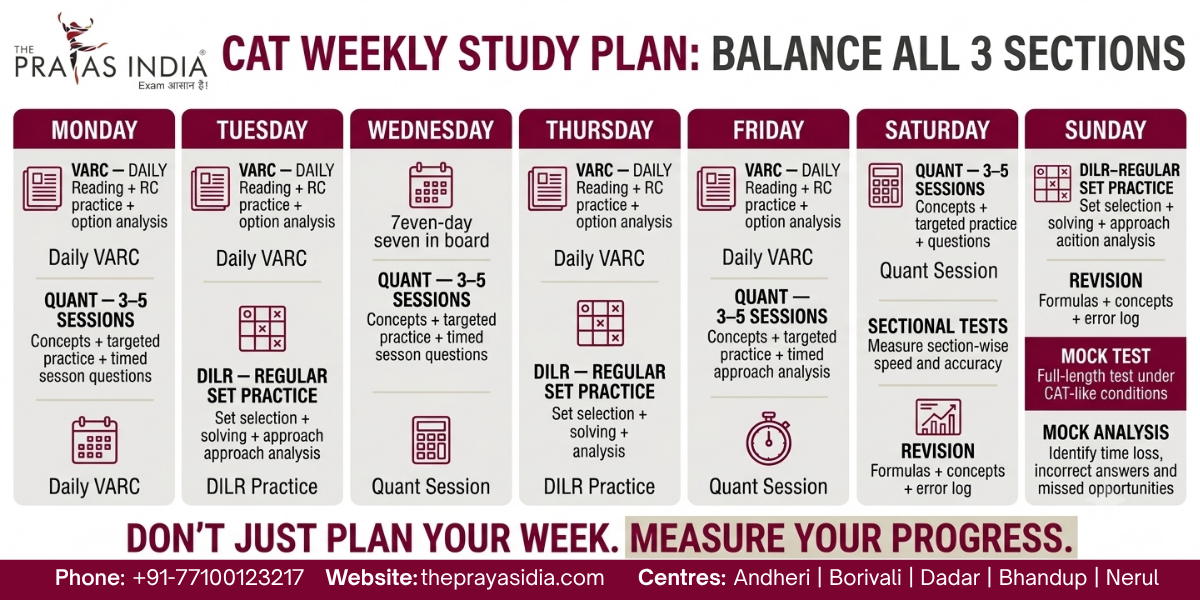
While a daily routine provides consistency, your weekly plan determines whether all three sections are receiving adequate attention. A week should contain a combination of concept learning, topic-wise practice, sectional tests, DILR sets, reading and revision.
For example, you could dedicate certain days to heavier Quant and DILR practice while maintaining daily VARC reading. However, avoid creating a schedule where one section completely disappears for several days. Regular exposure is particularly important for VARC and DILR because both require familiarity with different question and passage structures.
A useful weekly framework can include:
- Daily VARC reading and RC practice to maintain comprehension ability.
- Three to five focused Quant practice sessions depending on your current level.
- Regular DILR set practice with detailed analysis of your approach.
- One or more sectional tests to evaluate section-specific performance.
- Revision sessions for formulas, concepts and previously made mistakes.
- Mock-test practice once you have sufficient syllabus coverage.
- Dedicated mock analysis, rather than immediately moving on to the next test.
The exact number of hours can be adjusted according to your schedule. What matters is that the week has a clear balance between learning, practice and evaluation.
When Should You Start Taking CAT Mock Tests?
Mock tests should not be treated as something to be attempted only after completing every topic. At the same time, taking full-length mocks too early, without sufficient conceptual preparation, can create unnecessary frustration.
The right time depends on your preparation level. Once you have reasonable familiarity with the major concepts and question types, begin introducing sectional tests and gradually move towards full-length mocks. The purpose of the early mocks is not necessarily to achieve an impressive score. They are an opportunity to understand how you perform under time pressure.
Initially, your mock score may not accurately represent your eventual CAT performance. Treat these tests as diagnostic tools. Look for patterns in your performance rather than becoming overly concerned about individual scores.
As your preparation progresses, the frequency and importance of mocks should increase. But every mock should be followed by meaningful analysis. A test without analysis gives you a number; a test followed by analysis gives you information that can improve your next performance.
How to Analyse a CAT Mock Test
Mock analysis should be a separate study activity in your CAT daily routine. Do not consider the mock finished as soon as you submit it.
Start by dividing the questions into different categories. Identify the questions you answered correctly, the ones you answered incorrectly, the questions you left unattempted and the questions that consumed significantly more time than they should have.
For every incorrect question, determine whether the problem was conceptual, procedural or caused by careless execution. For questions you got correct but solved slowly, examine whether another method could have saved time.
DILR requires an additional layer of analysis. If you could not solve a set, ask whether the difficulty was actually in the questions or whether you made the wrong set-selection decision. Similarly, in VARC, examine whether you selected the wrong passage or misinterpreted the author’s argument.
This process allows your routine to evolve based on evidence rather than assumptions.
How Your Routine Should Change in the Final Phase
The final phase of CAT preparation should not look like the first phase. By this stage, repeatedly learning basic concepts should no longer consume most of your study time.
Your focus should shift towards timed application, mocks, revision, error reduction and question selection. You should become increasingly comfortable making decisions under the same kind of time pressure that you will face in the actual examination.
A typical final-phase study day may contain shorter revision sessions followed by timed sectional practice, DILR sets, RC practice or mock analysis. The emphasis should be on converting existing knowledge into marks.
This is also the stage where your personal strategy becomes important. You should know which types of questions you generally solve well, which areas consume too much time and which situations cause your accuracy to fall.
Do not attempt to completely reinvent your preparation strategy close to the examination. Use your mock-test data to make controlled improvements.
Balancing CAT Preparation With College or Work
Not every CAT aspirant can dedicate the entire day to preparation. Many candidates are studying in college, working full-time or managing other responsibilities.
This does not make CAT preparation impossible, but it makes planning more important. Instead of creating a timetable based on an ideal student with unlimited time, build your routine around the hours you can realistically protect.
For working professionals, early morning or evening sessions can be used for focused preparation, while shorter breaks can be used for reading or reviewing notes. College students may have more flexibility during certain periods but should still maintain consistency rather than relying entirely on weekend preparation.
The key is to distinguish between available time and usable study time. If you have five free hours but only three hours of those are genuinely productive, build your routine around those three hours and gradually improve your concentration.
A consistent routine adapted to your real circumstances is more sustainable than trying to copy someone else’s timetable.
Common Problems With CAT Study Routines
Many aspirants create elaborate schedules but struggle to follow them. The issue is often not a lack of discipline but poor planning.
One common problem is allocating excessive time to passive activities such as watching lectures or reading solution explanations while leaving insufficient time for independent problem-solving. Concepts are important, but CAT performance depends on applying those concepts yourself.
Another problem is treating every topic as equally important. Your preparation should be influenced by your current performance. If you consistently perform well in a particular area, maintenance practice may be enough while your weaker areas require greater attention.
A third problem is studying without reviewing previous mistakes. If every day starts with a completely new topic, your earlier weaknesses remain unresolved. Your routine should therefore contain a feedback loop in which mistakes influence what you study next.
Avoid Studying Only When You Feel Motivated
CAT preparation is too long to depend entirely on motivation. Some days will feel productive, while others will feel difficult. A sustainable routine helps you continue working even when your motivation is lower.
This does not mean forcing yourself to complete an unrealistic target every day. On difficult days, you can reduce the workload while maintaining continuity. A shorter but focused session can be more useful than abandoning preparation completely.
Consistency also helps reduce the psychological pressure associated with CAT. When preparation becomes a regular part of your routine, you spend less time deciding whether to study and more time actually studying.
Track Progress Beyond Your CAT Mock Score
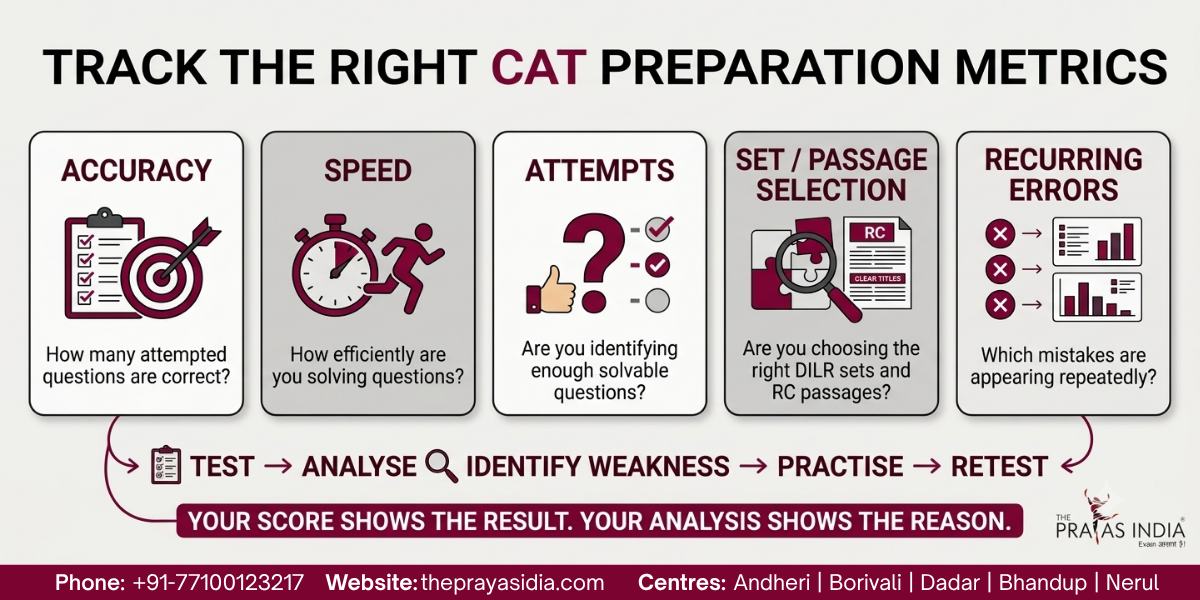
Your mock score is important, but it should not be the only metric you track. A strong preparation routine should measure several aspects of performance.
Keep an eye on your accuracy, attempts, average solving time, DILR set selection, RC performance and recurring errors. These indicators can reveal improvement even when your overall mock score temporarily fluctuates.
For example, if your score remains similar but your accuracy has improved significantly and your average solving time has decreased, your preparation may still be progressing positively. Similarly, if you are solving DILR sets more efficiently but making more mistakes in Quant, your next study cycle should reflect that information.
The objective is to make your preparation increasingly data-driven.
How The Prayas India Can Help Structure Your CAT Preparation
A well-designed CAT study routine becomes easier to maintain when you have access to a structured preparation system. Coaching can help reduce the uncertainty around what to study, when to practise, how to evaluate your performance and when to shift from concept building to mock-based preparation.
For aspirants looking for Best CAT Coaching in Mumbai, The Prayas India provides structured preparation support across Andheri, Borivali, Dadar, Bhandup and Nerul. The preparation approach can combine classroom guidance with self-study, practice, sectional tests, mock tests and performance analysis.
However, coaching should not replace your daily effort. CAT is ultimately an examination that rewards consistent practice and independent problem-solving. The value of a structured programme is that it can help you use your preparation time more effectively and identify areas where you need improvement.
For admission-related information, contact +91-77100 13217.
A Practical CAT Routine Is Better Than a Perfect Timetable
There is no single daily schedule that will work for every CAT aspirant. A college student, working professional and full-time aspirant may have completely different schedules. What they can share is the principle of maintaining consistent exposure to VARC, DILR and Quant while regularly reviewing performance.
Your routine should be realistic enough to follow, flexible enough to accommodate changes and structured enough to prevent important areas from being ignored.
The most effective CAT preparation cycle is simple: learn the concept, practise it, apply it under time pressure, analyse your mistakes and revise accordingly. Repeating this cycle consistently is far more valuable than constantly searching for a new timetable.
As the examination approaches, reduce passive learning and increase timed practice, mock analysis and revision. Your final objective should be to enter the CAT examination with not only strong concepts but also a clear understanding of how you want to use your time.
Contact Us
📞 Call Now: +91-77100 13217
🌐 Website: theprayasindia.com
📍 Centres: Andheri | Borivali | Dadar | Nerul | Bhandup
FAQs
1. How many hours should I study for CAT every day?
There is no fixed number of hours that works for every aspirant. The ideal study duration depends on your preparation level and other commitments. A consistent routine with focused concept learning, practice, revision and analysis is more valuable than simply increasing study hours.
2. Should I study all three CAT sections every day?
It is useful to maintain regular contact with all three sections, although the amount of time spent on each can vary. Daily VARC reading can be combined with alternating focused Quant and DILR sessions based on your strengths and weaknesses.
3. When should I start taking CAT mock tests?
You can begin sectional tests once you have reasonable familiarity with the relevant concepts and gradually introduce full-length mocks as your preparation develops. Mock tests should be followed by detailed analysis.
4. How should I balance CAT preparation with college or work?
Build your routine around the hours you can realistically protect. Working professionals and college students can use focused morning or evening sessions while maintaining shorter daily reading and revision activities.
5. Is coaching necessary for CAT preparation?
Coaching is not mandatory, but structured guidance can help aspirants follow a systematic preparation plan, identify weaknesses, practise regularly and analyse mock-test performance. The Prayas India provides CAT coaching support in Mumbai across Andheri, Borivali, Dadar, Bhandup and Nerul.