CAT Preparation Without Confusion: How to Build the Right Study Plan | The Prayas India
Preparing for CAT can become confusing very quickly.
One student is following a six-month timetable. Another is solving hundreds of questions every week. Someone is taking multiple mock tests, while another aspirant is still trying to finish the basics. Add YouTube strategies, Telegram PDFs, previous-year papers, coaching material and endless advice from other aspirants—and suddenly, CAT preparation becomes more about deciding what to do than actually doing it.
The real challenge is not finding enough study material.
It is building a preparation plan that you can follow consistently, measure honestly and improve over time.
For CAT 2026 aspirants, a good study plan should bring together three sections—VARC, DILR and QA—while leaving enough room for revision, mock tests and performance analysis.
If you are looking for CAT Coaching Mumbai, The Prayas India focuses on helping aspirants turn this preparation process into a more structured and exam-oriented journey.
This article explains how to build a CAT preparation strategy without getting overwhelmed.
CAT Preparation Starts With a Plan, Not a Pile of Books
One of the most common mistakes aspirants make is collecting resources before creating a strategy.
You may have:
- Multiple CAT preparation books
- PDFs from different sources
- Previous-year papers
- Online videos
- Mock tests
- Sectional tests
- Vocabulary lists
- Formula sheets
But having more resources does not automatically mean better preparation.
In fact, too many resources can create a different problem:
Where should I start?
A good CAT preparation strategy should answer five basic questions:
- What do I need to study?
- In what order should I study it?
- How much time should I spend on each section?
- How will I measure my progress?
- What will I change if my preparation is not working?
Once these questions are answered, preparation becomes considerably easier to manage.
Understanding the CAT Preparation Journey
CAT is not an examination that can be approached effectively through last-minute preparation.
The three sections test different abilities:
VARC
Reading ability, comprehension, verbal reasoning and language skills.
DILR
Logical thinking, data interpretation and the ability to identify workable approaches to unfamiliar sets.
QA
Mathematical concepts, application, calculation and problem-solving.
Because the nature of these sections is different, your study plan should not treat them identically.
A student may need intensive practice in Quant but relatively less time for VARC.
Another student may have strong mathematics but struggle with DILR.
Therefore, a good timetable should be personalised around your current level, not copied blindly from someone else’s schedule.
Step 1: Start With a Diagnostic Assessment
Before creating a detailed timetable, understand where you currently stand.
This is particularly important if you have already started CAT preparation.
Take a diagnostic test or a CAT-level sectional test under timed conditions.
Don’t worry too much about the initial score.
The objective is to identify your starting point.
Look at:
- Number of questions attempted
- Number of correct answers
- Accuracy
- Time spent
- Topics causing difficulty
- Questions left despite knowing the concept
- Questions that consumed excessive time
You may discover something interesting.
Perhaps your Quant concepts are actually strong, but your calculation speed is poor.
Maybe your VARC knowledge is adequate, but you struggle with selecting the right questions.
Or perhaps DILR is consuming too much time because you are unable to identify the right sets.
These observations are much more useful than simply saying:
“My CAT score is low.”
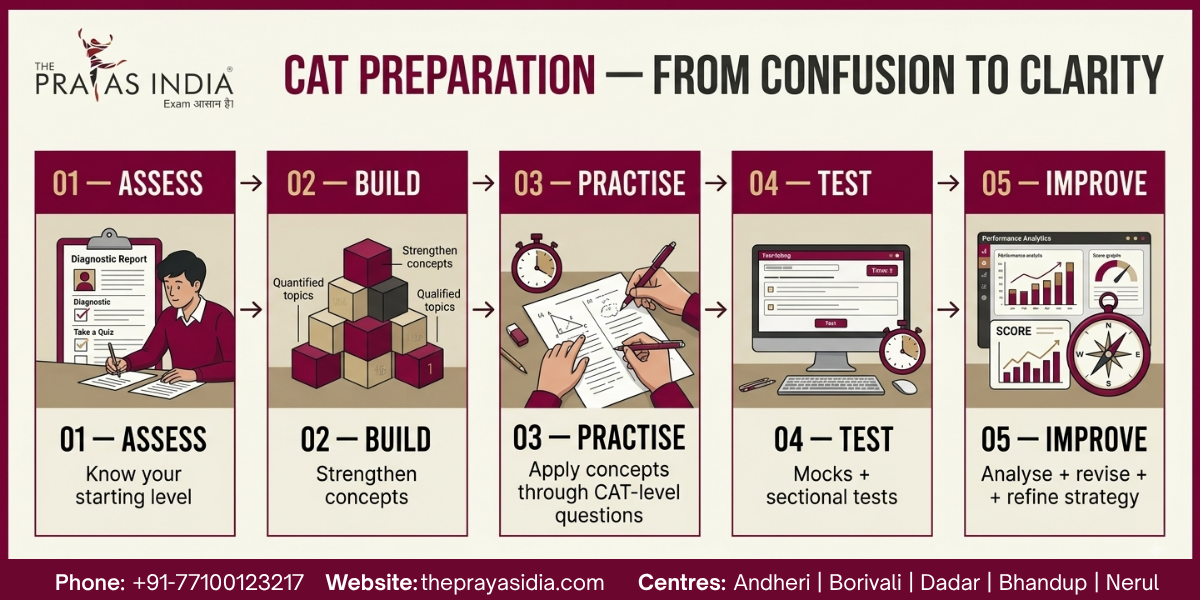
Step 2: Divide Your Preparation Into Phases
Instead of creating one giant timetable extending until CAT, divide the preparation into manageable phases.
A practical structure can look like this:
Phase 1 — Foundation
Build concepts and understand the basics.
Phase 2 — Application
Start solving CAT-level questions and previous-year problems.
Phase 3 — Sectional Development
Increase difficulty and introduce timed sectional practice.
Phase 4 — Mock-Based Preparation
Take full-length CAT mocks and analyse performance.
Phase 5 — Final Revision
Focus on weak areas, strategy, revision and examination temperament.
This approach prevents the common problem of trying to do everything simultaneously.
Building Your CAT Preparation Strategy Around Three Sections
VARC: Build Reading Into Your Routine
VARC is often misunderstood as a section that can be prepared only through grammar rules and vocabulary.
For CAT, reading plays a major role.
A strong VARC routine should include:
- Reading comprehension practice
- Editorial/article reading
- Para-summary questions
- Para-jumbles
- Odd sentence questions
- Vocabulary development
- Regular analysis of RC mistakes
But simply reading for an hour every day is not enough.
You should gradually learn to identify:
- The author’s central argument
- Tone
- Inference
- Supporting ideas
- Contrasting viewpoints
- Information that is directly stated versus implied
The goal is to make reading active rather than passive.
DILR: Don’t Measure Preparation Only by Number of Questions
DILR can be unpredictable.
You may solve one set comfortably and struggle with another that looks similar.
This is because CAT DILR often tests your ability to understand the structure of a problem and choose an appropriate approach.
Your preparation should therefore include different types of sets.
For example:
- Tables
- Charts
- Games and tournaments
- Arrangements
- Distribution
- Scheduling
- Routes
- Selection
- Logical conditions
- Mixed-data sets
But there is another important skill:
Set Selection
In the actual CAT examination, you don’t necessarily need to solve every set.
You need to identify the sets where your probability of scoring is highest.
That skill develops through repeated exposure and analysis.
QA: Build From Fundamentals to Application
Quantitative Aptitude can become overwhelming because the syllabus covers several areas.
A better approach is to organise topics into broader groups.
Arithmetic
- Percentages
- Profit and Loss
- Ratios
- Averages
- Time, Speed and Distance
- Time and Work
- Mixtures
- Simple and Compound Interest
Algebra
- Equations
- Inequalities
- Functions
- Progressions
- Quadratic concepts
Geometry
- Lines
- Angles
- Triangles
- Circles
- Polygons
- Coordinate geometry
Number System
- Divisibility
- Factors
- Remainders
- HCF and LCM
- Number properties
The objective should not be to complete every topic as quickly as possible.
The objective is to reach a stage where you can recognise the concept, choose an approach and solve efficiently.
Don’t Give Every Section Equal Time
This is one of the most important points while creating a CAT study plan.
Suppose your current performance looks like this:
| Section | Current Level | Priority |
|---|---|---|
| VARC | Strong | Maintenance |
| DILR | Weak | High |
| QA | Moderate | Medium-High |
Your study time should reflect this.
For example, instead of spending exactly two hours on every section, you could allocate more time to DILR while maintaining VARC through regular reading and practice.
Your timetable should be flexible enough to respond to your performance.
This is why blindly copying another student’s timetable rarely works.
The 70:20:10 Rule for Better Preparation
A simple framework can help structure your weekly study time.
70% — Core Preparation
Concept building and question practice.
20% — Testing
Sectional tests and mock tests.
10% — Analysis
Reviewing mistakes, identifying weak areas and updating your strategy.
The exact ratio does not have to remain fixed throughout the year.
During the foundation stage, you may spend more time learning.
As CAT approaches, the balance should gradually move towards testing and analysis.
A Sample Weekly CAT Study Structure
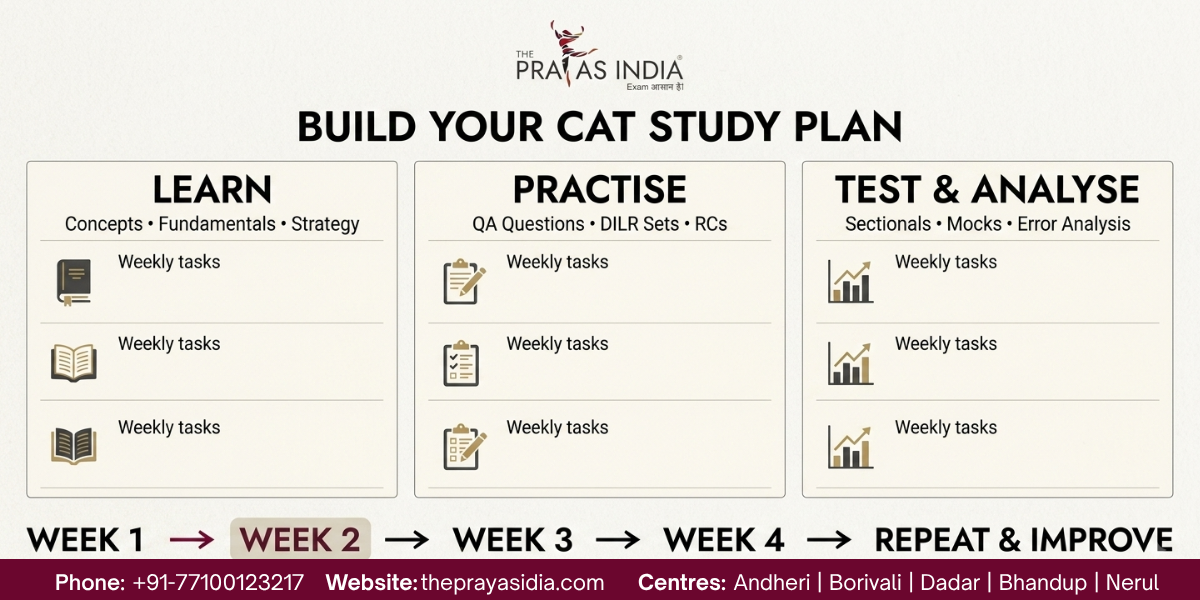
A practical weekly plan could look like this:
| Day | Primary Focus | Secondary Focus |
|---|---|---|
| Monday | QA | VARC |
| Tuesday | DILR | QA |
| Wednesday | VARC | DILR |
| Thursday | QA | VARC |
| Friday | DILR | QA |
| Saturday | Sectional Tests | Revision |
| Sunday | Mock Test | Detailed Analysis |
This is only a framework.
The exact schedule should depend on your available hours and current strengths.
A college student may have more flexibility during the day.
A working professional may need a different structure built around evenings and weekends.
The important thing is not the exact timetable.
It is consistency.
CAT Preparation for College Students
College students have one advantage:
Time can be distributed over a longer period.
But they also face another challenge—irregular schedules.
Classes, assignments, exams and social commitments can interfere with preparation.
A practical approach is to create two kinds of study sessions:
Short Sessions
30–60 minutes for:
- Reading
- Vocabulary
- Formula revision
- DILR set practice
Deep Sessions
1.5–3 hours for:
- QA concepts
- Intensive practice
- Sectional tests
- Mock analysis
This makes preparation easier to maintain even during busy academic periods.
CAT Preparation for Working Professionals
Working professionals often cannot follow the same timetable as full-time aspirants.
That does not mean CAT preparation is impossible.
Instead, the focus should be on efficient time allocation.
For example:
Weekdays
Use shorter sessions for reading, concept revision and selected practice.
Weekends
Reserve longer blocks for:
- DILR practice
- Quant practice
- Sectional tests
- Full-length mocks
- Mock analysis
The key is to avoid creating a timetable that requires more time than your lifestyle realistically allows.
A sustainable four-hour routine is better than an unrealistic eight-hour routine that lasts only a week.
Where CAT Coaching Can Add Value
Self-study can work extremely well when the student has:
- Strong fundamentals
- A clear study plan
- Good discipline
- Access to quality practice material
- The ability to analyse mistakes independently
But many aspirants struggle with one or more of these areas.
This is where professional CAT Coaching Mumbai can become useful.
A structured coaching programme can provide:
- A defined learning path
- Conceptual guidance
- Practice material
- Regular testing
- Peer competition
- Doubt support
- Exam strategy
- Performance feedback
The value of coaching should not be measured simply by the number of lectures.
It should be measured by whether it helps you prepare better and waste less time.
The Biggest Problem With an Unstructured CAT Plan
An unstructured plan usually follows this pattern:
Study → Get confused → Find another resource → Change strategy → Start again
This cycle can continue for months.
A structured plan looks different:
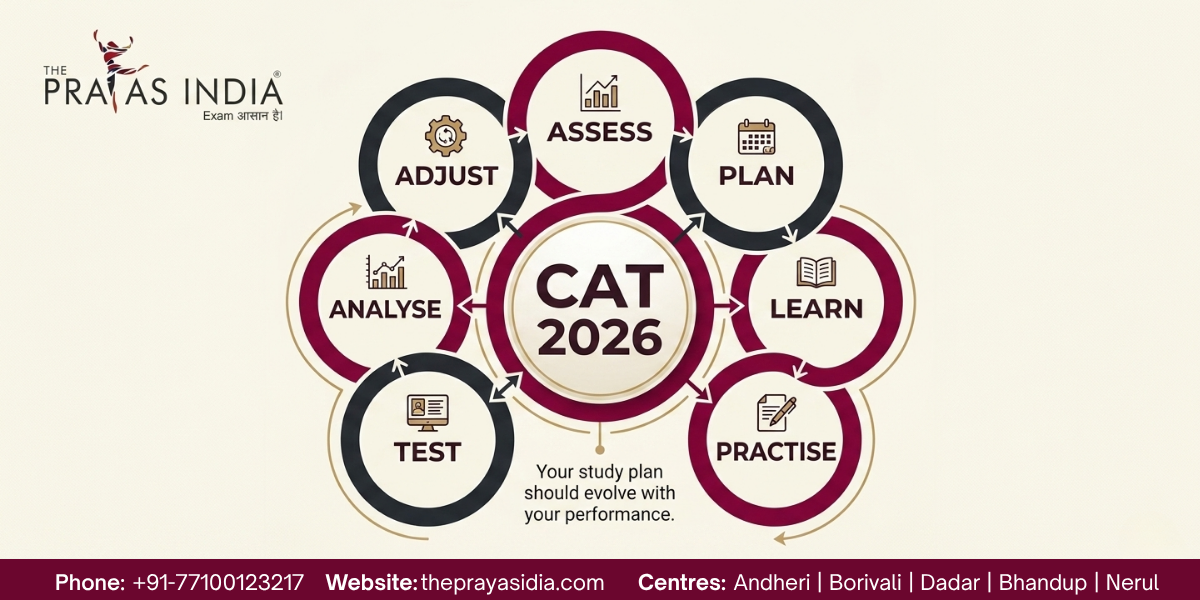
Assess → Plan → Study → Practise → Test → Analyse → Adjust
The second approach may feel slower initially.
But it creates something far more valuable:
direction.
And direction becomes particularly important as CAT approaches.
Your CAT Study Plan Should Change With Your Performance
Your first timetable should not be your final timetable.
As you take more tests, your understanding of your strengths and weaknesses will change.
Suppose your QA percentile improves significantly while DILR remains stagnant.
Your next study cycle should reflect that.
Similarly, if your VARC accuracy is strong but attempts are low, you may need to work on question selection and speed rather than basic concepts.
This is why CAT preparation should be treated as a feedback-driven process.
Your mock tests are not just scorecards.
They are data.
Use that data.
How Many Hours Should You Study for CAT?
There is no universal number of hours that guarantees a high CAT percentile.
A student preparing full-time may comfortably study for several hours a day, while a college student or working professional may have considerably less time.
What matters more is quality and consistency.
A practical routine could look like:
2–3 Hours Daily
Suitable for students balancing CAT preparation with college or work.
Focus on:
- One major concept
- One practice session
- Reading
- Short revision
4–5 Hours Daily
Allows more extensive sectional practice and regular testing.
6+ Hours Daily
Can work for full-time aspirants, provided the study sessions remain productive and include sufficient breaks.
The important distinction is:
Study hours ≠ productive hours.
Three focused hours can be more valuable than six hours of distracted preparation.
Build Your Daily Study Routine Around Three Activities
Instead of creating a timetable containing dozens of tiny tasks, divide your day into three broad activities.
1. Learn
Understand a new concept or strategy.
2. Practise
Apply what you learned through CAT-level questions.
3. Review
Analyse mistakes and revise important concepts.
For example:
90 minutes — QA concept + practice
60 minutes — DILR sets
45 minutes — VARC/Reading
30 minutes — Revision & error analysis
The exact duration can change according to your schedule.
The principle remains the same:
Learning without practice is incomplete.
Practice without analysis is inefficient.
Create a Weekly Target Instead of Only a Daily Target
Daily targets can sometimes become stressful.
If you miss one task on Tuesday, the entire timetable may feel disrupted.
Weekly targets provide greater flexibility.
For example, your weekly CAT targets could be:
VARC
- 5–7 RC sessions
- 3–4 VA practice sessions
- Daily reading
DILR
- 10–15 quality sets
- 2 timed sessions
- Detailed analysis of difficult sets
QA
- 2–3 major topics
- 100–150 quality questions
- 1–2 timed sectional sessions
Testing
- 2 sectional tests
- 1 full mock, depending on your preparation stage
These numbers are only examples.
Your targets should depend on your current level.
When Should You Start CAT Mock Tests?
A common misconception is that mock tests should begin only after completing the syllabus.
That can delay important learning.
You don’t need to wait until every topic is complete before experiencing a test environment.
However, the frequency and purpose of mocks should change over time.
Early Stage
Use diagnostic and sectional tests to understand your level.
Middle Stage
Gradually increase sectional and full-length testing.
Final Stage
Mocks become an important part of examination simulation and strategy refinement.
The objective changes from:
“How much can I score?”
to:
“How can I maximise my score?”
The Right Way to Analyse a CAT Mock Test
This is one of the most important parts of CAT preparation.
Many students spend two hours taking a mock and only ten minutes checking the result.
That is a missed opportunity.
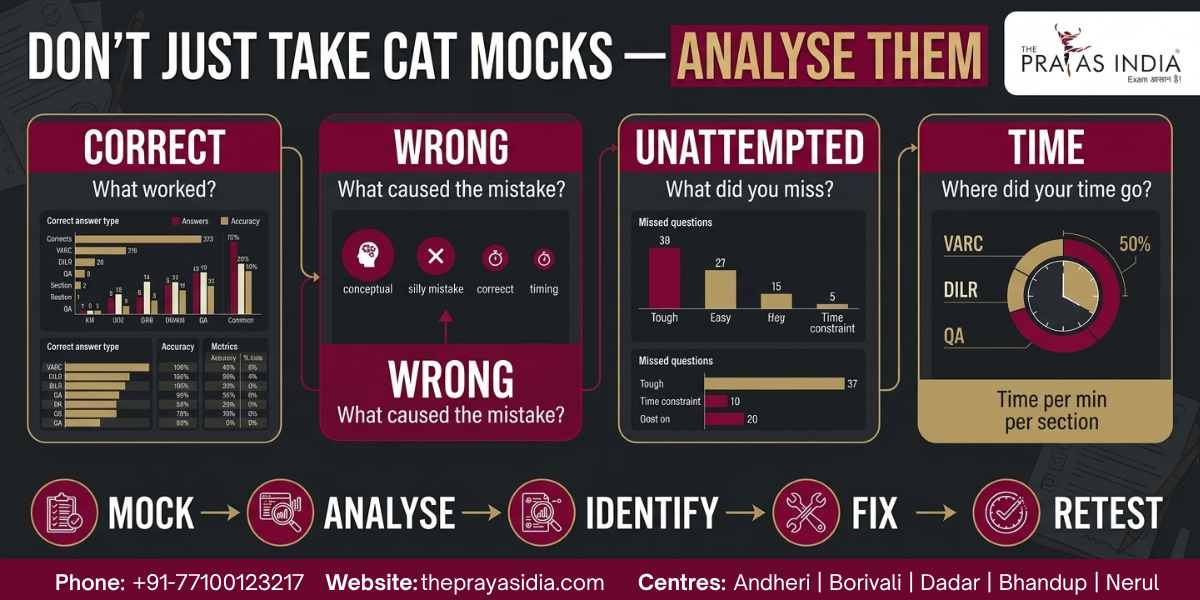
A proper mock analysis should examine four categories.
1. Correct Attempts
Which questions did you solve successfully?
Were they solved efficiently?
2. Incorrect Attempts
Why did you get them wrong?
- Conceptual mistake?
- Calculation error?
- Misreading?
- Guessing?
- Time pressure?
3. Unattempted Questions
Were there questions you could have solved but ignored?
Could better selection have increased your score?
4. Time Distribution
Where did your time go?
Did one DILR set consume too much time?
Did you spend several minutes on a difficult Quant question?
Did you rush through VARC towards the end?
This information can be more valuable than the overall percentile.
Your Mock Score Is Feedback, Not a Verdict
A low score in an early mock does not mean you cannot perform well in CAT.
Likewise, a high score in one mock does not guarantee a high CAT percentile.
Mocks are snapshots of your current preparation.
The important question is:
What did this mock teach me?
If your score remains similar across several tests, investigate why.
Perhaps your fundamentals need work.
Maybe your question selection is inefficient.
Maybe you’re losing marks because of accuracy.
Maybe you understand the concepts but haven’t developed enough speed.
Once you identify the reason, you can work on it.
Common CAT Preparation Mistakes You Should Avoid
Mistake 1: Changing Resources Constantly
Every new teacher, book or strategy may appear attractive.
But constantly changing resources prevents depth.
Choose reliable resources and stay consistent.
Mistake 2: Studying Only Your Favourite Section
Students naturally prefer subjects they are good at.
But CAT rewards overall performance.
Your weakest section deserves attention too.
Mistake 3: Ignoring DILR Until the End
DILR improves through exposure.
Waiting until the final months can make the section unnecessarily stressful.
Mistake 4: Treating VARC as “Easy”
VARC may look less technical than Quant, but CAT-level RCs require concentration, comprehension and careful option selection.
Mistake 5: Chasing Attempts Instead of Accuracy
More attempts are useful only when they contribute positively to your score.
The goal should be:
High-quality attempts.
Mistake 6: Taking Mocks Without Analysis
A mock without analysis is simply another test.
The real learning often begins after the test.
Mistake 7: Following Someone Else’s Timetable Blindly
Your preparation level, academic schedule and strengths are different.
Your timetable should reflect your situation.
How to Build a 90-Day CAT Preparation Framework
If you have approximately three months for focused preparation, divide the period into three stages.
Days 1–30: Strengthen the Foundation
Focus on:
- Important concepts
- Basic-to-moderate questions
- Daily reading
- Regular DILR practice
- Identifying weak areas
Don’t worry excessively about mock scores at this stage.
Your priority is building the base.
Days 31–60: Increase Difficulty
Now move towards:
- CAT-level questions
- Mixed-topic practice
- Timed sectional tests
- More difficult DILR sets
- Advanced application
- Regular mock tests
Begin identifying the question types that suit your personal strengths.
Days 61–90: Test and Refine
The focus should shift towards:
- Full-length mocks
- Mock analysis
- Revision
- Weak-area improvement
- Time management
- Question selection
- Examination strategy
At this stage, avoid constantly adding new resources.
Your preparation should become increasingly focused.
A 60-Day Framework Can Work Differently
Not everyone has 90 days.
If you have around 60 days, the preparation needs to be more targeted.
First 20 Days
Identify weaknesses and strengthen high-priority concepts.
Next 20 Days
Increase sectional practice and introduce regular mocks.
Final 20 Days
Focus heavily on mocks, analysis, revision and strategy.
The shorter the preparation window, the more important prioritisation becomes.
You cannot treat every topic as equally important.
What About a 30-Day CAT Preparation Plan?
Thirty days is a much tighter timeline, but it still requires a strategic approach.
Instead of attempting to learn everything from scratch, focus on:
VARC
Regular RC practice + question selection.
DILR
High-quality set practice + selection strategy.
QA
Strong areas + high-value concepts + repeated practice.
Mocks
Regular full-length testing and detailed analysis.
At this stage, the focus should be on maximising your existing strengths while repairing critical weaknesses.
Why CAT Coaching Can Make Preparation More Structured
Self-study has clear advantages.
You can study at your own pace and customise your timetable.
However, it also requires considerable self-management.
You have to decide:
- What to study
- Which questions to practise
- Which topics to prioritise
- Which mock tests to take
- How to analyse your performance
- When to revise
This can become overwhelming.
This is one reason aspirants consider CAT Coaching Mumbai when planning their preparation.
A structured coaching environment can reduce some of this uncertainty by providing a defined academic pathway.
What Should You Expect From CAT Coaching?
Joining coaching should not simply mean attending classes.
Before selecting a CAT coaching institute, consider whether it provides:
Conceptual Learning
Do the classes focus on understanding rather than memorising formulas?
Practice
Is there sufficient CAT-level question practice?
Test Series
Are sectional and full-length tests available?
Analysis
Can you understand why your performance is improving or declining?
Guidance
Can you get support when you’re stuck?
Strategy
Does the programme address time management and question selection?
Consistency
Does the environment help you maintain a regular preparation routine?
These factors are more important than simply counting the number of lectures.
How The Prayas India Can Help Bring Structure to CAT Preparation
For aspirants searching for CAT Coaching Mumbai, The Prayas India focuses on creating a preparation environment where learning and testing work together.
The objective is to help students move through the preparation cycle systematically:
Concept Building
↓
Practice
↓
Sectional Testing
↓
Mock Tests
↓
Performance Analysis
↓
Strategy Improvement
This approach helps students understand that CAT preparation is not a straight line.
It is a continuous process of learning and adjustment.
The Role of Faculty Guidance
CAT questions often have multiple possible approaches.
An experienced teacher can help students understand:
- Which method is more efficient
- Which questions should be avoided
- How to approach unfamiliar problems
- Why a particular option is incorrect
- How to improve solving time
- Which concepts require revision
This can be particularly valuable when students reach a plateau in their preparation.
Sometimes the problem isn’t that you need to study more.
You may need to change how you study.
Why Students Consider The Prayas India for CAT Preparation
Students have different reasons for joining CAT coaching.
Some need stronger fundamentals.
Some want regular mock-test practice.
Some struggle with consistency.
Others want guidance on how to convert their preparation into examination performance.
For these aspirants, The Prayas India aims to provide a structured environment where preparation has a clear direction.
The focus remains on:
Learn better.
Practise smarter.
Test regularly.
Analyse honestly.
Improve continuously.
How to Know Whether Your CAT Preparation Is Working
Don’t wait for the final CAT examination to evaluate your preparation.
Track a few indicators every week.
Accuracy
Is your percentage of correct attempts improving?
Speed
Are you solving familiar question types faster?
Selection
Are you becoming better at identifying questions and sets worth attempting?
Consistency
Are your mock scores becoming more stable?
Weaknesses
Are previously weak topics improving?
Decision-Making
Are you making fewer impulsive attempts?
These indicators can tell you much more about your preparation than the number of hours you studied.
The Final Weeks Should Be About Refinement
As CAT approaches, the temptation to learn something completely new becomes strong.
Avoid unnecessary experimentation.
The final phase should focus on:
- Revision
- Mock tests
- Error logs
- Important concepts
- Question selection
- Time management
- Maintaining confidence
Your strategy should become increasingly familiar.
You should know:
Which questions to attempt.
Which questions to leave.
How much time to spend.
When to move on.
This familiarity can reduce unnecessary decision-making during the actual examination.
A Simple CAT Preparation Formula
If CAT preparation feels confusing, return to a simple framework:
ASSESS
Know where you stand.
PLAN
Set realistic weekly targets.
LEARN
Build concepts properly.
PRACTISE
Solve quality CAT-level questions.
TEST
Take sectional and full-length mocks.
ANALYSE
Understand your mistakes.
ADJUST
Change your strategy based on evidence.
REPEAT
Keep improving.
Why a Personalised CAT Preparation Strategy Matters
There is no perfect timetable that works for every CAT aspirant.
A student with strong Quant fundamentals may need to devote more time to DILR.
A student who reads regularly may need less VARC concept-building but more timed practice.
Someone starting from scratch may need significantly more foundation work.
This is why a CAT preparation strategy should be dynamic.
Your timetable should answer your current needs—not someone else’s.
The Prayas India: Helping Aspirants Prepare With Direction
For students exploring CAT Coaching Mumbai, the objective should not be to find an institute that simply promises a high percentile.
Look for an environment that helps you build the habits required to achieve your target.
At The Prayas India, the preparation approach is built around:
- Concept clarity
- Structured learning
- CAT-level practice
- Sectional preparation
- Mock tests
- Performance analysis
- Strategy refinement
- Consistent guidance
The idea is simple:
Your preparation should have a system.
And that system should become stronger as you progress.
Conclusion: Don’t Let CAT Preparation Become a Confusing Routine
CAT preparation becomes difficult when everything feels equally important.
Every book looks necessary.
Every topic looks urgent.
Every mock score feels important.
Every new strategy seems worth trying.
But effective preparation is about prioritisation.
You don’t need to do everything.
You need to do the right things consistently.
Build your fundamentals.
Practise deliberately.
Read regularly.
Solve DILR sets.
Work on Quant.
Take mocks.
Analyse them.
Identify your weaknesses.
Adjust your plan.
Repeat.
If you are considering CAT Coaching Mumbai, choose an environment that gives your preparation structure while still encouraging independent thinking and self-study.
The Prayas India aims to help aspirants build that structure—from the first concepts to mock-test analysis and final examination strategy.
Don’t prepare harder just for the sake of preparing harder.
Prepare smarter, measure your progress and keep improving.
If CAT 2026 is your target, the right time to build your preparation system is before the pressure of the final weeks begins.
Start with clarity. Prepare with consistency. Move towards your MBA goal with a strategy that works for you.
Contact Us
📞 Call Now: +91-77100 13217
🌐 Website: theprayasindia.com