CAT Quantitative Aptitude Strategy 2026 | How to Choose Questions and Maximise Your QA Score | The Prayas India
For many CAT aspirants, Quantitative Aptitude (QA) is the section where preparation can become highly unpredictable.
A student may spend weeks learning formulas, solving hundreds of questions and completing topic-wise practice, yet the mock-test score may remain inconsistent.
The reason is often not a lack of knowledge.
It is question selection.
CAT QA is not designed simply to test how many mathematical concepts you know. It also tests whether you can identify the right questions, manage limited time and avoid spending too long on problems that offer poor returns.
For CAT 2026 aspirants targeting a strong percentile and competitive MBA admissions, the objective should therefore be:
Know the concepts → Identify the right questions → Solve efficiently → Maximise correct attempts.
This is where a structured CAT Quantitative Aptitude strategy becomes important.
Why Question Selection Matters in CAT QA
Imagine that you have a strong understanding of percentages, ratios, algebra and geometry.
You enter the CAT exam and see a difficult-looking question.
You start solving it.
After two minutes, you’re still working through the calculations.
Another minute passes.
You finally realise that the question requires a lengthy approach.
Meanwhile, you have already spent three minutes on one question.
The problem wasn’t your mathematical ability.
The problem was decision-making.
In CAT, every question has an opportunity cost.
The time spent on one difficult question is time that cannot be spent on another question that may have been easier to solve correctly.
That is why a strong QA strategy isn’t:
Solve everything you know.
It is:
Identify what is worth solving first.
The Real Goal: Maximise Correct Attempts
A common misconception among aspirants is that a high QA score requires attempting a very large number of questions.
That’s not necessarily true.
Your objective should be to maximise the number of correct and strategically selected attempts.
Consider two hypothetical approaches.
Approach A
Attempt 18 questions with rushed calculations and several errors.
Approach B
Attempt 14–15 questions with stronger accuracy and better time control.
The second approach can potentially produce a better outcome.
Therefore, don’t build your CAT QA strategy around a fixed attempt number.
Instead, develop the ability to recognise:
“This is a question I should solve.”
and equally importantly:
“This is a question I should leave for later.”
The CAT QA Question Selection Framework
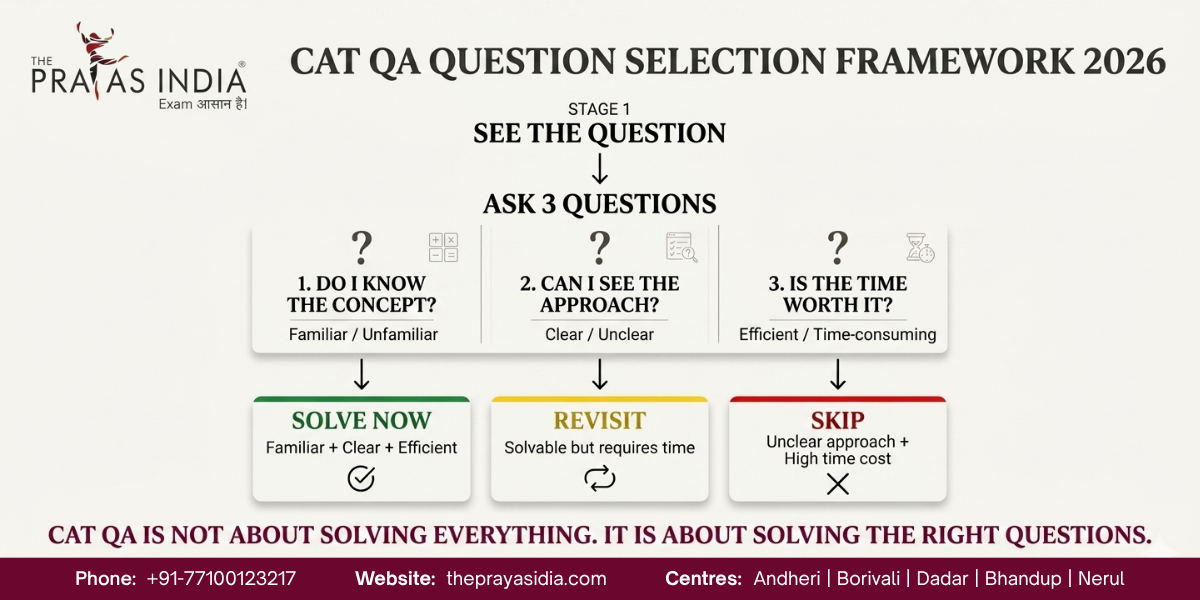
Every question you see can broadly be evaluated using three factors:
1. Familiarity
Do you understand the concept being tested?
2. Approach
Can you identify a workable method quickly?
3. Time
Can you realistically solve it without consuming disproportionate time?
If the answer to all three is positive, the question deserves priority.
If the question looks unfamiliar and the approach is unclear, moving ahead may be the smarter decision.
Easy Does Not Always Mean Short
One important CAT lesson is that question length and difficulty are not the same thing.
A relatively lengthy question may have a simple concept behind it.
A two-line question may require considerable mathematical insight.
For example, a question may look intimidating because of a large amount of information, but once you identify the underlying ratio or percentage relationship, the solution may be straightforward.
Therefore, don’t reject a question merely because it looks long.
Spend a few seconds identifying the mathematical core.
Ask:
What concept is actually being tested here?
If you can identify the concept and the approach quickly, the question may still be worth attempting.
The 3-Level CAT QA Classification
During practice, train yourself to classify questions into three broad categories.
Level 1 — Direct Scoring Questions
These are questions where:
- The concept is familiar
- The approach is obvious
- Calculations are manageable
- You have high confidence
These should generally receive priority.
Level 2 — Solvable With Thought
These questions require:
- Some calculation
- Multiple steps
- Careful interpretation
- More time than a direct question
They can be attempted once the high-confidence questions are under control.
Level 3 — Time-Consuming or Uncertain
These may involve:
- An unfamiliar concept
- Complicated calculations
- Multiple possible approaches
- A solution path you cannot identify quickly
Don’t automatically spend several minutes on them.
Mark them mentally as potential revisit questions and move ahead.
Don’t Let One Question Control Your Section
A dangerous habit in CAT QA is becoming emotionally attached to a question.
You start solving it.
The first method doesn’t work.
You try another.
Then another.
Because you’ve already invested time, you feel that leaving the question would “waste” your effort.
This is a classic sunk-cost trap.
The time you have already spent is gone.
The only question that matters is:
“Is continuing from this point worth the remaining time?”
If the answer is no, move on.
Strong CAT candidates aren’t necessarily the ones who solve every difficult question.
They are often the ones who know when to stop solving one question and start solving another.
Topic-Wise CAT QA Strategy
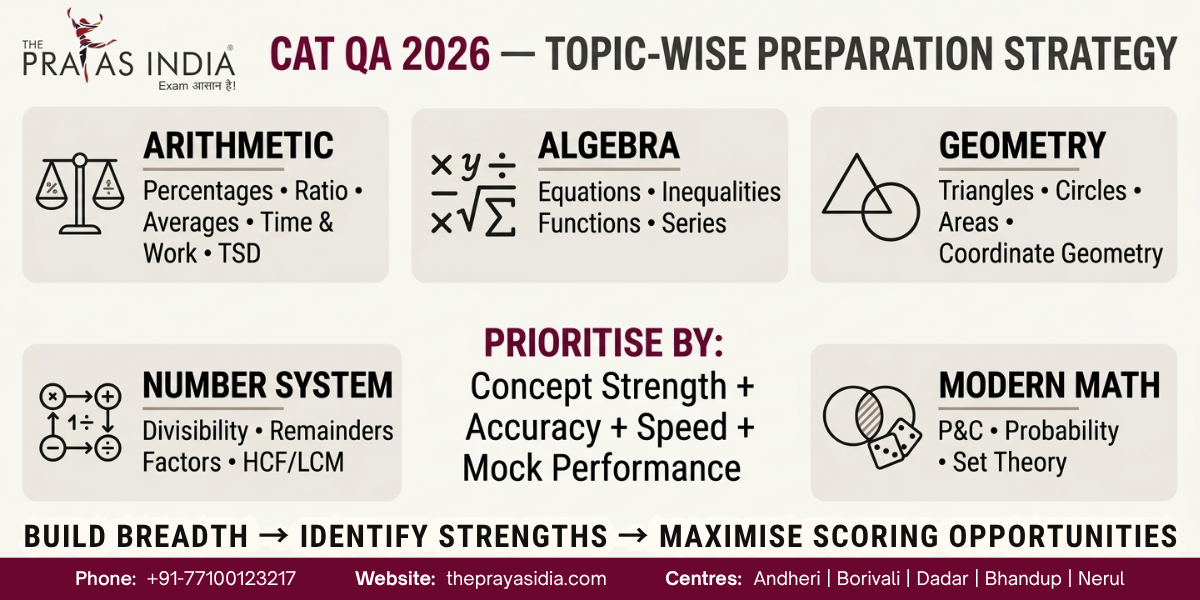
CAT QA covers multiple mathematical areas, but preparation should not mean giving every topic exactly the same amount of time.
Your priority should depend on:
- Your conceptual strength
- Frequency of questions in recent CAT papers
- Your accuracy
- Your speed
- Your ability to solve questions from the topic under pressure
Broadly, your preparation can revolve around:
Arithmetic
Important areas include:
- Percentages
- Profit & Loss
- Ratio & Proportion
- Averages
- Mixtures
- Time, Speed & Distance
- Time & Work
- Simple and Compound Interest
Arithmetic is especially important because many questions can be approached through practical mathematical reasoning rather than lengthy formulas.
Algebra
Important areas include:
- Linear equations
- Quadratic equations
- Inequalities
- Functions
- Sequences and series
- Algebraic expressions
Algebra can initially feel difficult because questions often require you to identify the right manipulation rather than simply apply a formula.
Regular practice is essential.
Geometry and Mensuration
Important concepts include:
- Triangles
- Circles
- Quadrilaterals
- Coordinate geometry
- Areas
- Volumes
The key here is conceptual clarity.
Memorising formulas without understanding relationships can make unfamiliar questions difficult.
Number System
Important concepts include:
- Divisibility
- Factors
- Multiples
- Remainders
- HCF and LCM
- Units digit
- Integers
Number System questions can sometimes reward conceptual understanding more than lengthy calculations.
Modern Mathematics
Depending on the CAT pattern, questions may also involve areas such as:
- Permutation and Combination
- Probability
- Set Theory
These topics should not automatically be ignored simply because they may feel less comfortable.
Instead, evaluate them based on your own preparation and mock performance.
Build Your Strategy Around Strengths, Not Fear
Some students spend most of their preparation time on topics they find difficult.
That may sound logical, but it isn’t always efficient.
Suppose you are extremely strong in Arithmetic and consistently score well in it, but struggle with a particular advanced Algebra concept.
You shouldn’t stop practising Arithmetic.
Instead:
Maintain your strength + improve your weakness.
Your goal is to create a broad enough preparation base that you can identify scoring opportunities regardless of which topics appear prominently in your particular CAT paper.
Practice Question Selection Before the Exam
Question selection cannot be learned effectively only by reading about it.
You need to practise it.
During your sectional tests, deliberately introduce a selection phase.
Instead of immediately solving the first question, scan the section and identify:
Questions I want to solve immediately
Questions I may revisit
Questions I should probably avoid
Then compare your decisions with your actual performance.
Were the questions you selected actually efficient?
Did you underestimate an easy question?
Did you waste time on a difficult one?
This process gradually develops your exam instinct.
From Preparation to Performance
A strong CAT QA preparation cycle should look like:
CONCEPTS
↓
TOPIC PRACTICE
↓
TIMED PRACTICE
↓
SECTIONALS
↓
FULL-LENGTH MOCKS
↓
ANALYSIS
↓
STRATEGY REFINEMENT
This is what converts mathematical knowledge into exam performance.
Why CAT Coaching Can Help
Self-study can build conceptual knowledge, but CAT preparation also involves strategy.
A structured coaching environment can help aspirants with:
- Concept building
- CAT-level practice
- Doubt resolution
- Sectional tests
- Full-length mocks
- Performance analysis
- Time-management strategies
- Personalised improvement areas
For students looking for CAT coaching in Mumbai, the value of coaching should therefore not be judged only by the number of classes conducted.
The more important question is:
Does the preparation system help you become better at solving the right questions under pressure?
At The Prayas India, CAT aspirants can work towards building that combination of conceptual preparation and exam-oriented strategy.
Takeaway
CAT QA is ultimately a decision-making section as much as a mathematics section.
You need to know the concepts, but you also need to know:
- Which questions to solve first
- Which questions to postpone
- Which questions to leave
- How much time to invest
- Where your strengths lie
- Which mistakes repeatedly affect your score
The most effective mindset is:
Don’t chase questions. Chase scoring opportunities.
CAT QA Time Management, Mock Analysis & Score Maximisation
Knowing which questions to attempt is only the first part of a successful CAT Quantitative Aptitude strategy.
The next challenge is executing that strategy within the limited time available.
A strong QA candidate needs to constantly balance three things:
Speed + Accuracy + Decision-Making
If you solve too slowly, you may leave scoring opportunities untouched.
If you rush, calculation and interpretation errors can increase.
If you spend too long on difficult questions, your overall attempt strategy can collapse.
For CAT 2026, the goal should therefore be to develop a QA approach that is fast enough to maximise opportunities and controlled enough to protect accuracy.
CAT QA Time Management: Think in Decisions, Not Minutes
Many aspirants prepare a fixed timetable such as:
“I will spend exactly two minutes on every question.”
This sounds organised but doesn’t work well in practice.
Questions are not equally difficult.
One question may take 45 seconds.
Another may require two minutes.
A third may take four minutes even when you know the concept.
Instead of assigning identical time to every question, develop time checkpoints.
At regular intervals, ask:
- How many questions have I evaluated?
- How many have I solved?
- Am I spending too long on one problem?
- Are there easier questions still waiting?
- Should I change my approach?
This keeps you in control of the section.
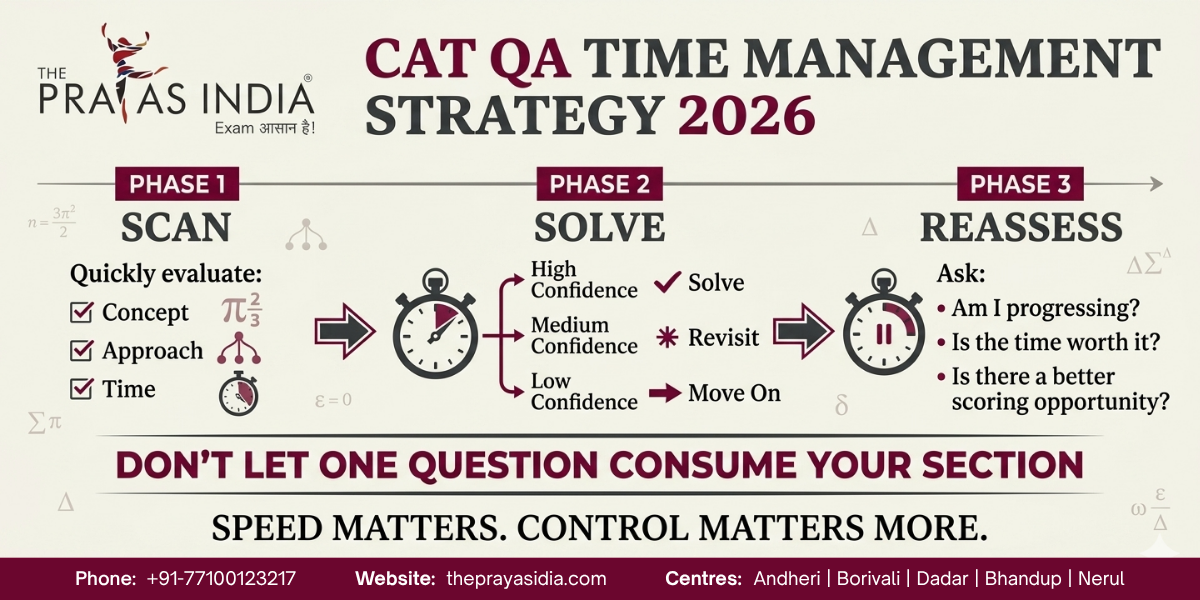
The 30-Second Decision Rule
The first few seconds of a QA question should be used to understand its structure.
Ask:
What concept is this?
If you recognise the topic, immediately think:
Do I know a workable method?
Then:
Is this method likely to be efficient?
If the answer is yes, solve.
If you understand the concept but the calculations appear unnecessarily long, consider marking it for later.
If you cannot identify the approach, don’t keep staring at the question hoping the solution will magically appear.
Move.
This small decision can save significant time across the section.
When Should You Skip a CAT QA Question?
Skipping is not failure.
In a competitive exam, strategic skipping is a scoring skill.
Consider skipping or postponing a question when:
- You don’t understand what the question is asking
- You cannot identify the relevant concept
- Your first approach has failed
- Calculations are becoming excessively long
- You are repeatedly making arithmetic mistakes
- Another question appears significantly more promising
The key is to distinguish between:
“I can’t solve this.”
and
“I can solve this, but not efficiently right now.”
The second category can often be revisited later.
The 2-Minute Trap
One of the most dangerous situations in QA is the question that looks almost solved.
You think:
“I’m just one step away.”
So you continue.
Another 60 seconds passes.
Then another.
Eventually, you realise that you have spent four minutes on a question that still isn’t solved.
This is the 2-minute trap.
The exact time limit will vary depending on the question and your strategy, but the principle remains:
If the solution path isn’t progressing, reassess.
Don’t allow one question to consume the time required for multiple other scoring opportunities.
Don’t Let Calculations Control Your Strategy
CAT QA is not a test of how quickly you can perform endless calculations.
Many questions reward:
- Estimation
- Approximation
- Ratio-based reasoning
- Option-based approaches
- Substitution
- Logical elimination
- Smart calculation
Before performing a long calculation, ask:
“Do I actually need the exact value?”
Sometimes the options themselves can help you reach the answer more efficiently.
However, shortcuts should only be used when you understand why they work.
A shortcut that creates an error is not a shortcut.
Accuracy Comes Before Speed
During the learning phase, don’t force yourself to solve everything quickly.
First build accuracy.
Suppose you are currently solving 10 questions with 70% accuracy.
Trying to suddenly increase your attempts to 15 may simply produce more mistakes.
Instead, work towards:
10 questions → higher accuracy
Then:
12 questions → maintain accuracy
Then:
14 questions → maintain control
This gradual progression is more sustainable.
Mock Tests Are Your QA Laboratory
Mock tests should not simply tell you your percentile.
They should tell you how you behave under pressure.
A mock can reveal things that topic-wise practice cannot.
For example:
You may know Arithmetic extremely well during practice.
But in a mock, you may spend too much time on a difficult Arithmetic question because you feel confident about the topic.
Or perhaps you solve Algebra accurately but too slowly.
These are strategy problems, not necessarily conceptual problems.
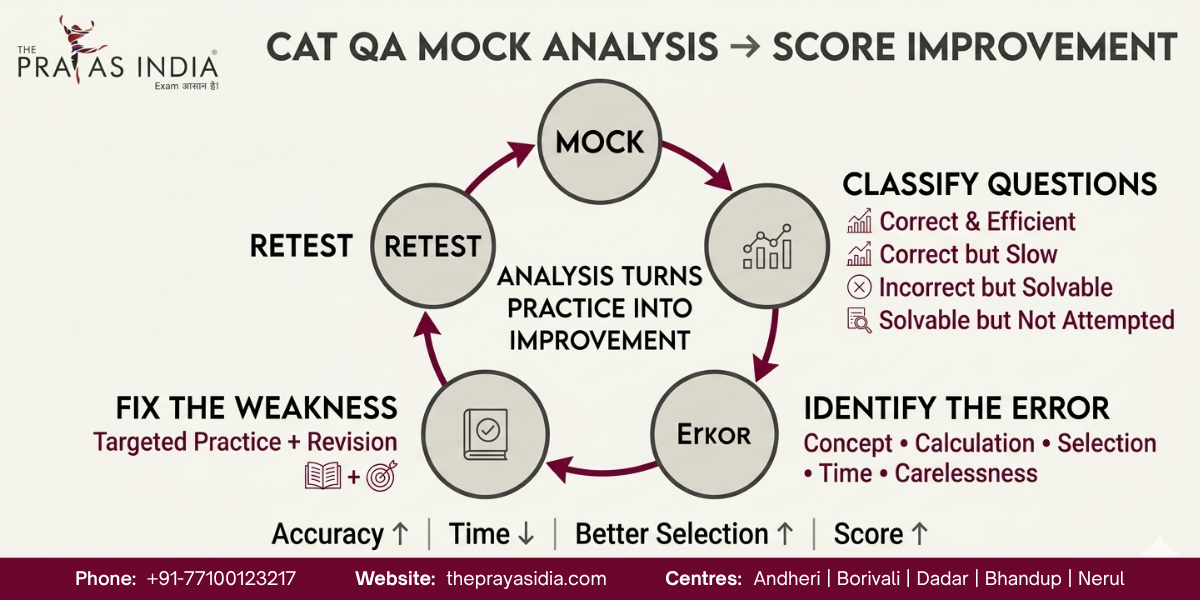
How to Analyse a CAT QA Mock
After every mock, divide your questions into four categories.
Category 1 — Correct & Efficient
These are your strongest questions.
Understand why your approach worked.
Category 2 — Correct but Slow
You got the answer but spent too much time.
Look for a more efficient method.
Category 3 — Incorrect but Solvable
You understood the concept but made an error.
Identify whether it was:
- Calculation
- Interpretation
- Formula
- Logical mistake
- Carelessness
Category 4 — Not Attempted but Solvable
This category is extremely important.
These questions may represent missed scoring opportunities.
Ask:
Why didn’t I attempt this?
Was it because:
- You didn’t notice it?
- You misjudged the difficulty?
- You ran out of time?
- You were stuck on another question?
This analysis can significantly improve future question selection.
Create a CAT QA Error Log
Don’t simply write:
“Question wrong.”
Write down the reason.
A useful error log can look like this:
| Error Type | Example | Corrective Action |
|---|---|---|
| Conceptual | Formula not known | Revise concept |
| Application | Couldn’t identify method | Practise mixed questions |
| Calculation | Arithmetic mistake | Slow down calculation |
| Selection | Spent too long | Improve scanning |
| Time | Ran out of time | Practise timed sections |
| Careless | Misread condition | Improve question reading |
After 5–10 mocks, patterns become much easier to identify.
You may discover that your biggest problem isn’t Quant knowledge at all.
It may be question selection.
Use Your Mock Data to Build a Personal Strategy
Suppose your mock analysis shows:
Arithmetic: High accuracy + good speed
Algebra: Moderate accuracy + moderate speed
Geometry: Low accuracy
Number System: High accuracy but slow
Your strategy should reflect that.
You might:
- Prioritise strong Arithmetic questions
- Attempt familiar Number System questions selectively
- Improve Algebra through targeted practice
- Avoid forcing difficult Geometry questions until confidence improves
This is much better than following a generic strategy that assumes every aspirant has identical strengths.
CAT QA Strategy for the Final 60 Days
The final two months should be divided into preparation and refinement.
60–45 Days Before CAT
Focus on:
- Strengthening core concepts
- Mixed-topic practice
- Building calculation efficiency
- Identifying strong and weak areas
- Regular QA sectionals
Don’t worry excessively about achieving your final mock score at this stage.
Focus on fixing weaknesses.
45–30 Days Before CAT
Start increasing the importance of:
- Full-length mocks
- Timed QA sections
- Question selection
- Mock analysis
- Revising recurring errors
You should gradually develop your preferred order of attack.
For example:
Scan → Strong Questions → Moderate Questions → Revisit
The exact sequence can change based on your performance.
30–15 Days Before CAT
At this stage, focus heavily on execution.
Your preparation should include:
- Full-length CAT mocks
- Sectional tests
- Mixed QA sets
- Error-log revision
- Weak-topic revision
- Time-management practice
Avoid spending most of your time learning obscure concepts that have little relevance to your overall preparation.
Strengthen the areas that can actually improve your performance.
Final 15 Days
Your strategy should become stable.
Focus on:
Revision
Formulae, concepts and frequently repeated mistakes.
Practice
Selected CAT-level questions.
Testing
Mocks and timed sections.
Analysis
Understanding your decisions.
Consistency
Maintaining the strategy that has worked for you.
This is not the stage for completely reinventing your preparation.
Four Common CAT QA Mistakes
1. Trying to Solve Questions in Order
Question order does not determine question value.
Scan and select.
2. Spending Too Long on Familiar Topics
Confidence can sometimes become a disadvantage.
Just because you know the topic doesn’t mean every question from it is worth solving.
3. Ignoring Calculation Errors
If calculation mistakes repeatedly reduce your score, treat them as a separate preparation problem.
Accuracy isn’t only about conceptual understanding.
4. Taking Mocks Without Analysis
A mock score is feedback.
If you don’t analyse it, you’re throwing away some of the most useful information available during preparation.
Turning QA Preparation Into a Stronger CAT Percentile
CAT preparation is not simply about finishing Quantitative Aptitude topics.
Your ultimate goal is to perform effectively in a high-pressure examination.
That means your preparation must gradually move through three stages:
Stage 1 — Knowledge
Do I know the concept?
Stage 2 — Application
Can I solve a CAT-level question?
Stage 3 — Strategy
Can I identify whether this question is worth solving right now?
Many aspirants spend most of their preparation stuck at Stage 1.
They keep revising concepts but don’t spend enough time developing the decision-making required in the actual examination.
CAT 2026 preparation should therefore include all three.
How The Prayas India Can Support CAT Preparation
For aspirants searching for Best CAT Coaching in Mumbai, preparation should go beyond classroom lectures.
A structured CAT programme can help students develop:
- Strong conceptual foundations
- CAT-level question-solving ability
- Sectional strategy
- Mock-test discipline
- Time-management skills
- Question-selection techniques
- Performance analysis
At The Prayas India, the focus can be on helping aspirants prepare for the CAT as an actual competitive examination—not merely completing Quantitative Aptitude topics.
For students targeting leading MBA institutes, this combination of conceptual preparation + exam strategy + regular testing can make preparation more structured and measurable.
Contact Us
📞 Call Now: +91-77100 13217
🌐 Website: theprayasindia.com
📍 Centres: Andheri | Borivali | Dadar | Nerul | Bhandup
CAT QA: The Right Mindset for 2026
Don’t enter the examination thinking:
“I need to solve every question.”
Instead, think:
“I need to maximise my correct attempts.”
That small change can influence your entire strategy.
You will become more comfortable leaving questions.
You will stop spending excessive time on problems that aren’t progressing.
You will pay more attention to question selection.
And most importantly, you will start treating time as a strategic resource.
Final Takeaway
A strong CAT QA strategy isn’t about being the fastest calculator in the room.
It is about making better mathematical decisions under pressure.
Your preparation should therefore follow this cycle:
BUILD CONCEPTS
↓
PRACTISE
↓
LEARN TO SELECT
↓
TAKE MOCKS
↓
ANALYSE ERRORS
↓
REFINE STRATEGY
↓
RETEST
The aspirants who learn to identify scoring opportunities, control their time and protect their accuracy can put themselves in a much stronger position for CAT 2026.
If your goal is a competitive CAT percentile and admission to a top MBA programme, start treating question selection as a core Quantitative Aptitude skill, not an exam-day trick.
FAQs
1. How can I improve my CAT QA score?
Focus on conceptual clarity, mixed-topic practice, question selection, time management and detailed mock analysis. Improving accuracy is often more valuable than simply increasing attempts.
2. How should I select questions in CAT Quantitative Aptitude?
First identify the concept, then determine whether you can see a workable approach and finally evaluate the likely time requirement. Prioritise questions where all three factors are favourable.
3. Should I attempt difficult QA questions in CAT?
Difficult questions can be attempted if you can identify a workable approach and have sufficient time. However, don't allow one difficult question to consume time that could be used on easier scoring opportunities.
4. How important are mock tests for CAT QA preparation?
Mocks are important because they allow you to practise question selection, time management and accuracy under pressure. Their real value comes from detailed analysis after the test.
5. Which QA topics should I prioritise for CAT 2026?
Arithmetic, Algebra, Geometry, Number System and other relevant QA areas should all be prepared. Your individual priority should depend on conceptual strength, accuracy, speed and performance in CAT-level tests.
6. Can CAT coaching improve Quantitative Aptitude strategy?
A structured CAT coaching programme can provide conceptual guidance, CAT-level practice, mock tests, performance analysis and strategy feedback, helping aspirants build a more systematic preparation approach.