CAT Revision Strategy: How to Revise Without Losing Momentum | Best CAT Coaching in Mumbai | The Prayas India
Revision is one of the most underestimated parts of CAT preparation.
Most aspirants spend the first few months trying to finish the syllabus, solve practice questions and take mock tests. Once a substantial portion of the syllabus is covered, they assume revision will simply mean going back through their books and notes.
That is where the problem begins.
CAT revision is not about reading everything again from the beginning. It is about making important concepts, approaches, mistakes and decision-making patterns available when you need them under exam pressure.
A candidate may have studied Arithmetic three months ago and solved dozens of questions at that time. But if the formulas, approaches and common traps are no longer readily accessible, that earlier effort will not automatically translate into performance.
At the same time, revision can create another problem: loss of momentum.
You may have been taking mocks regularly and improving your speed. Then you decide to revise the entire syllabus before taking another mock. Days turn into weeks, and your exposure to timed problem-solving decreases.
A better CAT revision strategy therefore needs to achieve two things simultaneously:
Strengthen what you already know without interrupting the momentum you have built.
For aspirants preparing for CAT in Mumbai, this becomes particularly important because preparation schedules often need to accommodate college, work, coaching classes and other responsibilities. The solution is not to study everything again. The solution is to revise selectively, repeatedly and intelligently.
Revision Should Not Feel Like Starting CAT Preparation Again
One of the biggest revision mistakes is going back to the beginning and treating every topic as equally important.
Suppose you have already completed:
- Arithmetic
- Algebra
- Geometry
- Number Systems
- Modern Mathematics
You do not need to spend the same amount of time revisiting every chapter.
Some concepts may already be strong. Others may require targeted practice. A few may repeatedly cause errors in your mocks.
Your revision should reflect these differences.
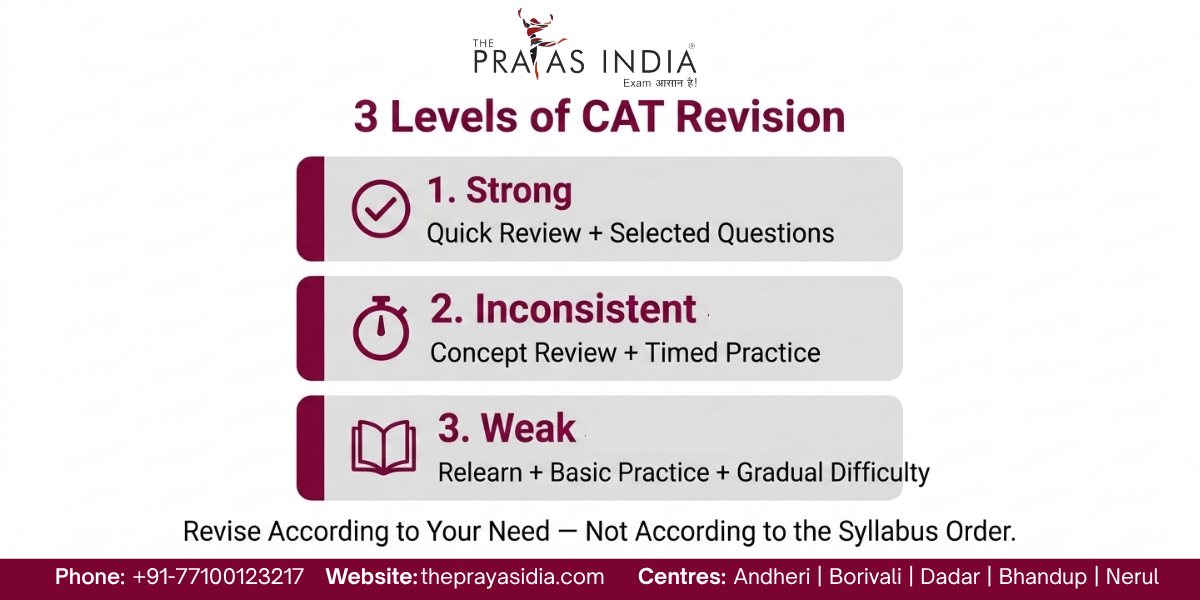
Think of the process as three categories:
Strong
You understand the concept, can recognise the question type and usually solve it accurately.
Revision approach: Quick review + selected questions.
Familiar but Inconsistent
You understand the basic concept but make mistakes under pressure or take too long.
Revision approach: Concept review + timed practice.
Weak
You struggle to understand the approach or repeatedly make similar errors.
Revision approach: Relearn the concept + basic practice + gradual difficulty increase.
This simple classification prevents you from wasting valuable preparation time.
Start With a Revision Audit
Before opening your books, spend some time understanding what actually needs revision.
Take your recent mock-test performance, sectional tests and practice records and create a simple revision audit.
For each major topic, record:
| Topic | Concept Clarity | Accuracy | Speed | Revision Priority |
|---|---|---|---|---|
| Arithmetic | Good | High | Good | Low |
| Algebra | Good | Moderate | Moderate | Medium |
| Geometry | Moderate | Low | Slow | High |
| Number Systems | Good | Moderate | Slow | Medium |
| Modern Math | Weak | Low | Slow | High |
The exact ratings will differ from student to student.
The important point is that revision should be evidence-based.
If your mock performance shows that you consistently lose marks in a particular area, that topic deserves more attention than one that you already handle comfortably.
This is much more efficient than simply opening Chapter 1 and moving sequentially through the entire syllabus.
Build a Revision Notebook, Not Another Textbook
Your revision notes should be short enough to review quickly.
Do not copy entire chapters into a notebook.
Instead, maintain a compact collection of:
- Important formulas
- Key concepts
- Standard approaches
- Frequently repeated question types
- Common traps
- Personal mistakes
- Useful shortcuts that you genuinely understand
- Questions worth revisiting
The last two categories are particularly valuable.
A formula may be easy to remember, but knowing why you previously got a question wrong can prevent the same mistake from appearing again.
Your revision notebook should therefore answer:
“What do I personally need to remember before CAT?”
It should not attempt to recreate your entire study material.
The Three-Layer CAT Revision Model
A useful way to organise revision is to divide it into three layers.
Layer 1: Concept Revision
Start by refreshing the underlying concept.
For example, if you are revising percentages, do not immediately jump into difficult questions.
Spend a few minutes reviewing:
- Basic percentage relationships
- Percentage increase/decrease
- Successive percentage changes
- Applications in profit and loss
- Applications in mixtures and averages
The objective is to make the conceptual framework active again.
Layer 2: Application Revision
Once the concept is refreshed, solve a small number of representative questions.
Do not attempt 50 questions simply because you are revising the chapter.
Choose questions that test different applications of the concept.
This helps you determine whether you actually remember how to use the concept rather than merely recognising the formula.
Layer 3: Timed Revision
The final stage should involve time-bound practice.
CAT is not a theoretical examination.
You must be able to:
Recognise → Choose → Solve → Move On
under time pressure.
A concept that works perfectly in an untimed environment may still fail during a mock if you spend too much time identifying the approach.
Timed revision bridges this gap.
Don’t Pause Mocks for Revision
One of the most damaging revision strategies is:
“I will finish revision first, then start taking mocks again.”
This can break your exam rhythm.
Mocks should continue while revision happens.
Think of them as two parallel tracks.
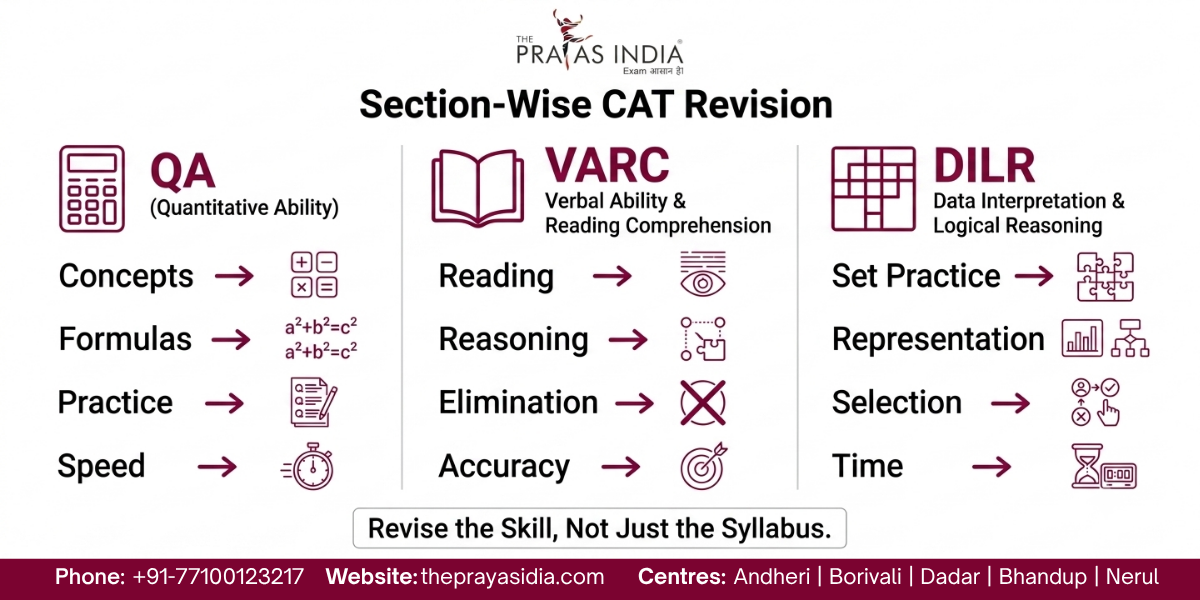
Track 1: Revision
Strengthen concepts, formulas, question types and weak areas.
Track 2: Testing
Use sectional tests and full-length mocks to check whether revision is translating into performance.
This creates a feedback loop:
Revise → Test → Identify Gaps → Revise Again
That cycle is much more effective than completing a huge revision block and only then discovering what you still do not know.
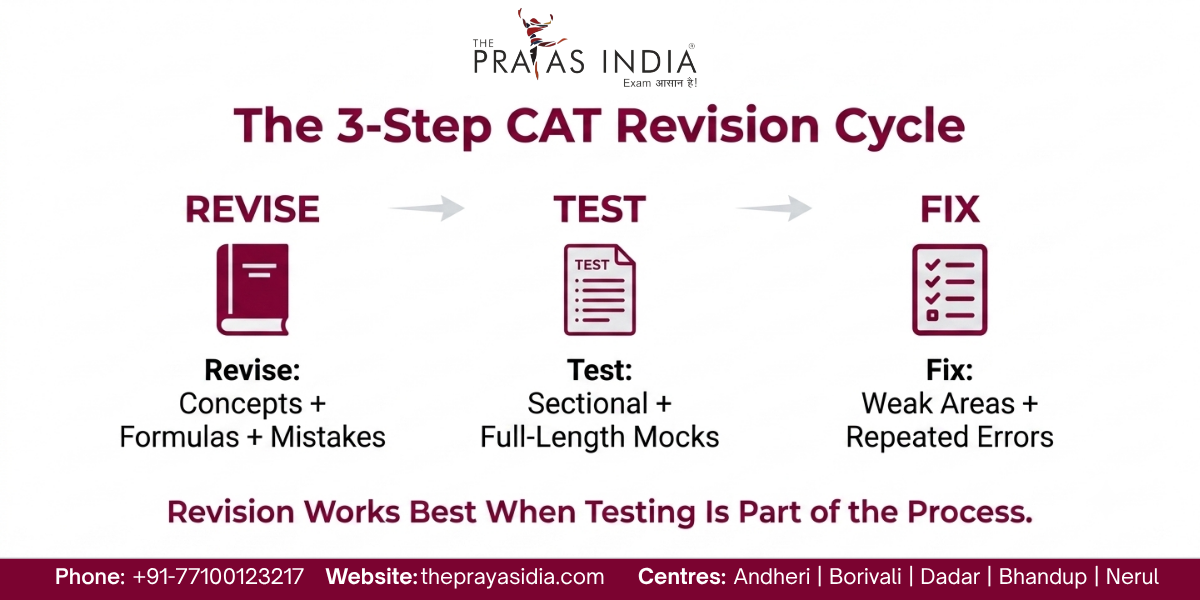
How to Revise Quant Without Losing Speed
Quant revision should not become a formula-reading exercise.
After reviewing a topic, ask yourself:
Can I identify the concept quickly?
Can I choose the appropriate method?
Can I solve a moderate question without unnecessary calculations?
Can I recognise when a question is not worth attempting?
For example, while revising Arithmetic, divide your practice into smaller groups:
Percentages → Profit & Loss → Ratio → Averages → Mixtures → Time & Work → Time, Speed & Distance
But do not spend equal time on every subtopic.
Your mock performance should determine where additional effort goes.
VARC Revision Is Different
VARC cannot be revised exactly like Quant.
You cannot simply memorise a set of formulas and expect reading comprehension performance to improve.
VARC revision should focus on patterns and mistakes.
Review the RC questions you previously got wrong and identify the reason:
- Misread the passage
- Missed the author’s central argument
- Chose an extreme option
- Relied on outside knowledge
- Ignored a qualifying statement
- Misinterpreted an inference
- Spent too much time between two options
This type of analysis is far more valuable than simply reading more vocabulary lists.
Your reading habit should also continue during revision.
DILR Revision Should Focus on Set Selection
DILR revision should not be limited to solving more sets.
A major part of DILR performance is deciding which set deserves your time.
When revising previous sets, ask:
- How quickly did I understand the structure?
- Did I identify the correct variables?
- Did I organise the information efficiently?
- Where did my approach become complicated?
- Was there a simpler representation?
- At what point should I have abandoned the set?
This trains the decision-making skill that matters in the actual CAT examination.
Keep Daily Practice Alive During Revision
Revision should not consume your entire preparation schedule.
Even during intensive revision weeks, maintain some regular timed practice.
A simple daily structure could be:
30–45 minutes: Concept revision
45–60 minutes: Targeted questions
30 minutes: VARC reading or DILR set
15 minutes: Error-log review
The exact duration can change according to your schedule.
The principle is more important:
Revision should strengthen your preparation, not replace active problem-solving.
Avoid the “I Remember This” Trap
One of the most dangerous feelings during revision is familiarity.
You open a chapter and think:
“Yes, I know this.”
But recognition is not the same as mastery.
A better test is to close your notes and ask yourself:
- Can I explain the concept?
- Can I recall the important formulas?
- Can I solve a representative question?
- Can I identify the correct approach quickly?
- Can I avoid the mistake I made previously?
If you can do these things, the concept is probably in usable shape.
If not, it needs more revision.
Build a CAT Revision Timetable Around Priorities
Your revision timetable should not simply divide the syllabus into equal portions.
If you have 20 topics and four of them are responsible for most of your mistakes, those four topics deserve greater attention.
A practical way to structure revision is to divide your available time into three categories:
| Revision Priority | Time Allocation | Approach |
|---|---|---|
| High-priority weak areas | 40–50% | Concept + Practice + Tests |
| Moderate areas | 30–35% | Review + Targeted Questions |
| Strong areas | 15–20% | Quick Revision + Mixed Practice |
These percentages are flexible. Your own mock performance should determine the actual allocation.
The central idea is simple:
Do not spend equal time on unequal problems.
Use Spaced Revision Instead of One-Time Revision
One revision session is rarely enough.
If you revise a concept today and do not revisit it for several weeks, much of the information may become less accessible.
Instead, use a simple spaced approach.
For example:
Day 1: Learn/revise the concept
Day 3: Quick recall
Day 7: Solve representative questions
Day 14: Timed practice
Day 30: Mixed revision
The intervals do not have to be exact.
What matters is that important concepts are revisited after some time rather than being treated as permanently completed.
This is particularly useful for Quant formulas, standard approaches and recurring DILR structures.
Revise Through Active Recall
Reading your notes repeatedly can create a false sense of confidence.
Active recall is more demanding but more useful.
Close the notebook and try to recall:
What is the formula?
When should I use it?
What are the common traps?
Can I solve an example without looking at the solution?
For VARC, recall the reasoning behind questions you previously got wrong.
For DILR, try to reconstruct the approach used to organise the set.
For Quant, attempt representative questions without checking the method first.
The harder act of recalling information helps determine whether the knowledge is actually available to you.
Don’t Revise Only What You Like
A common habit is to revise comfortable topics because they make preparation feel productive repeatedly.
For example, an aspirant who enjoys Arithmetic may spend hours solving it while avoiding Geometry or Algebra.
This creates a preparation imbalance.
Revision should deliberately include uncomfortable areas.
A simple rule can help:
More comfort does not always mean more marks.
If a weak topic has realistic potential for improvement, targeted revision can produce greater returns than repeatedly practising an already strong area.
CAT Revision for Quantitative Aptitude
Quant revision should move from concept recall to application and then speed.
A useful structure is:
Step 1: Formula Recall
Review the formulas and relationships you actually need.
Step 2: Concept Check
Solve one or two representative questions without looking at the solution.
Step 3: Targeted Practice
Work on questions from the areas where you make mistakes.
Step 4: Timed Practice
Solve a small mixed set under time pressure.
Step 5: Error Review
Record mistakes that are likely to repeat.
This approach prevents revision from becoming passive.
CAT Revision for VARC
VARC revision should revolve around reading, reasoning and mistake patterns.
Do not reduce VARC revision to memorising vocabulary.
Instead, review your previous RC attempts and classify your mistakes.
For example:
| Error Type | Possible Problem |
|---|---|
| Main idea error | Weak passage understanding |
| Inference error | Overthinking |
| Option confusion | Poor elimination |
| Extreme option selection | Ignoring qualifiers |
| Time pressure | Slow reading/decision-making |
Once you identify a pattern, your revision becomes more specific.
If you repeatedly select extreme options, your next practice sessions should deliberately focus on option elimination.
If you struggle with central ideas, analyse how arguments develop across the passage.
That is much more useful than simply solving another random set of RC questions.
CAT Revision for DILR
DILR revision should include both set solving and set selection.
Take previously attempted sets and ask:
Would I recognise this as a manageable set in the actual exam?
How long did I take to understand it?
Where did I get stuck?
Did I choose the right representation?
Could I have abandoned it earlier?
You should also maintain exposure to different types of DILR structures.
The objective is to develop flexibility.
CAT may present an unfamiliar-looking set, and you need to be comfortable breaking it down rather than waiting for a familiar template.
How to Revise in the Final 30 Days
The final month should not be treated as a completely new preparation phase.
By this point, your focus should gradually shift from learning everything to maximising what you can actually use in the exam.
A practical final-month structure can look like:
Week 1: Identify and Repair
Review mock performance and identify your highest-impact weaknesses.
Week 2: Strengthen and Test
Revise priority topics while maintaining sectional and full-length tests.
Week 3: Mixed Practice
Increase mixed-topic practice and focus heavily on question selection and time management.
Week 4: Exam Simulation
Use mocks, revision notes, error logs and targeted practice while avoiding unnecessary new resources.
The exact number of mocks depends on your preparation level and recovery needs.
The important point is that revision and testing should continue together.
The Final 30 Days Are Not the Time for Resource Hunting
As the exam approaches, new resources can become distracting.
Aspirants often begin searching for:
- New books
- New YouTube playlists
- New PDFs
- New Telegram material
- New mock series
- New shortcuts
This creates the illusion of preparation without necessarily improving performance.
Your final phase should be based on depth rather than accumulation.
Use your existing material effectively.
Complete your error logs.
Review your mock analysis.
Revisit important concepts.
Practise previous CAT questions.
Take quality mocks.
The closer you get to CAT, the more important focus becomes.
Use an Error Log as Your Personal Revision Guide
An error log is one of the most useful revision tools because it is unique to you.
For every important mistake, record:
Question Type
What I Did
Correct Approach
Why I Made the Mistake
How I Will Avoid It Next Time
For example:
Error: Spent four minutes on a difficult DILR set without making progress.
Reason: Did not evaluate the set before committing time.
Correction: Spend the initial reading period assessing structure and solvability.
This is much more valuable than simply writing:
“DILR weak.”
Your error log should identify behaviour, not just topics.
Revise Previous Mistakes More Than Once
A mistake that appears once may be accidental.
A mistake that appears three times is a pattern.
Repeated errors deserve special attention.
At the end of each week, identify:
Top 3 recurring mistakes
Then make sure they are specifically addressed in the following week’s practice.
This creates a direct link between testing and revision.
Instead of repeatedly asking:
“What should I study next?”
you can ask:
“What mistake is currently costing me the most?”
That question often leads to a much better revision decision.
Don’t Let Revision Destroy Your Mock Rhythm
Suppose you normally take a mock every Sunday.
You begin revision and decide to skip the next three Sundays because you want to “finish the syllabus.”
By the time you return to mocks, your test-taking rhythm may have weakened.
Instead:
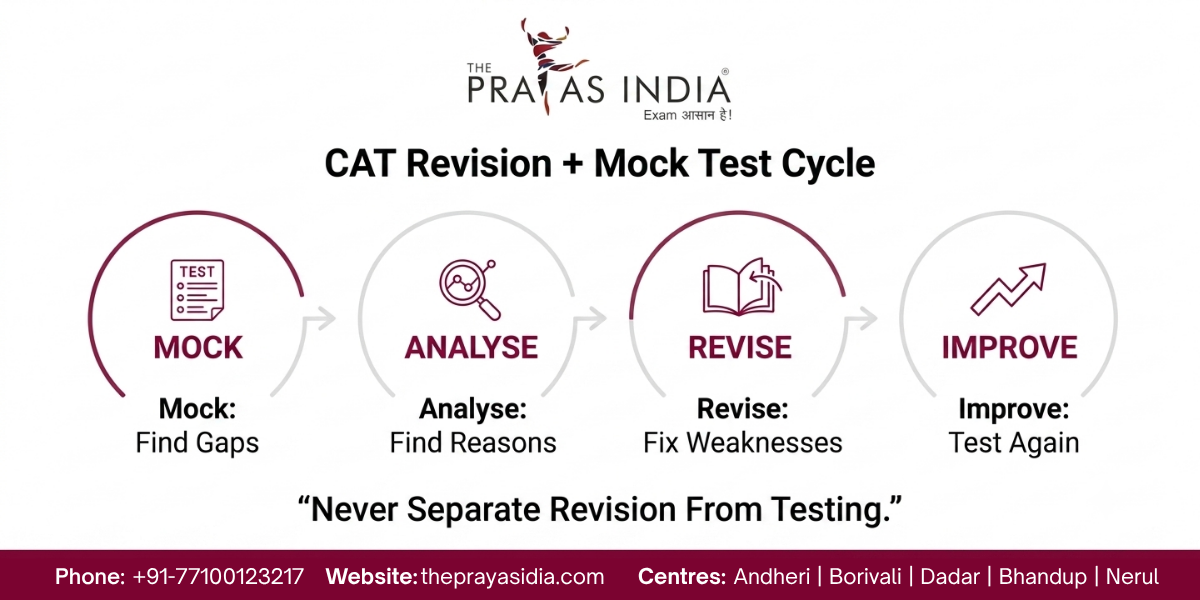
Revision happens between mocks.
The mock tells you what needs revision.
The revision prepares you for the next mock.
The next mock tells you whether the revision worked.
This continuous cycle is far more useful than separating revision and testing into completely different phases.
How to Prevent Revision Fatigue
Revision can become repetitive, especially when you revisit the same concepts multiple times.
One way to avoid fatigue is to vary the format.
Instead of spending three hours reading notes, combine:
Concept recall
Timed questions
Mixed practice
Mock analysis
Error-log review
Previous CAT questions
This keeps the brain engaged in different ways.
You can also alternate sections.
For example:
Morning: Quant revision
Evening: VARC reading
Next day: DILR practice
This prevents long periods of repetitive work.
Don’t Measure Revision by Pages Completed
The number of pages you revised is not a meaningful measure of CAT readiness.
You could read 100 pages and still struggle to solve questions.
Instead, measure outcomes.
Ask:
- Can I solve the question type faster?
- Has my accuracy improved?
- Am I making fewer repeated mistakes?
- Can I recognise the approach more quickly?
- Is my mock performance improving?
- Am I making better question-selection decisions?
These are the indicators that matter.
Maintain Momentum With Short Daily Practice
Even during heavy revision periods, retain a small amount of active practice every day.
For example:
5–10 Quant questions
1 RC passage
1 DILR set or selected questions
The exact workload depends on your preparation stage.
The principle is to maintain daily contact with CAT-style problem-solving.
This prevents revision from becoming completely passive and helps retain the speed and familiarity developed during earlier preparation.
What If You Have Very Little Time for Revision?
Not every aspirant has several hours available each day.
If you have limited time, prioritise.
First Priority
Repeated mistakes and weak areas that can realistically improve.
Second Priority
Important formulas, concepts and standard approaches.
Third Priority
Previous CAT questions and representative practice.
Fourth Priority
Quick review of already strong areas.
Do not attempt to revise everything equally.
A focused two-hour session can be highly productive when the priorities are clear.
How Coaching Can Make CAT Revision More Structured
For many aspirants, revision becomes difficult because there is no external structure.
They may know that revision is important but remain uncertain about:
What to revise first?
Which questions to practise?
How many mocks should I take?
Why is my score not improving?
Which weaknesses should receive more attention?
A structured CAT coaching programme can help answer these questions through planned classes, revision sessions, sectional tests, mock examinations, performance analysis and mentorship.
For students looking for the best CAT coaching in Mumbai, the quality of this support can be more important than simply the number of classes offered.
A useful coaching environment should help you understand not only what to study, but also how to evaluate whether your preparation is working.
How to Choose the Right CAT Coaching for Revision Support
If you are considering CAT coaching in Mumbai, evaluate the institute on factors such as:
| Factor | What to Check |
|---|---|
| Curriculum | Is revision built into the programme? |
| Tests | Are sectional and full mocks available? |
| Analysis | Is performance analysed meaningfully? |
| Mentorship | Can students discuss individual weaknesses? |
| Study Material | Is there targeted revision material? |
| Doubt Support | Are doubts resolved quickly? |
| Strategy | Is there guidance on question selection and time management? |
| Tracking | Can students monitor their progress? |
The purpose of coaching should be to make preparation more structured and measurable, not simply more crowded.
A Practical Weekly CAT Revision Template
A balanced week could look like this:
| Day | Revision Focus | Practice |
|---|---|---|
| Monday | Quant weak area | Timed QA set |
| Tuesday | VARC mistakes | RC practice |
| Wednesday | DILR concepts | Timed DILR sets |
| Thursday | Quant revision | Mixed QA |
| Friday | VARC + error log | RC practice |
| Saturday | Mixed revision | Sectional tests |
| Sunday | Full revision review | Mock + analysis |
This is a framework rather than a rigid timetable.
Students preparing alongside work or college can reduce the workload while retaining the same structure.
The most important thing is to keep revision, practice and testing connected.
The CAT Revision Rule: Less Re-reading, More Retrieval
A simple principle can improve the quality of your revision:
Don’t just read it. Retrieve it.
Don’t just look at a formula.
Recall it.
Don’t just read a solved question.
Try solving it yourself.
Don’t just look at a mock score.
Analyse why you got it.
Don’t just mark a topic as “completed.”
Test whether you can use it under time pressure.
This shift turns revision from passive review into active preparation.
Final Takeaway
CAT revision should not feel like starting the preparation from zero.
You have already invested time in learning concepts, solving questions and building exam skills. Revision should now help you retain, sharpen and apply those skills.
A strong revision strategy has several elements working together:
Prioritised Topics
Active Recall
Targeted Practice
Error Analysis
Spaced Revision
Regular Mocks
Previous CAT Questions
Section-Wise Strategy
Continuous Performance Tracking
Most importantly, do not stop taking tests simply because you are revising.
The best revision system keeps both tracks moving:
Learn → Practise → Test → Analyse → Revise → Improve
As CAT approaches, your goal should not be to touch every possible resource one more time.
Your goal should be to make your existing knowledge faster, more accurate and more accessible under exam conditions.
For aspirants preparing for CAT in Mumbai, the right coaching environment can add structure through planned revision, quality practice material, mock tests, performance analysis and mentorship. The Prayas India can help students approach CAT preparation systematically rather than relying on last-minute revision or random practice.
If you are searching for CAT coaching in Mumbai, evaluate the programme not only on teaching but also on how effectively it supports revision, testing, analysis and continuous improvement.
Because effective revision is not about going backwards.
It is about strengthening what you have learned while continuing to move forward.
Contact Us
📞 Call Now: +91-77100 13217
🌐 Website: theprayasindia.com