CAT VARC Mock Test Analysis: How to Turn Mistakes into Score Improvement
Best CAT Coaching in Mumbai | The Prayas India
Taking CAT VARC mocks is important. But taking mock after mock without analysing them properly can create the illusion of preparation without producing meaningful improvement.
A student may take ten tests, see the scores, identify a few wrong answers and immediately move to the next mock. After several weeks, the same mistakes continue to appear.
The real improvement begins after the mock ends.
A CAT VARC mock should not be treated simply as a test of your current ability. It should work as a diagnostic tool that tells you where your preparation is breaking down.
Did you misunderstand the passage?
Did you select the wrong RC?
Did you fall for an attractive option?
Did you spend too much time on one difficult question?
Did you change a correct answer?
Or do you have a genuine conceptual gap?
Each of these problems requires a different solution.
For CAT 2026 aspirants, therefore, the objective should not be:
“How many mocks have I taken?”
It should be:
“How much have I improved after every mock?”
That shift can make your VARC preparation much more productive.
Why CAT VARC Mock Analysis Matters More Than Mock Count
A mock test gives you a score.
Analysis gives you a reason for that score.
Imagine two students both score 70 percentile in a VARC sectional test.
Student A simply checks the solutions and starts another mock.
Student B spends an hour analysing:
- Which RC was selected?
- Which questions were left?
- Which wrong answers were avoidable?
- Which questions consumed excessive time?
- Which errors came from poor comprehension?
- Which mistakes were caused by incorrect option elimination?
After five or ten mocks, Student B is likely to have a much clearer understanding of their actual weaknesses.
This is why mock analysis should become a separate part of your preparation schedule.
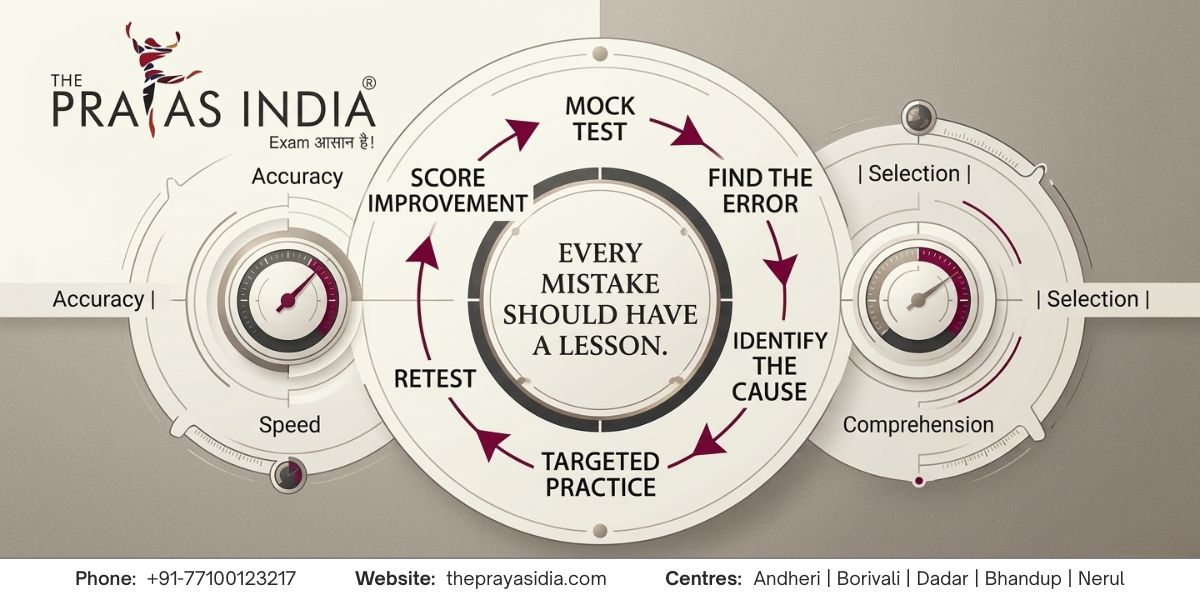
A simple cycle works well:
MOCK → AUDIT → CORRECT → PRACTISE → RETEST
The mock tells you what happened.
The audit tells you why it happened.
Practice fixes the problem.
The next test tells you whether the correction worked.
Start With More Than Just Your Score
The first mistake students make is opening the scorecard, seeing the percentile and immediately deciding whether the mock was “good” or “bad.”
Your score is only one metric.
After every VARC mock, record:
- Total questions attempted
- Correct answers
- Incorrect answers
- Questions left unattempted
- Time spent
- RCs attempted
- RCs avoided
- Accuracy
- Question types causing errors
For example:
| Metric | Mock 1 | Mock 2 | Mock 3 |
|---|---|---|---|
| Attempts | 18 | 20 | 21 |
| Correct | 12 | 15 | 17 |
| Accuracy | 67% | 75% | 81% |
| Time Used | 40 min | 40 min | 40 min |
The score trend becomes much more meaningful when you understand the numbers behind it.
If your attempts increase but accuracy falls sharply, you may be attempting too aggressively.
If accuracy improves but attempts remain low, your question-selection strategy may need attention.
If both improve gradually, your preparation system is working.
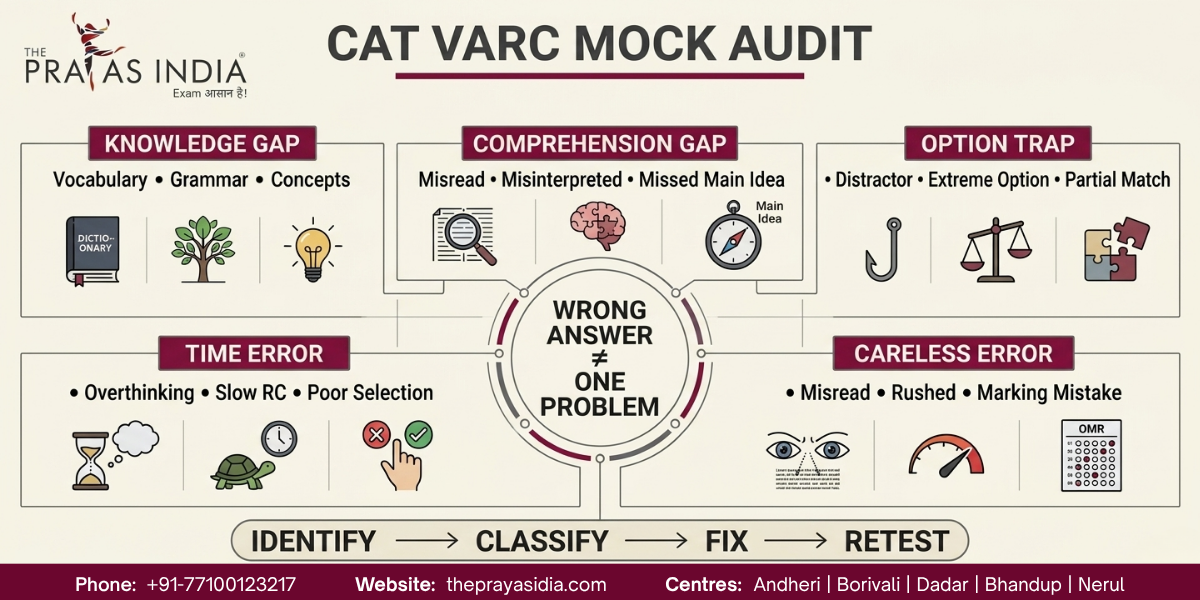
Create a VARC Mistake Classification System
Not every wrong answer should be treated as the same type of mistake.
This is one of the most important habits you can develop.
Divide your mistakes into five categories.
Type 1: Knowledge Error
You didn’t know the required vocabulary, grammar concept or language rule.
Type 2: Comprehension Error
You misunderstood the passage, sentence or question.
Type 3: Option Trap
You understood the passage but selected an attractive distractor.
Type 4: Time Management Error
You spent too much time on a question or passage.
Type 5: Careless Error
You knew the answer but misread the question or marked incorrectly.
This classification immediately makes your analysis more useful.
If most mistakes are knowledge errors, revise concepts.
If most are comprehension errors, work on reading and passage interpretation.
If option traps dominate, improve elimination.
If time errors dominate, change your question-selection strategy.
Analyse the RC Before Looking at Individual Questions
When analysing an RC, don’t immediately jump to question number one.
First ask:
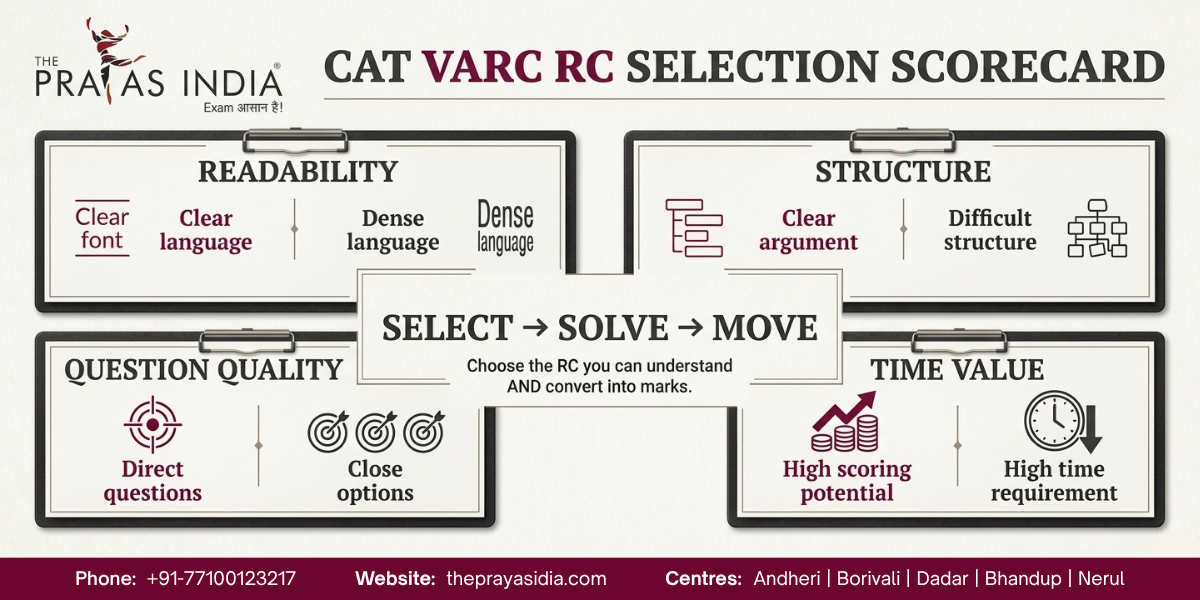
Did I choose the right passage?
This is often overlooked.
Suppose you attempted a difficult philosophical passage and got only two out of five questions correct.
The problem may not be your RC ability.
It may be your set selection.
Review the passage and ask:
- Was the topic unfamiliar?
- Was the language unusually dense?
- Did I understand the author’s argument?
- Did the questions have closely competing options?
- Did another passage look easier?
This distinction is important.
Sometimes you don’t need to become better at solving a particular difficult RC.
You simply need to become better at recognising when not to spend valuable time on it.
Review Every Wrong RC Question
Once you have assessed the passage, analyse each incorrect question.
Ask four questions:
What did I think the answer was?
Write your reasoning.
What is the correct answer?
Understand the official explanation.
Why was my option wrong?
This is the most important question.
What clue did I miss?
The answer may lie in a particular sentence, tone, qualification or argument.
Don’t stop at:
“I got it wrong.”
Find the exact reason.
For example:
I chose option B because it sounded reasonable.
That is not enough.
The real diagnosis may be:
I selected B because I ignored the author’s qualification in paragraph three.
That gives you something specific to correct.
Learn From Correct Answers Too
Not every question you got right was necessarily solved correctly.
This is an underrated part of mock analysis.
Suppose you guessed between two options and selected the correct one.
The scorecard marks it correct.
But your preparation should mark it:
Uncertain Correct
Similarly, if you solved a question correctly but spent four minutes on it, that deserves attention.
Create three categories:
Confident Correct
Correct answer with clear reasoning.
Uncertain Correct
Correct answer but based on guessing or weak reasoning.
Efficient Correct
Correct answer solved quickly with strong elimination or comprehension.
Your objective is to gradually move questions from uncertain correct → confident correct → efficient correct.
Identify Your “Time Sinks”
One difficult question can sometimes damage the entire section.
Imagine spending six minutes on one RC question because two options seem almost identical.
During those six minutes, you could potentially have attempted several other questions.
After every mock, identify:
Which question consumed disproportionate time?
Mark it in your analysis sheet.
You may discover patterns such as:
- Spending too long on inference questions
- Re-reading dense RCs
- Overthinking vocabulary
- Trying to force an answer from an unfamiliar passage
- Changing answers repeatedly
Once you know your time sinks, you can deliberately practise avoiding them.
Analyse Your Question Selection
CAT VARC is not just a test of solving ability.
It is also a test of decision-making under time pressure.
After every mock, record:
RCs Attempted
Which passages did you choose?
RCs Skipped
Why did you leave them?
Accuracy
How successful were your selections?
Time
How long did each passage consume?
You might discover something interesting.
Perhaps you are consistently choosing the most difficult RC because its topic looks familiar.
Or perhaps you are avoiding a particular passage type unnecessarily.
The goal is to develop a reliable selection instinct.
Build an Error Log That You Actually Revisit
Creating an error log is easy.
Using it consistently is harder.
Your error log should not become a collection of hundreds of questions that you never review.
Keep it focused.
For every important error, record:
Question Type
My Mistake
Correct Reasoning
Lesson
For example:
Question Type: RC inference
My Mistake: Chose an option based on outside knowledge.
Correct Reasoning: Answer had to be derived only from the passage.
Lesson: Do not introduce external assumptions.
This takes only a few minutes but creates a personalised revision database.
Before your next mock, spend 10–15 minutes reviewing recent mistakes.
Convert Mistakes Into Targeted Practice
This is where mock analysis becomes score improvement.
Suppose your analysis shows:
8 RC errors
Out of these:
- 4 were inference mistakes
- 2 were tone mistakes
- 1 was an extreme-option trap
- 1 was careless
Don’t simply take another full mock.
Instead, spend your next practice session specifically on:
Inference + Tone + Option Elimination
This is called targeted practice.
Your mock tells you what to practise next.
That makes your preparation personalised rather than generic.
Use the 24-Hour Rule
Try to analyse a mock relatively soon after taking it.
If you wait several days, you may forget why you selected a particular option.
Ideally:
Day 1: Take the mock
Same day / next day: Analyse it
Next practice session: Work on identified weaknesses
Later: Retest the same skill
This creates a continuous feedback loop.
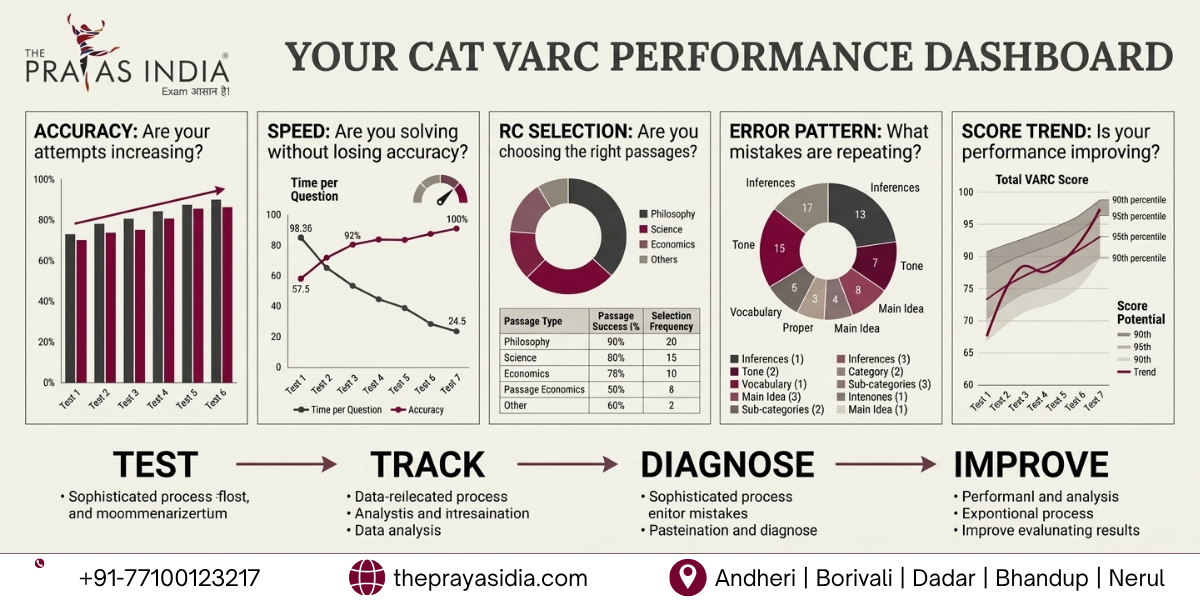
Track Trends Across Multiple Mocks
One mock can be misleading.
Three to five mocks reveal patterns.
Create a simple tracker:
| Metric | Mock 1 | Mock 2 | Mock 3 | Mock 4 |
|---|---|---|---|---|
| VARC Attempts | ||||
| Accuracy | ||||
| RC Accuracy | ||||
| VA Accuracy | ||||
| Avg. Time/Question | ||||
| Score |
You don’t need complicated software.
A spreadsheet is enough.
The important thing is to look for direction, not isolated scores.
If your percentile fluctuates but your accuracy is steadily improving, your preparation may still be progressing.
If your scores remain flat despite taking more mocks, the problem may be analysis quality rather than test quantity.
Don’t Take Mocks Just to Increase the Count
A common CAT preparation trap is:
“I have taken 15 mocks, so I must be well prepared.”
Not necessarily.
If you take 15 mocks but repeat the same mistakes, the number itself has little value.
One deeply analysed mock can teach you more than several tests that are treated casually.
Your target should therefore be:
Quality of Analysis > Quantity of Mocks
As CAT approaches, mock frequency can increase, but analysis should never disappear.
When Should You Take a Full VARC Mock?
Don’t wait until the final month to start testing yourself.
Once you have enough familiarity with the basic concepts and question types, sectional mocks can become part of your preparation.
Initially, the objective is diagnosis.
Later, the objective becomes performance optimisation.
A broad progression can look like:
Concept Practice
↓
Topic Tests
↓
VARC Sectional Tests
↓
Full CAT Mocks
↓
Advanced Mock Analysis
The exact number and frequency should depend on your preparation stage.
More mocks are not automatically better if they reduce the time available for learning and analysis.
Create a Personal VARC Strategy
By the time you have completed several mocks, you should start developing your own strategy.
You should know:
- Which RC types you prefer
- Which question types you solve quickly
- Which questions you tend to overthink
- How much time you need for RCs
- How many VA questions you can comfortably attempt
- What your ideal question-selection approach looks like
Don’t blindly copy a strategy from another aspirant.
A student scoring well with one approach may have completely different strengths from you.
Your mocks should help you build your own CAT strategy.
How Coaching Can Make Mock Analysis More Effective
This is where structured CAT preparation can add value.
A mock score can tell a student:
“You got 12 questions wrong.”
But a mentor can help identify:
“You are losing marks because you are selecting the wrong RCs and spending too much time on inference questions.”
That difference matters.
Structured CAT coaching can provide:
- Regular mock tests
- Sectional tests
- Performance tracking
- Detailed solutions
- Faculty-led analysis
- Personalised feedback
- Doubt resolution
- Strategy correction
For students preparing seriously for CAT 2026, this kind of feedback can reduce the trial-and-error involved in developing a strategy independently.
Choosing the Right CAT Coaching in Mumbai
If you are considering CAT coaching in Mumbai, don’t evaluate an institute only on classroom teaching.
Ask whether its system helps you answer a more important question:
“Why am I not improving?”
Look for an institute that provides:
Structured Preparation
A clear roadmap for VARC, DILR and QA.
Regular Testing
Sectional and full-length tests at appropriate stages.
Detailed Analysis
Not just scores, but meaningful performance insights.
Faculty Guidance
Someone who can help identify recurring mistakes.
Doubt Support
A mechanism for resolving conceptual and strategy-related doubts.
Progress Tracking
Your preparation should be measurable.
The right coaching environment should make the preparation process more systematic, not simply add more study material.
The Real Goal of Mock Analysis
The objective of mock analysis is not to make you feel bad about your mistakes.
It is to make your mistakes predictable and fixable.
If Mock 1 shows that you struggle with inference questions, work on inference.
If Mock 2 shows that RC selection is improving but time management remains weak, work on time.
If Mock 3 shows that accuracy is improving, maintain the approach and focus on efficiency.
Gradually, your mistakes should become fewer, more specific and easier to correct.
That is genuine progress.
CAT VARC Mock Analysis: The Score-Improvement Formula
A productive VARC preparation system can be simplified into five steps:
1. Take the Mock
Simulate the actual exam environment.
2. Audit Your Performance
Don’t look only at the score.
3. Identify the Root Cause
Know exactly why you lost marks.
4. Practise the Weak Area
Turn mistakes into targeted practice.
5. Retest
Check whether the correction actually worked.
MOCK → ANALYSE → TARGET → PRACTISE → RETEST
Repeat this cycle consistently.
Conclusion
CAT VARC preparation should not be measured by how many mock tests you have completed.
It should be measured by how much better you perform after each test.
A mock test is only the beginning.
The real learning starts when you review your wrong answers, identify your time sinks, analyse your RC selection, understand option traps and classify your mistakes.
For CAT 2026 aspirants, the goal should be to gradually move from:
Random Attempts → Informed Selection
Wrong Answers → Diagnosed Mistakes
Repeated Errors → Targeted Practice
Mock Scores → Consistent Improvement
And if you are preparing with CAT coaching in Mumbai, choose a system that goes beyond lectures and study material. Look for structured testing, analysis, mentorship and performance tracking.
At The Prayas India, the objective should be to make preparation more systematic—so every mock becomes a source of feedback and every mistake becomes an opportunity to improve.
Don’t take mocks just to test yourself. Take them to understand yourself.
Contact Us
📞 Call Now: +91-77100 13217
🌐 Website: theprayasindia.com