How Many Hours Should You Study for CAT Every Day? | Best CAT Coaching in Mumbai | The Prayas India
Introduction
One of the most common questions asked by CAT aspirants is deceptively simple: How many hours should I study for CAT every day?
There is no universal number that guarantees a high percentile. A student preparing for CAT alongside college may have a different schedule from a working professional, while a full-time aspirant may be able to dedicate significantly more hours to preparation. More importantly, two students can spend the same number of hours studying and still achieve very different results depending on how effectively those hours are used.
CAT preparation is not about sitting at a desk for a fixed number of hours. It is about building the ability to solve questions accurately, manage time under pressure, identify patterns, analyse mistakes and gradually improve performance across VARC, DILR and QA.
For aspirants looking for CAT coaching in Mumbai, this distinction is particularly important. A structured coaching programme can help students understand where their preparation time should go, how to prioritise weak areas and how to combine classroom learning with self-study and mock-test analysis.
The right question, therefore, is not simply “How many hours should I study?” It is:
“How can I make the hours I study contribute meaningfully to my CAT score?”
There Is No Magic Number of Study Hours for CAT
Aspirants often compare their preparation schedules with those of toppers or high-percentile candidates. Someone may claim to study eight hours every day, another student may say they study four hours, and a third may prepare for only two to three hours alongside college or work.
These numbers should not be treated as universal benchmarks.
CAT is an aptitude examination, and improvement depends heavily on the quality of practice. If a student spends six hours repeatedly solving questions without analysing mistakes, those six hours may produce less improvement than three focused hours involving concept revision, timed practice and detailed analysis.
A sustainable CAT routine should account for:
- Your current academic level
- Time available before the examination
- Strengths and weaknesses across sections
- College or work commitments
- Daily concentration capacity
- Mock-test performance
- Revision requirements
- Time required for analysis and practice
This is why a realistic study plan is usually more useful than copying someone else’s timetable.
How Many Hours Should Different CAT Aspirants Study?
The ideal number of hours depends largely on your starting point and daily commitments.
A student who has a strong mathematical foundation and regularly reads may need to spend more time on advanced problem-solving and DILR practice than on basic concepts. Another student may need substantial time to rebuild arithmetic fundamentals before attempting difficult CAT-level questions.
For a full-time aspirant, around 5–7 focused hours of preparation can be a reasonable working range during an intensive phase, provided those hours are distributed intelligently across learning, practice, revision and analysis.
Students preparing alongside college may find 3–5 focused hours more sustainable, while working professionals may need to build their preparation around 2–4 highly productive hours on weekdays, supplemented by longer sessions on weekends.
These are planning ranges, not rules.
The important thing is to gradually increase the quality and consistency of preparation rather than chasing a specific number on the clock.

Study Hours Should Increase With Your Preparation Needs
The number of hours required for CAT preparation can also change as the examination approaches.
During the initial stage, aspirants may spend more time learning concepts and understanding the fundamentals of each section. At this point, solving a large number of difficult questions may not be the most productive use of time.
Once the fundamentals become stronger, the emphasis can gradually shift towards timed practice, mixed-question sets and sectional tests. In the later stages, mock tests and their analysis can occupy a much larger part of the preparation routine.
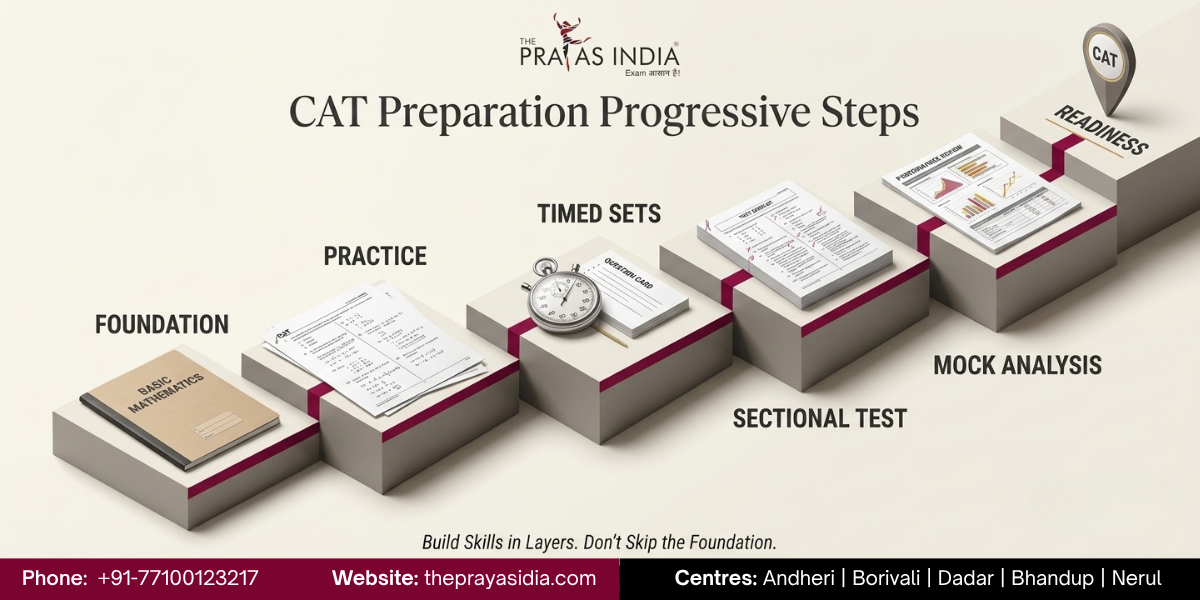
A broad preparation cycle can therefore look like this:
- Foundation phase: Concept building and basic practice
- Development phase: CAT-level questions and sectional practice
- Performance phase: Timed sets and sectional tests
- Mock phase: Full-length mocks and detailed analysis
- Final revision phase: Weak areas, formulas, strategies and selected practice
This progression is important because the purpose of your study hours should change as your preparation develops.
Don’t Count Classroom Hours as Complete CAT Preparation
Joining a coaching institute can provide structured learning, but classroom time should not be confused with total preparation time.
A two-hour classroom session may explain concepts, demonstrate problem-solving approaches and introduce important strategies. However, students still need to revise those concepts, solve questions independently and identify whether they can apply the methods without assistance.
This is where a structured CAT coaching programme in Mumbai can become useful. The purpose of coaching should be to make self-study more effective rather than replace it.
A productive cycle could be:
Learn in class → Revise independently → Practise questions → Analyse mistakes → Revisit weak concepts
When these stages work together, even a moderate number of daily study hours can become considerably more productive.
Quality of Practice Matters More Than Quantity
Aspirants sometimes measure preparation by the number of questions solved.
For example, completing 100 questions in a day may look impressive, but the number alone does not reveal whether those questions were understood, whether mistakes were analysed or whether the same errors will occur again.
CAT preparation requires students to develop problem-solving judgement. You need to understand why an approach works, recognise when a particular method is inefficient and learn to abandon a question when it is consuming too much time.
After solving a set of questions, ask:
- Which questions did I get wrong?
- Why did I make the mistake?
- Was it a conceptual error?
- Did I misread the question?
- Did I choose an inefficient method?
- Did I spend too much time on it?
- Could I have solved it using another approach?
This analysis can often provide more value than simply moving on to another set of questions.
Build Your Daily CAT Routine Around Four Activities
A balanced CAT study day should not consist entirely of solving questions.
Aspirants generally need four broad types of preparation: concept learning, practice, revision and analysis.
Concept learning helps build the knowledge required to approach different question types. Practice converts that knowledge into problem-solving ability. Revision prevents previously learned concepts from fading, while analysis identifies weaknesses and helps improve strategy.
A typical study session could therefore include:
- Concept revision or learning
- Section-specific question practice
- Timed DILR or QA sets
- VARC reading and question practice
- Error-log review
- Formula or shortcut revision
- Mock or sectional-test analysis
The exact distribution can change depending on the aspirant’s weaknesses.
For example, a student with strong QA fundamentals but weak VARC may need to dedicate more daily time to reading and verbal practice rather than spending equal hours on all three sections.
VARC Preparation Cannot Be Built Through Last-Minute Study
VARC often requires a different preparation approach from QA.
Reading comprehension performance improves through regular exposure to different types of passages and consistent practice in understanding arguments, identifying central ideas and eliminating unsuitable options.
This means aspirants should ideally include some reading or VARC practice in their routine throughout the preparation period.
Instead of studying VARC intensively for a few days and then ignoring it for a week, a better approach is to create regular exposure.
A daily routine could include reading, followed by a limited number of carefully analysed questions. The objective is not simply to increase the number of passages attempted but to improve comprehension accuracy and option-selection ability.
DILR Requires Deliberate Practice
DILR can be unpredictable, which makes regular practice particularly important.
The goal should not be to memorise formulas. Aspirants need to become comfortable interpreting information, identifying structures, making deductions and deciding whether a particular set is worth attempting.
A student may spend considerable time solving one difficult set without recognising that another set in the examination is much more approachable. Therefore, DILR preparation should include not only solving sets but also learning set selection.
Timed practice can help students gradually develop this judgement.
With guidance from experienced faculty and regular practice, aspirants can learn to recognise different set structures and build a more systematic approach to DILR.
QA Preparation Should Be Based on Your Current Level
Quantitative Aptitude is one area where the required study time can differ significantly between students.
Candidates with strong mathematics fundamentals may quickly move towards CAT-level application and mixed-question practice. Students who have been away from mathematics for several years may first need to rebuild basic concepts.
A sensible QA progression is therefore:
Fundamentals → Basic Questions → CAT-Level Questions → Timed Practice → Mixed Sets → Sectional Tests
Trying to jump directly into advanced questions can create unnecessary frustration for students who have not yet built the required foundation.
This is another area where structured coaching can help. Instead of randomly choosing topics, students can follow a progression that reflects their current preparation level.
Mock Tests Change the Meaning of Your Study Hours
As CAT gets closer, mock tests become increasingly important because they bring together concepts, speed, accuracy and decision-making.
However, a mock should not simply be added to the timetable as another two-hour activity.
A full-length CAT mock can be followed by a detailed analysis session in which the aspirant categorises questions into different groups: questions solved correctly, questions solved incorrectly, questions left despite being solvable and questions that were correctly skipped.
This can reveal patterns that ordinary practice may not show.
For example, an aspirant may discover that their accuracy is strong but they spend too much time on difficult DILR sets. Another student may discover that they attempt too many QA questions without sufficient confidence. Someone else may find that VARC errors are concentrated around particular question types.
These insights can then influence the following week’s study plan.
How Coaching Can Help You Use Your Study Time Better
One of the advantages of joining a structured CAT coaching institute in Mumbai is that students do not have to design every aspect of their preparation independently.
A structured programme can provide a roadmap for syllabus coverage, concept learning, practice, sectional tests and mock analysis. Faculty guidance can also help students identify areas that require more attention.
This can be especially useful for aspirants who struggle with questions such as:
“What should I study today?”
“Which topic should I revise?”
“Why am I making the same mistakes?”
“Should I attempt another mock or work on my weak section?”
The goal of coaching should be to answer these questions with an organised academic system, allowing students to spend more of their time actually preparing.
Avoid the “8-Hour Study Day” Trap
Aspirants can easily fall into the belief that longer study sessions automatically indicate better preparation.
They may create an ambitious timetable with eight or ten hours of study, follow it for two days and then struggle to maintain it.
A sustainable four-hour routine followed consistently for several months can be far more valuable than an exhausting ten-hour schedule that repeatedly collapses.
CAT preparation requires consistency because aptitude skills develop through repeated exposure and feedback. The objective should therefore be to create a routine that you can maintain even on days when motivation is low.
Instead of asking, “Can I study for ten hours today?”, ask:
“Can I follow this routine for the next six months?”
That question leads to a much more practical preparation strategy.
A Sample CAT Study Structure
There is no single timetable that every aspirant should follow, but a balanced full-time preparation day could distribute study time across different activities.
For example:
- 90 minutes: Quantitative Aptitude concepts and practice
- 60 minutes: VARC reading and practice
- 90 minutes: DILR sets and timed practice
- 45–60 minutes: Revision and error analysis
- 30 minutes: Formula, vocabulary or strategy revision
On mock-test days, the structure can change considerably. The mock itself may take around two hours, followed by substantial analysis.
For working professionals and college students, the same components can be divided across smaller sessions rather than completed in one continuous block.
The important principle is to protect time for analysis and revision, not simply question solving.
Admission-Focused Preparation at The Prayas India
For aspirants searching for the best CAT coaching in Mumbai, the choice of institute should be based on how effectively it supports the complete preparation process.
The Prayas India can be considered by students looking for a structured CAT preparation environment where classroom learning can be combined with practice, testing, analysis and guided preparation.
Aspirants should evaluate coaching based on their individual requirements and understand how the programme fits into their daily schedule. The objective should be to select an environment that helps convert available study time into measurable preparation progress.
With the right structure, students can focus on improving concepts, developing problem-solving ability, strengthening section-wise performance and becoming more comfortable with the demands of the CAT examination.
Final Thoughts
So, how many hours should you study for CAT every day?
The most useful answer is: as many focused hours as you can sustain consistently while covering learning, practice, revision and analysis.
For some aspirants, this may mean two to four focused hours around college or work. For others, five to seven focused hours may be practical during full-time preparation. The number itself matters less than what happens during those hours.
A strong CAT preparation routine should evolve with your progress. Early preparation may require more concept building, while later stages should increasingly involve timed practice, sectional tests, mocks and detailed performance analysis.
If you are preparing for CAT in Mumbai, structured coaching can provide an organised framework around these activities and help you make better use of your preparation time.
Ultimately, CAT preparation is not a competition to see who can sit at a desk the longest. It is a process of learning smarter, practising deliberately, analysing honestly and improving consistently.
Contact Us
- Call Now: +91-77100 13217
- Website: theprayasindia.com
- Centres: Andheri | Borivali | Dadar | Nerul | Bhandup