How Mentorship and Test Analysis Can Improve Your CAT Preparation | Best CAT Coaching in Mumbai | The Prayas India
CAT preparation is often described as a combination of hard work, practice and mock tests. While all three are important, many aspirants eventually discover that working harder does not automatically translate into better scores. A student can spend several hours solving questions every day and still remain stuck at the same level if there is no clear understanding of what is going wrong.
This is where mentorship and test analysis become important. CAT is not simply a test of how much you have studied. It also tests how effectively you apply what you know, how quickly you recognise an opportunity, how carefully you manage time and whether you can make the right decisions when several questions compete for your attention.
A well-designed preparation process therefore needs two things alongside regular study: an outside perspective that helps you identify the right areas to work on, and a systematic method of analysing your performance. Mentorship can provide direction, while test analysis can provide evidence. Together, they can make CAT preparation more focused and less dependent on guesswork.
For students considering CAT coaching in Mumbai, this becomes particularly relevant. The value of a coaching programme is not limited to classes or study material. Structured guidance, regular testing, performance feedback and personalised academic direction can help an aspirant understand whether the preparation strategy is actually producing progress.
CAT Preparation Is Not Just About Completing the Syllabus
One of the easiest ways to measure preparation is to look at how much of the syllabus has been completed. You may have finished Arithmetic, Algebra, Geometry, Reading Comprehension, Logical Reasoning and Data Interpretation and feel that you are progressing well.
However, syllabus completion does not necessarily mean exam readiness.
A candidate may know the concepts but struggle to identify them in an unfamiliar question. Another student may understand the question but spend too much time solving it. Someone else may have excellent accuracy but attempt too few questions because of excessive caution. These are very different problems, and completing another chapter will not necessarily solve them.
CAT preparation becomes more meaningful when you start measuring performance rather than completion. Your preparation should answer questions such as whether your accuracy is improving, whether you are selecting questions intelligently, whether your speed is increasing and whether your mistakes are becoming less repetitive.
This is one of the areas where regular tests become valuable. A mock test creates a controlled environment in which your preparation is converted into measurable performance.
The Role of a Mentor Is Different From the Role of a Teacher
A teacher primarily helps you understand a concept. A mentor helps you understand how to approach the larger preparation journey.
This distinction matters because CAT aspirants rarely have only one problem. A student may have reasonable conceptual knowledge but poor time management. Another may be spending too much time on difficult questions. Someone else may be preparing from too many resources and revising too little.
A mentor can look at these patterns from outside and help the student identify priorities.
For example, if your Quant score is low, the immediate assumption may be that you need to study more Quant. But your test data might reveal that you are actually solving a reasonable number of questions correctly but spending too much time on them. In that situation, the solution may involve question selection and timed practice rather than simply adding more theory.
Similarly, if your VARC performance fluctuates considerably, the issue may not necessarily be vocabulary. It could be passage selection, over-analysis of options or difficulty in identifying the author’s central argument.
Good mentorship therefore does not simply tell you to “work harder”. It helps determine where your effort is likely to produce the greatest improvement.
Mentorship Can Prevent Random Preparation
Without a structured plan, CAT preparation can easily become reactive. A difficult mock may convince you to start a new topic. A low Quant score may lead you to buy another book. A conversation with another aspirant may make you change your strategy completely.
This constant switching can consume considerable time.
A mentor can help bring continuity to the preparation process by evaluating your performance over a period rather than reacting to one individual test. This is important because CAT performance naturally fluctuates. One difficult mock should not completely change your preparation strategy.
The purpose of mentorship is not to make every decision for the aspirant. Instead, it should help the student develop a clearer understanding of their own preparation. Over time, the aspirant should become capable of analysing performance and making increasingly independent decisions.
That is particularly useful in the later stages of preparation, when the focus shifts from learning concepts to maximising performance.
Test Analysis Begins After the Mock Ends
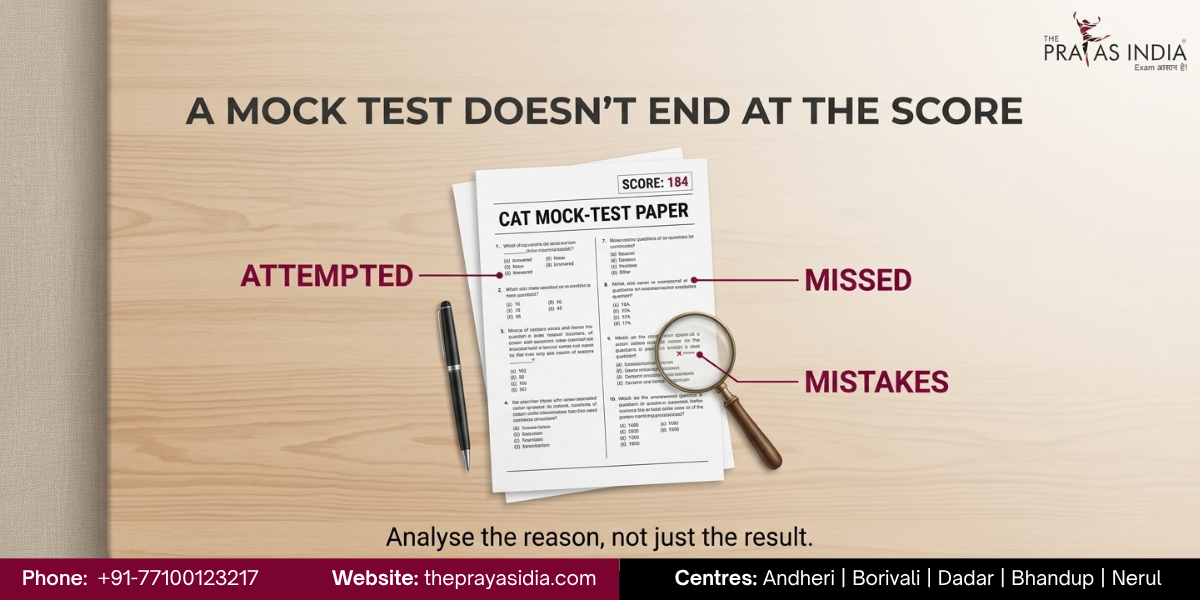
Many students consider a mock test complete as soon as they submit it and see the score. In reality, that is when one of the most useful stages of the exercise begins.
A mock contains information that the final score cannot show. It tells you which questions you attempted, which ones you left, where you spent time, which mistakes you made and which questions you could potentially have solved with a different decision.
If you simply record your percentile and move on to the next mock, you are losing much of the learning value of the test.
A useful analysis should examine both what happened and why it happened.
Suppose you attempted a Quant question and got it wrong. Was the concept unknown? Did you misunderstand the question? Did you use the wrong method? Was the calculation incorrect? Did you rush because you had already spent too much time elsewhere?
Each reason points towards a different corrective action.
Look at the Questions You Did Not Attempt
One of the most overlooked parts of mock analysis is the set of questions you left unanswered.
Students generally spend their analysis time looking at incorrect attempts. That is important, but skipped questions can reveal another layer of information.
Some questions were probably correct skips. They may have been too lengthy, unfamiliar or unsuitable for the available time. But some questions may have been manageable if you had recognised the right approach or if you had reached them earlier.
This distinction can significantly improve your exam strategy.
If you consistently discover that you are leaving relatively straightforward questions because you spend too much time on difficult ones, your issue may be question selection rather than knowledge. If you are skipping questions because you cannot identify the underlying concept, then additional conceptual practice may be required.
Over multiple tests, this analysis helps you understand whether your attempt strategy is limiting your score.
Separate Conceptual Errors From Execution Errors
Not every wrong answer means that you need to study the topic again.
This is an important distinction for efficient CAT preparation.
A conceptual error occurs when you do not understand the underlying idea required to solve the question. In that situation, you need to revisit the concept and practise similar applications.
An execution error is different. You may know exactly how to solve the problem but make an arithmetic mistake, misread a condition or select an incorrect option while rushing.
There can also be strategic errors. Perhaps you spent four minutes on a question that should have been left after one minute. The mathematics may have been correct, but the decision was inefficient.
Keeping these categories separate makes your analysis more actionable. Instead of writing “Quant needs improvement”, you can identify whether the actual problem is concept, calculation, comprehension or decision-making.
Identify Your High-Value Improvement Areas
Not every weakness deserves the same amount of attention.
Suppose your test analysis shows that you are making mistakes in several topics. You might be tempted to revise all of them equally. However, some areas may have a much greater impact on your performance than others.
Consider a student who is making repeated errors in basic Arithmetic but is also struggling with a few highly difficult Geometry questions. Strengthening Arithmetic may offer a better return because it can improve both accuracy and confidence across a wider range of questions.
This is where mentorship and test analysis can work particularly well together. The test provides the evidence, while an experienced mentor can help interpret the evidence and decide what should be prioritised.
The objective is not to eliminate every weakness before CAT. The objective is to maximise your overall performance with the time available.
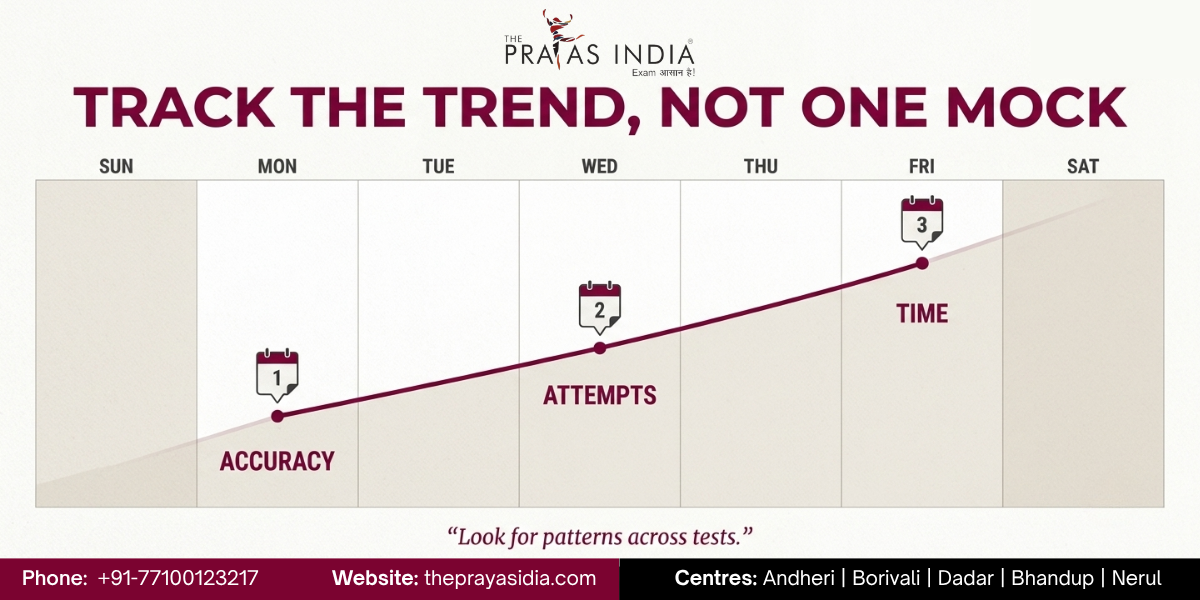
Track Trends Instead of Individual Mock Scores
A single mock score can be misleading. Your performance can change because of the difficulty level, question selection, test-day mindset or simply the nature of the paper.
Instead of reacting strongly to every individual score, maintain a record of your performance across multiple tests.
Look for patterns in your sectional accuracy, attempts, time management and recurring errors. If your VARC accuracy is gradually improving while your attempts remain stable, that is meaningful progress. If your Quant attempts are increasing but accuracy is falling, you may need to reconsider your selection strategy.
The purpose of tracking is to identify direction.
A preparation strategy should ideally evolve based on several pieces of evidence, not one unusually good or bad mock.
How Mentorship Can Improve Your Mock-Test Analysis
A mock-test report can contain a large amount of information, but data by itself does not always tell you what to do next.
This is where experienced guidance can become useful. A mentor can look beyond the score and identify patterns that an aspirant may overlook. For example, a student may believe that low Quant performance is caused by difficult concepts, while the analysis reveals that most lost marks came from spending excessive time on just a few questions.
Similarly, a candidate may believe that they need to increase attempts in VARC when the bigger issue is accuracy. Increasing attempts without fixing the underlying problem could actually reduce the score.
Mentorship can help convert test data into a practical action plan. Instead of leaving a mock with a long list of mistakes, the student can identify two or three specific changes to implement in the next test.
That makes preparation more focused and gives every mock a clear purpose.
Build a Feedback Loop Between Preparation and Testing
The strongest preparation systems are not linear. You do not simply study, finish the syllabus and then take mocks. Instead, preparation should operate as a continuous feedback loop.
You study a concept, practise questions and take a test. The test reveals weaknesses. You analyse those weaknesses, revise the relevant areas and modify your approach. The next test then shows whether those changes worked.
This cycle gradually makes preparation more personalised.
For example, if repeated mocks show that you are losing marks because of calculation errors, your preparation schedule should include targeted calculation practice. If the problem is excessive time spent on difficult questions, your next tests should focus on question selection.
This means the test is not separate from preparation. The test becomes part of the preparation process itself.
Mentorship Should Encourage Independent Decision-Making
Good mentorship should not create dependency.
A student should not need to ask a mentor whether every individual question is worth attempting or whether every mock score is good enough. The long-term objective should be to develop the ability to evaluate your own performance.
Initially, a mentor may help you identify patterns and explain why certain strategies are ineffective. Over time, you should begin recognising those patterns yourself.
This is particularly valuable for CAT because the final examination will not look exactly like your mocks. You may encounter unfamiliar questions, unexpected difficulty levels or a section that behaves differently from your expectations.
A student who understands the principles behind good decision-making is better prepared to adapt.
Choosing CAT Coaching With Mentorship and Testing in Mind
When aspirants search for the Best CAT Coaching in Mumbai, classroom teaching and study material naturally receive considerable attention. However, students should also examine what happens after the class.
Does the programme provide regular tests? Is there a system for analysing performance? Can students discuss their preparation challenges? Is feedback available when scores stagnate? Does the academic structure help students identify their weak areas and improve them?
These questions can be especially important for students who are preparing alongside college, work or other commitments. When study time is limited, knowing what to prioritise becomes just as important as having more material.
A structured coaching environment can provide continuity between classroom learning, practice, testing and feedback. The Prayas India offers CAT preparation support in Mumbai through its centres at Andheri, Borivali, Dadar, Bhandup and Nerul. Students considering admission can evaluate the programme according to their academic needs, preparation level and preferred learning approach.
For admission-related information, aspirants can contact +91-77100123217.
The purpose of choosing coaching should not simply be to access more content. It should be to create a preparation system in which learning, practice, testing and feedback work together.
A Practical CAT Test-Analysis Routine
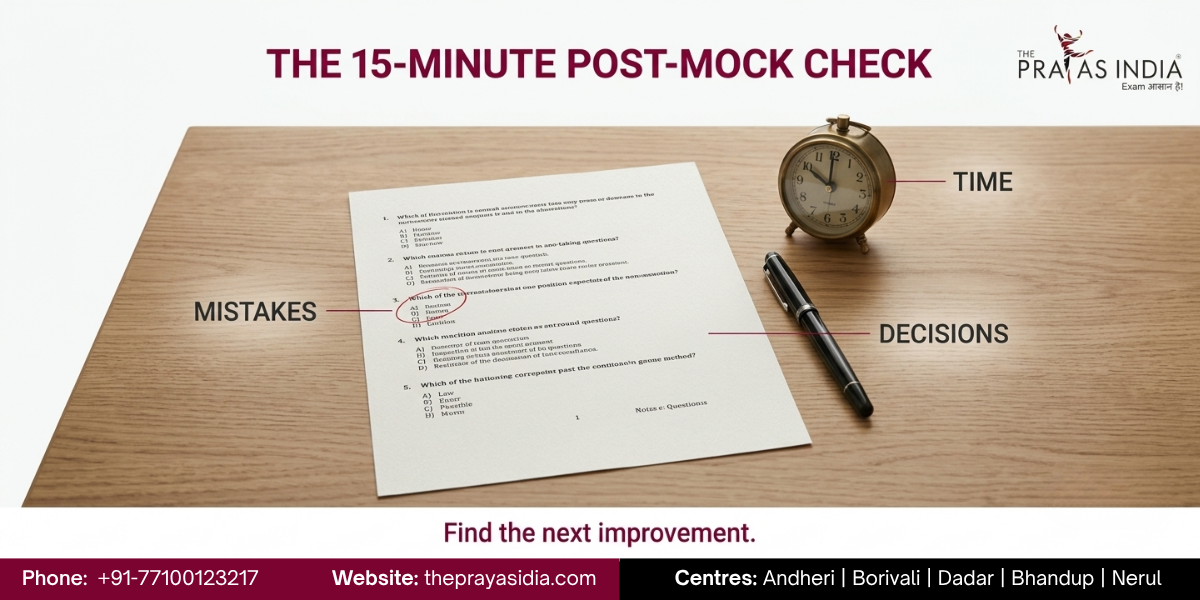
After completing a mock, resist the temptation to immediately look only at your percentile. Give yourself enough time to examine the paper carefully.
First, identify questions that you got wrong and determine the exact reason for each error. Then review questions you skipped and check whether any of them were realistically solvable. After that, examine questions that consumed too much time even if you eventually answered them correctly.
Next, classify the problems. Were they conceptual, calculation-based, comprehension-related or strategic? Once the categories are clear, decide what action each category requires.
Finally, choose a small number of changes for the next test. You do not need to completely redesign your strategy after every mock. One or two meaningful improvements implemented consistently can be more valuable than changing everything at once.
Don’t Let Mentorship Become a Substitute for Self-Study
While guidance can improve the quality of preparation, it cannot replace individual practice.
A mentor can identify a weakness, explain a strategy and suggest a practice plan. The actual improvement still comes from solving questions, reviewing mistakes and applying the feedback.
Students should therefore treat mentorship as a way of making self-study more efficient rather than avoiding it.
The strongest combination is structured guidance followed by independent execution. You learn, practise, test, analyse, receive feedback and then repeat the process.
Key Takeaway
CAT preparation becomes considerably more effective when you stop viewing mocks as simple examinations and start treating them as sources of information.
Your score tells you where you are. Your analysis helps explain why you are there. Mentorship can then help you decide what to change and where to invest your preparation time.
The combination is particularly powerful because CAT rewards not just knowledge but decision-making. Knowing a concept is useful, but recognising when to apply it, deciding whether a question deserves your time and avoiding repeated mistakes can have an equally important impact on your performance.
For aspirants considering CAT coaching in Mumbai, look for an environment that connects teaching with practice, testing, analysis and feedback. The Prayas India provides CAT preparation support at Andheri, Borivali, Dadar, Bhandup and Nerul, giving students the opportunity to explore structured preparation according to their individual requirements.
Ultimately, successful CAT preparation is not about taking the maximum number of tests or studying for the maximum number of hours. It is about making every stage of preparation more purposeful.
Study with direction. Test with purpose. Analyse with honesty. Improve with consistency.
Turn Mock-Test Data Into a Personal CAT Strategy
A mock test becomes genuinely useful when it changes the way you prepare for the next test. Many CAT aspirants take a mock, look at the percentile, compare it with their previous score and immediately move on to the next one. While this provides a basic measure of performance, it does not explain the decisions behind that performance. Two students with the same percentile may have completely different preparation problems, and therefore they should not follow the same improvement strategy.
A more effective approach is to treat every mock as a detailed performance report. Look at how many questions you attempted, how many were correct, where you spent excessive time and which questions you left despite potentially being solvable. Then connect these observations with your preparation history. If the same issue appears repeatedly across several tests, it becomes a genuine priority rather than a one-time mistake.
This process gradually creates a personal CAT strategy. Instead of blindly following generic advice about attempts, time allocation or section order, you begin making decisions based on your own performance. That is one of the biggest advantages of systematic test analysis.
Identify the Difference Between Knowledge and Performance
One of the most important insights that test analysis can provide is whether your problem is a lack of knowledge or an inability to convert knowledge into marks.
Consider a Quant question based on a concept you have studied several times. If you cannot solve it because you do not remember the underlying concept, the solution lies in revision and additional practice. But if you understand the concept, identify the correct method and still take four minutes to reach the answer, repeating the same chapter may not solve the problem.
The same distinction applies to VARC and DILR. You may understand how to approach an RC but spend too much time debating between two options. You may know how to solve a DILR set but fail to recognise that it is not worth attempting within the available time.
These are performance problems rather than purely academic problems. Mentorship can be particularly useful here because an experienced perspective can help determine whether you need more learning, more practice or a change in strategy.
Analyse the Questions You Got Correct Too
It is natural to focus on incorrect answers after a mock, but correct answers can also contain valuable information.
Suppose you solved a difficult Quant question correctly but spent significantly longer than expected. Technically, the answer is correct, but the decision may still have been inefficient. If the same amount of time could have produced two easier attempts, the question may not have been a good use of your examination time.
Similarly, you may have guessed correctly in VARC or solved a DILR question through an approach that was unnecessarily complicated. These situations should not simply be recorded as successes.
A strong analysis therefore examines the quality of your correct attempts as well as your incorrect ones. The objective is to identify which decisions should be repeated in the actual CAT and which apparently successful decisions should be modified.

Build a Feedback System Instead of Collecting Scores
A useful test-analysis system should lead to action. If you identify ten mistakes after every mock but do nothing differently in the following test, the analysis has limited value.
After reviewing a mock, select a small number of specific changes for the next attempt. These could include spending less time on difficult Quant questions, reducing over-analysis in VARC, identifying DILR sets more carefully or improving the order in which you approach a section.
The following mock then becomes an opportunity to test whether those changes worked.
This creates a simple feedback loop: prepare, test, analyse, modify and test again. Over several weeks, this process can reveal which strategies actually improve your performance and which ones only sound useful in theory.
The important point is to avoid making too many changes simultaneously. If you completely alter your section strategy, time allocation and question-selection rules after every mock, it becomes difficult to identify what actually helped.
Use Mentorship to Challenge Your Assumptions
Aspirants often develop strong opinions about their own performance. Someone may believe that they are naturally weak in Quant, another may assume that VARC is unpredictable for them, while someone else may conclude that they simply need to attempt more questions.
Sometimes these conclusions are correct. Sometimes they are not.
A mentor can provide an external perspective that challenges these assumptions. Instead of accepting “I am weak in Quant” as a complete diagnosis, the discussion can move towards more specific questions. Is the problem conceptual understanding? Calculation speed? Question selection? Confidence? Time allocation?
This makes the problem easier to solve because a broad weakness has been converted into a specific performance issue.
Good mentorship should therefore encourage analysis rather than dependency. The goal is to help the aspirant understand their preparation well enough to eventually identify these patterns independently.
Don’t Compare Your Mock Strategy With Someone Else’s
CAT preparation often involves considerable comparison. Students discuss attempts, scores, percentiles and preferred strategies with friends and classmates. Such conversations can be useful, but they can also create unnecessary confusion when aspirants start copying strategies that were designed for someone else’s strengths.
For example, one student may perform well with a high-attempt strategy because their accuracy and speed are strong. Another student may achieve a better result by being more selective. Neither strategy is automatically superior.
The same applies to section order. A candidate who performs strongly in VARC may prefer beginning with that section, while another aspirant may be more comfortable starting with Quant or following the order that feels most natural to them.
Your mock analysis should therefore answer a simple question: What works for me?
Mentorship can help you reach that answer without blindly following someone else’s preparation model.
Make Section-Wise Analysis More Detailed
Overall CAT performance can hide important sectional differences. A strong VARC score may compensate for a weaker Quant performance in one mock, while the opposite may happen in another.
For this reason, analyse each section separately.
In VARC, examine passage selection, accuracy, time spent reading, option elimination and the types of questions where errors occur. In DILR, look at set selection, time spent understanding the set and whether you recognised the most manageable sets early enough. In Quant, analyse topic-wise accuracy, calculation errors, time spent and the efficiency of your chosen methods.
This does not mean that you need an unnecessarily complicated spreadsheet. A simple record maintained consistently can reveal useful trends.
Over time, you should be able to identify the areas that are improving, those that are stagnant and those where your performance remains inconsistent.
Create a Simple Post-Mock Routine
A consistent post-mock routine can prevent analysis from becoming overwhelming. After completing a test, first review your overall performance without immediately judging yourself based on the score. Then revisit incorrect answers and determine the reason for each mistake.
After that, review the questions you skipped and identify whether any could realistically have been attempted. Next, examine unusually time-consuming correct answers. Finally, note two or three changes that you want to implement in the next test.
This routine keeps analysis focused.
You do not need to spend hours rewriting every solution from the mock. The objective is to identify information that can influence your future preparation. If a particular question does not teach you anything new, there may be little value in spending excessive time documenting it.
Mentorship Becomes More Valuable as CAT Gets Closer
The role of mentorship can change throughout the CAT preparation journey. In the beginning, the focus may be on understanding the syllabus, building fundamentals and establishing a study routine. As preparation progresses, the focus naturally shifts towards performance optimisation.
At that stage, students may not need more and more study material. They may instead need help deciding which areas deserve additional practice, which weaknesses can realistically be improved and which mistakes need to be eliminated before the examination.
This is where regular performance discussions can become useful. A mentor who has followed your preparation over time can identify whether a problem is temporary or recurring and whether a strategy needs adjustment.
The closer you get to CAT, the more important these decisions can become because preparation time becomes limited. Efficient allocation of that remaining time matters.
Don’t Use Mock Tests as a Confidence Test
A mock test should not be used to prove that you are capable of scoring well.
Some students approach every mock with the expectation that their score must increase. When it does not, they become discouraged and change their preparation strategy. This creates an unhealthy cycle in which every test becomes an emotional judgement rather than an academic exercise.
A better approach is to assign a purpose to each test.
One mock may be used to improve question selection. Another may be focused on reducing calculation errors. Another may help you experiment with section strategy. This does not mean that the score is irrelevant; rather, the score becomes one part of a larger performance picture.
Once you stop expecting every mock to produce a higher percentile, you can analyse the test more objectively.
Learn When Your Strategy Needs to Change
Consistency is important, but consistency does not mean repeating the same ineffective approach indefinitely.
If your mock analysis shows the same issue across several tests despite targeted practice, it may be time to reconsider your strategy. Perhaps you are attempting too many questions. Perhaps your preparation is too broad and lacks revision. Maybe you are spending too much time learning difficult concepts while neglecting high-value areas.
A mentor can help identify when persistence is appropriate and when a change is necessary.
The key is to make changes based on evidence rather than frustration. One bad mock should rarely trigger a complete strategy change. A repeated pattern across multiple tests deserves much more attention.
How The Right CAT Coaching Environment Can Support This Process
When evaluating CAT coaching in Mumbai, aspirants often compare faculty, classroom infrastructure, study material, fees and past results. These factors matter, but students should also understand how the institute supports the period between one test and the next.
A structured preparation environment should ideally connect classroom learning with practice, testing, analysis and feedback. For a student, this means that a difficult mock does not simply end with a disappointing score. There is an opportunity to understand the problem, discuss it and build a plan for improvement.
This can be particularly useful for aspirants who are preparing for CAT while managing college, employment or other responsibilities. When available study time is limited, random practice can become inefficient. A structured academic framework can help students identify where their preparation needs attention instead of constantly searching for new resources.
The Prayas India provides CAT preparation support in Mumbai through its centres at Andheri, Borivali, Dadar, Bhandup and Nerul. Students considering admission can evaluate the available programme based on their preparation stage, learning requirements and the kind of academic support they are looking for.
For admission-related information, aspirants can contact +91-77100123217.
The decision to join a coaching programme should ultimately be based on whether its academic approach suits your preparation needs. For an aspirant who wants regular testing and structured feedback, the ability to connect learning with performance analysis can be an important consideration.
Build a Preparation System That Becomes More Personal Over Time
At the beginning of CAT preparation, generic guidance can be useful because you are still understanding the examination and its requirements. But as you take more tests and gather more performance data, your preparation should become increasingly personalised.
You may discover that your strongest VARC performance comes from selecting certain passage types. You may realise that your Quant score improves when you become more selective with lengthy questions. You may find that your DILR performance depends heavily on identifying the right set within the first few minutes.
These insights cannot be obtained entirely from a syllabus or a generic preparation timetable. They emerge from repeated testing and honest analysis.
Mentorship can accelerate this process by helping you recognise patterns earlier, but the ultimate goal should be to develop your own understanding of what produces your best performance.
The Final Months Should Focus on Refinement
As CAT approaches, the nature of preparation should gradually change. Early preparation is largely about learning and strengthening concepts. Later preparation should increasingly focus on refinement.
At this stage, repeatedly learning new concepts may not always be the best use of time. Revising important areas, solving mixed questions, taking mocks and analysing performance can become more valuable.
Your objective should be to reduce avoidable mistakes and improve the efficiency of your attempts. You should know which types of questions you generally handle well, where you tend to lose time and how you respond when a section feels more difficult than expected.
Mentorship during this period can help maintain perspective. Instead of reacting emotionally to every mock score, you can focus on whether your underlying performance indicators are moving in the right direction.
Final Takeaway
CAT preparation becomes stronger when learning and evaluation work together. Studying concepts gives you the knowledge required to solve questions, but testing reveals how effectively you can use that knowledge under examination conditions.
Mentorship adds another layer by helping you interpret the evidence. It can help distinguish between a knowledge gap and a performance problem, identify recurring mistakes and guide you towards changes that are realistic within your preparation timeline.
Test analysis, meanwhile, ensures that your mocks are not reduced to percentile numbers. Every test can reveal something about your accuracy, speed, question selection, time management and decision-making.
For aspirants looking for CAT coaching in Mumbai, these factors are worth considering while evaluating a preparation programme. The right academic environment should ideally help you move through the complete cycle of learning, practice, testing, analysis and improvement. The Prayas India has CAT preparation centres at Andheri, Borivali, Dadar, Bhandup and Nerul, giving aspirants the opportunity to explore structured preparation according to their individual needs.
Ultimately, effective CAT preparation is not about taking the maximum number of mocks or studying for the maximum number of hours. It is about understanding what your performance is telling you and making better decisions because of it.
Prepare with direction, test with purpose and use every analysis to improve the next attempt.
Contact Us
- Call Now: +91-77100 13217
- Website: theprayasindia.com
- Centres: Andheri | Borivali | Dadar | Nerul | Bhandup
Frequently Asked Questions
1. How does mentorship help in CAT preparation?
Mentorship can help an aspirant understand where preparation is going off track and what should be prioritised next. Instead of relying only on overall mock scores, a mentor can help interpret patterns related to accuracy, speed, question selection, time management and recurring mistakes.
2. Why is CAT mock-test analysis important?
Mock-test analysis shows why a particular score was achieved. It helps identify conceptual errors, calculation mistakes, poor question selection, excessive time spent on individual questions and potentially solvable questions that were left unattempted. This information can be used to improve the strategy for future tests.
3. Should I analyse every question after a CAT mock?
You do not necessarily need to spend equal time on every question. Give greater attention to incorrect answers, time-consuming attempts, important skipped questions and problems that reveal a recurring weakness. The purpose of analysis is to find actionable insights rather than document every solution.
4. How often should CAT aspirants take mock tests?
The ideal frequency depends on the candidate’s preparation stage. Early preparation can focus more on sectional and topic-wise tests, while full-length mocks can become more frequent as the examination approaches. The quality of analysis is more important than simply increasing the number of tests.
5. Can mentorship improve CAT scores even if my concepts are already strong?
Yes. A student with strong concepts can still lose marks through poor question selection, inefficient methods, time management or avoidable mistakes. Mentorship can help identify these performance-level issues and develop a more effective test-taking strategy.
6. What should I record after every CAT mock?
A useful record can include overall and sectional performance, attempts, accuracy, major conceptual mistakes, calculation errors, questions that consumed excessive time and potentially solvable questions that were skipped. Tracking these indicators across several tests can reveal meaningful trends.
7. How do I know whether I need more practice or better strategy?
Look at the reason behind your mistakes. If you cannot understand the concept, you need conceptual revision. If you know the concept but cannot apply it quickly, you need targeted practice. If you can solve questions but spend too much time on them, strategy and question selection may require greater attention.
8. What should I look for when choosing CAT coaching in Mumbai?
Aspirants should consider factors such as faculty quality, study material, foundation support, doubt resolution, testing frequency, mock analysis, mentorship and the overall academic structure. The right choice depends on your current preparation level and the type of guidance you require.
9. Where does The Prayas India offer CAT coaching in Mumbai?
The Prayas India offers CAT preparation support through centres at Andheri, Borivali, Dadar, Bhandup and Nerul. Students seeking admission-related information can contact +91-77100123217.
10. Is mock analysis more important than taking more mocks?
Taking mocks and analysing them serve different purposes, and both are necessary. However, taking a large number of tests without understanding recurring mistakes can lead to limited improvement. A smaller number of well-analysed mocks can often provide more actionable learning than repeatedly testing without review.