
How Personalized Mentorship Helps You Crack MBA CET | Best MBA CET Coaching in Mumbai | The Prayas India
The Best Preparation Plans Don’t Begin with Books. They Begin with the Right Conversation.
Every MBA CET aspirant starts the journey with ambition.
Some dream of studying at JBIMS. Others aim for SIMSREE, PUMBA, Welingkar, or one of Maharashtra’s top management institutes. The destination may differ, but the first few weeks of preparation often look remarkably similar.
Students download the syllabus.
They purchase recommended books.
They join Telegram groups.
They bookmark YouTube channels.
They prepare colourful timetables.
For a while, everything feels organised.
Then reality arrives.
The first mock test produces an average score.
A few Quantitative Aptitude questions remain unsolved.
Logical Reasoning takes longer than expected.
Reading Comprehension consumes precious minutes.
Within a month, the carefully planned schedule begins to fall apart.
This is the point where many aspirants make an incorrect assumption.
They believe they need more resources.
In reality, what they often need is better direction.
That is where personalised mentorship changes the entire preparation experience.
It doesn’t replace your effort.
It makes every hour of your effort more meaningful.
The Difference Isn’t Always Talent
Imagine two MBA CET aspirants.
Both graduated with similar academic records.
Both begin their preparation on the same day.
Both dedicate four hours every evening after work or college.
After three months, however, their journeys look completely different.
The first student keeps changing study plans.
One week focuses on Quantitative Aptitude.
The next week shifts entirely to Logical Reasoning after watching a motivational video.
Soon another online topper suggests a different book.
Every new suggestion feels like a better strategy than the previous one.
The preparation becomes busy.
But not productive.
The second student follows a different path.
Instead of searching for answers everywhere, this student regularly discusses progress with a mentor.
Every mock test becomes a conversation.
Every mistake becomes an improvement plan.
Instead of asking,
“Which book should I buy next?”
the mentor asks,
“Why did you spend six minutes on one Logical Reasoning question?”
That single question changes everything.
Preparation becomes focused.
Progress becomes measurable.
Confidence begins to grow naturally.
The difference was never intelligence.
It was guidance.
When Self-Study Starts Asking Questions
Self-study is powerful.
Every successful MBA CET aspirant spends countless hours studying independently.
However, self-study also has limitations.
There comes a stage where students struggle to answer questions like:
- Am I improving at the right pace?
- Is my study plan realistic?
- Which topic deserves more attention this week?
- Why are my mock scores fluctuating?
- Should I continue with the same strategy?
Books cannot answer these questions.
Video lectures cannot evaluate your habits.
Generic preparation plans cannot understand your individual strengths and weaknesses.
Personalised mentorship begins exactly where general guidance ends.
Preparation Becomes Personal
One of the biggest misconceptions about mentorship is that mentors simply teach difficult concepts.
Teaching is only one part of the process.
A good mentor observes patterns that students often fail to notice.
For example:
A student believes Quantitative Aptitude is the weakest section.
After reviewing three mock tests, the mentor discovers something unexpected.
The student actually understands the concepts.
The real issue is poor question selection.
Another student blames English.
The mentor notices that Reading Comprehension accuracy is excellent.
The actual problem is spending too much time on Vocabulary questions.
These insights are difficult to discover alone.
Sometimes, improving a score isn’t about learning more.
It’s about correcting one small habit.
The Confidence Gap
MBA CET preparation is not only academic.
It is deeply psychological.
Many aspirants lose confidence after one disappointing mock test.
Others become overconfident after one excellent score.
Neither reaction is helpful.
Consistent mentorship introduces balance.
Instead of reacting emotionally to every result, students learn to interpret performance objectively.
Questions become:
- What improved?
- What stayed the same?
- What needs immediate attention?
This mindset gradually replaces anxiety with clarity.
Reflection Points
Instead of asking yourself only,
“How many hours did I study?”
Start asking:
- What did I improve today?
- Which mistake did I eliminate this week?
- Which topic feels easier than last month?
- What will I change before my next mock?
These questions create long-term progress.
Small Conversations. Big Improvements.
Many breakthrough moments in preparation don’t happen during lectures.
They happen during brief discussions.
A five-minute conversation about time management.
A ten-minute review after a mock test.
A simple suggestion to change the order of attempting sections.
These small corrections accumulate over months.
Eventually, they become the difference between an average percentile and an excellent one.
That is the true value of mentorship.
It doesn’t perform the examination for you.
It helps you perform at your best.
The Value of Learning With Direction
MBA CET preparation has become more competitive every year.
Information is available everywhere.
Guidance is not.
Students who receive structured mentoring often spend less time wondering what to do next and more time actually improving.
At The Prayas India, mentorship is treated as an ongoing process rather than an occasional interaction. Experienced faculty work closely with students to understand their preparation patterns, provide structured academic guidance, recommend focused study material, review mock test performance, resolve doubts promptly, and help aspirants stay accountable throughout their MBA CET journey.
The objective isn’t simply to complete the syllabus.
It is to ensure that every student understands how to improve, where to improve, and when to change strategy.
Key Insights
- Personalised mentorship saves time by reducing confusion.
- Every aspirant has different strengths and weaknesses.
- Continuous feedback accelerates improvement.
- Mock tests become meaningful only when discussed and analysed.
- Confidence grows through clarity, not guesswork.
- Small strategy changes often produce significant score improvements.
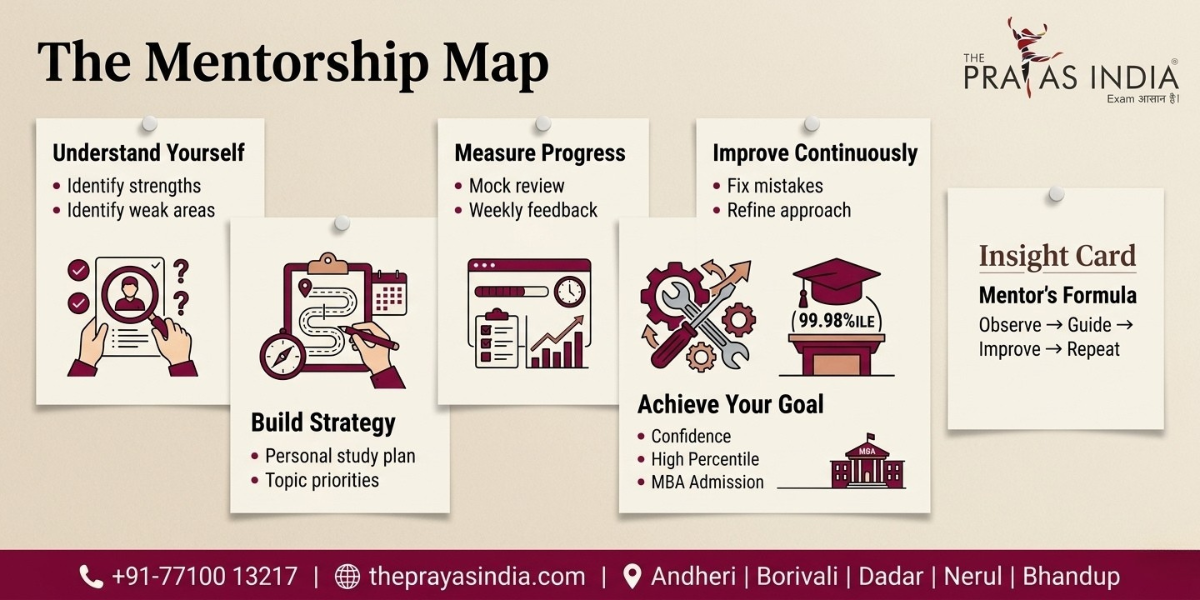
A Mentor Doesn’t Give You More Work. They Help You Do the Right Work.
One of the biggest myths about MBA CET preparation is that success belongs to students who study the longest.
In reality, success usually belongs to students who spend the highest percentage of their study time on the right activities.
This is exactly where personalised mentorship creates a measurable difference.
Imagine preparing for a journey through an unfamiliar city.
You can certainly find your way using maps, videos, and online suggestions.
Eventually, you’ll reach your destination.
But imagine travelling with someone who already knows every shortcut, every traffic bottleneck, and every alternate route.
The destination remains the same.
The experience becomes faster, smoother, and far less stressful.
MBA CET preparation follows a similar pattern.
A mentor doesn’t replace your effort.
A mentor ensures your effort is moving in the right direction.
Every Aspirant Has a Different Story
No two MBA CET aspirants begin from the same place.
One student may have excellent Logical Reasoning but struggle with Quantitative Aptitude.
Another may perform exceptionally well in English yet panic during timed mock tests.
Some students are fresh graduates.
Others prepare while working full-time.
Some have appeared before.
Many are attempting the examination for the first time.
Yet thousands of students continue following identical preparation plans downloaded from the internet.
That’s where many lose valuable time.
Personalised mentorship recognises an important truth:
Preparation should adapt to the student—not the other way around.
Planning Becomes Practical
One common reason students lose momentum is unrealistic planning.
A timetable looks impressive on paper.
Six hours of daily study.
Three mock tests every week.
Complete revision every Sunday.
After five days, reality takes over.
College assignments.
Office deadlines.
Family responsibilities.
Unexpected interruptions.
The timetable slowly disappears.
A mentor approaches planning differently.
Instead of asking,
“How many hours can you study?”
they ask,
“How many quality hours can you maintain consistently?”
The answer creates a sustainable preparation plan.
Consistency always beats intensity.
Smart Planning Principles
Instead of creating impossible schedules, focus on:
- Fixed daily study blocks.
- Weekly revision targets.
- Monthly performance goals.
- Flexible planning for unexpected events.
- Time reserved for mock analysis.
A realistic plan survives.
An unrealistic plan usually doesn’t.
Learning Isn’t the Problem. Retention Is.
Many MBA CET aspirants understand concepts during lectures.
A week later, they struggle to recall the same methods.
The problem isn’t intelligence.
It’s retention.
A mentor constantly checks whether learning has actually become long-term understanding.
Instead of asking,
“Did you complete this chapter?”
they ask,
“Can you solve these questions without looking at your notes?”
This subtle difference changes the entire preparation process.
Completion feels satisfying.
Retention produces results.
When Mock Tests Become Conversations
Students often treat mock tests like report cards.
Score high.
Feel happy.
Score low.
Lose confidence.
Mentors see mock tests differently.
Every mock becomes a diagnostic report.
Suppose a student scores 82 percentile.
Instead of discussing only the score, the mentor begins asking questions.
- Why did Accuracy fall in Quantitative Aptitude?
- Which Logical Reasoning set consumed unnecessary time?
- Were Reading Comprehension mistakes conceptual or careless?
- Which five questions should have been skipped?
Suddenly, the discussion moves beyond marks.
The focus shifts toward improvement.
This is how scores gradually increase.
Feedback Is More Valuable Than More Questions
Many aspirants believe improvement comes from solving thousands of additional questions.
Additional practice certainly helps.
But practice without feedback often repeats the same mistakes.
Think of a cricketer.
Playing hundreds of shots every day doesn’t automatically improve technique.
Watching recordings with an experienced coach does.
Preparation follows the same principle.
Feedback transforms practice into progress.
After Every Mock, Review These Areas
Instead of looking only at percentile, analyse:
- Accuracy in every section.
- Time spent on easy questions.
- Questions skipped unnecessarily.
- Questions guessed incorrectly.
- Repeated conceptual mistakes.
- Improvement compared with the previous mock.
Numbers tell a story.
Learn to read it.
Confidence Is Built Through Evidence
Motivation is temporary.
Confidence is earned.
Students often say,
“I think I’m improving.”
A mentor prefers measurable proof.
Instead of relying on feelings, preparation is evaluated using data.
Questions such as:
- Is your average score improving?
- Has your accuracy increased?
- Are you attempting more quality questions?
- Are mistakes reducing week after week?
When improvement becomes visible, confidence grows naturally.
No motivational speech can replace consistent progress.
The Accountability Advantage
Preparing alone gives complete freedom.
Unfortunately, it also makes procrastination easier.
Missing one study session doesn’t feel serious.
Postponing one mock test feels harmless.
Skipping revision seems acceptable.
Over time, these small decisions create large preparation gaps.
A mentor introduces accountability.
Not through pressure.
Through responsibility.
Knowing that someone will review your progress often encourages students to remain disciplined even on difficult days.
This steady accountability prevents preparation from becoming inconsistent.
The Questions Students Rarely Ask
Most aspirants ask:
“Which chapter should I study next?”
Experienced mentors often ask completely different questions.
- Which mistake has repeated three weeks in a row?
- Which section creates unnecessary stress?
- Which habit is slowing your improvement?
- Which topic deserves less attention now?
- Which strategy is no longer working?
These questions uncover problems that books cannot identify.
Sometimes, changing one habit produces more improvement than learning one new chapter.
Learning Through Reflection
The most successful MBA CET aspirants don’t simply finish each study session.
They reflect on it.
Spend five minutes every evening asking yourself:
- What did I learn today?
- What challenged me today?
- What became easier this week?
- What should I improve tomorrow?
Reflection transforms preparation into continuous improvement.
Without reflection, many mistakes quietly become permanent habits.
Personal Growth Beyond the Examination
One of the overlooked benefits of mentorship is that it develops skills extending far beyond MBA CET.
Students gradually learn to:
- Make better decisions under pressure.
- Think analytically.
- Plan realistically.
- Accept constructive feedback.
- Build consistency.
- Solve problems systematically.
These qualities remain valuable throughout MBA, interviews, and professional careers.
In many ways, mentorship prepares students not only for an examination but also for management itself.
Guidance That Evolves With Your Preparation
As preparation progresses, students require different kinds of support.
The guidance needed during the first month is very different from the guidance required a few weeks before the examination.
At The Prayas India, personalised mentorship evolves with every stage of a student’s MBA CET journey. Experienced faculty provide academic direction, structured study material supports concept-building, regular mock tests measure progress, doubt-solving sessions strengthen understanding, and continuous mentoring ensures that preparation remains focused on steady improvement rather than random effort.
The emphasis is never on following a fixed template.
It is on helping every student develop a preparation strategy that matches individual strengths, addresses specific weaknesses, and builds confidence step by step.
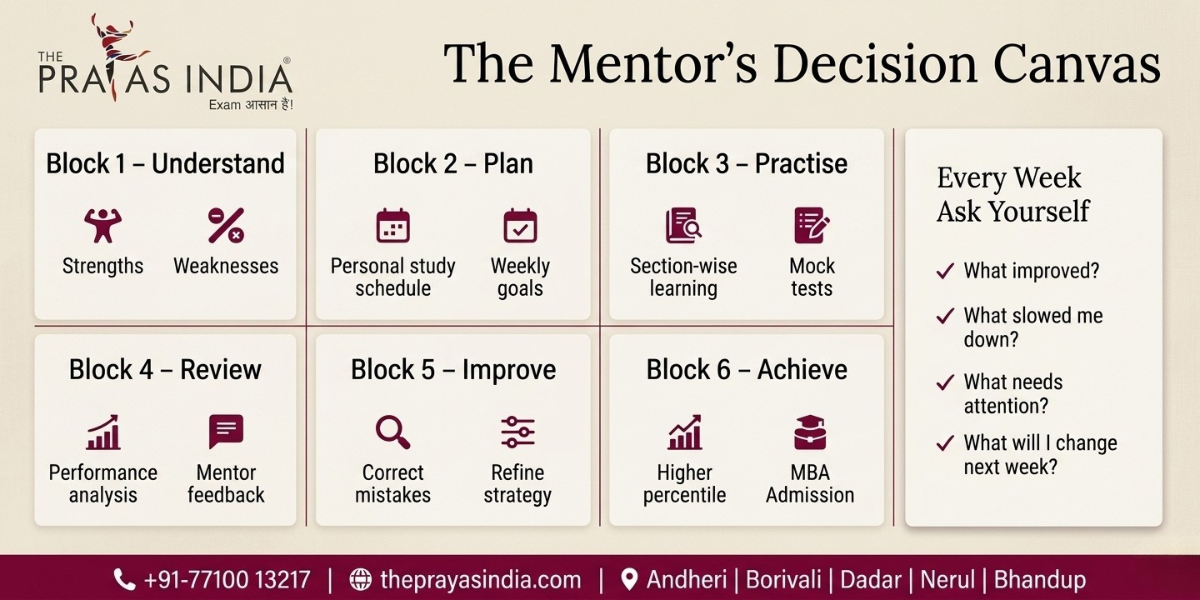
When Preparation Stops Feeling Random
Real Improvement Begins the Day You Understand Why Your Scores Change.
Every MBA CET aspirant remembers one mock test that changed everything.
Sometimes it is a surprisingly good score that boosts confidence.
Sometimes it is a disappointing result that raises uncomfortable questions.
“I’ve completed the syllabus. Why am I still not improving?”
This is one of the most common turning points in MBA CET preparation.
Students often assume that once concepts are clear, better scores will naturally follow.
Unfortunately, competitive examinations don’t work that way.
Knowledge helps you solve questions.
Performance helps you solve them faster, more accurately, and under pressure.
That transition—from knowing to performing—is where personalised mentorship becomes invaluable.
The Hidden Gap Between Preparation and Performance
Many students prepare consistently but struggle to convert that preparation into a high percentile.
The reason usually isn’t a lack of effort.
It’s the absence of structured performance improvement.
Think about a professional athlete.
Winning isn’t determined only by daily practice.
It depends on analysing performance, correcting weaknesses, refining technique, and repeating the process.
MBA CET preparation follows the same principle.
Every week should answer one important question:
“Am I becoming a better test-taker?”
Not just a better learner.
Progress Should Be Visible
One of the biggest advantages of personalised mentorship is measurable progress.
Instead of studying without direction, students begin tracking improvement using practical indicators.
Rather than asking,
“Did I complete today’s targets?”
Ask,
“What became easier compared to last week?”
Improvement can be measured through:
- Faster question selection.
- Better time management.
- Higher accuracy.
- Reduced careless mistakes.
- Greater confidence during mock tests.
- Better decision-making under pressure.
When these indicators improve, scores usually follow.
Mock Tests Become a Mirror
Most students see mock tests as examinations.
Mentors see them as feedback systems.
A mock test should never end when the score appears on the screen.
In many ways, that’s where learning actually begins.
Suppose two students score 92 percentile.
The first student celebrates and moves on.
The second student spends an hour analysing every section with a mentor.
Which student is more likely to score 96 or 98 percentile next month?
Usually, the second one.
Because improvement comes from understanding performance—not simply recording it.
A Better Mock Review Process
After every mock test, review these five questions.
1. Which questions consumed unnecessary time?
Sometimes students know the concept but hesitate before solving.
That hesitation is often more costly than the question itself.
2. Which mistakes were repeated?
Repeated mistakes deserve immediate attention.
One repeated error often reveals a habit rather than a knowledge gap.
3. Which section felt comfortable?
Strong areas also require maintenance.
Don’t ignore them completely.
4. Which questions should have been skipped?
Learning to leave difficult questions is an underrated examination skill.
5. What will change before the next mock?
Every mock should end with one clear improvement goal.
Without action, analysis has little value.
Building Consistency Instead of Chasing Perfection
Perfection is attractive.
Consistency is effective.
Students often become discouraged after one poor mock test.
Some even stop attempting mocks for a few weeks.
This usually delays improvement.
Personalised mentorship helps students see mock tests differently.
A single poor score doesn’t define preparation.
It simply identifies the next area of improvement.
This perspective removes unnecessary pressure.
Preparation becomes a continuous learning process rather than an emotional roller coaster.
Small Habits Create Big Percentiles
MBA CET preparation is rarely transformed by one dramatic change.
Instead, improvement usually comes from small daily habits.
For example:
- Reviewing yesterday’s mistakes before beginning today’s study.
- Revising formulas for fifteen minutes every morning.
- Reading business articles to improve comprehension.
- Solving one Logical Reasoning set under strict timing.
- Recording weekly observations in a notebook.
Each habit appears simple.
Together, they produce remarkable results over several months.
Daily Performance Habits
Successful aspirants often develop routines like these:
🗸 Revise one previously studied topic every day.
🗸 Solve a timed practice set.
🗸 Read for vocabulary and comprehension.
🗸 Spend ten minutes reviewing mistakes.
🗸 End the day by planning tomorrow’s priorities.
Simple routines create lasting consistency.
Learning to Think Like a Manager
MBA CET isn’t designed only to test mathematical ability or reasoning skills.
It also evaluates decision-making.
During the examination, every candidate constantly makes choices.
Should I attempt this question?
Should I skip this puzzle?
Should I return later?
Should I guess?
These decisions influence the final percentile as much as subject knowledge.
Personalised mentorship gradually develops this judgement.
Students learn when to attempt, when to pause, and when to move ahead.
This ability often separates high performers from average performers.
The Weekly Reflection Model
Every weekend, instead of asking,
“How much did I study?”
Reflect using these questions.
Learning
What new concept became clear this week?
Performance
Did my mock score improve?
Accuracy
Which mistakes disappeared?
Time Management
Where did I save time?
Mindset
Did I remain calm during practice?
Next Week
Which one improvement deserves maximum attention?
Reflection converts experience into progress.
Avoiding the Comparison Trap
MBA CET aspirants often compare:
- Mock scores.
- Study hours.
- Books.
- Coaching methods.
- Online strategies.
Unfortunately, comparison rarely improves preparation.
Every student begins from a different starting point.
The better comparison is with your previous self.
Ask:
- Am I stronger than I was one month ago?
- Do I solve questions faster now?
- Has my confidence improved?
If the answer is yes, you’re moving in the right direction.
From Aspirant to Future Manager
One interesting aspect of personalised mentorship is that it doesn’t only prepare students for an entrance examination.
It gradually develops qualities expected in management professionals.
Students begin to:
- Analyse situations logically.
- Prioritise effectively.
- Accept constructive feedback.
- Improve through reflection.
- Build disciplined routines.
- Make informed decisions.
These are the same qualities that help students succeed in MBA classrooms and corporate careers.
Preparation becomes more than examination training.
It becomes professional development.
Growth Is Easier When Someone Tracks It With You
Many aspirants lose momentum because they don’t realise when they’re improving—or when they’re repeating the same mistakes.
At The Prayas India, mentorship focuses on continuous growth throughout the MBA CET preparation journey. Regular mock tests, detailed performance discussions, structured study material, experienced faculty guidance, personalised doubt-solving, and ongoing mentoring help students stay accountable while improving their speed, accuracy, confidence, and examination strategy.
The objective is not simply to prepare for the next mock test.
It is to build a preparation system that consistently moves students towards a higher MBA CET percentile.
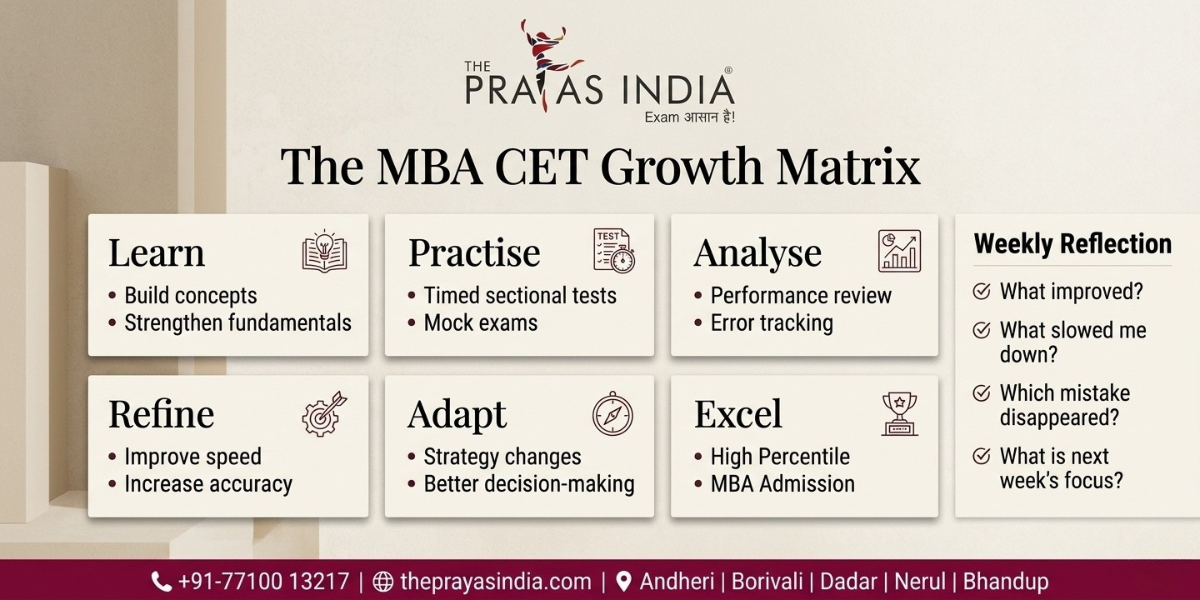
One Decision Can Shape Your MBA Journey
Mentorship Doesn’t Guarantee Success—It Helps You Earn It.
By the final stage of MBA CET preparation, the syllabus is usually complete.
Most concepts have been revised.
Several mock tests have been attempted.
Weak areas have been identified.
At this point, students often believe there is nothing significantly new left to do.
Ironically, this is where many aspirants either strengthen their chances—or slowly lose momentum.
The last few weeks are not about studying harder.
They are about preparing smarter.
The students who eventually secure admission into top MBA colleges are rarely those who panic during the final phase.
They are usually the ones who trust their preparation, refine their strategy, and continue making small improvements until the examination day.
This is where personalised mentorship often proves its greatest value.
Not because it teaches new concepts.
But because it prevents unnecessary mistakes when every mark matters.
The Last Month Is About Refinement
Imagine building a beautiful building.
You wouldn’t change the foundation during the final week.
You would focus on finishing touches.
MBA CET preparation follows the same principle.
The final month should concentrate on:
- Strengthening familiar topics.
- Reviewing mistakes.
- Improving speed.
- Increasing confidence.
- Maintaining consistency.
Avoid making drastic changes.
This is not the time to experiment with entirely new preparation methods.
A Practical Four-Week Plan
Week 1 – Review
- Analyse previous mock tests.
- Revise important concepts.
- Identify recurring mistakes.
Week 2 – Improve
- Focus on weak sections.
- Attempt sectional tests.
- Build speed gradually.
Week 3 – Simulate
- Attempt full-length mock tests.
- Follow actual examination timing.
- Review every mock carefully.
Week 4 – Stabilise
- Light revision.
- Formula review.
- Reading practice.
- Confidence building.
- Healthy routine.
A calm and organised mind performs far better than an overworked one.
Frequently Asked Questions
Can an average student score well in MBA CET?
Yes.
MBA CET rewards consistency, smart preparation, and decision-making far more than extraordinary academic records.
Many successful candidates begin with average scores and steadily improve through disciplined preparation.
How important are mock tests?
Mock tests are essential.
However, attempting mocks without analysing them limits their value.
The real improvement happens after understanding why mistakes occurred.
Should I keep changing books during preparation?
No.
Changing resources frequently creates confusion.
A well-planned study strategy supported by consistent revision usually produces better results than constantly collecting new material.
Is mentorship useful even for good students?
Absolutely.
High-performing students also benefit from objective feedback, performance analysis, and strategic refinement.
Mentorship is not only for solving doubts.
It is equally valuable for maximising strengths.
What should I avoid before the examination?
Avoid:
- Comparing mock scores every day.
- Following random preparation advice.
- Purchasing multiple new books.
- Ignoring sleep.
- Panicking after one poor mock test.
Stay committed to the strategy that has consistently worked for you.
Common Myths About MBA CET Preparation
Many preparation myths continue to mislead aspirants every year.
Let’s separate assumptions from reality.
| Myth | Reality |
|---|---|
| More study hours always produce higher percentiles. | Productive study matters more than long study sessions. |
| Coaching alone guarantees success. | Guidance works only when combined with disciplined effort. |
| Mock scores always predict final performance. | They indicate progress, not final outcomes. |
| Weak students need mentors. | Every aspirant benefits from constructive feedback. |
| Completing the syllabus means preparation is complete. | Revision, analysis, and performance improvement remain equally important. |
MBA CET Readiness Checklist
Before entering the examination hall, ask yourself these questions honestly.
Academic Preparation
🗸 Core concepts revised.
🗸 Formula notebook updated.
🗸 Logical Reasoning practice completed.
🗸 Reading Comprehension improving.
Performance Preparation
🗸 Multiple mock tests attempted.
🗸 Mock analysis completed.
🗸 Weak areas reviewed.
🗸 Time management strategy ready.
Mental Preparation
🗸 Consistent sleep schedule.
🗸 Positive mindset.
🗸 Confidence in preparation.
🗸 Comfortable examination routine.
Strategic Preparation
🗸 Question selection strategy decided.
🗸 Guesswork under control.
🗸 Revision completed.
🗸 Last-week plan ready.
If most of these boxes are ticked, your preparation is moving in the right direction.
The Value of Learning With a Mentor
Competitive examinations often appear to test only aptitude.
In reality, they also test judgement.
Every student faces moments of uncertainty.
Should I spend another hour on this chapter?
Should I attempt another mock today?
Should I change my strategy?
Mentorship doesn’t make these decisions for you.
It helps you make better decisions yourself.
That confidence gradually becomes one of your strongest competitive advantages.
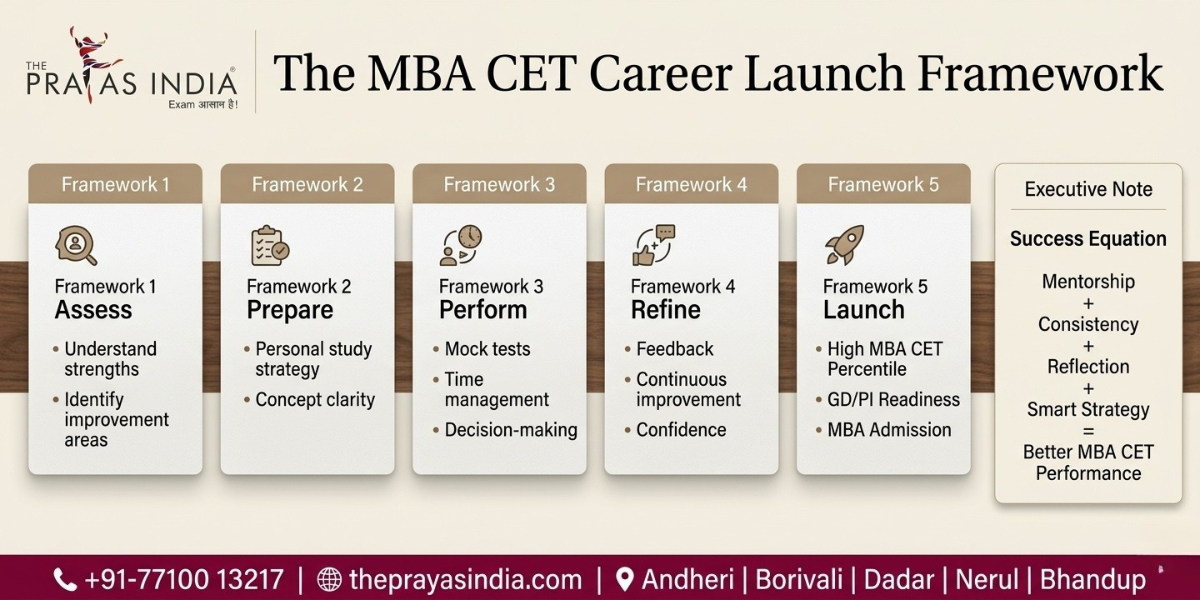
Why Students Choose The Prayas India
Preparing for MBA CET requires more than completing a syllabus—it requires a structured approach that evolves as your preparation progresses.
At The Prayas India, students receive a learning environment built around continuous improvement. Experienced faculty guide aspirants through every stage of preparation, comprehensive study material supports concept-building, regular mock tests measure real progress, personalised doubt-solving ensures conceptual clarity, and one-to-one mentorship helps students refine strategies based on individual strengths and weaknesses.
Rather than following a one-size-fits-all approach, the focus remains on helping every aspirant prepare with clarity, consistency, and confidence.
Final Thoughts
MBA CET is not merely an entrance examination.
It is the beginning of your management career.
The percentile you achieve depends not only on how much you study but also on how effectively you learn, review, adapt, and improve.
Throughout this guide, we explored how personalised mentorship transforms preparation from a collection of study hours into a structured journey of continuous growth.
Books provide information.
Practice develops skill.
Reflection creates improvement.
Mentorship brings all three together.
If your goal is to secure admission into a leading MBA college, choose a preparation approach that values progress over pressure and strategy over guesswork.
With the right guidance and consistent effort, success becomes a planned outcome—not just a hopeful possibility.
📞 Call: +91-77100 13217
🌐 Website: https://theprayasindia.com