How The Prayas India Helps Students Prepare for CAT | Best CAT Coaching in Mumbai | The Prayas India
Preparing for CAT is rarely about finding one perfect book, one shortcut or one last-minute strategy. For most aspirants, the bigger challenge is creating a preparation system that can take them from understanding concepts to solving questions accurately, managing time under pressure and eventually performing consistently in mocks.
This is where structured CAT preparation can make a meaningful difference. The Prayas India approaches CAT preparation as a gradual process in which students are expected to build fundamentals, practise application, identify weaknesses and improve through regular testing. The objective is not simply to complete the syllabus but to help aspirants become comfortable with the kind of decision-making CAT demands.
For a student preparing for CAT in Mumbai, coaching should ideally provide more than classroom teaching. The quality of explanations, practice environment, test strategy, doubt resolution, revision support and performance analysis can all influence how effectively a student converts preparation time into actual improvement.
This article looks at how The Prayas India helps students prepare for CAT, from the initial assessment and conceptual foundation to regular practice, mock-test preparation and personalised improvement.
CAT Preparation Starts With Understanding the Student
Every CAT aspirant enters preparation with a different academic background. Some students are naturally comfortable with Quantitative Aptitude but struggle with Reading Comprehension. Others have strong English skills but find Logical Reasoning and Data Interpretation unfamiliar. There are also students who have been away from academics for several years and need to rebuild their fundamentals before attempting advanced questions.
Because of this variation, treating every student exactly the same may not be the most effective approach.
A structured preparation process should begin by identifying the student’s current level. Performance in initial assessments, practice questions and sectional tests can reveal where the candidate is comfortable and where additional support is required. This gives the student a clearer starting point instead of relying on assumptions.
At The Prayas India, the preparation approach is designed around the idea that students should progressively understand where they stand, what needs improvement and how they can work on it. For an aspirant starting CAT preparation, this clarity can be particularly useful because it prevents random study and helps create a more focused routine.
Building Strong Fundamentals Before Advanced Practice
CAT preparation often becomes stressful when students start directly with difficult questions. A question may look challenging not because the CAT concept itself is complicated, but because the candidate has not yet developed the basic framework required to approach it.
This is particularly relevant in Quantitative Aptitude. Topics such as arithmetic, algebra, geometry and numbers require students to understand concepts before they can efficiently apply shortcuts or alternative approaches. Similarly, Logical Reasoning and Data Interpretation require familiarity with different structures and ways of organising information.
The same principle applies to Verbal Ability and Reading Comprehension. Students need to develop the ability to understand passages, identify arguments, interpret tone and eliminate unsuitable options rather than simply memorising vocabulary.
A strong foundation therefore becomes the first layer of CAT preparation. Once the basics are stable, students can gradually move towards higher-level questions and timed practice.
A Section-Wise Approach to CAT Preparation
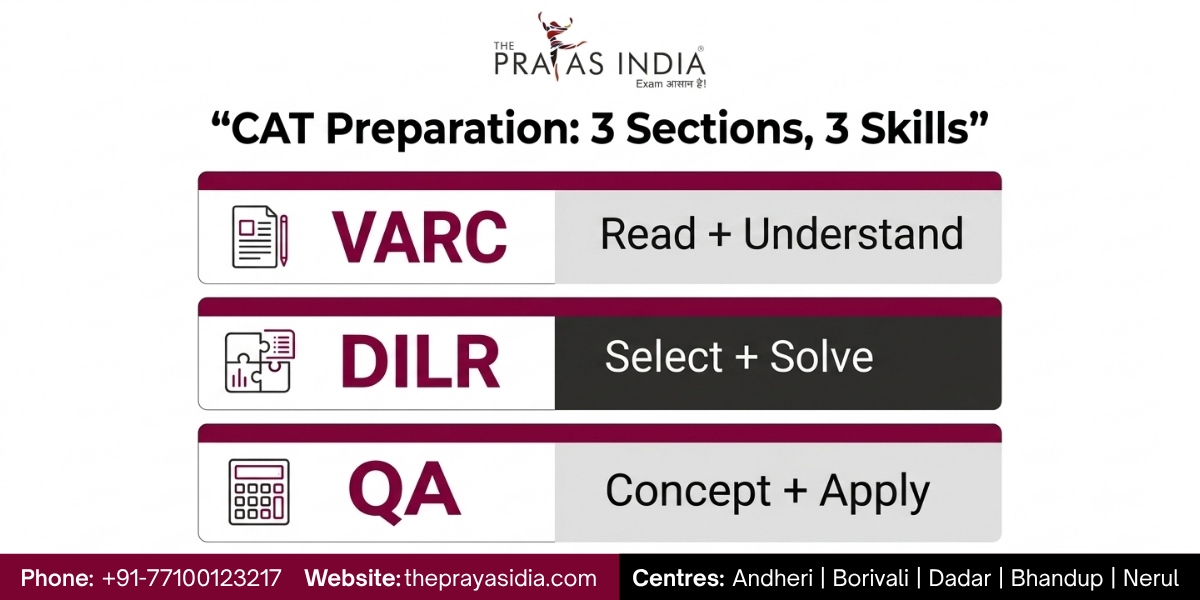
CAT consists of three major sections: VARC, DILR and QA. Each section requires a different preparation approach, and students need to develop the ability to switch between different styles of thinking.
VARC: Developing Reading and Interpretation Skills
Verbal Ability and Reading Comprehension cannot be improved effectively through last-minute preparation. Reading habits, comprehension ability and option analysis develop over time.
Students need regular exposure to different types of passages and questions. Instead of simply checking whether an answer is correct, effective preparation should encourage students to understand why an option is correct and why the alternatives are unsuitable.
Reading comprehension practice also helps students become comfortable with unfamiliar subjects. CAT passages may discuss philosophy, economics, science, society, history or abstract ideas. The objective is not to become an expert in every subject but to develop the ability to understand and analyse unfamiliar information.
Regular practice can gradually improve reading efficiency, comprehension and decision-making.
DILR: Learning to Identify the Right Set
Data Interpretation and Logical Reasoning can be unpredictable because the challenge is not always the calculation itself. Often, the candidate first has to identify the right way to organise the information.
Students need exposure to different set structures, including arrangements, tables, games, selection problems, networks and data-based sets. With practice, they begin to recognise patterns and evaluate which sets are likely to be manageable within the available time.
One of the important habits in DILR preparation is learning not to become emotionally attached to a difficult set. A student may spend several minutes trying to unlock a problem simply because they have already invested time in it.
CAT preparation therefore needs to develop set selection as well as set-solving ability.
QA: Combining Concepts With Efficient Application
Quantitative Aptitude rewards conceptual clarity, but CAT performance also depends on how efficiently those concepts can be applied.
Students need to become comfortable with fundamental areas before progressing to mixed and advanced questions. Regular practice can then help them identify multiple approaches and select the most efficient one for a particular question.
Calculation accuracy also matters. A student may understand the concept perfectly but still lose marks because of a small arithmetic error. Tracking these mistakes can help identify whether the underlying issue is conceptual, procedural or related to concentration.
The goal is not to solve every question. The goal is to recognise which questions offer the best opportunity for a correct attempt within the available time.
Regular Practice Turns Concepts Into Performance
Knowing a concept and being able to apply it under exam conditions are two different things. This is why practice needs to be an integral part of CAT preparation.
After learning a concept, students should solve questions that gradually increase in difficulty. Initially, the emphasis should be on understanding the method and maintaining accuracy. Once the method becomes familiar, time limits can be introduced.
This creates a natural progression from learning to application and eventually to speed.
Regular practice also reveals weaknesses that may not be visible during classroom learning. A student might feel confident about percentages, for example, but discover during a mixed practice set that they struggle when percentages are combined with ratios or profit and loss.
Such discoveries are useful because they tell the student what needs to be worked on next.
The Importance of Doubt Resolution
A small unresolved doubt can become a larger problem when related concepts build upon it. Students may understand a classroom explanation but become confused when they encounter a differently worded question during self-study.
Effective doubt resolution therefore forms an important part of preparation.
Instead of simply providing an answer, the objective should be to understand where the student’s reasoning went wrong. Was the concept misunderstood? Was the question interpreted incorrectly? Was there an inefficient approach? Or was the mistake simply due to calculation?
Understanding the reason behind the error helps prevent the same mistake from recurring.
For students preparing for CAT alongside college or work, accessible doubt support can also help maintain continuity because they do not have to wait until the next scheduled class to resolve every problem.
Building Speed Without Sacrificing Accuracy
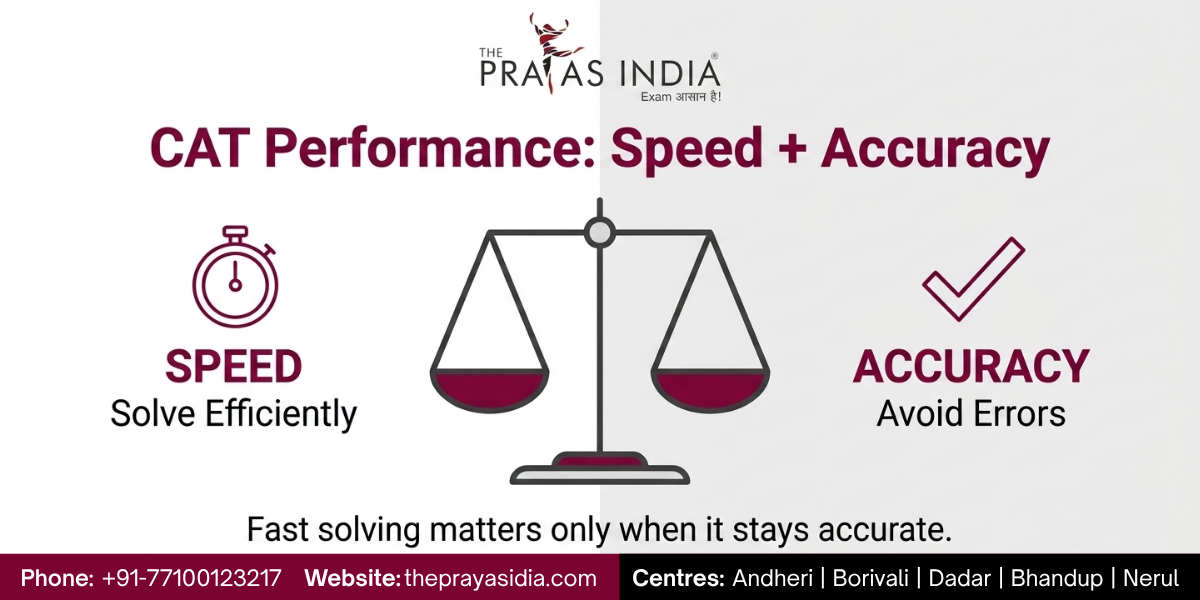
Speed is one of the most discussed aspects of CAT preparation, but speed should not be developed in isolation.
A student who attempts questions very quickly but makes frequent errors may actually lose more marks than a slower but accurate candidate. Similarly, a candidate who spends too much time trying to achieve perfect accuracy may not attempt enough questions.
The objective is to develop efficient accuracy.
This happens gradually. First, students should become comfortable solving standard questions correctly. Then they can compare different solving methods and identify more efficient approaches. Timed practice can subsequently help them reduce unnecessary steps.
The same principle applies across all three sections. In VARC, students need to improve reading and option evaluation. In DILR, they need to identify manageable sets quickly. In QA, they need to recognise concepts and select efficient approaches.
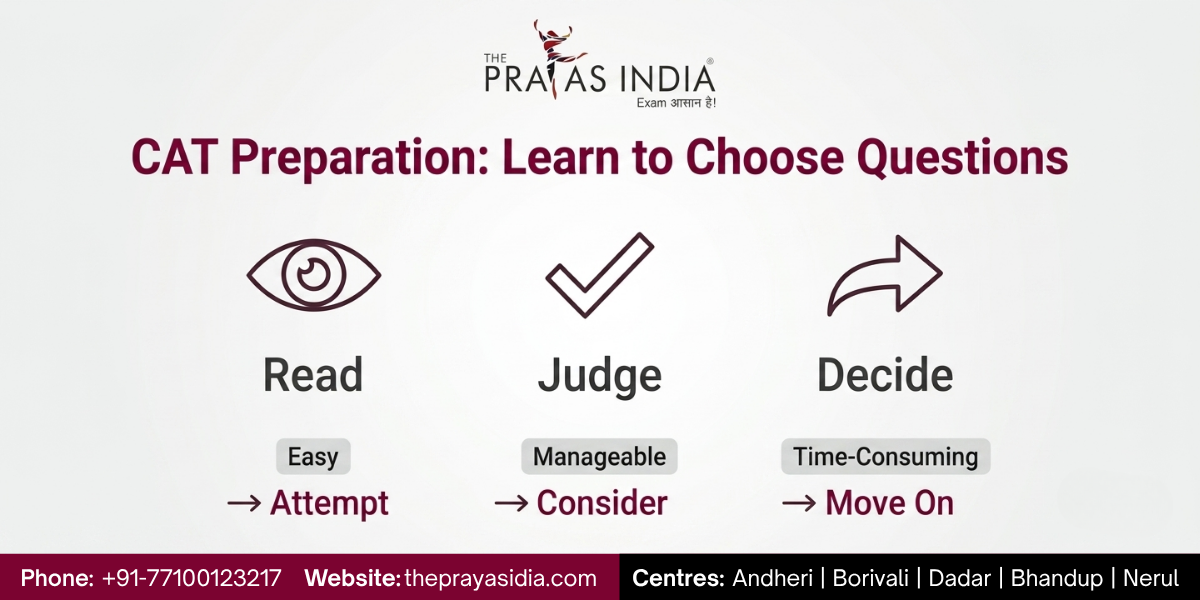
Learning How to Choose Questions
One of the biggest differences between ordinary practice and CAT-oriented preparation is the emphasis on question selection.
The CAT paper does not require candidates to solve every question. It requires them to make good decisions within limited time.
A question may be easy conceptually but still consume too much time because of lengthy calculations. Another question may initially look difficult but become manageable once the correct approach is identified.
Students therefore need repeated exposure to different question types and difficulty levels. Through practice and mock analysis, they can begin to understand their personal solving patterns.
Over time, this develops an important CAT skill: knowing when to attempt, when to postpone and when to leave a question.
Mock Tests: More Than Just a Score
Mock tests become increasingly important as students move deeper into CAT preparation. However, their value does not come from the score alone.
A mock test provides a controlled environment in which students can evaluate their preparation, time management, question selection and mental approach. The score is only one part of the information.
A student should ideally analyse which questions were answered correctly, which were answered incorrectly, which questions consumed too much time and which potentially easy questions were left unattempted.
This analysis can reveal patterns that are difficult to identify through ordinary practice.
For example, a student may discover that their QA accuracy is strong but that they spend too much time on DILR sets. Another student may realise that their VARC score fluctuates because they attempt questions without adequately analysing options.
Such insights allow preparation to become more targeted.
Performance Analysis Creates a Feedback Loop
The most useful preparation cycle is not simply:
Study → Test → Score
It is:
Study → Practise → Test → Analyse → Correct → Retest
This feedback loop helps students understand whether their preparation methods are actually producing improvement.
At The Prayas India, structured testing and performance review can help students move beyond simply collecting mock scores. The broader objective is to understand performance and identify areas that require intervention.
A candidate preparing seriously for CAT should eventually be able to answer questions such as:
“Which topics are consistently weak?”
“Where am I losing time?”
“What type of questions do I misread?”
“Which section is affecting my overall score?”
“Am I improving because of better accuracy or simply because the paper was easier?”
The answers to these questions make preparation more intelligent.
Personalised Guidance for Different Preparation Levels
A CAT aspirant who has just started preparation and a candidate who has already completed the syllabus should not necessarily follow the same strategy.
Beginners may need more time for conceptual learning and guided practice. Intermediate students may need to focus on mixed questions and speed. Advanced aspirants may need greater emphasis on mock analysis, question selection and fine-tuning their exam strategy.
Recognising these different stages can make preparation more efficient.
The role of a good coaching programme is therefore not merely to provide content. It should help students understand what stage they are at and what they need to do next.
Building Consistency Through a Structured Routine
CAT preparation usually extends over several months, and maintaining consistency can become more difficult than understanding individual topics.
Students often begin with highly ambitious schedules and gradually struggle to maintain them. A more sustainable approach is to create a realistic routine that can be followed alongside college, work or other commitments.
A structured routine should include learning, practice, revision and testing. The exact number of hours can differ from student to student, but each study session should have a defined objective.
For example, instead of writing “Study Quant,” a student could set a specific target such as completing a topic, solving a particular practice set or analysing errors from a previous test.
This makes progress easier to track and reduces the feeling of studying without direction.
Why Structured CAT Coaching Can Help
CAT preparation can certainly involve self-study, but structured coaching can provide an organised environment for students who need external guidance and accountability.
For an aspirant looking for CAT coaching in Mumbai, important factors include the quality of faculty, conceptual teaching, practice material, doubt support, mock-test ecosystem and performance analysis.
The objective should not be to join an institute simply because it claims to offer the “best CAT coaching.” Students should evaluate whether the teaching methodology matches their learning requirements and whether the programme supports them through the complete preparation journey.
At The Prayas India, the focus can be viewed as a combination of conceptual learning, practice, testing, analysis and continuous improvement. This approach is particularly relevant for students who want a structured path rather than completely unplanned self-study.
The Prayas India Approach to CAT Preparation
A strong CAT preparation ecosystem should bring multiple components together instead of treating them as separate activities.
The journey can begin with understanding the student’s current level and establishing the fundamentals. It can then move into section-wise practice, mixed question sets and timed exercises.
As students progress, regular tests can provide performance data. Analysis of these tests can highlight recurring errors and inefficient approaches. This information can then be used to modify practice and revision.
The process continues throughout preparation rather than ending after the syllabus is completed.
This creates a more meaningful preparation cycle:
Learn → Practise → Test → Analyse → Improve
For serious aspirants, this continuous cycle can help turn preparation into a measurable process rather than a collection of disconnected study sessions.
Preparing Beyond the Classroom
Joining CAT coaching does not mean that all preparation happens inside the classroom. Students still need to build independent study habits.
Regular reading, revision, question practice and mock analysis require individual effort. Classroom sessions can provide direction and explanation, but students need to convert that learning into performance through consistent work outside class.
This is particularly important for CAT because improvement often comes from repeated exposure to different question types.
The ideal relationship between coaching and self-study is therefore complementary. Coaching provides structure, guidance and feedback, while self-study provides the repetition and discipline needed to internalise those skills.
Ket Takeaway
Preparing for CAT is a long-term process in which every stage builds on the previous one. Students need conceptual clarity, regular practice, section-specific strategies, speed, accuracy, question selection and mock-test analysis.
The role of The Prayas India is to provide a structured environment in which these elements can work together. Rather than treating CAT preparation as simply completing a syllabus, the focus is on helping students understand their current level, strengthen fundamentals, practise intelligently and improve through testing and analysis.
For an aspirant considering CAT coaching in Mumbai, the most important question should not simply be which institute has the biggest claims. It should be whether the preparation system can help you consistently move from learning to application and from performance application.
Turning Mock Tests Into a Learning Tool
Mock tests are one of the most important components of CAT preparation, but simply taking a large number of mocks does not automatically lead to improvement. The real value comes from what students do after the test.
A mock should be treated as a diagnostic tool. Once the test is over, students need to understand where marks were gained, where they were lost and where time was unnecessarily spent. A candidate may have a low score because of weak concepts, poor question selection, careless errors or ineffective time management. Each of these problems requires a different solution.
At The Prayas India, mock-based preparation can help students develop a habit of looking beyond the final score. The purpose of analysis is to identify patterns and use them to modify future preparation.
This transforms the mock from a simple test into a feedback mechanism.
A Practical Mock Analysis Framework
After every mock, divide your questions into clear categories. Questions answered correctly and confidently indicate areas that are working well. Questions answered incorrectly despite knowing the concept usually point towards careless mistakes, misreading or poor execution.
Questions that took too long are equally important. A candidate may eventually reach the correct answer but still need to change the approach if the question consumed disproportionate time.
There will also be questions that you could not solve at all. These may indicate a genuine conceptual gap or simply lack of exposure to that particular question type.
Finally, look at questions that you skipped but could have solved. These represent lost opportunities and can reveal weaknesses in question selection.
The objective is to create a personal performance profile rather than simply recording a score.
Building a Personal Error Log
A well-maintained error log can become one of the most useful resources during CAT preparation.
Whenever you make an important mistake, record the question type and the reason behind the error. You do not need to copy every question. The purpose is to identify recurring patterns.
For example, your notes may show that you frequently make calculation mistakes in arithmetic, misinterpret certain RC questions or spend too much time on particular DILR structures.
Over several weeks, these patterns become visible. You can then dedicate targeted practice to the areas that are repeatedly affecting your performance.
The error log should also be revised regularly. There is little benefit in maintaining a detailed record that you never revisit.
Improving DILR Through Set Selection
DILR can become one of the most unpredictable parts of CAT preparation because the difficulty of individual sets can vary significantly. Students therefore need to develop two separate abilities: solving sets and selecting sets.
During practice, do not immediately start calculating after opening a set. First understand the information presented, identify what the set is asking and estimate how approachable it appears.
With repeated exposure, students begin to notice structural clues. Some sets may have a clear starting point, while others may require extensive casework. The ability to recognise these differences can save valuable time.
The Prayas India can help students build this mindset through regular practice and discussion of different DILR structures. The objective is not to teach students to avoid difficult questions completely, but to help them make better decisions about where to invest their limited time.
Developing VARC Beyond Vocabulary
A common misconception is that improving VARC simply means learning more vocabulary. While vocabulary can help, CAT Reading Comprehension requires a broader set of skills.
Students need to understand arguments, distinguish central ideas from supporting details, identify tone and evaluate answer choices carefully. Many difficult RC questions are not difficult because the passage uses complicated words. They are difficult because multiple options may appear plausible.
Regular reading and discussion of passages can help students develop a more analytical approach.
Instead of asking only, “Which option is correct?”, students should learn to ask, “What evidence in the passage supports this option?” and “Why are the other options weaker?”
This approach can improve both accuracy and decision-making.
Building QA Speed Without Losing Accuracy
Quantitative Aptitude preparation should gradually transition from concept learning to efficient application.
At the beginning, students should focus on solving questions correctly. Once accuracy becomes stable, they can compare approaches and identify unnecessary steps. Timed practice can then help improve speed.
Students should also learn to recognise familiar structures. When a question belongs to a pattern they have practised repeatedly, they should be able to identify the relevant approach quickly.
However, speed should never become an excuse for careless calculation. The goal is not to solve every question as quickly as possible. It is to maximise the number of accurate and worthwhile attempts.
Revision Should Be Continuous
Revision should not be reserved for the final few weeks before CAT. Students who revise continuously are less likely to forget concepts and can spend the final phase focusing on performance rather than relearning the syllabus.
A practical revision system can include short notes, formulas, recurring question types, vocabulary, important DILR approaches and personal mistakes.
After completing a topic, revisit it periodically. As preparation progresses, revision should become increasingly selective. Instead of revisiting everything with equal intensity, spend more time on areas where your performance is inconsistent.
This is another area where mock-test analysis becomes useful. Your test performance tells you which topics deserve greater revision priority.
Building a Strong Final-Month Strategy
The final month should be different from the first few months of CAT preparation. By this stage, the objective is no longer to accumulate unlimited new information.
Your attention should increasingly move towards mocks, revision, analysis, time management and question selection.
Full-length tests should be taken under conditions that closely resemble the actual examination. After each test, spend sufficient time analysing your performance. If a particular section repeatedly causes problems, identify the specific reason rather than simply taking more mocks.
The final month should also be used to establish a reliable examination routine. Students should know how they intend to approach each section, how they will react when they encounter a difficult set and when they will move away from a time-consuming question.
Don’t Change Your Strategy After Every Mock
A poor mock score can be discouraging, especially when students have been preparing consistently. However, changing the entire strategy after every disappointing result can create more confusion.
First determine whether the problem is temporary or recurring.
If the same issue appears repeatedly, it deserves intervention. If one mock contains an unusually difficult section, the result should be interpreted in context.
Students should look for trends across multiple tests rather than reacting emotionally to a single score.
This is why structured performance tracking can be valuable. It allows students to distinguish between a bad day and a genuine preparation weakness.
Personalised Support Can Make Preparation More Efficient
CAT preparation is not identical for every student. Someone with a strong mathematical background may need relatively less conceptual support in QA but more practice in VARC. Another candidate may have strong reading skills but require extensive DILR practice.
A structured coaching environment can help students identify these differences and adjust their preparation accordingly.
The Prayas India can support students through a combination of classroom learning, practice, tests and performance-oriented guidance. The larger objective is to ensure that students are not simply following a generic preparation schedule but are gradually becoming more aware of their own strengths and weaknesses.
From Classroom Learning to Independent Problem Solving
Good CAT coaching should eventually make students more independent, not more dependent.
Classroom sessions provide explanations, approaches and guidance. But students need to develop the ability to sit with an unfamiliar question, interpret it correctly, choose an approach and make a decision without waiting for someone to tell them what to do.
This is particularly important for DILR and VARC, where unfamiliarity can be a major challenge.
The preparation process should therefore gradually move students from guided solving to independent solving. As their confidence increases, they should be able to analyse their own mistakes and decide what needs additional practice.
Building Exam Temperament
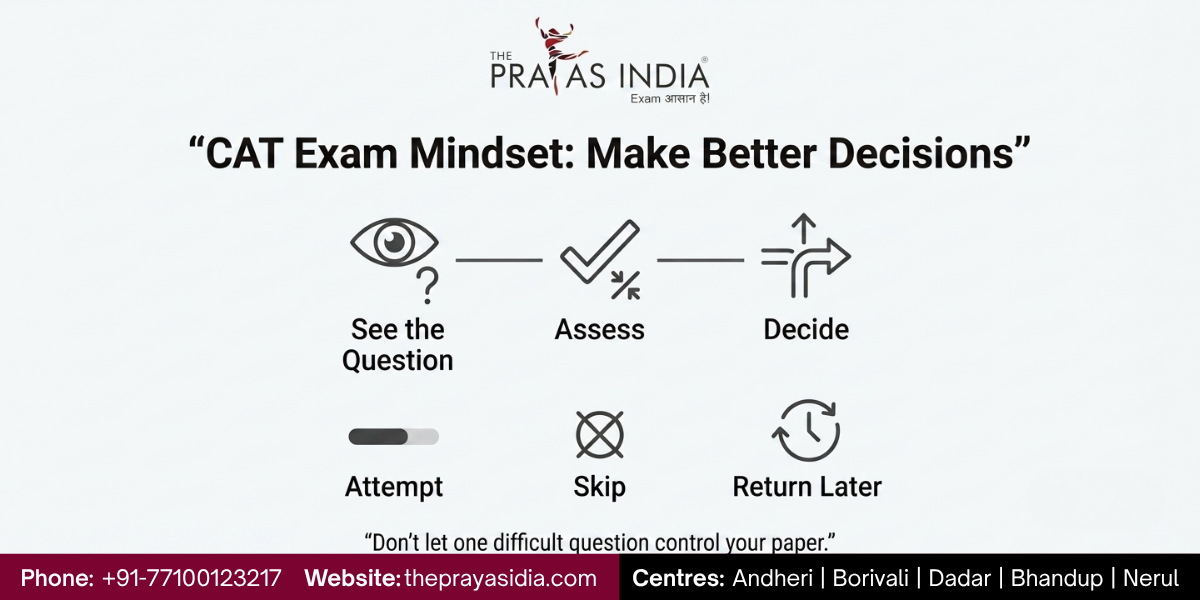
CAT is not only a test of academic knowledge. It also tests how effectively a candidate handles uncertainty and limited time.
A student may encounter a difficult DILR set, an unfamiliar RC passage or a calculation-heavy QA question. The ability to remain calm and make a sensible decision is important.
Mock tests provide an opportunity to practise this environment before the actual examination. Students can experiment with different approaches and discover what works for them.
Over time, the goal is to reduce emotional reactions to difficult questions. Instead of thinking, “I have to solve this,” students learn to think, “Is this the best use of my time?”
That change in mindset can be an important part of CAT preparation.
How The Prayas India Supports the Final Preparation Phase
As CAT approaches, students often need more than additional study material. They need clarity about what to revise, how to interpret mock performance and where to focus their remaining preparation time.
A structured preparation programme can help bring these activities together. Classroom learning covers concepts, practice strengthens application, tests provide performance data and analysis identifies areas for improvement.
The final phase can then focus on consolidating what has already been learned rather than constantly introducing new material.
For students looking for CAT coaching in Mumbai, this integrated approach can provide a more organised preparation environment.
Choosing CAT Coaching in Mumbai
Choosing a CAT coaching institute should involve more than comparing promotional claims. Students should consider the complete learning ecosystem.
Faculty quality matters because conceptual clarity affects the rest of preparation. Practice material matters because students need sufficient exposure to different question types. Tests matter because CAT preparation needs regular performance measurement. Doubt support matters because unresolved confusion can affect subsequent topics.
Most importantly, students should consider whether the institute’s preparation methodology matches their own needs.
The best coaching environment is one where students receive structure but are also encouraged to develop independent problem-solving skills.
What Students Should Expect From a CAT Coaching Programme
A serious CAT coaching programme should ideally help students through several connected stages.
The first is concept development, where fundamental ideas are explained clearly.
The second is guided practice, where students apply those concepts under supervision.
The third is independent practice, where students solve unfamiliar questions on their own.
The fourth is testing, where their performance is measured under time pressure.
The fifth is analysis and correction, where recurring mistakes are identified and addressed.
The final stage is revision and exam strategy, where students consolidate their preparation and develop a reliable approach for the actual examination.
This complete cycle is more useful than simply attending classes and collecting study material.
A Student-Centric Approach to CAT Preparation
Students preparing for CAT often have different academic backgrounds, schedules and learning speeds. A student-centric approach recognises these differences instead of assuming that one timetable works for everyone.
Someone starting from scratch may require additional foundation support. A student with strong fundamentals may benefit more from advanced practice and mock analysis. A working professional may need a more flexible preparation structure.
The Prayas India aims to support students through a structured CAT preparation environment while encouraging them to understand their own performance and take responsibility for consistent practice.
The ultimate objective remains the same: helping aspirants become better equipped to make accurate, efficient and informed decisions during the CAT examination.
FAQs
1. How does The Prayas India help students prepare for CAT?
The preparation approach combines conceptual learning, section-wise practice, doubt resolution, testing, mock analysis, revision and exam-oriented strategy to create a structured CAT preparation journey.
2. Is The Prayas India suitable for CAT beginners?
Yes. Students starting their CAT preparation can begin with fundamentals and gradually move towards advanced questions, timed practice and mock tests.
3. How important are mock tests for CAT preparation?
Mock tests are extremely useful because they help students practise under exam-like conditions and understand their speed, accuracy, question selection and time management.
4. Does taking more CAT mocks guarantee a better score?
No. The quality of mock analysis matters as much as the number of tests. Students need to identify mistakes and modify their preparation based on test performance.
5. How can students improve DILR for CAT?
Regular practice with different set structures is important. Students should develop both set-solving skills and the ability to identify which sets are worth attempting.
6. How can The Prayas India help with CAT VARC preparation?
Consistent Reading Comprehension and Verbal Ability practice can help students improve comprehension, interpretation, option analysis and decision-making.
7. How can students improve CAT Quantitative Aptitude?
Students should first strengthen fundamentals and then gradually move towards mixed practice, timed sets and efficient solving methods while monitoring calculation and conceptual errors.
8. Is CAT coaching necessary for every student?
Not necessarily. Some students can prepare effectively through self-study. However, structured coaching can be valuable for aspirants who need organised learning, regular testing, expert guidance and performance feedback.
9. What should I look for before joining CAT coaching in Mumbai?
Consider faculty quality, teaching methodology, practice material, mock tests, doubt support, performance analysis and whether the programme is suitable for your current preparation level.
10. How early should I join CAT coaching?
Starting early provides more time for fundamentals, practice, revision and mock-test improvement. It also allows students to correct weaknesses without depending on last-minute preparation.
11. Can working professionals prepare for CAT with coaching?
Yes. Working professionals can benefit from a structured programme that helps them organise limited preparation time. Consistency and realistic scheduling remain important.
12. What is the biggest benefit of structured CAT preparation?
The biggest advantage is clarity. Students know what to study, how to practise, how to evaluate their performance and what to improve next instead of preparing randomly.
Final Takeaway
CAT preparation is a process of continuous improvement. A student does not become CAT-ready simply by completing the syllabus. The real transformation happens when concepts become application skills, practice becomes accuracy, accuracy becomes speed and mock-test experience becomes better decision-making.
The Prayas India can support this journey through a structured preparation ecosystem that brings together conceptual teaching, practice, testing, analysis, revision and exam strategy.
For aspirants considering the best CAT coaching in Mumbai, the right institute should not merely promise a high score. It should provide an environment where students can identify their weaknesses, practise consistently, learn from mistakes and gradually become independent problem solvers.
The most effective CAT preparation cycle can be summarised simply:
Learn → Practise → Test → Analyse → Improve → Repeat
That cycle, maintained consistently over months, can turn preparation into measurable progress and help students approach CAT with greater clarity and confidence.
Contact Us
📞 Call Now: +91-77100 13217
🌐 Website: theprayasindia.com