
How to Analyse MBA CET Mock Tests for Better Scores | Best MBA CET Coaching in Mumbai | The Prayas India
MBA CET mock tests are among the most useful tools for improving exam performance, but only when they are analysed properly. Many aspirants take one mock after another, check their score and percentile, and immediately start preparing for the next test. This creates a lot of testing activity but does not necessarily create improvement.
The real value of a mock test begins after the test is over. Your score tells you where you currently stand, but your mistakes, attempts, time usage, question selection and accuracy explain why you are at that level. Without analysing these factors, it becomes difficult to understand whether your preparation is actually improving or whether you are simply repeating the same mistakes in different mocks.
For MBA CET aspirants, this distinction is particularly important because the examination rewards a combination of conceptual understanding, speed, accuracy and smart question selection. A student may know how to solve a question but still lose valuable marks by spending too much time on it. Another student may attempt a large number of questions but lose accuracy because of rushed decision-making. Mock analysis helps uncover these patterns.
For students preparing for MBA CET with structured guidance, this process can become even more effective when mock performance is connected with targeted practice, revision and expert feedback. For aspirants looking for MBA CET coaching in Mumbai, the right preparation environment should therefore focus not only on conducting tests but also on helping students understand what those tests reveal.
A Mock Test Is More Than a Score
The first mistake many MBA CET aspirants make is treating the mock score as the final outcome. A score or percentile is certainly an important indicator, but it is only the starting point of analysis.
Imagine two students scoring the same marks. One student may have attempted fewer questions with excellent accuracy, while the other may have attempted significantly more questions but made several avoidable mistakes. Their improvement requirements would be completely different.
Similarly, an aspirant may score lower in one mock because the paper was relatively difficult, yet perform better in terms of accuracy and question selection. Looking only at the final score could make that student believe that preparation has gone backwards when the underlying performance has actually improved.
A meaningful mock analysis should therefore examine the complete performance picture. You should know how many questions you attempted, how many were correct, where you lost time, which questions you should have attempted, which questions should have been skipped and which mistakes were caused by a lack of knowledge rather than poor execution.
The objective is simple: turn every mock into a source of actionable information.
Start With the Four Most Important Metrics
Before looking at individual questions, record four basic metrics after every mock:
Attempts: How many questions did you try?
Accuracy: How many of your attempts were correct?
Time: How efficiently did you use the available test time?
Score: What marks did those decisions ultimately produce?
These four metrics should be considered together.
A high number of attempts with poor accuracy is not necessarily a positive sign. Similarly, excellent accuracy with very few attempts may indicate that you are being too cautious. The most productive performance lies in finding a balance between speed, accuracy and intelligent question selection.
Over multiple mocks, these numbers can reveal trends that are difficult to notice from individual test results.
For example, if your attempts are increasing while accuracy is falling, your strategy may be becoming too aggressive. If accuracy is consistently high but attempts remain low, speed or confidence may be limiting your performance. If both attempts and accuracy are stable but your score is not improving, you may need to examine question selection or topic-level weaknesses.
Analyse Attempts Before Analysing Mistakes
Many students immediately start reviewing incorrect answers after a mock. Before doing that, analyse your attempts.
Create three broad categories:
Attempted and Correct
These are your successful attempts. Identify the questions you solved comfortably and the areas where your preparation is already strong.
Attempted and Incorrect
These are the questions that require deeper investigation. Not every wrong answer has the same cause.
Not Attempted
This category is often ignored, even though it can contain some of the biggest opportunities for improvement.
An unattempted question may have been too difficult, too time-consuming or outside your current preparation level. But it may also have been a perfectly manageable question that you missed because you did not identify it quickly enough.
That distinction matters.
If several unattempted questions were actually easy or moderate and you could have solved them with sufficient time, your problem may not be conceptual preparation. It may be question scanning, selection or time management.
Ask “Why?” After Every Important Mistake
Simply knowing that an answer was wrong is not enough. You need to understand why it was wrong.
For every significant mistake, ask yourself:
Did I not know the concept?
Did I misunderstand the question?
Did I make a calculation error?
Did I rush because of time pressure?
Did I choose the wrong approach?
Did I spend too much time before realising that I should have left the question?
These questions turn a generic mistake into a specific learning point.
Suppose you get a Quantitative Aptitude question wrong because you do not understand the underlying concept. The solution is conceptual revision.
If you understand the concept but make a calculation mistake, more theory will not solve the problem. You need deliberate calculation practice and better checking habits.
If you spend several minutes on a question that eventually remains unanswered, the issue may be question selection rather than knowledge.
The same score can therefore originate from very different problems. Effective mock analysis identifies the cause before deciding on the solution.
Build a Simple Error Classification System
A practical error log can make mock analysis much more useful. Instead of writing lengthy explanations for every incorrect question, classify your mistakes into a few recurring categories.
A simple system can include:
- Conceptual Error
- Calculation Error
- Misread Question
- Wrong Approach
- Time Pressure
- Poor Question Selection
- Guessing or Overconfidence
After three or four mocks, review which categories appear most frequently.
If conceptual errors dominate, your preparation needs more topic-wise revision and practice. If calculation errors are recurring, accuracy drills should become part of your routine. If poor question selection appears repeatedly, you need to work on scanning and decision-making rather than simply increasing the number of questions you solve.
This is where mock analysis becomes a bridge between testing and preparation. Instead of randomly deciding what to study next, you use your own performance data to determine your priorities.

Do Not Ignore Questions You Got Right
Correct answers are usually treated as completed business, but they can also provide valuable information.
Suppose you answered a question correctly but spent much longer than expected on it. That question deserves attention even though the final answer was right.
Similarly, you may have reached a correct answer through an unnecessarily complicated method. In a speed-based examination, inefficient solving methods can become a hidden problem.
During mock analysis, identify questions that were:
Correct + Fast — these represent strong areas.
Correct + Slow — these may require speed improvement.
Correct + Uncertain — these may indicate that you need greater confidence or conceptual reinforcement.
This approach prevents a common mistake: assuming that every correct answer represents equally strong performance.
The goal is not simply to increase the number of correct answers. It is to improve the efficiency with which you produce those correct answers.
Analyse the Questions You Left Unattempted
One of the most valuable parts of mock analysis is reviewing unattempted questions.
Go back through the questions you did not attempt and divide them into three categories.
The first category consists of questions that were genuinely difficult or unsuitable for your current level. Leaving them was probably a good decision.
The second category consists of questions that were solvable but required more time than you had available. These can highlight speed or preparation issues.
The third category consists of questions that were relatively straightforward but were overlooked during the test. These are especially important because they represent lost scoring opportunities.
If the third category is large, you may not need to study more topics. You may need to improve how you scan the paper and identify opportunities.
This is one of the reasons why strong mock analysis can sometimes produce more improvement than simply taking additional tests.
Question Selection Can Directly Affect Your Score
MBA CET preparation is not only about knowing the syllabus. It is also about knowing where to spend your time.
During a mock, you will encounter questions with different levels of difficulty and different solving times. A question may be easy conceptually but lengthy to calculate. Another may initially look difficult but have a short solution once the correct approach is recognised.
Your analysis should therefore examine whether the questions you selected were worth the time invested.
For every time-consuming question, ask:
Was the question actually difficult?
Could I have solved it faster?
Should I have left it earlier?
Did another question offer a better scoring opportunity?
Over time, these observations help develop a personalised question-selection strategy.
Your Mock Analysis Should Lead to Your Next Study Plan
The most important outcome of mock analysis is not a notebook full of mistakes. It is a better plan for the next stage of preparation.
Suppose your analysis shows that Logical Reasoning is strong but slow, Quantitative Aptitude has conceptual gaps and Verbal Ability has high accuracy. Your study plan should reflect that exact situation.
You may need targeted Quant revision, timed LR practice and maintenance-level VARC practice.
This is far more efficient than spending equal amounts of time on every section.
Your preparation should increasingly become data-driven as the number of mocks increases. The objective is to invest more time in weaknesses that have a meaningful impact on your score while maintaining the areas where you are already performing well.
The Difference Between Taking Mocks and Learning From Mocks
There is a significant difference between an aspirant who takes ten mocks and one who takes ten mocks and analyses each one carefully.
The first student may have ten scores.
The second student has ten sets of performance data.
The difference becomes important because improvement is created by the changes made between tests. If you take Mock 1, make the same mistakes in Mock 2, repeat them in Mock 3 and continue without changing your strategy, the number of mocks has little meaning.
A productive mock routine should look something like:
Take the Mock → Analyse the Performance → Identify the Weakness → Practise the Weak Area → Change the Strategy → Take the Next Mock
This creates a continuous feedback loop.

How The Prayas India Can Help With MBA CET Mock Analysis
For many aspirants, the challenge is not taking mock tests but understanding what the results actually mean. A score may show the outcome, but identifying the right corrective action requires a more detailed look at performance.
Structured MBA CET coaching can provide a framework for connecting classroom preparation with mock performance. Faculty guidance, regular testing, question-solving practice and performance discussions can help aspirants identify recurring patterns and work on specific weaknesses.
At The Prayas India, MBA CET preparation is designed to combine conceptual learning with practice and test-oriented preparation. For students preparing in Mumbai, a structured coaching environment can help create greater consistency in preparation while giving aspirants a systematic way to monitor their progress.
The objective is not to make students dependent on mock scores. It is to help them understand what those scores are telling them and use that information to improve.
For an aspirant searching for the best MBA CET coaching in Mumbai, mock-test analysis should be one of the factors considered while evaluating a coaching programme. A strong preparation system should help students not only attempt tests but also understand their performance and make targeted improvements.
What to Focus on After Every MBA CET Mock
You do not need to spend an entire day analysing every test. The analysis should be detailed enough to identify important patterns but practical enough to maintain consistently.
After each mock, focus on these questions:
1. What went well?
Identify the sections, topics and question types where your performance was strong.
2. Where did I lose marks?
Look beyond incorrect answers and include missed opportunities and inefficient attempts.
3. Which mistakes are recurring?
Repeated mistakes deserve higher priority than isolated errors.
4. Did I use my time efficiently?
Identify sections or questions that consumed disproportionate time.
5. Which questions should I have attempted?
Review unattempted questions to identify potential scoring opportunities.
6. What should I change before the next mock?
This is the most important question because it converts analysis into action.
A mock analysis is successful only when it changes something in your preparation.
Key Takeaway
MBA CET mock tests should not be treated as simple score generators. They are performance-diagnostic tools that can reveal your strengths, weaknesses, time-management issues, accuracy problems and question-selection habits.
Instead of asking only “What did I score?”, start asking:
“Why did I score this?”
That shift can completely change the way you approach mock tests.
The next stage is to use this analysis at the section level, identify high-impact weaknesses, compare performance across multiple mocks and create a targeted improvement strategy. With structured preparation and expert guidance, aspirants can turn mock-test data into meaningful score improvement.
From Mock Analysis to Measurable Score Improvement
Analysing one MBA CET mock can reveal mistakes, but analysing multiple mocks can reveal patterns. This is where mock-test analysis becomes a powerful part of long-term preparation. A single test may show that your score was low in a particular section, but a series of tests can tell you whether that weakness is temporary or consistently affecting your performance.
As your preparation progresses, your objective should gradually shift from simply completing more questions to understanding the quality of your attempts. You should know which topics are becoming stronger, which mistakes are recurring, where your time is being spent and whether your question-selection decisions are producing enough correct answers.
For MBA CET aspirants, this process is particularly valuable because the examination demands a combination of speed, accuracy and decision-making. The students who learn to analyse their performance objectively can make their preparation more focused instead of repeatedly practising the same areas without knowing whether they are actually improving.
Compare Your Mocks Instead of Studying Them in Isolation
Looking at each mock separately can make your preparation feel inconsistent. One test may produce a very good score, while the next may be disappointing. Instead of reacting emotionally to every fluctuation, compare your performance across several tests.
Create a simple performance record containing your total score, attempts, accuracy and section-wise performance. You can also track the number of questions you left despite knowing how to solve them, the number of avoidable mistakes and the approximate time spent on each section.
The purpose is to identify trends.
For example, if your Logical Reasoning attempts have increased steadily while accuracy remains stable, that indicates useful progress. If your Quantitative Aptitude attempts increase but incorrect answers rise sharply, you may be pushing speed at the expense of accuracy. If your Verbal Ability performance remains stable but your overall score fluctuates significantly, question selection or test difficulty may be influencing your results.
A trend-based approach prevents one unusually good or bad mock from dominating your perception of preparation.
Create a Section-Wise Performance Dashboard
A simple section-wise dashboard can make mock analysis much more actionable. You do not need complicated software. A spreadsheet, notebook or structured preparation sheet can work effectively.
For each section, record:
Logical Reasoning: Attempts, accuracy, time and difficult question types.
Abstract Reasoning: Attempts, accuracy, pattern-recognition issues and time spent.
Quantitative Aptitude: Attempts, accuracy, calculation errors, conceptual gaps and lengthy questions.
Verbal Ability & Reading Comprehension: Attempts, accuracy, reading time and recurring question-type errors.
After several mocks, identify the section that has the greatest gap between your potential and actual performance.
That section should receive focused attention, but it should not completely replace preparation in your stronger areas. Your goal is to raise your overall performance while maintaining existing strengths.
Logical Reasoning: Analyse Decisions, Not Just Answers
Logical Reasoning can contain questions that appear approachable but become time-consuming once you begin solving them. This makes question selection particularly important.
During mock analysis, look at the questions you attempted and determine whether they were efficient choices. If a question consumed several minutes but produced only one correct answer, compare it with other questions that you skipped during the same period.
You should also identify the types of reasoning questions where you repeatedly lose time. Some aspirants may struggle with arrangements, while others may spend too much time on conditions, sequences or complex logical relationships.
The purpose is not to avoid difficult questions permanently. It is to become better at recognising their likely time cost before committing to them.
Abstract Reasoning: Improve Pattern Recognition
Abstract Reasoning rewards the ability to identify relationships quickly. If your performance is slow, repeatedly solving questions without analysing the pattern may not be enough.
After a mock, revisit questions that took too long and ask what visual or logical relationship you failed to recognise initially. Was it movement, rotation, symmetry, counting, position, alternation or another recurring pattern?
The more consciously you identify these structures, the faster your recognition can become.
Your mock analysis should therefore include not only whether an answer was correct but also how quickly you recognised the underlying pattern.
Quantitative Aptitude: Track Calculation and Conceptual Errors Separately
Quantitative Aptitude requires careful analysis because wrong answers can originate from completely different problems.
If you did not know how to solve a question, it represents a conceptual gap.
If you knew the method but calculated incorrectly, it represents an accuracy problem.
If you understood the concept and calculation but spent too much time, it represents an efficiency problem.
These three issues should not be treated identically.
For conceptual gaps, revise the relevant topic and solve targeted questions. For calculation errors, practise accuracy and calculation techniques. For efficiency problems, explore shorter approaches and practise timed sets.
This makes your preparation more precise and prevents you from revising entire chapters when only one specific skill needs improvement.
VARC: Analyse Why the Wrong Option Looked Right
In Verbal Ability and Reading Comprehension, simply reading the explanation may not always be enough. The real learning comes from understanding why your chosen option appeared attractive and why it was ultimately incorrect.
For every important RC mistake, compare your option with the correct answer. Look for differences in scope, tone, inference, factual support and relevance to the passage.
You should also examine your reading time. If you are spending too long on passages, determine whether the problem comes from slow reading, repeated rereading or difficulty identifying the central argument.
For VA questions, analyse whether the problem is understanding paragraph structure, sentence relationships or eliminating unsuitable options.
Over time, this can help make your VARC preparation more analytical rather than dependent on simply solving more questions.
Improve Your Attempts Without Chasing a Number
A common mistake in MBA CET preparation is setting an arbitrary target for the number of questions to attempt and trying to reach that number in every mock.
Attempting more questions is useful only when those attempts produce enough correct answers.
Suppose your attempts increase significantly but your score does not improve. That indicates that additional attempts are not yet productive. You may be attempting questions too quickly, taking unnecessary risks or selecting questions without evaluating their difficulty and time requirement.
Instead of asking, “How many questions should I attempt?”, ask:
“How many questions can I attempt accurately within the available time?”
This changes the focus from quantity to productive attempts.
Use the “Correct but Slow” Category
One of the most overlooked categories in mock analysis is the correct but slow question.
A correct answer can create a false sense of satisfaction, but if the question took much longer than it should have, it may still represent a preparation weakness.
For example, if you correctly solve a moderate Quant question but spend several minutes reaching the answer, you should not simply mark it as a success and move on. Identify whether another method could have reduced the solving time.
Similarly, if you understand an RC passage correctly but spend too long deciding between two options, your issue may be elimination technique rather than comprehension.
Tracking correct-but-slow questions helps you improve efficiency without unnecessarily increasing risk.
Use Unattempted Questions as Missed Opportunities
Unattempted questions deserve their own category because some of them represent potential marks that were never pursued.
After every mock, revisit the unattempted questions and ask:
Was it genuinely difficult?
Could I have solved it with more time?
Did I fail to recognise an easy opportunity?
Did I spend too much time elsewhere?
If you consistently discover manageable questions among your unattempted ones, your question-scanning process needs improvement.
This can be particularly important in a high-speed examination like MBA CET, where recognising a good question quickly can be as valuable as knowing the underlying concept.
Turn Every Mock Into a Targeted Practice Plan
Mock analysis becomes truly useful when it determines what you do next.
Suppose your analysis identifies three major problems: calculation errors in QA, slow selection in LR and inconsistent RC accuracy.
Your next preparation cycle should address exactly those problems.
Instead of randomly solving hundreds of questions, you could schedule focused calculation drills, timed LR selection practice and targeted RC analysis.
After completing that cycle, take another mock and check whether the identified weaknesses have improved.
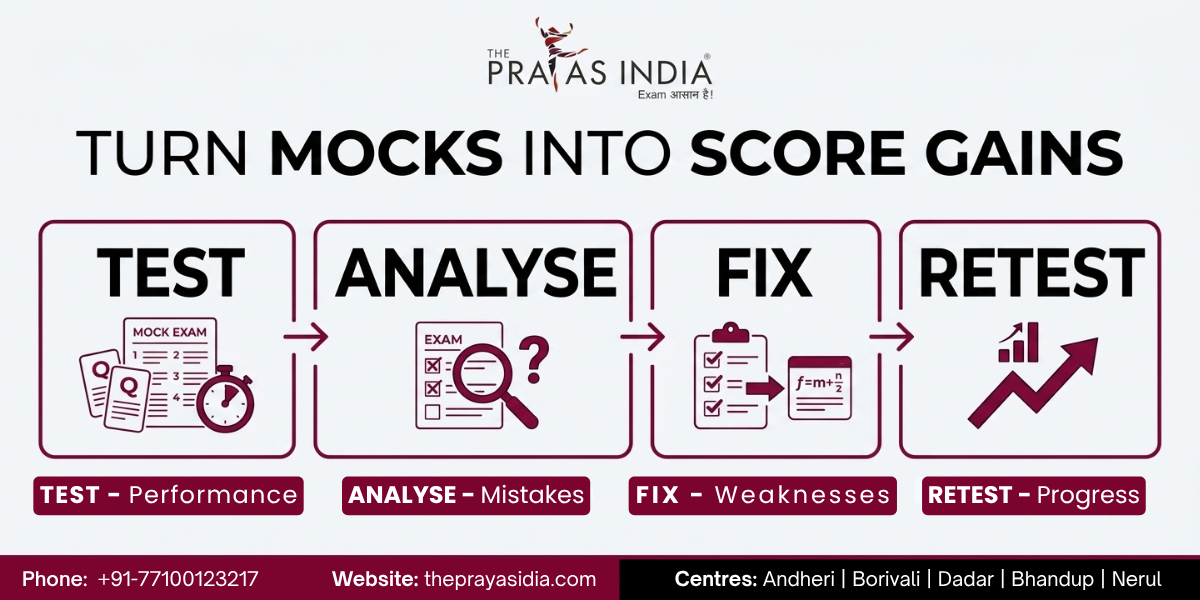
This creates a structured loop:
Mock → Analyse → Identify → Practise → Retest
The process ensures that your preparation keeps responding to your actual performance.
How to Know Whether Your Mock Analysis Is Working
Effective analysis should eventually create visible changes in your performance.
You may notice that the number of avoidable mistakes decreases. You may begin leaving time-consuming questions earlier. Your accuracy may improve even before your total attempts increase. You may also become faster at recognising familiar question types.
These changes are signs that your preparation process is becoming more efficient.
Do not expect every mock to produce a dramatic score increase. Improvement can occur gradually and may first appear in smaller indicators such as better accuracy, fewer wasted minutes or stronger section-wise consistency.
The key is to identify these improvements and continue building on them.
Common Mistakes to Avoid During MBA CET Mock Analysis
Mock analysis itself can become ineffective if it is done incorrectly.
One common mistake is spending too much time reading solutions without attempting to understand your own error. The solution explains how the question can be solved, but your job is to understand why you did not solve it correctly or efficiently.
Another mistake is analysing only incorrect questions. Correct-but-slow and unattempted-but-solvable questions can also contain important learning opportunities.
Some students also try to fix too many weaknesses simultaneously. This can make preparation scattered. Prioritise the weaknesses that have the greatest impact on your performance.
Finally, avoid changing your entire strategy after one poor mock. Look for recurring patterns across multiple tests before making major strategic decisions.
How Coaching Can Make Mock Analysis More Effective
Self-analysis can work well when the aspirant has enough experience to recognise patterns independently. However, many students find it difficult to determine whether their problem is conceptual, strategic or related to execution.
This is where structured MBA CET coaching can add value.
A coaching environment can connect classroom learning, practice questions, mock tests and performance analysis into one preparation system. Faculty guidance can help students understand recurring mistakes, while regular testing provides measurable feedback on whether those weaknesses are improving.
At The Prayas India, MBA CET preparation focuses on building conceptual clarity alongside exam-oriented practice and performance improvement. For students preparing in Mumbai, structured coaching can provide a consistent academic routine and a framework for tracking preparation over time.
For aspirants searching for the best MBA CET coaching in Mumbai, it is important to look beyond classroom teaching. Mock-test quality, analysis support, practice resources, faculty guidance and the overall preparation system can all influence how effectively students use their preparation time.
When Should You Start Taking MBA CET Mocks Seriously?
Mock tests should become an increasingly important part of preparation as your conceptual foundation develops. However, taking full-length mocks without sufficient preparation can sometimes produce scores without providing enough actionable learning.
Early in preparation, topic-wise tests and sectional practice can help build fundamentals. As more of the syllabus is covered, full-length mocks become increasingly useful for testing speed, accuracy and overall strategy.
In the later stages, mock analysis becomes even more important because there is less time available for broad preparation. The focus should shift towards refining your approach, reducing recurring mistakes and maximising productive attempts.
The exact number of mocks depends on your preparation level, available time and individual performance. What matters most is that each test contributes to the next stage of preparation.
Admission-Focused MBA CET Preparation at The Prayas India
Preparing for MBA CET with a clear target can make the journey more structured. Students aiming for leading management institutes need to develop not only subject knowledge but also the ability to perform under a demanding time environment.
The Prayas India provides a structured preparation environment for aspirants looking to strengthen their MBA CET preparation in Mumbai. The focus is on connecting learning with practice, testing and performance improvement so that students can progressively refine their strategy.
If you are currently preparing through self-study but struggling to maintain consistency, understand mock results or identify what to practise next, joining a structured coaching programme can provide a more organised path.
For students considering MBA CET coaching in Mumbai, the admission decision should be based on the complete preparation ecosystem—faculty support, practice, mock tests, analysis, doubt resolution and the ability to work systematically towards the target percentile.
A Practical Mock-Test Routine for MBA CET Aspirants
A useful routine can be divided into four stages.
Before the Mock: Revise important concepts and enter the test with a clear strategy rather than an arbitrary attempt target.
During the Mock: Focus on question selection, time management and accuracy. Avoid becoming emotionally attached to difficult questions.
Immediately After the Mock: Record your score, attempts, accuracy and section-wise performance before reviewing solutions.
During Analysis: Categorise mistakes, review unattempted questions, identify correct-but-slow attempts and decide what needs to change.
The final stage is the most important because it determines how useful the mock actually becomes.
Your next study cycle should directly address the weaknesses discovered during analysis.

Final Takeaway
MBA CET mock tests should not be treated as isolated examinations. They should form part of a continuous performance-improvement system.
Your score tells you the outcome, but your analysis tells you what to change.
Track attempts and accuracy. Review wrong answers and unattempted questions. Identify correct-but-slow attempts. Separate conceptual gaps from execution problems. Compare multiple mocks rather than reacting to one result. Then convert those findings into targeted practice.
The most effective mock-test strategy is not:
Mock → Score → Next Mock
It is:
Mock → Analyse → Improve → Retest
For aspirants preparing for MBA CET in Mumbai, structured coaching can make this process more consistent by connecting classroom preparation with regular testing and performance analysis.
If your goal is to improve your MBA CET performance and prepare with a structured approach, The Prayas India can help you build a preparation system focused on concepts, practice, mock tests and measurable improvement.
Frequently Asked Questions
1. How should I analyse my MBA CET mock test?
Start by checking your attempts, accuracy, score and time usage. Then review incorrect answers, unattempted questions and correct-but-slow attempts. Categorise your mistakes into conceptual, calculation, selection, interpretation and time-management issues.
2. Should I analyse every question after an MBA CET mock?
You do not necessarily need an equally detailed analysis of every question. Prioritise incorrect questions, time-consuming questions, uncertain correct answers and unattempted questions that could have been solved. These usually provide the most actionable insights.
3. Why is my MBA CET mock score not improving?
Stagnant scores can result from weak concepts, low accuracy, poor question selection, slow calculations, inefficient time management or repeated mistakes. Analysing several mocks can help identify which issue is consistently affecting your performance.
4. How can mock analysis improve my MBA CET score?
Mock analysis helps you identify where marks are being lost and what needs to change. When you use that information for targeted practice and then retest yourself, each mock becomes part of an improvement cycle rather than an isolated test.
5. Should I focus on attempts or accuracy in MBA CET?
Both matter. Increasing attempts without maintaining accuracy may not improve your score meaningfully. The goal should be to increase productive attempts—questions that you can solve correctly within a reasonable amount of time.
6. How many MBA CET mocks should I take?
There is no universal number that works for every aspirant. The quality of analysis is more important than simply increasing the number of tests. Your mock frequency should increase as your preparation becomes more exam-ready, with enough time between tests for analysis and targeted improvement.
7. Should I join MBA CET coaching if I am already taking mock tests?
If you are struggling to interpret your mock performance, maintain consistency or identify what to practise next, structured coaching can be useful. Faculty guidance and a systematic preparation framework can help reduce trial and error.
8. What should I look for in MBA CET coaching in Mumbai?
Look at the complete preparation system rather than only the classroom schedule. Consider faculty guidance, conceptual teaching, practice resources, mock tests, mock analysis, doubt-solving support, revision and how effectively the programme tracks student performance.