How to Balance All Sections in MBA CET Preparation | Best MBA CET Coaching in Mumbai | The Prayas India
MBA CET preparation is often approached as a race to solve more questions in less time. But for aspirants targeting a strong percentile and competitive MBA admissions, the bigger challenge is often balance. MBA CET tests candidates across multiple areas, and performing well in one section cannot completely compensate for neglecting another. A student may be excellent at Logical Reasoning but lose valuable marks because of weak Quantitative Aptitude, or have strong Verbal Ability but struggle to maintain speed across the paper.
This makes section-wise balance an important part of preparation from the beginning. The objective is not to spend exactly the same amount of time on every subject. Instead, students need to understand their individual strengths and weaknesses, identify the sections that require more attention and create a study routine that keeps every area active.
For aspirants targeting admission to leading MBA colleges through MAH MBA CET, preparation should therefore be approached with both the examination and the admission goal in mind. A high score can expand the range of colleges available during the admission process, while stronger performance can give students greater confidence when evaluating their MBA options.
This is also where structured guidance can become valuable. Students preparing on their own often know the sections they need to study, but may struggle with deciding how much time to allocate to each one, when to switch from concept learning to timed practice and how to prevent one weak area from consuming their entire preparation schedule. A structured MBA CET coaching programme can help provide a clearer framework while allowing students to adapt the plan to their own performance.
Understanding the Four Areas of MBA CET Preparation
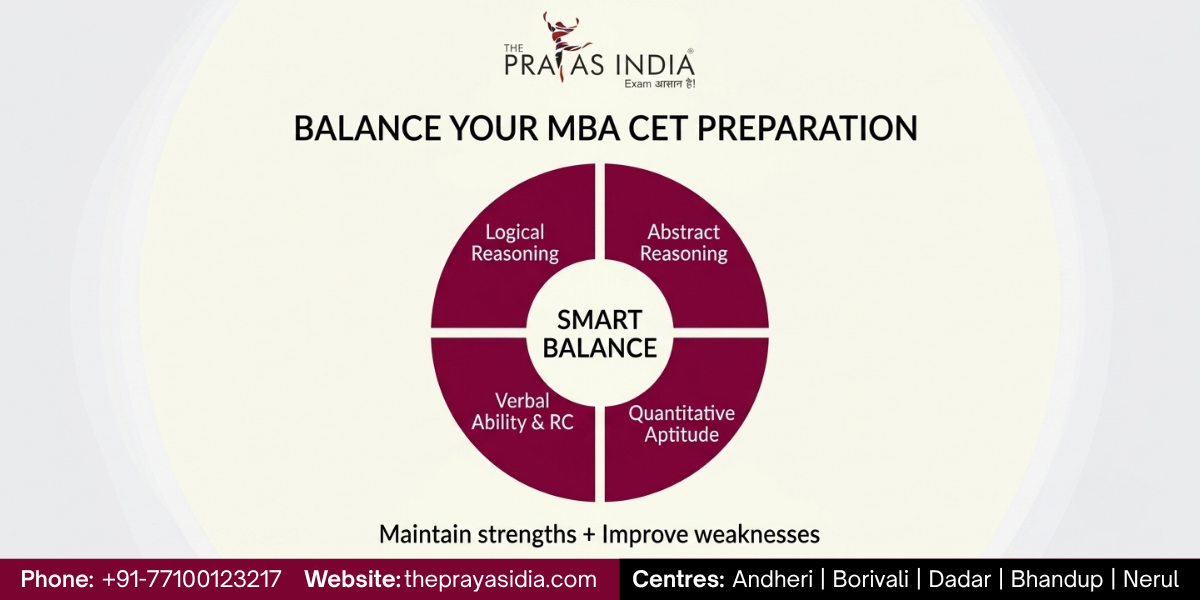
Before creating a timetable, students need to understand what each area demands from them. MBA CET preparation broadly involves Logical Reasoning, Abstract Reasoning, Quantitative Aptitude and Verbal Ability & Reading Comprehension.
These areas do not require exactly the same preparation style. Quantitative Aptitude is more dependent on conceptual understanding, calculation ability and repeated problem-solving. Logical Reasoning requires candidates to recognise patterns, analyse conditions and make deductions efficiently. Abstract Reasoning relies heavily on visual pattern recognition and familiarity with different question structures, while Verbal Ability and Reading Comprehension require language skills, comprehension and careful interpretation.
Because the nature of these sections differs, a single study method cannot work equally well for all of them.
A student may need several focused sessions to strengthen Quant concepts but may improve Abstract Reasoning through shorter, frequent practice. Similarly, Reading Comprehension may benefit from regular reading and timed passages rather than occasional long study sessions.
The first step towards balance, therefore, is recognising that balanced preparation does not mean identical preparation.
The Right Way to Divide Your MBA CET Study Time
One of the most common preparation mistakes is dividing study hours equally among all subjects simply because there are four areas in the examination.
Suppose an aspirant studies for four hours every day and gives exactly one hour to each section. This may appear balanced, but it ignores individual performance. If Quantitative Aptitude is a major weakness while Verbal Ability is already strong, equal allocation may not be the most efficient use of those four hours.
A better approach is to establish a base allocation for all sections and then provide additional time to weaker areas.
For example, every section can receive regular exposure during the week, while the weakest area receives extra practice blocks. As performance improves, the additional time can gradually be shifted towards another area.
This creates a flexible preparation model instead of a rigid timetable.
| Preparation Area | Main Focus | Practice Approach |
|---|---|---|
| Logical Reasoning | Logic, arrangements, decision-making | Topic practice + timed sets |
| Abstract Reasoning | Pattern recognition | Short, frequent practice |
| Quantitative Aptitude | Concepts, calculation, application | Concept study + problem solving |
| Verbal Ability & RC | Language, comprehension, accuracy | Reading + timed questions |
The table should be treated as a framework rather than a fixed daily schedule. Your actual allocation should depend on your current preparation level.
Start With a Diagnostic Assessment
Before changing your study timetable, understand where you currently stand.
A diagnostic test can be extremely useful because students often misjudge their own strengths. A candidate may feel that Quant is their weakest section because they dislike mathematics, while their actual test performance may show that their bigger problem is Logical Reasoning speed.
Similarly, someone who feels confident in English may discover that they lose marks because they rush through Reading Comprehension questions.
The purpose of an initial assessment is not to judge your preparation. It is to establish a starting point.
Record your performance in each area and look at more than the score. Analyse the number of questions attempted, accuracy, time spent and the types of questions that caused difficulty.
Once this information is available, your study plan becomes more evidence-based.
Give More Time to Weaknesses Without Ignoring Strengths
A weak section deserves attention, but it should not completely replace your stronger sections.
This is particularly important during a long preparation period. If you spend several weeks focusing almost exclusively on Quant because it is your weakest area, your Logical Reasoning or Verbal Ability performance may gradually decline due to lack of practice.
The better strategy is to maintain your strengths while repairing your weaknesses.
For instance, if Quant is currently weak, you could dedicate additional practice sessions to arithmetic and other difficult areas while continuing short daily or alternate-day sessions for Reasoning and English.
As the weak section improves, its additional time allocation can be reduced.
This approach prevents the common cycle where students repeatedly improve one section only to see another section deteriorate.
Build Your Preparation Around Priorities, Not Just Subjects
Another useful way to balance MBA CET preparation is to divide your work into three priority levels.
The first level contains topics that are weak and frequently tested or particularly important for your preparation. These deserve focused study and regular testing. The second level consists of topics where you have reasonable understanding but need more speed or accuracy. The third includes areas where you are already comfortable and mainly need maintenance through periodic revision and practice.
This system prevents students from spending hours repeatedly practising questions they already solve comfortably.
For example, if you can consistently solve basic Logical Reasoning questions accurately but struggle with complex arrangements, spending another hour on easy questions may have limited value. That time could be used to understand the more difficult question structure and then practise it under a time limit.
The idea is simple: your preparation time should be proportional to your learning need, not merely divided according to the syllabus.
Quantitative Aptitude Needs Consistent Attention
Quantitative Aptitude can become difficult to manage when students postpone it.
Unlike some areas where short bursts of practice can maintain familiarity, Quant often requires regular problem-solving to keep methods and calculations active. If a student studies Quant intensely for a few days and then ignores it for a week, the next session may begin with unnecessary revision.
A more sustainable approach is to maintain frequent contact with the subject.
You do not necessarily need to spend several hours on Quant every day. Short conceptual revision followed by targeted problem-solving can be effective when done consistently. As the examination approaches, these sessions can gradually become more time-bound.
Students should also distinguish between conceptual weakness and calculation weakness. If you understand the method but take too long to complete calculations, your preparation should focus on speed and practice. If you do not understand why the method works, additional timed practice alone will not solve the problem.
This distinction helps you use your study time more intelligently.
Logical Reasoning Requires Variety
Logical Reasoning preparation should expose you to different question structures rather than repeatedly solving the same familiar format.
The benefit of variety is that MBA CET requires candidates to recognise the nature of a question quickly. The faster you can identify what kind of reasoning is required, the sooner you can decide whether to attempt it and which approach to use.
During preparation, alternate between individual reasoning questions and larger sets. Individual questions can help strengthen specific concepts, while sets can develop the ability to process multiple conditions under time pressure.
As your preparation progresses, introduce mixed practice rather than informing yourself beforehand about the topic of every question. This makes your practice closer to the decision-making environment of the actual examination.
Abstract Reasoning Should Not Be Left for the End
Abstract Reasoning is sometimes underestimated because students assume that pattern-based questions can be prepared quickly.
While familiarity can certainly improve performance, students still need enough exposure to recognise common patterns without spending excessive time analysing every option.
Regular short practice sessions can work well here.
Instead of keeping Abstract Reasoning for one long weekly session, include smaller sets throughout your preparation schedule. This allows your visual pattern-recognition skills to develop gradually.
You should also maintain a record of the patterns or question structures that repeatedly cause difficulty. Revisiting these later can be more useful than simply solving a large number of random questions.
Keep Verbal Ability and Reading Active
English preparation can suffer when students assume that good language skills require little maintenance.
Reading comprehension, vocabulary and verbal reasoning improve through consistent exposure. A student who understands English well may still lose marks by reading too quickly, overlooking qualifiers in a passage or spending too much time between two similar options.
Regular reading can help improve familiarity with different writing styles and subjects. Alongside this, timed RC practice can help students develop the ability to comprehend information without repeatedly rereading the same paragraph.
Vocabulary and grammar work should also be incorporated according to individual needs. Students who already have strong language fundamentals can devote more time to speed and question selection, while students with weaker fundamentals may require more structured revision.
Admission-Focused Preparation: Think Beyond the Exam
MBA CET preparation should ultimately connect with the larger objective of securing admission to a suitable management institute.
A percentile is not an isolated number. It can influence the range of colleges and programmes that become accessible during the admission process. This makes it important for aspirants to approach preparation with a clear understanding of their academic goals.
Students should identify the types of MBA programmes they are interested in and understand the role their entrance examination performance can play in the admission journey.
This does not mean becoming anxious about college outcomes during every study session. Instead, the admission objective should provide direction. If your target is a highly competitive management programme, your preparation strategy should reflect the level of performance you are aiming for.
A structured MBA CET coaching in Mumbai programme can help students connect examination preparation with this broader objective by providing guidance on preparation strategy, mock performance and areas that require improvement.
Don’t Let One Section Control Your Preparation
One of the most important principles of balanced preparation is avoiding emotional decision-making.
Students naturally prefer subjects in which they perform well. Solving questions correctly creates confidence, so it becomes tempting to spend more time on those sections.
The opposite can also happen. If a student fears Quantitative Aptitude, they may repeatedly avoid it and spend more time on comfortable subjects.
Neither approach is ideal.
Your study plan should be based on performance data rather than preference alone.
You should be able to say, “This section needs more time because my accuracy is low,” rather than, “I will study this section because I like it.”
That small shift can make preparation much more objective.
Key Takeaway
Balancing all sections in MBA CET preparation does not mean dividing your study hours into four identical blocks. It means creating a flexible system where every section receives regular attention while weaker areas receive additional focused practice.
The most effective preparation begins with a diagnostic assessment, followed by a realistic study allocation based on individual performance. Quantitative Aptitude, Logical Reasoning, Abstract Reasoning and Verbal Ability & Reading Comprehension each require a somewhat different approach, so students should avoid forcing every subject into the same preparation method.
For aspirants targeting MBA admissions through MAH MBA CET, this balance becomes even more important. A strong overall performance can expand the range of admission opportunities, but achieving that performance requires consistency across the preparation journey.
The role of structured MBA CET coaching in Mumbai can be particularly useful for students who need help creating a roadmap, maintaining practice discipline and understanding where their preparation needs improvement. However, coaching works best when combined with regular self-study and honest performance analysis.
Move From Topic-Wise Practice to Mixed Practice
Early in preparation, topic-wise practice is useful because it helps students understand individual concepts and question types. However, continuing with only topic-wise questions for too long can create a false sense of confidence.
In an actual MBA CET paper, you are not told what type of question is coming next. You have to recognise it yourself, decide whether it deserves your time and then solve it under pressure. Mixed practice gradually develops this decision-making ability.
Once the basics of a section are reasonably strong, start combining different topics in the same practice session. Instead of solving twenty questions from one chapter, create a set that contains multiple concepts.
This change may initially reduce your accuracy or increase your solving time. That is normal. The purpose is to make your preparation increasingly similar to the real examination environment.
Mixed practice also reveals an important difference between knowing a method and recognising when to use it. This distinction becomes increasingly valuable when the examination demands quick decisions.
Use Sectional Tests to Measure Individual Performance
Full-length mocks are important, but they should not be the only form of testing.
Sectional tests allow students to isolate one area and understand its performance more clearly. If your overall mock score falls, it may not immediately tell you whether the problem is Quantitative Aptitude, Logical Reasoning, Abstract Reasoning or Verbal Ability.
A sectional test provides more focused information.
For example, if your Logical Reasoning accuracy is consistently high but your average time per question is excessive, your problem is not necessarily conceptual. You may need to work on question selection and solving efficiency.
Similarly, if Quantitative Aptitude accuracy remains low even when sufficient time is available, additional conceptual work may be required before increasing speed.
This is why tests should be used as diagnostic tools rather than simply score-generating exercises.
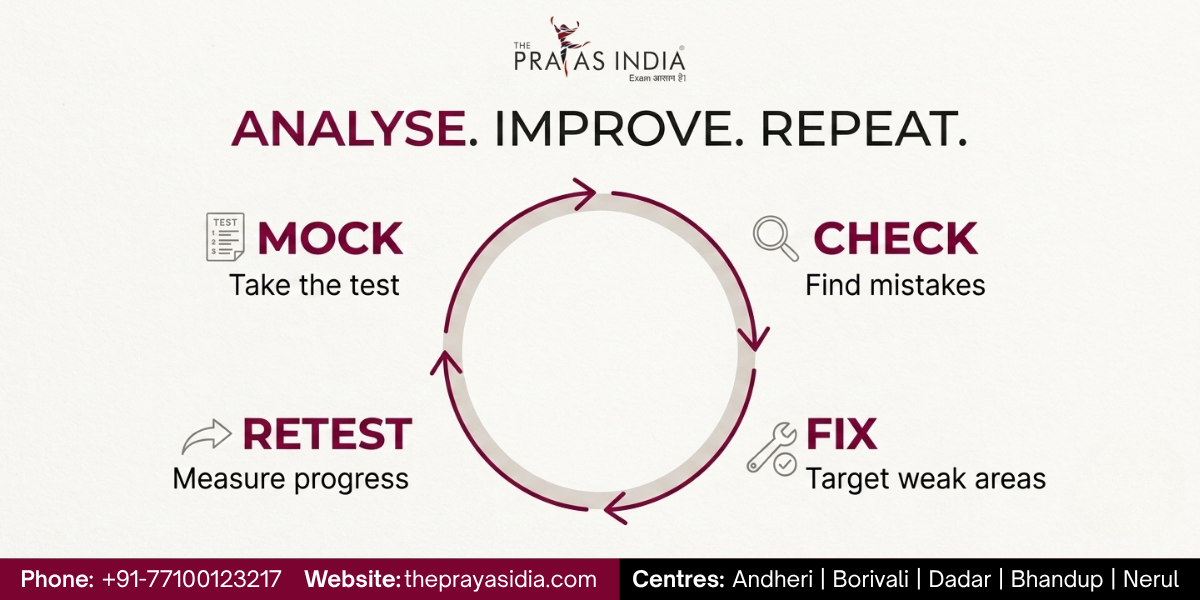
Analyse Every Mock With a Fixed Framework
A mock test is incomplete until it has been analysed.
Students often spend considerable time taking a test and then immediately move on to the next one after checking the score. This misses one of the biggest advantages of mock testing: discovering patterns in your mistakes.
Create a consistent analysis framework and use it after every test.
| Area to Analyse | Question to Ask |
|---|---|
| Accuracy | Where am I making repeated mistakes? |
| Speed | Which questions are taking too long? |
| Selection | Which questions should I have skipped? |
| Concepts | Which topics need revision? |
| Guesswork | Which attempts were unnecessarily risky? |
| Strategy | Did my attempt order work effectively? |
Over several tests, these observations become more useful than any individual score. You may discover that your mistakes are concentrated around a few recurring topics or that your score falls because you spend too much time on difficult questions.
Once the pattern becomes visible, your preparation can become much more targeted.
Adjust Your Study Plan as the Exam Approaches
A preparation timetable that works several months before the examination may not be appropriate during the final few weeks.
In the early phase, students generally need more time for concept building and topic-wise practice. As preparation progresses, the proportion of timed practice, sectional tests and full-length mocks should increase.
This does not mean abandoning concepts completely. Weak concepts still need attention, but the method of preparation changes.
A practical progression can look like this:
Foundation Phase: Concept learning + basic practice
Development Phase: Mixed practice + sectional tests
Performance Phase: Full-length mocks + detailed analysis
Final Phase: Revision + strategic testing + weak-area correction
This gradual transition helps students avoid the common mistake of taking too many mocks before they have enough conceptual preparation to learn from those mocks.
Don’t Try to Improve Everything at Once
One of the biggest problems with performance analysis is identifying too many weaknesses simultaneously.
After a mock, a student may discover problems in calculation speed, RC accuracy, puzzles, vocabulary, arithmetic and abstract reasoning. Trying to fix everything in the same week can make the preparation schedule unrealistic.
Instead, prioritise.
Select two or three areas that can produce meaningful improvement and work on them systematically. Once performance stabilises, move to the next set of weaknesses.
This approach creates a more manageable improvement cycle.
For example, if Quantitative Aptitude is consuming excessive time and Logical Reasoning accuracy is also low, prioritise these areas while maintaining shorter sessions for English and Abstract Reasoning. Once the major issues improve, redistribute your time.
The objective is not to create a perfect preparation plan on paper. It is to create a plan that you can actually follow and measure.
Maintain a Separate Error Log
An error log can become one of the most valuable resources during MBA CET preparation.
Instead of simply marking an answer wrong and moving forward, record the reason behind the error. Was it a conceptual mistake, calculation error, misreading, poor question selection or lack of time?
Over time, this record can reveal patterns.
If the same type of error appears repeatedly, it indicates that the issue has not been fully addressed. Revisiting the error log before a mock or revision session can therefore be more productive than randomly solving another large question set.
Keep the error log concise. The purpose is not to reproduce entire questions but to capture the lesson behind the mistake.
Balance Speed With Accuracy
MBA CET preparation requires speed, but speed without accuracy can become counterproductive.
Students sometimes attempt to increase their solving rate by rushing through questions. This can create calculation mistakes, misreading and incorrect assumptions.
A better approach is to improve speed gradually while protecting accuracy.
Begin by developing a reliable solving method. Once accuracy becomes stable, introduce time limits. Then gradually reduce the time available for similar question sets.
This creates a more sustainable progression:
Accuracy → Efficiency → Speed
The sequence matters. If you try to build speed before understanding the correct approach, you may simply become faster at making mistakes.
Develop a Question Selection Strategy
Balancing sections is closely connected with question selection.
The ability to recognise an easy question quickly can be as useful as the ability to solve a difficult question. During preparation, students should therefore practise identifying questions according to their likely effort and reward.
A question may look familiar but still require too many calculations. Another may appear difficult but become straightforward once the correct pattern is recognised.
Mock tests provide an opportunity to experiment with these decisions.
Try different approaches and analyse the outcome. Did starting with familiar questions improve your score? Did spending more time on one section reduce your performance elsewhere? Did skipping lengthy questions give you more opportunities to attempt easier ones?
These observations help build a personal examination strategy instead of relying on generic advice.

Build a Final-Phase Routine That You Can Sustain
The final stage of preparation can become stressful because students often attempt to increase their study hours dramatically. However, longer study hours do not automatically translate into better performance.
A sustainable final-phase routine should protect revision, testing and recovery.
Students should know what they intend to study before beginning a session rather than spending the first few minutes deciding what to do. This reduces wasted time and makes the day easier to manage.
A practical routine can include a focused concept or revision session, a timed practice block, sectional or mock testing on selected days and a dedicated analysis period.
The exact schedule will depend on the student’s availability, but the principle remains the same: every study day should have a clear purpose.
Avoid Burnout While Preparing for MBA CET
Preparation becomes less effective when students remain in a constant state of pressure.
Long study sessions without adequate breaks can reduce concentration. Repeatedly taking mocks without analysing them can create frustration. Comparing your scores with other aspirants after every test can also make the preparation unnecessarily stressful.
A better approach is to focus on your own improvement trajectory.
There will be days when your mock score drops. There may be topics that take longer than expected to master. These fluctuations are part of competitive exam preparation.
The important question is whether your overall performance is improving over time.
Consistent preparation, proper sleep, reasonable breaks and realistic daily targets can help maintain concentration over the long term.
Connecting MBA CET Preparation With MBA Admissions
For an aspirant, the ultimate purpose of preparing for MBA CET is not simply to obtain a score. The larger objective is to create opportunities for admission to a suitable management programme.
This is why students should understand their target colleges and the level of entrance performance they are aiming for.
Admission planning can give preparation greater direction. Instead of preparing without a benchmark, students can establish realistic targets and monitor whether their mock performance is moving towards them.
Aspirants should also remember that the admission journey can involve more than the entrance examination. Depending on the institute and admission process, academic background, eligibility requirements and other selection considerations may also matter.
Therefore, preparation should be serious and exam-focused while keeping the broader MBA admission objective in view.
How The Prayas India Can Support MBA CET Aspirants
A structured coaching environment can help students avoid the uncertainty that often comes with managing multiple sections independently.
At The Prayas India, students preparing for MBA CET can approach preparation through a structured framework that connects concept learning with practice and performance evaluation.
The advantage of such an approach is that students can spend less time wondering what to study next and more time working on the areas that actually require improvement.
Regular practice can help strengthen fundamentals. Sectional testing can provide a clearer understanding of individual performance. Mock tests can simulate examination pressure, while analysis can reveal where marks are being lost.
For students looking for MBA CET coaching in Mumbai, this kind of structured preparation can be particularly useful when combined with disciplined self-study.
The institute’s role is to provide direction and an organised learning environment; the student’s role is to practise consistently, analyse performance honestly and keep improving.
A Practical Weekly Balance for Serious Aspirants
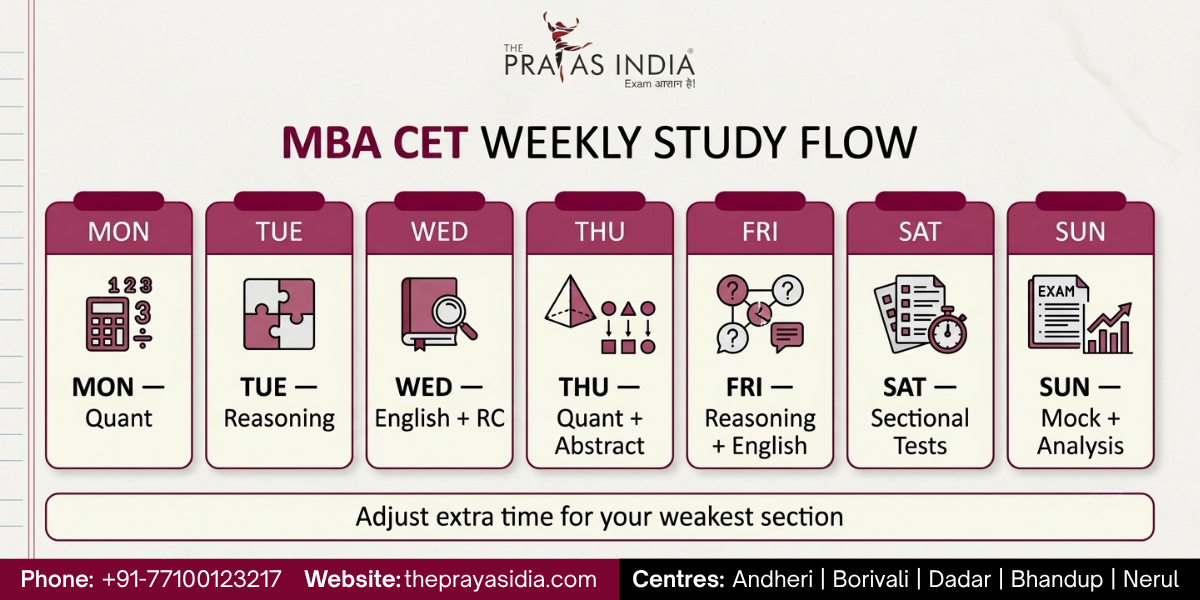
Once students have understood their strengths and weaknesses, they can create a weekly structure that keeps all four areas active.
For example, a student may dedicate the first part of the week to concept strengthening and targeted practice, use the middle of the week for mixed sectional work and reserve the weekend for testing and analysis.
The exact distribution should change according to performance.
| Day | Core Work | Additional Focus |
|---|---|---|
| Monday | Quantitative Aptitude | Short Abstract Reasoning practice |
| Tuesday | Logical Reasoning | Verbal Ability & RC |
| Wednesday | Quantitative Aptitude | Logical Reasoning sets |
| Thursday | Verbal Ability & RC | Abstract Reasoning |
| Friday | Mixed Sectional Practice | Weak-area correction |
| Saturday | Sectional Tests | Error-log revision |
| Sunday | Mock Test | Detailed performance analysis |
This structure keeps every section active without requiring equal hours every day.
The most important part is the adjustment after each assessment. If one section begins to underperform, its allocation should increase temporarily. If another section remains consistently strong, maintenance practice may be sufficient.
Contact Us
- Call Now: +91-77100 13217
- Website: theprayasindia.com
- Centres: Andheri | Borivali | Dadar | Nerul | Bhandup
Final Takeaway
Balancing all sections in MBA CET preparation is not about trying to become equally strong in everything overnight. It is about building a preparation system that prevents any section from becoming a major weakness while continuously improving your overall performance.
Aspirants should gradually move from topic-wise learning to mixed practice, sectional testing and full-length mocks. Every mock should be followed by meaningful analysis, and repeated mistakes should be addressed through targeted practice rather than simply taking more tests.
Speed should develop alongside accuracy, while question selection should become an integral part of preparation. At the same time, students should adjust their timetable as the examination approaches instead of following the same routine throughout the preparation period.
For those targeting MBA admissions through MBA CET, the preparation strategy should remain connected to the larger goal. A strong percentile can improve the range of opportunities available, but reaching that level requires consistency across all sections.
With structured guidance, disciplined self-study and regular performance analysis, aspirants can make their preparation more focused and measurable. For students seeking the Best MBA CET Coaching in Mumbai, choosing an environment that supports this complete preparation cycle can make the journey more organised and purposeful.
FAQs
1. How can I balance all sections during MBA CET preparation?
Start by giving every section regular exposure and then allocate additional time to the areas where your performance is weaker. The objective is not equal study hours but balanced overall performance.
2. Should I study all four MBA CET sections every day?
Not necessarily. Studying every section every day can make the schedule unnecessarily repetitive. A better strategy is to ensure that every section is covered consistently during the week while adjusting daily focus according to your preparation needs.
3. How often should I take MBA CET mock tests?
Mock-test frequency should increase as your preparation progresses. In the early stage, focus more on concepts and sectional practice. Later, introduce regular full-length mocks and detailed analysis.
4. Why is mock-test analysis important for MBA CET?
Mock analysis helps identify whether your problems are related to concepts, speed, accuracy, question selection or time management. This allows you to correct specific weaknesses instead of simply taking more tests.
5. How should I improve speed in MBA CET?
Build accuracy first and then introduce timed practice. Regular mixed-question sets and sectional tests can help you become more comfortable making quick decisions under time pressure.
6. Which section should I give the most time to?
The section requiring the most time depends on your individual performance. Use diagnostic tests and mock analysis to identify your weakest area, then give it additional focused practice while maintaining your stronger sections.
7. Is MBA CET coaching useful for students preparing for the exam?
Structured MBA CET coaching can help students with study planning, concept building, practice, mock testing and performance analysis. However, regular self-study and individual practice remain essential.
8. How can The Prayas India help with MBA CET preparation?
The Prayas India provides a structured preparation environment where aspirants can work on concepts, practise questions, take tests and analyse their performance. This can help students organise preparation across different MBA CET sections.
9. How should I prepare for MBA admissions along with MBA CET?
Start by understanding your target management programmes and the level of entrance performance you want to achieve. Keep your preparation focused on the examination while also remaining aware of the broader admission requirements of your preferred institutes.