How to Crack IBPS Clerk Prelims in First Attempt | Best IBPS Clerk Coaching in Mumbai | The Prayas India
Cracking IBPS Clerk Prelims in the first attempt is absolutely possible, but it requires more than simply completing the syllabus. The real challenge is learning how to combine conceptual clarity, speed, accuracy, question selection and regular practice within the limited time available in the examination. Many aspirants begin their preparation with enthusiasm but struggle later because they do not have a clear strategy for converting their study hours into actual mock-test performance.
For a first-time aspirant, this is where a structured preparation approach can make a major difference. Instead of studying every topic randomly, students need to understand the examination requirements, identify their current level and build their preparation around measurable improvement. This is also why choosing the right IBPS Clerk coaching in Mumbai can be an important decision for students who want regular guidance, practice and performance analysis.
The First Attempt Should Begin With a Strategy, Not Just a Timetable
One of the most common mistakes aspirants make is creating a timetable before understanding what the examination demands.
A timetable can tell you when to study Quantitative Aptitude, Reasoning or English. But it cannot automatically tell you how to improve your performance in those sections.
A strong first-attempt strategy should answer four basic questions:
- What topics do I need to prepare?
- Which areas are currently weak?
- How much time should I dedicate to each section?
- How will I measure whether I am actually improving?
Once these questions are answered, the timetable becomes much more useful.
The objective should not be to create the most complicated schedule. It should be to create a routine that can be followed consistently and adjusted when your performance changes.
Understand What IBPS Clerk Prelims Demands
IBPS Clerk Prelims is a speed-oriented examination. Aspirants have to deal with multiple sections within a limited time, which means knowing the concepts is only one part of preparation.
You also need to be able to recognise familiar question patterns quickly, avoid unnecessary calculations, select questions intelligently and maintain accuracy when working under pressure.
This is why students who prepare only through theory can find the transition to mock tests difficult.
A candidate may understand a particular concept while studying without time pressure but struggle to apply it quickly during an actual test.
The preparation therefore needs to move through three broad stages:
Understand → Practise → Perform
Understanding creates the foundation.
Practice develops familiarity.
Performance is built through timed tests and analysis.
The Three Core Sections Need Different Strategies
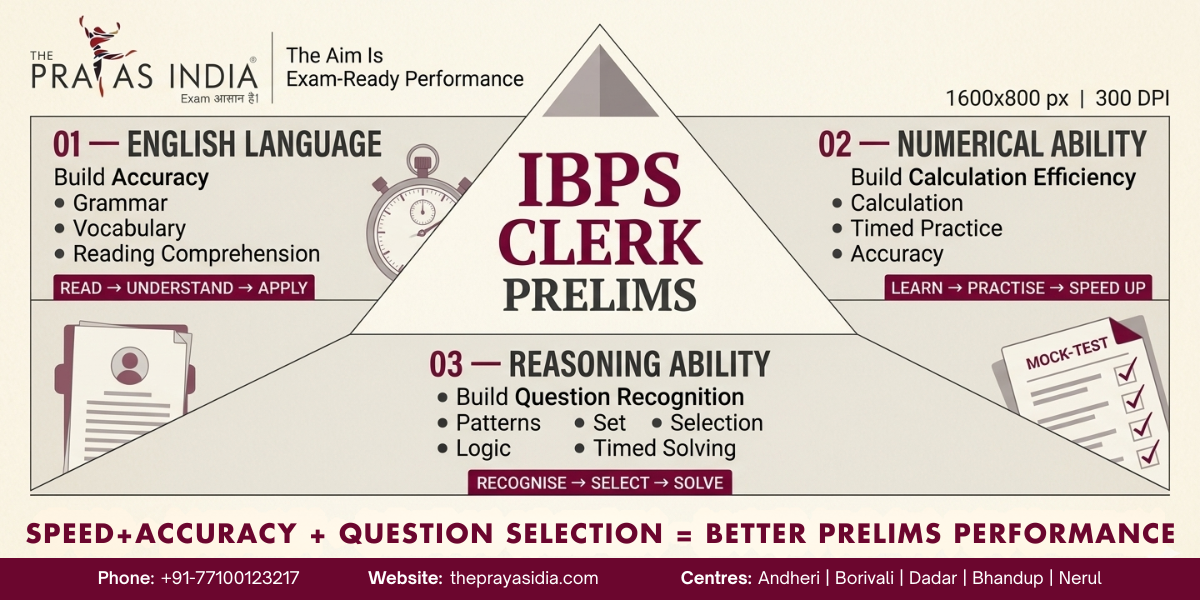
IBPS Clerk Prelims preparation generally revolves around English Language, Numerical Ability and Reasoning Ability.
Although all three sections contribute to the overall performance, they should not necessarily be prepared in exactly the same way.
English preparation requires a combination of grammar, vocabulary, reading ability and question practice.
Numerical Ability requires conceptual understanding, calculation efficiency and familiarity with different question types.
Reasoning requires logical understanding, pattern recognition and the ability to make quick decisions about which questions to attempt first.
This means a single study method for all three sections is unlikely to be equally effective.
A personalised preparation strategy becomes particularly useful here.
English: Build Accuracy Before Chasing Speed
For many aspirants, English can become a scoring section when preparation is systematic.
Instead of trying to memorise everything at once, students should build familiarity with commonly tested concepts and question patterns.
Regular reading can improve comprehension, while targeted grammar practice can help reduce avoidable mistakes.
The important thing is consistency.
A student who studies English for a few hours once a week may not see the same benefit as someone who spends a manageable amount of time practising it regularly.
A practical routine can include:
- Grammar concept revision
- Vocabulary development
- Reading practice
- Topic-wise questions
- Error analysis
- Sectional tests
The focus should gradually move from understanding the rules to applying them quickly and accurately.
Numerical Ability: Concepts Alone Are Not Enough
Numerical Ability can become challenging when students know the formulas but cannot apply them efficiently under time pressure.
This is why calculation practice should become part of regular preparation.
The student should gradually develop familiarity with important areas and learn to recognise which approach is most efficient for a particular question.
At the same time, blindly increasing calculation speed can be counterproductive if it causes accuracy to fall.
A better approach is:
Concept clarity → Basic practice → Timed practice → Error analysis → Retest
If a student repeatedly makes calculation mistakes, that pattern needs to be addressed separately.
If the problem is spending too much time on a particular question type, question selection and timed practice may be more important.
Reasoning: Learn to Recognise Patterns Quickly
Reasoning preparation is not simply about solving a large number of questions.
With practice, students need to become familiar with common patterns and develop the ability to decide quickly whether a question is worth attempting immediately.
This becomes particularly important in timed tests.
A student may eventually know how to solve a question but still lose valuable time if they spend too long identifying the approach.
Regular topic-wise practice followed by timed sets can help develop familiarity.
The preparation should gradually move from:
“How do I solve this?”
to:
“How quickly can I recognise and solve this?”
That transition is an important part of first-attempt preparation.
Your First Goal Should Be Consistency
Many aspirants begin preparation with extremely ambitious targets.
They may plan to study for eight or ten hours every day, complete multiple topics and take frequent tests from the beginning.
The problem is that such routines can become difficult to maintain.
For first-attempt candidates, consistency is often more valuable than occasional intense study sessions.
A realistic preparation routine should leave sufficient time for:
Learning
Practice
Revision
Testing
Analysis
If one of these elements is continuously ignored, preparation can become unbalanced.
Don’t Measure Preparation Only by Study Hours
Studying for six hours does not automatically mean that six hours of useful preparation has happened.
A more meaningful approach is to track outcomes.
Instead of saying:
“I studied Quant for three hours.”
ask:
“What did I improve in those three hours?”
Perhaps you completed a weak topic, improved calculation speed, solved a targeted question set or analysed mistakes from your previous test.
These are measurable outcomes.
This shift from time-based preparation to performance-based preparation can help aspirants use their study hours more effectively.
Why First-Time Aspirants Often Need Structured Guidance
Students preparing for the first time may not always know whether their preparation strategy is working.
They may complete topics without understanding their actual level.
They may take mock tests without analysing mistakes.
They may spend excessive time on one subject because it feels comfortable.
They may keep changing books, teachers or online resources.
These problems are not necessarily caused by a lack of effort.
Often, they are caused by a lack of feedback.
A structured coaching environment can provide that feedback through regular classes, practice, tests and guidance.
For students considering the best IBPS Clerk coaching in Mumbai, this is an important factor to evaluate before taking admission.
What a Good IBPS Clerk Coaching System Should Provide
Choosing coaching should not be based only on the number of lectures or the amount of study material provided.
A serious aspirant should look at the complete preparation ecosystem.
Important factors include:
- Experienced and approachable faculty
- Structured topic-wise teaching
- Relevant practice material
- Regular sectional and full-length tests
- Doubt-solving support
- Mock-test analysis
- Performance feedback
- Revision support
- Mentorship and preparation guidance
The purpose of coaching should be to make the student’s preparation more organised and measurable.
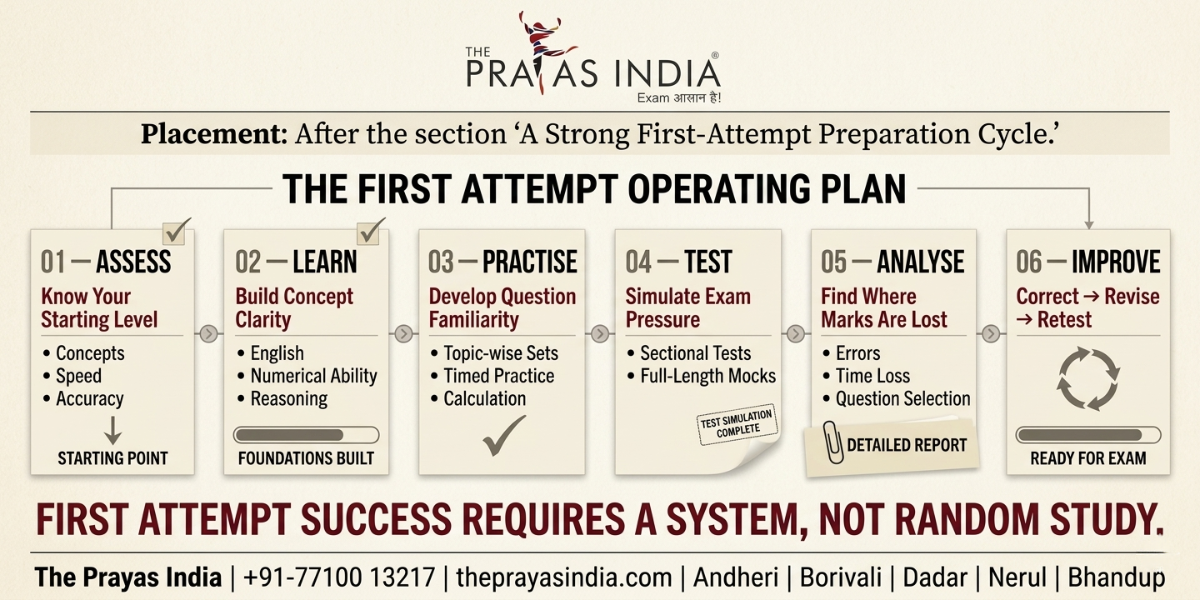
A Strong First-Attempt Preparation Cycle
The preparation process can be viewed as a continuous cycle rather than a straight line.
First, learn the concept.
Then practise it.
Then test yourself.
After the test, identify mistakes.
Work on those mistakes.
Test yourself again.
This creates a simple but powerful process:
LEARN → PRACTISE → TEST → ANALYSE → CORRECT → RETEST
The cycle should continue throughout preparation.
A student who follows this process consistently is more likely to understand not only what they know, but also what they still need to improve.
Mastering the Three Sections of IBPS Clerk Prelims
Once the basic preparation framework is in place, the next challenge is to understand how to prepare each section differently. IBPS Clerk Prelims is not an examination where one preparation method works equally well for English Language, Numerical Ability and Reasoning Ability.
A student may be naturally comfortable with one section and struggle with another. That is why first-attempt preparation should focus not only on completing the syllabus but also on developing the right combination of speed, accuracy and question-selection ability for each section.
The goal is simple: by the time you begin taking regular mocks, each section should have a clear preparation strategy behind it.
English Language: Turn Familiarity Into Accuracy
English can become a scoring section when preparation is consistent and question patterns become familiar.
However, many aspirants make the mistake of treating English preparation as a vocabulary-only exercise. Knowing more words is useful, but IBPS Clerk preparation also requires understanding grammar, comprehension and the way questions are framed.
A student preparing for the first attempt should gradually develop three abilities:
Understand the rule → Recognise the question → Apply it quickly
Regular reading can support comprehension, while focused grammar practice can reduce avoidable errors. At the same time, solving questions under a time limit helps students understand how quickly they can work without sacrificing accuracy.
A practical English preparation routine can include:
- Daily reading practice
- Grammar revision
- Vocabulary building
- Topic-wise question sets
- Reading comprehension practice
- Error identification
- Regular sectional tests
The important part is not completing a huge number of questions in one sitting. It is learning from the questions you get wrong and understanding why the mistake happened.
Don’t Ignore Reading Ability
Many students concentrate heavily on grammar and vocabulary while giving less attention to reading.
That can become a problem because comprehension-based questions require more than knowing individual words. Students need to understand the passage, identify relevant information and avoid spending excessive time on one question.
Regular reading can gradually improve familiarity with sentence structures and help students process information more efficiently.
The objective is not to read for hours.
It is to build a habit that improves comprehension, familiarity and confidence over time.
Numerical Ability: Build Calculation Confidence
Numerical Ability is often where the difference between knowing a concept and performing under examination conditions becomes visible.
A student may understand percentages, averages, ratios or other important concepts during practice but still take too long to solve questions in a timed test.
This is why numerical preparation needs two parallel tracks:
Conceptual clarity + Calculation efficiency
First, understand the method.
Then practise different question types.
After that, introduce time pressure.
Finally, analyse the mistakes.
This progression helps prevent students from rushing into speed practice before their fundamentals are ready.
Accuracy Should Come Before Extreme Speed
One common mistake is trying to increase the number of questions attempted immediately.
Suppose a student normally solves 15 questions accurately but starts rushing to attempt 20. If the additional attempts create several incorrect answers, the strategy may not actually improve the score.
A better approach is to increase speed gradually while monitoring accuracy.
The preparation can move through:
Comfortable solving → Timed solving → Faster solving → Exam-level execution
This allows speed to develop without unnecessarily damaging accuracy.
Calculation Practice Can Save Valuable Time
In a speed-based banking examination, unnecessary calculation time can affect the number of questions you are able to attempt.
Students should therefore work on becoming comfortable with calculations that repeatedly appear during practice.
The focus should not be on memorising random tricks.
It should be on developing familiarity with calculations and learning when a particular method is efficient.
Regular short calculation sessions can be more practical than occasionally spending several hours on calculation practice.
For example, a student can include a focused calculation session as part of the daily routine and gradually increase the difficulty.
Reasoning Ability: Develop Recognition, Not Just Solving Skills
Reasoning preparation becomes significantly more effective when students learn to recognise patterns quickly.
Initially, a student may look at a question and ask:
“How do I solve this?”
With consistent practice, the objective is to reach:
“I recognise this type of question. I know the approach.”
That familiarity can save valuable time.
Reasoning preparation should therefore include regular exposure to different question types along with timed practice.
Students should also learn to distinguish between questions that can be solved quickly and questions that are likely to consume too much time.
Question Selection Is a Skill
One of the most overlooked aspects of IBPS Clerk Prelims preparation is question selection.
In a timed examination, attempting every question in the order presented is not necessarily the best approach.
You need to identify questions that offer a reasonable return for the time invested.
For example, if a question is taking significantly longer than expected, continuing to struggle with it may prevent you from reaching several easier questions later.
This is why mock tests are important.
They allow students to experiment with different approaches and understand which question-selection strategy works best for them.
Sectional Preparation Should Eventually Become Integrated
During the early stages of preparation, studying subjects separately makes sense.
You may spend a session learning English grammar, another working on numerical concepts and another practising reasoning.
But eventually, preparation needs to resemble the actual examination environment.
That means students should gradually introduce:
- Sectional tests
- Timed practice
- Mixed question sets
- Full-length mocks
- Performance analysis
This transition is important because solving questions individually is very different from solving them while managing multiple sections and a fixed time limit.
Your Strongest Section Can Become Your Score Anchor
Every aspirant does not need to have identical performance across all three sections.
If English is your strongest section, the objective should be to make it highly reliable.
If Reasoning is strong, you should aim to maximise accuracy while maintaining speed.
If Numerical Ability is currently weak, more preparation time may need to be allocated there.
This is where a personalised strategy becomes important.
Instead of trying to improve everything equally, students can identify:
Strong Section → Maintain and maximise
Average Section → Stabilise and improve
Weak Section → Strengthen systematically
This approach can make preparation more efficient.
Don’t Let One Weak Section Control Your Entire Preparation
A weak section should receive attention, but it should not automatically consume all your preparation time.
Suppose an aspirant struggles with Numerical Ability but is already performing strongly in English and Reasoning.
Spending nearly the entire day on Quantitative Aptitude could cause the stronger sections to decline.
A better strategy is to create a balance where the weak section receives additional attention while stronger sections are maintained through regular practice.
The objective is to build a balanced Prelims performance, not simply one excellent section.
Coaching Can Help Bring Section-Wise Preparation Together
Self-study can certainly work for disciplined aspirants, but first-time candidates may sometimes struggle to determine how much attention each section requires.
A structured coaching environment can provide a framework through classes, practice sets, tests and feedback.
For students searching for IBPS Clerk coaching in Mumbai, this becomes an important factor when comparing institutes.
The question should not simply be:
“How many classes will I get?”
It should also be:
“How will the institute help me improve my actual examination performance?”
That includes understanding whether the coaching provides section-wise practice, regular testing, doubt support and performance analysis.
What a First-Attempt Aspirant Should Track
Instead of simply tracking how many chapters have been completed, maintain a simple performance record.
Track:
- Section-wise mock scores
- Accuracy percentage
- Average time spent
- Frequently repeated mistakes
- Weak topics
- Strong topics
- Questions left unattempted
- Improvement between tests
This information can help you identify whether your preparation is moving in the right direction.
A student who tracks performance can make more informed decisions than one who relies only on the feeling that they are “studying enough.”
The Aim Is Exam-Ready Performance
Ultimately, IBPS Clerk Prelims preparation should lead towards one outcome: being able to perform under actual examination conditions.
That means knowing the concepts is important.
But so are:
Speed
Accuracy
Question selection
Time management
Mental control
Consistency
The earlier these elements become part of preparation, the easier it becomes to identify and correct problems before the examination.
The Right Preparation Strategy Changes With Your Performance
There is no guarantee that the same study plan will work equally well for every aspirant.
As preparation progresses, your performance will reveal new information.
You may discover that English requires less daily time than expected.
You may realise that calculation speed is affecting Numerical Ability.
You may find that your Reasoning accuracy is strong but question selection needs improvement.
These observations should influence the next stage of preparation.
That is why the best strategy is not necessarily the most complicated one.
It is the one that responds to your actual performance.
A Structured Approach Can Reduce Preparation Confusion
First-time aspirants often have access to more resources than they can realistically use.
Different books, online classes, test series, preparation videos and advice from other candidates can make it difficult to decide what deserves attention.
A structured coaching programme can help bring these elements together.
The student can focus on learning from selected resources, practising relevant questions and using mock tests to measure progress instead of constantly searching for something new.
This can be particularly useful for aspirants who are preparing for the IBPS Clerk exam for the first time and want a clear preparation path.
Mock Tests, Speed and Accuracy: Turning Preparation Into Performance
Knowing the syllabus and practising individual questions gives you the foundation, but mock tests are where IBPS Clerk Prelims preparation starts becoming exam-oriented.
Many aspirants take mocks regularly but still struggle to improve their scores. The problem is often not the number of tests. It is the way those tests are attempted and analysed.
A mock test should answer more than “How many marks did I score?”
It should tell you:
- Where did I lose marks?
- Which questions consumed too much time?
- Which mistakes were avoidable?
- Which section needs more attention?
- Did my attempt strategy work?
- What should I change before the next test?
For a first-attempt aspirant, developing this habit early can make mock tests one of the most valuable parts of preparation.
Don’t Wait Until the End of Preparation to Start Testing
Some students postpone mock tests because they believe they should first complete the entire syllabus.
This approach can create problems.
If you wait until the syllabus is finished, you may discover too late that your speed is low, your accuracy is inconsistent or your question-selection strategy does not work under time pressure.
Testing should therefore begin progressively.
During the early stage, topic-wise and sectional tests can help establish familiarity.
As preparation improves, students can introduce more timed sectional tests.
Eventually, full-length mocks should become a regular part of the preparation routine.
The progression can look like:
Topic Tests → Sectional Tests → Timed Practice → Full-Length Mocks → Exam Simulation
Speed and Accuracy Must Improve Together
Speed is important in IBPS Clerk Prelims, but increasing speed at the cost of accuracy can be counterproductive.
Imagine two aspirants.
Aspirant A attempts more questions but makes several avoidable errors.
Aspirant B attempts slightly fewer questions but maintains much stronger accuracy.
Simply comparing their attempt counts does not tell you who is performing better.
This is why your preparation should focus on efficient solving, not merely faster solving.
Efficient solving means:
Recognise the question → Select the right approach → Solve accurately → Move on
The objective is to avoid spending unnecessary time on questions that do not offer enough value.
Learn to Identify Time-Wasting Questions
One of the most important skills developed through mock tests is recognising when a question is taking too long.
During practice, students often continue working on a difficult question because they have already invested time in it.
In an actual examination, this can become costly.
If a question is consuming significantly more time than expected, you should be able to evaluate whether continuing is sensible.
This is especially important when there are several other questions available that may be easier to solve.
Mock tests give you an opportunity to identify these habits before the actual examination.
Your Attempt Strategy Should Be Tested, Not Assumed
There is no universal attempt order that every student must follow.
Some aspirants may be more comfortable beginning with English.
Others may perform better when they start with Reasoning.
Another student may prefer to begin with the section in which they have the highest confidence.
The important thing is to test different approaches during mocks.
For example, you can compare:
Strategy A: Strongest section first
Strategy B: English first
Strategy C: Reasoning first
Strategy D: Section order based on mock difficulty
After several tests, your performance data can reveal which approach gives you the best combination of confidence, speed and accuracy.
This is much more reliable than blindly following someone else’s strategy.
Mock Analysis Is More Important Than Mock Count
Taking 30 mocks does not automatically make you better prepared than someone who takes 15.
The difference often lies in what happens after the test.
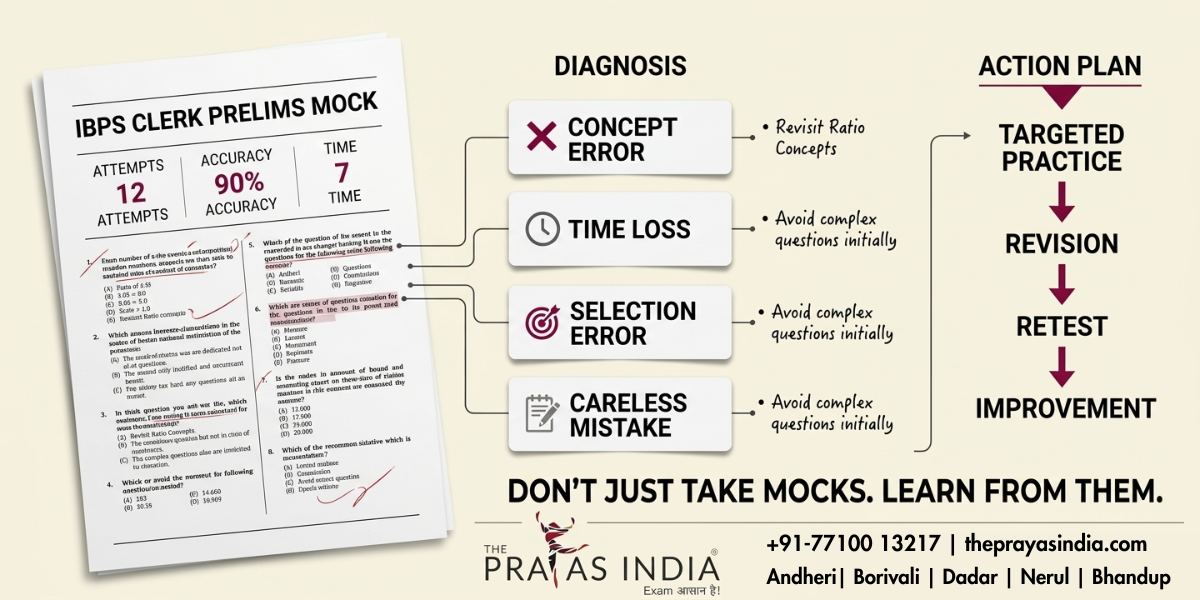
A useful mock-analysis process should separate mistakes into categories.
Conceptual Errors
You didn’t understand the underlying concept.
Application Errors
You knew the concept but applied it incorrectly.
Calculation Errors
The method was correct but the calculation went wrong.
Reading Errors
The question was misunderstood or read too quickly.
Time-Management Errors
Too much time was spent on a particular question or section.
Selection Errors
A difficult question was attempted when a better opportunity was available.
This classification makes the analysis more useful because each problem requires a different solution.
Maintain an Error Log
One simple habit can significantly improve mock analysis: maintain an error log.
Whenever you make an important mistake, record:
Question type → Mistake → Reason → Correct approach → Action required
For example, instead of simply writing:
“Wrong percentage question.”
write:
“Percentage calculation — rushed calculation — revise method and practise 20 timed questions.”
This turns an incorrect answer into a specific learning task.
Over time, your error log can reveal patterns.
If the same type of mistake appears repeatedly, it deserves immediate attention.
Accuracy Should Be Measured Section-Wise
An overall accuracy percentage can be useful, but section-wise analysis can tell you much more.
Suppose your overall accuracy looks acceptable, but your Numerical Ability accuracy is significantly lower than English and Reasoning.
That suggests a different preparation requirement.
Similarly, if your accuracy is strong but your attempts are low, your problem may be speed or question selection rather than conceptual understanding.
This is why students should track both:
How many questions did I attempt?
and
How many of those attempts were correct?
Both numbers matter.
Improve Speed Through Targeted Practice
Telling yourself to “solve faster” is not a strategy.
Speed improves when the causes of slow performance are identified.
If calculations are slow, work on calculations.
If you take too long to understand questions, practise reading and interpretation.
If you struggle to recognise patterns, increase exposure to that question type.
If you spend too much time deciding whether to attempt a question, practise question-selection under timed conditions.
The goal is to remove specific sources of wasted time.
Short Timed Sets Can Be Extremely Useful
Full-length mocks are important, but they should not be the only timed practice you do.
Short timed sets can help you isolate individual skills.
For example, you can practise:
- A short Numerical Ability calculation set
- A timed Reasoning set
- An English comprehension exercise
- A mixed set of previously weak questions
- A question-selection drill
Because the time window is short, these exercises can be repeated regularly without consuming the time required for a complete mock.
They can be especially useful when you are trying to correct one specific weakness.
Don’t Ignore Easy Questions
One of the biggest benefits of improving question selection is learning to recognise opportunities.
In a competitive examination, you do not necessarily need to prove that you can solve the hardest question.
You need to maximise your performance within the available time.
If an easy or moderate question is available, spending excessive time on a difficult question can be a poor trade-off.
This is why smart preparation focuses on score efficiency, not simply question difficulty.
The Final Weeks Should Look Different From the Initial Weeks
As the examination approaches, preparation should gradually become more performance-oriented.
During the early phase, concept learning may dominate.
Later, practice and sectional testing should become more prominent.
In the final phase, students should increasingly focus on:
Full-length mocks
Revision
Error correction
Time management
Accuracy
Question selection
The objective is to make the transition from preparation mode to examination mode as smooth as possible.
A Mentor Can Make Mock Analysis More Objective
Self-analysis is useful, but students can sometimes misinterpret their own performance.
For example, an aspirant may assume:
“My Quant score is low, so I need to study more Quant.”
But detailed analysis might show that the actual issue is not conceptual weakness. It could be that the student spends too much time on lengthy questions.
Similarly, a student may believe that their English is strong because their accuracy is high, while their attempt count remains too low.
A mentor can provide an external perspective and help distinguish between these situations.
This is one of the areas where structured IBPS Clerk coaching in Mumbai can add value for first-time aspirants.
Use Every Mock to Create One Clear Improvement Target
You do not need to fix everything after every test.
Trying to correct ten different problems simultaneously can make preparation overwhelming.
Instead, identify one or two high-impact areas.
For example:
Mock 1: Reduce calculation errors.
Mock 2: Improve question selection.
Mock 3: Reduce time spent on difficult Reasoning questions.
Mock 4: Improve English attempt rate.
This makes improvement more measurable.
The next mock then becomes a test of whether the correction worked.
The First-Attempt Mindset: Improve Before You Compete
The goal of mock tests is not to prove that you are already ready.
Early mocks may produce disappointing scores.
That is normal.
A low score can be useful if it shows you exactly what needs to change.
The important thing is to avoid emotionally judging your preparation after every test.
Instead ask:
What did this test teach me?
That question keeps the focus on improvement.
Why Structured Coaching Can Accelerate This Process
For many first-time aspirants, the difficult part is not finding questions to solve.
It is knowing which questions to solve, how to analyse mistakes and what to do next.
A structured coaching programme can bring these elements together through planned classes, practice material, sectional tests, full-length mocks, doubt support and performance guidance.
For aspirants looking for the best IBPS Clerk coaching in Mumbai, these are important factors to evaluate before taking admission.
The right coaching environment should help you move from simply studying the syllabus to developing actual examination readiness.
The Complete Mock-Test Improvement Cycle
A productive mock-test routine can be summarised as:
TAKE THE TEST
↓
CHECK THE SCORE
↓
ANALYSE EVERY IMPORTANT ERROR
↓
IDENTIFY THE ROOT CAUSE
↓
PRACTISE THE WEAK AREA
↓
REVISE
↓
TAKE THE NEXT TEST
↓
COMPARE THE PERFORMANCE
This is how mock tests become a preparation tool rather than just a scorecard.
The Real Objective Is Not More Mocks — It Is Better Performance
Aspirants often focus on how many mocks they have completed.
A more useful question is:
“What has changed because of those mocks?”
If your accuracy is improving, your time per question is decreasing, your mistakes are becoming less frequent and your attempt strategy is becoming more disciplined, then your mock tests are doing their job.
If your score remains unchanged despite taking many tests, it may be time to change the way you analyse and respond to those tests.
This is precisely why guidance can become valuable during the preparation journey.
Don’t Wait for the Exam to Discover Your Weaknesses
The actual examination is not the place to discover that you cannot manage time.
It is not the place to realise that you repeatedly make calculation mistakes.
It is not the place to experiment with your question-selection strategy for the first time.
Mock tests provide a controlled environment where these issues can be identified and corrected.
The earlier you discover them, the more time you have to improve.
For a candidate aiming to crack IBPS Clerk Prelims in the first attempt, this mindset can be extremely important.
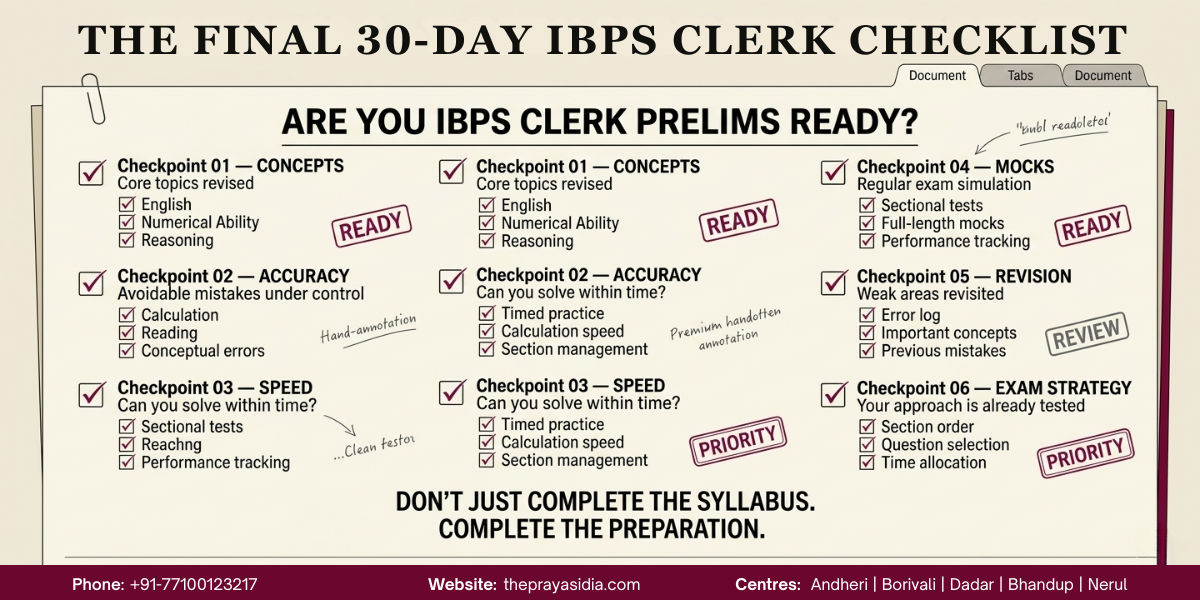
Final Preparation, Exam-Day Strategy & Choosing the Right Coaching
The final stage of IBPS Clerk Prelims preparation is not about trying to learn everything again. It is about converting what you already know into reliable examination performance. By this point, your preparation should increasingly focus on revision, mock tests, accuracy, speed, question selection and maintaining consistency under time pressure.
For a first-attempt aspirant, the final weeks can be particularly important because this is when preparation moves from learning mode to execution mode.
The Final Preparation Phase Needs a Different Approach
During the initial months, learning new concepts may take up most of your study time.
As the examination gets closer, the balance should gradually change.
Your preparation should increasingly include:
- Full-length mock tests
- Sectional tests
- Revision of important concepts
- Error-log revision
- Timed practice
- Calculation practice
- Weak-topic correction
- Previous mistakes
- Question-selection practice
The objective is not to keep adding new material.
It is to make your existing preparation more dependable.
A useful final-phase cycle is:
Revise → Test → Analyse → Correct → Retest
Don’t Keep Changing Your Preparation Resources
One common problem during the final phase is resource switching.
Aspirants may suddenly start following a new teacher, download a new PDF or purchase another test series because they feel that something is missing.
This can create unnecessary confusion.
If your existing resources are sufficient, focus on mastering them.
The final phase should be about consolidation, not constantly starting over.
Before adding a new resource, ask yourself:
“Will this genuinely improve my preparation, or am I simply looking for something new?”
Revision Should Focus on Your Weaknesses
Revision does not mean giving every topic equal time.
Your mock tests and error log should tell you where revision is most needed.
For example, if a particular Numerical Ability topic repeatedly causes mistakes, it deserves more attention than a topic you consistently solve accurately.
Similarly, if your English accuracy is already strong, you may only need regular maintenance practice rather than spending several hours revising basic concepts.
A smart revision approach is:
Strong Areas → Maintain
Average Areas → Strengthen
Weak Areas → Target Intensively
This makes limited preparation time more productive.
Keep an Error Notebook Until the Examination
Your error log can become especially valuable during the final weeks.
Instead of revising everything from the beginning, you can revisit the exact mistakes that repeatedly affected your performance.
Your final revision notebook can contain:
- Frequently repeated mistakes
- Important calculation errors
- Difficult concepts
- Common grammar mistakes
- Question-selection errors
- Time-management observations
- Important shortcuts you actually use
- Questions you repeatedly get wrong
This creates a personalised revision resource.
You are no longer revising a generic syllabus.
You are revising your own weaknesses.
Build a Practical Final-Week Routine
The last week should not become a period of panic.
Your goal should be to maintain familiarity and confidence without exhausting yourself.
A practical final-week routine can include:
Regular Mock Practice
Take mocks according to your preparation level rather than attempting excessive tests every day.
Error Revision
Review mistakes from previous tests.
Sectional Maintenance
Keep all three sections active.
Light Concept Revision
Revise important areas instead of trying to learn an entirely new syllabus.
Time Management Practice
Continue working within realistic time limits.
Adequate Rest
Avoid sacrificing sleep repeatedly in the hope of gaining a few additional study hours.
The objective is to reach the examination with a clear and alert mind.
Don’t Try to Become a Different Aspirant on Exam Day
Your exam-day strategy should be based on the approach you have tested during mocks.
If you have already discovered which section you prefer to attempt first, don’t suddenly change your entire strategy because someone suggested a different approach.
Similarly, don’t attempt unfamiliar shortcuts or question-selection techniques for the first time during the actual examination.
Your mock-test experience should have already answered important questions:
Which section should I start with?
How much time should I spend?
When should I move away from a difficult question?
What type of questions should I prioritise?
The examination should be an execution of a tested strategy.
Read the Question Before You Solve It
In a speed-based examination, rushing can create avoidable errors.
A question may look familiar, but one word or condition can change what it is asking.
This is particularly important when you are trying to increase speed.
The goal is not to read unnecessarily slowly.
It is to develop the ability to read accurately and identify the requirement quickly.
Fast solving begins with correct understanding.
Don’t Let One Difficult Question Affect the Rest of the Paper
Every competitive examination can contain questions that require more time or feel unfamiliar.
The important thing is not to allow one difficult question to disturb your entire attempt.
If a question is consuming too much time, move ahead when appropriate.
Your objective is to maximise your overall performance, not to solve every question you encounter.
This is one of the most important habits that mock tests can develop.
Mental Discipline Is Also Part of Preparation
Exam preparation often focuses heavily on concepts, but performance can also be affected by how you respond to pressure.
If one section feels difficult, avoid immediately assuming that the entire paper is difficult.
If you make one mistake, don’t allow it to affect the next five questions.
Stay focused on the question in front of you.
This type of composure develops partly through repeated exposure to timed tests.
The more familiar you become with examination pressure, the easier it can be to remain focused when the actual test begins.
Common Mistakes First-Attempt IBPS Clerk Aspirants Should Avoid
Aspirants preparing for the first time often make mistakes that have little to do with intelligence or ability.
They are usually strategy-related.
Studying Without Testing
If you never test yourself, you may not know whether your preparation is translating into performance.
Taking Mocks Without Analysis
A score without analysis tells you very little about how to improve.
Chasing Attempts
More attempts are not automatically better if accuracy falls.
Ignoring Weak Sections
Avoiding a difficult subject does not make the weakness disappear.
Changing Resources Constantly
Too many resources can create confusion instead of clarity.
Ignoring Revision
Completing a topic once does not guarantee retention.
Copying Someone Else’s Strategy
A strategy that works for another aspirant may not match your strengths.
Ignoring Rest
Exhaustion can affect concentration, recall and decision-making.
Avoiding these mistakes can make preparation more efficient without requiring dramatically more study hours.
How to Choose the Right IBPS Clerk Coaching in Mumbai
If you are considering coaching for your first attempt, don’t choose an institute simply because it claims to be the “best.”
Look at the actual preparation system.
Ask yourself whether the institute provides:
- Experienced faculty
- Structured classes
- IBPS-oriented study material
- Regular practice
- Sectional tests
- Full-length mock tests
- Mock-test analysis
- Doubt-solving support
- Revision guidance
- Mentorship
- Performance tracking
The most important question is:
“Will this coaching help me understand what to do next?”
A good preparation environment should reduce confusion and provide a clear path from learning to examination readiness.
Why Structured Guidance Can Be Valuable for First-Time Aspirants
Self-study can work extremely well for students who are disciplined, experienced and capable of analysing their own preparation.
However, first-time aspirants may sometimes struggle with questions such as:
Am I studying the right topics?
Is my speed sufficient?
Why are my mock scores not improving?
Which mistakes should I fix first?
How should I divide my preparation time?
When should I increase mock-test frequency?
A structured coaching environment can help address these questions through faculty guidance, regular testing and performance feedback.
For students specifically looking for IBPS Clerk coaching in Mumbai, this support can be an important factor when deciding where to take admission.
The Prayas India: Building a Structured IBPS Clerk Preparation Journey
For aspirants preparing for IBPS Clerk, The Prayas India can provide a structured environment where preparation is approached through concept learning, practice, testing and improvement.
The objective should not simply be to complete lectures.
Students need to develop the ability to apply concepts under time pressure, identify mistakes, improve accuracy and adapt their strategy based on performance.
For a first-attempt candidate, having a structured preparation environment can make the journey more organised and easier to track.
The decision to join coaching should ultimately depend on your individual preparation needs, learning style and the level of guidance you want throughout the process.
A Simple First-Attempt Formula
If you want to simplify your preparation, remember these six stages:
1. BUILD
Develop conceptual clarity.
2. PRACTISE
Solve different question types.
3. TIME
Introduce timed practice.
4. TEST
Take sectional and full-length mocks.
5. ANALYSE
Understand why marks are being lost.
6. IMPROVE
Correct the problem and test again.
This cycle should continue until the examination.
Your Goal Should Be Exam Readiness, Not Just Syllabus Completion
Completing the syllabus can give you confidence, but it does not automatically mean you are ready for the examination.
You should also be able to:
- Solve familiar questions efficiently
- Maintain accuracy under pressure
- Recognise time-consuming questions
- Select questions intelligently
- Manage section-wise time
- Recover after a difficult question
- Analyse your own mistakes
- Revise efficiently
That is what transforms preparation into performance.
Frequently Asked Questions
Can I crack IBPS Clerk Prelims in my first attempt?
Yes, a first-attempt candidate can prepare effectively with a structured strategy, consistent practice, regular testing and proper revision. The key is to focus on both knowledge and examination execution.
How many hours should I study for IBPS Clerk Prelims?
There is no single number that works for everyone. The quality and consistency of your preparation matter more than simply counting study hours. Your routine should provide sufficient time for learning, practice, testing, analysis and revision.
When should I start taking mock tests?
You should not necessarily wait until the entire syllabus is completed. Topic-wise and sectional tests can be introduced earlier, followed by full-length mocks as your preparation develops.
How can I improve my IBPS Clerk Prelims accuracy?
First identify why your mistakes are happening. They may come from conceptual gaps, calculation errors, rushing, misunderstanding questions or poor question selection. Once the cause is identified, targeted practice can address it.
Is coaching necessary for IBPS Clerk preparation?
Not necessarily. Some students can prepare effectively through self-study. Coaching can be particularly useful for aspirants who want structured classes, expert guidance, regular tests, doubt support and performance analysis.
What should I look for in IBPS Clerk coaching in Mumbai?
Consider faculty quality, study material, practice support, mock tests, analysis, mentorship, doubt resolution and the overall structure of the programme before taking admission.
The First Attempt Should Be a Planned Attempt
Cracking IBPS Clerk Prelims in the first attempt should not depend entirely on last-minute effort.
It should be built through months of small, consistent improvements.
Learn the concepts.
Practise regularly.
Test yourself.
Analyse your performance.
Correct your mistakes.
Revise intelligently.
Repeat.
When this process becomes a habit, preparation becomes more measurable and less dependent on guesswork.
For aspirants who are serious about their first attempt, the right guidance and preparation environment can help make this journey more structured.
If you are looking for the best IBPS Clerk coaching in Mumbai, evaluate coaching institutes based on what they can actually provide throughout your preparation—not just on advertisements or promises.
Conclusion
Your first IBPS Clerk attempt deserves a preparation strategy that is clear from the beginning.
You need to know what to study, how to practise, when to test yourself, how to analyse mistakes and how to improve before the examination.
That is where structured coaching can become valuable.
At The Prayas India, aspirants can explore a structured approach to IBPS Clerk preparation with academic guidance, practice and examination-focused preparation.
If you are serious about preparing for IBPS Clerk and want expert guidance rather than preparing without a clear direction, now is the right time to evaluate your preparation requirements and choose the learning environment that fits you.
🎓 Admissions Open for IBPS Clerk Preparation at The Prayas India
Contact Us
- 📞 Call: +91-77100 13217
- 🌐 Website: https://theprayasindia.com
- 📍 Centres: Andheri | Borivali | Dadar | Nerul | Bhandup
Don’t wait for your first attempt to become your learning experience. Prepare for it like it matters.