How to Decide Which Questions to Attempt in CAT | Best CAT Coaching in Mumbai | The Prayas India
Introduction: CAT Is Not a Test of How Many Questions You Can Attempt
CAT preparation often focuses heavily on increasing speed. Aspirants practise more questions, take more mocks and try to reduce the time spent on each question. While speed matters, there is another skill that can have an equally important impact on your performance: knowing which questions to attempt and which ones to leave.
CAT does not reward you simply for attempting a large number of questions. Your final performance depends on the combination of correct answers, incorrect answers, unattempted questions and the time you spend reaching those decisions. A candidate who recognises the right questions quickly can often outperform someone who knows more concepts but spends too much time fighting with questions that are not worth attempting.
This is particularly important because CAT tests three different areas — VARC, DILR and QA — and each section requires a different approach to question selection. In VARC, you may have to decide whether a particular RC passage is worth investing your time in. In DILR, the biggest decision may be which set to pick first. In QA, you need to quickly distinguish between questions that are familiar and manageable and those that can consume several minutes without a reliable path to the answer.
Therefore, question selection should not be treated as something you figure out on the examination day. It should become a deliberately practised CAT strategy during your preparation and mock tests.
Why Question Selection Matters So Much in CAT
Imagine two candidates who have similar conceptual knowledge.
Candidate A attempts questions almost entirely based on confidence. Whenever a question looks familiar, the candidate starts solving it immediately, even if the calculation is lengthy. Candidate A may eventually solve several questions correctly, but valuable time is lost on questions that required too much effort.
Candidate B spends the first few moments identifying the questions that offer a reasonable balance between familiarity, difficulty and time required. This candidate skips questions that appear unnecessarily complicated and returns to them only if sufficient time remains.
Even if both candidates have similar knowledge, Candidate B may produce a better score because the available time is used more efficiently.
This is the central idea behind CAT question selection.
The examination is not asking you to prove that you can solve every question. It is testing whether you can make good decisions under a strict time constraint.
That is why CAT preparation should develop two abilities together:
Problem-solving ability + Question-selection ability
One without the other can limit your performance.
The Three Questions You Should Ask Before Attempting Any CAT Question
Before committing significant time to a question, develop the habit of mentally asking yourself three things:
Do I understand what the question is asking?
Do I know the concept or approach required?
Can I reasonably solve it within the available time?
If the answer to all three is yes, the question is usually a strong candidate for immediate attempt.
If you understand the question but have no clear approach, it may be better to leave it temporarily.
If you know the concept but the calculation appears extremely lengthy, you need to evaluate whether the expected return is worth the time.
This does not mean that you should abandon every difficult question. Some questions initially look complicated but become straightforward once you identify the correct approach. The objective is to distinguish productive difficulty from time-consuming difficulty.
Don’t Judge a Question Only by Its Appearance
One of the most common CAT mistakes is judging difficulty based on how complicated a question looks.
A long question is not automatically difficult.
A short question is not automatically easy.
A question containing several numbers may actually require one simple formula. Conversely, a two-line question can require significant conceptual reasoning.
This is why experienced CAT aspirants develop the habit of reading before deciding.
Spend enough time to understand the basic structure of the question. Then decide whether you have a realistic path to solving it.
The same principle applies to DILR sets. A set may contain a large table and several conditions but still be highly manageable once the structure is established. Another set may look visually simple but contain complicated cases that consume considerable time.
Question selection is therefore not about judging a question from its surface appearance.
It is about evaluating the expected effort and probability of getting the answer right.
The 30-Second Decision Framework
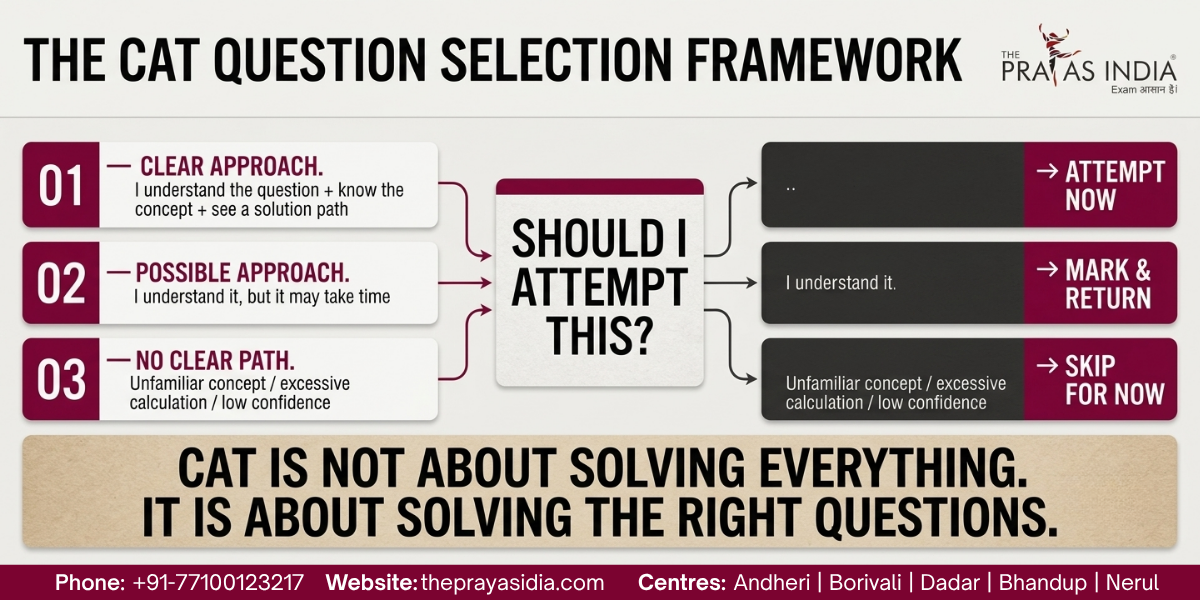
You should not turn CAT into a mathematical calculation where you spend 30 seconds analysing every question before attempting it. However, developing a rough decision framework can help you avoid impulsive attempts.
When you first encounter a question, quickly classify it into one of three categories.
Category A: Direct Attempt
You recognise the concept, understand the requirement and can see a reasonably clear path to the answer.
These questions deserve priority because they offer a strong probability of getting marks without excessive time investment.
Category B: Possible but Time-Dependent
You understand the question and have some idea about the approach, but you are not immediately sure how long the solution will take.
These questions can be marked mentally or physically, depending on the test interface, and revisited after completing the stronger questions.
Category C: Low-Confidence or High-Time-Risk
You do not recognise the approach, the calculations appear unnecessarily complicated, or you are already spending too much time without meaningful progress.
These questions should generally be left for later.
The purpose of this classification is not to label questions permanently. A Category C question can become a Category A question later if you suddenly recognise the required concept or approach.
Question Selection in CAT VARC
VARC requires a slightly different selection strategy because the section is not simply a collection of independent questions.
The first major decision often concerns Reading Comprehension passages.
A passage may be interesting but difficult.
Another may be lengthy but relatively straightforward.
A third may be short but conceptually dense.
Instead of automatically starting with the first passage, learn to spend a short amount of time evaluating the available options.
Look at the passage length, subject, writing style and your familiarity with the topic. More importantly, observe whether you can understand the basic direction of the argument.
The goal is not to find a passage whose topic you personally enjoy.
The goal is to find a passage in which you have a reasonable probability of understanding and answering the questions accurately.
How to Choose the Right RC Passage
When scanning RC passages, pay attention to several factors.
The first is subject familiarity. If you have regularly read about psychology, you may naturally process a psychology passage more comfortably than a highly specialised passage on an unfamiliar philosophical concept.
The second is writing density. Some passages use relatively direct language, while others contain abstract arguments and complex sentence structures.
The third is question structure. A passage with questions that primarily test direct comprehension may feel different from one containing several difficult inference-based questions.
The fourth is your own mock-test experience. Your personal performance data matters more than generic advice.
If your mock analysis consistently shows that you perform well in social science passages and poorly in dense philosophical passages, this information should influence your selection strategy.
Don’t Select an RC Because You Like the Topic
This is a subtle but important distinction.
A candidate may see a passage about cricket, technology or movies and immediately assume it will be easy because the topic is familiar.
But CAT tests comprehension, not general topic familiarity.
You may know a lot about the subject and still struggle with the author’s argument.
Similarly, a topic that looks unfamiliar may actually be written in a straightforward manner and become one of your easiest passages.
Therefore, choose RCs based on readability and question solvability, not personal interest.
How to Decide Which RC Questions to Attempt
Once you have selected a passage, question selection becomes the next challenge.
Do not assume that every question attached to a passage deserves equal time.
Some questions may ask about a specific statement or idea that is clearly explained in the passage.
Others may require deeper inference.
Some options may be easy to eliminate, while others may require careful comparison.
Start with questions where the relevant information or reasoning path is relatively clear.
If a question is taking significantly longer than expected and you are still uncertain between multiple options, move forward and return later if time permits.
This prevents one difficult question from consuming the time that could have been used to answer two or three more manageable questions.
Verbal Ability Questions Also Require Selection
VARC strategy should not become synonymous with RC strategy.
Para Summary, Para Jumbles and other verbal ability questions also require judgement.
A candidate may have strong comprehension but still waste time trying to force a sequence in a difficult Para Jumble.
If you cannot identify a clear opening sentence, mandatory pair or logical progression after reasonable analysis, it may be better to move on and return later.
Similarly, in Para Summary, if two options appear close, focus on the author’s central argument rather than getting trapped by minor details.
The general principle remains the same:
Attempt questions where your reasoning has a clear direction. Delay questions where you are repeatedly circling the same uncertainty.
Question Selection in DILR Is a Different Game
DILR is perhaps the section where question or set selection can have the most visible impact.
Unlike QA, where questions are generally independent, DILR often requires you to invest time in understanding a complete set before solving individual questions.
This creates a major strategic risk.
You may spend five or six minutes setting up a difficult set and then discover that the arrangement is not progressing.
At that point, continuing simply because you have already invested time is a classic mistake.
This is known as the sunk-cost trap.
The time you have already spent cannot be recovered. Your next decision should be based on whether continuing is likely to produce useful returns.
How to Choose DILR Sets
When the DILR section begins, don’t automatically start solving the first set.
Scan the available sets and look for clues about their structure.
A set involving straightforward tables, rankings, distribution or simple arrangements may be more approachable if those are your strengths.
A set involving multiple conditions, complicated cases or unfamiliar logical structures may require more time.
But remember that topic familiarity alone is not enough.
A familiar topic can still produce a difficult set, while an unfamiliar topic can sometimes turn out to be surprisingly manageable.
The best DILR strategy is therefore:
Scan → Evaluate → Select → Solve → Reassess
The ability to abandon a set when it stops making sense is just as important as the ability to solve one.
The Five-Minute Check in DILR
A useful practice during mocks is to establish a personal reassessment point.
Suppose you have selected a DILR set and spent several minutes constructing the initial framework.
Ask yourself:
Am I making meaningful progress?
If you have established a table, derived useful relationships and reduced the possibilities, continuing may make sense.
But if you are repeatedly rereading the conditions, making and discarding cases without progress, or still don’t understand the structure, reassess.
This does not mean you must abandon the set at exactly five minutes.
The timing is only a reference point.
The real question is whether your progress justifies continued investment.
Don’t Let One DILR Set Decide Your Entire Section
One of the worst reactions to a difficult DILR set is emotional commitment.
You may think:
“I have already spent six minutes, so I must finish it.”
That thought can turn a difficult set into a disastrous section.
If a set is not working, move to another one.
CAT rewards the marks you eventually earn, not the number of difficult problems you refused to abandon.
Strong DILR preparation should therefore include practice in leaving sets behind.
This sounds counterintuitive, but it is an important competitive-exam skill.
Question Selection in Quantitative Aptitude
QA is more individual-question oriented, so selection becomes a continuous process.
When you scan a QA question, first identify the topic.
Then ask whether the required concept is familiar.
If the question appears to involve a standard application that you can solve confidently, it should receive priority.
If you recognise the topic but the problem appears calculation-heavy, consider whether there is a shortcut or alternate method.
If you cannot identify the approach, do not spend several minutes trying random methods.
The strongest QA candidates are not necessarily those who attempt every difficult problem.
They are often the candidates who can quickly identify which problems are worth their time.
Build a Personal “Question Value” Judgement
During CAT preparation, you should gradually develop an internal sense of question value.
For example:
A familiar arithmetic question requiring a few steps may be high-value.
A geometry question involving an unfamiliar construction may be medium- or low-value.
A simple algebra question may be worth attempting immediately.
A complex-looking question that you recognise from a familiar pattern may actually be high-value.
This judgement cannot be built through theory alone.
It develops through practice and mock-test analysis.
Every time you take a mock, record not only whether your answer was correct but also whether your decision to attempt the question was good.
The “Time Spent vs Marks Potential” Principle
One of the most useful ways to think about CAT questions is to compare the likely time investment with the probability of getting the question correct.
Consider two questions.
Question A: You can probably solve it in 60–90 seconds with high confidence.
Question B: You may need four minutes and still have only moderate confidence.
Even if Question B looks intellectually more challenging, Question A is usually the better immediate investment.
This is not about avoiding difficult questions forever.
It is about prioritising opportunities.
A difficult question can become worth attempting later when you have completed the higher-value questions and have additional time.
Don’t Chase a Perfect Attempt Rate
Many CAT aspirants become obsessed with attempting a particular number of questions.
For example, they may decide that they must attempt 20 questions in VARC, 15 in DILR or a fixed number in QA.
This can be counterproductive.
The ideal number of attempts depends on the difficulty of the paper, your accuracy, the time available and your individual strengths.
A candidate with high accuracy may perform better with fewer, carefully selected attempts than a candidate who attempts many questions with poor accuracy.
Your target should therefore not be:
“I must attempt X questions.”
Instead, think:
“I must maximise my expected score from the time available.”
That is a much more useful CAT mindset.
Accuracy Should Come Before Aggressive Attempts
Attempting more questions is valuable only when the quality of your attempts remains strong.
Suppose you increase your attempts by rushing through questions but your accuracy falls sharply.
The additional attempts may not improve your overall score.
This is particularly important because CAT includes negative marking for incorrect MCQ responses, while non-MCQ questions are treated differently.
Therefore, your question-selection strategy should always account for confidence and error probability.
Do not guess simply because you have 30 seconds remaining.
If you have a logical basis for eliminating options and the question is worth considering, that is different from blind guessing.

Choosing the right questions is one of the most important skills you can develop during CAT preparation.
You should not enter the examination with the mindset that every question must be solved.
Instead, develop the ability to recognise high-value opportunities.
In VARC, learn to select passages and questions based on readability, comprehension and your own performance patterns.
In DILR, learn to scan sets, identify manageable structures and abandon unproductive sets when necessary.
In QA, recognise familiar concepts quickly and avoid spending excessive time on questions without a clear solution path.
Most importantly, practise question selection during your mocks. Do not wait until the actual CAT exam to develop this skill.
Every mock should teach you not only how to solve questions, but also which questions you should have solved first, which ones you should have postponed and which ones you should have left altogether.
That is how question selection becomes a genuine scoring strategy rather than a last-minute exam trick.
Build a Section-Wise Question Selection Strategy
Question selection becomes much easier when you stop treating CAT as one single exam and start recognising that VARC, DILR and QA demand different decisions. The basic principle remains the same across all three sections: identify questions where the probability of a correct answer is reasonably high compared with the time and mental effort required.
However, the way you identify those questions changes from section to section. In VARC, passage selection and comprehension are central. In DILR, set selection can determine the entire section’s efficiency. In QA, the focus is more on quickly recognising familiar concepts and avoiding questions that consume disproportionate time.
This is why a strategy that works perfectly in QA may not work in DILR, and a strategy designed for DILR may not be suitable for VARC. Your mock-test analysis should therefore produce three separate question-selection strategies, not one generic rule.
VARC: Choose the Passage Before You Choose the Question
In VARC, your first major decision is often not about an individual question. It is about the RC passage itself.
A passage determines the context for several questions, so choosing an unsuitable passage can affect multiple potential attempts. If you spend too much time struggling with a dense passage, you may lose the opportunity to attempt easier questions elsewhere in the section.
When scanning the RCs, look beyond the topic. Ask yourself whether the language is readable, whether the argument appears reasonably structured and whether you can identify the author’s direction after reading the opening portion.
Do not reject a passage simply because the topic sounds unfamiliar. Likewise, do not choose a passage simply because the topic interests you.
Your selection should be based on readability, structure, question comfort and your previous performance patterns.
A Practical VARC Passage Selection Method
During mocks, experiment with reading the opening portion of different passages before committing to one.
As you read, mentally evaluate three things: comprehension, engagement and question potential.
If you can understand the argument without repeatedly rereading sentences, the passage may be a strong candidate.
If every paragraph feels abstract and you are struggling to identify the author’s position, consider postponing it.
If you understand the passage but the questions appear highly inference-heavy, compare it with other available options before committing.
The important point is that you should not spend excessive time “scanning” passages. The purpose of the scan is to make a quick strategic decision, not to read every RC completely before starting.
Prioritise Questions With a Clear Evidence Trail
Once you choose an RC, look for questions where the answer can be supported by a specific part of the passage.
This does not mean that every question with a direct line reference is easy. CAT can deliberately create close options. However, questions where you can identify the relevant evidence generally provide a more reliable starting point than questions where you are uncertain about the entire passage.
For inference questions, ask whether the inference is strongly supported by the passage or whether you are relying on outside knowledge.
For main-idea questions, focus on the author’s overall argument rather than one interesting paragraph.
For tone questions, look for repeated language patterns and the author’s attitude rather than relying on your personal interpretation of the subject.
Question selection and option elimination therefore work together.
Don’t Spend Too Long Fighting Between Two Options
One of the most common VARC time traps occurs when you reduce four options to two and then spend several minutes trying to decide between them.
There is nothing wrong with careful comparison. The problem begins when the comparison stops producing new evidence.
Ask yourself whether you can eliminate one option using the passage.
If you cannot, mark the question mentally and move ahead if the section permits you to return later.
Sometimes another question from the same passage may clarify your understanding of the author’s argument. Returning later with a fresh perspective can be more productive than forcing a decision immediately.
DILR: Your First Decision Is the Set, Not the Question
DILR requires a different mindset because one set can contain several questions.
If you choose the wrong set, you may spend a large portion of the section’s time without generating enough marks.
Therefore, DILR should usually begin with a controlled scan of all available sets.
Look for sets where the structure appears understandable and where you can identify a logical starting point.
You may prefer arrangements, tables, distributions or games depending on your strengths. But don’t blindly choose a set because it belongs to your favourite topic.
A familiar topic can contain an unusually complex structure.
The real question is:
Can I see how I would begin solving this set?
If the answer is yes, it deserves consideration.
The First Few Minutes of a DILR Set Are Diagnostic
After selecting a DILR set, the first few minutes should not be treated as a commitment to finish it at any cost.
Use those minutes to build the structure.
If the information begins falling into place and you are deriving useful relationships, that is a positive signal.
If you are repeatedly rereading conditions without converting them into usable information, reassess the decision.
This is one of the biggest differences between strong and weak DILR strategy.
A strong candidate is willing to say:
“This set is not working for me right now.”
A weaker strategy says:
“I have already spent five minutes, so I must finish it.”
The second approach often leads to further time loss.
Develop a Personal DILR Exit Rule
You can create a simple rule during mock practice: if a set is not producing meaningful progress after a reasonable amount of time, leave it and reassess the remaining options.
The exact duration should depend on your preparation level and the difficulty of the section.
Do not blindly follow a universal five-minute or seven-minute rule.
Instead, track your own data.
If your mock analysis shows that you regularly spend eight minutes on difficult sets and still fail to complete them, you need to become more aggressive about leaving those sets.
If you can establish a set structure in four minutes and then solve its questions efficiently, you may reasonably invest more time.
Your exit rule should therefore be data-driven rather than arbitrary.
QA: Recognise the Concept Before You Start Calculating
In QA, question selection becomes much faster when you train yourself to identify the underlying concept quickly.
A question may appear lengthy, but if you immediately recognise it as a standard percentage, ratio, time-speed-distance or algebraic application, you may know exactly how to begin.
On the other hand, a short question may require a complex insight that you have not yet developed.
During practice, therefore, do not only ask:
“Did I get this question right?”
Also ask:
“How quickly did I recognise what this question was testing?”
That recognition speed can have a major impact on your CAT performance.
Create Three QA Buckets
A useful approach is to mentally divide QA questions into three groups during mocks.
Bucket 1: Familiar and Direct
You recognise the concept and the solution path is clear.
These questions should generally be attempted early.
Bucket 2: Familiar but Lengthy
You know the concept but the calculation or reasoning may take more time.
These questions can be attempted after the direct questions, depending on your time.
Bucket 3: Unfamiliar or Unclear
You cannot identify the correct approach quickly or the question requires an insight you do not currently have.
These should generally be postponed.
This classification becomes increasingly automatic with practice.
Don’t Let Ego Influence Question Selection
A difficult question can be tempting because it makes you want to prove that you can solve it.
This is especially common among students who are strong in mathematics or logical reasoning.
You may think:
“I know this topic. I should be able to solve it.”
But CAT is not a classroom where you receive marks for demonstrating that you can eventually solve a difficult problem.
It is a competitive examination with limited time.
If a question is taking too long, leaving it is not a sign of weakness.
It is a strategic decision.
The same applies to VARC and DILR. Your objective is not to defeat every question.
Your objective is to maximise your score from the available time.
Use Mock Tests to Build Your Personal Selection Rules
Generic CAT strategies can provide a starting point, but your final strategy should come from your own performance data.
After every mock, create a simple analysis table.
| Question/Set | Attempted? | Correct? | Time Taken | Difficulty | Better Decision? |
|---|---|---|---|---|---|
| QA Q1 | Yes | Yes | 1:10 | Easy | Yes |
| QA Q8 | Yes | No | 3:20 | Hard | No |
| DILR Set 2 | Yes | No | 9:00 | Difficult | No |
| VARC RC 3 | Yes | Yes | 8:30 | Moderate | Yes |
The last column is particularly important.
You are not merely analysing whether you were right or wrong.
You are analysing whether attempting the question was the right decision.
That distinction can reveal problems that conventional mock analysis misses.
Track “Wrong Attempts” and “Missed Opportunities”
Suppose you attempted a difficult QA question for three minutes and got it wrong.
That is one type of mistake.
But suppose you skipped an easy question because you assumed it was difficult, and later discovered that you could have solved it in one minute.
That is a different type of mistake.
Both should be tracked.
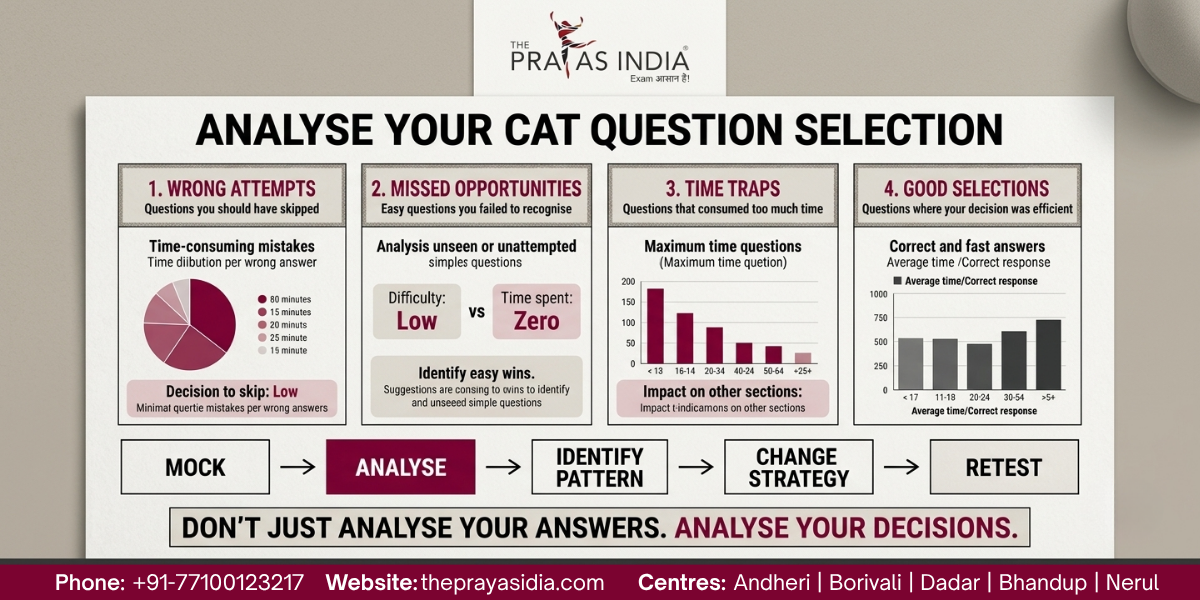
Your mock analysis should therefore include:
Wrong attempts — questions you should probably have skipped.
Missed opportunities — questions you should probably have attempted.
Time traps — questions or sets that consumed too much time.
Good selections — questions where your decision was efficient and accurate.
Over several mocks, these categories can reveal your personal selection pattern.
Your CAT Strategy Should Evolve With Your Mocks
Do not expect your first question-selection strategy to be perfect.
Your early mocks may reveal that you are too conservative and skip questions that you could have solved.
Later, you may become too aggressive and start attempting questions simply because you recognise the topic.
Both situations are normal.
The objective is to gradually find the balance between attempt volume and accuracy.
For example, if your VARC accuracy remains high but your attempts are too low, you may need to become more aggressive about selecting additional questions.
If your attempts are high but accuracy is falling, you may need to become more selective.
Similarly, if DILR is consuming too much time, the problem may not be your solving ability. It may be your inability to leave an unproductive set.
This is why mock analysis should directly influence your next preparation cycle.
How to Handle a Difficult CAT Paper
One of the most important question-selection skills is staying flexible when the paper is unexpectedly difficult.
You may enter CAT expecting a certain difficulty level based on your mocks, only to encounter a section that feels much harder.
The worst response is to continue using a fixed attempt target.
If VARC feels unusually difficult, your normal number of attempts may no longer be appropriate.
If DILR contains several unfamiliar sets, your selection threshold needs to become more conservative.
If QA is calculation-heavy, you may need to prioritise conceptual questions and return to lengthy calculations later.
Remember that difficulty is relative.
If a section is difficult for you, it is likely difficult for many other candidates as well.
The objective is not to solve the paper you expected.
The objective is to respond intelligently to the paper that actually appears in front of you.
Don’t Change Your Strategy Every Five Minutes
Flexibility does not mean panic.
A difficult paper can cause aspirants to repeatedly change their approach.
They start with RC, switch to VA, return to RC, attempt one difficult question, leave it, jump to another section mentally and lose focus.
This is not flexibility.
It is indecision.
Your strategy should provide structure while allowing reasonable adjustments.
For example, you may decide to scan all RCs first, select the most comfortable passage, complete the strongest questions and then move to the next passage.
If that strategy works, continue.
If you encounter a particularly difficult passage, move on according to your pre-decided rules.
The important thing is to make decisions calmly rather than emotionally.
Establish Time Checkpoints
Question selection becomes easier when you know roughly where you should be in the section.
These checkpoints should not become rigid deadlines.
Instead, they should help you recognise when your pace is becoming inefficient.
For example, during mocks you might notice that spending too much time on the first few questions causes you to rush the final portion of the section.
That is a signal that your selection strategy needs adjustment.
Your checkpoints should answer questions such as:
Am I spending too much time on individual questions?
Have I completed enough high-confidence attempts?
Am I still fighting with a question that should have been postponed?
Do I need to move to another RC or DILR set?
These questions help maintain control over the section.
Practice Question Selection Separately From Full-Length Mocks
You do not have to wait for full-length CAT mocks to practise selection.
During sectional practice, deliberately create selection exercises.
Take a set of 20 QA questions and spend a few minutes scanning them before solving anything.
Mark them as:
Immediate
Later
Skip
Then solve according to your selection.
Afterward, compare your choices with actual difficulty and time taken.
The same exercise can be performed with DILR sets and VARC passages.
This develops your first-look judgement, which is extremely valuable during CAT.
Learn From Questions You Did Not Attempt
One of the biggest mock-analysis mistakes is ignoring unattempted questions.
After the mock, go through the questions you skipped.
If you discover that you could have solved several of them quickly, ask yourself why you rejected them.
Did the question look complicated?
Did you misunderstand the wording?
Did you lack confidence?
Did you spend too much time on another question?
This analysis can reveal a selection bias.
Some candidates systematically underestimate their ability and become overly conservative.
Others systematically overestimate their ability and attempt too many risky questions.
Your goal is to identify which side you lean toward.
The Right Attempt Strategy Depends on Accuracy
There is no universal “ideal number of attempts” that works for every CAT aspirant.
Two students can attempt the same number of questions and receive very different scores because their accuracy levels differ.
Your strategy should therefore be based on your personal performance.
If your accuracy is consistently high, you may be able to increase attempts gradually.
If your accuracy is inconsistent, your first priority should be improving question selection and reducing low-confidence attempts.
The sequence should generally be:
Better selection → Better accuracy → Better speed → More productive attempts
Trying to increase attempts before fixing selection can simply increase the number of mistakes.
Question Selection Is a Skill That Can Be Coached
Many students believe that question selection is an instinct that only naturally strong CAT candidates possess.
That is not necessarily true.
It can be developed through structured practice.
When faculty or mentors analyse your mocks, they can help you identify recurring patterns such as:
- Spending too much time on familiar but lengthy questions
- Avoiding unfamiliar-looking but easy questions
- Selecting the wrong DILR sets
- Choosing RCs based on topic rather than readability
- Attempting low-confidence questions
- Failing to revisit marked questions
- Rushing the final minutes because of poor time allocation
Once these patterns become visible, you can deliberately work on them.
This is one of the areas where structured CAT preparation can provide value beyond simply explaining concepts.

How Structured CAT Coaching Can Help With Question Selection
Conceptual preparation and question-selection strategy are closely connected, but they are not identical.
You may know how to solve percentages, algebra, geometry or arithmetic and still lose time because you do not recognise which questions are worth attempting first.
Similarly, you may understand DILR concepts but struggle to decide which set deserves your time.
Structured CAT coaching can help by providing repeated exposure to different question types, sectional tests, full-length mocks and performance analysis.
The value is not simply in having more questions to solve.
It is in learning how to interpret those questions, prioritise them and learn from your decisions.
For students considering CAT Coaching in Mumbai, this can be an important factor when comparing institutes.
Look beyond the number of classes or study materials. Consider whether the preparation system includes:
- Regular mock tests
- Sectional tests
- Detailed test analysis
- Faculty feedback
- Doubt-solving support
- Individual performance tracking
- Strategy sessions
- Mentorship
- Revision planning
A structured environment can make it easier to turn question selection into a measurable skill.
Choosing CAT Coaching in Mumbai: What Should You Evaluate?
If you are considering joining a CAT coaching institute, the decision should not be based solely on brand recognition or advertisements.
Ask how the institute approaches mock-test analysis and exam strategy.
Will students receive guidance on why they are losing marks?
Will they understand which questions they should have attempted?
Will they learn how to identify suitable DILR sets?
Will their VARC strategy be analysed separately from their QA strategy?
Will faculty help them understand whether their problem is knowledge, speed, accuracy or decision-making?
These questions are important because CAT preparation is not just about learning concepts.
It is about converting those concepts into marks under examination conditions.
For aspirants in Mumbai, The Prayas India has centres at Andheri, Borivali, Dadar, Bhandup and Nerul. Students looking for information about CAT preparation can contact +91-77100 13217.
A Simple Question Selection Checklist for CAT
Before the examination, develop a simple mental checklist.
When you see a question, ask:
Do I understand it?
If yes, continue.
Do I recognise the concept or approach?
If yes, continue.
Can I reasonably solve it within the available time?
If yes, attempt it.
If the answer to one of these questions is no, consider postponing it.
For DILR, apply the same principle at the set level.
For VARC, apply it first to passages and then to individual questions.
This checklist should eventually become automatic.
The less mental effort you spend deciding what to do, the more attention you can devote to actually solving the question.
What You Should Practise Before CAT
Question selection should be developed gradually rather than suddenly during the final weeks.
During the early preparation phase, focus primarily on concepts and accuracy.
Once your fundamentals are stronger, begin incorporating timed sectional practice.
Then introduce full-length mocks.
During the mock phase, start tracking question-selection decisions.
In the final stage, your strategy should become increasingly personalised.
You should know:
Which VARC passages you generally prefer
Which DILR structures you solve efficiently
Which QA topics are your strongest
Which question types regularly waste your time
How quickly you recognise a good question
When you tend to panic
Whether you are too conservative or too aggressive
This creates a personalised CAT exam strategy rather than a generic one.
Final Takeaway: CAT Rewards Smart Decisions
CAT preparation is often described as a competition of knowledge, speed and accuracy.
But there is another factor that deserves equal attention: decision-making.
You can know the concept and still lose marks by choosing the wrong question.
You can be capable of solving a DILR set and still hurt your score by spending too long on it.
You can understand an RC passage and still lose time by fighting with one difficult question.
You can be strong in QA and still underperform because you attempt lengthy questions before simpler ones.
The solution is not to become afraid of difficult questions.
The solution is to become better at recognising when a difficult question is worth your time.
During every mock, ask yourself not only:
“How many questions did I get right?”
but also:
“Did I make the right decisions?”
That question can transform the way you analyse your CAT preparation.
The strongest CAT strategy is not about attempting everything.
It is about finding the questions that offer the best opportunity to convert your preparation into marks.
- 📞 Call Now: +91-77100 13217
- 🌐 Website: theprayasindia.com
- 📍 Centres: Andheri | Borivali | Dadar | Nerul | Bhandup
FAQs
1. How do I decide which questions to attempt in CAT?
Start by evaluating whether you understand the question, recognise the concept or approach and can reasonably solve it within the available time. Questions with a clear solution path and high confidence should generally receive priority.
2. Should I attempt more questions or focus on accuracy in CAT?
Accuracy should generally come first. Increasing attempts without maintaining accuracy can lead to unnecessary negative marks and wasted time. Once your accuracy becomes stable, you can gradually increase productive attempts.
3. How should I select RC passages in CAT?
Evaluate passages based on readability, structure, comprehension and your previous performance patterns. Do not select a passage solely because you like its topic or are familiar with the subject.
4. How should I select DILR sets in CAT?
Scan the available sets and identify those where you can understand the structure and see a logical starting point. During practice, learn to leave a set when you are not making meaningful progress.
5. How should I select QA questions in CAT?
Identify the underlying topic and determine whether you recognise the concept and solution approach. Direct and familiar questions should generally be prioritised over unfamiliar or highly time-consuming questions.
6. Is there an ideal number of questions to attempt in CAT?
There is no universal ideal number. The appropriate number depends on the difficulty of the paper, your accuracy, time management and individual strengths. Focus on maximising your expected score rather than chasing a fixed attempt count.
7. How can mock tests improve question selection?
Mock tests allow you to identify wrong attempts, missed opportunities, time traps and successful selections. Analysing these patterns helps you develop a personalised question-selection strategy.
8. Should I skip difficult questions in CAT?
Not necessarily. A difficult-looking question may still be worth attempting if you recognise the concept and have a clear solution path. The key is to distinguish productive difficulty from questions that consume excessive time without sufficient confidence.
9. What should I do if CAT is much more difficult than expected?
Stay flexible and avoid rigid attempt targets. If a section is unusually difficult, become more selective and prioritise questions where you have a reasonable probability of success.
10. Can question selection improve my CAT score?
Yes, effective question selection can help you use limited examination time more efficiently and reduce low-value attempts. However, it works best when combined with strong conceptual preparation, accuracy and regular mock-test practice.
11. Can CAT coaching help improve question selection?
Structured CAT coaching can help aspirants understand different question types, practise under timed conditions and analyse mock-test decisions. Mentorship can also help identify recurring patterns in question selection.
12. Which is the best CAT coaching in Mumbai?
The right CAT coaching institute depends on faculty, study methodology, mock-test quality, analysis, mentorship, doubt support and your individual requirements. The Prayas India has CAT preparation centres at Andheri, Borivali, Dadar, Bhandup and Nerul.
13. Why is DILR question selection so important in CAT?
DILR often requires you to invest time in understanding an entire set before answering its questions. Selecting a manageable set can therefore have a significant impact on how efficiently you use the section's time.
14. How can I practise CAT question selection before the actual exam?
Use sectional tests and mocks to practise scanning questions before solving them. Categorise questions into immediate attempts, revisit-later questions and low-confidence questions, then compare your decisions with the actual difficulty and time required after the test.