How to Improve Accuracy in Railway Exams | Best Railway Coaching in Mumbai | The Prayas India
Railway exams are often described as speed-based competitive examinations, but speed alone does not guarantee a strong score. A candidate may attempt a large number of questions and still lose valuable marks because of avoidable mistakes. In exams such as RRB NTPC, RRB Group D, RRB ALP and other Railway recruitment examinations, accuracy plays a critical role in converting preparation into marks. The ability to understand a question correctly, apply the right concept and select the correct answer without unnecessary hesitation can make a significant difference to overall performance.
For many aspirants, improving accuracy does not require studying completely new topics. Instead, it requires understanding why mistakes are happening in the first place. A wrong answer can result from a conceptual gap, misreading the question, a calculation error, rushing under time pressure or selecting an option without sufficient verification. Unless these patterns are identified, students may continue making the same mistakes even after solving hundreds of practice questions.
Accuracy Is a Preparation Skill, Not Just an Exam-Day Skill
Accuracy is often treated as something that will automatically improve once the syllabus is completed. In reality, it needs to be developed during preparation itself. When you practise questions regularly, your objective should not simply be to increase the number of questions you solve. You should also pay attention to how many questions you solve correctly and what type of mistakes you make.
For example, suppose an aspirant solves 100 questions in a practice session and gets 75 correct. Increasing the number of questions to 150 may not solve the underlying problem if the same types of errors continue. A better approach would be to examine those 25 incorrect responses and understand whether they were caused by weak concepts, careless calculations, incorrect interpretation or hurried decision-making.
This changes the purpose of practice. Instead of simply asking, “How many questions did I solve today?”, you begin asking, “How many mistakes did I understand and prevent today?”
That shift can gradually improve the quality of your preparation.
Start by Understanding Your Mistakes
One of the most effective ways to improve accuracy is to stop treating every wrong answer in the same way. Not all mistakes indicate the same weakness.
A question answered incorrectly because you did not understand the concept requires a different solution from a question you knew but marked incorrectly because you rushed. Similarly, spending too much time on a calculation-based question and then making an arithmetic error indicates a different problem from misunderstanding the language of a reasoning question.
After every meaningful practice session or mock test, try to identify the nature of your mistakes. Over time, you may notice recurring patterns. Perhaps you regularly make calculation errors in Quantitative Aptitude, overlook important words in General Intelligence and Reasoning questions, or make avoidable mistakes in General Awareness because you answer without carefully considering the question.
Once these patterns become visible, accuracy becomes something you can actively work on rather than something you simply hope will improve.
Build the Habit of Reading Questions Carefully
In Railway exams, some mistakes happen before the actual solving process even begins. Candidates read quickly, assume what the question is asking and start calculating. Under examination pressure, this habit can become particularly costly.
Words such as “not,” “incorrect,” “except,” “only,” “approximately” and similar qualifiers can completely change the meaning of a question. Missing one such word can turn a correctly solved problem into a wrong answer.
Developing careful reading does not mean reading every question extremely slowly. The objective is to become selectively attentive. Read the actual requirement of the question first, identify the information provided and then decide how you want to approach it.
With consistent practice, careful reading can become faster and more natural. This is especially useful when you are simultaneously trying to maintain speed.
Don’t Confuse Speed With Rushing
A common mistake among Railway exam aspirants is trying to increase speed by solving every question as quickly as possible.
Speed and rushing are not the same thing.
Speed means reaching the correct answer efficiently. Rushing means sacrificing accuracy in an attempt to save a few seconds.
If you regularly make avoidable errors because you are attempting questions too quickly, increasing your speed further may actually hurt your score. Instead, first build a reliable solving method and then gradually reduce the time taken.
During practice, focus on becoming fast and correct, rather than simply fast.
Use Practice Sessions to Train Accuracy
Your regular practice should gradually simulate the conditions you are likely to experience during the examination. Start by solving questions without excessive time pressure so that you can establish conceptual clarity and a reliable approach. Once your accuracy becomes stable, introduce timed practice.
This creates a progression from understanding to application and finally to execution under pressure.
If your accuracy drops sharply whenever a timer is introduced, that itself is useful information. It may indicate that you need more timed practice, better question selection or greater familiarity with the relevant concepts.
The purpose of timed practice is not merely to make you nervous under a clock. It is to teach you how to maintain accuracy when time becomes a constraint.
An Error Log Can Turn Mistakes Into Learning
Keeping a simple record of mistakes can make your preparation more analytical. Instead of allowing incorrect questions to disappear after checking the answer key, record the important ones and revisit them.
Your error log can contain the question, the reason for the mistake and the correct approach. You don’t need to record every question you get wrong. Focus particularly on mistakes that are repeated, questions involving an important concept or errors that reveal a weakness in your exam strategy.
When you revisit the error log regularly, you begin seeing patterns that may not be obvious from individual practice sessions.
The objective is not to maintain a huge notebook of mistakes.
The objective is to make sure the same mistake does not keep costing you marks.
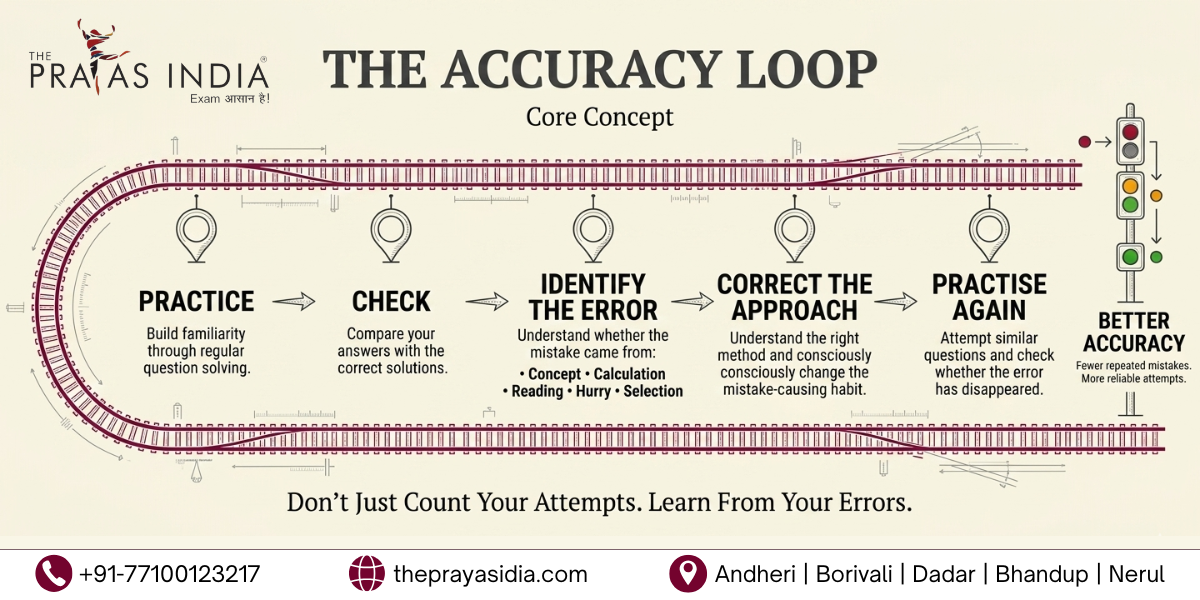
The Accuracy Loop
A productive Railway exam preparation cycle can be viewed as:
Practice → Check → Identify the Mistake → Understand the Cause → Correct the Approach → Practise Again
The important part is the middle of this process. Simply checking the answer isn’t enough. You need to understand what caused the error and what you will do differently the next time you encounter a similar question.
That is how accuracy gradually becomes a habit rather than an occasional outcome.
Why Accuracy Matters More as the Exam Gets Competitive
When candidates prepare for Railway exams, the natural focus is often on completing the syllabus and increasing attempts. These are important goals, but they should not come at the expense of accuracy.
A candidate who attempts more questions with frequent avoidable mistakes may not necessarily outperform a candidate who makes fewer but more accurate attempts. The exact impact of negative marking and examination rules depends on the particular Railway examination and its applicable notification, so aspirants should always prepare according to the rules of their specific exam.
The larger lesson remains consistent: every additional attempt should be made with a clear understanding of its risk and probability of being correct.
As your preparation progresses, the aim should therefore be to increase your ability to identify questions you can solve confidently and avoid unnecessary errors in questions where your approach is uncertain.
How to Improve Accuracy Across Railway Exam Sections
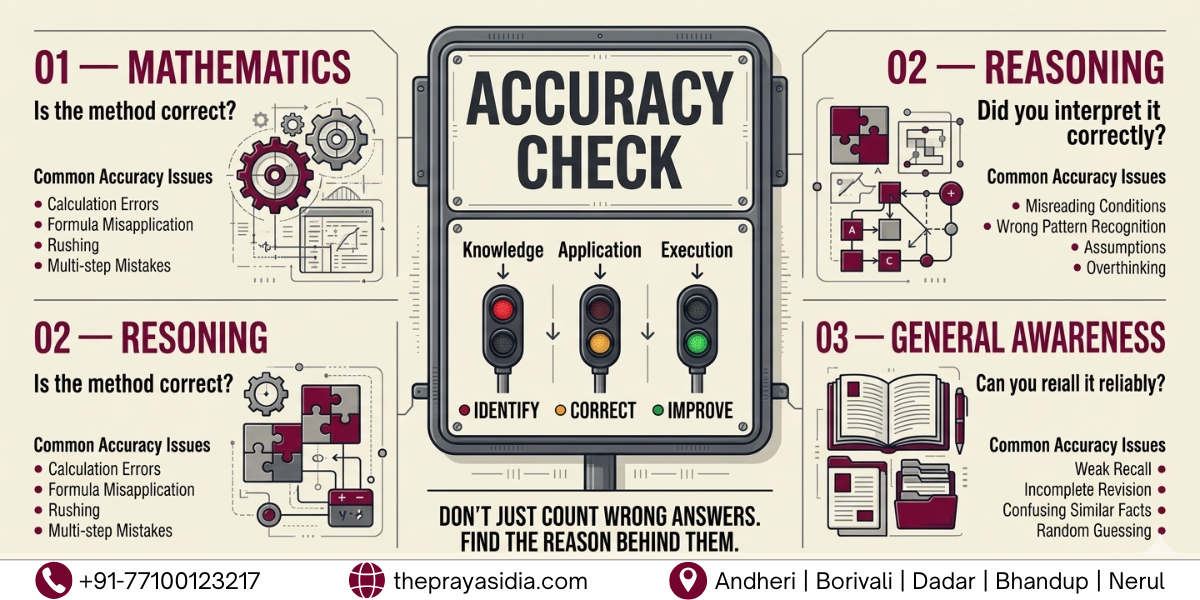
Improving accuracy in Railway exams does not mean following the same technique for every subject. Mathematics, General Intelligence & Reasoning, and General Awareness test different abilities, so the reasons behind incorrect answers can also be different. A candidate who makes calculation mistakes in Mathematics may have excellent accuracy in Reasoning, while another candidate may solve numerical questions correctly but lose marks because of rushed decisions in General Awareness.
The more useful approach is to understand how accuracy breaks down in each section and then build specific habits around those weaknesses.
Mathematics: Accuracy Begins With Fundamentals
In Railway exam preparation, Mathematics often becomes a section where speed and accuracy directly influence each other. Candidates may know the formula but still make mistakes while applying it, especially when calculations become lengthy or several steps are involved.
The first step is therefore to strengthen your understanding of the basic concepts. Topics such as percentages, ratio and proportion, averages, profit and loss, time and work, time, speed and distance, simple and compound interest, algebra and arithmetic require familiarity with the underlying method. When the concept is clear, you spend less time trying to remember what to do and more time executing the solution correctly.
Calculation practice also deserves attention. Many avoidable errors happen because students rush through basic multiplication, division, percentage calculations or intermediate steps. Rather than trying to eliminate every calculation step immediately, first develop a reliable method. Once accuracy becomes stable, you can gradually work on shortcuts and faster calculation techniques.
The objective should be efficient calculation, not careless calculation.
Don’t Memorise Shortcuts Without Understanding Them
Shortcuts can be useful in competitive exams, but they should support conceptual understanding rather than replace it.
If you memorise a shortcut without knowing when it applies, you may use it in a situation where it doesn’t belong. This can produce an incorrect answer very quickly.
A better approach is to first understand the standard method, practise it sufficiently and then learn faster approaches for familiar question types. This gives you two advantages: you understand the logic behind the solution and you can eventually solve routine questions more efficiently.
That combination is particularly useful when the exam places pressure on both time and accuracy.
Reasoning: Accuracy Depends on Interpretation
General Intelligence and Reasoning questions often require a different kind of accuracy.
Here, the biggest challenge may not be calculation. It may be understanding the pattern or condition correctly.
Questions involving coding-decoding, analogy, series, syllogism, blood relations, direction sense, classification and other reasoning concepts can become confusing when the candidate starts solving before fully understanding the information provided.
Before selecting an answer, make sure you know exactly what relationship or condition the question is testing.
For questions involving multiple statements or conditions, avoid relying on assumptions. Work with the information actually given in the question.
This habit can prevent a large number of errors that occur because the candidate unconsciously adds information that was never provided.
Learn to Recognise Familiar Patterns
Reasoning accuracy often improves when students become familiar with recurring question structures.
With regular practice, you begin recognising the difference between a question that requires a direct pattern and one that needs detailed analysis. This familiarity reduces hesitation and allows you to approach questions more confidently.
However, pattern recognition should not become blind pattern matching.
If a question looks similar to something you’ve seen before, verify whether the conditions are actually the same before applying the previous method.
A few seconds of verification can prevent an otherwise avoidable mistake.
General Awareness: Accuracy Comes From Strong Revision
General Awareness presents a different challenge because the section depends heavily on what you know and how reliably you can recall it.
Here, accuracy is less about solving a problem and more about retrieving the correct information under exam pressure.
Random reading of large amounts of information can make preparation difficult to manage. A better approach is to organise your preparation around relevant topics and revise them repeatedly.
Instead of reading something once and assuming you will remember it, revisit important information at planned intervals. Repeated exposure helps strengthen recall and makes it easier to retrieve information during a timed examination.
The goal isn’t to memorise everything.
It is to build reliable recall of high-priority information.
Don’t Guess Because an Option Looks Familiar
General Awareness can create a particular psychological trap.
You see an option that looks familiar and immediately assume it must be correct.
But familiarity isn’t proof.
Before marking an answer, consider whether you actually know the information or whether the option simply resembles something you have seen before.
If you genuinely don’t know the answer, follow the examination’s applicable marking scheme and your own risk-management strategy rather than making random attempts.
Accuracy and Speed Must Develop Together
One of the biggest mistakes Railway aspirants make is trying to improve accuracy and speed separately for too long.
In the early stages of preparation, it makes sense to prioritise correctness. You need to understand concepts and develop a reliable solving process.
Once your accuracy becomes reasonably stable, introduce timed practice.
This creates a progression:
Correctness → Consistency → Speed → Exam Execution
If you start chasing speed before establishing correctness, you may simply become faster at making mistakes.
On the other hand, if you never introduce time pressure, your accuracy during relaxed practice may not translate into examination performance.
Use Sectional Tests to Find the Real Problem
Full-length mocks tell you how you perform overall, but sectional tests can sometimes reveal problems more clearly.
Suppose your overall mock accuracy is low.
That doesn’t immediately tell you whether the problem is Mathematics, Reasoning, General Awareness or a combination of factors.
Sectional testing allows you to examine each area separately.
If your Mathematics accuracy is strong in untimed practice but falls significantly in timed tests, your issue may be speed or pressure.
If your Reasoning accuracy is consistently low even without strict time pressure, conceptual understanding or question interpretation may require attention.
If General Awareness performance fluctuates significantly, revision and recall may be the bigger issue.
The important point is to diagnose before changing your preparation strategy.
The 3-Level Accuracy Test
A useful way to evaluate your preparation is to test yourself at three different levels.
Level 1 — Concept Accuracy
Can you solve the question correctly when there is no major time pressure?
Level 2 — Timed Accuracy
Can you maintain that accuracy when the clock is running?
Level 3 — Mock Accuracy
Can you maintain it while managing the entire examination environment?
If your performance drops between these stages, you have identified where additional work is required.
For example, strong concept accuracy but weak timed accuracy suggests that you may need more timed practice and better execution.
Careless Mistakes Need a Separate Strategy
Not every mistake needs more study.
Sometimes you already know the answer but make an avoidable error.
You may:
- Read a number incorrectly
- Copy a value incorrectly
- Miss a negative sign
- Select the wrong option
- Skip a condition
- Perform a calculation too quickly
- Mark an answer without checking it
These mistakes should not automatically be treated as knowledge gaps.
Instead, identify the specific habit behind them.
If you repeatedly make calculation errors, slow down slightly at the critical step rather than making the entire solution slow.
If you repeatedly misread questions, consciously identify the requirement before solving.
If you repeatedly mark answers incorrectly, build a deliberate final-check habit.
Small corrections can have a surprisingly large impact when the same mistake occurs repeatedly.
Don’t Change Your Strategy After Every Bad Mock
A poor mock-test score can be frustrating.
But one bad performance doesn’t necessarily mean your entire preparation strategy is wrong.
Before making major changes, examine what actually happened.
Was the problem:
Conceptual?
Calculation-related?
Time-related?
Question-selection related?
Revision-related?
Carelessness?
Only after identifying the reason should you decide what needs to change.
This prevents the common cycle of repeatedly changing books, teachers, timetables and strategies without addressing the actual weakness.
Accuracy Improves Through Deliberate Review
Your practice sessions should contain both solving time and review time.
If you spend one hour solving questions and immediately move to the next topic, you may miss the most valuable learning opportunity—the mistakes.
Spend time understanding why questions went wrong and revisit important errors later.
Over several weeks, your review process should help answer three questions:
Which mistakes are decreasing?
Which mistakes are repeating?
Which mistakes have disappeared completely?
That is a much better indicator of accuracy improvement than simply counting how many questions you solved.
Accuracy Is Built Before the Exam
The best time to discover your accuracy problems is not during the actual Railway examination.
It is during preparation.
Every practice session gives you an opportunity to identify a mistake before it becomes a repeated pattern. Every sectional test can show you where your accuracy drops. Every mock can reveal how well you maintain precision under time pressure.
The candidates who make the most of this process don’t simply ask whether they got a question right or wrong.
They ask:
Why was it right?
Why was it wrong?
Can I avoid the same mistake next time?
That mindset gradually turns accuracy from a vague goal into a measurable preparation skill.
How Mock Tests Can Help You Improve Accuracy in Railway Exams
Once your concepts are reasonably strong and you have developed section-wise accuracy, the next challenge is maintaining that accuracy when the clock is running.
This is where mock tests become extremely important.
A Railway exam mock is not simply a test of how many questions you can answer. It is an opportunity to understand how you behave under exam-like pressure. You may perform extremely well during untimed practice and still make avoidable mistakes when several sections, a ticking clock and negative marking come together.
The purpose of mock tests should therefore be much bigger than obtaining a score.
A mock should tell you what is working, what is costing you marks and what needs to change before the actual examination.
Don’t Judge a Mock Only by Its Score
Suppose you take a mock and score lower than expected.
Your first reaction might be disappointment.
But the score alone doesn’t explain the reason.
Imagine that you attempted fewer questions but maintained excellent accuracy. In that case, your primary issue may be speed or question selection.
Another student may attempt a large number of questions but make many avoidable mistakes. Their priority could be accuracy and decision-making.
A third student may have reasonable accuracy and attempts but perform poorly in one particular section.
All three students have different problems even though the final score may be similar.
This is why mock analysis is more valuable than simply collecting mock scores.
Analyse Every Wrong Answer
After completing a mock, don’t immediately move to the next one.
Go back to the questions you answered incorrectly and ask what happened.
Was the concept unfamiliar?
Did you understand the question incorrectly?
Did you use the wrong method?
Did you make a calculation error?
Did you rush?
Did you spend too much time on the question?
Did you know the answer but select the wrong option?
These questions help classify mistakes.
Once mistakes are classified, your preparation becomes much more specific.
For example, if most of your Mathematics errors are conceptual, you need stronger topic revision.
If the concepts are clear but calculations are going wrong, calculation practice may be more useful.
If you solve correctly when relaxed but make errors under time pressure, your problem may be execution rather than knowledge.
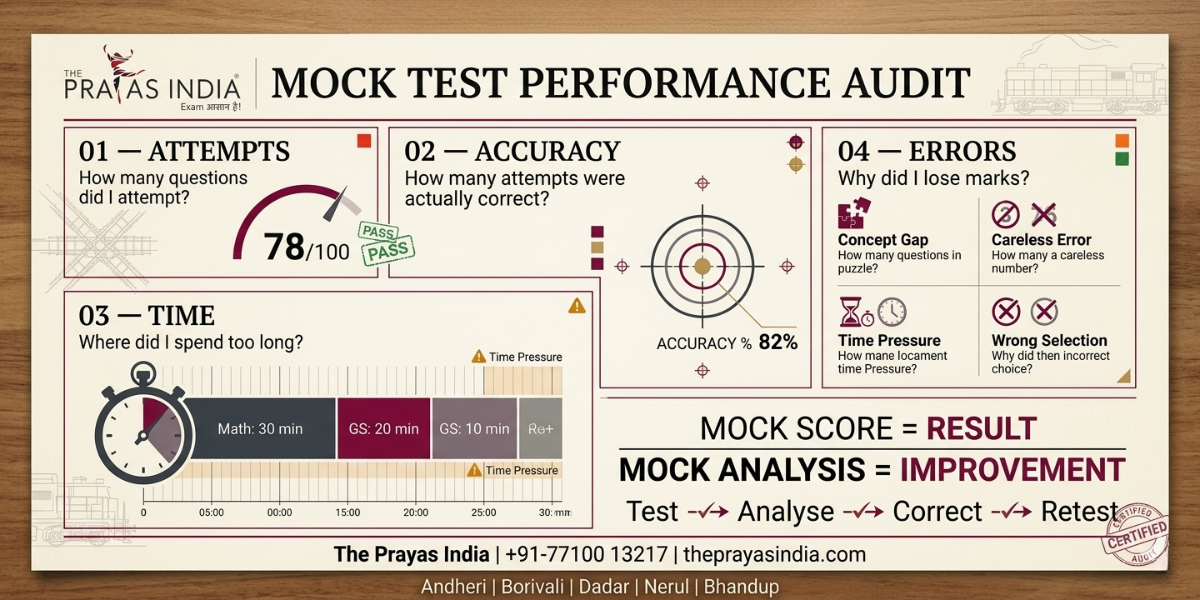
Track Accuracy, Not Just Attempts
A common preparation mistake is celebrating an increase in attempts without checking whether accuracy has remained stable.
Suppose your performance changes like this:
Mock 1: 70 attempts, 60 correct
Mock 2: 82 attempts, 61 correct
The number of attempts increased, but the number of correct answers barely changed.
This suggests that simply increasing attempts may not be producing meaningful improvement.
Instead, track multiple indicators together:
Attempts + Accuracy + Time + Mistake Pattern
This gives you a much clearer picture of performance.
Your target should not be to maximise one number.
It should be to develop a combination that works effectively for your specific Railway examination and its marking scheme.
Understand the Cost of Careless Errors
In competitive examinations, a careless mistake can cost more than the mark associated with the individual question.
The immediate problem is the wrong answer.
But there is also the opportunity cost of the time spent solving the question and the potential impact of negative marking where applicable.
This is why repeated careless mistakes deserve serious attention.
If you repeatedly lose marks because of calculation errors, don’t simply tell yourself to “be careful” next time.
Identify exactly where the errors occur.
Perhaps you rush the final calculation.
Perhaps you copy numbers incorrectly.
Perhaps you use mental calculations where writing the intermediate step would be safer.
Once you identify the behaviour, you can change it deliberately.
Time Management Should Protect Accuracy
Time management is often presented as a race against the clock.
But effective time management is actually about making good decisions with limited time.
If you spend too long on one difficult question, you may lose the opportunity to solve several easier questions.
Similarly, if you rush through every question, your accuracy may fall.
The objective is therefore to create a balance.
A useful approach during practice is to observe how long you spend on different question types. Over time, you will become better at recognising when a question is worth your time and when moving ahead is the smarter decision.
This is particularly important in Railway exams where candidates need to work efficiently across multiple areas.
Learn When to Move On
One of the most difficult skills for an aspirant is accepting that a question should be left temporarily.
You may understand the topic but still find yourself stuck because the particular question is taking longer than expected.
The psychological reaction is often:
“I’ve already spent so much time on this. I should finish it.”
This can lead to poor time management.
A better approach is to recognise when your current approach isn’t working and move ahead when appropriate.
Leaving a question temporarily does not mean you cannot solve it.
It means you are protecting your overall performance.
With regular mock practice, this decision-making ability becomes easier.
Create a Personal Mistake Pattern
After several mocks, your mistakes should start revealing a pattern.
You may notice that:
- You repeatedly make errors in arithmetic calculations.
- You lose accuracy when solving quickly.
- You spend too long on unfamiliar Reasoning questions.
- You forget facts that you studied several weeks earlier.
- You change correct answers unnecessarily.
- You misread questions when under pressure.
These patterns are much more valuable than isolated mistakes.
Once a pattern is identified, create a specific corrective action.
For example, if calculation errors are recurring, introduce focused calculation drills.
If misreading is the issue, consciously underline or identify the key requirement during practice.
If revision is the problem, introduce spaced revision rather than repeatedly reading the same material in one sitting.
Don’t Change the Strategy After Every Mock
Mock scores naturally fluctuate.
One difficult mock can produce a lower score even when your preparation hasn’t deteriorated.
Similarly, an easier mock may produce a higher score without representing a major improvement.
Therefore, don’t make major strategic decisions based on one test.
Look at your performance across several mocks.
Ask:
Is accuracy improving overall?
Are repeated errors decreasing?
Are attempts becoming more efficient?
Is time management improving?
Are weak sections becoming more stable?
Trends are generally more useful than isolated scores.
Use a Three-Stage Mock Review
A simple review structure can make mock analysis more systematic.
Stage 1 — Immediate Review
Right after the mock, note your overall experience.
Which section felt difficult?
Where did you feel rushed?
Were there questions you knew but couldn’t complete?
This captures your experience before you forget it.
Stage 2 — Detailed Analysis
Review incorrect and unattempted questions.
Identify the reason behind each important error.
This is where you distinguish between knowledge gaps, careless mistakes, time problems and question-selection issues.
Stage 3 — Corrective Practice
Don’t stop after identifying the problem.
Practise the relevant question type again.
Then test yourself later to see whether the mistake has reduced.
This creates the complete cycle:
Mock → Analysis → Correction → Retest
Accuracy Under Pressure Needs Separate Training
You may notice that your accuracy is excellent when practising at home but falls during full-length tests.
This is not unusual.
The examination environment introduces additional pressure:
- Limited time
- Multiple sections
- Continuous decision-making
- Fear of negative marking
- Performance expectations
The solution isn’t necessarily to take more and more mocks without analysis.
Instead, gradually expose yourself to timed and exam-like conditions while maintaining your review process.
The goal is to make your solving process more stable under pressure.
Build a Personal Exam Strategy
There is no single question-attempt strategy that is automatically ideal for every candidate.
Your approach should be based on your strengths, weaknesses and performance data.
For example, a student with strong Reasoning accuracy but slower Mathematics performance may need a different section approach from someone with strong Mathematics but inconsistent Reasoning.
Similarly, one candidate may perform well when starting with easier questions, while another may prefer a different sequence.
Use your mocks to test your strategy.
Try an approach.
Measure the outcome.
Analyse it.
Refine it.
Then test it again.
This turns exam strategy into something evidence-based rather than guess-based.
Accuracy Should Become a Habit Before the Final Month
Waiting until the final weeks to focus on accuracy can create unnecessary pressure.
Accuracy should be developed throughout preparation.
Every practice session is an opportunity to improve it.
Every sectional test gives you feedback.
Every mock reveals your behaviour under pressure.
Every error can become a lesson.
By the time the examination approaches, your objective should not be to suddenly become accurate.
It should be to maintain an accuracy habit that you have already developed.
From Mock Scores to Meaningful Improvement
The purpose of taking a mock test is not to prove that you are already ready.
It is to discover what still needs work.
A lower score can actually be useful if it reveals a weakness that you can correct before the real examination. Similarly, a high score becomes more valuable when you understand why you performed well and how to reproduce that performance.
This is why serious Railway exam preparation should treat every mock as a feedback opportunity.
The goal isn’t simply:
“I scored well.”
The better question is:
“What did this mock teach me about my preparation?”
Accuracy Is the Result of Better Decisions
Improving accuracy isn’t about becoming unnecessarily slow or checking every question multiple times.
It is about making better decisions throughout the paper.
You need to know when to solve, when to move on, when to verify, when to attempt and when not to take an unnecessary risk.
With regular practice, mock analysis and deliberate correction, these decisions become more natural.
And once that happens, accuracy stops feeling like something you have to force.
It becomes part of your examination strategy.
How to Maintain Accuracy in the Final Stage of Railway Exam Preparation
As the Railway examination approaches, preparation enters a different phase. At this point, the focus should gradually move away from simply collecting more study material and towards consolidating what you already know. Many aspirants make the mistake of changing their entire routine during the final weeks. They start new books, watch multiple strategy videos, attempt random question sets and keep adding new topics without giving enough attention to revision and accuracy.
The final stage should be more controlled. Your objective is to make your existing preparation more reliable so that you can reproduce it under examination pressure. This means revising important concepts, analysing recent mocks, correcting recurring mistakes and maintaining a balanced approach towards speed and accuracy.
Revision Should Target Weaknesses, Not Just Familiar Topics
Revision is often misunderstood as reading everything again from the beginning. That approach can consume a lot of time without necessarily improving performance.
A more productive revision strategy is based on your actual performance.
If your mock tests show that certain topics repeatedly cause mistakes, those topics deserve greater attention. Strong areas still need revision, but they may not require the same amount of time.
For example, if you are consistently comfortable with one type of Mathematics question but repeatedly struggle with another, spending equal time on both is unlikely to be the most efficient use of your preparation hours.
Your revision should therefore answer a simple question:
“What is most likely to improve my performance if I revise it now?”
This makes the final phase more focused.
Don’t Chase Every New Question
As the exam gets closer, aspirants often become anxious about the possibility of encountering an unfamiliar question.
This can lead them to collect increasingly difficult or unrelated questions.
But attempting complicated questions during the final phase does not automatically make your preparation stronger. Your priority should remain the topics and question types relevant to your examination level and preparation strategy.
Practise enough variety to remain comfortable with different question formats, but don’t let unusual questions distract you from mastering the fundamentals.
A strong final revision phase should create confidence through familiarity, not anxiety through endless novelty.
Negative Marking Requires Intelligent Decision-Making
Where negative marking applies, accuracy becomes even more important because an incorrect response can affect your overall score.
This doesn’t mean that you should avoid every question unless you are completely certain. Your decision should depend on the applicable examination rules, your confidence level and the probability of reaching the correct answer.
The important skill is distinguishing between:
A question you can reasonably solve
and
A question where you are making a random guess.
Your mock tests should help you understand your own decision-making pattern.
If you frequently attempt questions that later turn out to be low-confidence guesses, analyse why you are taking those risks.
Improving this behaviour can help you use your attempts more intelligently.
Create a Final-Week Revision System
The final week should not become a period of panic.
Instead of trying to cover the entire syllabus repeatedly, create a compact revision system based on your previous preparation.
Revisit important formulas, frequently tested concepts, difficult question types, error-log entries and key General Awareness notes according to your examination requirements.
Your mock-test analysis can help you decide what deserves attention.
The closer you get to the examination, the more valuable targeted revision becomes.
Protect Your Accuracy During the Final Days
Sometimes aspirants make an unexpected mistake during the final stage: they over-practise.
They take too many mocks, study for unusually long hours and sleep less because they feel that every additional hour will improve their preparation.
This can have the opposite effect.
Fatigue can reduce concentration and increase careless mistakes.
The final days should therefore include adequate rest, manageable practice and revision that keeps you mentally active without exhausting you.
The objective is to reach the examination with your preparation fresh and usable, rather than feeling mentally overloaded.
Develop a Reliable Question-Selection Habit
One of the most useful skills you can carry into the examination is the ability to quickly recognise the nature of a question.
Some questions may immediately appear familiar and manageable.
Others may require more calculation or thought.
Some may look easy but contain a condition that requires careful reading.
With regular mock practice, you can develop a better instinct for categorising questions.
This helps you avoid spending excessive time on one difficult question while easier opportunities remain unanswered.
Question selection is therefore not about avoiding difficult questions completely.
It is about using your limited examination time where it has the highest potential value.
The Last Few Minutes Should Be Used Wisely
The final moments of an examination can be stressful.
Some candidates rush through unanswered questions. Others change answers unnecessarily because they become doubtful at the last minute.
Your final-minute behaviour should be developed during mocks rather than invented on examination day.
Use your practice tests to understand how much time you realistically need for final review, if the specific exam format allows it.
Most importantly, avoid changing a correctly reasoned answer simply because of sudden anxiety unless you identify a genuine mistake.
Confidence should come from preparation and evidence, not from last-minute impulse.
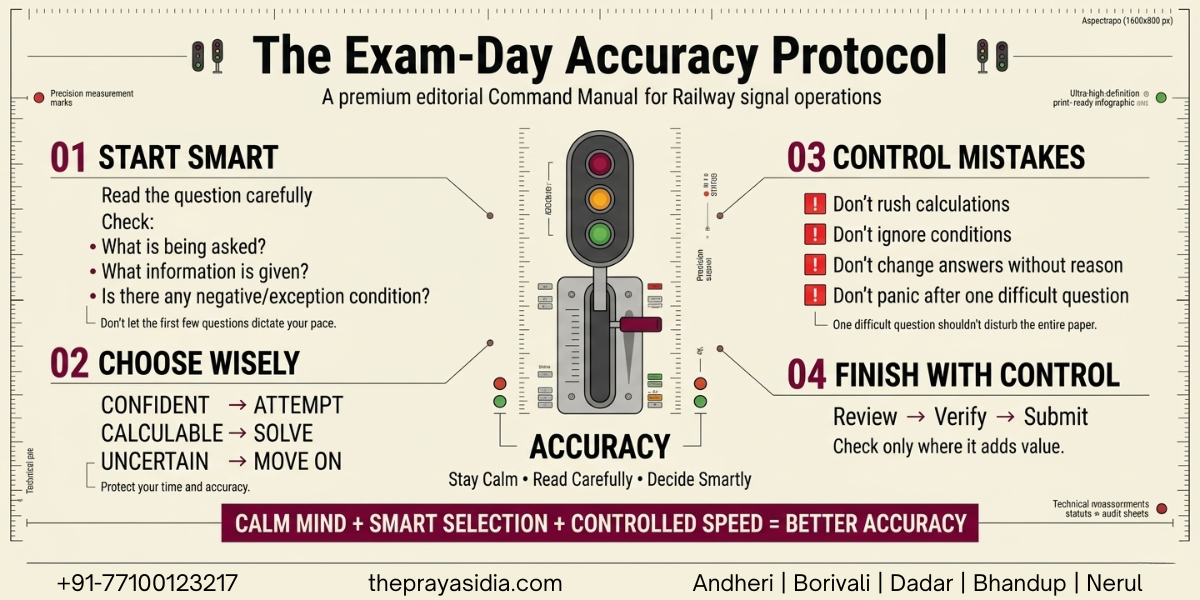
Build an Exam-Day Accuracy Routine
Your accuracy can be affected by small habits even before you start solving questions.
Arrive prepared, understand the examination instructions, settle yourself before beginning and avoid unnecessary distractions.
Once the examination starts, read questions carefully and maintain awareness of your time without constantly checking the clock.
If you encounter a difficult question, don’t let one problem disturb the rhythm of the entire paper.
Move forward when appropriate and return only if your strategy permits it.
The objective is to maintain a stable decision-making process from the first question to the last.
A Simple Accuracy Framework for Railway Aspirants
Your preparation can be organised around four questions:
1. Do I Know It?
This tests your conceptual and factual preparation.
2. Can I Solve It?
This tests your application and problem-solving ability.
3. Can I Solve It in Time?
This tests your execution speed.
4. Can I Solve It Correctly Under Pressure?
This tests your examination readiness.
A candidate who can consistently answer all four questions positively is much closer to a reliable exam strategy.
What If Your Accuracy Is Still Low?
A low accuracy percentage doesn’t mean that you are incapable of improving.
It means your preparation needs diagnosis.
Go back to your recent practice and mocks and identify the largest source of lost marks.
If conceptual errors dominate, revise the relevant topics.
If calculation errors dominate, work on calculation accuracy.
If time pressure is responsible, introduce more timed practice.
If question selection is hurting your performance, analyse your attempt pattern.
If General Awareness recall is weak, strengthen revision rather than simply reading more material.
The solution should match the problem.
That is one of the most important principles of efficient competitive-exam preparation.
When Should You Consider Professional Railway Exam Coaching?
Self-study can work for many aspirants, particularly those who are comfortable creating their own schedule, selecting reliable resources and analysing their performance independently.
However, some students find it difficult to identify their weaknesses or maintain consistency without external structure.
This is where professional coaching can become useful.
A structured Railway exam coaching programme can provide a learning framework, faculty guidance, regular practice, mock tests, doubt support and performance feedback. Instead of spending excessive time deciding what to study next, students can focus more directly on learning and improving.
For aspirants looking for Railway coaching in Mumbai, the important thing is not simply to choose an institute because it promises results. Evaluate the quality of teaching, study material, practice ecosystem, mock tests, faculty support and the extent to which the programme fits your individual preparation needs.
How The Prayas India Can Support Railway Exam Preparation
Preparing for a Railway examination requires consistency over an extended period. A structured environment can help students maintain that consistency while working towards stronger accuracy and performance.
At The Prayas India, Railway exam aspirants can approach preparation through a combination of conceptual learning, practice, mock testing and guidance. The objective is to help students understand the syllabus, strengthen fundamentals, practise examination-oriented questions and analyse their performance as preparation progresses.
For students who struggle with deciding what to study, how to practise or how to interpret mock-test performance, expert guidance can provide a more structured direction.
The ultimate aim is not simply to complete classes.
It is to develop a preparation process that helps you learn, practise, test, analyse and improve.
Frequently Asked Questions
How can I improve accuracy in Railway exams?
Start by identifying the reasons behind your mistakes. Analyse practice tests and mocks to distinguish between conceptual errors, calculation mistakes, misreading, time pressure and poor question selection. Then work specifically on the most frequent problems.
Should I focus on speed or accuracy first?
Accuracy should generally be established before aggressively increasing speed. Once you can solve questions reliably, introduce timed practice so that you learn to maintain accuracy under pressure.
Why do I make more mistakes in mocks than during practice?
Mocks introduce time pressure, multiple sections and continuous decision-making. If your accuracy falls during mocks, analyse whether the issue is pressure, speed, question selection or concentration.
Is an error log useful for Railway exam preparation?
Yes. An error log can help you identify repeated mistakes and prevent them from becoming permanent patterns. Focus on recording meaningful or recurring errors rather than every single incorrect question.
How many mock tests should I take?
There is no universal number that works for every aspirant. The quality of analysis matters as much as the number of mocks. A mock that you carefully analyse and learn from can be more valuable than several tests that you take without reviewing.
Should I attempt every question in a Railway exam?
Not necessarily. Your attempt strategy should depend on the specific examination, its marking scheme and your confidence level. Avoid random guessing where it creates unnecessary risk, particularly in exams with negative marking.
Can coaching improve Railway exam accuracy?
Coaching cannot guarantee a particular score, but structured teaching, guided practice, mock tests, doubt resolution and performance analysis can help students identify weaknesses and prepare more systematically.
The Real Goal Is Reliable Performance
Accuracy should not be treated as a last-minute trick.
It is the result of repeated correct habits.
You learn a concept.
You practise it.
You make mistakes.
You understand those mistakes.
You correct your approach.
You test yourself again.
Then you repeat the process until the correct approach becomes natural.
That is how accuracy develops.
And when this process is combined with sensible time management, question selection and mock-test analysis, your preparation becomes far more aligned with the actual demands of a competitive Railway examination.
From Preparation to Performance
Railway exams can reward candidates who are able to remain calm, precise and efficient when the clock is running.
You don’t need to solve every question perfectly.
You need to make better decisions consistently.
Read carefully.
Recognise the question type.
Choose the right approach.
Avoid unnecessary risks.
Manage your time.
Review your mistakes.
And most importantly, learn from every test you take.
Your score is the outcome.
Your preparation process determines how consistently you can produce that outcome.
Final Takeaway
Improving accuracy in Railway exams is not about becoming slow or overthinking every answer.
It is about developing a disciplined approach where knowledge, speed and decision-making work together.
Start by identifying your mistakes. Strengthen weak concepts. Practise regularly. Introduce timed tests. Analyse your mocks. Maintain an error log. Improve question selection. Revise strategically. And as the exam approaches, focus on consistency rather than panic.
If you are preparing for RRB NTPC, RRB Group D, RRB ALP or other Railway recruitment examinations and feel that your preparation needs more structure, expert guidance and regular performance evaluation can help you stay on track.
For aspirants looking for Railway coaching in Mumbai, The Prayas India offers a structured preparation environment designed around learning, practice, testing and improvement.
Contact Us
- 📞 Call: +91-77100 13217
- 🌐 Website: https://theprayasindia.com
- 📍 Centres: Andheri | Borivali | Dadar | Nerul | Bhandup
Prepare with clarity. Practise with discipline. Attempt with confidence.
Because in a competitive exam, every correct decision counts.