How to Improve CAT Quant Accuracy and Speed | Best CAT Coaching in Mumbai | The Prayas India
CAT Quantitative Aptitude is often misunderstood as a section where success depends mainly on knowing more formulas or solving a large number of questions. In reality, a strong Quant score comes from a combination of conceptual clarity, question selection, calculation ability, accuracy and time management. An aspirant may understand almost every major topic and still lose valuable marks because of calculation errors, spending too long on difficult questions or choosing the wrong questions to attempt.
For CAT aspirants targeting a high percentile, the objective should therefore not be to solve every question. The objective is to identify the right questions, solve them efficiently and avoid unnecessary mistakes.
This becomes particularly important because CAT is a competitive exam in which every decision during the section can affect the final percentile. Spending three or four minutes on one difficult Quant question may appear harmless, but if that decision prevents you from reaching two comparatively easier questions later, the opportunity cost can be significant.
Improving CAT Quant speed and accuracy is therefore not about rushing through questions. It is about developing a repeatable decision-making system.
Why CAT Quant Accuracy and Speed Matter
A common mistake among aspirants is to treat speed and accuracy as two separate goals. In practice, they are closely connected.
If you attempt questions very quickly but make frequent calculation or interpretation errors, your accuracy suffers. On the other hand, if you focus entirely on getting every question correct and spend excessive time checking every step, your attempt count may become too low.
The real target is efficient accuracy.
Consider two students.
Student A attempts a large number of questions but makes several avoidable errors.
Student B attempts fewer questions but selects questions carefully and maintains high accuracy.
The second student may perform better because CAT rewards the quality of attempts, not simply the number of questions touched.
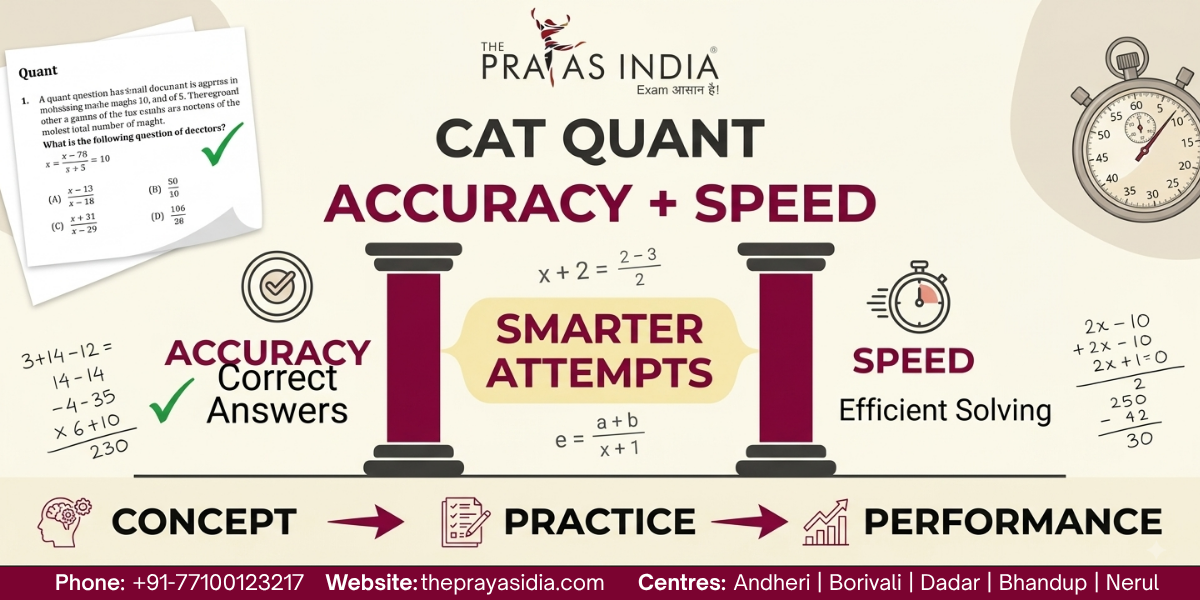
This is why your preparation should gradually move through three stages:
Conceptual Accuracy → Controlled Speed → Strategic Attempt Selection
The first stage ensures that you know how to solve a problem. The second helps you solve familiar problems faster. The third helps you decide whether a problem deserves your time in the first place.
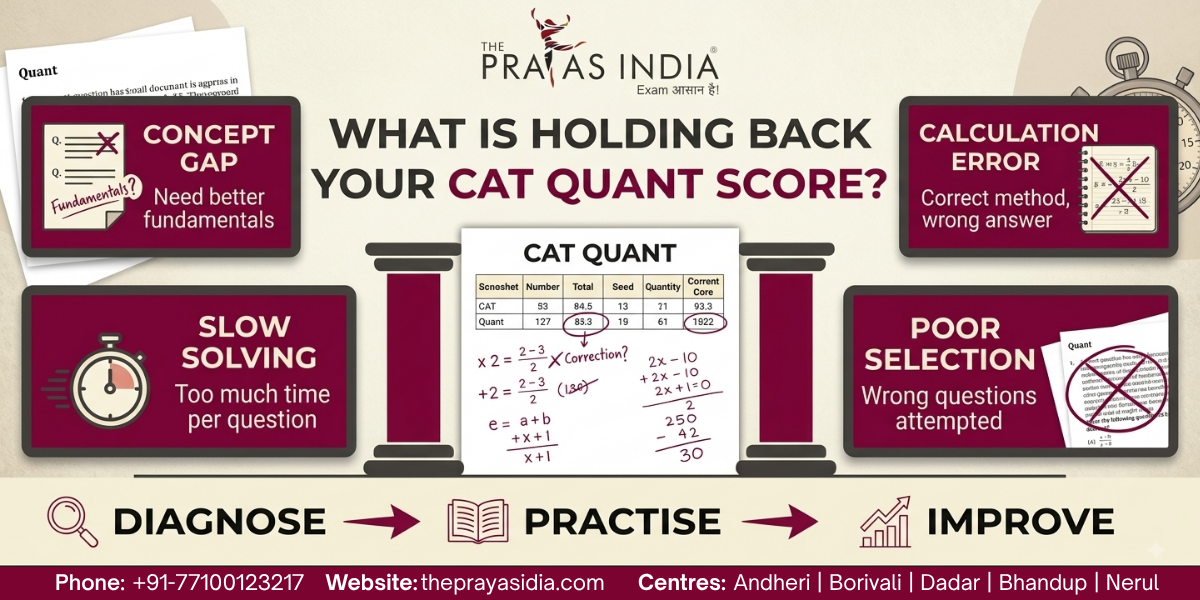
First Understand What Is Actually Slowing You Down
Before trying to increase your speed, identify the reason behind your slow performance.
Not every slow solver has the same problem.
For one aspirant, the issue may be weak concepts. For another, it may be lengthy calculations. Someone else may know the concept but spend too much time deciding which method to use.
Your first task is therefore to diagnose the source of the problem.
| Problem | Likely Reason | Corrective Approach |
|---|---|---|
| You cannot start a question | Conceptual gap | Relearn the topic |
| You know the method but take too long | Low familiarity | Practise similar questions |
| You make calculation mistakes | Weak calculation discipline | Practise controlled calculations |
| You solve easy questions slowly | Lack of fluency | Timed practice |
| You spend too long on difficult questions | Poor question selection | Practise skipping decisions |
| You understand the solution afterward but not during the test | Weak recognition | Solve varied question sets |
| You make silly mistakes | Poor checking habits | Maintain an error log |
| Your mock score fluctuates heavily | Inconsistent selection/accuracy | Analyse attempts, not only marks |
This diagnosis is important because simply solving more questions will not automatically fix every problem.
If the issue is question selection, solving another hundred questions may not address it.
If the issue is conceptual weakness, increasing speed drills may only make you faster at making mistakes.
Build Accuracy Before Chasing Speed
Speed should be developed on top of accuracy.
During the early stages of preparation, do not force yourself to solve every question under severe time pressure.
First make sure that you can:
- Understand the question correctly.
- Identify the relevant concept.
- Set up the solution properly.
- Perform calculations carefully.
- Reach the correct answer consistently.
Once the method becomes familiar, start reducing the time gradually.
For example, if you currently need four minutes to solve a particular type of problem accurately, the first target should not immediately be two minutes.
Try to bring it down systematically:
4 minutes → 3.5 minutes → 3 minutes → 2.5 minutes
The exact target depends on the complexity of the problem.
This approach prevents the common mistake of confusing speed with rushing.
The Accuracy-Speed Relationship
Think of your CAT Quant performance as a balance.
Very High Accuracy + Very Low Speed
You may solve questions correctly but attempt too few.
Very High Speed + Low Accuracy
You may attempt many questions but lose marks through errors.
Moderate Speed + Strong Accuracy
You create a more sustainable performance level.
Strategic Speed + High Accuracy
This is the ideal direction for a high-percentile aspirant.
The final goal is not maximum speed.
It is maximum useful output within the available time.
Strengthen Your Quant Fundamentals
One of the most effective ways to improve speed is to make common concepts automatic.
CAT Quant does not require you to use a complicated method for every problem.
A student with strong fundamentals can often recognise the structure of a problem quickly and choose an efficient approach.
The major areas generally include:
- Arithmetic
- Algebra
- Geometry
- Number Systems
- Modern Mathematics
Within these broad areas, you should develop strong command over frequently tested concepts and their applications.
For example, in Arithmetic, concepts such as percentages, ratios, averages, profit and loss, mixtures, time and work, time-speed-distance and simple/compound interest can appear in different forms.
The important point is not to memorise isolated formulas.
You should understand relationships between concepts.
A percentage question may actually be testing ratios.
A profit-and-loss question may involve percentages and equations.
A time-and-work problem may be simplified through ratios.
The more connections you recognise, the less time you spend trying to identify the appropriate method.
Stop Memorising Formulas Without Understanding Them
Formula memorisation has its place in CAT Quant preparation, but formula-based preparation alone is not enough.
Suppose you memorise a formula and immediately apply it whenever you see a familiar-looking question.
The problem is that CAT can change the structure of the question.
Instead of asking for a direct value, the question may require you to work backwards.
Instead of giving all values explicitly, it may provide relationships between them.
Therefore, for every important formula, ask:
What does this formula actually represent?
When can I use it?
When should I not use it?
Can the same problem be solved through another method?
This type of conceptual understanding improves both accuracy and speed because it reduces hesitation.
Develop Question Recognition Skills
One of the biggest differences between a beginner and an experienced CAT aspirant is often recognition speed.
An experienced student may read a question and quickly recognise its underlying structure.
The student is not necessarily calculating faster.
They are spending less time deciding what to do next.
This skill develops through varied practice.
After solving a question, do not simply check whether your answer is correct.
Ask:
What was the key clue that revealed the method?
For example:
- Was there a ratio relationship?
- Was a percentage change involved?
- Was there a hidden equation?
- Could the values be assumed?
- Was there a symmetry or pattern?
- Could options be substituted?
- Could estimation eliminate options?
Over time, create a mental library of such patterns.
Learn More Than One Approach, But Know When to Use Each
Multiple approaches can be useful in CAT Quant, but learning five methods for every topic can create confusion.
The better approach is to know:
Primary Method + Alternative Shortcut + Appropriate Situation
For example, a problem may be solvable using a conventional algebraic method, but the options may allow substitution to reach the answer much faster.
Another problem may look lengthy but become simple through assuming convenient values.
The objective is not to showcase how many methods you know.
The objective is to select the most efficient valid method for that question.
Use Options as a Tool
CAT is not a school mathematics examination where every problem must necessarily be solved from beginning to end in the traditional manner.
In many questions, the answer choices themselves can provide useful information.
Depending on the question, you may be able to use:
- Option substitution
- Elimination
- Approximation
- Boundary values
- Back-solving
But these techniques should not be applied mechanically.
Before using a shortcut, understand why it works.
A shortcut that saves thirty seconds on one question can become dangerous if it increases the chance of an error.
Efficiency must always remain connected to accuracy.
Improve Mental Calculation Gradually
Calculation speed can make a significant difference in Quant, particularly when a problem contains several arithmetic steps.
However, mental calculation should not mean trying to perform every calculation mentally.
The objective is to reduce unnecessary written work.
Useful areas for regular practice include:
- Percentage conversions
- Fraction-decimal relationships
- Squares of commonly occurring numbers
- Multiplication patterns
- Approximation
- Basic arithmetic operations
- Ratio comparisons
You should aim to recognise familiar numerical relationships quickly.
For example, being comfortable with common fraction-percentage equivalents can reduce the amount of calculation required in many problems.
The goal is not to turn Quant preparation into a memorisation contest.
It is to make basic calculations sufficiently familiar that they do not interrupt your reasoning process.
CAT Quant Accuracy Requires an Error Log
If you want to improve accuracy seriously, maintain an error log.
Do not simply write:
“Wrong answer.”
That information is almost useless.
Instead, classify the mistake.
| Error Type | Example |
|---|---|
| Conceptual | Did not know the underlying concept |
| Interpretation | Misread the question |
| Calculation | Arithmetic mistake |
| Formula | Applied the wrong relationship |
| Logic | Incorrect reasoning |
| Selection | Chose a time-consuming question |
| Time | Spent too long |
| Carelessness | Missed a condition or sign |
This classification tells you what needs improvement.
If most of your mistakes are conceptual, return to fundamentals.
If most are calculation errors, focus on calculation discipline.
If most happen because you spend too much time on difficult questions, your problem may be strategy rather than mathematics.
Don’t Treat Every Wrong Answer Equally
This is an important part of mock-test analysis.
Suppose you get five questions wrong.
Your first instinct may be to count five errors.
Instead, classify them.
Error A
You did not know the concept.
Error B
You knew the concept but made a calculation error.
Error C
You understood the question but selected a poor approach.
Error D
You spent four minutes before discovering that the question was unsuitable.
Error E
You misunderstood one word in the question.
These five errors require five different solutions.
This is why simply calculating your accuracy percentage is not enough.
You need to understand the quality and source of your mistakes.
Use the Three-Question Review Method
After every important Quant practice session, ask yourself three questions:
1. Why did I get this wrong?
Identify the actual cause.
2. Could I have solved it more efficiently?
Look for a better method, shortcut or question-selection decision.
3. How will I prevent this mistake next time?
Convert the lesson into a specific action.
For example:
Mistake: Misread a percentage condition.
Action: Underline the key condition before calculating.
Or:
Mistake: Spent too long on a difficult algebra question.
Action: If no clear approach emerges within the initial evaluation, move on and return later if time permits.
This converts analysis into behaviour.
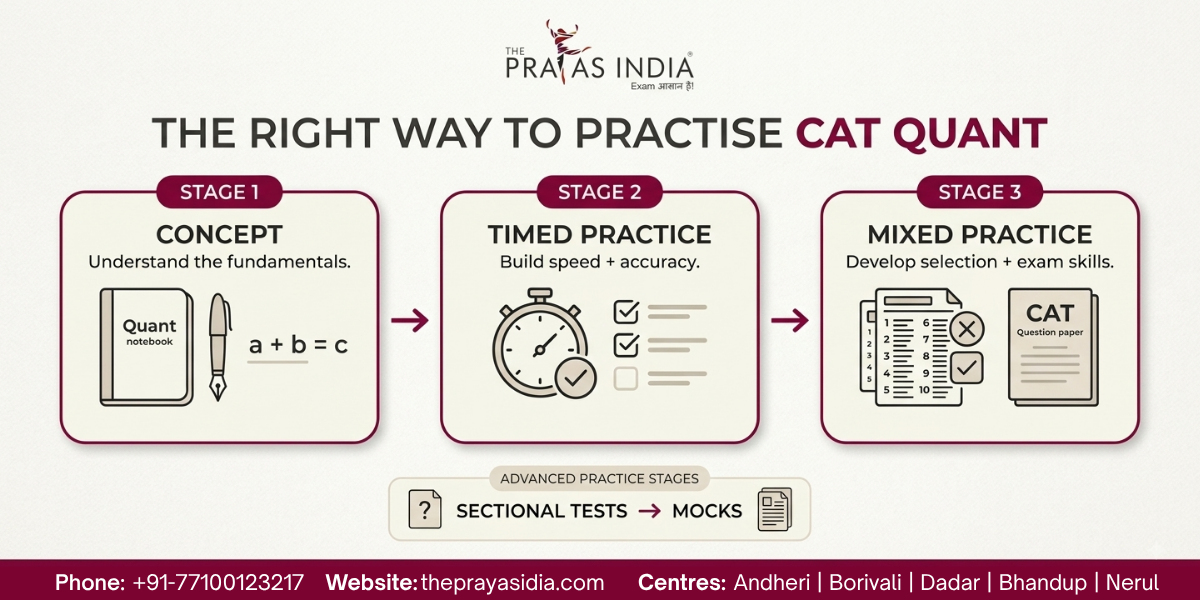
Practice in Three Different Modes
A common problem with CAT preparation is using only one type of practice.
You should ideally work through three modes.
Mode 1: Concept Practice
The objective is to understand the topic and solve problems without excessive time pressure.
Focus on:
- Concepts
- Methods
- Applications
- Variations
Mode 2: Timed Practice
Now introduce time constraints.
Focus on:
- Speed
- Accuracy
- Method selection
- Calculation discipline
Mode 3: Mixed Practice
Combine topics.
This is important because CAT does not tell you which concept a question belongs to before you solve it.
Mixed practice develops recognition and selection skills.
Why Topic-Wise Practice Alone Is Not Enough
Suppose you spend an entire session solving only Time and Work questions.
After a few questions, your brain already knows the topic.
Therefore, recognising the method becomes easier.
But in CAT, the next question may be from Algebra, followed by Geometry, then Arithmetic.
You must first identify what type of problem you are looking at.
That is why mixed practice becomes increasingly important as the exam approaches.
A useful progression is:
Topic Practice → Chapter Tests → Mixed Sets → Sectional Tests → Full-Length Mocks
Each stage develops a different ability.
How to Know When You Are Ready to Increase Speed
Do not increase your speed target simply because you have completed a certain number of questions.
Look for signs of conceptual stability.
You are ready to increase speed when:
- You understand the question quickly.
- Your method selection is consistent.
- Your accuracy remains strong.
- You make fewer avoidable calculation errors.
- You can solve standard questions without hesitation.
- You can recognise when a question is likely to consume too much time.
Once these conditions improve, timed practice becomes significantly more productive.
A Better Way to Practise CAT Quant
Effective Quant preparation should not be based on randomly solving questions for several hours.
Every practice session should have a purpose.
For example:
Session Objective: Improve Arithmetic accuracy.
You might spend the first part revising concepts, the second part solving moderate-level questions and the final part analysing mistakes.
On another day:
Session Objective: Improve question selection.
You could solve mixed Quant questions under a time constraint and record which questions you attempted, skipped and returned to.
This makes practice more targeted.
The 80–20 Principle in CAT Quant Preparation
Not every topic deserves exactly the same amount of preparation time.
You should identify:
- High-priority concepts
- Frequently used fundamentals
- Your weak areas
- Your strong areas
- Topics where improvement can produce meaningful gains
This does not mean completely ignoring difficult or less familiar topics.
Instead, allocate preparation time according to your current level and target.
An aspirant who already performs strongly in one area may gain more by correcting recurring errors elsewhere.
This is why a personalised preparation strategy is usually more useful than blindly following a fixed number of questions per day.
What High-Percentile Aspirants Do Differently
High-percentile preparation is not necessarily about solving the hardest questions.
It is often about becoming extremely reliable on questions that should be solved.
A strong aspirant gradually develops the ability to distinguish between:
Questions I should solve now
Questions I can solve later
Questions I should probably leave
This decision-making skill can have a major impact on sectional performance.
The ability to leave a question is not a sign of weakness.
In a competitive exam, it can be a sign of strategic maturity.
Admission Perspective: Why Structured CAT Preparation Can Help
Students often begin CAT preparation with enthusiasm but struggle to maintain a systematic process over several months.
A structured CAT coaching programme can provide an organised framework covering concepts, practice, sectional preparation, mock tests, performance analysis and guidance.
For students considering Best CAT Coaching in Mumbai, it is important to look beyond classroom teaching.
Before choosing an institute, aspirants should evaluate how the programme handles:
- Concept building
- Quant practice
- Doubt solving
- Mock-test analysis
- Personalised feedback
- Study planning
- Performance tracking
- Mentorship
The right coaching environment should help students understand not only how to solve a Quant question, but also how to approach the CAT section strategically.
At The Prayas India, CAT aspirants can explore a structured preparation approach designed around conceptual learning, practice and test-oriented preparation.
However, coaching should complement—not replace—individual practice. The final improvement in speed and accuracy comes from how consistently a student studies, analyses mistakes and applies feedback.
Key Takeaway
Improving CAT Quant speed and accuracy is not about turning every calculation into a race.
It starts with understanding the concepts, recognising question patterns, choosing efficient methods and building calculation confidence. Once accuracy becomes more consistent, timed practice can gradually improve speed.
The most important shift is to stop measuring preparation only by the number of questions solved.
Instead, track:
How many questions did I solve correctly?
How much time did I spend?
Which mistakes did I make?
Which questions should I have skipped?
Which methods could have been faster?
Am I making the same mistakes repeatedly?
These questions transform Quant practice from routine problem-solving into deliberate preparation.
Master the Art of Question Selection
One of the biggest differences between ordinary practice and CAT-level preparation is question selection.
During practice, students naturally want to solve every question they see. In an exam, that approach can become costly.
When you encounter a Quant question, your first objective should be to determine:
Can I solve this?
How familiar is the concept?
Does the question appear calculation-heavy?
Do I see a clear starting approach?
Is the expected effort worth the possible return?
This evaluation should become increasingly quick with practice.
A question that appears difficult at first glance may actually be straightforward once you recognise its structure. Similarly, a question that looks familiar may turn out to consume excessive time.
Therefore, question selection should be based on your ability and the question’s likely effort, not simply on whether you recognise the topic.
Learn to Identify Three Types of Questions
During mixed practice and mocks, classify questions into three broad categories.
Type A — Immediate Attempts
These are questions where you recognise the concept and see a reasonably clear approach.
These should generally receive priority.
Type B — Possible but Time-Consuming
You understand the question but know that the calculation or reasoning may require significant time.
These can be considered after securing easier opportunities.
Type C — High-Risk or Unclear
You do not immediately understand the approach, or the problem appears unusually lengthy.
These questions should not automatically consume your valuable time.
The objective is not to permanently avoid Type C questions.
It is to avoid allowing one difficult question to control your entire section.
Use the First Few Moments Wisely
The initial reading of a question should not become a mini-solution.
You are trying to determine the nature of the problem, not solve it completely.
Look for:
- Familiar concepts
- Number relationships
- Key conditions
- Possible shortcuts
- Calculation intensity
- Option-based possibilities
If a clear path appears, proceed.
If you are still trying to understand the problem after spending too much time, move forward.
This discipline can improve both speed and confidence.
Don’t Confuse Difficulty With Length
A long-looking question is not necessarily difficult.
Similarly, a short question can contain a tricky conceptual requirement.
This is why you should avoid judging questions only by their visual appearance.
Instead, train yourself to assess:
Concept difficulty + calculation requirement + method clarity + expected time
This four-part judgement becomes increasingly useful during mock tests.
Improve Your Calculation Speed Without Becoming Careless
Calculation speed should improve naturally through repeated exposure.
You can practise numerical fluency separately from full Quant questions.
For example, spend a short daily session working on:
- Fractions and percentages
- Ratio comparisons
- Approximation
- Squares and cubes of frequently occurring values
- Multiplication
- Division
- Percentage increase/decrease
- Simple arithmetic relationships
The objective is not to memorise hundreds of numbers.
The objective is to reduce the mental effort required for routine calculations.
If basic arithmetic becomes automatic, more attention can be devoted to the actual logic of the question.
Approximation Can Save Time—When Used Carefully
Approximation can be useful in questions where the options are sufficiently separated.
However, approximation should never be used blindly.
Before approximating, consider:
How close are the answer choices?
If two options are extremely close, a rough approximation may not be reliable.
If the options are widely separated, estimation may help you reach the correct choice faster.
The same principle applies to option elimination.
The best shortcut is one that saves time without compromising confidence in the answer.
Build a Personal Shortcut Notebook
Instead of collecting random tricks from multiple sources, maintain a small notebook containing only the methods that have actually helped you.
Divide it into sections such as:
Arithmetic Shortcuts
Algebraic Methods
Number System Observations
Geometry Approaches
Option-Based Techniques
Calculation Tricks
Common CAT Patterns
For every shortcut, write one example.
This is more useful than maintaining a huge collection of tricks that you never revise.
Your shortcut notebook should become a revision tool, not another source of information overload.
Analyse Your Attempts, Not Just Your Score
After a CAT mock or Quant sectional test, the score is only the beginning of the analysis.
Suppose your Quant result is lower than expected.
Do not immediately conclude:
“My Quant is weak.”
Break the result down.
| Metric | What It Tells You |
|---|---|
| Questions Attempted | Your overall attempt strategy |
| Questions Correct | Effective accuracy |
| Questions Incorrect | Error pattern |
| Unattempted Easy Questions | Missed opportunities |
| Time per Question | Speed |
| Questions Left Due to Time | Time-management issue |
| Questions Consuming Excessive Time | Selection issue |
| Conceptual Errors | Knowledge gap |
| Calculation Errors | Accuracy gap |
This gives you a much clearer picture.
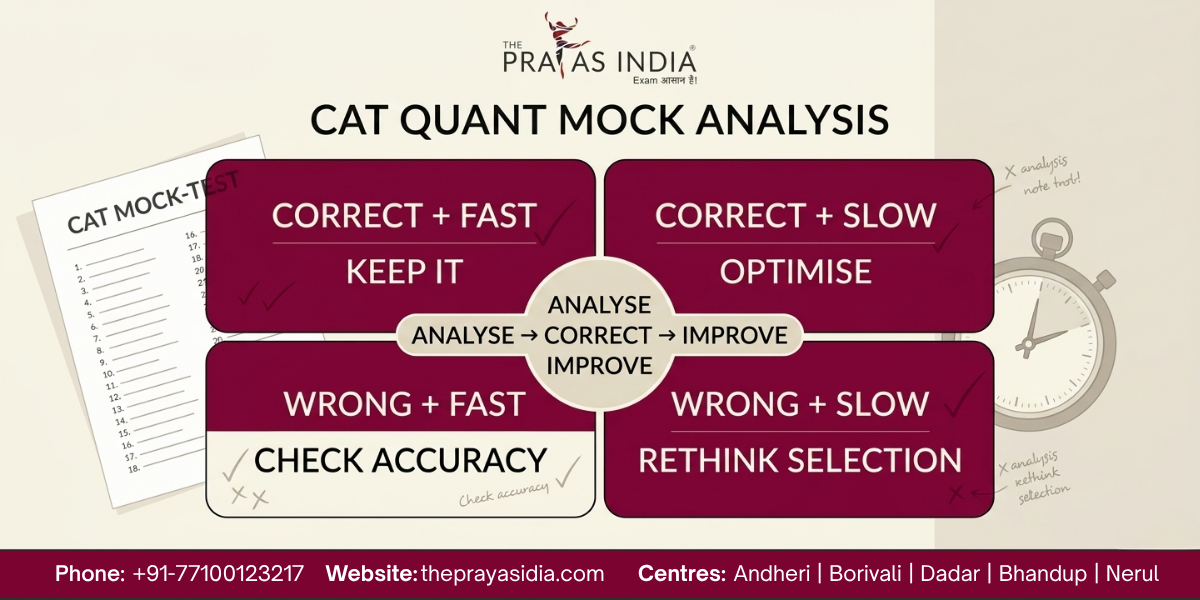
The Four-Box CAT Quant Mock Analysis
After every serious mock, divide your questions into four boxes.
Box 1 — Correct + Fast
These are your strengths.
Continue maintaining them.
Box 2 — Correct + Slow
These questions show that your concepts are strong but efficiency can improve.
Look for alternative approaches.
Box 3 — Wrong + Fast
These are dangerous because they can create false confidence.
Identify whether the issue was:
- Calculation
- Misreading
- Guessing
- Conceptual confusion
Box 4 — Wrong + Slow
These require the most careful analysis.
Determine whether they should have been attempted at all.
This framework helps you understand whether the problem is knowledge, accuracy, speed or selection.
Turn Mock-Test Analysis Into a Weekly Improvement Plan
Mock analysis becomes useful only when it changes your preparation.
Suppose your analysis shows:
Arithmetic accuracy: strong
Algebra accuracy: moderate
Calculation errors: frequent
Question selection: weak
Your next week’s preparation should reflect these findings.
Instead of randomly solving another 200 questions, you might allocate your time to:
- Algebra concept revision
- Calculation drills
- Mixed Quant sets
- Question-selection practice
- One sectional test
This creates a feedback loop.
Mock → Analysis → Weakness Identification → Targeted Practice → Next Mock
That is far more productive than treating every mock as an isolated event.
Create a Quant Accuracy Tracker
A simple tracker can help you monitor whether your accuracy is genuinely improving.
| Week | Attempts | Correct | Incorrect | Accuracy | Main Issue |
|---|---|---|---|---|---|
| Week 1 | 14 | 9 | 5 | 64% | Calculation |
| Week 2 | 15 | 11 | 4 | 73% | Selection |
| Week 3 | 16 | 13 | 3 | 81% | Time |
| Week 4 | 17 | 15 | 2 | 88% | Minor errors |
The exact numbers will differ for every student.
The important point is to observe the trend.
You want to see not only more attempts, but better-quality attempts.
Don’t Increase Attempts at the Cost of Accuracy
A student may see that they are attempting fewer questions than peers and decide to increase attempts aggressively.
This can backfire.
If additional attempts come with a substantial increase in incorrect answers, the improvement may be illusory.
Instead, increase attempts gradually while monitoring accuracy.
A better progression is:
Stable Accuracy → Slightly Higher Attempts → Recheck Accuracy → Increase Again
This approach allows you to understand your actual capacity.
Build Sectional Stamina
Quant performance is not only about individual questions.
You also need the ability to remain focused across the entire section.
During longer practice sessions, you may notice that:
- Your first few questions are highly accurate.
- Your concentration drops later.
- Calculation errors increase.
- You start rushing near the end.
If this happens, your preparation should include sectional practice rather than only isolated question sets.
The purpose is to replicate the mental demands of an actual test.
How to Handle a Difficult Quant Section
Sometimes the Quant section may feel unexpectedly difficult.
In such a situation, the strategy should not be:
“I need to solve everything.”
Instead:
Stay calm → identify accessible questions → secure reliable attempts → avoid unnecessary time sinks → return to difficult questions if time permits.
Your preparation should therefore include difficult-section simulations.
A student who has practised only easy or predictable sets may struggle when the actual paper feels unfamiliar.
CAT Quant Preparation Is Also About Emotional Control
Speed can disappear when panic begins.
A student may spend too long on a question because they become emotionally committed to solving it.
Thoughts such as:
“I have already spent two minutes, so I must finish it.”
can create a sunk-cost problem.
The time already spent cannot be recovered.
The better question is:
“Is continuing from this point still the best use of my remaining time?”
This mindset is particularly important during a high-pressure competitive examination.
A Practical 30-Day Plan to Improve CAT Quant Speed and Accuracy
If your Quant fundamentals are already reasonably developed, the following four-stage approach can help organise the next month.
Days 1–7: Diagnose
Start by identifying your actual weaknesses.
Review previous mocks and practice sessions.
Determine:
- Which topics cause the most errors?
- Which calculations slow you down?
- Which question types consume excessive time?
- How often do you misread questions?
- Are you attempting questions that should be skipped?
Do not attempt to fix everything simultaneously.
Select the most important weaknesses.
Days 8–15: Build Accuracy
Focus on targeted practice.
For each weak area:
Revise → Practise → Analyse → Reattempt
Maintain your error log.
The objective during this stage is to reduce repeated mistakes.
Days 16–23: Increase Speed
Introduce more timed practice.
Work on:
- Calculation drills
- Mixed Quant sets
- Method selection
- Question recognition
- Controlled skipping
Your objective is not maximum speed.
It is faster decision-making without sacrificing accuracy.
Days 24–30: Test and Recalibrate
Take sectional tests and mocks.
After every test, analyse:
Attempt → Accuracy → Time → Errors → Selection
Then modify the following week’s strategy.
This makes the process continuous rather than static.
How CAT Coaching Can Support Quant Preparation
Self-study can be effective, but many aspirants struggle with consistency, doubt resolution, structured practice and objective performance analysis.
This is where a structured coaching environment can add value.
For students researching Best CAT Coaching in Mumbai, Quant preparation should not be evaluated only on the basis of classroom lectures.
Consider whether the programme provides:
- Strong conceptual instruction
- Structured Quant practice
- Doubt-solving support
- Sectional tests
- Full-length mocks
- Mock analysis
- Performance tracking
- Mentorship
- Personalised guidance
- Revision support
A good preparation environment should help students understand both the mathematics and the strategy required to apply that mathematics under CAT conditions.
The Prayas India can be considered by aspirants looking for a structured CAT preparation environment in Mumbai. Students should evaluate the programme based on their individual requirements, including faculty interaction, course structure, test practice, mentorship and academic support.
Coaching, however, cannot replace individual effort. Speed and accuracy ultimately improve through repeated practice, honest analysis and consistent implementation of feedback.
When Should You Start Focusing on Speed?
The answer depends on your current preparation level.
If your concepts are still weak, focus primarily on understanding.
If concepts are strong but you are slow, introduce timed practice.
If your speed is reasonable but accuracy is poor, focus on error reduction.
If both speed and accuracy are strong but scores remain inconsistent, examine question selection and mock strategy.
This is why there is no universal Quant timetable that works equally well for every aspirant.
Your preparation should evolve according to your performance.
What Not to Do While Improving CAT Quant
Avoid these common mistakes:
Don’t Solve Questions Without Reviewing Them
A question that you solved correctly can still teach you something if there was a faster method.
Don’t Chase Every Shortcut
A shortcut is useful only when it is reliable.
Don’t Compare Your Speed With Someone Else’s
Different students have different strengths and starting points.
Don’t Ignore Easy Questions
A high-percentile strategy is not built around solving only difficult problems.
Don’t Repeat the Same Mistake
An error repeated several times is no longer just a mistake. It is a preparation problem.
Don’t Treat Every Mock as a Score Test
Mocks are diagnostic tools.
Their real value comes from analysis.
The Final CAT Quant Improvement Formula
By the end of your preparation, your Quant strategy should become a combination of five abilities:
1. KNOW
Understand the concept.
2. RECOGNISE
Identify the underlying question type.
3. SELECT
Decide whether the question deserves your time.
4. SOLVE
Use the most efficient reliable method.
5. REVIEW
Understand what happened after the test.
This creates a complete preparation cycle:
CONCEPT → PRACTICE → TIMING → MOCK → ANALYSIS → CORRECTION → REPEAT
That cycle is more valuable than simply counting the number of questions completed.
Frequently Asked Questions About CAT Quant Accuracy and Speed
1. How can I improve my CAT Quant speed?
Start with conceptual clarity and then practise standard question types under gradually increasing time limits. Focus particularly on question recognition, efficient methods and calculation fluency rather than simply trying to solve everything faster.
2. How can I improve accuracy in CAT Quant?
Maintain an error log and classify your mistakes into conceptual, calculation, interpretation, logic, selection and careless errors. Once you know the source of your mistakes, practise specifically to reduce that category of error.
3. Should I attempt every CAT Quant question?
No. CAT rewards strategic decision-making. You should prioritise questions where you have a reasonable expectation of solving them accurately within an appropriate amount of time.
4. Why am I slow in CAT Quant despite knowing the concepts?
You may be spending too much time recognising the method, performing calculations or deciding whether to continue with a difficult question. Mixed practice and timed sets can help identify the specific bottleneck.
5. How many Quant questions should I solve every day for CAT?
There is no universal number. Quality of practice matters more than a fixed daily count. A focused set followed by detailed analysis can be more valuable than solving a large number of questions without reviewing mistakes.
6. Is mental calculation important for CAT Quant?
Basic numerical fluency can help reduce unnecessary calculation time. However, accuracy should always take priority over attempting complicated calculations mentally.
7. How important are mock tests for CAT Quant preparation?
Mocks help you understand how your concepts perform under time pressure. Their biggest value comes from detailed analysis of attempts, errors, time usage and question selection.
8. Can coaching help improve CAT Quant speed and accuracy?
Structured coaching can provide conceptual guidance, practice material, tests, evaluation and mentorship. However, the actual improvement depends heavily on how consistently the student practises and applies feedback.
9. What should I look for in the best CAT coaching in Mumbai?
Evaluate faculty quality, course structure, Quant practice, mock-test frequency, analysis, doubt support, mentorship, study material and the overall learning environment rather than relying only on promotional claims.
10. Can a non-maths student improve CAT Quant speed and accuracy?
Yes. A non-maths background does not automatically prevent a student from performing well in Quant. Strong fundamentals, systematic practice and gradual improvement in calculation and problem recognition can make a significant difference.
Final Takeaway
Improving CAT Quant accuracy and speed is a gradual process.
You do not become faster simply by putting a timer beside every practice question. You become faster when your concept recognition, method selection, calculation ability and decision-making improve together.
At the same time, speed without accuracy can be counterproductive.
The better approach is:
Build concepts → Practise accurately → Introduce timing → Analyse mistakes → Improve selection → Take mocks → Recalibrate
For aspirants targeting a strong CAT percentile, this approach can turn Quant preparation from a question-solving exercise into a structured performance-building process.
If you are considering CAT coaching in Mumbai, choose a preparation environment that supports this entire journey—from concept building and practice to mocks, analysis, mentorship and revision.
Ultimately, the goal is not to solve the maximum number of Quant questions.
The goal is to make the right decisions on the right questions within the limited time available.
That is where CAT Quant accuracy and speed truly come together.
Contact Us
📞 Call Now: +91-77100 13217
🌐 Website: theprayasindia.com