How to Improve CAT Reading Comprehension: Strategy, Practice and Common Mistakes | Best CAT Coaching in Mumbai | The Prayas India
Reading Comprehension is one of the most important areas of the CAT VARC section, but it is also one of the sections where many aspirants prepare in the wrong way. Students often assume that improving Reading Comprehension simply means reading more passages, learning difficult vocabulary or solving a large number of questions every day. In reality, CAT RC tests a combination of reading ability, logical interpretation, attention to detail, inference, elimination and decision-making under time pressure.
For aspirants targeting CAT 2026 and future management entrance examinations, RC preparation needs to be treated as a skill-building process rather than a chapter that can be completed. The objective is not merely to understand a passage but to understand how the author has constructed the argument, what the passage is actually saying, which conclusions are supported by the text and which options are deliberately designed to mislead you.
A structured preparation approach can make this process considerably more efficient. At The Prayas India, CAT aspirants in Mumbai can build their VARC preparation through guided practice, regular testing, faculty feedback and systematic analysis rather than depending entirely on random online practice.
Start by Understanding What CAT Reading Comprehension Actually Tests
Before developing a preparation strategy, it is important to understand the nature of CAT Reading Comprehension. The passages can come from diverse areas such as philosophy, economics, psychology, sociology, science, history, culture, politics, literature and contemporary social issues. You are not expected to possess specialist knowledge of these subjects. Instead, CAT expects you to understand the passage using the information and reasoning provided within it.
This distinction is extremely important for beginners. If you encounter a passage discussing a subject you have never studied, the correct response is not to panic or abandon it immediately. Your task is to identify the central argument, understand the relationship between ideas and answer questions based on the evidence available in the passage.
CAT RC questions commonly test areas such as:
- Main idea or central argument
- Author’s purpose and tone
- Inference
- Specific details
- Logical implications
- Strengthening or weakening of an argument
- Meaning of a statement in context
- Application of an idea presented in the passage
The difficulty often comes from the options rather than the passage itself. Several options may appear reasonable, but only one may accurately represent the passage. This is why CAT RC preparation must combine reading ability with option analysis.
The First Rule: Do Not Read Every Passage in the Same Way
One of the most common mistakes beginners make is using exactly the same reading approach for every RC passage. They read every sentence at the same speed, underline numerous lines and attempt to remember every detail. This creates unnecessary cognitive load and consumes valuable time.
A better approach is to understand the structure of the passage while reading it. Ask yourself what role each paragraph plays. Is the author introducing an idea, presenting an opposing argument, providing an example, explaining a development or reaching a conclusion?
You do not need to memorise the passage. Instead, build a mental map of it.
For example, while reading, you may identify a structure such as:
Background → Existing View → Author’s Argument → Evidence → Counterpoint → Conclusion
Once you understand this structure, returning to the passage for detail-based questions becomes easier. You also become less dependent on rereading the entire passage every time you encounter a difficult question.
This is particularly useful in CAT because RC passages are designed to test comprehension under time constraints. Efficient reading does not mean reading every word as quickly as possible. It means allocating attention to the parts that matter most.
Build the Habit of Reading for Structure, Not Just Information
Good CAT RC preparation begins with changing the purpose of your reading. Instead of asking only, “What is this passage about?”, start asking, “How is the author developing this idea?”
Suppose a passage begins by discussing a commonly accepted belief and then introduces evidence that challenges that belief. The important point is not merely the information contained in each paragraph. You need to understand that the author is questioning the existing belief and building an alternative interpretation.
This structural awareness becomes extremely valuable when solving main-idea, inference and author’s-tone questions.
During practice, try to identify three things after every passage:
- Subject: What broad topic is being discussed?
- Central idea: What is the author primarily saying about that topic?
- Purpose: Why has the author written the passage in this particular way?
If you can answer these three questions consistently, your RC comprehension will gradually become more organised.

Develop a Reliable RC Reading Process
Once you understand passage structure, the next step is to develop a repeatable reading process. A consistent process reduces the mental effort required to decide what to do every time a new passage appears in a mock test.
A useful beginner-level framework is:
Preview → Read → Map → Question → Eliminate → Verify
You do not necessarily need to spend separate time “previewing” every passage. The idea is to quickly understand the passage’s length, broad subject and apparent complexity before committing to it.
During the reading stage, focus on understanding the argument rather than translating every sentence into simpler language. If the passage contains an unfamiliar term, try to understand its meaning from context instead of stopping repeatedly to recall vocabulary.
After reading, mentally map the passage. You should have a basic idea of the role played by each paragraph. When you move to the questions, identify what the question is actually asking before looking at the options.
Finally, use elimination intelligently. CAT options often contain subtle distortions such as exaggeration, extreme language, unsupported assumptions or statements that are true in general but not supported by the passage.
Improve Your Ability to Identify the Main Idea
Main-idea questions appear straightforward, but they can be deceptively difficult. Many aspirants select an option because it mentions a significant point from the passage. However, a significant point is not necessarily the central point.
The main idea should generally encompass the passage as a whole. An option that describes only one example, one paragraph or one supporting argument is usually too narrow. At the same time, an option that makes a sweeping claim beyond the passage is likely too broad.
A useful practice method is to write a one-sentence summary of every passage you solve. Do this after completing the questions rather than before. Your summary should capture the central argument without including unnecessary examples or details.
Over time, compare your summary with the correct answer to the main-idea question. This helps you understand whether you are identifying the author’s argument accurately or merely remembering the most noticeable information.
Learn to Separate Inference from Assumption
Inference-based questions are among the areas where CAT aspirants frequently lose marks. The difficulty is that an inference may not be directly stated in the passage, yet it must still be logically supported by what the author has written.
A common mistake is choosing an option that sounds intelligent or logically possible. But “possible” is not enough. The inference must be reasonably supported by the passage.
Consider the distinction:
The passage supports it → Inference
The passage allows it to be imagined → Possibility
The student personally believes it → Assumption
These are not interchangeable.
When solving inference questions, ask yourself: “Can I point to the reasoning in the passage that supports this option?” If the answer is no, be cautious about selecting it.
This habit becomes especially important when preparing through mocks. Instead of simply marking an inference question as wrong, identify whether you misunderstood the author’s argument, made an unsupported assumption or failed to connect two relevant statements.
Build Vocabulary Through Context, Not Memorisation Alone
Vocabulary does matter in Reading Comprehension, but preparing for CAT RC does not require memorising thousands of isolated words. A student can know an extensive list of words and still struggle with RC because comprehension depends on context and argument structure.
When you encounter an unfamiliar word during reading practice, first attempt to understand its meaning from the surrounding sentences. Look at how the word functions in the argument and whether the tone around it is positive, negative, critical or neutral.
Maintain a small vocabulary record for words that repeatedly appear in serious reading material. Instead of writing only:
Word → Meaning
use:
Word → Context → Meaning → Example
This approach makes vocabulary more usable during actual reading.
Regular reading of quality editorials, essays, non-fiction and analytical articles can also gradually improve your familiarity with complex sentence structures. The objective is not to turn every reading session into vocabulary homework. It is to become comfortable processing unfamiliar language without losing the main argument.
Practice RC in Increasing Levels of Difficulty
Another common mistake is jumping directly into the hardest CAT-level passages. This can make beginners feel that their reading ability is poor when the real issue is that they have not developed the underlying skill progressively.
A better practice progression is:
Stage 1: Basic comprehension
Focus on identifying the topic, central idea and paragraph structure.
Stage 2: Moderate passages
Add inference, tone and detail-based questions.
Stage 3: CAT-level passages
Work on difficult arguments, closely worded options and unfamiliar subjects.
Stage 4: Timed RC sets
Introduce time pressure and question selection.
Stage 5: Mock integration
Practise deciding which passages to attempt and which to leave during a full VARC section.
This progression is particularly useful for students joining structured CAT coaching because faculty can help identify whether the problem is reading speed, comprehension, question interpretation or option elimination instead of treating every incorrect answer as the same type of mistake.
The Most Important Practice Rule: Analyse Every RC You Solve
Solving 20 passages without analysing them may produce less improvement than solving 10 passages and carefully reviewing every mistake.
After completing an RC set, do not stop at checking the answer key. Revisit every incorrect question and ask:
- Did I misunderstand the passage?
- Did I miss an important sentence?
- Did I misunderstand the question?
- Did I choose an option that was too broad?
- Did I choose an option that was too narrow?
- Did I make an unsupported assumption?
- Did I eliminate the correct option incorrectly?
- Did time pressure affect my decision?
Also analyse questions you answered correctly through guessing. A correct answer obtained through weak reasoning is not necessarily evidence of mastery.
The purpose of analysis is to identify repeatable patterns in your mistakes. Once those patterns become visible, your preparation becomes far more targeted.
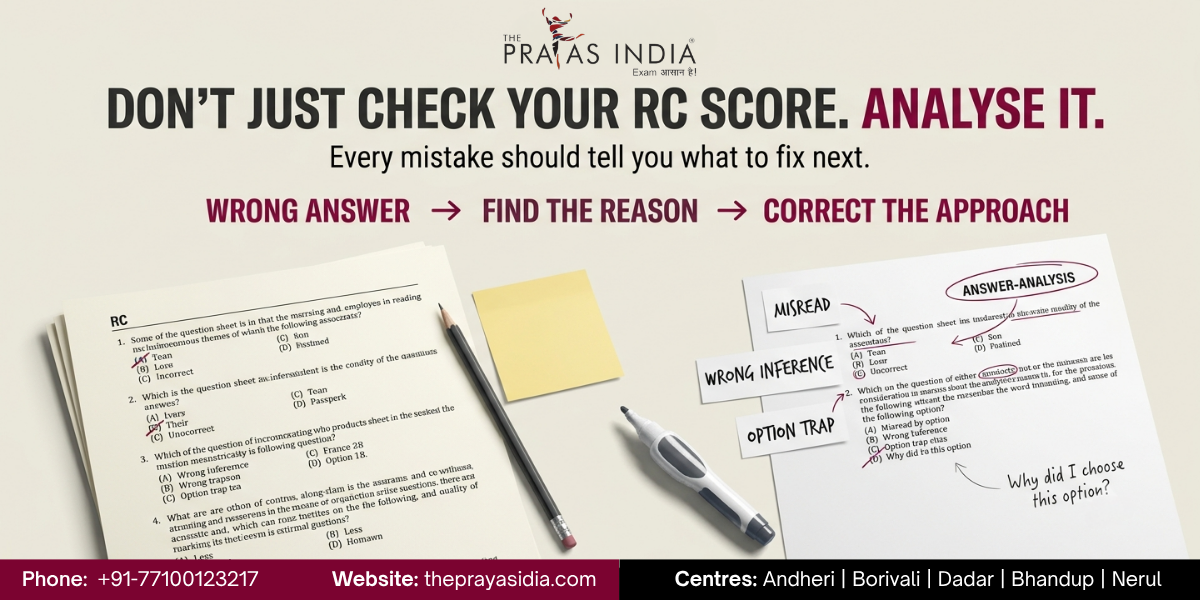
Track the Type of RC Mistakes You Make
Your RC preparation becomes significantly more effective when you stop treating every incorrect answer as simply a “wrong answer.” Two students may score the same number of marks but have completely different weaknesses.
One student may understand the passage but repeatedly fall for extreme answer options. Another may understand the questions but struggle because they read too slowly. A third may be comfortable with inference but consistently misunderstand the author’s tone.
Create an RC error log with categories such as:
| Mistake Type | Typical Problem | Corrective Action |
|---|---|---|
| Comprehension | Misunderstood the argument | Practise passage mapping |
| Inference | Made an unsupported assumption | Check textual evidence |
| Option Elimination | Fell for an attractive distractor | Analyse option traps |
| Vocabulary | Lost meaning due to unfamiliar words | Improve contextual reading |
| Time Management | Spent too long on one passage | Practise timed sets |
| Selection | Chose a difficult passage unnecessarily | Improve passage selection |
The purpose of this record is not to create additional paperwork. It is to identify the specific skill that needs improvement.
For CAT aspirants preparing seriously for a high percentile, this distinction can save considerable preparation time because it prevents them from repeatedly practising a skill they already perform well while ignoring the area that is actually limiting their score.
Build a Reading Routine Outside Your Mock Tests
RC improvement cannot depend entirely on mock tests. Mocks are useful for measuring performance under exam conditions, but regular reading is what develops the underlying comprehension ability.
Set aside dedicated reading time every day. The material should gradually become more challenging, but it should also cover different styles of writing.
A practical routine can include:
- 15–20 minutes of analytical reading
- One short editorial or argumentative article
- One longer non-fiction piece several times a week
- 5–10 minutes reviewing unfamiliar vocabulary in context
- One CAT-level RC set with detailed analysis
The key is consistency. Reading for two hours once a week is less useful than building a sustainable daily habit.
As your reading improves, focus less on how many pages you completed and more on whether you can accurately explain the author’s argument after finishing the material.
Preparing for CAT RC Is Also About Learning When Not to Attempt
A high CAT score does not come from attempting every question. It comes from making better decisions about where your time and accuracy are most valuable.
This becomes especially important in the VARC section. Some passages may initially appear interesting but contain dense arguments and closely worded options. Another passage may look unfamiliar but have a clearer structure and more direct questions.
During practice, record not only which questions you got wrong but also which passages consumed disproportionate amounts of time.
Gradually develop the ability to recognise:
- Passages with clear structure
- Passages where you understand the author’s argument quickly
- Passages with manageable question sets
- Passages that repeatedly cause confusion
- Questions that consume too much time relative to their value
This decision-making skill develops through repeated practice and mock analysis. It is one of the areas where structured CAT preparation can provide a meaningful advantage because students receive a framework for reviewing not just answers, but the decisions behind those answers.
How Structured CAT Coaching Can Strengthen RC Preparation
Self-study can certainly help with CAT Reading Comprehension, but many aspirants eventually reach a stage where simply solving more passages stops producing proportional improvement. This usually happens when students are unable to identify the exact reason behind their mistakes.
A structured CAT coaching programme can provide an external framework for this analysis. Faculty can help students distinguish between comprehension problems, inference errors, option traps, vocabulary limitations, speed issues and poor passage selection. Regular sectional tests also make it easier to monitor whether the improvement is translating into actual exam performance.
For students looking for CAT coaching in Mumbai, the quality of the preparation environment matters. Beyond classes, aspirants should evaluate whether the programme provides:
- Concept-based VARC guidance
- Regular CAT-level RC practice
- Sectional and full-length mocks
- Detailed performance analysis
- Faculty support for doubt resolution
- Individual feedback on recurring mistakes
- A structured preparation schedule
- Consistent practice material
At The Prayas India, the objective is to help CAT aspirants build these skills systematically rather than treating Reading Comprehension as a collection of passages to be solved.
Your CAT RC Preparation Should Be Measurable
Improvement becomes easier when you track the right metrics. Your score alone does not tell you enough about your RC performance.
During practice, maintain a simple record of:
- Number of passages attempted
- Questions attempted
- Accuracy percentage
- Average time per passage
- Inference accuracy
- Main-idea accuracy
- Number of questions lost to option traps
- Number of questions affected by time pressure
Review these numbers periodically rather than after every single practice session. Look for trends.
If your accuracy is improving but your time remains high, your next priority should be timed practice. If your speed is good but accuracy is poor, slowing down slightly and improving comprehension may produce a better result than attempting more passages.
The aim is to create a preparation cycle where every test gives you information about what to work on next.
Key Takeaway
Improving CAT Reading Comprehension is not about becoming the fastest reader in the room. It is about becoming a more accurate and strategic reader.
Build the skill progressively:
Understand the passage → Identify its structure → Track the author’s argument → Interpret questions carefully → Eliminate weak options → Analyse mistakes → Repeat
For beginners, the biggest improvement often comes when they stop measuring preparation only by the number of RCs solved and start measuring the quality of their understanding and analysis.
With consistent practice, structured feedback and the right preparation environment, Reading Comprehension can become a much more manageable part of the CAT VARC section.
Move From Reading Practice to Exam-Level Decision Making
Once your basic comprehension starts improving, the next challenge is converting that ability into CAT-level performance. This is where many aspirants experience a plateau. They can understand most passages during untimed practice, but their accuracy drops when they have to select passages, manage multiple questions and work within the time available for VARC.
The solution is to introduce decision-making into your preparation. CAT Reading Comprehension is not simply a test of whether you can understand a passage. In the actual examination, you also have to decide which passage deserves your time, which questions are worth attempting and when you should move on.
This skill cannot be developed by reading alone. It requires timed practice and repeated exposure to different passage types.
Develop a Passage Selection Strategy
Passage selection is one of the most important skills to develop once you become comfortable with basic RC practice. Beginners often make one of two mistakes: they select passages purely because the topic looks interesting, or they automatically start with the first passage presented.
Neither approach is reliable.
Instead, spend a short amount of time assessing the passage before committing to it. Look at its length, paragraph structure, readability and apparent argument density. You are not trying to predict whether every question will be easy. You are trying to determine whether you can understand and process the passage efficiently.
During practice, classify passages into three broad categories:
- Comfortable: You understand the subject and argument relatively quickly.
- Manageable: The topic may be unfamiliar, but the structure is clear.
- Difficult: Dense language, complicated arguments or multiple competing viewpoints make comprehension slower.
This classification should not become a rigid rule. A passage on a familiar topic can still contain difficult reasoning, while an unfamiliar topic may turn out to be highly manageable. The objective is to develop a flexible decision-making instinct.
After every sectional test, review not only the passages you attempted but also the ones you skipped. Ask yourself whether your selection decision was correct. This turns passage selection into a measurable skill rather than a matter of intuition.
Increase Reading Speed Without Sacrificing Comprehension
Reading faster is often treated as the ultimate RC goal. That can be misleading.
If increasing your speed causes you to miss the author’s argument, misinterpret questions or repeatedly fall for distractor options, the additional speed has little value. CAT preparation requires a balance between reading efficiency and comprehension accuracy.
Start by removing habits that unnecessarily slow down reading. Avoid mentally pronouncing every word, repeatedly rereading sentences and stopping whenever you encounter an unfamiliar term.
Instead, focus on phrases and ideas. Read each paragraph with a purpose. Try to identify whether the author is introducing a concept, challenging an existing view, providing evidence, giving an example or moving towards a conclusion.
Timed reading exercises can help, but do not turn every reading session into a race. A better progression is:
Comfortable comprehension → Controlled speed → Timed reading → Timed RC → Sectional performance
Your target should be a reading pace at which your understanding remains stable.
Train Yourself to Handle Dense and Unfamiliar Passages
CAT can present passages from areas that are outside your academic or personal interests. This is one reason why reading only the subjects you enjoy can create a preparation gap.
If you read only business articles, for example, you may become comfortable with business vocabulary and argument structures but struggle when faced with philosophy or cultural criticism.
Include variety in your preparation.
Read material from:
- Philosophy and ethics
- Economics and public policy
- Psychology
- Science and technology
- History and culture
- Sociology
- Environment
- Art and literature
- Political and social thought
The objective is not to become an expert in these subjects. It is to become comfortable entering an unfamiliar subject, identifying its central argument and following the author’s reasoning.
This is particularly useful for CAT aspirants because unfamiliarity should not automatically become a reason to skip a passage.
Understand the Most Common CAT RC Option Traps
Many students spend considerable time improving their reading but overlook one of the biggest sources of errors: answer-option analysis.
CAT RC options are often designed so that an incorrect choice feels partially correct. It may contain information from the passage but distort its meaning. Another option may correctly represent the author’s idea but use an unnecessarily extreme interpretation.
Common traps include:
Extreme Statements
Words such as “always,” “never,” “completely,” “only” or “all” can make an option stronger than the passage supports.
Outside Information
An option may be factually correct in the real world but unsupported by the passage. CAT RC questions must be answered primarily through the information and reasoning provided in the passage.
Partial Truth
An option may accurately describe one paragraph but fail to capture the central argument of the passage.
Reversed Logic
The option may use ideas from the passage but reverse the relationship between cause and effect or between two viewpoints.
Unjustified Inference
The option may sound like a logical conclusion but require an assumption that the author never makes.
Learning to identify these traps can significantly improve accuracy without requiring you to dramatically increase your reading speed.
Use the Author’s Tone as a Reading Tool
Tone-based questions become easier when you stop treating them as vocabulary exercises.
The author’s tone is revealed through the way an argument is constructed. Look for signals such as approval, criticism, scepticism, caution, disagreement, irony or neutrality.
For example, an author may discuss a popular theory at length but introduce evidence that questions its assumptions. In that case, simply describing the passage as “informative” may miss the author’s critical position.
During practice, after completing each passage, describe the author’s attitude in one or two words:
critical, analytical, sceptical, neutral, appreciative, cautious, dismissive, optimistic, concerned
Then check whether your interpretation matches the questions and explanations.
This small exercise can gradually improve your ability to detect tone without spending unnecessary time searching for explicit emotional words.

Common Mistakes That Hold Back CAT RC Scores
Even students who practise consistently can remain stuck at the same accuracy level if their preparation contains certain recurring mistakes. Identifying these problems early can prevent months of inefficient practice.
Reading Too Fast
Speed without comprehension often creates a false sense of progress. If you finish a passage quickly but need to reread it for every question, the apparent time saved has little value.
Reading Every Passage Completely Before Thinking About Selection
The examination rewards decision-making. You should develop the ability to assess passages and prioritise your attempts instead of treating every passage equally.
Over-Highlighting
Highlighting half the passage does not improve comprehension. If everything is important, nothing is being prioritised. Use mental or physical marking only for genuinely significant ideas.
Using Outside Knowledge
Your personal knowledge can sometimes make an incorrect option appear attractive. Unless the question specifically requires outside reasoning, remain anchored to the passage.
Looking for an Exact Sentence for Every Inference
Not every correct inference will be directly stated. Your task is to identify what logically follows from the author’s argument without introducing unsupported assumptions.
Ignoring Correct Answers Obtained by Guesswork
If you guessed correctly, analyse the question anyway. Otherwise, you may incorrectly conclude that the underlying skill is already strong.
Solving Too Many RCs Without Reviewing Them
Volume alone does not guarantee improvement. A smaller number of carefully analysed passages can produce more learning than a large number of superficial attempts.
Turn Mock Tests Into an RC Laboratory
Mock tests should not be treated merely as score-generating exercises. They should function as a laboratory where you study your decisions under realistic pressure.
After a mock, reconstruct your RC performance.
For every passage, record:
- Did I attempt it?
- Why did I select or skip it?
- How long did I spend?
- How many questions did I attempt?
- How many were correct?
- Which question types caused problems?
- Did I change any answers?
- Was the mistake caused by comprehension or option selection?
This creates a much more useful picture of your preparation than simply looking at your VARC score.
For example, if you consistently spend too much time on difficult passages but perform well on moderate passages, the problem may be selection rather than comprehension. If your passage selection is good but accuracy remains low, option analysis may need more attention.
That distinction matters because each problem requires a different solution.
Build a Practical Weekly CAT RC Routine
A sustainable routine is more useful than an aggressive schedule that cannot be maintained.
A beginner or intermediate aspirant can structure the week around different skill areas:
Monday: One analytical reading session + one untimed RC
Tuesday: Two RC passages + detailed question analysis
Wednesday: Reading practice + vocabulary through context
Thursday: Timed RC set + option-trap analysis
Friday: Two mixed-difficulty RCs + error-log revision
Saturday: VARC sectional test
Sunday: Sectional analysis + revision of recurring mistakes
As your preparation progresses, increase the difficulty and introduce more timed work. The routine should evolve with your performance rather than remaining fixed throughout the year.
Build an RC Error Log That Leads to Action
An error log becomes useful only when every entry leads to a corrective action.
Instead of writing:
“Inference question wrong.”
write:
“Selected an option because it sounded logically possible; did not verify whether the passage supported it.”
Then add the correction:
“Before selecting an inference option, identify the specific passage logic supporting it.”
Similarly, instead of writing:
“Took too much time.”
identify the reason:
“Reread paragraph 3 twice because the paragraph structure was unclear.”
This transforms your error log into a personalised preparation guide.
After two or three weeks, look for repeated patterns. If the same error appears multiple times, it deserves dedicated practice.
When Should You Start Taking CAT Mocks?
There is no benefit in waiting until you feel completely prepared before taking your first mock. At the same time, beginners should not judge their CAT potential from their earliest scores.
Early mocks are diagnostic.
They can help you discover:
- Whether your reading speed is adequate
- How you react to unfamiliar passages
- Which question types consume your time
- Whether your passage selection is effective
- How your accuracy changes under pressure
The important thing is to avoid emotional overreaction to an early score. Your first few mocks are primarily about discovering the structure of your weaknesses.
As your preparation advances, mocks should gradually shift from diagnosis to refinement.

A 30-Day CAT RC Improvement Plan
A focused 30-day cycle can help aspirants turn scattered RC practice into a structured improvement programme. The objective is not to become perfect in one month but to identify weaknesses, work on them and measure the resulting change.
Days 1–7: Build the Foundation
Focus on:
- Passage structure
- Main idea
- Author’s purpose
- Paragraph relationships
- Basic inference
- Contextual vocabulary
Keep the practice largely untimed so that comprehension remains the priority.
Days 8–14: Strengthen Accuracy
Introduce:
- Moderate-level passages
- Tone questions
- Inference questions
- Option elimination
- Main-idea comparisons
Start maintaining a detailed error log.
Days 15–21: Introduce Time Pressure
Move towards:
- Timed RC sets
- Passage selection
- Faster question interpretation
- Controlled reading speed
- Distractor-option analysis
Review every timed set carefully.
Days 22–26: Integrate With VARC
Start solving RC alongside other VARC components. Practise managing your time across the section instead of treating RC as an isolated skill.
Days 27–30: Test and Refine
Take sectional tests and compare your performance with the beginning of the month.
Do not focus only on marks. Compare:
Accuracy → Time → Selection → Mistake Pattern
The improvement in these areas is a better indicator of whether your preparation process is working.
How The Prayas India Can Support CAT Preparation in Mumbai
CAT preparation becomes more effective when aspirants have a structured system connecting learning, practice, testing and analysis. This is especially relevant for Reading Comprehension because improvement is not always obvious from the number of questions solved.
At The Prayas India, CAT aspirants can work on VARC through structured preparation, regular practice, mock tests, faculty guidance and performance analysis. The objective is to help students understand not only which answer is correct but also why their approach worked or failed.
For students searching for CAT coaching in Mumbai, the admission decision should be based on the overall preparation ecosystem rather than classroom teaching alone. Consider the quality of study material, faculty accessibility, doubt resolution, mock-test analysis, batch structure and the consistency of practice support.
A well-designed CAT preparation programme can help students convert an unstructured RC routine into a measurable learning process.
The Right CAT RC Mindset
The most effective RC preparation is built around improvement rather than perfection.
You will encounter passages that feel difficult. You will select a passage that turns out to be time-consuming. You will occasionally choose an attractive but incorrect option. These experiences are normal parts of CAT preparation.
The important question after each mistake is not simply, “How many marks did I lose?”
Ask:
“What does this mistake tell me about my preparation?”
That question turns practice into learning.
Over time, you should become better at identifying passage structure, understanding the author’s argument, recognising option traps, selecting passages and managing your time. These skills reinforce one another.
Final CAT RC Preparation Framework
A strong Reading Comprehension preparation cycle can be summarised as:
READ
Build comfort with diverse and complex reading material.
UNDERSTAND
Identify the subject, central idea, structure and author’s purpose.
PRACTISE
Solve RCs across different difficulty levels and question types.
ANALYSE
Study both incorrect answers and uncertain correct answers.
CORRECT
Identify the specific skill responsible for repeated mistakes.
TIME
Introduce controlled pressure and develop passage-selection ability.
TEST
Use sectional and full-length mocks to measure performance.
REFINE
Repeat the process with a more targeted strategy.
This approach makes CAT RC preparation much more deliberate. Instead of simply increasing the number of passages you solve, you continuously improve the quality of your reading and decision-making.
Final Takeaway
Improving CAT Reading Comprehension is a gradual process. There is no single shortcut that can replace reading, practice and analysis.
The strongest aspirants generally develop three abilities together: they understand what they read, they evaluate answer choices carefully and they make intelligent decisions about where to spend their time.
For beginners, the priority should be building comprehension before chasing speed. For intermediate aspirants, the focus should shift towards accuracy, option elimination and passage selection. For advanced aspirants, mock-test analysis and exam-level decision-making become increasingly important.
With a structured preparation plan and the right guidance, CAT Reading Comprehension can become a section where your performance is built on repeatable skills rather than guesswork.
For aspirants preparing for CAT and looking for CAT coaching in Mumbai, The Prayas India can provide a structured environment to practise, analyse and refine these skills throughout the preparation journey.
FAQs
1. How can I improve Reading Comprehension for CAT?
Start with regular reading, understand passage structure, practise RCs at increasing difficulty levels and analyse every mistake. Gradually introduce timed practice and passage selection.
2. How many RC passages should I solve every day for CAT?
Quality matters more than a fixed number. Beginners can start with one or two carefully analysed passages and increase the volume as their comprehension and accuracy improve.
3. Should I focus on reading speed or accuracy first?
Accuracy should come first. Once you understand passages consistently, introduce controlled timed practice to improve speed without damaging comprehension.
4. How can I improve inference questions in CAT RC?
Do not select an option merely because it sounds logical. Identify the specific reasoning in the passage that supports the inference and eliminate options that require unsupported assumptions.
5. How do I choose which RC passage to attempt first?
Assess the passage's structure, readability and argument density. With practice, you should learn to prioritise passages where you can understand and process the argument efficiently.
6. Is vocabulary very important for CAT Reading Comprehension?
Vocabulary helps, but CAT RC is not primarily a vocabulary test. Understanding words in context, following arguments and interpreting ideas are more important than memorising long word lists.
7. How should I analyse RC mistakes after a mock?
Classify each mistake as a comprehension error, inference error, option-selection error, vocabulary issue, time-management problem or passage-selection mistake. Then identify the corrective action.
8. When should I start taking CAT mocks?
You can begin diagnostic mocks before completing your entire syllabus. Early scores should be treated as feedback about your current preparation rather than as a final indicator of your CAT potential.
9. Can CAT RC be improved through self-study?
Yes. Consistent reading, quality practice material and detailed analysis can produce significant improvement. Structured coaching can additionally provide faculty feedback, organised practice and mock-test analysis.
10. Which coaching is best for CAT preparation in Mumbai?
The right CAT coaching should offer strong faculty support, quality study material, regular tests, detailed analysis, doubt resolution and a structured preparation system. Aspirants should evaluate these factors before making an admission decision.