
How to Improve MBA CET Verbal Ability Score in 2026 | Best MBA CET Coaching in Mumbai | The Prayas India
MBA CET Verbal Ability is often treated as the easiest section to prepare because many questions are based on familiar English concepts. But in an exam where speed, question selection and accuracy matter, simply knowing grammar rules or reading passages occasionally is not enough.
For MBA CET 2026, the Verbal Ability and Reading Comprehension section carries 50 questions for 50 marks. The official pattern also states that the examination has no negative marking.
That changes the way you should approach the section.
You need to build three things together:
Language Skills + Reading Speed + Question-Solving Efficiency
A student with strong English but poor time management may still leave easy questions.
On the other hand, a student with average English can significantly improve their score through consistent practice and smart question selection.
So, how should you prepare?
Start by Understanding What MBA CET Tests
The first step towards improving your Verbal Ability score is understanding what the section actually tests.
The official syllabus description includes areas such as:
- Reading comprehension
- Grammar
- Vocabulary
- Sentence completion
- Synonyms and antonyms
- Understanding passage content
- Appropriate words, phrases and expressions
This means your preparation cannot depend on only one activity.
Reading novels, for example, may improve general reading ability, but it will not automatically prepare you for every type of CET question.
Similarly, memorising hundreds of vocabulary words without seeing them in context may have limited value.
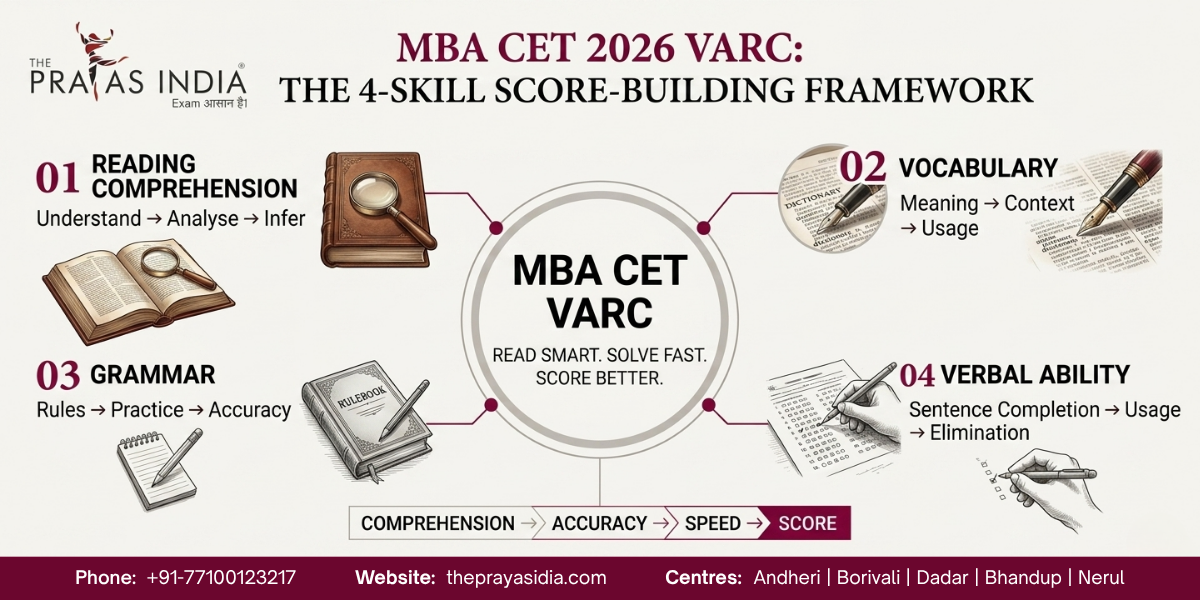
A better approach is to divide preparation into four skill areas:
1. Reading Comprehension
Understand passages quickly and accurately.
2. Vocabulary
Improve word meaning, usage and contextual understanding.
3. Grammar
Recognise errors and understand sentence structure.
4. Verbal Reasoning & Usage
Work on sentence completion, expressions, arrangement and related language-based questions.
This gives your preparation a clear structure.
Make Reading Comprehension a Daily Habit
If you want to improve your MBA CET VARC score, reading cannot be an occasional activity.
You need to read regularly.
But there is an important difference between reading for entertainment and reading for exam preparation.
When you read for CET, actively think about:
What is the main idea?
Why has the author written this?
What is the tone?
Which statement best represents the passage?
What is the author’s conclusion?
Which option is supported by the passage?
This turns reading into an active exercise.
Start with manageable passages from newspapers, magazines, editorials and quality online publications.
Don’t worry if your reading speed is initially slow.
The objective is to gradually improve both comprehension and speed.
Learn to Identify the Main Idea Quickly
One of the most useful RC skills is identifying the central idea of a passage.
Many students read every sentence with equal attention.
That can consume unnecessary time.
Instead, while reading, ask:
“What is this passage really trying to tell me?”
A passage may discuss several examples, arguments and supporting points, but usually there is a central idea connecting them.
For example, a passage might discuss:
- The growth of artificial intelligence
- Changes in workplace roles
- New employment opportunities
- Concerns about automation
The central idea may not be simply “AI is changing jobs.”
The author could actually be arguing that technological change is reshaping jobs rather than simply eliminating them.
Recognising this distinction helps with main-idea and inference questions.
Don’t Read Every RC the Same Way
Different passages require different levels of attention.
Some may be straightforward and factual.
Others may involve complex arguments or unfamiliar subjects.
Your first objective should be to understand the structure and purpose of the passage.
While reading, identify:
Topic
What is the passage about?
Purpose
Why is the author discussing it?
Argument
What is the author trying to establish?
Tone
Is the author critical, analytical, neutral, optimistic, sceptical or descriptive?
Conclusion
What does the passage ultimately suggest?
Once you develop this habit, you don’t need to treat every sentence as an isolated piece of information.
You start reading the passage as an argument.
Improve RC Accuracy Before Chasing Speed
Speed is important in MBA CET.
But trying to read extremely fast before developing comprehension can actually hurt your score.
Suppose you read a passage in two minutes but misunderstand its central argument.
You may then spend another two or three minutes struggling with questions.
The time saved during reading disappears.
Therefore, use this progression:
Accuracy → Comprehension → Speed
Start by understanding passages correctly.
Then gradually reduce the time required.
A useful practice method is:
Week 1–2
Focus mainly on comprehension.
Week 3–4
Introduce moderate time limits.
After that
Practise passages under realistic exam conditions.
This approach develops controlled speed rather than rushed reading.
Build a Context-Based Vocabulary
Vocabulary is important for MBA CET, but you don’t need to turn preparation into a memorisation marathon.
Instead of trying to learn hundreds of unrelated words every week, learn words in context.
For example, if you encounter the word “pragmatic” in an article, don’t simply memorise:
Pragmatic = practical
Also note how it is used.
Then create your own sentence.
Similarly, when learning a word, try to remember:
- Meaning
- Synonym
- Antonym
- Usage
- Common phrases
- Context
This makes the word easier to recognise during the examination.
Use a Smart Vocabulary Notebook
A simple vocabulary notebook can become extremely useful during MBA CET preparation.
Instead of creating long dictionary-style entries, keep them compact.
For example:
Word: Reluctant
Meaning: Unwilling
Synonym: Hesitant
Antonym: Willing
Usage: He was reluctant to accept the proposal.
Then revise the notebook regularly.
You can divide words into categories:
- Frequently encountered words
- Difficult words
- Synonyms & antonyms
- Confusing words
- Idioms & expressions
- Words learnt from RCs
The last category is particularly useful because it connects vocabulary learning with actual reading.
Strengthen Grammar Through Patterns
Grammar preparation should not become an exercise in memorising hundreds of rules.
You need to recognise patterns of correct and incorrect usage.
Focus on areas such as:
- Subject-verb agreement
- Tenses
- Articles
- Prepositions
- Pronouns
- Modifiers
- Conjunctions
- Parallelism
- Sentence structure
- Active and passive voice
- Common grammatical errors
Once you understand the underlying rule, solve several questions based on that rule.
For example:
Learn the concept → Solve 10–15 questions → Analyse errors → Revise → Retest
This is much more effective than simply reading grammar theory repeatedly.
Don’t Ignore Sentence-Based Questions
Students preparing primarily for RCs sometimes overlook other verbal questions.
That can be a mistake.
Sentence completion, vocabulary-based questions, grammar-based questions and expressions can often be quicker to solve than lengthy passages.
These questions can therefore become useful time-saving opportunities.
During practice, record the average time you need for different question types.
For example:
| Question Type | Target |
|---|---|
| Vocabulary | Quick recognition |
| Grammar | Rule-based solving |
| Sentence Completion | Context + elimination |
| RC | Comprehension + inference |
| Usage/Expression | Contextual understanding |
The exact time target will vary from student to student.
The important thing is to discover which questions are your fastest scoring opportunities.
Practise Question Selection, Not Just Question Solving
This is one of the most important differences between preparation and exam preparation.
When practising, you may try to solve every question.
In the actual exam, you need to identify which questions deserve your time.
For example, suppose you see:
Question A: Familiar vocabulary, clear options
Question B: Long and confusing RC inference
Question C: Straightforward grammar error
Question D: Difficult passage with two uncertain options
If you spend excessive time on Question B before securing A and C, you may lose easy marks.
Therefore, train yourself to ask:
Can I solve this confidently within reasonable time?
If yes, attempt it.
If not, move forward and return later if appropriate.
Since MAH-MBA/MMS CET has no negative marking, candidates can also use the absence of negative marking strategically, while still avoiding careless solving.
The objective is not simply maximum attempts.
It is maximum useful attempts within the available time.
Turn Every Practice Session Into an Analysis Session
Simply solving 50 verbal questions doesn’t guarantee improvement.
After practice, ask:
Which questions did I get wrong?
Why did I get them wrong?
Was the problem vocabulary, grammar, comprehension or interpretation?
Did I spend too much time?
Could I have eliminated options faster?
This analysis helps identify patterns.
If you repeatedly make mistakes in inference questions, you need more inference practice.
If vocabulary questions consume too much time, improve contextual vocabulary.
If grammar questions are consistently wrong, revisit the relevant concepts.
Your preparation should therefore follow:
Practice → Analyse → Correct → Repeat
Takeaway
Improving your MBA CET Verbal Ability score in 2026 is not about becoming an English expert overnight.
It is about developing the specific skills the examination rewards:
Reading comprehension
Vocabulary
Grammar
Question selection
Speed
Accuracy
Start by strengthening the basics, make reading a daily habit and practise different verbal question types regularly.
Learn the Art of Option Elimination
You don’t always need to know the answer immediately.
Sometimes, the fastest way to reach the correct answer is to eliminate the wrong options.
This is especially useful in:
- Reading Comprehension
- Vocabulary
- Sentence completion
- Grammar
- Inference questions
Suppose an RC question has four options.
You may not immediately know which one is correct.
Instead, ask:
Which option contradicts the passage?
Which option is too extreme?
Which option introduces information not mentioned in the passage?
Which option only partially answers the question?
Removing two clearly incorrect options can make the final decision much easier.
This is a skill that improves with practice.
Be Careful With Extreme Options
In RC questions, options containing words such as:
- Always
- Never
- Completely
- Only
- All
- None
- Impossible
should be examined carefully.
They are not automatically wrong.
But if the passage makes a moderate argument and an option converts it into an absolute statement, that option deserves scrutiny.
For example, if the passage says:
Technology can significantly change certain jobs.
An option stating:
Technology will completely eliminate all jobs.
goes much further than the original argument.
This distinction between what the passage says and what the option exaggerates is extremely important.
Understand the Difference Between Inference and Assumption
Many RC mistakes happen because students choose an option that sounds logical but is not actually supported by the passage.
An inference must be reasonably derived from the information given.
An assumption, on the other hand, may introduce an idea that the reader personally believes.
Consider this simple example:
A passage discusses increasing online education and says that digital platforms have made learning resources more accessible.
A valid inference could be:
Digital platforms have increased access to educational resources.
But saying:
Online education is always better than classroom education
would introduce a much broader claim that the passage may never support.
The key question is:
“Can I justify this option using the passage?”
If the answer is no, be careful.
Don’t Overanalyse Simple Questions
There is another problem that can reduce your MBA CET score: overthinking.
Sometimes students identify the correct answer quickly but then start looking for hidden meanings.
This can waste valuable time.
If:
- The grammar rule is clear
- The vocabulary meaning is obvious
- The sentence completion has one strong contextual answer
- The RC option is directly supported
move ahead.
Not every question requires deep analysis.
A good MBA CET candidate knows not only how to solve a question, but also when to stop solving it.
15. Build a Section-Wise Time Strategy
Time management should be developed during practice, not invented on exam day.
Since the overall examination is time-bound, you should experiment with different approaches during mocks.
For example, you can test:
Approach A: Verbal first → Reasoning → Quant
Approach B: Reasoning first → Verbal → Quant
Approach C: Quant first → Verbal → Reasoning
There is no universal sequence that works for everyone.
Your goal is to identify the order in which you perform most efficiently.
If Verbal is one of your stronger areas, starting with it may allow you to collect several quick marks early.
If you need more time for RCs, you may prefer completing them before mental fatigue increases.
Test different approaches before finalising your strategy.
Create a Two-Level RC Strategy
Not every RC passage should be approached identically.
A useful strategy is to divide RCs into two levels.
Level 1: Comfortable Passages
These have:
- Familiar language
- Clear structure
- Straightforward questions
- Easy-to-follow arguments
Try to solve these efficiently.
Level 2: Difficult Passages
These may contain:
- Dense arguments
- Unfamiliar subjects
- Complex vocabulary
- Closely related answer choices
Don’t get trapped.
If a passage is consuming too much time, move to another available question and return later.
This is where question selection becomes more important than simply reading ability.
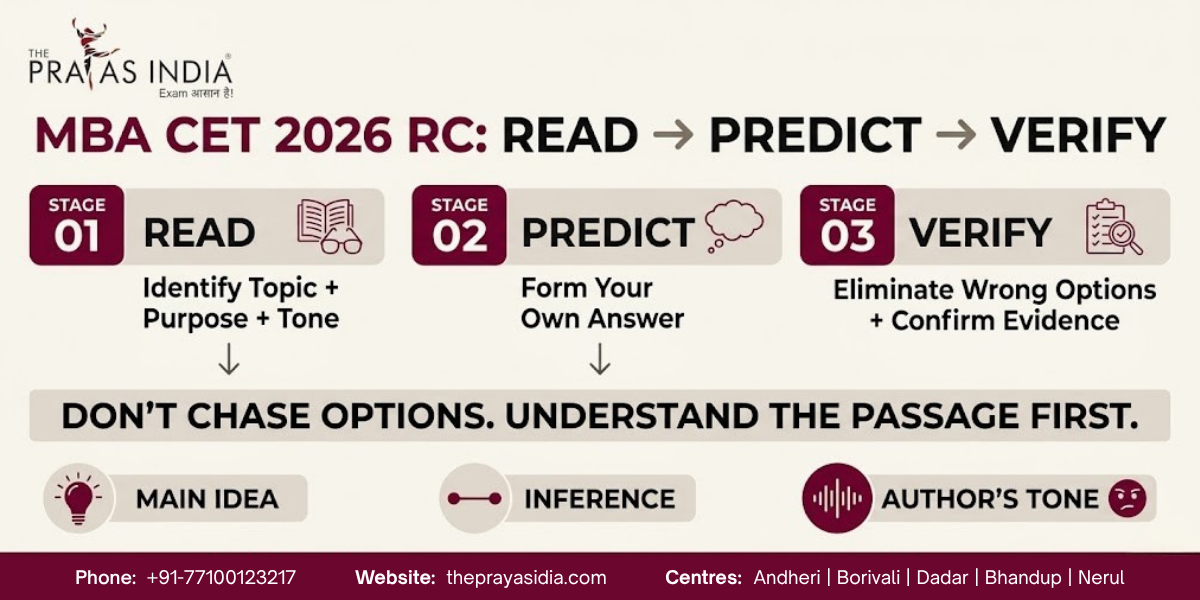
Use the “Read, Predict, Verify” Method
A useful way to approach RC questions is:
Read
Understand what the passage is saying.
Predict
Before looking deeply at the options, form a rough idea of what the answer should contain.
Verify
Compare your understanding with the options.
This reduces the chances of getting distracted by attractive but incorrect choices.
For example, if the question asks for the author’s main argument, first identify the argument yourself.
Then examine the options.
The correct option will usually align with the author’s actual position rather than simply repeating an isolated sentence from the passage.
Make Mock Tests Part of Your VARC Preparation
Mock tests should not be reserved for the final weeks.
Start sectional tests once you have covered the basic concepts.
Initially, don’t worry if your score isn’t where you want it to be.
Your first objective is to understand:
- Which question types take the most time?
- Which RCs cause difficulty?
- Where do you make repeated mistakes?
- How quickly can you solve grammar questions?
- How much time do you spend on vocabulary?
- Are you changing correct answers unnecessarily?
As your preparation improves, move towards full-length mocks.
The objective should be:
Test → Analyse → Improve → Retest
Analyse Your Mock Tests Properly
A mock-test score alone doesn’t tell you everything.
Suppose you score 35/50.
That sounds useful.
But what if you spent excessive time on RCs and guessed several questions?
The score doesn’t explain the complete picture.
After each mock, record:
| Metric | What to Check |
|---|---|
| Attempts | How many questions did you attempt? |
| Correct | How many were genuinely correct? |
| Wrong | Which question types caused errors? |
| Time | Where did you lose time? |
| Accuracy | Is it improving? |
| Selection | Did you choose the right questions? |
Then classify your errors.
Knowledge Gap
You didn’t know the concept.
Interpretation Error
You misunderstood the question or passage.
Silly Mistake
You knew the answer but made an avoidable error.
Time Pressure
You rushed because you spent too much time elsewhere.
This analysis is far more valuable than simply checking your score.
Maintain a VARC Error Log
Create a simple document or notebook specifically for mistakes.
For every important error, write:
Question Type
What I Chose
Correct Answer
Why My Answer Was Wrong
What I Should Have Noticed
Over time, patterns will emerge.
You may discover that:
- You frequently misread inference questions.
- You struggle with vocabulary in context.
- You spend too long on difficult RCs.
- You make repeated grammar errors.
- You change correct answers unnecessarily.
Once the pattern becomes visible, improvement becomes much easier.
Improve Speed Without Sacrificing Accuracy
Speed should never mean rushing.
Suppose your current accuracy is 80%.
If you increase your speed and your accuracy drops to 60%, the strategy has not improved.
Instead, work towards controlled speed.
Use timed practice in stages:
Untimed Practice → Moderate Time Limit → Strict Time Limit → Full Mock
This gives your brain time to develop familiarity before adding pressure.
For RCs, try timed passage sets.
For grammar and vocabulary, use short rapid-fire sets.
For mixed VARC practice, recreate the pressure of the actual examination.
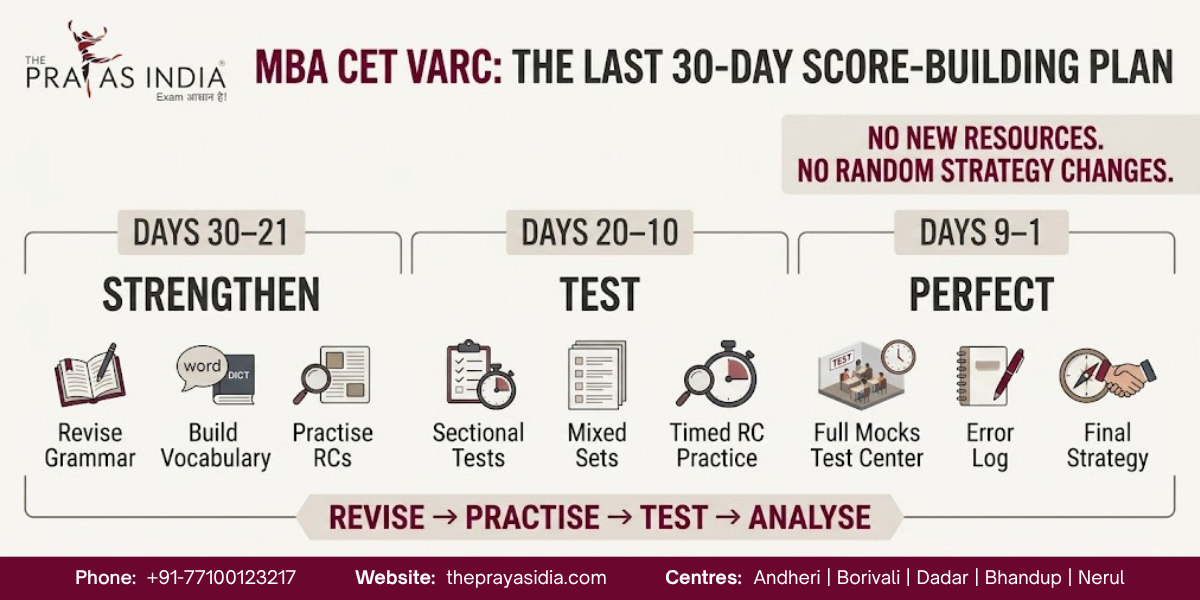
What Should You Do in the Last 30 Days?
The final month should not become a period of endless new learning.
Your priority should shift towards:
Revision
Review vocabulary, grammar rules and important concepts.
Practice
Solve mixed question sets and previous-year-style questions.
Mock Tests
Increase the frequency of timed tests.
Analysis
Identify your final weak areas.
Strategy
Finalise your question-selection and time-management approach.
Avoid constantly switching between books, teachers, apps and test series.
At this stage, consistency is more valuable than collecting new resources.
When Should You Consider MBA CET Coaching?
Self-study can work if you have:
- Strong fundamentals
- Good study discipline
- Access to quality resources
- A reliable test series
- The ability to analyse your own performance
But some students struggle to maintain all these elements independently.
This is where structured coaching can become useful.
A good MBA CET coaching programme should not simply provide lectures.
It should help students with:
Concept Building
Exam-Oriented Practice
Mock Tests
Performance Analysis
Doubt Resolution
Time Management
Mentorship
The objective is to reduce the amount of time students spend figuring out what to study and allow them to focus more on actual preparation.
Choosing the Best MBA CET Coaching in Mumbai
If you are searching for the Best MBA CET Coaching in Mumbai, don’t make the decision only on advertisements or popularity.
Evaluate the programme based on the support it provides throughout your preparation.
Ask:
Is the teaching exam-oriented?
Understanding concepts is important, but MBA CET preparation should eventually translate into faster question solving.
Are regular tests provided?
Testing should be a consistent part of the programme rather than something introduced at the end.
Is performance analysed?
A test without meaningful analysis has limited value.
Are doubts addressed?
Students should have access to guidance when they get stuck.
Is the preparation structured?
A clear roadmap can prevent random studying.
Does the institute understand MBA CET’s speed-oriented nature?
The strategy required for MBA CET is not necessarily identical to the strategy required for CAT.
This distinction matters when selecting coaching.

Why Structured Preparation Can Make a Difference
MBA CET preparation involves multiple moving parts.
You need to manage:
Syllabus
Practice
Mocks
Revision
Speed
Accuracy
Question Selection
Doing everything independently is possible, but it can become difficult to maintain consistency.
A structured coaching environment can provide a defined preparation cycle:
Learn → Practise → Test → Analyse → Improve
For students who perform better with deadlines, classroom discipline and regular evaluation, this structure can be particularly useful.
The important point is that coaching should support your preparation—not replace your effort.
You still need to practise independently, revise regularly and analyse your performance.
Final Strategy: Turn VARC Preparation Into a Score-Building System
Improving your MBA CET Verbal Ability score is ultimately about converting individual skills into a repeatable process.
Start with reading.
Build contextual vocabulary.
Strengthen grammar.
Practise different question types.
Learn elimination.
Develop RC comprehension.
Then introduce timed practice.
After that, move towards sectional tests and full-length mocks.
And most importantly, analyse your performance after every serious test.
Your preparation cycle should look like:
READ → PRACTISE → TEST → ANALYSE → IMPROVE → REPEAT
Don’t measure your preparation only by the number of chapters completed.
Measure it through:
- Accuracy
- Time per question
- RC comprehension
- Mock performance
- Mistake reduction
- Question selection
For aspirants targeting MBA admissions through MAH MBA/MMS CET, choosing the right preparation environment can also make the process more structured. If you are looking for MBA CET Coaching in Mumbai, evaluate institutes based on faculty, practice support, mock tests, analysis and mentorship rather than simply choosing the most visible name.
Conclusion
A strong MBA CET Verbal Ability score does not require perfect English.
It requires consistent reading, smart practice and efficient decision-making.
The biggest improvement often comes when you stop treating every question equally.
Solve the easy questions quickly.
Use elimination when necessary.
Don’t get trapped inside difficult RCs.
Analyse every mock.
Maintain an error log.
And gradually build the speed required for the examination.
With the right strategy and consistent practice, your VARC preparation can become one of the strongest parts of your overall MBA CET performance.
Read smart. Practise consistently. Analyse honestly. Improve continuously.
That is the approach that can help you turn MBA CET VARC preparation into a more focused score-building process.
Contact Us
📞 Call Now: +91-77100 13217
🌐 Website: theprayasindia.com