How to Improve Reasoning for SBI Clerk and IBPS Clerk | Best Banking Coaching in Mumbai | The Prayas India
Reasoning Ability is one of the sections where smart preparation can create a significant difference in bank exam performance. For aspirants preparing for SBI Clerk and IBPS Clerk, the challenge is usually not limited to understanding individual reasoning concepts. The bigger challenge is learning how to recognise patterns quickly, choose the right questions, manage time and maintain accuracy while solving a mixed set under examination pressure.
Many candidates begin their preparation by solving large numbers of questions. While practice is essential, simply increasing the number of questions does not guarantee improvement. If the same mistakes are repeated, lengthy methods are used or too much time is spent on questions that should have been skipped, practice may not translate into better scores.
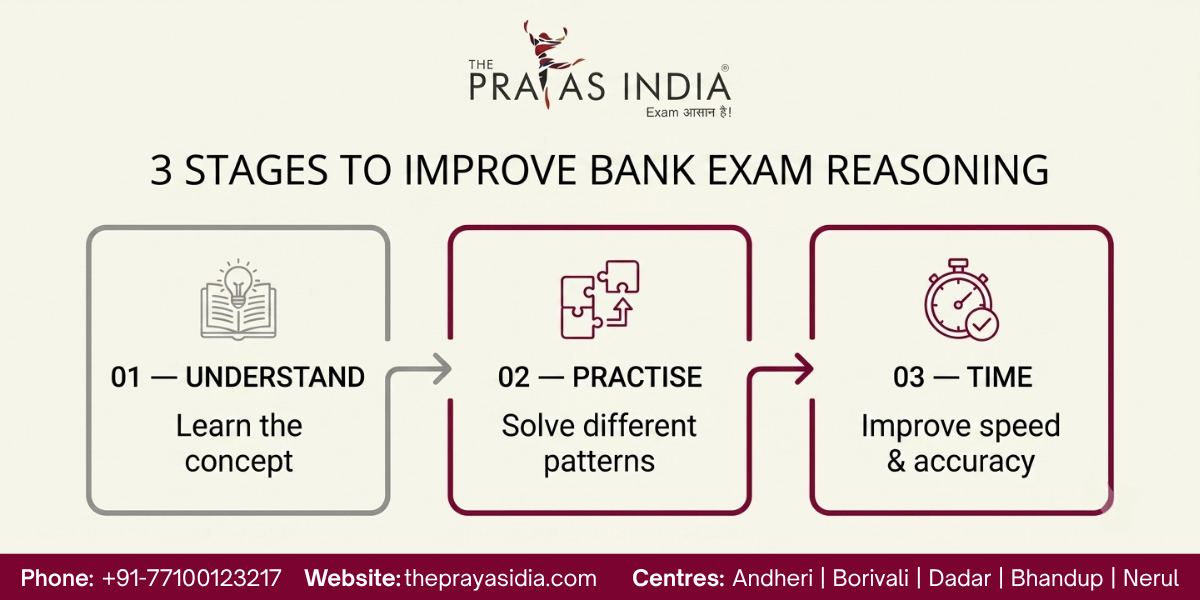
A more effective approach is to build reasoning preparation in stages. First, develop clarity about the underlying concepts. Then practise different question types until their structures become familiar. Once the basics become comfortable, introduce timed practice and sectional tests. Finally, use mock-test analysis to identify where your reasoning performance is actually breaking down.
For aspirants targeting SBI Clerk or IBPS Clerk, reasoning should therefore be treated as a skill that develops through structured repetition, rather than a section that can be mastered by memorising shortcuts alone.
Understanding What Makes Bank Exam Reasoning Different
Reasoning questions in banking examinations often test your ability to process information and make deductions within a limited amount of time. You may understand the logic behind a question perfectly, but if you take too long to organise the information, your performance can still suffer.
This is why reasoning preparation has two parallel objectives. The first is to become capable of solving different question types correctly. The second is to become efficient enough to solve them without allowing one question or set to consume an unreasonable amount of your available time.
This distinction becomes particularly important in SBI Clerk and IBPS Clerk preparation. A candidate may be strong in puzzles but comparatively slow in inequality or syllogism questions. Another candidate may solve individual questions quickly but struggle when multiple conditions are introduced in a puzzle. Both students need different preparation strategies.
Your objective should therefore be to identify your personal reasoning profile rather than assuming that every aspirant needs to practise in exactly the same way.
Start With the Fundamentals Instead of Chasing Shortcuts
One of the most common mistakes in reasoning preparation is searching for tricks before understanding the underlying concept.
Shortcuts can certainly help once you are comfortable with a question type. However, a shortcut cannot replace conceptual understanding. If you do not know why a particular approach works, it becomes difficult to adapt when the question is presented in a slightly different format.
For example, when preparing topics such as syllogism, inequality, coding-decoding or blood relations, first understand the logic that connects the information. Once you can solve standard questions comfortably, you can start identifying faster methods and recurring patterns.
This approach also makes revision easier because you are not trying to remember dozens of disconnected rules. Instead, you understand the structure behind them.
A strong foundation should help you answer three questions whenever you encounter a new problem:
- What information has been given?
- What relationship or pattern does that information create?
- What exactly is the question asking me to establish?
Once these become natural, your solving process becomes faster without depending entirely on memorised tricks.
Divide Reasoning Into Question Families
Instead of treating Reasoning Ability as one large subject, divide it into smaller families of questions.
This allows you to identify which areas require conceptual learning, which require repeated practice and which are primarily dependent on speed.
A useful preparation framework can include:
| Question Family | Examples | Primary Skill |
|---|---|---|
| Basic Logic | Inequality, Syllogism | Deduction |
| Relationship-Based | Blood Relations, Direction Sense | Visualisation |
| Pattern-Based | Coding-Decoding, Alphanumeric Series | Pattern Recognition |
| Arrangement-Based | Seating Arrangement, Order & Ranking | Organisation |
| Puzzle-Based | Floor, Box, Scheduling Puzzles | Multi-condition Reasoning |
| Miscellaneous | Input-Output, Data Sufficiency | Analytical Thinking |
This classification makes your preparation more manageable.
If you are consistently performing well in basic logic but struggling with puzzles, you do not need to restart your entire reasoning preparation. You need to allocate more targeted practice to the areas where your performance is weaker.
Build Speed Through Familiarity, Not Rushing
Speed is one of the most misunderstood aspects of bank exam reasoning.
Many aspirants try to increase speed by simply forcing themselves to solve questions faster. This can produce the opposite result because rushing often increases calculation mistakes, misreading and incorrect deductions.
A better way to improve speed is to develop familiarity with recurring structures.
When you solve enough questions from a particular topic, you begin to recognise what kind of information matters immediately. You also become familiar with common ways in which questions are framed.
For instance, in a seating arrangement, an experienced candidate may quickly identify whether the information is sufficient to create a workable arrangement. A beginner may repeatedly reread the same conditions before starting.
That difference is not necessarily intelligence. It is often the result of exposure.
This is why consistent practice should gradually reduce the time you spend understanding the structure of a question.
The Right Way to Practise Puzzles
Puzzles deserve special attention because they can consume a significant amount of preparation time and examination time.
A common approach is to solve as many puzzles as possible without analysing how the solution was reached. This may improve exposure but does not necessarily improve efficiency.
Instead, begin by understanding the structure of each puzzle. Before making a table, diagram or arrangement, read all the conditions carefully and identify what type of information you have.
Ask yourself whether the puzzle has a clear starting point. Identify fixed information, direct relationships and conditions that can reduce the number of possibilities.
As your experience increases, you will begin to recognise which pieces of information should be used first.
This is where puzzle preparation becomes more than solving. You are training yourself to organise information efficiently.
If you get stuck, do not immediately look at the solution. First identify exactly where your reasoning stopped working. After reviewing the solution, try to reconstruct the entire puzzle independently. This second attempt is often more useful than simply reading the explanation.
Don’t Solve Every Puzzle You See
Another important reasoning skill is set selection.
In a timed examination, not every puzzle deserves immediate attention. Some may be straightforward once you understand the arrangement, while others may require multiple cases and consume substantial time.
During practice tests, start observing the signals that distinguish the two.
A puzzle may be worth attempting early when the conditions are relatively direct, the arrangement is familiar and you can identify a clear starting point.
A puzzle may deserve lower priority when the conditions are highly interconnected, multiple cases appear necessary or you are struggling to establish the basic framework.
This does not mean difficult puzzles should be permanently avoided. It means you should understand that timing matters.
A candidate who can solve a difficult puzzle but chooses the wrong time to attempt it may still lose valuable marks elsewhere.
Practise Individual Questions Before Moving to Full Sets
When learning a new reasoning topic, start with individual questions.
This helps you understand the basic logic without simultaneously worrying about speed and set selection.
Once you become comfortable, move towards mixed sets.
This transition is important because the examination does not tell you which questions belong to your strongest topics. You need to identify them yourself.
A good progression is:
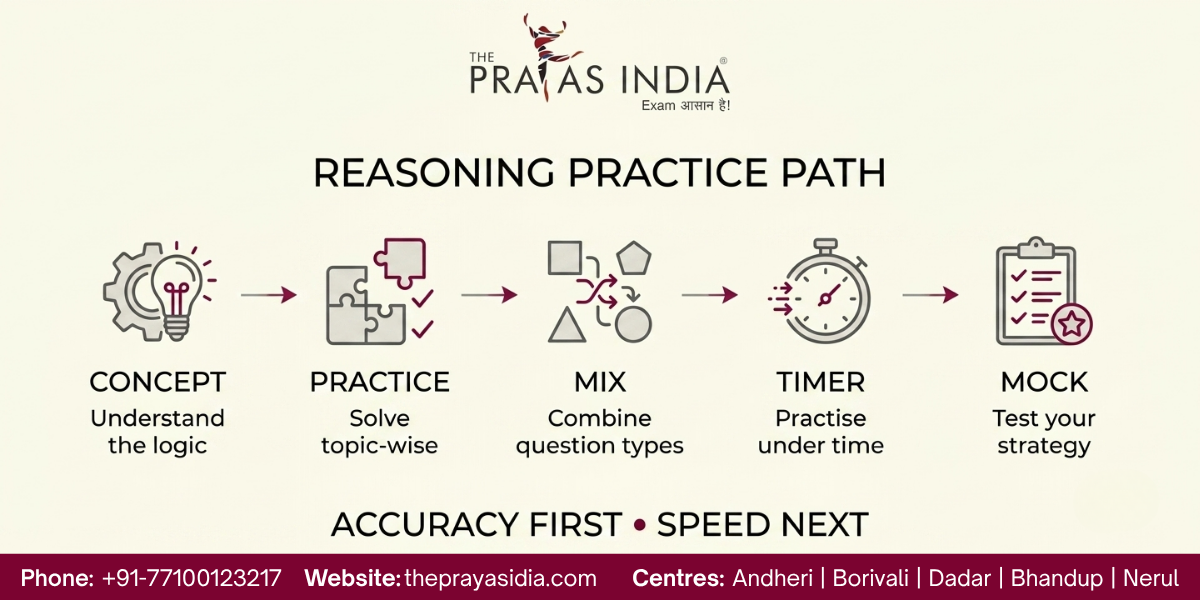
Concept → Basic Questions → Moderate Questions → Mixed Practice → Timed Sets → Sectional Tests → Full Mocks
Each stage serves a different purpose.
Concept learning builds understanding. Basic practice develops familiarity. Moderate questions test application. Mixed practice develops recognition. Timed sets build speed. Sectional tests test consistency. Full mocks bring everything together under realistic conditions.
Skipping these stages and jumping directly into difficult mocks can create unnecessary frustration.
Use Timed Practice to Change the Way You Think
Once your fundamentals are reasonably strong, start introducing time limits.
However, timed practice should not simply mean putting a stopwatch next to every question.
Initially, use time limits to understand your current pace.
For example, complete a set without obsessing over speed and record how long you take. Then repeat similar sets and try to improve your efficiency without sacrificing accuracy.
Gradually, you should become comfortable making decisions while the clock is moving.
This includes deciding whether to attempt a question, whether to continue with a puzzle and whether your current approach is working efficiently.
The goal is to make time awareness a natural part of your reasoning process.
Accuracy Must Come Before Aggressive Speed Improvement
Speed without accuracy can be misleading.
Suppose you solve 30 questions in a short period but make several avoidable mistakes. Your attempt count may look impressive, but your actual score may not reflect it.
For bank exams, the better objective is to develop controlled speed.
First establish that you can solve a question correctly. Then improve the method. Then reduce the time gradually.
If you notice that your accuracy drops sharply whenever you try to increase speed, slow down and identify why.
Are you reading the conditions incorrectly?
Are you skipping steps?
Are you making assumptions?
Are you rushing through answer options?
Are you using a shortcut without understanding it?
The answer will determine how you should modify your practice.
How to Improve Syllogism, Inequality and Other High-Accuracy Topics
Some reasoning topics can become valuable scoring opportunities once their underlying logic is clear.
Syllogism, inequality, direction sense and blood relations, for example, often reward structured thinking and repeated practice.
Instead of spending hours solving random questions, practise these topics in focused batches.
Begin with standard formats and gradually introduce variations.
Your objective should be to reach a stage where reading the question immediately activates the correct method in your mind.
However, avoid turning preparation into mechanical memorisation. If the question format changes, you should still be able to reason through it.
The real sign of improvement is not that you can remember a particular trick. It is that you can recognise the logical structure quickly.
Key Takeaway
Improving Reasoning Ability for SBI Clerk and IBPS Clerk requires more than solving a large number of questions. The real improvement comes when your practice starts changing the way you approach problems.
Build your concepts before chasing shortcuts. Divide the syllabus into manageable question families so that you can identify specific weaknesses. Practise individual questions while learning a topic, then gradually move towards mixed sets and timed practice. Most importantly, learn to recognise which questions and puzzles deserve your time.
Speed should develop through familiarity rather than rushing, and accuracy should remain the foundation of that speed. If your attempt rate increases but your mistakes increase at the same time, the solution is not simply to practise faster. You need to understand where your decision-making or solving process is breaking down.
For aspirants preparing for SBI Clerk and IBPS Clerk, reasoning can become a strong scoring area when preparation is systematic and performance is reviewed regularly.
Turn Every Reasoning Mistake Into a Learning Opportunity
When you get a reasoning question wrong, it is tempting to check the answer, understand the explanation and move ahead. This approach may help you complete more questions, but it does not necessarily improve your performance.
Instead, classify your mistakes.
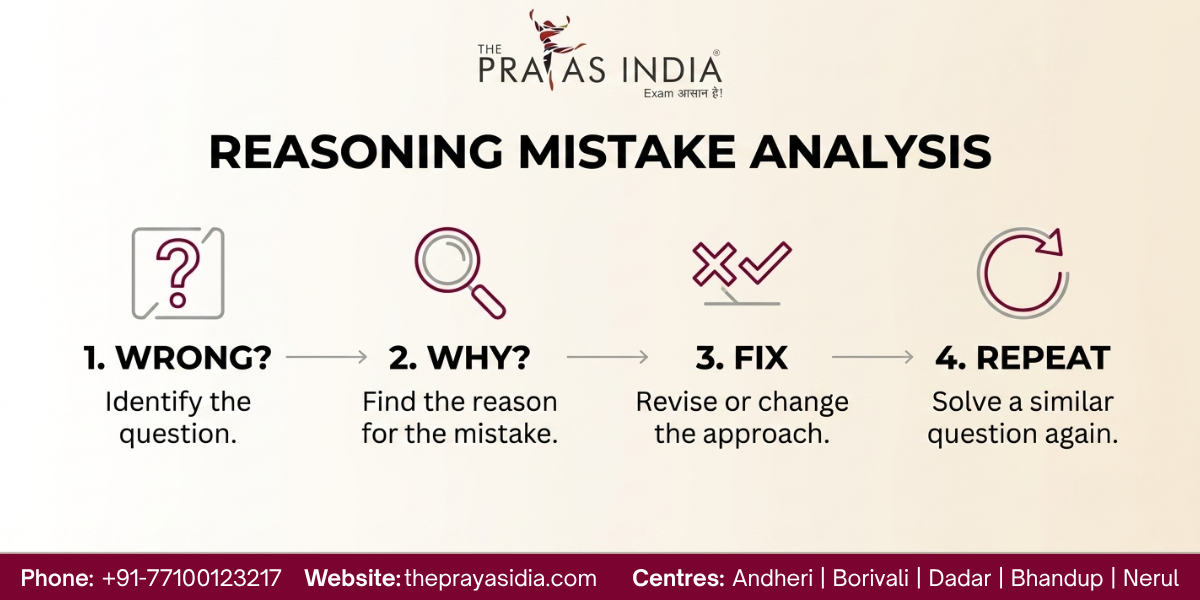
A reasoning error may happen because you did not understand the concept, misunderstood a condition, made an incorrect assumption, used an inefficient approach or simply rushed through the question. These problems require different solutions.
For example, if you repeatedly make mistakes in syllogism because you misunderstand the relationship between statements, more practice alone will not solve the problem. You need to revisit the underlying logic. On the other hand, if you understand the concept but make mistakes because you are rushing, your preparation should include controlled timed practice.
A simple error log can help you identify these patterns over time.
| Mistake Type | What It Indicates | What You Should Do |
|---|---|---|
| Conceptual Error | Fundamentals are weak | Revise the concept |
| Interpretation Error | Question was misunderstood | Practise careful reading |
| Approach Error | Method was inefficient | Learn alternate approaches |
| Calculation/Marking Error | Execution problem | Slow down and verify |
| Time Pressure Error | Pace is affecting accuracy | Add timed practice |
| Selection Error | Wrong question/set chosen | Improve exam strategy |
The purpose of an error log is not to create another notebook that you never revisit. It should help you identify recurring patterns and guide your future practice.
Analyse the Reasoning Process, Not Just the Answer
A common mistake during preparation is to focus only on whether the final answer is correct.
However, two candidates can arrive at the same correct answer using very different amounts of time.
Suppose you solve a puzzle correctly in nine minutes while another candidate solves a similar puzzle in five minutes. Both answers are correct, but their examination readiness is different.
This is why you should occasionally analyse how you reached an answer.
After solving a question, ask yourself whether there was a shorter route. Could you have organised the information more efficiently? Did you spend too much time on an unnecessary possibility? Could you have identified a useful condition earlier?
This type of analysis gradually develops efficiency.
The objective is not to make every solution artificially complicated by searching for shortcuts. Instead, you want to become aware of methods that reduce unnecessary work without compromising accuracy.
Make Puzzle Practice More Structured
Puzzles are often responsible for a large portion of the preparation difficulty in bank exam reasoning. Their complexity can vary significantly, and solving them randomly can make preparation feel inconsistent.
A better approach is to practise puzzles according to their structure.
Begin with familiar formats such as linear seating arrangements and gradually introduce circular arrangements, floor-based puzzles, box arrangements, scheduling problems and other multi-condition sets.
Do not immediately chase the hardest available puzzles. Your objective should be to build a mental framework for organising information.
When solving a puzzle, first identify the information that gives you the strongest starting point. Fixed positions, direct relationships and clearly defined conditions can often reduce the number of possibilities considerably.
As you practise more, you should begin recognising these entry points faster.
The eventual goal is to move from “How do I solve this puzzle?” to “What is the most efficient way to organise this puzzle?”
That change in thinking can significantly improve your performance.
Learn When to Leave a Puzzle
Knowing how to solve a puzzle is valuable. Knowing when to stop solving one can be equally valuable.
In an examination, you have limited time and multiple questions competing for that time. Continuing with a puzzle simply because you have already spent several minutes on it can lead to poor time allocation.
During practice, therefore, record not only whether you solved a set but also whether your decision to continue was sensible.
If a puzzle takes substantially longer than expected and you are still unable to establish a workable arrangement, stepping away may be the better decision.
This does not mean abandoning challenging questions permanently. You can return to them during analysis and understand the underlying logic. The distinction is that practice is the place to learn difficult methods, while the examination is the place to maximise your score with limited time.
Developing this mindset can make your reasoning attempts considerably more strategic.
Use Mock Tests to Develop Reasoning Strategy
Mock tests should not be treated merely as score-generating exercises.
Their real value lies in showing you how your preparation performs under pressure.
A mock can reveal that you know the concepts but spend too much time on puzzles. It may show that your accuracy in individual questions is good but falls when you attempt questions rapidly. It may also reveal that you repeatedly choose difficult sets while leaving easier questions unanswered.
These observations are more valuable than the overall score alone.
After every mock, divide your reasoning performance into different categories. Look at the questions you attempted correctly, the ones you attempted incorrectly, the ones you skipped and the ones where you spent excessive time.
This creates a much more accurate picture of your performance.
A student who attempted 30 questions with 22 correct answers and another who attempted 25 questions with 24 correct answers may require very different strategies. The first candidate may need to work on accuracy and question selection, while the second may need to gradually improve attempt volume without damaging accuracy.
Build a Reasoning Performance Dashboard
You do not need complicated software to track your progress.
A simple spreadsheet or notebook can record the information that matters most.
Track your performance across:
- Number of questions attempted.
- Number of correct answers.
- Number of incorrect answers.
- Accuracy percentage.
- Average time spent.
- Puzzle sets attempted.
- Puzzle sets successfully completed.
- Questions skipped despite knowing the concept.
- Questions where excessive time was spent.
Review these numbers every week.
The purpose is not to become obsessed with statistics. It is to identify trends.
If your accuracy remains stable while your solving time gradually decreases, your preparation is moving in the right direction. If your attempt count rises but accuracy falls sharply, you may be increasing speed too aggressively.
Similarly, if your performance improves in topic tests but drops considerably in mixed mocks, you may need more mixed practice.
Create a Daily Reasoning Practice Routine
A strong daily routine does not require solving hundreds of questions.
Instead, divide your reasoning practice into different activities.
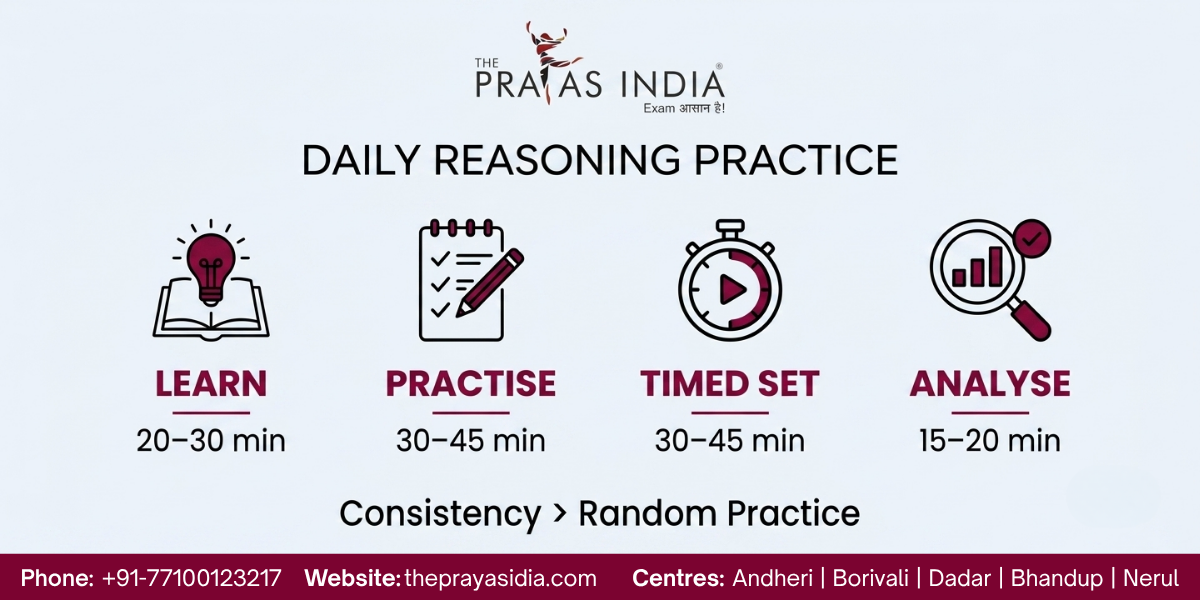
A typical session could begin with a short revision of concepts or previously identified mistakes. This can be followed by topic-specific questions, after which you can attempt a timed set.
The final portion of the session should be reserved for analysis.
For example:
| Session | Activity | Purpose |
|---|---|---|
| 20–30 min | Concept Revision | Strengthen fundamentals |
| 30–45 min | Topic Practice | Improve application |
| 30–45 min | Puzzle/Set | Build structured reasoning |
| 20–30 min | Timed Questions | Develop speed |
| 15–20 min | Error Analysis | Identify weaknesses |
The duration does not have to remain fixed. If you have limited preparation time, shorten the sessions while maintaining the same structure.
The important point is that your daily practice should contain both solving and analysis.
How to Balance Reasoning With the Other Bank Exam Sections
Reasoning should be an important part of SBI Clerk and IBPS Clerk preparation, but it should not consume your entire study schedule.
Bank exams require candidates to prepare Quantitative Aptitude, English Language and, particularly for mains, areas such as General/Financial Awareness and Computer Aptitude depending on the examination.
Your reasoning routine should therefore fit into your broader preparation plan.
If reasoning is currently your weakest section, give it additional time for a few weeks. Once your performance becomes stable, redistribute that time towards other weaker areas.
This is one reason a rigid timetable can become ineffective. Your preparation needs change as you improve.
A good weekly review allows you to adjust your schedule rather than following the same distribution regardless of your performance.
How Banking Coaching Can Improve Your Reasoning Preparation
Self-study can certainly help an aspirant develop reasoning skills, particularly when the student has strong fundamentals and can maintain consistency independently.
However, many candidates struggle with identifying the right preparation sequence, selecting appropriate practice material and understanding why their performance has plateaued.
This is where structured banking coaching can provide an advantage.
A good coaching programme should not merely provide a collection of reasoning questions. It should help students understand concepts, practise different difficulty levels, learn efficient approaches and evaluate performance through tests and analysis.
For an aspirant preparing in Mumbai, selecting the right Banking Coaching in Mumbai should therefore involve more than comparing class timings or course fees.
Look at the quality of teaching, practice resources, mock-test system, doubt support, performance analysis and the extent to which the programme supports both Prelims and Mains preparation.
The right guidance can be particularly useful for students who repeatedly practise but are unable to identify why their scores are not improving.
What Makes Reasoning Preparation Effective for SBI Clerk and IBPS Clerk?
Effective reasoning preparation eventually creates a combination of four abilities:
Understanding: You know what the question is asking and understand the underlying logic.
Recognition: You can identify the question type and likely approach quickly.
Execution: You can solve the problem accurately without unnecessary steps.
Decision-making: You know whether the question deserves your time during the examination.
These abilities develop at different speeds.
A beginner may initially focus heavily on understanding. As preparation progresses, recognition and execution become more important. Near the examination, decision-making and time management become increasingly significant.
This is why preparation should evolve rather than remain identical throughout the entire study period.
Common Reasoning Mistakes Bank Aspirants Should Avoid
Some habits can quietly reduce the effectiveness of otherwise serious preparation.
Solving Without Reviewing
If you complete practice sets but never analyse mistakes, you are missing one of the most valuable opportunities to improve.
Chasing Difficult Puzzles Too Early
Advanced puzzles can be useful, but spending excessive time on them before developing fundamentals may reduce overall preparation efficiency.
Ignoring Question Selection
Knowing how to solve a question does not automatically mean it should be attempted immediately in the examination.
Increasing Speed Too Aggressively
Speed should grow alongside accuracy. A higher attempt count means little if it comes with a major decline in correct answers.
Depending Completely on Shortcuts
Shortcuts are useful tools, but conceptual understanding provides the flexibility required when questions are modified.
Practising Only One Question Type
Topic-wise practice is necessary initially, but mixed practice is essential for examination readiness.
How The Prayas India Can Support Bank Exam Preparation
For aspirants looking for Banking Coaching in Mumbai, The Prayas India can provide a structured preparation environment where students can work systematically across the different components of bank examinations.
The focus should not be limited to completing the syllabus. Effective preparation also requires regular practice, mock tests, revision and performance analysis.
For SBI Clerk and IBPS Clerk aspirants, this structured approach can help create a preparation cycle in which students learn concepts, apply them through questions, identify weaknesses and gradually improve their examination strategy.
Students should also use coaching as a support system rather than depending entirely on classroom learning. Regular self-practice, revision and mock analysis remain essential for converting guidance into actual performance.
The objective is to make the aspirant increasingly independent as the examination approaches—capable of recognising question types, selecting the right questions, managing time and maintaining accuracy under pressure.
Final Takeaway
Improving Reasoning for SBI Clerk and IBPS Clerk is a gradual process. There is no single shortcut that can replace consistent practice.
The most effective preparation combines conceptual clarity, structured question practice, puzzle-solving, timed sessions, mistake analysis and mock-test review. As your preparation progresses, the focus should gradually shift from simply solving questions to solving the right questions efficiently.
Remember that speed is not created by rushing. It develops when concepts become familiar, patterns become recognisable and your solving process becomes more efficient. Similarly, accuracy does not come from attempting fewer questions forever. It comes from understanding your mistakes and learning how to prevent them.
For students targeting a strong performance in SBI Clerk or IBPS Clerk, the ultimate goal should be to reach a stage where reasoning feels less like an unpredictable section and more like a structured decision-making exercise.
Contact Us
📞 Call Now: +91-77100 13217
🌐 Website: theprayasindia.com
📍 Centres: Andheri | Borivali | Dadar | Nerul | Bhandup
FAQs
1. How can I improve Reasoning for SBI Clerk and IBPS Clerk?
Start with conceptual clarity and practise individual topics before moving to mixed sets and timed practice. Regular puzzle solving, mock tests and detailed error analysis can help improve both accuracy and speed.
2. Which reasoning topics should I prepare first for SBI Clerk and IBPS Clerk?
Begin with fundamental topics such as syllogism, inequality, coding-decoding, direction sense, blood relations and alphanumeric reasoning. Once your basics are strong, gradually move towards seating arrangements and different types of puzzles.
3. How can I improve my reasoning speed?
Speed improves through familiarity and repeated practice. First focus on solving correctly, then introduce time limits and gradually work towards faster execution without allowing accuracy to decline.
4. How important are puzzles in bank exam reasoning preparation?
Puzzles are an important component of reasoning preparation because they test your ability to organise multiple conditions and make deductions. Practising different puzzle structures can also improve your ability to select suitable sets during the examination.
5. Should I solve reasoning questions every day?
Yes. Regular practice is generally more effective than irregular long sessions. Even a focused daily session involving concept revision, practice, timed questions and error analysis can help maintain consistency.
6. How should I analyse reasoning mistakes?
Identify whether each mistake was caused by a conceptual gap, misinterpretation, inefficient approach, execution error, time pressure or poor question selection. Then take corrective action and solve a similar question again.
7. Is coaching necessary for SBI Clerk and IBPS Clerk reasoning preparation?
Not every aspirant requires coaching, but structured guidance can be useful for students who need help with concepts, practice strategy, mock analysis, doubt resolution or maintaining consistency. The right Banking Coaching in Mumbai can provide a structured preparation framework.