How to Improve Vocabulary for CAT Without Memorising Hundreds of Words | Best CAT Coaching in Mumbai | The Prayas India
Introduction: CAT Vocabulary Is About Context, Not a Giant Word List
Many CAT aspirants assume that improving vocabulary means memorising hundreds or even thousands of difficult English words. This approach often creates unnecessary pressure. Students prepare long word lists, revise meanings repeatedly and still struggle when the same words appear in a Reading Comprehension passage or verbal reasoning question in an unfamiliar context.
The reason is simple: knowing the dictionary meaning of a word is not the same as understanding how that word works in context.
CAT VARC does not primarily reward candidates for memorising obscure vocabulary. A stronger vocabulary helps you read faster, understand complex passages, identify the author’s tone and interpret ideas accurately. It also makes unfamiliar words less intimidating because you can often infer their meaning from surrounding sentences.
This means CAT aspirants do not necessarily need a vocabulary notebook containing thousands of words. They need a smarter vocabulary-building system that combines reading, contextual learning, active recall and regular practice.
For a candidate preparing for CAT 2026, this distinction is particularly important. The CAT exam is scheduled for November 29, 2026, and registration is scheduled to remain open until September 15, 2026. That makes efficient preparation especially valuable for aspirants who are balancing VARC with DILR and QA.
The objective should therefore not be:
“How many words can I memorise?”
It should be:
“How effectively can I understand and use unfamiliar vocabulary while solving CAT VARC?”
Why Vocabulary Matters in CAT VARC
Vocabulary is not tested in isolation as frequently as students sometimes imagine. Its real value becomes visible when you start reading CAT-level passages.
A strong vocabulary can make a difficult passage easier to process because you spend less mental energy decoding individual words. When you understand the language quickly, you can focus on the larger argument, the author’s perspective, the relationship between ideas and the purpose of specific statements.
This becomes especially useful in Reading Comprehension.
Imagine that a passage contains one unfamiliar word. A candidate with weak contextual reading may stop immediately, search for its exact meaning mentally and lose track of the argument. A candidate with stronger reading habits may use the sentences around the word to estimate its meaning and continue reading.
The second approach is often more useful in a timed examination.
Vocabulary also supports Para Summary, Para Jumbles and Odd Sentence-type questions, where understanding the relationship between words and ideas can influence how quickly you identify the logical structure of the content.
Therefore, vocabulary should not be treated as a separate subject that you study for 30 minutes and forget afterward.
It should become part of your overall VARC preparation routine.
The Problem With Memorising Huge Word Lists
Large vocabulary lists appear productive because they provide a measurable target.
You can say that you learnt 50 words today.
You can revise 100 words tomorrow.
But the number of words memorised does not automatically translate into better CAT performance.
There are several reasons for this.
First, isolated memorisation creates weak associations. You may remember that “abate” means “to reduce”, but when you encounter the word in a complicated sentence several weeks later, recognition may not be immediate.
Second, similar words can become confusing. If you memorise synonyms without understanding their differences in tone and usage, you may recognise several possible meanings without knowing which one fits the context.
Third, vocabulary learned without reading does not necessarily improve comprehension speed.
Finally, CAT preparation time is limited. Every hour spent memorising an enormous list is an hour that could potentially be used for RC practice, mock analysis, DILR or Quant.
This does not mean vocabulary lists are useless.
They can be helpful when used selectively.
The mistake is making them the entire vocabulary strategy.
Build Vocabulary Through Reading Instead
The most sustainable way to improve CAT vocabulary is to read material that is slightly above your current comfort level.
The purpose is not to understand every word perfectly.
The purpose is to expose yourself to different writing styles, subjects and forms of argument.
A good reading mix can include:
- Editorials and opinion articles
- Long-form journalism
- Essays
- Popular science writing
- Economics and business articles
- History and culture articles
- Philosophy and social science writing
- High-quality magazines
- Books written in accessible but sophisticated English
The key is consistency.
Reading for 20–30 minutes every day can be more useful than spending several hours once a week memorising vocabulary lists.
When you encounter an unfamiliar word, do not immediately stop reading.
First, try to understand the sentence.
Then examine the surrounding paragraph.
Ask yourself what the author appears to be communicating.
Only after attempting contextual interpretation should you check the dictionary.
This turns vocabulary learning into an active process.
Learn Words in Context, Not in Isolation
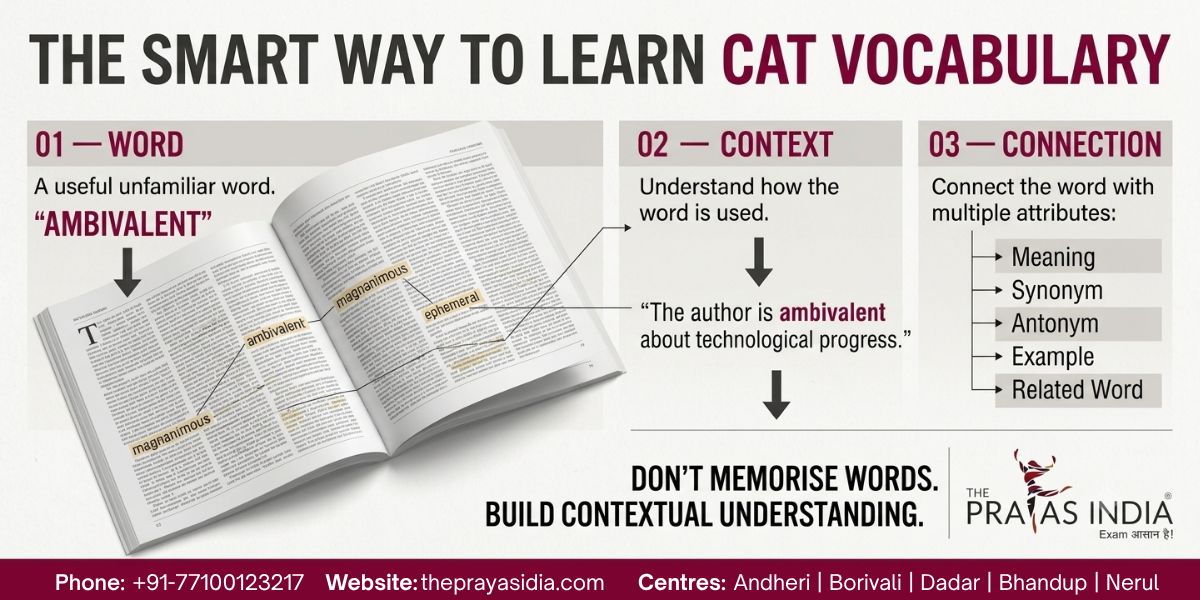
Consider the word “ambivalent.”
If you simply write:
Ambivalent = having mixed feelings
you may remember the definition for a short period.
But imagine encountering:
The author’s attitude towards technological progress is ambivalent.
Now the word is connected to a complete idea.
You can understand that the author is neither completely supportive nor completely opposed. The meaning becomes attached to an actual situation.
That contextual association is much stronger.
The same approach can be applied to every useful word you encounter.
Instead of writing:
Pragmatic — practical
write:
Pragmatic approach — choosing a practical solution rather than an ideal but unrealistic one.
Instead of:
Cynical — distrustful
write:
Cynical view of politics — assuming that political actions are primarily motivated by self-interest.
This makes the word easier to recognise when it appears in a new passage.
The “Word + Context + Connection” Method
A practical vocabulary system for CAT can use three elements:
Word
Record the unfamiliar or useful word.
Context
Write the sentence or situation in which you encountered it.
Connection
Connect it with a synonym, antonym, root, related word or real-life example.
For example:
| Word | Context | Connection |
|---|---|---|
| Mitigate | Mitigate the impact of climate change | Reduce / lessen |
| Ambiguous | The statement was ambiguous | Unclear / open to interpretation |
| Pragmatic | A pragmatic solution to the problem | Practical |
| Scrutinise | The proposal was carefully scrutinised | Examine closely |
| Resilient | A resilient economy can recover from shocks | Able to recover |
This method requires slightly more effort than copying definitions, but it creates stronger mental associations.
Learn Fewer Words, But Learn Them Better
A CAT aspirant does not need to know every difficult word in the English language.
Instead, build a high-quality personal vocabulary bank.
If you encounter 20 unfamiliar words during a week of reading, you do not necessarily need to memorise all 20. Identify the words that are:
- Frequently appearing
- Useful across different contexts
- Common in editorial and academic writing
- Relevant to CAT-level comprehension
- Easy to confuse with other words
- Important for understanding arguments
This creates a smaller but more useful vocabulary database.
For example, words such as contradictory, inherent, arbitrary, coherent, plausible, explicit, implicit, inevitable, empirical, subjective, objective, contentious and pragmatic can appear across a wide range of reading contexts.
Learning such words deeply can provide greater value than memorising a random list of obscure words that you may never encounter.
Use Word Families to Multiply Your Learning
One of the most efficient vocabulary techniques is to learn related forms of a word together.
For example:
Analyse → Analysis → Analytical → Analytically
Similarly:
Interpret → Interpretation → Interpretive
Economy → Economic → Economical → Economically
Contradict → Contradiction → Contradictory
This approach helps you recognise words faster when their grammatical form changes.
You are not really learning four completely different words.
You are learning a word family.
This is particularly useful for CAT because reading comprehension passages can use different forms of the same root.
Understanding the root or base word can therefore help you infer meaning even when the exact form is unfamiliar.
Learn Synonyms Carefully
Synonyms are useful, but they should not be treated as perfectly interchangeable.
Consider:
Criticise, condemn, question, challenge, dispute
All of these can relate to disagreement, but their intensity and usage can differ.
Similarly:
Frugal, economical, stingy, miserly
may all relate to spending less, but they carry different connotations.
A CAT aspirant should therefore learn not just:
Word = synonym
but also:
Word = meaning + tone + context
This is particularly useful for understanding an author’s attitude.
A writer who describes a policy as “economical” is not necessarily expressing the same attitude as someone who calls it “stingy.”
The underlying idea may be related, but the tone is different.
Understand Positive, Negative and Neutral Connotations
Vocabulary becomes much more powerful when you understand its emotional or evaluative tone.
For example:
Confident — generally positive
Arrogant — negative
Assertive — generally positive or neutral depending on context
Similarly:
Traditional can be neutral.
Conservative may be neutral or descriptive depending on context.
Regressive usually carries a negative judgement.
This matters in CAT Reading Comprehension because questions can ask you to identify the author’s tone or attitude.
If you understand the connotation of important vocabulary, you can often identify the emotional direction of a passage more quickly.
Don’t Ignore the Importance of Roots
Word roots can help you make intelligent guesses when you encounter unfamiliar vocabulary.
For example:
Bio relates to life.
Biology, biography and biodiversity all carry this connection.
Geo relates to Earth.
Geography, geology and geophysical share the root.
Chron relates to time.
Chronology, chronological and synchronise have related origins.
Anti means against.
Antibiotic, antisocial and antioxidant demonstrate different applications of the root.
The objective is not to memorise hundreds of roots like another vocabulary list.
Instead, learn commonly recurring roots gradually while reading.
When an unfamiliar word appears, the root may provide a useful clue.
Use Context to Guess Meaning Before Checking the Dictionary
This is one of the most important skills for CAT VARC.
Suppose you encounter an unfamiliar word.
Do not immediately search for its meaning.
Ask:
What is happening in the sentence?
Then:
Is the word describing something positive, negative or neutral?
Then:
What words around it provide clues?
Finally:
What approximate meaning would make the sentence logically coherent?
Only after making your prediction should you check the dictionary.
This creates an important cognitive connection between the word and its meaning.
Even if your prediction is slightly wrong, the process helps you remember the word later.
Why Contextual Guessing Helps in the Actual CAT Exam
You will inevitably encounter words during CAT that you have never studied.
No vocabulary list can guarantee that you will know every word appearing in the examination.
Therefore, your preparation should teach you how to deal with unfamiliar vocabulary.
Suppose a difficult word appears in an RC passage but the rest of the paragraph clearly establishes whether the author is praising or criticising an idea.
You may not know the exact dictionary definition, but you may still understand its approximate role in the argument.
That may be enough to answer the question.
This is why reading comprehension ability and vocabulary development should progress together.
Make Reading an Active CAT Exercise
Reading for CAT should not mean simply finishing an article.
After reading an editorial or essay, spend a few minutes asking:
What is the central argument?
What is the author’s position?
Which words were unfamiliar?
Which words were used in an unusual way?
What was the tone of the article?
Which sentence best captures the author’s argument?
This transforms reading from a passive activity into CAT preparation.
It also improves your ability to identify structure, tone and argumentation.
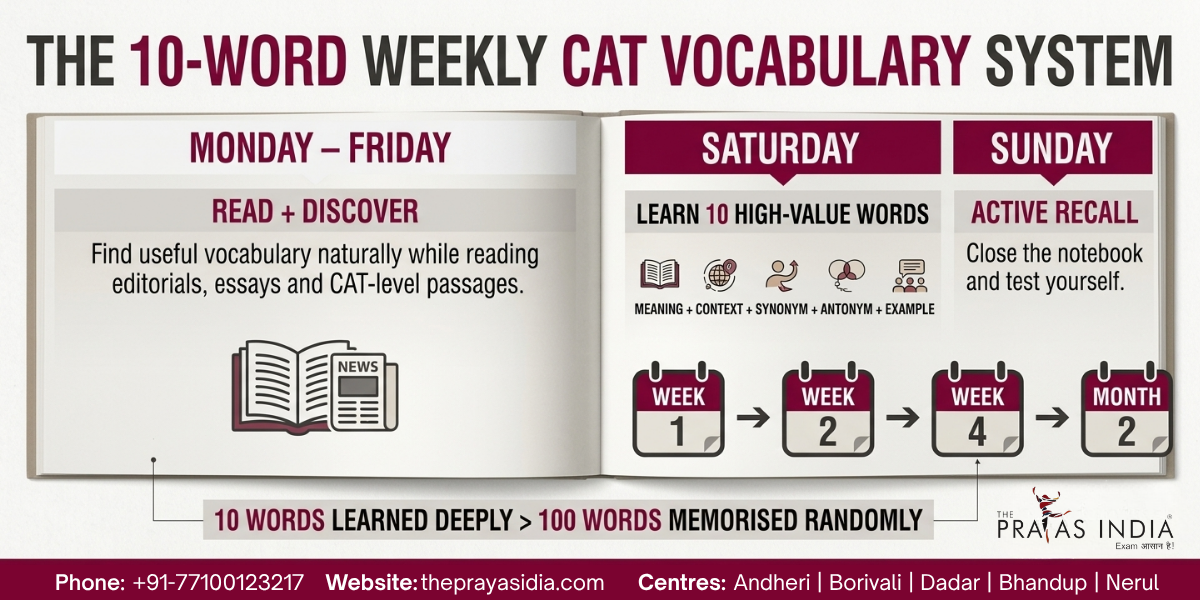
Create a “10-Word Weekly” System
Instead of attempting to learn 50–100 words every day, start with a manageable target.
For example, choose 10 high-value words each week.
But learn those words properly.
For each word, record:
- Meaning
- Original context
- Your own example sentence
- Synonym
- Antonym
- Word family
- Connotation
- Root, if useful
At the end of the week, test yourself without looking at the answers.
Then revisit the same words after one week, two weeks and one month.
This is much closer to spaced revision than repeatedly reading a word list.
Over several months, even 10 words per week can create a meaningful vocabulary base.
Key Takeaway
Improving vocabulary for CAT does not require turning your preparation into a race to memorise the largest possible number of words.
A better strategy is to make vocabulary part of your reading and VARC practice.
Read consistently.
Notice unfamiliar words.
Understand them in context.
Connect them with related words.
Learn word families.
Pay attention to tone and connotation.
Use contextual guessing.
Revise through active recall.
Most importantly, prioritise depth over volume.
When vocabulary becomes connected to reading comprehension rather than isolated memorisation, you begin to develop a more useful skill: the ability to understand unfamiliar language without losing the larger meaning of the passage.
Turn Reading Into a Vocabulary-Building System
Reading is one of the most effective ways to improve vocabulary for CAT, but only when it is done actively. Simply reading newspapers, articles or books for an hour every day does not guarantee vocabulary improvement. If you finish an article without noticing new words, understanding their context or revisiting them later, much of the potential benefit is lost.
A better approach is to make reading serve multiple purposes simultaneously. While reading, pay attention to the author’s argument, paragraph structure, tone and unfamiliar vocabulary. When you encounter a useful word, first try to infer its meaning from the passage. Then verify the meaning and record only the information that is genuinely useful for future reading.
This approach turns ordinary reading into a continuous CAT VARC exercise. Over time, you are not merely accumulating words; you are becoming better at understanding how sophisticated English is actually written.
What Should You Read for CAT Vocabulary?
CAT aspirants often ask whether they should read newspapers, novels, magazines or websites. There is no single source that can provide everything you need.
The ideal reading material should expose you to different subjects and writing styles because CAT Reading Comprehension can draw upon diverse areas such as philosophy, economics, science, history, sociology, culture, politics and business.
A balanced reading routine can include:
- Editorial and opinion pieces
- Long-form journalism
- Essays on philosophy and society
- Popular science articles
- Economics and business writing
- History and culture articles
- Psychology and behavioural science articles
- Well-written books and essays
- CAT-level RC passages
The objective is not to read everything available. Choose a manageable set of sources and read consistently.
If a particular article is extremely difficult, do not spend half an hour decoding every sentence. Your reading material should challenge you, but it should not make every session exhausting.
Read for Meaning Before Reading for Vocabulary
One common mistake is stopping every time an unfamiliar word appears.
This breaks your reading flow and prevents you from developing contextual comprehension.
Instead, follow a three-step process.
First, continue reading. Try to understand the overall argument without immediately searching for the unfamiliar word.
Second, return to the word. Use the surrounding sentences to estimate what it means.
Third, verify it. Check a reliable dictionary and compare the actual meaning with your prediction.
This process is particularly valuable because CAT may present unfamiliar words that you have never studied.
Your goal is not to eliminate every unfamiliar word.
Your goal is to become comfortable reading despite unfamiliar vocabulary.
Learn to Separate “Important” Words From “Interesting” Words
Not every difficult word deserves a place in your vocabulary notebook.
You may encounter an obscure historical term that is interesting but unlikely to be useful again. On another page, you might find a word such as “contentious,” “inherent,” “ambiguous” or “plausible” that can appear across hundreds of different reading contexts.
Prioritise words that improve your ability to understand arguments.
A useful word is usually one that:
- Appears frequently in serious reading
- Has multiple contextual applications
- Helps describe arguments or attitudes
- Has commonly confused synonyms
- Appears in academic or editorial writing
- Is useful for understanding tone
- Helps you interpret complex sentences
This filtering process prevents your vocabulary notebook from becoming another enormous syllabus.
Use a Vocabulary Notebook That You Will Actually Revise
A vocabulary notebook should be designed for revision, not decoration.
Avoid writing long dictionary definitions that take several minutes to read.
A practical entry can look like this:
| Word | Simple Meaning | Context | Connection |
|---|---|---|---|
| Contentious | Causing disagreement | A contentious political issue | Controversial |
| Plausible | Seemingly reasonable | A plausible explanation | Credible |
| Inherent | Naturally present | Inherent limitations | Intrinsic |
| Scrutinise | Examine carefully | Scrutinise the evidence | Analyse closely |
| Arbitrary | Based on random choice | An arbitrary decision | Unreasonable/random |
The purpose is quick recall.
When revising, you should be able to look at the word and mentally reconstruct its meaning and context.
If your notebook takes too long to revise, it is probably too detailed.
Don’t Memorise Synonyms Without Understanding Their Differences
A common vocabulary strategy is to create chains such as:
Big → Large → Huge → Enormous → Massive
This may help basic vocabulary, but CAT-level vocabulary requires more precision.
Consider:
Criticise → Question → Challenge → Condemn → Denounce
These words can all express disagreement, but they differ in intensity and usage.
Similarly:
Confident → Assertive → Arrogant
These words may describe related behaviour, but their connotations are different.
Learning these distinctions can help you interpret an author’s attitude more accurately.
When studying a synonym, ask:
Is it stronger or weaker?
Is it positive, negative or neutral?
Is it formal or informal?
Can it be used in exactly the same context?
These questions create deeper vocabulary knowledge.
Improve Vocabulary Through CAT Previous-Year Questions
Previous-year questions should be part of your vocabulary preparation because they show you the level and style of language used in the actual examination.
While solving CAT VARC questions, don’t simply mark the answer and move on.
Look at the passage again.
Identify words that influenced your understanding.
Notice how the author uses terminology.
Pay attention to phrases that indicate contrast, concession, emphasis or conclusion.
Words such as however, nevertheless, consequently, despite, although, therefore and whereas may appear simple, but understanding their function is extremely important for comprehension.
Similarly, academic words such as assumption, implication, contradiction, inference, proposition, premise and assertion frequently appear in analytical reading.
Learning such vocabulary through actual CAT questions gives it a direct exam connection.
Use Vocabulary to Improve Reading Speed
Vocabulary and reading speed are closely connected.
When you frequently encounter a word and understand it immediately, your brain does not need to stop and decode it.
This reduces cognitive load.
Consider reading a paragraph containing several unfamiliar words. If you have to pause repeatedly, your comprehension becomes fragmented.
Now consider reading the same paragraph after months of exposure to similar vocabulary. The words become recognisable, and your attention can shift toward the argument itself.
This is one reason why consistent reading can gradually improve both vocabulary and RC speed.
However, do not try to increase speed by rushing through passages.
The goal is efficient comprehension, not simply reading more words per minute.
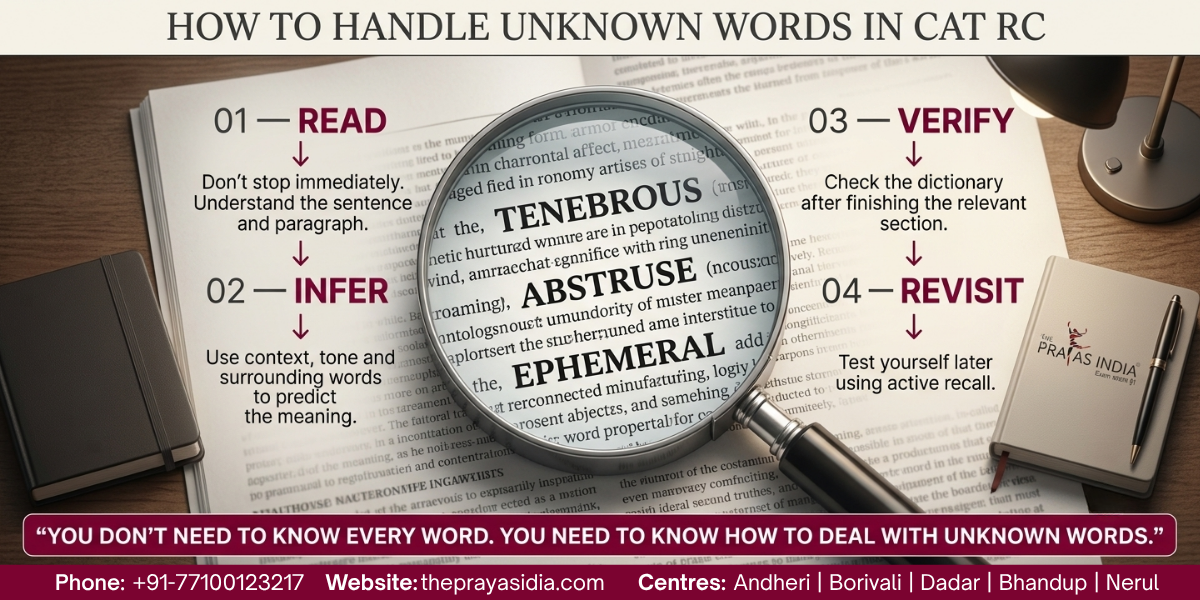
Use the “Read, Infer, Verify, Revisit” Cycle
A simple vocabulary cycle can make your reading more productive:
READ the passage naturally.
INFER the meaning of unfamiliar vocabulary from context.
VERIFY the meaning after completing the relevant paragraph or article.
REVISIT the word later through active recall.
This four-stage process is more powerful than immediately opening a dictionary for every unfamiliar word.
It trains you to become independent from the dictionary, which is exactly what you need during a timed CAT examination.
Use Spaced Revision Instead of Repeated Reading
One of the biggest reasons students forget vocabulary is that they revise it only once or twice.
Reading a word ten times in the same notebook session may create temporary familiarity, but that does not guarantee long-term recall.
Spaced revision works differently.
Suppose you learn ten words on Monday.
Instead of revising them five times on Monday, revisit them:
Monday → Wednesday → Sunday → Two weeks later → One month later
The intervals can be adjusted according to your retention.
The important principle is to create a gap between learning and recalling.
During revision, cover the meanings and test yourself.
Do not simply read:
“Ambiguous = unclear.”
Instead, look at:
Ambiguous
and ask yourself:
What does this mean? Where have I seen it? Can I use it in a sentence?
That small change turns revision into active recall.
Flashcards Can Help, But Don’t Turn Them Into Another Word List
Digital or physical flashcards can be useful for vocabulary, especially when you have a large number of words to revise.
But a flashcard should not simply contain:
Front: Ambiguous
Back: Unclear
A stronger card could include:
Front: Ambiguous
Back: Open to more than one interpretation
Context: The statement was ambiguous.
Related: Ambiguity
Opposite: Explicit / clear
This provides multiple retrieval cues.
However, don’t create thousands of flashcards simply because an app makes it easy.
The objective is not to maintain a giant vocabulary database.
The objective is to remember words that actually improve your CAT reading ability.
Build Vocabulary Around Themes
Another efficient strategy is to learn vocabulary in thematic clusters.
Suppose you are reading about economics.
You may encounter:
Inflation, recession, austerity, subsidy, fiscal, monetary, liquidity, expenditure, deficit and productivity.
These words become easier to remember because they are connected through a common topic.
Similarly, a psychology article may expose you to:
Cognition, perception, behaviour, bias, stimulus, rationality and motivation.
The brain naturally creates associations between related concepts.
This can make vocabulary retention easier than learning unrelated words from an alphabetical list.
Learn Transition Words and Logical Connectors
Students often focus on difficult nouns and adjectives but overlook simple words that determine the direction of an argument.
Words such as:
However
Nevertheless
Although
Conversely
Therefore
Consequently
Furthermore
In contrast
Despite
Whereas
can fundamentally change how a paragraph should be interpreted.
For CAT VARC, understanding these connectors is extremely valuable because they reveal relationships between ideas.
For example, “however” signals contrast.
“Therefore” signals a conclusion or consequence.
“Although” introduces a concession.
“Furthermore” adds supporting information.
A strong vocabulary strategy should therefore include not only difficult words but also functional vocabulary.
Understand Vocabulary Through Tone
CAT passages often require you to understand what the author thinks about a subject.
Vocabulary can provide important clues.
Compare:
The policy was implemented.
with:
The policy was recklessly imposed.
The second sentence carries a clear negative judgement.
Words such as reckless, misguided, admirable, flawed, superficial, compelling, questionable, sophisticated, regressive and innovative can influence the tone of a passage.
Learning such words with their connotations can improve your ability to answer tone-based RC questions.
Don’t Ignore Phrases and Idiomatic Expressions
Vocabulary is not limited to individual words.
Authors often use phrases whose meaning cannot be understood by translating each word separately.
For example:
“At odds with” means in disagreement.
“A double-edged sword” refers to something that has both positive and negative consequences.
“By and large” means generally.
“In light of” means considering something.
You do not need to memorise hundreds of idioms.
Focus on expressions that repeatedly appear in serious reading.
Whenever you encounter a useful phrase, record the complete expression rather than breaking it into individual words.
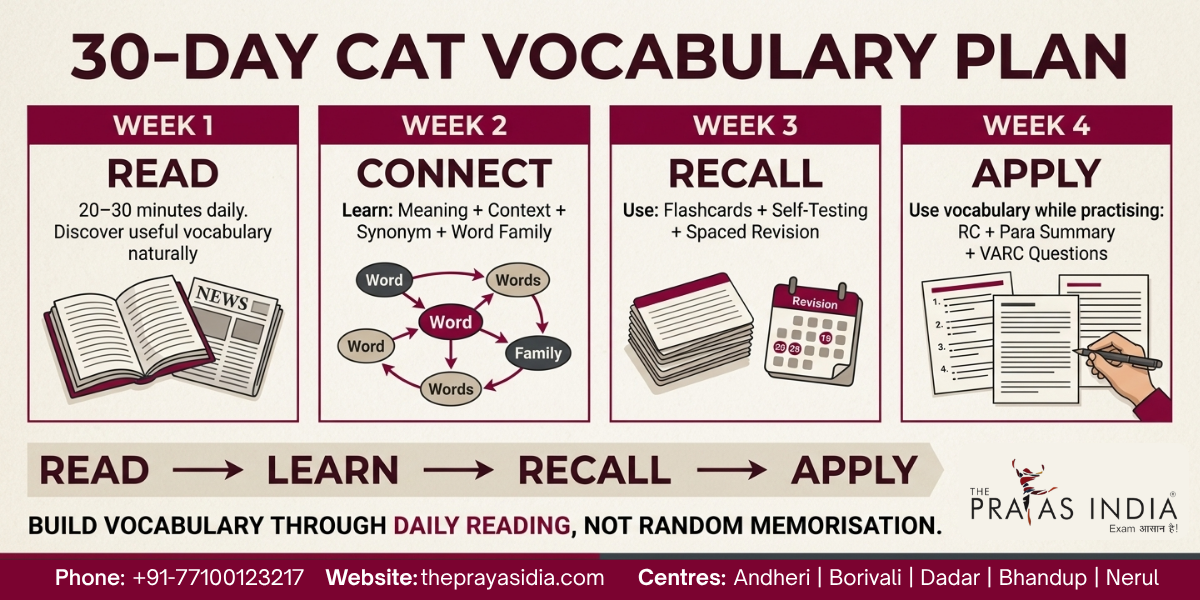
A Practical 30-Day CAT Vocabulary Plan
If your vocabulary needs improvement, you do not need to spend the entire preparation period on it.
A focused 30-day system can establish the right habits.
Days 1–7: Build the Reading Habit
Read for 20–30 minutes every day.
Do not worry about learning a large number of words.
Focus on understanding the argument and identifying useful vocabulary.
At the end of each session, select approximately two or three high-value words.
Days 8–15: Add Contextual Learning
Continue daily reading and start recording the context of unfamiliar words.
For every selected word, write a short example and one useful synonym or antonym.
Start revising the words from the first week.
Days 16–23: Add Active Recall
Begin testing yourself without looking at the meanings.
Use flashcards or a notebook.
Also solve CAT-level RC passages and observe whether familiar vocabulary is becoming easier to recognise.
Days 24–30: Integrate With VARC Practice
Reduce isolated vocabulary study and connect it directly with RC practice.
After each passage, identify useful vocabulary, tone-related words and logical connectors.
Review your vocabulary notebook at the end of each week.
The objective after 30 days is not to know 500 words.
It is to establish a repeatable vocabulary-learning system that you can continue throughout CAT preparation.
Common CAT Vocabulary Mistakes to Avoid
Trying to Memorise Too Many Words
The biggest mistake is confusing vocabulary quantity with vocabulary quality. If you memorise 100 words but cannot recognise them six weeks later, the exercise has produced little value.
Focus on words that repeatedly appear in your reading and CAT practice.
Learning Only Synonyms
Knowing that “hostile” means “unfriendly” is useful, but understanding its intensity, tone and usage is more valuable.
Vocabulary should be learned through context.
Ignoring Revision
Vocabulary disappears quickly when it is not revisited. Build spaced revision into your weekly routine.
Using Extremely Difficult Reading Material
Reading highly academic material that you barely understand may feel impressive but can become inefficient.
Choose challenging material that remains comprehensible enough for you to follow the argument.
Looking Up Every Word Immediately
This interrupts comprehension and prevents you from developing contextual inference.
Try to predict the meaning first.
Treating Vocabulary as Separate From VARC
Vocabulary should support reading comprehension, not become an isolated subject.
Use the words you learn while solving passages and analysing questions.
Copying Dictionary Definitions
Long definitions are difficult to retain.
Rewrite meanings in simple language and connect them to examples.
How Vocabulary Improvement Can Raise Your VARC Performance
Vocabulary improvement does not guarantee a particular CAT percentile.
However, it can strengthen several skills that contribute to VARC performance.
When you understand vocabulary more comfortably, you can process sentences faster.
When sentence processing becomes easier, you can focus more on the author’s argument.
When you understand the argument better, you are better positioned to identify the central idea, tone, inference and relationship between statements.
That means vocabulary can indirectly support:
Reading speed → Comprehension → Question interpretation → Accuracy
This is why vocabulary should be developed as part of an integrated VARC strategy rather than treated as a separate memorisation exercise.
How Mock Tests Can Help Identify Your Vocabulary Gaps
Mock tests can reveal vocabulary weaknesses that ordinary reading may not expose.
Suppose you repeatedly struggle with RC passages from economics or philosophy.
The problem may not be your reasoning alone.
You may also be unfamiliar with the terminology used in those areas.
Similarly, if you understand the passage but repeatedly misinterpret questions because of words such as “primarily,” “necessarily,” “implicitly,” “except,” “least likely” or “best supported,” you have a question-language issue rather than a conventional vocabulary issue.
After every CAT mock, identify whether your errors were caused by:
- Vocabulary
- Reading speed
- Passage comprehension
- Question interpretation
- Logical reasoning
- Option elimination
- Time management
This diagnosis prevents you from trying to solve every VARC problem with the same solution.
What to Do If English Is Your Weakest Section
Students who come from a non-English-medium background sometimes assume that they need to become fluent in spoken English before they can perform well in CAT VARC.
That is not the right benchmark.
CAT preparation requires strong reading comprehension and analytical language skills.
You can improve these systematically.
Start with articles that are challenging but understandable.
Gradually increase difficulty.
Read consistently.
Summarise what you read.
Learn vocabulary from context.
Practise RC passages.
Analyse your mistakes.
Over time, the language that initially felt difficult begins to become familiar.
You do not need to transform your English overnight.
You need to build consistent exposure and deliberate practice.
Should You Join CAT Coaching for Vocabulary and VARC Preparation?
Self-study can certainly help you improve vocabulary, particularly if you are disciplined about reading and revision.
However, CAT preparation involves three sections, a fixed examination structure and significant competition. Many aspirants struggle not because they lack resources, but because they do not know how to organise those resources effectively.
A structured CAT coaching programme can provide a framework in which vocabulary development is integrated with VARC preparation instead of becoming another isolated task.
For example, a good preparation system can connect:
Reading → Vocabulary → RC Practice → Sectional Tests → Mock Analysis → Revision
This makes it easier to identify whether your actual problem is vocabulary, comprehension, accuracy or time management.
What to Look for in CAT Coaching in Mumbai
If you are considering CAT coaching in Mumbai, do not select an institute only because it claims to have the highest number of selections or the most extensive study material.
Evaluate the complete academic system.
Look for:
- Experienced VARC faculty
- Structured CAT syllabus coverage
- Regular RC and VARC practice
- CAT-level reading material
- Sectional tests
- Full-length mock tests
- Detailed mock analysis
- Personalised performance feedback
- Doubt-solving support
- Mentorship and strategy guidance
- Revision support
- A convenient centre location
The right coaching environment should reduce preparation confusion rather than increase it.
For aspirants looking for CAT coaching in Mumbai, The Prayas India has centres at Andheri, Borivali, Dadar, Nerul, and Bhandup.
Students can contact +91-77100 13217 for information about CAT preparation programmes and centre details.
Why The Prayas India Can Be a Structured Choice for CAT Aspirants
CAT preparation is not simply about completing a collection of books or attending classes.
It requires a system that allows you to identify weaknesses, practise consistently and improve through feedback.
For VARC, that means developing reading habits, strengthening vocabulary, solving quality RCs, understanding question patterns and analysing mock performance.
The Prayas India can support aspirants who prefer a structured preparation environment with guidance across the CAT preparation journey.
For students in Mumbai, the availability of centres across Andheri, Borivali, Dadar, Bhandup and Nerul can also make regular classroom preparation more accessible.
The objective of coaching should ultimately be to help students become independent problem-solvers rather than dependent on endless study material.
Final Takeaway: Build Vocabulary Through Understanding
You do not need to memorise hundreds of difficult words every month to improve your CAT vocabulary.
You need a system that allows you to encounter useful words repeatedly, understand them in context, connect them with related ideas and recall them when necessary.
Read every day.
Choose quality material.
Infer meanings before checking the dictionary.
Maintain a focused vocabulary notebook.
Learn word families.
Understand connotations.
Study useful phrases.
Use active recall.
Revise through spaced repetition.
Apply new vocabulary while solving CAT RCs.
Most importantly, do not measure vocabulary improvement by the number of words written in your notebook.
Measure it by how comfortably you can understand a difficult passage.
That is the real purpose of vocabulary preparation for CAT.
For aspirants seeking structured CAT coaching in Mumbai, The Prayas India has centres at:
📞 Call Now: +91-77100 13217
🌐 Website: theprayasindia.com
📍 Centres: Andheri | Borivali | Dadar | Nerul | Bhandup
A smarter vocabulary strategy can help make CAT VARC preparation more manageable, more consistent and more closely connected to the skills actually required in the examination.
FAQs
1. How can I improve my vocabulary for CAT without memorising hundreds of words?
The best approach is to learn vocabulary through regular reading and context. Identify useful unfamiliar words, understand their meaning from the passage, verify them, record a short example and revise them using active recall.
2. Does CAT require a very large vocabulary?
A huge vocabulary is not necessary. CAT VARC rewards strong reading comprehension and analytical ability. A focused vocabulary that helps you understand complex passages, arguments, tone and questions can be more useful than memorising thousands of isolated words.
3. How many vocabulary words should I learn every day for CAT?
There is no fixed requirement. Learning around two or three useful words during daily reading can be more sustainable than trying to memorise dozens of unrelated words. The important factor is whether you revise and can recognise the words in context.
4. Is reading newspapers enough to improve CAT vocabulary?
Newspaper reading can help, particularly editorials and opinion pieces, but it should be combined with CAT-level RC practice and other forms of long-form reading. The objective is to develop both vocabulary and comprehension.
5. Should I use flashcards for CAT vocabulary?
Flashcards can be useful for active recall and spaced revision. However, avoid creating thousands of cards. Prioritise useful words and include context, meaning and related vocabulary rather than only a dictionary definition.
6. How can I remember difficult CAT vocabulary for a long time?
Use spaced revision and contextual learning. Encounter the word in reading, understand its context, create your own example and revisit it after increasing intervals. This is generally more effective than repeatedly reading the same word list.
7. How does vocabulary affect CAT Reading Comprehension?
Strong vocabulary can make sentence processing easier and reduce the effort required to understand unfamiliar language. This allows you to focus more on the author's argument, tone, structure and inference.
8. How can I guess the meaning of an unknown word in CAT RC?
Look at the surrounding sentences, identify whether the word has a positive, negative or neutral role, examine contrasting or supporting information and estimate the meaning that best fits the paragraph. Exact dictionary knowledge is not always necessary to understand a word's role.
9. Should I learn synonyms and antonyms for CAT vocabulary?
Yes, but learn them carefully. Synonyms are not always interchangeable. Pay attention to differences in intensity, tone, formality and context.
10. How long does it take to improve CAT vocabulary?
There is no fixed timeline. Consistent reading and revision over several months can gradually improve vocabulary and reading comfort. Even a focused 30-day system can establish useful habits that can then be continued throughout CAT preparation.
11. Can CAT coaching help improve VARC and vocabulary?
Yes, structured CAT coaching can integrate reading, vocabulary, RC practice, sectional tests and mock analysis into a systematic preparation plan. This can be useful for aspirants who struggle to maintain consistency through self-study.
12. Which is the best CAT coaching in Mumbai?
The right CAT coaching institute depends on factors such as faculty, study methodology, test series, mock analysis, mentorship, doubt support, location and your individual preparation needs. The Prayas India has CAT preparation centres at Andheri, Borivali, Dadar, Bhandup and Nerul for aspirants in Mumbai.
13. Can a non-English-medium student improve CAT VARC?
Yes. CAT VARC skills can be developed through consistent reading, contextual vocabulary learning, RC practice, analysis and revision. The key is to gradually increase the difficulty of reading material instead of expecting immediate fluency.
14. What is more important for CAT VARC: vocabulary or reading comprehension?
Both are connected, but reading comprehension is the larger skill. Vocabulary should support your ability to understand passages, arguments, tone and questions. Therefore, vocabulary preparation should be integrated with regular RC practice rather than treated as an isolated exercise.