How to Overcome Maths Fear During CAT Preparation | Best CAT Coaching in Mumbai | The Prayas India
For many CAT aspirants, Quantitative Aptitude becomes less of a mathematical challenge and more of a psychological one. A student may understand several concepts but still hesitate when seeing a lengthy calculation, an unfamiliar equation or a question from a topic they have struggled with before. Over time, this hesitation can turn into a larger belief: “I am simply not good at maths.”
That belief can become a serious obstacle during CAT preparation.
The reality, however, is different. CAT Quant does not require you to be a mathematical genius. It requires conceptual understanding, regular practice, logical thinking and the ability to make sensible decisions under time pressure. Students from non-mathematics backgrounds can also build strong Quant performance when they approach preparation systematically.
The first step is therefore not solving 50 questions in a day. It is changing your relationship with the subject.
Maths Fear During CAT Preparation Is More Common Than You Think
When students say they are afraid of CAT Quant, the fear may not actually come from mathematics itself. It can come from previous academic experiences, lack of practice, repeated mistakes or the feeling that other students are progressing faster.
A student who has struggled with mathematics in school may enter CAT preparation already expecting Quant to be difficult. Every wrong answer then reinforces the same assumption.
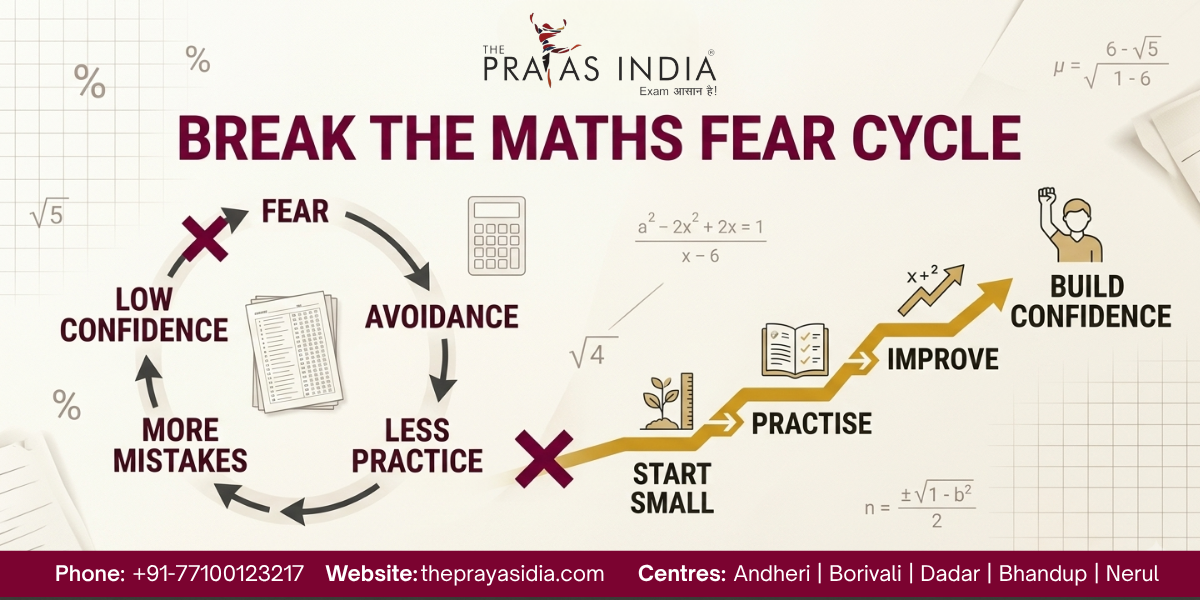
This creates a cycle:
Fear → Avoidance → Less Practice → More Mistakes → Lower Confidence → More Fear
Breaking this cycle is more important than trying to eliminate every weakness immediately.
Instead of asking, “Why am I bad at maths?”, ask:
“Which specific part of Quant am I finding difficult?”
That question changes the problem from something personal into something that can be solved.
Stop Calling Yourself a “Weak Maths Student”
One of the most damaging habits during CAT preparation is attaching a permanent identity to your current performance.
Statements such as:
- “I have always been bad at maths.”
- “I cannot understand Quant.”
- “Commerce students are better at CAT Quant.”
- “I haven’t studied maths for years.”
- “I will never be able to solve CAT-level questions.”
do not help you identify the actual problem.
Your current Quant score represents your present level of preparation, not your permanent mathematical ability.
There is a major difference between:
“I cannot solve this yet.”
and
“I can never solve this.”
The first statement creates room for improvement.
The second closes it.
CAT preparation should always be approached with the first mindset.
Understand What Is Actually Creating the Fear
Before designing a solution, identify the source of your anxiety.
For one student, the problem may be calculation speed. For another, it may be algebraic concepts. Someone else may understand the concepts but panic during timed tests.
Common reasons include:
Weak Fundamentals
If percentages, ratios, equations, averages or basic arithmetic are unclear, advanced questions naturally feel intimidating.
Long Gap From Mathematics
Students who have not regularly studied mathematics for several years may need time to rebuild familiarity.
Fear of Calculations
Some aspirants become uncomfortable when a question contains multiple numerical steps.
Previous Academic Experience
Repeated poor performance in school or college can create a psychological association between mathematics and failure.
Comparing Yourself With Others
Watching another student solve a question quickly can make your own pace appear worse than it actually is.
Mock-Test Pressure
A concept may seem manageable during practice but suddenly become difficult when a timer is running.
Fear of Difficult Questions
Sometimes students assume that every CAT Quant question will require complicated mathematics. This creates unnecessary anxiety before they even begin.
Identifying the specific reason matters because different problems require different solutions.
The First Rule: Don’t Start With Difficult CAT Questions
This is one of the most important changes a student with maths anxiety can make.
If your fundamentals are weak, immediately jumping into difficult CAT-level questions can create repeated failure.
Repeated failure can reinforce the belief that Quant is beyond your ability.
Instead, create a gradual difficulty curve.
Start with:
Basic Concept → Simple Application → Moderate Question → CAT-Level Question → Timed CAT Set
This allows your brain to build familiarity before facing greater difficulty.
The objective of early practice is not to prove that you can solve the hardest question.
It is to create enough successful experiences that mathematics stops feeling threatening.
Rebuild Your Quant Foundation Without Feeling Overwhelmed
If your mathematics foundation is weak, you do not need to revise the entire school mathematics syllabus before starting CAT preparation.
Instead, identify the concepts that frequently appear in CAT Quant and build them systematically.
Important areas include:
| Area | Foundation to Build |
|---|---|
| Arithmetic | Percentages, ratios, averages, profit & loss |
| Algebra | Equations, inequalities, functions and expressions |
| Number System | Divisibility, remainders, factors and multiples |
| Geometry | Lines, angles, triangles, circles and mensuration |
| Modern Math | Basic counting, probability and set concepts |
The purpose of foundation building is not memorising formulas.
It is developing enough familiarity that a question no longer looks completely unfamiliar.
Focus on Arithmetic First if Quant Feels Intimidating
For many students, Arithmetic provides a useful starting point because several concepts are connected to everyday numerical reasoning.
Percentages, ratios, averages, mixtures, profit and loss and time-based problems can gradually improve numerical confidence.
For example, instead of trying to memorise every percentage conversion, understand relationships.
Knowing that:
25% = 1/4
or
20% = 1/5
can make certain calculations faster and more intuitive.
The more relationships you recognise, the less every question feels like a completely new mathematical problem.
Don’t Memorise Formulas Without Understanding Them
Formula memorisation can create temporary confidence but often breaks down when the question is presented differently.
Suppose you memorise a formula for a particular type of problem. If CAT changes the structure of that problem, you may struggle to identify how the formula applies.
Instead, understand:
What does the formula represent?
Why does it work?
When should I use it?
When should I not use it?
This approach may take slightly longer initially, but it creates stronger long-term confidence.
Use a Three-Layer Learning Method
Students with maths anxiety often try to understand everything at once.
A better method is to divide learning into three layers.
Layer 1 — Understand
Learn the concept without worrying about speed.
Layer 2 — Apply
Solve straightforward questions based on the concept.
Layer 3 — Challenge
Move toward CAT-level and mixed questions.
Do not move to the next layer simply because you have spent a fixed amount of time.
Move forward when you demonstrate reasonable understanding.
This gives your preparation a logical progression instead of creating unnecessary pressure.
Turn Every Wrong Answer Into Information
A wrong answer can trigger frustration, especially when you are already afraid of mathematics.
Instead of saying:
“I can’t do this.”
ask:
“Why did I get this wrong?”
There are several possibilities.
Conceptual Error
You did not understand the underlying concept.
Application Error
You understood the concept but applied it incorrectly.
Calculation Error
Your approach was correct but arithmetic went wrong.
Interpretation Error
You misunderstood what the question was asking.
Time-Pressure Error
You rushed because you were worried about the clock.
Careless Error
You knew the solution but made an avoidable mistake.
Each category requires a different response.
That is why simply counting wrong answers does not help enough.
Create an Error Log
An error log can become one of the most useful tools for overcoming maths fear.
Whenever you make a significant mistake, record:
Question type
Your approach
Where you went wrong
Correct approach
Lesson learned
You do not need to record every easy mistake.
Focus on recurring errors and questions that reveal a genuine weakness.
After several weeks, your error log can show patterns that are difficult to notice while solving questions individually.
Never Compare Your Beginning With Someone Else’s Middle
CAT preparation is highly competitive, which makes comparison almost unavoidable.
You may see someone solving 20 Quant questions while you are still working through fundamentals.
That comparison is often meaningless.
You do not know:
- How long they have been preparing
- What their mathematics background is
- Which topics they already studied
- How many questions they solved previously
- Whether their answers are actually accurate
Your useful comparison is with your own previous performance.
If you previously needed eight minutes to understand a particular question type and now need four, that is progress.
If your accuracy has improved from 55% to 75%, that is progress.
If you are attempting questions without panic, that is also progress.
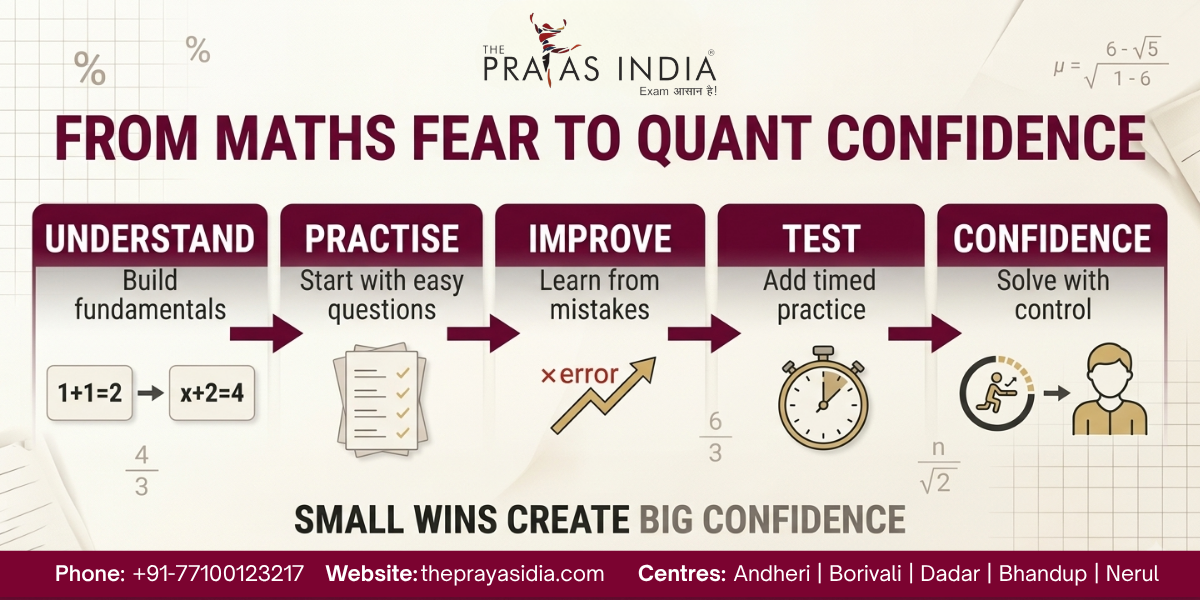
Build Confidence Through Small Wins
Confidence is not something you need to wait for before starting Quant.
It is something you build through repeated successful experiences.
Begin with achievable targets.
For example:
Day 1: Understand one concept.
Day 2: Solve basic applications.
Day 3: Attempt moderate questions.
Day 4: Revisit mistakes.
Day 5: Attempt a timed set.
This approach creates momentum.
Eventually, the question that once looked intimidating becomes familiar.
Give Yourself Enough Time to Become Comfortable With Quant
One of the biggest mistakes students make is expecting immediate transformation.
You may study a concept today and still struggle with it tomorrow.
That does not mean the method is failing.
Mathematical familiarity develops through repetition.
The first time you encounter a particular question type, you may need several minutes to understand it. After solving multiple variations, the structure becomes easier to recognise.
Eventually, your brain begins to identify patterns automatically.
This is one of the foundations of speed.
Speed is often the result of familiarity, not pressure.
Don’t Use Speed as Your First Measure of Progress
Students with maths fear frequently use solving time as their primary performance indicator.
That can create unnecessary pressure.
During the initial stages, ask:
Did I understand the concept?
Could I solve the question correctly?
Did I understand my mistake?
Only after these become reasonably stable should you aggressively focus on reducing time.
A student who solves correctly in four minutes can eventually work toward three minutes.
A student who solves incorrectly in one minute first needs to improve accuracy.
That distinction is critical.
The Role of Timed Practice
Once your fundamentals improve, introduce time gradually.
Do not suddenly move from unlimited practice to full-length mock pressure.
A better progression is:
Untimed Practice
↓
Loose Time Limit
↓
Strict Topic Timer
↓
Mixed Timed Set
↓
Quant Sectional
↓
Full Mock
This allows you to develop speed without making the timer itself a source of anxiety.
Key Takeaway
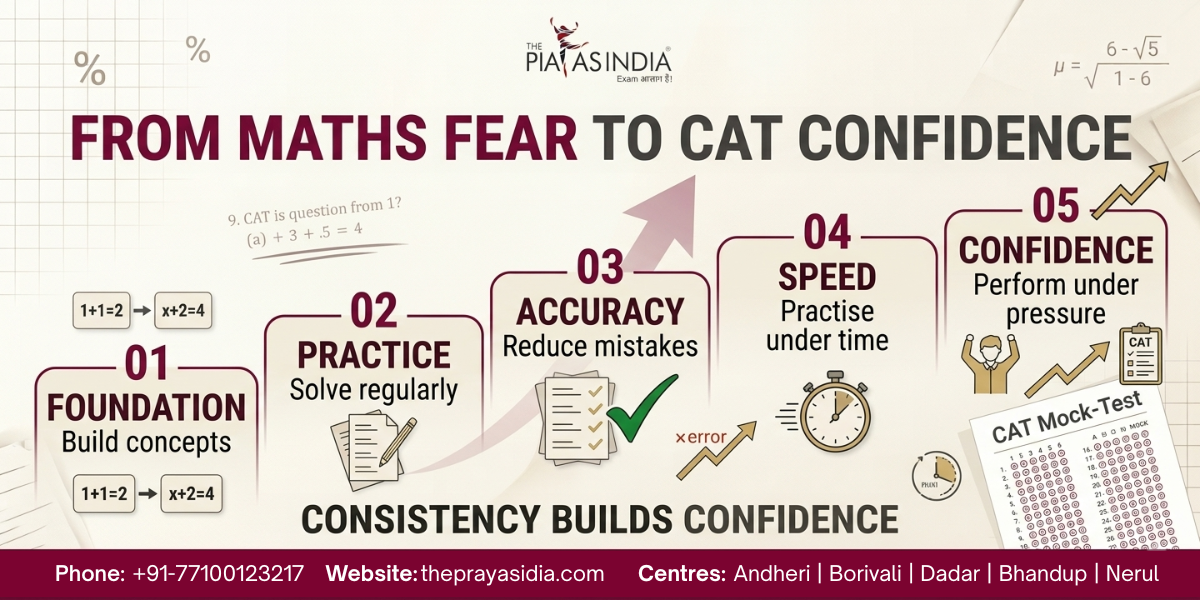
Overcoming maths fear during CAT preparation is not about convincing yourself that mathematics is easy.
It is about developing enough understanding, familiarity and practice that mathematics becomes manageable.
Start by identifying the actual source of your fear. Rebuild fundamentals, practise progressively, maintain an error log and stop treating every mistake as evidence of inability.
Most importantly, do not expect confidence to appear before practice.
Confidence is created by practice.
Don’t Let One Difficult Question Affect the Entire Section
A common problem during CAT Quant is getting emotionally attached to a question.
You read it once.
You try an approach.
It doesn’t work.
You try again.
Another minute passes.
Instead of moving on, you start thinking:
“I should be able to solve this.”
This is where maths fear and time pressure combine.
The problem is no longer only mathematical. It becomes psychological.
A difficult question should remain one difficult question. It should not become a reason to panic about the entire Quant section.
If you cannot identify a workable approach within a reasonable amount of time, moving on is not failure.
It is strategic decision-making.
Learn the Difference Between “I Don’t Know” and “I Need More Time”
These two situations look similar but require different responses.
Situation 1: You Don’t Know
You cannot identify the concept or approach.
Continuing to stare at the question is unlikely to help.
Move on.
Situation 2: You Know the Approach
You understand what needs to be done, but the calculations are lengthy.
This question may be worth returning to if you have sufficient time.
Learning this distinction is one of the most important skills in CAT Quant preparation.
Build a Question Selection Habit
During practice, don’t immediately solve every question in the order presented.
Before starting, quickly classify questions based on your comfort level.
Priority 1
Questions where the concept and approach are immediately visible.
Priority 2
Questions that appear manageable but may require more calculation.
Priority 3
Questions where the approach is unclear or the problem looks unusually time-consuming.
This practice gradually trains your brain to make decisions faster.
The goal is not to become afraid of difficult questions.
The goal is to choose when difficult questions deserve your attention.
Use the 3-Step Decision Rule
A simple decision framework can help during timed Quant practice.
STEP 1 — RECOGNISE
What concept or structure does the question involve?
STEP 2 — ESTIMATE
Can you see a reasonable approach, and is it likely to require too much time?
STEP 3 — DECIDE
Attempt now, leave for later or skip.
With enough practice, these decisions can become almost automatic.
Don’t Turn Every Question Into a Prestige Battle
Some students feel that skipping a question means they are weak.
This is particularly common among students who are already anxious about mathematics.
But CAT is not a school examination where you are expected to demonstrate that you can solve every question.
You are competing for a percentile.
That changes the objective.
The important question is not:
“Can I solve this?”
It is:
“Is solving this the best use of my time right now?”
That is a much more useful question.
Practise Difficult Questions Without Letting Them Control You
Avoiding difficult questions completely is also not the answer.
You need exposure to challenging problems.
However, separate learning practice from exam practice.
During learning practice, you can spend more time understanding a difficult question.
You can look at multiple approaches, study the solution and attempt the problem again.
During exam practice, the priority changes.
You must make decisions based on time and expected return.
This distinction helps you become comfortable with difficult questions without becoming dependent on solving every difficult question immediately.
Make Mock Tests a Learning Tool
A mock test should not be treated as a final judgement of your CAT potential.
Your mock score tells you where you currently stand.
The analysis tells you what to do next.
After every mock, examine:
- Which questions did you attempt?
- Which were correct?
- Which were incorrect?
- Which easy questions did you miss?
- Which questions consumed too much time?
- Where did you panic?
- Which concepts need revision?
- Which errors are repeating?
A mock becomes valuable when its findings influence your next study cycle.

Control Anxiety During Mock Tests
Mock-test anxiety often comes from attaching too much importance to the score.
A student starts thinking:
“If this mock goes badly, my CAT preparation is failing.”
That thought increases pressure.
Instead, assign every mock a specific purpose.
One mock may be used to analyse question selection.
Another may focus on maintaining accuracy.
Another may help you test your time-management strategy.
This changes the psychological meaning of the mock.
It becomes a practice environment, not a judgement day.
Use a Pre-Mock Routine
A consistent routine before a mock can help reduce unnecessary anxiety.
Avoid studying random difficult questions immediately before the test.
Instead:
Before the Mock
- Review key formulas briefly.
- Take a few deep breaths.
- Remind yourself of your attempt strategy.
- Set a realistic objective.
- Start without obsessing over the expected score.
The objective is to enter the test with a clear process.
What to Do When You Panic During the Quant Section
Sometimes anxiety will still appear.
You may encounter the first few questions and feel that the section is difficult.
Do not immediately conclude that the entire paper is difficult.
Take a brief mental reset.
Then look for a question where your approach is familiar.
Solving one manageable question correctly can restore confidence.
The important thing is to avoid carrying the emotional impact of one question into the next.
Think in terms of individual decisions, not the entire section at once.
Create a “Confidence Set”
This can be particularly useful for students who experience strong maths anxiety.
Maintain a small collection of questions that you previously found difficult but can now solve comfortably.
Revisit them periodically.
The purpose is psychological as well as academic.
When you see evidence that:
“I couldn’t solve this earlier, but now I can,”
your perception of your own ability begins to change.
This is one of the most effective ways to replace fear with evidence-based confidence.
Don’t Overload Yourself With Study Material
Maths fear can become worse when students collect too many resources.
One book.
Another PDF.
Several YouTube playlists.
Multiple Telegram groups.
Different shortcut notes.
Mock platforms.
Coaching material.
Soon, the problem is no longer lack of resources.
It is lack of direction.
Choose a structured source of learning and complete the material systematically.
A smaller amount of well-understood material is usually more useful than a huge collection of partially completed resources.
Build a Consistent Daily Quant Routine
Your daily schedule should be realistic enough to maintain.
For example:
| Activity | Purpose |
|---|---|
| Concept Revision | Strengthen fundamentals |
| Practice Set | Apply concepts |
| Calculation Drill | Improve numerical fluency |
| Error Review | Prevent repeated mistakes |
| Timed Questions | Build speed |
| Weekly Sectional | Test performance |
You do not need to perform every activity for several hours every day.
The important thing is maintaining a balance between learning, practice and evaluation.
Use the Right Ratio Between Learning and Testing
Your preparation should gradually move from learning-heavy to test-heavy.
Early Preparation
More learning + less testing
Middle Preparation
Learning + practice + regular testing
Advanced Preparation
More testing + analysis + targeted revision
This progression prevents you from taking too many mocks before you have the foundation required to learn from them.
Track Progress Beyond Your Mock Score
Your percentile is important, but it is not the only metric worth tracking during preparation.
Also monitor:
Accuracy
Average time per question
Number of avoidable errors
Easy questions missed
Questions left due to time
Repeated topic-wise mistakes
Confidence during timed practice
These metrics can reveal improvement even when your overall mock score fluctuates.
Mock scores naturally move up and down.
Your underlying skills should gradually move upward.
When CAT Coaching Can Help With Maths Fear
For some aspirants, the biggest problem is not lack of effort but lack of structure.
They study whenever they feel motivated, change resources frequently and have no clear way of knowing whether they are improving.
A structured CAT coaching programme can provide an organised framework for:
- Concept building
- Topic-wise practice
- Doubt resolution
- Timed exercises
- Sectional tests
- Full-length mocks
- Performance analysis
- Mentorship
- Revision
For students searching for Best CAT Coaching in Mumbai, it is important to look beyond the number of classes or promotional claims.
The more useful question is:
Will this preparation system help me understand my weaknesses and work on them consistently?
That is particularly relevant for students who lack confidence in Quant.
What to Look for in CAT Coaching if You Fear Mathematics
If maths is your biggest concern, evaluate a coaching programme carefully.
Conceptual Teaching
Does the teaching focus on understanding rather than formula memorisation?
Doubt Support
Can you ask questions when a concept remains unclear?
Structured Practice
Are questions arranged progressively from basic to advanced?
Mock Analysis
Does the programme help you understand why you are losing marks?
Personal Guidance
Can you receive feedback based on your actual performance?
Balanced Preparation
Does the programme help you manage Quant along with VARC and DILR?
These factors can make the preparation process more manageable.
Don’t Become Dependent on Coaching
Coaching can provide direction, but it cannot remove the need for independent practice.
If you attend classes but rarely solve questions on your own, maths fear will remain.
The strongest combination is:
Guidance + Self-Practice + Testing + Analysis
Use classes to understand.
Use practice to strengthen.
Use tests to evaluate.
Use analysis to improve.
A 30-Day Approach to Reducing CAT Quant Fear
If Quant currently creates significant anxiety, a gradual 30-day approach can help.
Week 1 — Rebuild Comfort
Focus on basic concepts and easy applications.
Do not worry excessively about speed.
Your objective is to become comfortable seeing mathematical questions again.
Week 2 — Build Accuracy
Increase the difficulty slightly.
Maintain an error log.
Focus on understanding why mistakes happen.
Your target should be better accuracy, not maximum attempts.
Week 3 — Introduce Pressure
Begin timed mixed sets.
Practise question selection.
Learn to move away from questions that consume excessive time.
Week 4 — Simulate the Exam
Take Quant sectionals and full mocks.
Analyse them carefully.
Track:
- Attempts
- Accuracy
- Time
- Selection
- Repeated mistakes
At the end of the month, compare your performance with where you started.
The objective is not perfection.
It is measurable improvement.
How to Stay Calm When Your Quant Score Is Low
There will be bad days.
A mock may go poorly.
A topic may remain difficult.
Your score may suddenly fall.
This does not mean your preparation has failed.
Look at the reason behind the result.
If the score dropped because of calculation errors, work on calculations.
If it dropped because you attempted too many difficult questions, work on selection.
If it dropped because of conceptual gaps, revise those topics.
A low score becomes useful when it tells you what to fix next.
Replace Fear With a Process
The most useful mindset shift is to stop asking:
“How do I become fearless in maths?”
Instead ask:
“What process will I follow when I encounter a difficult maths question?”
Your process can be:
Understand → Attempt → Evaluate → Move On → Return if Worthwhile
Once you have a process, uncertainty decreases.
You no longer need to know whether every question will be easy.
You only need to know what you will do when it isn’t.
Maths Fear Does Not Decide Your CAT Potential
A weak relationship with mathematics today does not determine your final CAT performance.
Students improve at different rates.
Some begin with strong fundamentals but struggle with speed.
Some start slowly but develop excellent accuracy.
Others need more time to regain mathematical familiarity after a long academic gap.
The important factor is whether your preparation is moving forward.
If today’s Quant practice feels slightly more manageable than last month’s, you are already progressing.
Frequently Asked Questions
1. How can I overcome maths fear during CAT preparation?
Start by identifying the exact source of your fear. Rebuild weak fundamentals, begin with manageable questions, practise consistently and gradually introduce timed exercises. Confidence usually develops through repeated successful practice.
2. Can a weak maths student crack CAT?
Yes. A student who currently struggles with mathematics can improve through structured preparation. CAT Quant requires logical application, conceptual clarity and strategic question selection rather than advanced mathematical expertise.
3. Should I start with difficult CAT Quant questions?
No. If your fundamentals are weak, start with basic applications and progressively increase difficulty. Beginning with very difficult questions can create unnecessary frustration.
4. How do I stop panicking during CAT Quant mocks?
Develop a clear attempt strategy before the mock. Practise question selection and avoid spending excessive time on one difficult question. Treat mocks as diagnostic exercises rather than final judgements.
5. What should I do if I cannot solve a CAT Quant question?
First determine whether you understand the underlying concept. If you do not see a workable approach, move on and return later if appropriate. During learning practice, analyse the solution and understand the reason behind your difficulty.
6. How important is an error log for CAT Quant?
An error log helps identify recurring mistakes. Instead of simply knowing that you got a question wrong, you can determine whether the problem was conceptual understanding, calculation, interpretation, application or time pressure.
7. Should I focus on speed or accuracy first?
For students struggling with Quant, accuracy and conceptual understanding should generally come first. Once your approach becomes reliable, timed practice can help improve speed.
8. Can CAT coaching help students who are afraid of maths?
A structured coaching programme can provide concept instruction, progressive practice, tests, analysis and mentorship. However, students still need consistent independent practice to build confidence.
9. How long does it take to become comfortable with CAT Quant?
There is no fixed timeline. It depends on your existing mathematical foundation, practice consistency and the areas causing difficulty. A gradual improvement plan is more useful than expecting an immediate transformation.
10. Is CAT Quant harder for students from non-maths backgrounds?
A non-mathematics background can mean that some concepts require additional preparation, but it does not automatically determine CAT performance. Consistent practice and strong fundamentals can bridge the gap.
Final Takeaway
Maths fear during CAT preparation is not a permanent limitation.
For many students, the fear comes from unfamiliarity, previous experiences, weak fundamentals, repeated mistakes or pressure during timed tests. Once these issues are addressed systematically, Quant can become much more manageable.
The solution is not to force yourself to solve the hardest questions immediately.
Instead:
Build the foundation.
Start small.
Practise consistently.
Learn from mistakes.
Introduce time gradually.
Develop question-selection skills.
Analyse your mocks.
Track your progress.
And most importantly, stop measuring your ability by one difficult question or one disappointing mock.
If you are considering CAT coaching in Mumbai, look for a structured learning environment that provides conceptual support, progressive practice, mock testing, analysis and mentorship. The right guidance can make the preparation journey more organised, but your confidence ultimately grows through your own consistent effort.
You do not need to become someone who loves mathematics.
You need to become someone who can approach a Quant question calmly, understand what it is asking, decide whether it is worth attempting and execute the solution accurately.
That is the kind of confidence that matters in CAT.
Contact Us
📞 Call Now: +91-77100 13217
🌐 Website: theprayasindia.com