How to Overcome Maths Fear During SBI Clerk Preparation | Best SBI Clerk Coaching in Mumbai | The Prayas India
For many SBI Clerk aspirants, Quantitative Aptitude is not difficult because they cannot understand mathematics. The bigger problem is often fear.
A candidate may see a lengthy calculation, a percentage question or a data interpretation set and immediately assume that the question will take too much time. That hesitation can affect concentration before the actual calculation even begins. Over time, repeated low scores in mocks can make the fear stronger, creating a cycle where the aspirant avoids Quant, gets less practice and becomes even less confident.
This is why overcoming maths fear during SBI Clerk preparation is not simply about learning more formulas. It is about changing the way you approach the section.
For SBI Clerk aspirants, Quantitative Aptitude requires a combination of conceptual clarity, calculation speed, question recognition, practice and confidence. Once these elements begin working together, mathematics can become a manageable and potentially scoring part of the examination.
Maths Fear Is Usually a Preparation Problem, Not an Ability Problem
The first step toward overcoming maths fear is understanding where it comes from.
Many students label themselves as “weak in maths” because they struggled with mathematics in school or because their early competitive-exam mock scores were low. But SBI Clerk Quant is not asking you to become a mathematics expert.
The section is primarily about applying familiar concepts under time pressure.
You need to recognise patterns, understand what the question is asking, select an efficient method and calculate accurately.
A candidate who currently takes too long to solve a percentage question may improve considerably after repeated practice. Similarly, someone who feels uncomfortable with simplification can become faster once calculation techniques become familiar.
Therefore, don’t begin your preparation with the assumption:
“I am bad at maths.”
Replace it with:
“I have specific areas of Quant that need structured practice.”
That change may appear small, but it creates a much healthier preparation mindset.
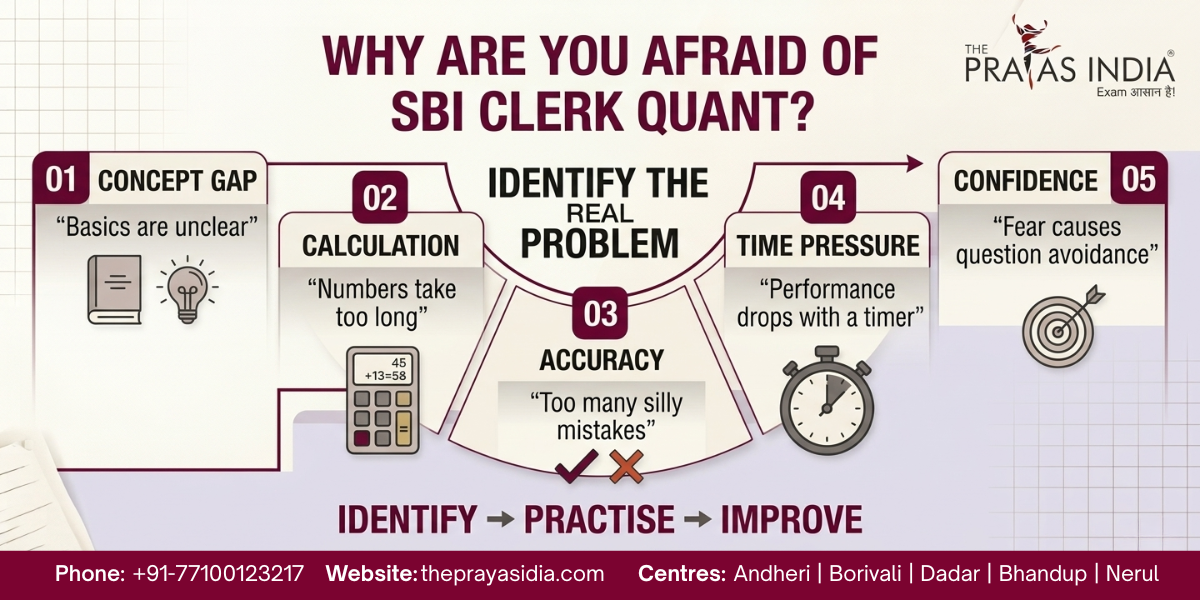
Identify What Exactly Scares You About Quant
“Maths is difficult” is too broad a diagnosis.
You need to identify the actual source of the problem.
For one aspirant, the problem may be calculation speed. For another, it may be percentage-based questions. Someone else may understand concepts but panic when the timer starts.
Start by dividing your difficulty into categories.
| Problem | What It Usually Indicates |
|---|---|
| I don’t understand the question | Concept or question interpretation issue |
| I know the method but take too long | Calculation or practice issue |
| I make silly mistakes | Accuracy and attention issue |
| I forget formulas | Revision issue |
| I panic during mocks | Time-pressure issue |
| I avoid Quant practice | Confidence issue |
| I can solve at home but not in tests | Exam execution issue |
This diagnosis is important because every problem needs a different solution.
If calculation is your weakness, reading another chapter of theory will not solve it.
If concepts are weak, doing hundreds of questions without understanding the method may not help either.
Start With the Quantitative Aptitude Basics
Maths fear becomes stronger when foundational concepts are unclear.
Before jumping into difficult questions, make sure you are comfortable with the basic areas that support multiple topics.
These may include:
- Percentages
- Ratio and proportion
- Average
- Profit and loss
- Simple and compound interest
- Time and work
- Time, speed and distance
- Number system
- Simplification
- Approximation
- Data interpretation
- Basic arithmetic concepts
The objective is not to memorise dozens of formulas immediately.
First understand what the concept means and when it is used.
For example, percentages appear in profit and loss, discounts, data interpretation, income-expenditure questions and many other arithmetic problems.
A strong foundation therefore makes several later topics easier.
Don’t Start With the Hardest Questions
A common mistake among anxious aspirants is to begin with difficult questions because they believe challenging practice will make them stronger faster.
In reality, repeatedly failing on difficult questions can reinforce the belief that you cannot handle mathematics.
A better progression is:
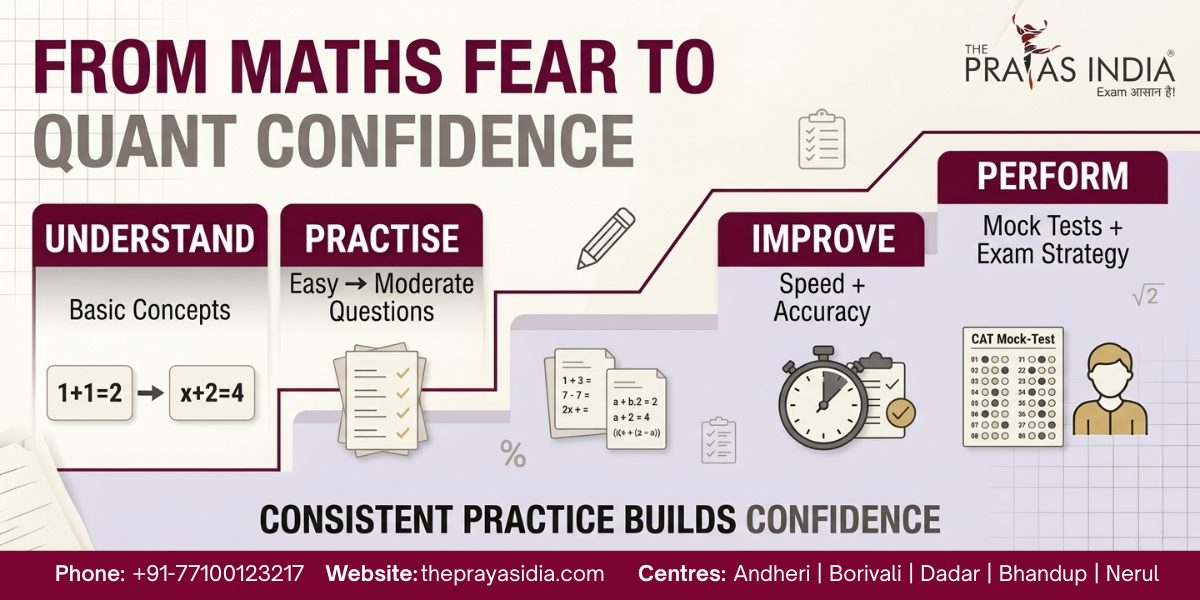
Basic → Moderate → Exam-Level → Mixed Practice
Begin with questions where you can understand the method.
Once accuracy becomes consistent, increase the difficulty.
This creates a gradual improvement in confidence while still moving toward the actual examination standard.
Build Confidence Through Small Wins
Confidence in Quant is usually built through evidence.
If you solve five questions correctly, you have evidence that you can solve those types of questions.
If you then solve ten, fifteen and twenty questions with improving accuracy, your perception of the subject begins to change.
Therefore, don’t measure your progress only through full-length mock scores.
Track smaller achievements as well.
For example:
Week 1: 15 questions with 60% accuracy
Week 2: 20 questions with 70% accuracy
Week 3: 25 questions with 80% accuracy
Week 4: 25 questions with 90% accuracy
This type of progress is much more useful than simply saying, “I am weak in maths.”
Learn to Recognise Question Types
Speed in SBI Clerk Quant does not come only from calculating faster.
It also comes from recognising what type of problem you are looking at.
When you have solved enough questions, you begin to identify familiar structures.
A question may initially look complicated, but you may recognise it as a standard percentage, ratio, average or time-and-work problem.
That recognition saves time because you don’t have to rediscover the method from scratch.
This is one reason topic-wise practice is important during the early stage of preparation.
Instead of immediately solving random mixed questions, spend time understanding the patterns within individual topics.
Make Calculation Practice a Daily Habit
For many SBI Clerk aspirants, fear of Quant is actually fear of calculations.
They understand the concept but become uncomfortable when numbers become large or calculations need to be performed quickly.
This is where short, regular calculation practice can help.
You can practise:
- Multiplication
- Division
- Percentage conversions
- Fractions
- Squares
- Cubes
- Approximation
- Basic mental calculations
You do not necessarily need to spend hours doing this.
A focused daily practice session can gradually improve familiarity with numbers.
The objective is to make common calculations feel less mentally demanding.
Learn Useful Fraction-Percentage Relationships
Percentage questions become easier when common fraction relationships are familiar.
For example:
| Fraction | Percentage |
|---|---|
| 1/2 | 50% |
| 1/3 | 33.33% |
| 1/4 | 25% |
| 1/5 | 20% |
| 1/8 | 12.5% |
| 1/10 | 10% |
| 1/20 | 5% |
| 1/25 | 4% |
These relationships can reduce calculation time in many arithmetic and DI questions.
However, the objective should not be blind memorisation.
Understand why these conversions work and practise applying them in actual questions.
Don’t Chase Speed Before Accuracy
This is one of the most important principles for aspirants who fear Quant.
When students hear that SBI Clerk is a speed-based examination, they often try to solve questions as quickly as possible from the beginning.
That can create a problem.
If you rush before understanding the method, your accuracy falls.
Then you become more anxious.
Then you rush even more.
Instead, follow this sequence:
Stage 1: Correct Method
Understand how the question is solved.
Stage 2: Accuracy
Solve similar questions consistently without mistakes.
Stage 3: Speed
Reduce the time gradually.
Stage 4: Exam Application
Practise selecting the right questions under time pressure.
Speed should therefore be the result of familiarity, not the starting point.
Use a Mistake Notebook
A mistake notebook can be extremely useful for Quant preparation.
Whenever you make an error, don’t simply check the answer and move forward.
Record:
What was the question type?
What did I do wrong?
Was the mistake conceptual or computational?
Did I use an inefficient method?
Could I have recognised the question faster?
This creates a record of your recurring problems.
Over time, you may discover that most of your mistakes come from a small number of patterns.
Perhaps you repeatedly make errors in percentage calculations.
Perhaps you misread questions involving ratios.
Perhaps you rush during DI.
Once you know the pattern, your practice becomes much more targeted.
Understand the Difference Between Fear and Weakness
Not every low score means you lack mathematical ability.
Suppose you score poorly in a mock because you spend too much time on three questions.
The problem may not be your mathematical knowledge.
It may be question selection.
Similarly, if you know the formula but repeatedly make arithmetic mistakes, the issue may be calculation accuracy rather than conceptual understanding.
This distinction matters because otherwise you may spend weeks studying topics that are not actually responsible for your poor performance.
Practice One Topic Until the Method Becomes Familiar
When learning a new Quant topic, avoid switching between too many unrelated areas.
For example, if you are working on percentages, first understand the basic concepts.
Then solve easy questions.
Move to moderate questions.
Then solve SBI Clerk-level questions.
Finally, mix percentage questions with other arithmetic topics.
This progression helps your brain recognise the underlying structure before dealing with the unpredictability of a mixed paper.
How to Handle Data Interpretation Without Panic
Data Interpretation often creates anxiety because the set appears visually large.
A table or graph with multiple values can make the question look more complicated than it actually is.
Don’t try to calculate everything.
First read the question carefully.
Identify:
What information is actually required?
Then locate only the relevant values.
Depending on the question, approximation may also help reduce unnecessary calculation, provided the options and required precision allow it.
DI should therefore be approached as a combination of reading, interpretation and calculation, not as a giant calculation exercise.
Don’t Solve Every Question in a Mock
This is another habit that can increase maths fear.
When an aspirant sees a Quant section, they may feel that every question must be solved.
That is not the right mindset.
Competitive exams reward efficient decision-making, not emotional attachment to individual questions.
During practice, learn to classify questions as:
Quick
Questions you can solve confidently with limited calculation.
Moderate
Questions requiring some time but using familiar concepts.
Time-Consuming
Questions that involve lengthy calculations or multiple steps.
Uncertain
Questions where you are not confident about the method.
Your goal is to maximise the value of your available time.
Key Takeaway
Overcoming maths fear during SBI Clerk preparation starts with changing your relationship with the subject.
You do not need to become a mathematics expert.
You need to become comfortable with the types of questions the examination expects you to solve.
Start with the basics.
Identify your actual weakness.
Build confidence through small improvements.
Practise calculations regularly.
Focus on accuracy before speed.
Maintain a mistake notebook.
Learn to recognise question patterns.
And gradually move from topic-wise practice to mixed, timed practice.
Most importantly, don’t allow one poor mock score to become a permanent judgement about your ability.
Quantitative Aptitude is a skill that can be developed through structured practice.
Create a Daily Quant Routine
You do not need to spend your entire study day on Quantitative Aptitude to improve.
A focused daily routine can be more effective than occasional long sessions.
A practical session can contain four components:
| Activity | Purpose |
|---|---|
| Concept Revision | Strengthen fundamentals |
| Calculation Practice | Improve numerical comfort |
| Topic Practice | Build question-solving ability |
| Timed Practice | Develop speed and decision-making |
For example, after learning a topic, spend some time solving questions without worrying excessively about speed. Once the method becomes familiar, introduce a timer.
The purpose of the routine is to make Quant a regular part of your preparation rather than a subject you study only when a mock test exposes a weakness.
Divide Quant Topics Into Strong, Moderate and Weak Areas
Not every topic deserves the same amount of your preparation time.
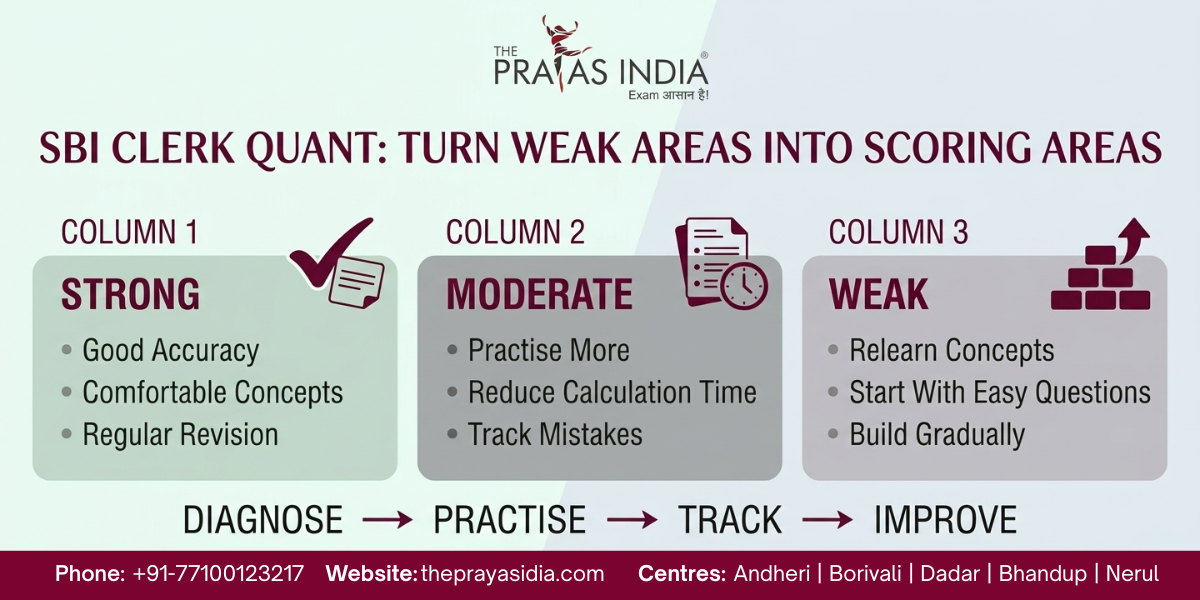
After solving practice sets and mocks, divide your topics into three categories.
Strong Areas
You understand the concept, maintain good accuracy and usually solve questions within reasonable time.
These areas need maintenance and periodic revision.
Moderate Areas
You understand the basics but sometimes make calculation errors or take too long.
These areas require regular practice.
Weak Areas
You struggle to understand the method, frequently make mistakes or avoid the topic altogether.
These areas need targeted concept-building followed by gradual practice.
This classification prevents you from spending the same amount of time on every chapter.
Gradually Introduce Time Limits
If maths creates anxiety, don’t immediately start solving every practice set under extreme time pressure.
Use a progression.
Level 1 — Untimed
Focus entirely on understanding the method.
Level 2 — Soft Timer
Give yourself a reasonable time limit but allow some flexibility.
Level 3 — Strict Timer
Solve a fixed number of questions within a defined period.
Level 4 — Mixed Section
Attempt questions from different topics under realistic conditions.
Level 5 — Full Mock
Apply the same approach in a complete SBI Clerk mock test.
This progression teaches your mind that a timer is simply another part of the examination rather than a threat.
Improve Speed by Reducing Unnecessary Steps
Speed does not always mean calculating faster.
Sometimes it means calculating less.
Suppose two methods can reach the same answer. If one requires several long calculations while another uses a simpler relationship, the second method may be more efficient.
This is why reviewing solutions is important even when you get a question correct.
Ask yourself:
Did I use the most efficient method?
Could I have simplified the calculation?
Could I have recognised a standard pattern?
Did I calculate something that the question did not actually require?
These questions can gradually improve your solving approach.
Learn From Every Mock Test
Mock tests are not only score-generating exercises.
They are diagnostic tools.
After every mock, analyse your Quant performance under four headings:
| Analysis Area | What to Check |
|---|---|
| Accuracy | How many attempted questions were correct? |
| Time | Which questions consumed excessive time? |
| Selection | Which questions should have been skipped? |
| Concepts | Which topics caused repeated errors? |
This analysis is often more valuable than immediately taking another mock.
If you repeatedly make the same mistake but never analyse it, additional mocks may simply reproduce the same problem.
Keep a Quant Performance Tracker
A simple tracker can help you see whether your fear is actually reducing.
Record your performance after every major practice session.
You can track:
- Number of questions attempted
- Correct answers
- Incorrect answers
- Accuracy percentage
- Average solving time
- Topics causing mistakes
- Questions left unattempted
- Common calculation errors
Over several weeks, patterns become visible.
You may discover that your accuracy has improved even though your overall mock score has not increased significantly yet.
That information is valuable because it tells you that the foundation is improving and speed may be the next area to address.
Don’t Compare Your Speed With Someone Else’s
One aspirant may solve arithmetic quickly while another may initially be stronger in simplification or DI.
Comparison can create unnecessary pressure.
Your real benchmark should be your own performance.
If you move from:
Low accuracy → better accuracy
and then:
Slow solving → moderate solving speed
and eventually:
Moderate speed → exam-ready speed
you are progressing.
Competitive preparation is not a race against another student’s practice schedule.
It is a process of improving your own performance before the examination.
How to Deal With Quant Anxiety During a Mock
Suppose the Quant section begins and the first few questions appear difficult.
The worst response is to panic and conclude that the entire section is difficult.
Instead, scan the section strategically.
Look for questions that appear familiar.
Attempt those first.
A few successful attempts can help settle your mind and give you a clearer sense of the section.
If a question appears unnecessarily time-consuming, move on.
The ability to leave a question temporarily is not weakness.
It is exam strategy.
Develop a Question-Selection Habit
During practice, don’t only ask:
“Can I solve this?”
Also ask:
“Should I solve this right now?”
This distinction is extremely important in a time-bound examination.
A question can be mathematically solvable but still be a poor choice if it requires too much time compared with the marks it offers.
With repeated mock analysis, you will become better at identifying:
- Direct questions
- Familiar arithmetic
- Manageable DI
- Lengthy calculations
- Unfamiliar concepts
- Questions requiring excessive steps
Good question selection can improve your effective speed without requiring you to become dramatically faster at every calculation.
Make Difficult Topics Less Intimidating
Some Quant topics may continue to feel uncomfortable even after regular practice.
Instead of repeatedly avoiding them, break them into smaller components.
For example:
Time and Work
Start with basic work concepts.
Then practise efficiency-based questions.
Then move to combined work.
Finally, attempt exam-level mixed questions.
The same approach can be applied to other difficult areas.
The idea is simple:
Don’t fight the entire topic at once. Break it into manageable pieces.
Use Revision to Prevent Fear From Returning
A topic you studied three weeks ago may feel unfamiliar again if you never revise it.
That can create the impression that you “forgot everything.”
Regular revision prevents this.
A simple cycle can be:
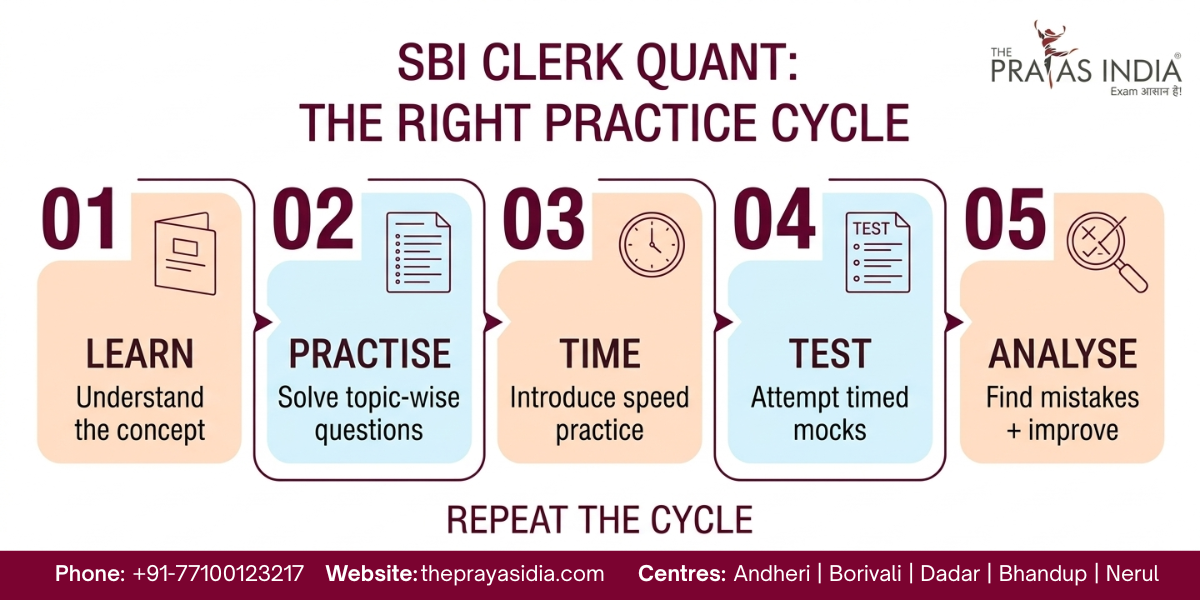
Learn → Practise → Revise → Test → Revisit Weaknesses
Revision does not always require solving an entire chapter again.
It can include reviewing:
- Key formulas
- Short methods
- Common mistakes
- Previously difficult questions
- Important question patterns
This makes familiar concepts remain accessible.
Build a Balanced SBI Clerk Preparation Schedule
Quant should not consume all your preparation time.
SBI Clerk preparation also requires attention to Reasoning and English, along with the relevant areas required for the examination stages.
A balanced schedule can prevent one section from becoming disproportionately strong while another remains neglected.
For example:
| Preparation Area | Regular Focus |
|---|---|
| Quant | Concepts + Practice + Speed |
| Reasoning | Concepts + Puzzles + Practice |
| English | Grammar + Vocabulary + Reading |
| Current/General Awareness | Regular revision |
| Mock Tests | Timed practice + Analysis |
Your exact time allocation should depend on your strengths, weaknesses and preparation stage.
What If You Keep Scoring Low in Quant?
A low score should trigger analysis rather than panic.
Start by checking whether the issue is:
Conceptual knowledge
Calculation speed
Accuracy
Question selection
Time management
Exam anxiety
If concepts are weak, return to fundamentals.
If accuracy is weak, slow down during practice and identify recurring mistakes.
If speed is weak, practise timed sets after improving accuracy.
If selection is weak, analyse which questions consumed too much time.
If anxiety is the problem, increase the frequency of controlled timed practice.
This approach converts a vague problem into a series of manageable problems.
When Should You Consider Structured SBI Clerk Coaching?
Self-study can work for many candidates, but some aspirants spend significant time deciding what to study, which questions to practise and how to evaluate their performance.
Structured SBI Clerk coaching in Mumbai can provide an organised preparation framework for candidates who want additional guidance.
The value of coaching should not be measured only by classroom teaching.
A useful preparation system can include:
- Concept-focused classes
- Topic-wise practice
- Regular mock tests
- Performance analysis
- Doubt-solving support
- Revision planning
- Exam-oriented strategies
- Mentorship and guidance
For an aspirant struggling specifically with Quant, structured guidance can help identify whether the problem is conceptual, calculation-based or related to exam execution.
How The Prayas India Can Support SBI Clerk Aspirants
For candidates preparing for SBI Clerk in Mumbai, The Prayas India can become part of a structured preparation approach where learning and practice are connected.
Instead of treating Quant as a subject that must simply be “completed,” aspirants should focus on building the complete chain:
Concept → Practice → Accuracy → Speed → Test → Analysis
This is particularly useful for students who have developed maths anxiety because of repeated mistakes.
The objective is to create an environment where mistakes become feedback rather than proof of inability.
With consistent practice and appropriate guidance, a candidate can gradually move from avoiding Quant questions to approaching them with a clearer strategy.
A Practical 30-Day Approach to Reducing Maths Fear
If you are starting from a low-confidence position, the next month can be structured around gradual improvement.
Days 1–7: Foundation
Focus on basic arithmetic concepts and calculation practice.
Do not worry excessively about speed.
Your priority is understanding.
Days 8–15: Topic Practice
Start solving moderate-level questions from important Quant topics.
Maintain a mistake notebook.
Days 16–22: Timed Practice
Introduce sectional time limits.
Track accuracy and average solving time.
Days 23–27: Mixed Sets
Solve questions from multiple topics.
Focus on recognising which questions deserve immediate attention.
Days 28–30: Mock + Analysis
Take realistic mock tests and spend significant time analysing them.
Identify the three biggest Quant problems that still remain.
Then make those problems your next improvement targets.
What You Should Not Do
Overcoming maths fear also requires avoiding habits that reinforce it.
Don’t Avoid Quant for Several Days
Avoidance creates unfamiliarity.
Don’t Collect Too Many Resources
Too many books, videos and PDFs can create confusion.
Don’t Start Every Topic From Zero
Use your mistakes and performance data to decide what actually needs revision.
Don’t Chase Speed Blindly
Accuracy must come before speed.
Don’t Take Every Low Score Personally
A mock is feedback, not a final judgement.
Don’t Compare Your Journey With Other Aspirants
Your improvement should be measured against your own previous performance.
The Right Mindset for SBI Clerk Quant
The most useful mindset is neither overconfidence nor fear.
It is controlled confidence.
You don’t need to believe that every Quant question will be easy.
You need to believe that you can:
Identify what you know.
Solve what you can solve efficiently.
Skip what is unnecessarily time-consuming.
Learn from what you get wrong.
Improve with repeated practice.
That is what exam readiness looks like.
Frequently Asked Questions
1. How can I overcome maths fear during SBI Clerk preparation?
Start by identifying the exact source of your fear. Build your fundamentals, begin with manageable questions, practise calculations regularly and gradually introduce timed practice. Avoid judging your mathematical ability based on a few poor mock scores.
2. Is Quantitative Aptitude difficult in SBI Clerk?
The difficulty can vary across questions and exam shifts. Candidates generally need strong fundamentals, regular practice, reasonable calculation speed and good question-selection skills to perform effectively.
3. I am weak in maths. Can I still prepare for SBI Clerk?
Yes. Being weak at the beginning does not mean you cannot improve. A structured progression from basic concepts to topic-wise practice, timed sets and mocks can help develop the required skills.
4. Should I focus on speed or accuracy first?
Focus on accuracy first. Once you can solve questions correctly and consistently, gradually reduce the time taken to solve them.
5. How can I improve calculation speed for SBI Clerk?
Regularly practise basic calculations, fractions, percentages, squares and approximation. Also review your solutions to identify unnecessary calculation steps.
6. How many Quant questions should I practise every day?
There is no fixed number suitable for every aspirant. Quality matters more than an arbitrary target. Your practice should include concept understanding, accuracy, timed solving and analysis.
7. Why do I solve Quant questions correctly at home but make mistakes in mocks?
The difference is often caused by time pressure, question selection or exam anxiety. Gradually introduce timed practice and analyse your mock performance to identify the specific issue.
8. Should I attempt difficult Quant questions in SBI Clerk?
Not automatically. Prioritise questions based on familiarity, expected time and confidence. A difficult question may be solvable, but it may not always be the best use of limited examination time.
9. Can coaching help if I am afraid of maths?
Structured coaching can help by providing systematic concept teaching, guided practice, doubt resolution, mock tests and performance analysis. The important factor is whether the preparation system addresses your actual weakness.
10. How can The Prayas India help with SBI Clerk preparation?
The Prayas India provides a structured preparation environment for banking aspirants, combining learning, practice and examination-oriented preparation. Aspirants can use guided preparation and regular evaluation to work systematically on areas such as Quantitative Aptitude.
Final Takeaway
Maths fear does not disappear because you tell yourself to “be confident.”
It reduces when you repeatedly experience understanding, practice, improvement and successful application.
Start with the basics instead of difficult questions.
Identify whether your real problem is concepts, calculations, accuracy, speed or question selection.
Practise regularly.
Build a mistake notebook.
Introduce time limits gradually.
Analyse every mock instead of looking only at the final score.
And never confuse a weak starting point with a permanent limitation.
For aspirants preparing for SBI Clerk, Quantitative Aptitude can become much more manageable when preparation follows a structured progression:
Understand → Practise → Improve Accuracy → Build Speed → Take Tests → Analyse → Repeat
If you are looking for SBI Clerk Coaching in Mumbai, the right guidance can make this process more systematic by helping you identify weaknesses, practise according to your level and prepare with an examination-oriented approach.
The goal is not to become someone who never finds a Quant question difficult.
The goal is to become someone who can stay calm, recognise the right questions, solve them efficiently and make smart decisions under pressure.
That is the confidence an SBI Clerk aspirant actually needs.
Contact Us
📞 Call Now: +91-77100 13217
🌐 Website: theprayasindia.com