
How to Prepare for CAT 2027 Alongside College | The Prayas India Andheri
Preparing for the Common Admission Test (CAT) while attending college can feel challenging. Between lectures, assignments, semester examinations, projects and social commitments, finding enough time for MBA entrance preparation is not always easy. However, with a realistic timetable and a consistent approach, college students can gradually build the skills required for CAT 2027 without neglecting their graduation studies.
The key is not to study for excessively long hours every day. Instead, focus on using your available time effectively, strengthening fundamentals, practising all three CAT sections and reviewing your progress regularly.
For students living in Andheri West, Andheri East, Vile Parle, Jogeshwari and nearby areas, having a structured preparation routine can make it easier to balance college and entrance exam preparation. Students exploring CAT coaching in Andheri can also consider how structured guidance and regular practice may fit into their academic schedule.
In this guide, we will discuss a practical CAT 2027 preparation strategy for college students, including a daily timetable, weekend plan, section-wise preparation tips and common mistakes to avoid.
Understand the CAT Exam Structure Before Starting
Before creating your study timetable, understand the broad structure of the examination.
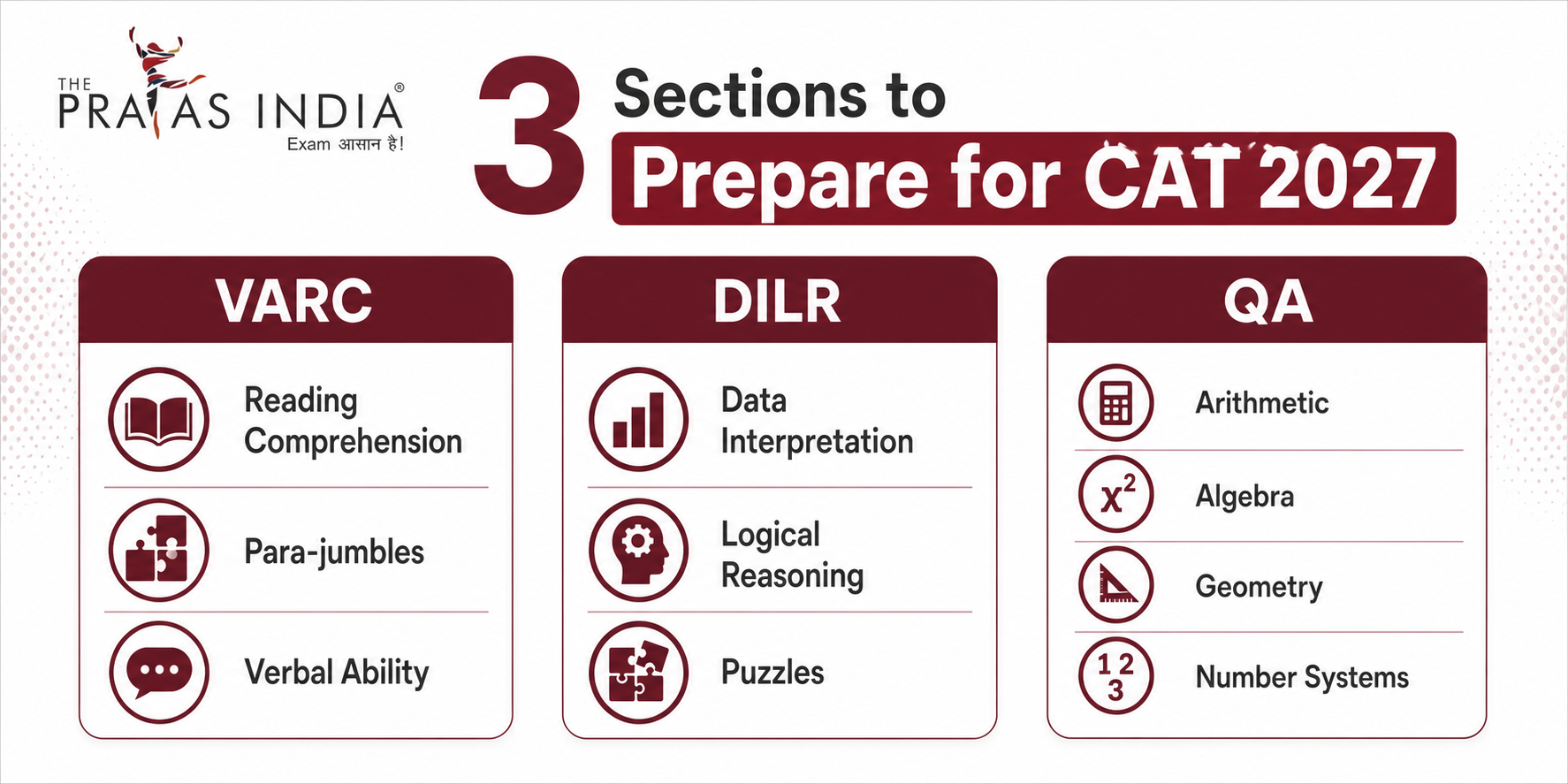
CAT has three main sections:
- Verbal Ability and Reading Comprehension (VARC)
- Data Interpretation and Logical Reasoning (DILR)
- Quantitative Ability (QA)
The CAT 2026 examination structure included three separately timed sections of 40 minutes each, with a total testing duration of 120 minutes. The exact CAT 2027 examination pattern, question distribution, marking scheme and dates should be verified when the official notification is released.
Understanding the sections will help you divide your preparation time more effectively. Rather than studying only your strongest subject, make sure that all three areas receive consistent attention.
Start Your CAT 2027 Preparation with a Realistic Goal
College students often make the mistake of creating a timetable that looks impressive but is difficult to follow.
For example, planning to study for six hours every day alongside regular college classes may not be practical for everyone. A better approach is to begin with manageable study targets and gradually increase the workload.
Start by identifying:
- Your college lecture and practical timings.
- Your semester examination schedule.
- Your daily commuting time.
- Your strongest and weakest CAT sections.
- The number of hours you can consistently dedicate to preparation.
If you can manage two focused hours on most college days and additional time on weekends, you can build a sustainable preparation routine.
Students searching for CAT preparation in Andheri should also consider whether their chosen study schedule leaves sufficient time for college attendance, assignments and examination preparation.
Follow a Daily CAT Study Timetable Alongside College
A structured daily routine helps you maintain consistency without allowing CAT preparation to interfere with your graduation studies.
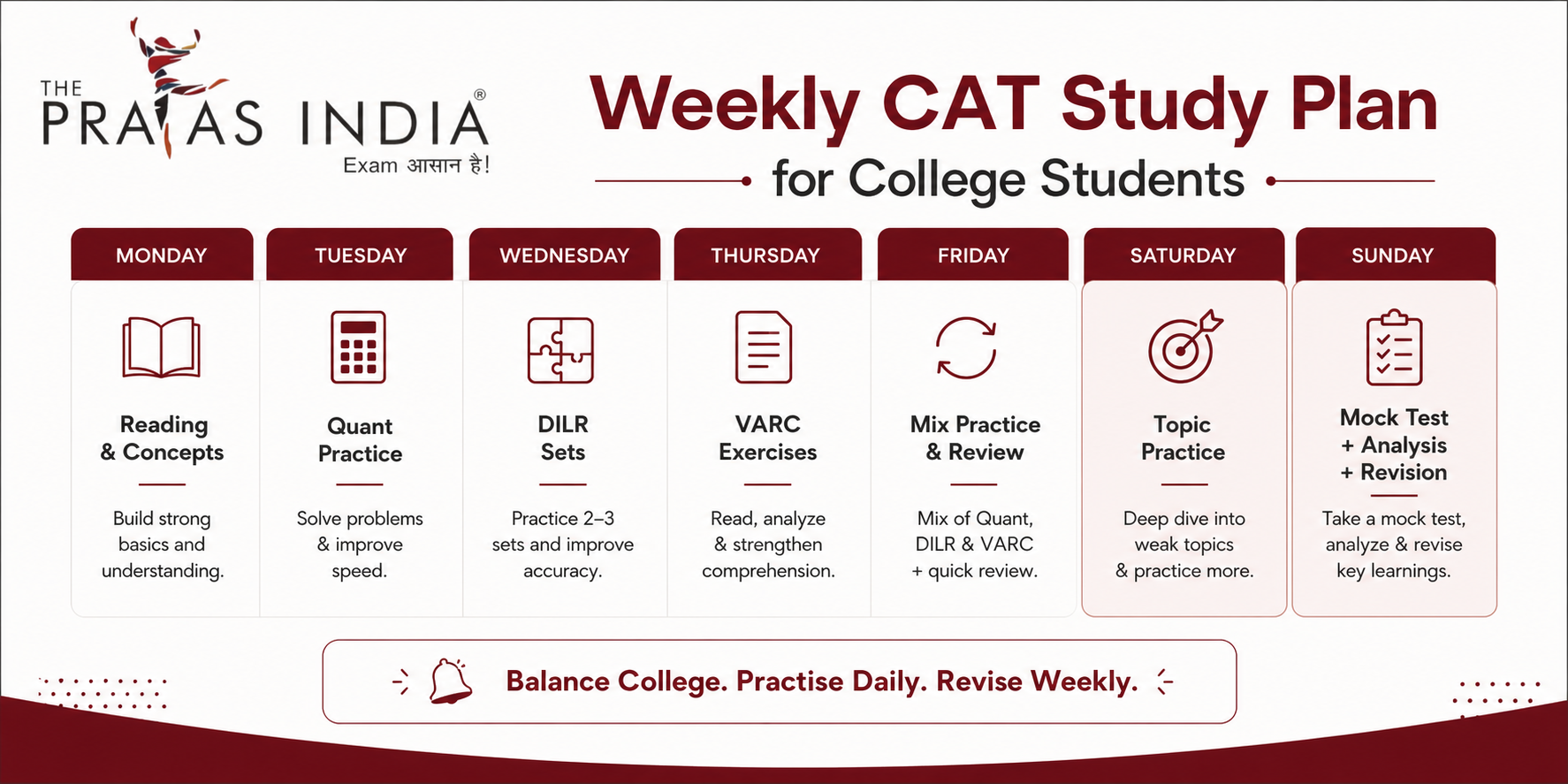
Here is an example of a weekday timetable for a college student.
| Time | Activity |
|---|---|
| Morning – 30 minutes | Newspaper or editorial reading |
| College hours | Lectures, practicals and assignments |
| Evening – 60 minutes | Quantitative Ability practice |
| Evening – 45 minutes | VARC or DILR practice |
| Night – 15 minutes | Revision and error-log review |
This is a sample schedule, not a compulsory timetable. You can adjust it according to your lecture timings, travel time and energy levels.
If you have a particularly busy college day, complete a shorter revision session instead of skipping preparation completely.
The most important objective is to maintain a regular connection with CAT concepts and questions.
Prepare for CAT 2027 Section by Section
CAT preparation requires different skills across its three sections. A balanced strategy will help you improve without becoming dependent on only one subject.
A. Verbal Ability and Reading Comprehension (VARC)
VARC preparation requires regular reading, comprehension and the ability to understand arguments.
College students can develop these skills through short daily activities.
What should you practise?
- Reading comprehension passages.
- Para-jumbles.
- Para-summary questions.
- Odd sentence questions, where applicable.
- Reading editorials and long-form articles.
- Understanding the author’s tone, argument and central idea.
Suggested daily routine:
- Read one editorial or quality article.
- Practise a short reading comprehension exercise.
- Review why an answer option is correct or incorrect.
- Maintain a list of unfamiliar words and their usage.
Do not focus only on memorising vocabulary. CAT reading comprehension requires the ability to interpret information, identify arguments and understand the relationship between ideas.
A regular reading habit can be especially useful for students who have limited time during college weekdays.
B. Data Interpretation and Logical Reasoning (DILR)
DILR requires analytical thinking, logical organisation and the ability to identify useful information within a set.
It can initially feel difficult because many questions require multiple steps before reaching the answer.
Important practice areas include:
- Tables and charts.
- Bar graphs and line graphs.
- Caselets.
- Seating arrangements.
- Games and tournaments.
- Distribution and grouping.
- Selection-based puzzles.
- Scheduling and arrangement problems.
Suggested practice routine:
Start with one manageable DILR set during a study session. Focus on understanding the information and building a logical approach before trying to solve it faster.
As your confidence improves, practise mixed sets under timed conditions.
Do not immediately check the solution when you get stuck. Spend some time identifying what information is available, what needs to be found and which relationships can be established.
C. Quantitative Ability (QA)
Quantitative Ability is an important section for students from all academic backgrounds. Students who have not studied mathematics recently may need additional time to strengthen their fundamentals.
Start with these topics:
- Percentages.
- Ratio and proportion.
- Averages.
- Profit and loss.
- Simple and compound interest.
- Time and work.
- Time, speed and distance.
- Number systems.
- Algebra.
- Geometry and mensuration.
Suggested preparation routine:
- Learn one concept at a time.
- Solve basic questions before moving to advanced problems.
- Maintain a formula notebook.
- Practise calculations regularly.
- Review mistakes and repeat difficult question types.
Students from commerce, arts, science and engineering backgrounds may have different levels of familiarity with mathematics. Your study plan should reflect your current understanding rather than follow someone else’s timetable blindly.
Use Weekends for Longer Practice Sessions
Weekends are valuable for college students because they often provide more uninterrupted study time.
Instead of spending the entire weekend studying one subject, divide the available time between all three CAT sections and revision.
Here is an example of a weekend preparation plan:
| Day | Study Activity | Suggested Duration |
|---|---|---|
| Saturday | Quantitative Ability concepts and practice | 90 minutes |
| Saturday | VARC reading and question practice | 60 minutes |
| Saturday | DILR set practice | 60 minutes |
| Sunday | Sectional test or mock practice | 120 minutes |
| Sunday | Test analysis and revision | 60 minutes |
| Total | Weekend Intensive Blocks | 390 minutes (6.5 hours) |
Adjust the duration based on your college workload and preparation level.
If semester examinations are approaching, reduce the CAT study load temporarily and prioritise your academic commitments. You can return to the regular schedule once your college examinations are over.
Divide CAT 2027 Preparation into Different Phases
A phased preparation strategy makes it easier to track progress and identify what needs attention.
Since CAT 2027 dates and the final examination pattern are yet to be officially notified, use the following as a flexible roadmap rather than a fixed exam calendar.
Phase 1: Build Your Fundamentals
Main focus: Strengthen basic concepts.
During this phase:
- Understand the three CAT sections.
- Review basic mathematics.
- Develop a daily reading habit.
- Start solving beginner-level DILR sets.
- Learn the fundamentals of each topic.
- Identify your weaker areas.
Do not rush into full-length mock tests before developing a basic understanding of the subjects.
Phase 2: Complete Core Topics and Increase Practice
Main focus: Apply concepts to CAT-level questions.
Once your fundamentals are reasonably strong:
- Cover important QA topics.
- Practise different types of DILR sets.
- Solve reading comprehension questions regularly.
- Start topic-wise timed exercises.
- Revise concepts covered earlier.
- Maintain an error notebook.
This phase should help you move from understanding concepts to solving questions independently.
Phase 3: Begin Sectional Tests
Main focus: Improve speed and accuracy.
Start attempting sectional tests for VARC, DILR and QA.
After each test, identify:
- Topics where you performed well.
- Questions that consumed too much time.
- Concepts that need revision.
- Errors caused by incorrect calculations or assumptions.
- Questions that should have been skipped.
Gradually increase the difficulty of your practice.
Phase 4: Mock Tests and Final Revision
Main focus: Develop examination readiness.
As the examination approaches:
- Attempt full-length mock tests under the notified examination conditions.
- Analyse every mock carefully.
- Revise important formulas and concepts.
- Practise previous-year CAT questions.
- Improve question selection.
- Avoid repeatedly changing your preparation resources.
Keep your college examination calendar in mind while planning mock tests so that your preparation remains manageable.
Balance Semester Exams and CAT Preparation
One of the biggest challenges for college students is managing two different examination schedules.
Semester examinations may require more attention during particular weeks. Instead of treating this as a disruption, plan your CAT preparation around your academic calendar.
During regular college weeks:
Maintain your regular CAT study routine with short daily sessions.
During internal assessments:
Reduce the number of CAT practice questions and focus on maintaining your reading and revision habits.
During semester examinations:
Prioritise college subjects. If possible, spend a short amount of time revising CAT formulas or reading an article, but do not compromise essential academic preparation.
After semester examinations:
Return to your regular CAT timetable and use the available time to cover pending topics.
A flexible study plan is more sustainable than trying to maintain the same study hours throughout the year.
How to Use Mock Tests Effectively
Mock tests help you understand how well you can apply your preparation under time constraints.
However, taking several tests without analysing them may not lead to meaningful improvement.
After each mock test, review your performance section by section.
For VARC:
Check whether you misunderstood the passage, misinterpreted the question or selected an option without sufficient evidence.
For DILR:
Identify whether you selected an unsuitable set, missed an important condition or made an error while organising the information.
For QA:
Review calculation mistakes, conceptual gaps and questions that took longer than necessary.
Maintain a simple mock-test record containing:
- Test date.
- Section-wise performance.
- Strong topics.
- Weak topics.
- Common mistakes.
- Action points for the next test.
Your objective should be to learn from each test rather than compare every score with someone else’s performance.
Common Mistakes College Students Should Avoid
Balancing college and CAT preparation becomes difficult when students follow an unplanned routine.
Avoid these common mistakes:
1. Ignoring college responsibilities: Your graduation studies remain important. Do not neglect assignments, attendance or semester examinations.
2. Studying only on weekends: Weekend study sessions are useful, but completely ignoring CAT preparation during weekdays can interrupt continuity.
3. Ignoring weaker sections: Avoid spending all your time on your favourite subject. Give additional attention to areas where you need improvement.
4. Collecting too many study materials: Constantly switching between resources can waste time. Choose suitable preparation material and use it consistently.
5. Taking mock tests without analysis: Review incorrect answers and unanswered questions to understand your preparation gaps.
6. Comparing your progress with others: Students have different academic backgrounds, strengths and available study hours. Focus on your own improvement.
7. Following an unrealistic timetable: A study schedule should support your routine, not create unnecessary pressure.
Should College Students Join CAT Coaching in Andheri?
Self-study can be an important part of CAT preparation. However, some students prefer additional structure, guided concept learning, regular practice and feedback.
When comparing the best CAT coaching in Andheri, do not select an institute based only on advertisements or general claims. Evaluate whether its preparation approach matches your requirements.
Consider these points before enrolling:
- Are all three CAT sections covered?
- Is the course structure explained clearly?
- Are practice tests and mock tests available?
- Is there a process for analysing performance?
- Can students ask questions and clarify doubts?
- Are the available class timings suitable for college students?
- Can the institute explain its preparation approach for CAT 2027?
Students looking for CAT classes in Andheri should also consider the convenience of travelling to the institute after college.
The Prayas India – Andheri is located at Office 803, Time Chambers, Swami Vivekanand Road, near Paneri, Andheri West, Mumbai. Students can contact the branch to enquire about CAT preparation options and understand the available learning support.
A Practical Weekly Checklist for College Students
Use this checklist to review your preparation at the end of every week.
- Complete your planned Quantitative Ability topics.
- Practise DILR sets regularly.
- Read articles and solve VARC questions.
- Revise previously covered concepts.
- Attempt at least one focused sectional test when appropriate.
- Review incorrect and unanswered questions.
- Update your preparation tracker.
- Plan the next week’s study sessions around college commitments.
You do not need to complete every task perfectly every week. The purpose of the checklist is to maintain direction and identify areas that need attention.
Build Your CAT 2027 Preparation Routine with The Prayas India – Andheri
Preparing for CAT 2027 alongside college is possible when you combine academic discipline with a realistic entrance exam study plan. Start with the fundamentals, practise all three sections, use weekends effectively and review your progress regularly.
Remember that consistency is more valuable than an unrealistic timetable. Even a focused daily study session can help you build a stronger preparation routine over time.
If you are looking for CAT entrance exam preparation in Andheri, connect with The Prayas India to enquire about available preparation options and understand how you can plan your CAT journey alongside college.
The Prayas India – Andheri Branch
Office 803, Time Chambers, Swami Vivekanand Road, near Paneri, Andheri West, Mumbai, Maharashtra 400058.
Contact Number: 083559 51603
Frequently Asked Questions – CAT 2027 Preparation Alongside College
1. Can I prepare for CAT 2027 while attending college?
Yes. College students can prepare for CAT 2027 by following a realistic timetable. Use short weekday study sessions for concepts and practice, and reserve weekends for longer practice sessions, revision and mock tests.
2. How many hours should college students study for CAT daily?
The required study time depends on your preparation level, college schedule and academic commitments. Around two focused hours on regular college days can be a practical starting point for many students. Increase or adjust the time as your preparation develops.
3. Which CAT subjects should I prepare during college?
Prepare all three CAT sections: Verbal Ability and Reading Comprehension (VARC), Data Interpretation and Logical Reasoning (DILR), and Quantitative Ability (QA). Give additional practice time to your weaker areas while maintaining regular revision.
4. When should college students start preparing for CAT 2027?
Starting early gives students more time to build mathematical fundamentals, develop reading habits, practise DILR sets and revise. Begin with a manageable routine and increase the intensity as your concepts improve.
5. How can I manage CAT preparation during semester examinations?
Prioritise your college examinations during busy academic weeks. Reduce your CAT workload temporarily and maintain only short revision or reading sessions if possible. Resume your regular preparation routine after the semester examinations.
6. Are mock tests necessary for CAT 2027 preparation?
Mock tests help you practise under examination conditions, evaluate your preparation and identify areas for improvement. Analyse your incorrect and unanswered questions after every test rather than focusing only on the score.
7. Where can I enquire about CAT coaching in Andheri?
You can contact The Prayas India at Office 803, Time Chambers, Swami Vivekanand Road, near Paneri, Andheri West, Mumbai, Maharashtra 400058. Call 083559 51603 to enquire about available CAT preparation options.
Prepare for CAT 2027 Alongside College with a Clear Plan
Balancing college and CAT preparation? Connect with The Prayas India – Andheri to enquire about available CAT preparation options and take the next step towards your MBA entrance exam goals.
Visit The Prayas India – Andheri:
Office 803, Time Chambers, Swami Vivekanand Road, near Paneri, Andheri West, Mumbai, Maharashtra 400058.
Contact: 083559 51603