How to Prepare for CAT DILR Without Getting Overwhelmed | Best CAT Coaching in Mumbai | The Prayas India
Introduction: Why CAT DILR Feels More Difficult Than It Actually Is
Data Interpretation and Logical Reasoning is often the section that creates the most uncertainty for CAT aspirants. Unlike Quantitative Aptitude, where many questions can be approached through familiar formulas and concepts, DILR presents problems in the form of sets. A candidate may understand every individual calculation involved in a set and still struggle to identify the right approach, organise the information, or decide whether the set is worth attempting.
This is also why DILR preparation can quickly become overwhelming. Students often move from one difficult set to another, compare their performance with high scorers, spend too much time trying to crack questions that are not suitable for them, and eventually feel that their preparation is going nowhere. The problem is not necessarily a lack of ability. In many cases, it is a lack of structure.
For CAT 2026 aspirants, developing a structured DILR preparation strategy is particularly important because the section tests much more than calculation speed. It evaluates how effectively a candidate can interpret information, identify relationships, build a logical framework, eliminate possibilities and make decisions under severe time pressure.
The good news is that DILR can be improved significantly with consistent practice and the right approach. You do not need to solve every difficult set available online. You need to learn how to recognise patterns, select manageable sets, develop efficient approaches and analyse your mistakes.
If you are preparing for CAT in Mumbai and looking for structured guidance, The Prayas India provides CAT preparation support through its centres in Andheri, Borivali, Dadar, Bhandup and Nerul.
Understanding the Real Challenge in CAT DILR
The first step towards better DILR preparation is understanding why the section feels difficult. Many aspirants make the mistake of treating DILR as a collection of random puzzles. That approach makes preparation unnecessarily stressful.
DILR questions generally require you to process a considerable amount of information before reaching the actual questions. A set may contain tables, charts, rankings, schedules, routes, games, tournaments, distributions, arrangements or combinations of different types of information. The difficulty is often not in performing one complicated calculation but in converting the given information into a workable structure.
For example, a set may provide information about several people, their preferences, their rankings and the days on which certain activities take place. Reading the information is only the beginning. You must identify what is fixed, what can change, what relationships are given and what deductions can be made.
This is where many students lose time.
A candidate may spend eight or ten minutes trying to understand a set simply because they entered it without first evaluating whether it was a suitable set to attempt. In CAT, that decision can be more important than knowing an advanced technique.
Therefore, DILR preparation should develop two abilities simultaneously:
- Set-solving ability: The ability to understand and solve a DILR set accurately.
- Set-selection ability: The ability to identify which sets should be attempted and which should be left for later.
The second ability is often ignored during preparation, even though it can have a major impact on actual CAT performance.
Stop Trying to Master Every DILR Set
One of the biggest reasons students become overwhelmed is the belief that they must be able to solve every type of DILR problem.
That is not a realistic CAT strategy.
The examination does not require you to solve every set. It requires you to maximise your score within the available time. A candidate who correctly identifies two or three highly manageable sets can potentially perform better than someone who spends most of the section trying to crack one exceptionally difficult set.
Your preparation should therefore focus on developing a broad understanding of DILR formats while gradually becoming stronger at the types of sets that are most suitable for you.
During practice, expose yourself to different formats such as:
- Arrangements and scheduling
- Games and tournaments
- Distribution-based sets
- Selection and grouping
- Ranking and ordering
- Venn diagrams and networks
- Tables and caselets
- Bar graphs and line graphs
- Pie charts and mixed graphs
- Quantitative comparison-based DI
- Routes, connections and networks
- Sets involving multiple conditions
The objective is not to memorise a formula for each category. Instead, you should learn how information behaves within different structures.
Over time, you should start recognising the underlying logic of a set rather than being intimidated by its presentation.
Build Your DILR Preparation Around Three Stages
A common mistake is to practise DILR in only one way: opening a question, attempting it, checking the solution and moving to the next question.
This creates activity but does not necessarily create improvement.
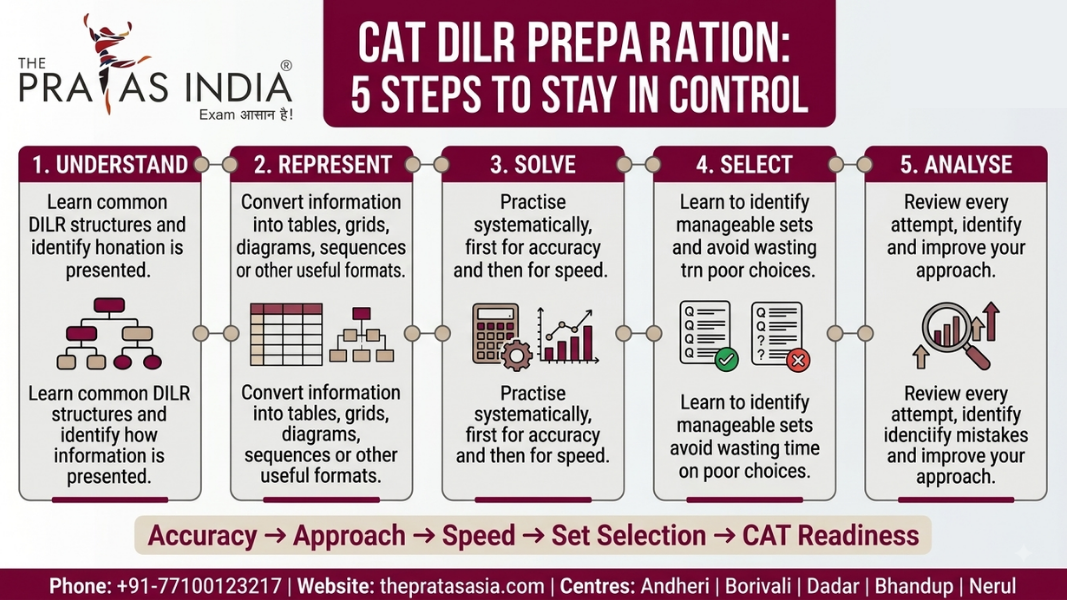
A more effective preparation process can be divided into three stages: understanding, solving and analysing.
Stage 1: Understand the Set
Before attempting a set, spend a short amount of time understanding what information has been provided.
Ask yourself:
- What are the entities involved?
- What information is fixed?
- What information is variable?
- What relationships or conditions are given?
- Can the information be represented through a table, grid, diagram or sequence?
- What deductions can immediately be made?
This initial organisation often determines how quickly you can solve the set.
Stage 2: Solve With a Structured Representation
Once you understand the information, convert it into a format that makes relationships easier to see.
For example, a scheduling problem may become easier when represented through a table. A ranking problem may require an ordered sequence. A network problem may be better represented through a diagram.
The representation is not merely a presentation technique. It is a problem-solving tool.
Stage 3: Analyse After Solving
Do not consider a DILR set complete simply because you have checked the answer.
Ask yourself why the set took the amount of time it did.
If you solved it correctly in 15 minutes, the important question is whether the approach can be improved. If you solved it incorrectly in 10 minutes, identify exactly where your reasoning broke down. If you could not solve it at all, determine whether the difficulty came from comprehension, representation, deduction or calculation.
This analysis turns practice into actual learning.
The Most Important DILR Skill: Set Selection
In the actual CAT examination, you will not have unlimited time to explore every set.
This makes set selection one of the most valuable skills you can develop.
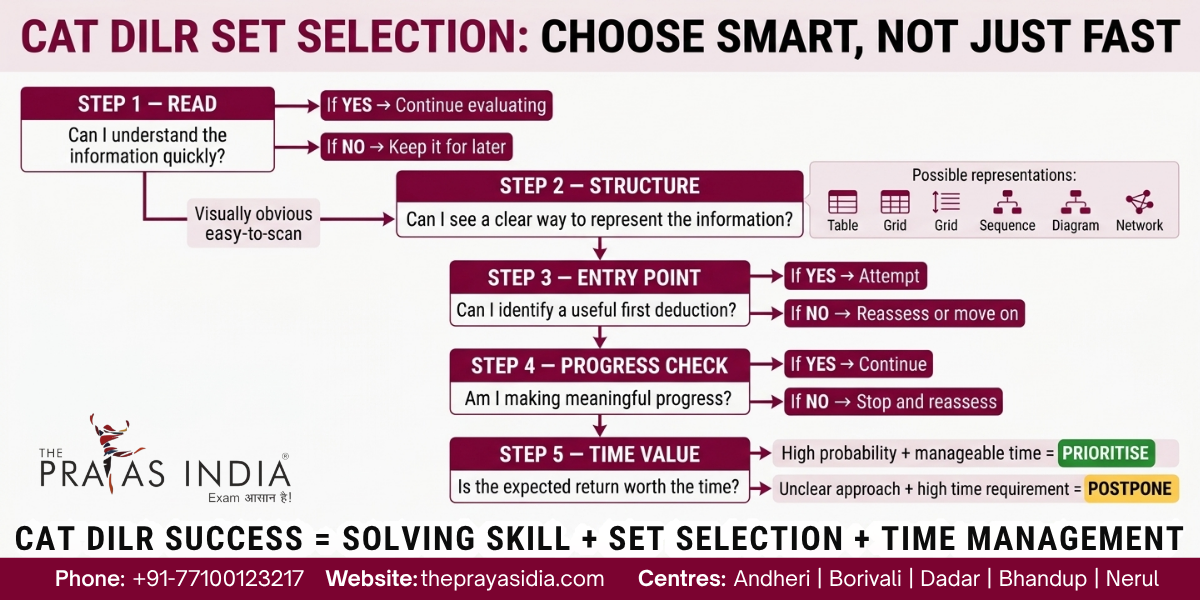
When you first look at a DILR section, avoid immediately starting with the first set. Instead, use the initial few minutes to scan the available sets and assess them.
Look for sets where:
- The information is relatively easy to understand.
- The number of variables is manageable.
- The conditions appear structured rather than extremely restrictive.
- The data can be represented quickly.
- You can identify a possible starting point.
- The questions appear interconnected in a useful way.
- You have previous experience with a similar structure.
Be cautious with sets where the information appears extremely dense, the conditions are difficult to organise or you cannot identify a clear starting point after reading the set.
This does not mean difficult-looking sets should always be avoided. Sometimes a visually complicated set can become straightforward once you identify the correct representation. The objective is to make an informed decision rather than choosing a set based purely on appearance.
A good DILR aspirant gradually develops an internal filter: Which set gives me the best probability of converting time into marks?
That is the mindset you should develop during mocks as well as practice.
How to Practise DILR Without Burning Out
DILR preparation does not become effective simply because the number of sets you solve increases.
Quality matters more than raw quantity.
Suppose one student solves 15 sets in a week but checks solutions immediately after getting stuck. Another student solves eight sets but spends substantial time analysing alternative approaches, identifying mistakes and revisiting difficult sets. The second student may develop stronger problem-solving ability despite solving fewer sets.
A practical weekly routine should include a mixture of activities.
Concept and Pattern Familiarisation
Spend some time learning the basic structures commonly seen in DILR. Understand how arrangements, distributions, games, charts, tables and networks can be represented.
At this stage, focus on understanding rather than speed.
Untimed Practice
Solve selected sets without imposing an aggressive time limit initially. The purpose is to develop your ability to decode information and construct the correct approach.
If you get stuck, do not immediately look at the complete solution. Try to identify the exact point where your reasoning stopped progressing.
Timed Practice
Once you become comfortable with a particular type of set, introduce time limits.
Timed practice teaches you an important CAT skill: knowing when to continue and when to move on.
Mixed Practice
After gaining familiarity with different formats, combine them randomly. This is important because CAT does not announce which set type will appear before the examination.
Mixed practice helps you develop adaptability.
Mock-Based Practice
Finally, practise DILR in complete mock tests. Your objective should not be only to score well. You should also observe:
- Which sets attracted you first.
- Which sets you should have avoided.
- How long you spent reading each set.
- Where you lost time.
- Whether you changed sets effectively.
- How many questions you attempted after identifying the correct approach.
- Whether accuracy declined because of time pressure.
Create a DILR Mistake Log
A mistake log can become one of the most useful tools in your CAT preparation.
However, do not create a notebook that simply records wrong answers. Record the reason behind the mistake.
Your analysis can include categories such as:
| Mistake Type | What to Record |
|---|---|
| Misread Information | Which condition or statement was misunderstood |
| Poor Representation | Why the table, diagram or arrangement was ineffective |
| Wrong Approach | Where the chosen method became inefficient |
| Calculation Error | What caused the numerical mistake |
| Logical Error | Which deduction was incorrect |
| Time Management | How much unnecessary time was spent |
| Poor Set Selection | Why the set should have been postponed |
| Incomplete Analysis | What insight was missed after the first attempt |
After several weeks, patterns will begin to appear.
You may discover that your calculations are accurate but your set selection is poor. Another student may find that they understand sets well but spend too much time constructing possibilities. Someone else may repeatedly make mistakes because they fail to convert verbal information into a visual structure.
Once you know the pattern, your preparation becomes more targeted.
Why DILR Preparation Should Not Be Separated From Mock Analysis
Mocks are not merely score-generating exercises.
For DILR, a mock test is also a decision-making laboratory.
After each mock, revisit every DILR set, including the ones you did not attempt.
This is important because a set that you skipped may actually have been easier than the one you attempted. If you repeatedly discover that you are choosing the wrong sets, your problem is not necessarily your DILR solving ability. It is your decision-making process.
Similarly, if you consistently identify the correct sets but fail to complete them within the available time, your focus should shift towards execution.
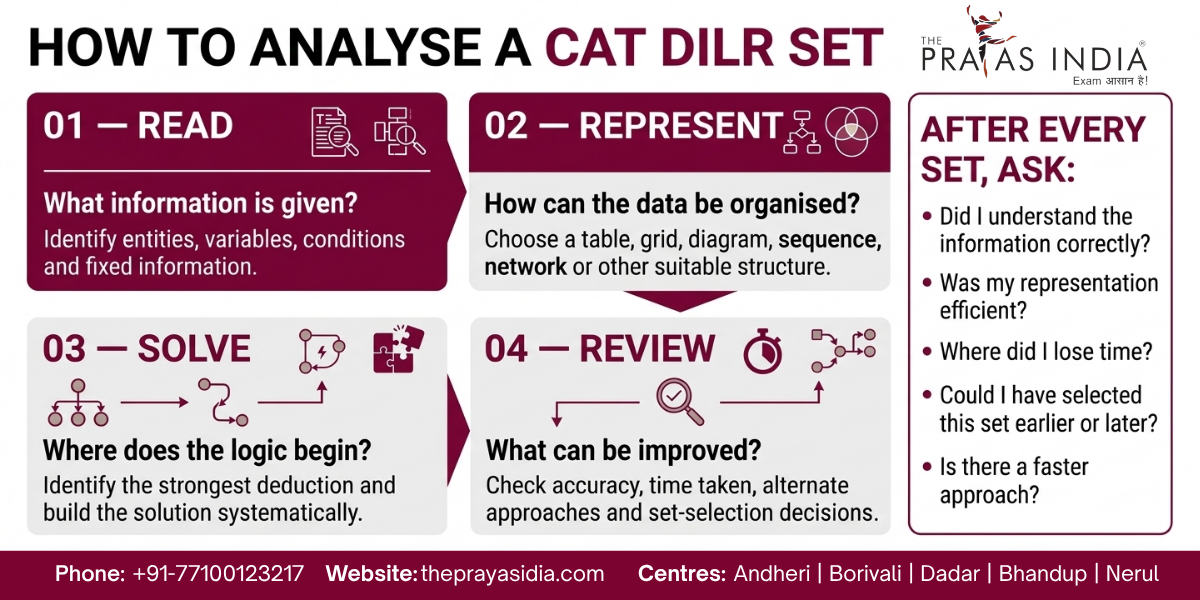
A useful post-mock analysis should answer four questions:
Which sets were the best opportunities?
Identify the sets that offered the highest probability of accurate attempts.
Which set did I choose and why?
Write down the reason behind your selection rather than simply calling it a good or bad decision.
Where did I lose time?
Separate reading time, representation time, deduction time and calculation time wherever possible.
What should I do differently next time?
The final question converts analysis into an actionable improvement.
Managing the Psychological Pressure Around DILR
DILR can create a unique kind of exam anxiety because the section sometimes feels unpredictable.
A candidate may solve five sets comfortably during practice and then encounter a mock in which none of the sets initially looks familiar. This can create the impression that preparation has failed.
It has not.
The purpose of DILR preparation is not to guarantee that every set will look familiar. It is to make you capable of dealing with unfamiliar information.
You should therefore avoid measuring your preparation only by whether you can solve a particular set.
Instead, measure progress through questions such as:
- Can I understand a new set faster than before?
- Can I identify useful information more quickly?
- Can I create a better representation?
- Can I recognise when my approach is not working?
- Can I abandon a poor set without emotional hesitation?
- Can I analyse an unfamiliar set after the test and understand its logic?
These are much stronger indicators of DILR readiness.
When CAT Coaching Can Make DILR Preparation More Structured
Self-study can work very well for CAT preparation, but DILR is one area where structured guidance can be particularly useful for many aspirants.
The challenge is not simply finding more questions. There are thousands of DILR sets available through books, websites, mock platforms and preparation material. The real challenge is deciding what to practise, in what sequence, how to analyse it and how to correct recurring weaknesses.
A structured CAT coaching programme can help by providing:
- Carefully graded DILR practice sets.
- Topic-wise and mixed-set practice.
- Regular sectional tests.
- Full-length CAT mocks.
- Detailed solution discussions.
- Performance analysis.
- Guidance on set selection.
- Time-management strategies.
- Peer comparison and performance benchmarking.
For students preparing in Mumbai, choosing a coaching institute should therefore involve more than checking the number of study materials provided. Evaluate whether the programme gives you a systematic path from basic understanding to advanced application and mock-test performance.
The Prayas India has CAT coaching centres across Andheri, Borivali, Dadar, Bhandup and Nerul, allowing Mumbai aspirants to access structured CAT preparation closer to their preferred location.
A Practical DILR Preparation Framework for CAT Aspirants
Instead of attempting to solve random sets every day, build your preparation progressively.
During the initial phase, focus on understanding different DILR structures. Your priority should be accuracy and logical clarity rather than speed.
In the next phase, start solving sets under moderate time limits. Track not only whether you solved them but also how efficiently you reached the correct representation.
As your preparation progresses, introduce mixed sets and sectional tests. This is where set selection becomes increasingly important.
In the final phase, make mock analysis a central part of your preparation. Revisit difficult sets, compare your approach with better approaches and maintain your mistake log.
A simple progression can look like this:
Foundation → Structured Practice → Timed Sets → Mixed Sets → Sectional Tests → Full Mocks → Detailed Analysis
The exact number of sets you solve each week can vary according to your overall CAT preparation schedule. What should remain consistent is the quality of your analysis.
Building a DILR Strategy That Works Under CAT Pressure
A strong DILR preparation strategy is not about solving increasingly difficult puzzles every day. It is about creating a repeatable process that works even when the set is unfamiliar and the examination environment is stressful.
CAT rewards candidates who can make good decisions with limited time. Therefore, your DILR preparation should gradually move from learning how to solve towards learning what to solve, when to solve it and when to stop.
This distinction becomes extremely important during the final months of preparation. At that stage, endlessly collecting new question types can increase anxiety rather than improve performance. Instead, aspirants should consolidate the structures they have already encountered, strengthen their weak areas and practise selecting the right opportunities.
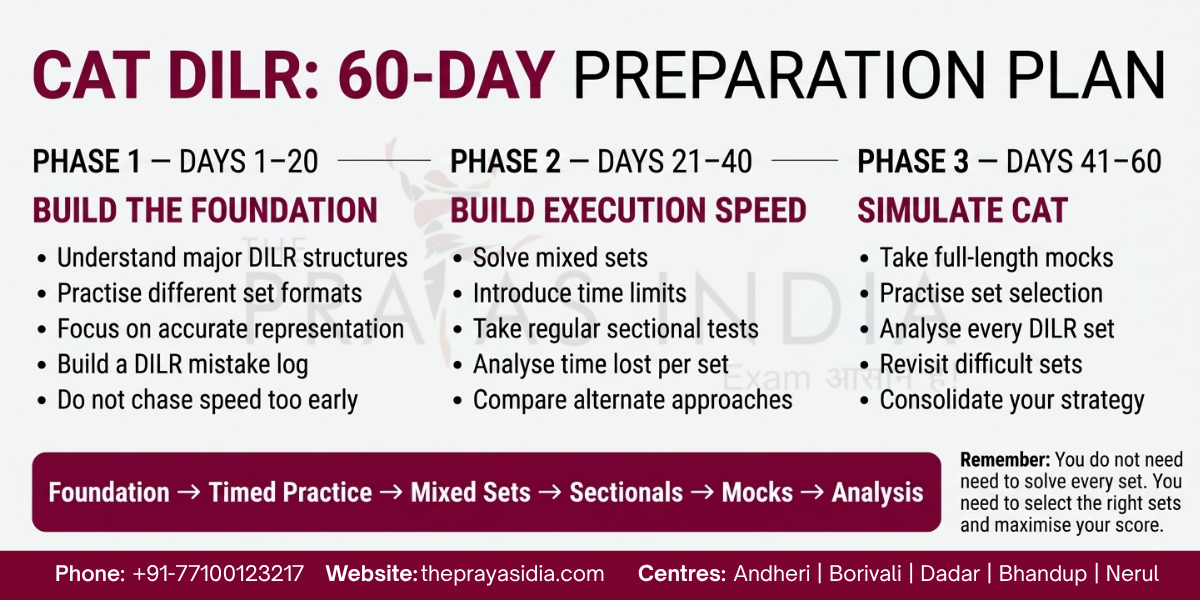
A 60-Day Approach to CAT DILR Preparation
If you are entering the final two months before CAT, your preparation should become more exam-oriented.
The first objective should be to identify your current DILR level. Take a few sectional tests and analyse them carefully. Do not focus only on your percentile or number of correct answers. Identify whether your biggest issue is comprehension, logical deduction, representation, speed, accuracy or set selection.
Once the problem is identified, divide your remaining preparation accordingly.
Days 1–20: Strengthen Your Fundamentals
Use the first stage to revisit major DILR structures and solve a balanced selection of sets.
Do not spend the entire period solving only difficult questions. Your objective is to create a strong foundation across different formats.
At this stage, pay attention to how quickly you can identify the structure of a set. You should gradually become comfortable with converting lengthy information into a usable table, chart, sequence or diagram.
Keep a record of sets that required significantly more time than expected. These will become useful material for later revision.
Days 21–40: Increase Timed Practice
The next stage should introduce more time pressure.
Start solving mixed DILR sets rather than practising only one category at a time. Use sectional tests regularly and analyse them immediately after completion.
The important shift here is from:
“Can I solve this set?”
to:
“Can I solve this set efficiently enough for CAT?”
A method that works in 18 minutes during relaxed practice may not be useful during the actual examination. Timed practice exposes these gaps.
Days 41–60: Focus on Selection and Execution
During the final stage, full-length mocks should become increasingly important.
Your objective is to develop a reliable examination routine. Practise scanning the DILR section, identifying promising sets, selecting the best opportunity and moving on when the expected return from a set becomes too low.
At this stage, avoid constantly changing your preparation strategy. Your goal is consolidation.
Review previously solved difficult sets, revisit your mistake log and analyse mock performance. The final weeks should make you more confident in your decision-making rather than introduce unnecessary confusion.
The 10-Minute Trap: When Should You Leave a DILR Set?
One of the most common DILR mistakes is becoming emotionally attached to a set.
You read the set carefully, make a few deductions, write some possibilities and then realise that your approach is not progressing. Instead of moving on, you continue because you have already invested several minutes.
This is the sunk-time trap.
The time already spent cannot be recovered. Continuing with a weak approach simply because you have invested time can make the situation worse.
There is no universal rule that says every DILR set must be abandoned after exactly a particular number of minutes. However, you should establish personal checkpoints during practice.
For example, if after reading and setting up a problem you cannot identify a meaningful path towards the questions, pause and reassess.
Ask:
Am I making progress, or am I merely spending time?
If the answer is the second one, move to another set.
Learning to leave a set is not a sign of weakness. In CAT, it is part of effective time management.
Accuracy Should Come Before Speed
Many aspirants try to increase their DILR speed too early.
They set aggressive time limits, rush through the information and make avoidable mistakes. This can create a misleading impression that they are poor at DILR when the actual problem is rushed execution.
A better progression is:
Correct Approach → Accurate Execution → Consistent Timing → Faster Execution
First understand how the set works. Then solve it accurately. Once the method becomes familiar, introduce time pressure.
Speed should be a consequence of familiarity and better decision-making rather than constant rushing.
This is particularly important for candidates who are already anxious about DILR. Trying to solve everything faster without improving the underlying approach often increases mental pressure.
How to Improve Your Set-Selection Ability
Set selection is difficult to teach through theory alone because it develops through exposure.
You need to look at many different sets and compare them.
After every sectional test or mock, create three categories:
Sets I Should Have Attempted
These are sets you skipped but could reasonably have solved.
Study why you missed them. Did the presentation look intimidating? Did you misjudge the data? Did you overlook an obvious structure?
Sets I Correctly Selected
These are sets where your judgement was good.
Analyse what attracted you to them. Was the information structured? Did you recognise the format? Was there an obvious starting point?
Sets I Should Have Avoided
These are sets where you invested too much time for too little return.
Identify the warning signs you missed.
Over several mocks, this classification will improve your decision-making considerably.
Don’t Compare Your DILR Journey With Someone Else’s
DILR performance can vary significantly from one candidate to another.
A student who solves a difficult set quickly may have encountered a similar structure before. Another student may need more time because the format is new to them.
Comparing the number of sets you solve with another aspirant can therefore be misleading.
Instead, compare your current performance with your own previous performance.
For example, if you previously needed 12 minutes to understand a complex set and now understand a similar structure in seven minutes, that is meaningful progress even if your raw score has not changed dramatically.
Track improvements such as:
- Faster comprehension
- Better representations
- Fewer logical errors
- Better set selection
- Lower average time per successful set
- Higher accuracy
- Better performance under timed conditions
These indicators provide a much more useful picture of your development.
The Role of Previous CAT Questions
Previous CAT questions should form an important part of DILR preparation because they help you understand the level and unpredictability of actual CAT sets.
However, simply solving previous questions once is not enough.
After solving a previous CAT set, study its structure.
Ask yourself why the set was designed that way. Identify the information that mattered most and the deductions that unlocked the problem.
Then compare your approach with the official or reliable solution.
If another approach is significantly cleaner, understand why.
The objective is not to memorise the exact question. It is to develop familiarity with the kind of reasoning CAT can demand.
Use a DILR Difficulty Ladder
A useful way to prevent overwhelm is to divide your practice into levels.
Level 1: Foundation Sets
These should help you understand basic structures and build confidence.
The focus should be on:
- Reading information correctly
- Creating appropriate representations
- Making basic deductions
- Maintaining accuracy
Level 2: Standard CAT-Level Sets
These should form the core of your preparation.
You should encounter multiple variables, conditions and deductions while working within reasonable time limits.
Level 3: Challenging Sets
These are useful for developing flexibility and advanced reasoning.
However, difficult sets should not dominate your preparation. Their purpose is to stretch your thinking, not to make you feel that every CAT set will be impossible.
Level 4: CAT Simulation
This is where mixed sets, sectional tests and full-length mocks become important.
The challenge is no longer simply solving the set. You must decide which set deserves your time.
What to Do When You Cannot Solve a Set
Getting stuck is a normal part of DILR preparation.
The important thing is how you respond.
Do not immediately read the complete solution. First identify the exact point where you became stuck.
Was the problem that:
- You misunderstood the conditions?
- You could not create the correct table?
- You made too many cases?
- You missed an important deduction?
- You selected the wrong starting point?
- You made an assumption that was not given?
- You spent too much time calculating?
Once you identify the problem, try the set again.
If you still cannot progress, study the solution carefully. But do not stop at understanding the final answer.
Reconstruct the solution yourself.
Then close the solution and attempt the set again from the beginning.
This process is much more valuable than simply reading an explanation and moving forward.
How CAT Coaching in Mumbai Can Help With DILR
For many students, the biggest advantage of structured CAT coaching is not simply access to study material. It is the presence of a systematic learning environment.
DILR preparation can become confusing when students collect material from multiple sources without knowing what should be prioritised. One book may contain hundreds of sets, an online platform may provide another large question bank, and mock providers may offer additional material.
Quantity can quickly become overwhelming.
A structured coaching programme can help candidates focus on the right sequence of preparation, identify performance gaps and receive guidance on solving approaches.
At The Prayas India, CAT aspirants preparing in Mumbai can access CAT preparation through centres in Andheri, Borivali, Dadar, Bhandup and Nerul.
Students looking for CAT coaching in Mumbai can also consider factors such as faculty interaction, quality of DILR practice material, mock-test analysis, doubt-solving support, class structure and the institute’s approach to individual performance improvement.
The right coaching environment should help you become more independent as the examination approaches. The ultimate objective is not to make you dependent on shortcuts but to build a process that you can execute confidently during CAT.
A Daily DILR Routine That Does Not Feel Overwhelming
A sustainable routine is usually more effective than an extremely aggressive schedule.
Instead of deciding that you must solve ten or fifteen DILR sets every day, create a balanced routine.
A typical practice session can include:
One set for accuracy:
Solve without excessive time pressure and focus on the approach.
One timed set:
Work under a controlled time limit.
One analysis session:
Review a previously attempted set and identify a better approach.
Short revision:
Review important deductions, recurring mistakes or patterns from your mistake log.
This approach ensures that you are not merely increasing your question count. You are improving different components of DILR performance.
On days when you have a full CAT mock, the mock analysis itself can become your primary DILR activity.
Consistency matters more than exhausting yourself.
Common DILR Preparation Mistakes to Avoid
Solving Only Difficult Sets
Difficult questions may make you feel that you are preparing seriously, but they should not become the majority of your practice.
CAT requires selection as well as problem-solving. You need to become comfortable with manageable sets too.
Ignoring Analysis
Finishing a set and immediately moving to another without analysing your approach limits improvement.
The solution is only the end point. The reasoning process is what you need to learn.
Practising Without a Timer Forever
Untimed practice is useful initially, but eventually you must introduce time pressure.
CAT is a time-bound examination, and DILR requires strong decision-making under that constraint.
Spending Too Long on One Set
Persistence is valuable during learning, but excessive persistence during a mock can damage your overall section strategy.
Learn the difference between productive struggle and unproductive time consumption.
Changing Resources Constantly
Jumping between books, websites, YouTube videos, coaching platforms and random question banks can create unnecessary confusion.
Choose reliable resources and follow a structured sequence.
Measuring Progress Only Through Scores
Scores can fluctuate depending on the difficulty and composition of the test.
Use scores as one indicator, but also track accuracy, selection, time management and approach quality.
The Final Mindset for CAT DILR
DILR preparation becomes much less overwhelming when you stop viewing every set as a challenge that must be conquered.
Your job is not to prove that you can solve the hardest puzzle in the room.
Your job is to identify opportunities, understand information quickly, build an efficient approach and convert manageable sets into accurate attempts.
That mindset changes the way you practise.
You stop asking, “Why can’t I solve this?”
You start asking, “Is this the right set for me, and what approach gives me the highest probability of solving it efficiently?”
That is a much more CAT-oriented way of thinking.
If you are preparing for CAT 2026 and looking for structured CAT coaching in Mumbai, The Prayas India offers preparation support through its centres at Andheri, Borivali, Dadar, Bhandup and Nerul.
Contact Us
📞 Call Now: +91-77100 13217
🌐 Website: theprayasindia.com
📍 Centres: Andheri | Borivali | Dadar | Nerul | Bhandup
For an aspirant who feels overwhelmed by DILR, the solution is not necessarily to study more. It is to study with a clearer system, practise deliberately, analyse consistently and develop the judgement required to perform under CAT conditions.