How to Prepare for RRB Group D from Zero Level? | Best RRB Coaching in Mumbai | The Prayas India
Preparing for RRB Group D from zero level can seem overwhelming when you are unfamiliar with competitive examinations, have weak fundamentals or simply do not know where to begin. Many beginners make the mistake of collecting multiple books, watching random online lectures and attempting mock tests before understanding the examination structure. This usually creates confusion rather than progress.
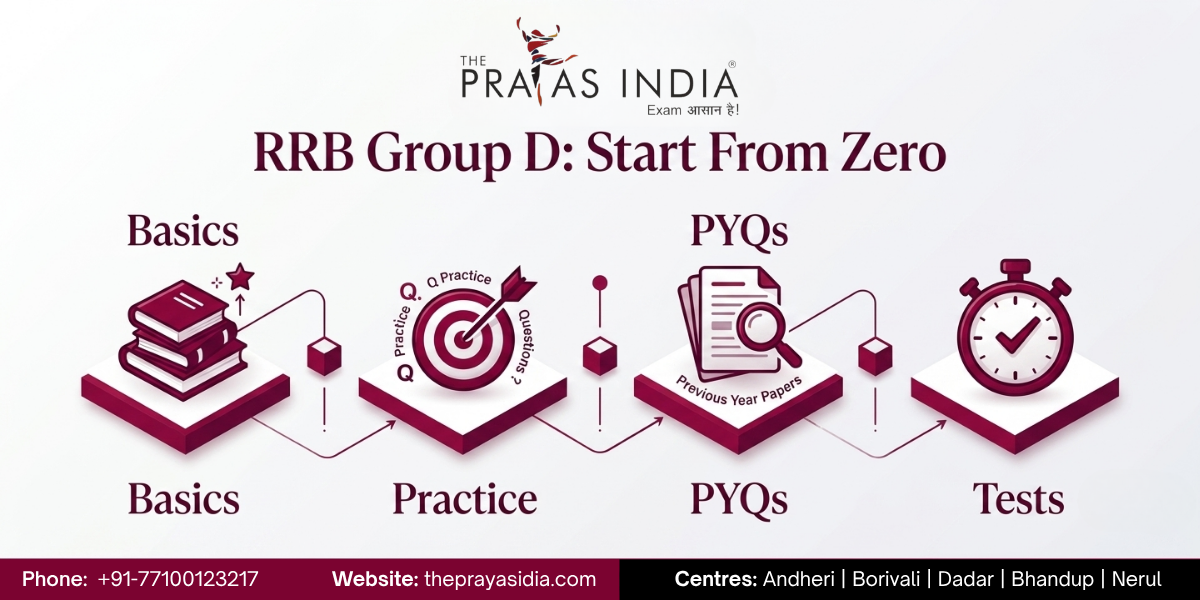
A better approach is to treat RRB Group D preparation as a gradual process. First understand the syllabus and question pattern, then build your fundamentals, practise questions topic by topic, revise regularly and eventually move towards timed tests and full-length mocks. For a beginner, the objective during the initial stage should not be to study everything at once. It should be to create a strong foundation that can support more advanced preparation later.
For students and working aspirants in Mumbai, structured RRB coaching can also make this process more organised. Instead of spending valuable time deciding what to study and which resources to follow, aspirants can benefit from a planned learning schedule, guided preparation, study material and regular practice. The right strategy combined with consistent effort can turn a zero-level preparation journey into a structured competitive-exam plan.
Can You Prepare for RRB Group D from Zero Level?
Yes. Starting from zero does not mean that you are at a permanent disadvantage. It simply means that your preparation needs to begin with the basics rather than immediately focusing on difficult questions or full-length tests.
A beginner should first become familiar with the RRB Group D syllabus and understand the broad areas covered in the examination. The commonly tested areas include Mathematics, General Intelligence and Reasoning, General Science, and General Awareness and Current Affairs. Each section requires a somewhat different preparation method, so understanding the syllabus helps you divide your available time effectively.
The first few weeks should be considered a foundation phase. During this period, focus on concepts, basic formulas, elementary question types and understanding how questions are solved. Do not become discouraged if your initial practice-test scores are low. At zero level, tests are primarily diagnostic tools. They tell you where you stand and which areas require more attention.
The most important thing for a beginner is to avoid comparing their preparation with candidates who have already spent months preparing. Competitive-exam preparation is a progression. Your focus should be on improving your own accuracy, speed and understanding week by week.
Start With the RRB Group D Syllabus and Exam Pattern
Before opening a book or starting a lecture, spend some time understanding what you are preparing for. The syllabus acts as a roadmap and prevents you from wasting time on topics that are outside your immediate preparation priorities.
For beginners, the syllabus can initially look large because it covers multiple subjects. The solution is to break it into smaller topic groups. Mathematics can be divided into arithmetic and other relevant mathematical areas, Reasoning can be approached through individual question types, General Science can be studied through basic Physics, Chemistry and Biology concepts, while General Awareness can be built through static knowledge and current-affairs revision.
The exam pattern should also influence your preparation strategy. Competitive examinations are not simply tests of whether you know the answer. They also test how quickly and accurately you can identify and solve questions. Therefore, your preparation should eventually include both knowledge-building and timed practice.
Do not try to memorise the entire pattern on your first day. Understand the broad structure first and gradually become familiar with the details as your preparation progresses.
The First 30 Days: Build Your Foundation
The first month should be treated differently from the later stages of preparation. Your objective should be to develop basic familiarity with every major section and identify your strengths and weaknesses.
Start Mathematics with fundamental arithmetic concepts. Topics such as percentages, ratio and proportion, averages, profit and loss, simple and compound interest, time and work, time and distance and basic number concepts can form an important part of your preparation. Rather than rushing through these topics, make sure you understand the method behind the questions.
For Reasoning, begin with comparatively accessible question types and gradually move towards more complex arrangements and logical problems. The objective is to understand the language of reasoning questions and develop a systematic approach to solving them.
General Science requires conceptual understanding. Beginners should focus on school-level fundamentals before moving into detailed exam-oriented preparation. If your Science basics are weak, trying to memorise advanced information immediately can become inefficient.
General Awareness should be introduced through short, regular sessions. Do not postpone it for the end of your preparation. Even 20–30 minutes of daily revision can accumulate into significant coverage over several months.
The first month is therefore less about completing a huge number of chapters and more about establishing a sustainable study habit.
How Many Hours Should a Beginner Study for RRB Group D?
A beginner does not need to immediately follow a 10-hour study schedule. In fact, an unrealistic timetable can be one of the fastest ways to lose consistency. The better approach is to begin with a manageable number of focused hours and gradually increase them as your concentration and preparation improve.
For a student or aspirant with other responsibilities, around 3–4 focused hours per day can be a practical starting point. Those who have more time available can extend their study sessions, particularly on weekends or holidays. The exact number of hours matters less than what happens during those hours.
A four-hour session containing concept learning, question practice, revision and error analysis is considerably more useful than spending eight hours passively watching lectures.
As your preparation progresses, your study time can be increased according to your needs. During the foundation stage, focus more on understanding. During the practice stage, increase question-solving. During the final phase, devote greater time to mocks, revision and performance analysis.
Your study plan should therefore evolve with your preparation level.
How to Divide Your Daily RRB Group D Study Time
A beginner should avoid spending the entire day on one subject. Since RRB Group D preparation involves multiple sections, regular exposure to all major areas is important.
A simple daily structure could include approximately 60–90 minutes for Mathematics, 45–60 minutes for Reasoning, 45–60 minutes for General Science and 30–45 minutes for General Awareness or revision. The exact distribution can be modified depending on your strengths and weaknesses.
If Mathematics is your weakest subject, you may give it additional time while maintaining shorter sessions for the other areas. Once your Mathematics foundation improves, the additional time can be shifted towards mock tests or another weak section.
Another useful approach is to divide the day into learning and practice blocks. For example, the first session can be used to learn a concept, while the second can be used to solve questions based on that concept. This creates an immediate feedback loop and makes it easier to identify whether you have actually understood the topic.
RRB Group D Mathematics: How Beginners Should Start
Mathematics is often one of the sections that creates anxiety among beginners. Students who have not practised mathematics since school may initially find even basic questions time-consuming. This is normal and should not become a reason to avoid the subject.
Begin with fundamental concepts and calculations. Learn how numbers work, strengthen basic arithmetic and practise calculations regularly. Once the fundamentals become comfortable, move into topic-wise preparation.
Do not focus only on shortcuts during the beginning. Short tricks can save time later, but they are useful only when you understand the underlying method. A beginner who memorises shortcuts without understanding concepts can easily become confused when the same concept appears in a different format.
Maintain a formula and concept notebook, but keep it concise. Write down formulas, approaches and recurring mistakes rather than copying entire chapters.
Most importantly, solve questions every day. Mathematics improves through active practice, not passive reading.
RRB Group D Reasoning: Build Pattern Recognition
Reasoning can become a scoring area when approached systematically, but beginners should first learn to recognise common question patterns.
Start with basic topics and understand the logic behind each question type. Once you become familiar with the structure of a particular type of problem, practise multiple questions of the same category before moving to mixed sets.
Over time, begin timing yourself. Initially, accuracy should receive greater attention than speed. Once you are consistently solving questions correctly, gradually introduce time limits.
This progression—understanding → accuracy → speed—is more effective for beginners than trying to solve every question as quickly as possible from the first day.
RRB Group D General Science: Focus on Concepts First
General Science can appear extensive because it includes concepts from Physics, Chemistry and Biology. Beginners should not approach it as a collection of facts to memorise blindly.
Start with basic concepts and understand common scientific principles. Once your fundamentals are clear, exam-oriented questions become easier to interpret.
Use short notes for revision and revisit important concepts repeatedly. Science is particularly suitable for spaced revision because information that appears familiar after one reading can easily be forgotten after several weeks.
Instead of reading the same chapter repeatedly without testing yourself, combine reading with questions. After completing a topic, solve relevant questions and identify which concepts you could not recall.
General Awareness and Current Affairs: Start Early
General Awareness is often postponed by beginners because it seems less urgent than Mathematics or Reasoning. This can create unnecessary pressure later.
The better approach is to make General Awareness a small daily habit. You do not necessarily need a long study session every day. Consistent short sessions can help you gradually build familiarity with important areas.
Static General Awareness and current affairs should be handled somewhat differently. Static topics can be revised according to subject or category, while current affairs should be covered through a systematic source and revised periodically.
The most important rule is to avoid collecting too many resources. One organised source that you revise properly is generally more useful than several sources that you only read once.
Use Previous-Year Questions as Your Preparation Compass
Once you have basic understanding of a topic, introduce previous-year questions into your routine. PYQs help beginners move from theoretical preparation to examination-oriented thinking.
They show how concepts are actually converted into questions and help you understand the level of difficulty you are likely to encounter. They can also reveal which topics require more practice.
For every topic you complete, try solving a relevant set of previous-year questions. Do not worry if you cannot solve everything initially. Mark the questions you could not understand, revisit the concept and attempt them again.
Over time, PYQs should become a regular component of your preparation rather than something reserved for the final weeks.
The Importance of Revision When Starting From Zero
Beginners often make another mistake: continuously moving forward without revisiting previous topics. This creates a large syllabus that appears completed but is difficult to recall.
Revision should begin from the first week.
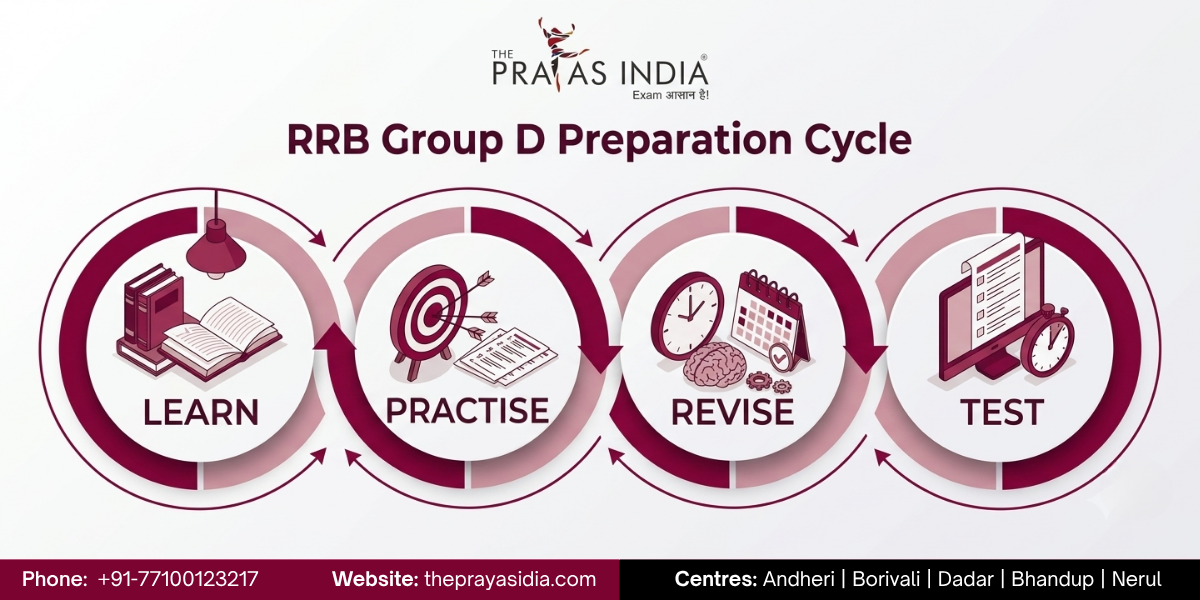
A simple revision cycle can involve reviewing a topic the next day, again after a few days and then periodically after that. The exact intervals can vary, but the principle remains the same: learn, practise, forget a little, revise and strengthen.
Keep your revision material short enough to review quickly. Formula sheets, error notes, vocabulary lists and General Awareness revision points can all become useful during later preparation.
When Should You Start Taking RRB Group D Mock Tests?
Beginners sometimes make one of two opposite mistakes. Some start taking full-length mocks before learning the fundamentals, while others avoid tests until they believe their entire syllabus is complete.
Neither approach is ideal.
During the initial stage, topic-wise quizzes and small sectional tests can help you check whether you understand what you have studied. Once you have covered a reasonable portion of the syllabus, sectional tests can become more regular. Full-length mocks should gradually be introduced as your preparation becomes more comprehensive.
Do not judge your preparation only by your score in the first few tests. Instead, analyse the reasons behind your mistakes. If you are repeatedly losing marks because of a conceptual weakness, return to the topic. If you know the concept but are making calculation errors, practise accuracy. If you are solving correctly but taking too long, work on speed and question selection.
This approach turns every test into a learning opportunity.
How Coaching Can Help a Beginner Start RRB Group D Preparation
Starting from zero becomes considerably easier when the preparation path is clearly structured. Without guidance, beginners often spend too much time deciding which book to use, which topics to study first, which questions to practise and when to start taking tests.
A structured RRB coaching programme can simplify this process by providing a defined sequence of topics, guided classes, study material, regular practice and test-based preparation. For beginners, this structure can be particularly useful because it reduces the uncertainty that comes with starting competitive-exam preparation for the first time.
Students looking for RRB coaching in Mumbai should evaluate a coaching institute based on the quality and structure of its preparation rather than relying only on promotional claims. Faculty guidance, course coverage, study resources, practice tests, doubt support and batch timings are important considerations.
The Prayas India can be considered by aspirants who want structured preparation for railway and other competitive examinations. For a zero-level candidate, the objective of coaching should be to build concepts correctly, establish a disciplined study routine and progressively move towards examination-level practice.
If you are planning to prepare for RRB Group D seriously, joining a structured programme early can help you avoid common beginner mistakes and make better use of your preparation time.
Build a 90-Day RRB Group D Preparation Roadmap
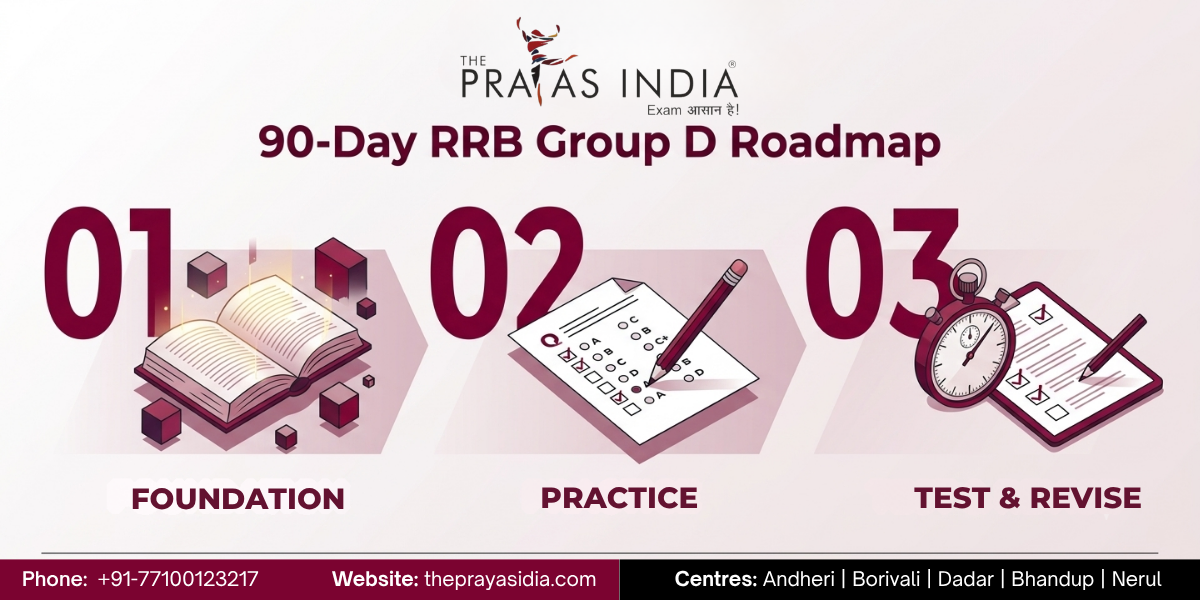
Once your basics are in place, the next step is to convert your preparation into a structured roadmap. A 90-day plan is useful for beginners because it divides a large syllabus into smaller and achievable stages. Instead of thinking about the entire RRB Group D syllabus every morning, you know what needs to be completed during each phase.
The first 30 days should primarily focus on foundation building. Your goal should be to understand the important concepts in Mathematics, Reasoning and General Science while establishing a regular General Awareness routine. Do not worry about achieving very high scores in tests at this stage. The priority is to remove conceptual gaps.
The next 30 days should focus on practice and accuracy. Once you have studied the basic concepts, increase your question-solving volume and introduce more previous-year questions and sectional tests. Start tracking the amount of time you require for different question types. This is also the stage when recurring mistakes should become easier to identify.
The final 30 days should increasingly focus on revision, mocks and performance improvement. Your preparation should move towards mixed question sets and full-length tests, while weak areas are revised repeatedly. Rather than continuously starting new topics, use this phase to strengthen what you have already studied.
The exact duration of each phase can be adjusted according to your starting level and available time. A beginner who needs more time for fundamentals can extend the foundation stage, while an aspirant with an existing base can move towards practice earlier.
Create a Daily Routine You Can Actually Follow
A preparation timetable is useful only when you can follow it consistently. Beginners often create schedules that allocate every minute of the day to studying, leaving no room for meals, travel, family responsibilities, rest or unexpected work. Such schedules may look impressive on paper but are difficult to maintain.
A better approach is to create a realistic routine around your existing responsibilities. If you are a full-time aspirant, you may have longer study windows. If you are working, studying in college or managing family responsibilities, your daily preparation time may be more limited. The plan should be adapted accordingly.
A practical routine could begin with a Mathematics session when your concentration is highest. Reasoning can be placed in another focused session, while General Awareness can be revised during a shorter study block. General Science can be covered through concept learning followed by question practice.
The important part is to maintain daily contact with your preparation. Even on a difficult day, completing a smaller target is preferable to abandoning the routine completely.
Follow the “Concept + Questions + Revision” Method
A beginner should avoid separating learning and practice for too long. Whenever you complete a topic, solve questions based on that topic.
For example, after studying percentages in Mathematics, solve a set of percentage questions immediately. If you are studying coding-decoding in Reasoning, practise several questions of the same type. After studying a General Science concept, test yourself with relevant questions.
This method helps you discover whether you have actually understood the concept. Sometimes a chapter appears easy while reading but becomes difficult when you attempt questions. That difference is important because competitive examinations test application rather than simple familiarity.
Revision should then follow practice. Mark the questions you got wrong or took too long to solve and revisit the relevant concept. This creates a continuous learning cycle rather than a one-time reading process.
How to Improve Speed Without Sacrificing Accuracy
Speed should not be the first target for a beginner. If you try to solve every question as quickly as possible before becoming accurate, you may develop careless habits.
Start by solving questions correctly without worrying too much about time. Once your accuracy becomes stable, introduce a moderate time limit. Gradually reduce the time while maintaining your accuracy.
Mathematics is particularly dependent on calculation speed, while Reasoning benefits from quick pattern recognition. English-style question-solving, where relevant to your preparation, also improves with familiarity and repeated practice. General Awareness and Science require strong recall so that you do not waste time thinking about information you should already know.
The objective is not simply to solve faster. It is to solve the right questions quickly and avoid wasting time on questions that are consuming too much of your examination time.
Make Previous-Year Questions a Core Part of Preparation
Previous-year questions should become increasingly important once you have completed the basic concepts. They provide a practical understanding of how the examination tests the topics you are studying.
Instead of treating PYQs as another book to finish, use them as a diagnostic tool. If a topic repeatedly produces questions that you cannot solve, return to the concept. If you can solve the questions but take too long, focus on practice and calculation. If you make avoidable mistakes despite knowing the correct method, work on accuracy.
Keep track of recurring patterns. Over time, you will begin to recognise familiar question structures more quickly, which can help reduce the time spent deciding how to approach a problem.
How to Revise RRB Group D Effectively
Revision should not mean reading the same chapter from the beginning every time. Effective revision is selective.
For Mathematics, revise formulas, approaches and frequently repeated mistakes. For Reasoning, revisit question patterns that still cause difficulty. For General Science, revise important concepts and factual information through short notes. For General Awareness, use concise revision material rather than repeatedly reading lengthy sources.
Your notes should therefore become shorter as your preparation progresses. During the foundation phase, you may need detailed explanations. Later, you should be able to revise the same topic using a compact set of formulas, concepts and mistakes.
This makes the final stage of preparation much more manageable.
Don’t Neglect Physical Preparation
Aspirants preparing for RRB Group D should also remain aware that the recruitment process can involve stages beyond the computer-based examination, depending on the applicable recruitment notification and post requirements. Therefore, candidates should not treat physical preparation as something to consider only after completing the written examination.
For candidates who need to prepare for a physical stage, gradually developing fitness can be more sensible than beginning intense physical training at the last moment. A basic routine involving regular walking or running, strength work and adequate recovery can help establish consistency.
Your academic preparation and physical preparation do not have to compete with each other. A short fitness session can be incorporated into the daily schedule without taking away the majority of your study time.
Common Mistakes Beginners Should Avoid
The first major mistake is trying to complete everything simultaneously. A beginner may open Mathematics, Reasoning, Science, Current Affairs and several books on the same day and end up completing none of them properly. Prioritisation is essential.
The second mistake is changing study material repeatedly. If you switch between multiple teachers, books and online sources every few days, your preparation can become fragmented. Choose reliable resources and complete them systematically.
The third mistake is ignoring weak subjects. Students naturally spend more time on subjects they enjoy. This can create an uneven preparation profile. Your strongest subject may need less additional time, while your weakest subject may require consistent attention.
Another common mistake is taking tests without analysing them. A mock test score by itself does not tell you how to improve. The real benefit comes from understanding why you lost marks and what you need to change.
Finally, beginners often underestimate revision. Completing a chapter once does not mean it will remain in your memory until the examination. Regular revision must be built into the preparation plan from the beginning.
How to Stay Consistent With RRB Group D Preparation
Consistency becomes easier when your targets are specific. Instead of saying “I will study Mathematics today,” decide what you will accomplish: complete a particular concept, solve a certain practice set or analyse a previous-year question set.
Track completed topics rather than simply tracking study hours. This gives you a clearer picture of actual progress.
You should also keep one day or one study session each week for reviewing your progress. Ask yourself which topics were completed, where mistakes occurred, whether your speed improved and what needs to be carried forward into the next week.
This simple review prevents your preparation from becoming directionless.
Choosing the Right RRB Coaching in Mumbai
For someone starting RRB Group D preparation from zero, structured guidance can be particularly valuable. Beginners often know that they want to prepare for a railway examination but are uncertain about the correct sequence of topics, appropriate study material, practice requirements and timing of mock tests.
A structured coaching programme can bring these elements together. Instead of creating the entire preparation system from scratch, students can follow an organised learning path and use their available time for actual learning and practice.
If you are looking for RRB coaching in Mumbai, consider factors such as faculty guidance, course structure, study material, batch timings, regular tests, doubt-solving support and the overall preparation environment before taking admission.
For beginners, batch compatibility is particularly important. A course may be academically strong, but if its schedule does not fit your routine, maintaining consistency can become difficult.
The Prayas India can be explored by aspirants looking for structured preparation for RRB and other competitive examinations. The focus for a beginner should be on building the fundamentals correctly, following a planned syllabus, practising regularly and gradually developing examination-level speed and accuracy.

Admission-Focused Preparation With The Prayas India
Starting from zero can actually be the right time to seek structured guidance because you have the opportunity to build your preparation correctly from the beginning. Instead of spending months experimenting with different resources and study schedules, you can begin with a defined preparation plan and gradually develop the skills required for the examination.
At The Prayas India, aspirants can explore structured preparation options designed around competitive examinations, including railway exam preparation. For a beginner, the objective should be more than simply attending classes. You should use the available guidance, study material, practice sessions and tests to build an independent preparation habit.
Before taking admission, understand the course structure and batch schedule and choose an option that matches your preparation requirements. A well-organised coaching programme can provide the framework, but your consistency, practice and revision will remain essential parts of the preparation journey.
If your goal is to prepare seriously for RRB Group D and you are looking for RRB coaching in Mumbai, this is the right stage to assess your options and begin with a structured plan rather than waiting until the examination is close.
Your RRB Group D Preparation Starts With the First Step
Preparing for RRB Group D from zero level is not about knowing everything from the first day. It is about knowing what to learn first, practising it correctly and continuously improving.
Begin with the syllabus. Build your fundamentals. Solve questions after learning concepts. Introduce PYQs. Revise regularly. Take tests when you are ready and analyse every important mistake. Gradually improve your speed while protecting accuracy.
Most importantly, do not allow the size of the syllabus to discourage you. A large examination becomes manageable when it is divided into smaller weekly and daily targets.
For aspirants in Mumbai who want professional guidance, joining a structured RRB coaching programme can provide a clearer preparation path and help establish discipline from the beginning. The Prayas India can be considered as part of that search for structured RRB preparation.
The best time to build your preparation is before you feel completely ready. Start with the basics, follow the right process and let your preparation level improve step by step.
Contact Us
- Call Now: +91-77100 13217
- Website: theprayasindia.com
- Centres: Andheri | Borivali | Dadar | Nerul | Bhandup
Frequently Asked Questions
1. Can I prepare for RRB Group D from zero level?
Yes. Beginners can start RRB Group D preparation by first understanding the syllabus, building basic concepts and gradually moving towards topic-wise practice, PYQs, sectional tests and full-length mocks.
2. How many hours should a beginner study for RRB Group D?
A beginner can start with around 3–4 focused hours per day and increase the study duration as their preparation improves. The ideal schedule depends on your available time, current level and other responsibilities.
3. Which subject should I study first for RRB Group D?
There is no requirement to complete one entire subject before starting another. A balanced routine covering Mathematics, Reasoning, General Science and General Awareness can help maintain consistent preparation across sections.
4. How important are previous-year questions for RRB Group D?
PYQs are extremely useful for understanding how concepts are converted into examination questions. They can also help identify weak areas and improve familiarity with common question patterns.
5. When should I start taking mock tests?
Topic-wise and sectional tests can be introduced during the practice stage. Full-length mocks become increasingly useful once you have covered enough of the syllabus to meaningfully evaluate your overall preparation.
6. Is coaching necessary for RRB Group D preparation?
Coaching is not compulsory, but structured guidance can be helpful, particularly for beginners who are unsure about the syllabus, study sequence, resources, practice strategy and test schedule.
7. How should I prepare for RRB Group D if I have weak Mathematics?
Start with basic concepts and arithmetic, practise regularly and focus on accuracy before speed. Identify recurring mistakes and revise the relevant concepts rather than avoiding Mathematics.
8. Which RRB coaching is suitable for beginners in Mumbai?
Students should compare faculty guidance, course structure, study material, batch timings, tests and doubt support before making an admission decision. The Prayas India is an option that Mumbai-based aspirants can explore for structured RRB preparation.
9. Can I prepare for RRB Group D without studying for many hours every day?
Yes. A consistent and realistic routine can be more sustainable than an extremely long timetable. The key is to use your available study hours effectively for concepts, practice, revision and tests.
10. When should I join RRB Group D coaching?
You do not have to wait until the examination is close. Starting earlier can give beginners more time to build fundamentals, practise questions and develop a consistent preparation routine.