How to Prepare for SSC CGL Alongside College | Best SSC Coaching in Mumbai | The Prayas India
College life comes with lectures, assignments, practicals, examinations, projects, social commitments and, in many cases, internships or part-time responsibilities. For students who want to prepare for the SSC CGL examination at the same time, this can make competitive-exam preparation appear difficult. The reality, however, is that college can actually be one of the most useful phases to begin SSC CGL preparation—provided the preparation is planned around the academic schedule rather than against it.
SSC CGL preparation does not require a college student to spend every waking hour studying. It requires a structured routine, consistent practice, familiarity with the syllabus, regular exposure to previous-year questions and gradual improvement in speed and accuracy. Current preparation guides also broadly emphasise the same progression: build concepts first, move towards PYQs and timed practice, and then increase the role of mocks and revision.
For a college student, the biggest advantage is time. Starting early gives you the opportunity to build your Quantitative Aptitude, English, Reasoning and General Awareness foundations gradually instead of trying to complete everything in a few months. It also allows you to identify weak areas while there is still enough time to improve them.
This makes college an ideal stage to develop an SSC CGL preparation habit without completely sacrificing academics or campus life.
Can You Prepare for SSC CGL Alongside College?
Yes, and the key is to stop thinking of SSC CGL preparation as something that requires a full-time aspirant’s timetable. A college student needs a different strategy. Instead of copying a routine designed for someone who studies for six to eight hours every day, you should build a schedule around your lectures, travel time, free periods, assignments and examination calendar.
The objective should be consistent preparation rather than maximum daily hours. Three focused hours every day can be more useful than studying for ten hours on one Sunday and then doing nothing for the next four days. A college student who studies Quant regularly, practices Reasoning several times a week, develops English gradually and revises General Awareness in smaller sessions can build a strong foundation over an extended period.
This approach is particularly useful because SSC CGL preparation is cumulative. Concepts learned in Quant become easier with repeated practice, vocabulary improves through continuous exposure, reasoning becomes faster through question-solving and General Awareness requires repeated revision. Starting these processes early means that your preparation develops alongside your graduation rather than beginning only after college is over.
The important distinction is between studying more and studying systematically. Your college timetable may change from semester to semester, but your preparation system should remain flexible enough to adapt without disappearing completely.
Why Starting SSC CGL Preparation During College Can Be an Advantage
One of the biggest benefits of starting during college is that you can divide preparation into manageable stages. You do not have to complete the entire syllabus immediately. Your first objective can be to understand the SSC CGL syllabus and build fundamentals. Once the basics become comfortable, you can gradually introduce previous-year questions, sectional tests and timed practice.
This long-term approach is especially helpful for Quantitative Aptitude. Many students initially struggle with calculations, arithmetic concepts or questions involving percentages, ratios, averages, profit and loss, time and work, algebra and geometry. These areas become much easier when students have sufficient time to learn the underlying concepts and practise them repeatedly rather than trying to memorise shortcuts just before the examination.
English also benefits considerably from early preparation. Vocabulary, grammar, reading comprehension and error detection cannot always be improved through last-minute preparation. A college student can develop these skills naturally by reading regularly, maintaining a vocabulary notebook, revising grammar concepts and solving SSC-level questions throughout the year.
Reasoning is another section where gradual practice can make a visible difference. With regular exposure to different question types, students begin to recognise patterns faster and reduce the amount of time spent on familiar problems.
General Awareness requires a different approach. Instead of trying to memorise enormous amounts of information in one stretch, college students can use short and repeated revision cycles. Static topics can be covered gradually, while current-affairs preparation can be incorporated into the routine closer to the relevant examination period.
In other words, college gives you the opportunity to build preparation in layers.
How Many Hours Should a College Student Study for SSC CGL?
There is no universal number of hours that will work for every college student. Your available time will depend on your course, commute, class schedule, semester workload and current level of SSC preparation. What matters more is creating a sustainable minimum that you can follow even during busy academic weeks.
For many students, around 3–4 focused hours on regular college days can provide a strong starting point. On weekends, holidays or relatively lighter academic days, this can be extended to 5–6 hours or more, depending on the student’s schedule and preparation stage.
The important word here is focused. Four hours of active problem-solving, revision and test practice are very different from four hours of watching lectures while checking messages or switching between unrelated study materials.
A practical college schedule could look like this:
| Study Window | Suggested Focus |
|---|---|
| 45–60 minutes | Quantitative Aptitude |
| 30–45 minutes | English |
| 30–45 minutes | Reasoning |
| 30–45 minutes | General Awareness / Revision |
| 30–60 minutes | PYQs, sectional practice or error analysis |
This is only a framework, not a rigid timetable. During internal examinations, assignments or practical submissions, academic commitments may need priority. During college holidays, the same student can increase SSC preparation significantly.
The goal is to create a routine that survives busy weeks instead of creating an impressive timetable that becomes impossible to follow.

How to Build a College-Friendly SSC CGL Study Routine
A successful routine should fit into the natural gaps in your day. College students often underestimate how much preparation can be completed through small, well-planned study windows.
For example, the morning can be used for a short Quant or English session before college. Travel time can be used for vocabulary revision, General Awareness notes or recorded learning where practical. Free periods between lectures can be used for a small set of Reasoning or English questions. The evening can then become the primary focused study session for Quant, PYQs or a sectional test.
This approach avoids putting the entire preparation burden on late-night study. It also reduces the risk of exhaustion, especially for students who have long college commutes.
Your weekly schedule should also be flexible. You may have five or six relatively predictable college days, but your academic workload will change. Therefore, rather than assigning a fixed number of chapters to every day, set weekly targets. For example, you could decide that by the end of the week you will complete a particular Quant topic, revise two English grammar areas, practise selected Reasoning chapters and cover a defined General Awareness portion.
Weekly targets provide accountability without making the timetable unnecessarily rigid.
Another useful principle is to separate learning sessions from performance sessions. A learning session is where you understand a concept or study a topic. A performance session is where you solve questions under time pressure. Both are necessary. Watching lectures continuously without solving questions creates the illusion of preparation, while solving difficult questions without understanding the underlying concept can lead to repeated mistakes.

How to Divide SSC CGL Subjects Alongside College
The four major areas of SSC CGL preparation require different study methods. Treating every subject in exactly the same way can make preparation inefficient.
Quantitative Aptitude
Quant should receive consistent attention because conceptual gaps can accumulate quickly. Start with fundamentals and gradually move towards exam-level problems. Rather than attempting large numbers of questions without analysis, focus on understanding methods, improving calculations and identifying recurring question patterns.
A college student can dedicate a substantial portion of the daily study schedule to Quant, especially during the foundation phase. Once the basic concepts become stronger, previous-year questions should increasingly become part of the practice routine.
English
English preparation can be spread across the entire college period. Grammar can be studied topic by topic, while vocabulary and reading habits can be developed through short daily sessions. Regular exposure is more sustainable than trying to memorise hundreds of words in a single sitting.
You can also combine English preparation with your normal college reading habits. Reading editorials, quality articles or books can help improve comprehension and familiarity with sentence structures, while dedicated SSC questions should be used to understand the actual examination style.
Reasoning
Reasoning is well suited to short practice sessions. A student can solve a small set of questions during a college break or after completing another study session. The focus should gradually shift from understanding question types to improving speed and accuracy.
As preparation progresses, mixed practice and previous-year questions become increasingly valuable because they teach you to identify the correct approach quickly rather than solving every problem from scratch.
General Awareness
General Awareness should be handled through short, repeated revision cycles. Trying to cover the entire subject in one continuous stretch is rarely practical alongside college. Instead, divide the subject into manageable areas and revisit them periodically.
The objective is not simply to read information once. Retention improves when the same material is revised multiple times. A short daily revision session can therefore be more useful than occasional long reading sessions.
Use Weekdays for Consistency and Weekends for Deep Practice
Weekdays and weekends should serve different purposes in a college student’s SSC CGL plan.
On weekdays, the priority should be maintaining continuity. Even when you have classes, assignments and commuting responsibilities, try to complete your minimum daily preparation. This could mean a Quant practice set, an English session, a Reasoning exercise or General Awareness revision.
Weekends provide the opportunity for deeper work. You can use longer sessions for completing difficult Quant chapters, solving previous-year papers, attempting sectional tests, analysing mistakes and revising the week’s learning.
This distinction makes the routine more realistic. You do not need every day to look identical. Instead, you need the overall week to move forward.
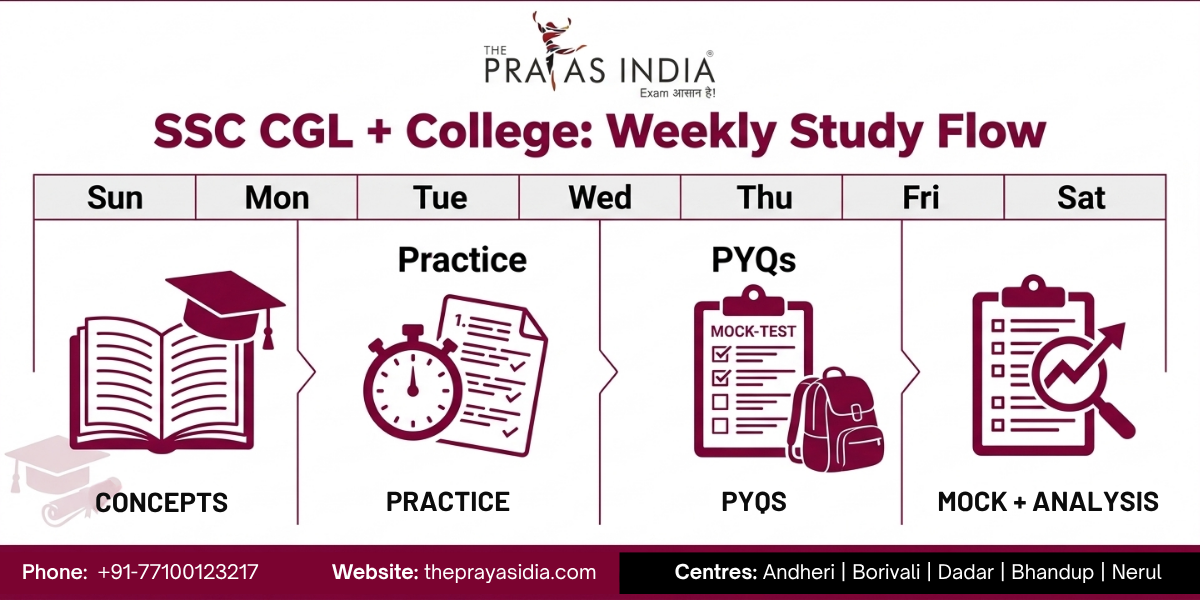
A useful weekly structure could therefore be:
- Monday to Friday: Short, focused subject sessions and daily practice
- Saturday: Longer concept-building and PYQ sessions
- Sunday: Revision, sectional/full-length testing and mistake analysis
As the examination approaches, the balance can gradually shift from learning towards timed practice, mocks and revision.
How Previous-Year Questions Should Fit Into Your College Preparation
Previous-year questions should not be postponed until the entire syllabus is complete. They can be introduced topic-wise as soon as you have developed sufficient understanding of a chapter.
PYQs help students understand the type of questions SSC repeatedly asks, the level of difficulty and the ways in which familiar concepts are presented differently. They also help prevent over-preparation. Instead of spending weeks studying material that has little relevance to the examination, students can use actual questions as a reference for prioritising their preparation. (MySSCGuide)
For a college student, PYQs are particularly useful because they make limited study time more productive. If you have only an hour available, solving relevant previous-year questions after learning a topic can provide much more meaningful feedback than simply watching another lecture.
Maintain a simple record of mistakes. You do not need an elaborate notebook containing every question you have ever attempted. Record recurring errors, forgotten formulas, vocabulary problems, calculation mistakes and question types that repeatedly consume too much time.
Over several months, this becomes a personalised revision resource.
How Coaching Can Make SSC CGL Preparation Easier Alongside College
Preparing independently while attending college is possible, but it also creates an additional challenge: you have to manage the preparation system yourself. You need to decide what to study, which topics to prioritise, which material to follow, when to practise, how to test yourself and how to evaluate your progress.
For a college student already managing academic responsibilities, this planning burden can become significant.
A structured SSC coaching programme can help reduce that burden by providing a defined learning path, organised study material, regular practice and test-based evaluation. Instead of spending a large portion of your available time deciding what to study next, you can devote more of that time to actually studying and solving questions.
This is where choosing a coaching institute in Mumbai can become a practical decision rather than simply a question of attending classes. Students should look for a programme that fits their college schedule, provides systematic coverage of the syllabus, encourages PYQ-based practice and offers opportunities for doubt resolution and performance tracking.
The Prayas India can be considered by students looking for structured SSC CGL preparation alongside graduation. A coaching environment can be particularly useful for students who know that they need consistency but find it difficult to create and maintain an organised preparation system independently.
The right coaching programme should complement college rather than compete with it. Students should therefore evaluate batch timings, course structure, faculty support, study material, test practice and the overall learning environment before enrolling.
For a college student, the most useful coaching setup is one that provides structure without making the preparation unnecessarily rigid.
Common Mistakes College Students Make While Preparing for SSC CGL
The first mistake is waiting until graduation is almost complete before starting. Students often assume they will have more time later, only to discover that placements, final-semester examinations, internships and other responsibilities create additional pressure. Starting earlier allows preparation to progress gradually.
Another common mistake is copying a full-time aspirant’s timetable. A student attending college for several hours a day cannot realistically follow the same schedule as someone whose entire day is available for competitive-exam preparation. Trying to do so often leads to burnout and eventually inconsistency.
The third mistake is focusing too heavily on lectures. Lectures are useful for understanding concepts, but SSC CGL preparation ultimately requires question-solving, revision and timed performance. A student who spends most of the preparation time consuming content but rarely tests their understanding may struggle when faced with actual exam-level questions.
Finally, many students neglect revision. Completing a chapter does not mean the chapter is permanently learned. Concepts, formulas, vocabulary and General Awareness facts need repeated exposure. Building revision into the weekly routine from the beginning prevents the syllabus from becoming a collection of forgotten topics.
SSC CGL Preparation: A Year-Wise Approach for College Students
The biggest advantage of starting SSC CGL preparation during college is that you can adjust the intensity of your preparation according to your year of graduation. A first-year student has considerably more time to build fundamentals, while a final-year student may need a more examination-oriented approach. Instead of following one identical strategy throughout college, it is better to gradually move from foundation building to intensive practice.
First Year: Build the Foundation
If you are in your first year of college, there is no need to rush towards full-length mocks immediately. This is the ideal stage to become comfortable with the core concepts of Quantitative Aptitude, English and Reasoning. You can also begin developing a consistent General Awareness revision habit.
The focus should be on understanding how SSC CGL questions are framed, learning basic concepts properly and developing the habit of solving questions every day. Even 2–3 focused hours on most days can create a strong foundation when maintained over a long period.
This is also a good stage to identify your weaker subjects. If Mathematics takes you considerably longer than other sections, you have enough time to improve it without the pressure of an approaching examination.
Second Year: Move Towards Exam-Level Practice
By the second year, your preparation should gradually become more structured. Concepts that were introduced during the first year should now be accompanied by regular PYQ practice and sectional tests.
Your Quant preparation can move towards mixed arithmetic and advanced topics, while English should increasingly include SSC-oriented grammar, vocabulary and comprehension practice. Reasoning should move from individual topics to mixed sets, and General Awareness should follow a systematic revision cycle.
This is also the stage where maintaining an error notebook becomes particularly useful. Instead of repeatedly making the same mistakes, you should be able to identify patterns in your errors and work specifically on them.
Final Year: Shift Towards Performance
Students in their final year should increasingly think like examination candidates rather than only learners. Concept building remains important, but timed practice, PYQs, sectional tests and full-length mocks should become a regular part of preparation.
At this stage, your preparation should answer three questions clearly: What are my strongest areas? Which topics are costing me marks? And how quickly can I solve questions accurately under examination pressure?
The closer you move towards the examination, the more important revision and test analysis become. A student who has studied everything once but cannot recall it under time pressure still has a preparation gap.
Build a Study Plan That Survives College Examinations
One of the biggest reasons college students abandon competitive-exam preparation is that their timetable works only during normal weeks. The moment internal examinations, semester exams or project submissions arrive, the entire plan collapses.
A better strategy is to create normal-week targets and busy-week targets.
During a normal college week, you may be able to complete three or four focused study hours per day. During an examination week, that may not be realistic. Instead of stopping SSC preparation completely, reduce it to a maintenance routine. Even 30–60 minutes of revision, vocabulary, formulas or PYQs can help preserve continuity.
Once your college workload reduces, you can increase the preparation hours again.
This approach prevents the common cycle of studying intensely for several days, stopping completely during college work and then spending another week trying to restart. Consistency becomes much easier when your preparation plan has room for real-life interruptions.
How to Use Vacations for SSC CGL Preparation
College vacations can become one of the most productive phases of your SSC CGL preparation. When lectures and assignments are temporarily reduced, you can use these periods to complete difficult topics, solve larger PYQ sets and take more tests.
However, vacations should not become an excuse to create an unrealistic 12-hour timetable. The purpose is to use additional free time intelligently.
A productive vacation routine can include longer Quant sessions, dedicated English practice, Reasoning sets, General Awareness revision and regular mock analysis. You can also use this period to complete topics that were repeatedly postponed during college days.
If you are considering joining an SSC CGL coaching programme, college vacations can also be a useful time to begin structured classroom preparation because you can devote more attention to understanding the course and establishing a regular routine.
The Role of Mock Tests in SSC CGL Preparation
Mock tests should gradually become an important part of your preparation, but their purpose changes as you progress.
In the beginning, tests help you understand your current level. You may not score highly, and that is perfectly normal. The purpose at this stage is to discover gaps.
Later, sectional tests help improve speed and accuracy in individual subjects. Once your syllabus coverage becomes stronger, full-length mocks become more important because they test your ability to manage multiple sections within the same examination environment.
However, simply taking mocks is not enough. Mock analysis is where much of the learning happens.
After every test, look at questions that were:
- Incorrect despite knowing the concept
- Incorrect because of a conceptual gap
- Left unanswered despite being solvable
- Solved correctly but took too much time
- Guessed without sufficient confidence
This analysis helps distinguish between knowledge problems and performance problems. A student who knows the formula but makes calculation errors needs a different solution from a student who does not understand the concept at all.
Create an SSC CGL Error Notebook
An error notebook is particularly useful for students balancing college and competitive-exam preparation because it makes revision more targeted.
You do not need to copy every question into it. Instead, record the mistakes that are likely to repeat. These could include a forgotten Quant formula, a grammar rule you repeatedly confuse, a particular Reasoning pattern that takes too long or an important General Awareness fact that you frequently forget.
Divide the notebook into a few broad categories such as Concept Errors, Calculation Errors, Silly Mistakes, Time Management and Revision Points.
Before a mock test, spend some time reviewing these errors. Over time, the notebook becomes more valuable than repeatedly revisiting entire chapters.
Don’t Ignore Tier 2 While Preparing for Tier 1
College students often make the mistake of treating the first stage of the examination as the complete goal. A better approach is to build the foundation with the broader examination journey in mind.
The current SSC CGL structure makes it important for serious aspirants to develop their preparation beyond simply clearing the first stage. Quantitative aptitude, English, reasoning, General Awareness and computer-related preparation should be approached systematically, with the eventual higher-level requirements in mind.
This does not mean attempting advanced-level preparation from the first day. It means avoiding a situation where you spend months preparing only for basic question formats and then have to completely change your strategy later.
An integrated approach makes the transition from foundation preparation to examination-level practice smoother.
How to Balance College Assignments, Attendance and SSC Preparation
A competitive-exam routine should not encourage students to neglect their graduation. Your college degree remains an important part of your academic journey, and maintaining reasonable academic performance should remain a priority.
The solution is better scheduling rather than sacrificing one responsibility for another.
Use your college timetable to identify predictable free periods. Keep lighter SSC activities for short breaks and reserve demanding topics for uninterrupted study sessions. Avoid scheduling your most difficult Quant topics immediately after a long day of lectures if you know that your concentration will be low.
Similarly, use weekends for tasks that require deeper concentration, such as mock tests, difficult chapters and detailed analysis.
The objective is to make your college schedule and SSC schedule work together rather than treating them as competing commitments.
Choosing the Right SSC CGL Coaching Alongside College
For a college student, selecting an SSC coaching institute is not simply about finding a place where classes are conducted. The more important question is whether the coaching structure fits your academic schedule and helps you maintain consistent preparation.
Students should consider factors such as batch timings, course structure, faculty guidance, study material, practice tests, doubt support and the overall learning environment. A good programme should reduce unnecessary confusion about what to study next and provide a clear path from concepts to practice and testing.
This becomes especially relevant for students in Mumbai, where commuting time can also affect the daily study schedule. A well-planned coaching routine can help students use their available time more efficiently instead of spending hours deciding which resources to follow.
The Prayas India offers SSC-focused preparation for students who want a structured approach to competitive-exam preparation. For college students, the value of coaching should be evaluated in terms of structure, guidance, practice and compatibility with their academic routine rather than simply the number of classroom hours.
Before taking admission, students should understand the batch schedule, course coverage, study methodology, test practice and support available to them. Choosing the right programme early can help establish a disciplined preparation routine while there is still sufficient time to strengthen fundamentals.

A Practical Weekly SSC CGL Plan for College Students
A weekly plan can be more useful than an extremely detailed day-by-day timetable because college schedules often change.
| Day | Primary Focus | Secondary Focus |
|---|---|---|
| Monday | Quant Concepts | English |
| Tuesday | Reasoning | General Awareness |
| Wednesday | Quant Practice | English |
| Thursday | Reasoning + PYQs | General Awareness |
| Friday | Quant + English | Revision |
| Saturday | PYQs + Difficult Topics | Sectional Test |
| Sunday | Mock Test | Mock Analysis + Revision |
The exact number of questions and study hours can be adjusted according to your academic workload. The important thing is to maintain regular exposure to every major area.
As the examination gets closer, the schedule can gradually move away from concept learning and towards mixed practice, mocks, revision and performance analysis.
What College Students Should Stop Doing
SSC CGL preparation becomes easier when students stop wasting their limited preparation time.
One common problem is constantly changing books, teachers and online resources. Every new resource can appear attractive, but switching repeatedly prevents you from completing any one structured course properly.
Another problem is making elaborate timetables without measuring actual progress. A timetable is useful only when it results in completed topics, solved questions and improved test performance.
Students should also avoid comparing their daily study hours with those of full-time aspirants. Your circumstances are different. Someone studying eight hours a day after graduation and someone attending college for six hours cannot be judged using the same timetable.
Instead, measure your preparation by completed targets, accuracy, speed, revision and mock-test performance.
When Should You Join SSC CGL Coaching During College?
There is no single correct year to join coaching. The right time depends on your academic schedule, current preparation level and ability to study independently.
Students who are completely new to competitive exams may benefit from structured guidance earlier because it can help them understand the syllabus, question patterns and preparation sequence. Students who already have a strong foundation may prefer joining when they are ready for more intensive practice and testing.
For many college students, the biggest benefit of starting early is not completing the entire syllabus immediately. It is developing the correct preparation habits before the pressure of graduation and recruitment exams increases.
If you are considering SSC CGL as a serious career option, admission into a structured coaching programme during college can therefore be viewed as a long-term preparation decision rather than a last-minute exam strategy.
SSC CGL Preparation Alongside College: The Bigger Picture
Preparing for SSC CGL while pursuing graduation requires patience because progress may sometimes appear slow. There will be weeks when college responsibilities dominate your schedule and weeks when you can devote considerably more time to competitive preparation.
That variation is normal.
The students who manage both successfully are not necessarily those who study for the longest number of hours every day. They are the ones who maintain a system: they know what they need to study, practise regularly, revise what they have already learned and test themselves often enough to identify weaknesses.
Starting during college gives you something that many late starters do not have—time to improve without unnecessary pressure.
You can strengthen Quant before it becomes a major weakness, improve English gradually, develop Reasoning speed through repeated practice and build a sustainable General Awareness revision habit. By the time you reach your final year, you can shift the focus towards examination-level performance instead of starting from zero.
For students in Mumbai who want to combine graduation with serious SSC CGL preparation, the next step is to evaluate whether a structured coaching environment can fit their college schedule and preparation goals. The right guidance, consistent practice and a realistic study plan can make the journey considerably more organised.
Conclusion
Preparing for SSC CGL alongside college is not about choosing between your degree and your competitive-exam goals. It is about building a preparation system that can coexist with your academic responsibilities. When you start early, you have the advantage of developing concepts gradually, practising without excessive pressure and identifying your weak areas while there is still enough time to improve.
A realistic routine, regular PYQ practice, systematic revision and mock-test analysis should form the foundation of your preparation. At the same time, the coaching you choose should fit your college schedule and provide the structure, guidance and practice environment required for consistent preparation.
For students looking for SSC CGL coaching in Mumbai, The Prayas India can be explored as an option for structured preparation alongside graduation. The right time to begin is not necessarily when college ends; for many students, beginning during college can make the overall preparation journey more organised and manageable.
The key is simple: start early, study consistently, revise intelligently and keep your preparation compatible with your college life.
Contact Us
- Call Now: +91-77100 13217
- Website: theprayasindia.com
- Centres: Andheri | Borivali | Dadar | Nerul | Bhandup
Frequently Asked Questions
1. Can I prepare for SSC CGL while pursuing college?
Yes. College students can prepare for SSC CGL by creating a realistic schedule around lectures, assignments and examinations. Consistency is more important than studying an extremely high number of hours every day.
2. How many hours should a college student study for SSC CGL?
A student can start with around 3–4 focused hours on regular college days and use weekends or holidays for longer study sessions. The ideal number depends on the student's academic workload and preparation level.
3. Which SSC CGL subjects should I focus on first?
Quantitative Aptitude, English and Reasoning are good areas to build gradually because they benefit from continuous practice. General Awareness should also be incorporated through short, regular revision sessions.
4. Should college students join SSC CGL coaching?
Coaching is not mandatory, but structured guidance can be useful for students who want a defined preparation path, organised study material, regular tests and support with doubts. Students should choose a programme that fits their college schedule.
5. Is it better to start SSC CGL preparation in the first year of college?
Starting in the first year can provide a significant time advantage. Students can focus on fundamentals initially and gradually move towards PYQs, sectional tests and mocks as their preparation develops.
6. How can I manage SSC CGL preparation during semester examinations?
During semester examinations, reduce SSC preparation rather than abandoning it completely. Use short sessions for revision, formulas, vocabulary or PYQs and increase your SSC study hours once the academic workload decreases.
7. When should I start giving SSC CGL mock tests?
Topic-wise and sectional tests can be introduced after developing basic understanding of the relevant subjects. Full-length mocks should become more frequent as syllabus coverage and examination readiness improve.
8. Is The Prayas India suitable for college students preparing for SSC CGL?
Students should evaluate the batch timings, course structure, faculty support, study material, tests and doubt-solving facilities before taking admission. The Prayas India can be considered by Mumbai-based college students looking for structured SSC CGL preparation alongside graduation.