IBCA 2026: International Big Cat Alliance, Objectives, Members, and Exam Relevance
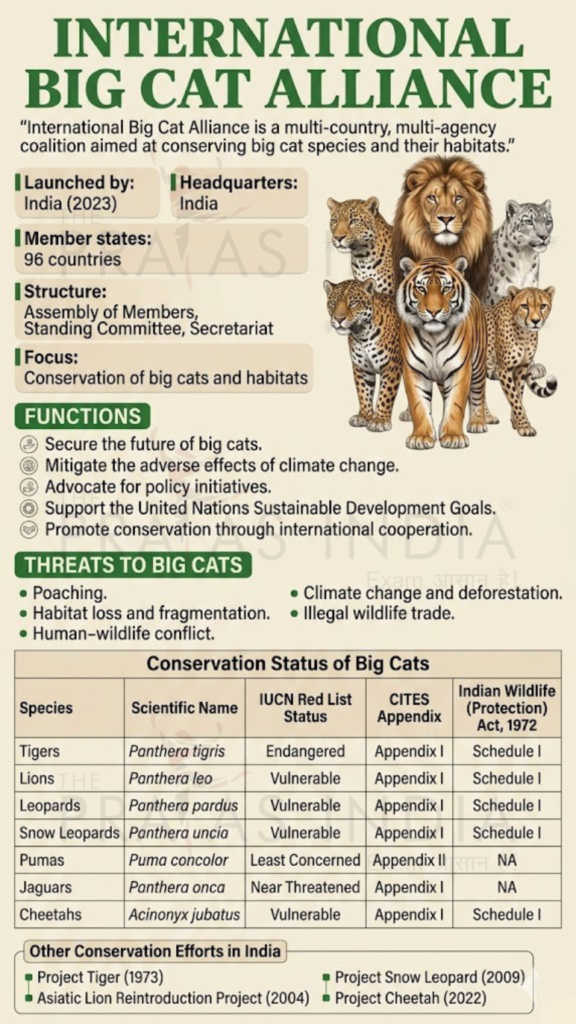
The International Big Cat Alliance (IBCA) is a global conservation initiative launched by India to protect seven iconic big cat species and their habitats. It was proposed by Prime Minister Narendra Modi in 2019, formally launched on April 9, 2023, and later became a treaty-based inter-governmental international organization on January 23, 2025.
IBCA is important because it combines wildlife conservation, climate action, international cooperation, and biodiversity protection in one framework. For UPSC aspirants, it is a high-value current affairs topic that connects environment, international relations, and sustainable development.
What is IBCA?
The International Big Cat Alliance is a multi-country, multi-agency coalition created to conserve big cats and their habitats across the world. It brings together range countries, non-range countries, conservation partners, scientific organisations, and other stakeholders interested in big cat protection.
The alliance was launched in April 2023 to mark the 50th anniversary of Project Tiger in India. The idea was first proposed by the Prime Minister in 2019 during Global Tiger Day, when he called for stronger international cooperation to curb poaching and illegal wildlife trade.
Why IBCA Was Created
Big cats face severe threats from habitat loss, fragmentation, poaching, and illegal wildlife trade. Since these species are found across multiple countries and ecosystems, conservation cannot be effective through isolated national efforts alone.
IBCA was therefore created as a specialised global platform to bring countries together, share best practices, improve field-level implementation, and mobilise technical and financial support. It also seeks to strengthen cooperation in biodiversity protection and climate resilience.
Focus Species
IBCA focuses on the conservation of seven big cat species:
- Tiger.
- Lion.
- Leopard.
- Snow leopard.
- Cheetah.
- Jaguar.
- Puma.
These species are spread across Asia, Africa, and the Americas. Five of them are found in India in some form or through conservation history: tiger, lion, leopard, snow leopard, and cheetah.
What Are Big Cats?
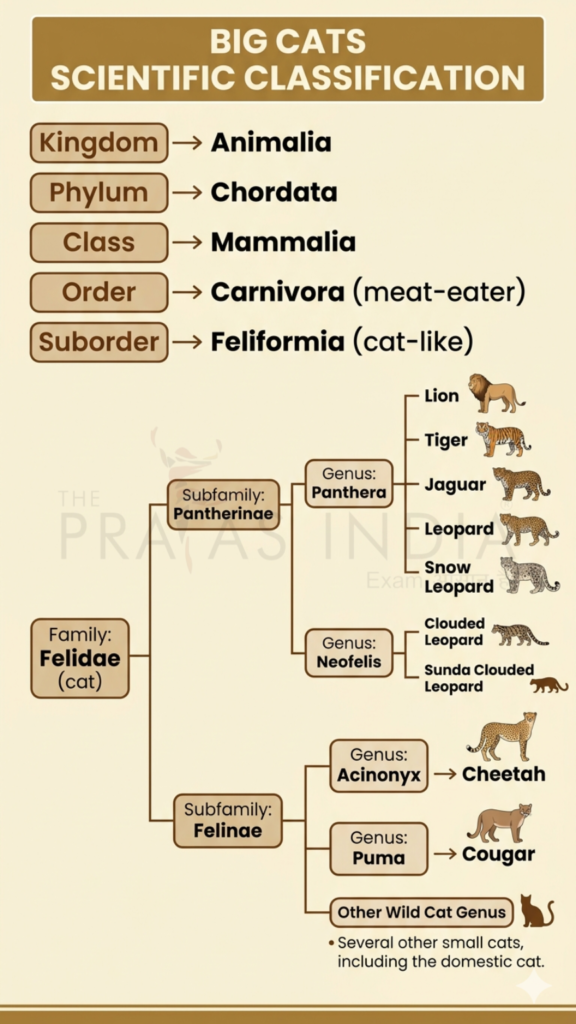
Big cats generally refer to large wild cats, especially species in the Panthera genus. Lions are the only big cats that live in social groups called prides, while most other big cats are solitary except for mothers with cubs.
They are considered keystone species because they play a crucial role in maintaining ecosystem balance. Their presence is also an important indicator of forest and habitat health, which is why their decline often signals wider ecological stress.
Member Countries and Participation
According to IBCA and government sources, the alliance is designed for participation by 96 big cat range countries and non-range countries interested in conservation. The official IBCA framework also says that countries and institutions can join as members or partners depending on their commitment to conservation.
As of the latest official update, the four countries specifically mentioned as members in the information you provided are India, Nicaragua, Eswatini, and Somalia. Government sources also note that additional countries have consented to join the alliance, and as of January 2025, the framework agreement had come into force as a treaty-based international organisation.
Headquarters and Governance
The headquarters of IBCA is in India, and the alliance is supported by the Ministry of Environment, Forest and Climate Change through the National Tiger Conservation Authority (NTCA).
Its governance structure includes:
- An Assembly of Members.
- A Standing Committee.
- A Secretariat based in India.
The framework is modelled in part on the International Solar Alliance, with a Director-General appointed by the Ministry of Environment, Forest and Climate Change.
Budget and Support
The Union Cabinet approved one-time budgetary support of Rs 150 crore for IBCA for the five-year period from 2023-24 to 2027-28. This funding is intended to help establish the alliance, build institutional capacity, and support its early operations.
This is significant because international conservation platforms often fail when they do not have enough funding, technical support, or coordination mechanisms. IBCA tries to fill that gap by building a common platform backed by resources.
Objectives of IBCA
IBCA has several core objectives:
- To prevent the illegal wildlife trade involving the seven big cat species.
- To promote conservation of the natural habitats of these big cats.
- To mobilise financial and technical resources for conservation and protection efforts.
- To mitigate the adverse effects of climate change on habitats and wildlife.
- To align biodiversity conservation with local needs and the Sustainable Development Goals.
These objectives show that IBCA is not only about wildlife protection in a narrow sense, but also about linking conservation with livelihoods, sustainability, and climate adaptation.
Why India Launched IBCA
India has a long history of big cat conservation, especially through Project Tiger, Project Lion, and cheetah reintroduction efforts. The IBCA initiative reflects India’s attempt to scale up its conservation experience into a global framework.
India’s role is especially important because it has experience in managing large-scale conservation programs and in balancing ecological goals with development needs. The alliance allows India to position itself as a global leader in wildlife diplomacy.
Cheetah and India
The cheetah deserves special mention because it was declared extinct in India in 1952. In 2022, the Government of India launched an ambitious effort to reintroduce African cheetahs into Kuno National Park in Madhya Pradesh.
This reintroduction project is significant for IBCA because it shows India’s willingness to combine conservation science, habitat management, and international cooperation. It also strengthens India’s case for leading a global big cat alliance.
Importance of IBCA for Climate and SDGs
IBCA is also relevant to climate change because healthy forests and wildlife habitats help maintain ecosystem services such as water regulation, carbon storage, and biodiversity balance. The alliance explicitly aims to support conservation efforts that reduce climate-related harm to habitats.
It also aligns with the UN Sustainable Development Goals by linking conservation with poverty reduction, sustainable livelihoods, and environmental protection. This makes IBCA a practical example of how biodiversity policy can support broader development objectives.
UPSC Relevance
IBCA is a very important topic for UPSC Prelims and Mains. In Prelims, questions may ask about the founding year, member countries, focus species, headquarters, and objectives.
In Mains, IBCA can be used to discuss:
- Biodiversity conservation.
- International environmental cooperation.
- India’s leadership in global governance.
- Climate-resilient conservation models.
- Wildlife trade and habitat protection.
For Essay and Interview, IBCA can be linked to India’s soft power, environmental diplomacy, and the idea of “One Earth, One Health” type cooperation.
Why The Prayas India
The Prayas India is a strong choice for UPSC coaching in Mumbai because it helps students connect current affairs with the broader syllabus in a structured way. For a topic like IBCA, that matters a lot, because the exam may test not only facts but also the conservation logic, policy framework, and India’s global role behind the initiative.
One of the biggest advantages of The Prayas India is its integrated preparation style. Students do not just memorize news items; they learn how to place them under GS Paper 3 environment, international cooperation, biodiversity, and government policy. This makes revision more effective and answers more analytical.
The institute is also useful because UPSC requires both factual recall and conceptual understanding. A topic like IBCA is a good example: students need to know what the alliance is, when it was launched, who initiated it, what species it protects, and why it matters for India and the world. The Prayas India’s current affairs-oriented guidance can help students convert such topics into exam-ready notes.
Another reason students prefer The Prayas India is its focus on answer writing and mentorship. Many aspirants know the content but struggle to present it well in mains answers. A coaching environment that provides structure, testing, feedback, and subject clarity can make a real difference in performance.
For Mumbai aspirants especially, The Prayas India offers a disciplined learning environment suited to one of India’s toughest exams. Its strength lies in helping students stay updated, think analytically, and build the consistency needed to succeed in UPSC.
FAQs
IBCA stands for the International Big Cat Alliance, a global coalition for big cat conservation.
IBCA was launched on April 9, 2023, during the commemoration of 50 years of Project Tiger.
It became a full-fledged treaty-based inter-governmental international organisation from January 23, 2025.
IBCA focuses on seven species: tiger, lion, leopard, snow leopard, cheetah, jaguar, and puma.
The IBCA Secretariat headquarters is in India.
It is important because it links biodiversity, climate change, international cooperation, and India’s environmental leadership.1. What is IBCA?
2. When was IBCA launched?
3. When did IBCA become a treaty-based organisation?
4. How many big cat species are covered under IBCA?
5. What is the headquarters of IBCA?
6. Why is IBCA important for UPSC?