
How to Identify Weak Areas Through Mock Test Analysis: A Complete Guide for MBA CET Aspirants
Preparing for MAH MBA CET requires more than solving questions and attempting mock tests. Students also need to understand their performance, identify mistakes and work consistently on areas that need improvement. One of the most effective ways to do this is through regular mock test analysis.
Many MBA CET aspirants attempt multiple mock tests but do not spend enough time reviewing their results. They focus mainly on their scores and percentiles without understanding why they lost marks, which questions consumed too much time or which concepts they have not understood properly.
Mock test analysis helps students identify these problems and develop a more focused preparation strategy.
For students preparing for MBA CET in Nerul, Seawoods, CBD Belapur, Vashi, Juinagar and other parts of Navi Mumbai, learning how to analyse mock tests can make their preparation more organised and productive.
In this article, we will explain how to identify weak areas through mock test analysis, evaluate performance section-wise, understand common mistakes and create an improvement plan for MAH MBA CET.
Introduction: Why Is Mock Test Analysis Important for MBA CET?
Mock tests are an essential part of MBA CET preparation. They help students practise different question types, understand time pressure and become familiar with the examination environment.
However, simply attempting mock tests does not guarantee improvement.
A student may attempt several tests and continue making the same mistakes because they are not analysing their performance properly. For example, a student may score poorly in Logical Reasoning because of difficulty with puzzles, while another may lose marks in Quantitative Aptitude because of slow calculations.
Without proper analysis, these problems may remain unnoticed.
Mock test analysis helps students answer important questions:
Which topics are causing the most difficulty?
Am I making conceptual mistakes or calculation errors?
Which questions take too much time?
Am I attempting questions without sufficient accuracy?
Which sections need more practice?
Am I improving from one mock test to another?
For MBA CET aspirants, understanding these areas can help create a preparation plan based on actual performance rather than assumptions.
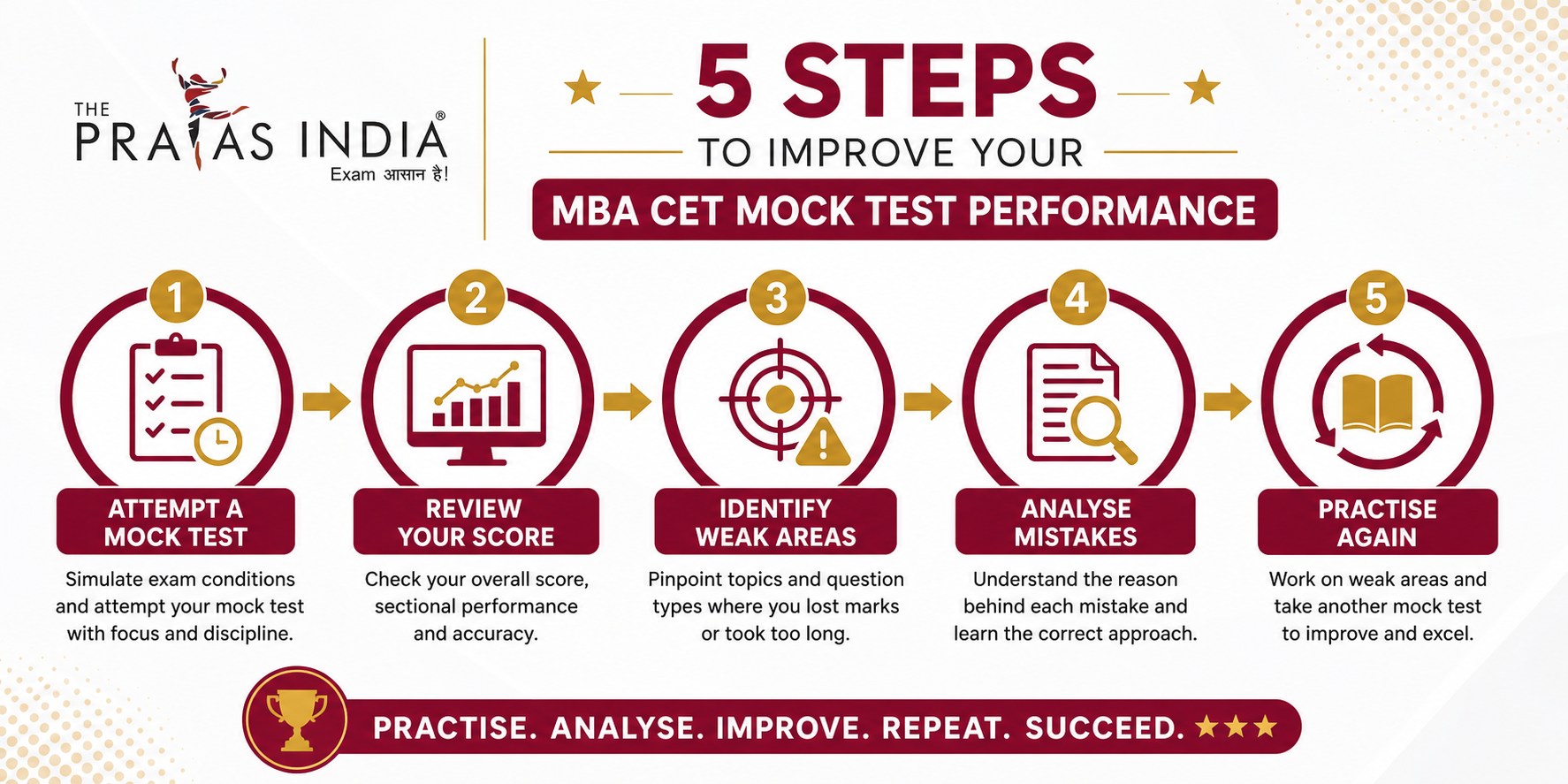
1. Analyse Your Overall Mock Test Performance
The first step is to review your overall mock test performance.
Do not look only at your total score. Examine different performance indicators to understand how effectively you attempted the paper.
Important factors to review include:
Total Score: Check your overall score and compare it with your previous mock tests.
Number of Attempts: Understand how many questions you attempted during the test.
Accuracy: Calculate how many attempted questions you answered correctly.
Time Taken: Identify whether you spent too much time on particular questions or sections.
Unattempted Questions: Review whether you skipped questions because of a lack of knowledge, time pressure or uncertainty.
For example, consider a student who attempts 100 questions but answers only 65 correctly. Another student attempts 85 questions and answers 72 correctly.
The second student has fewer attempts but better accuracy.
This comparison shows why students should evaluate their overall approach instead of focusing only on the number of questions attempted.
2. Identify Weak Sections Through Section-Wise Analysis
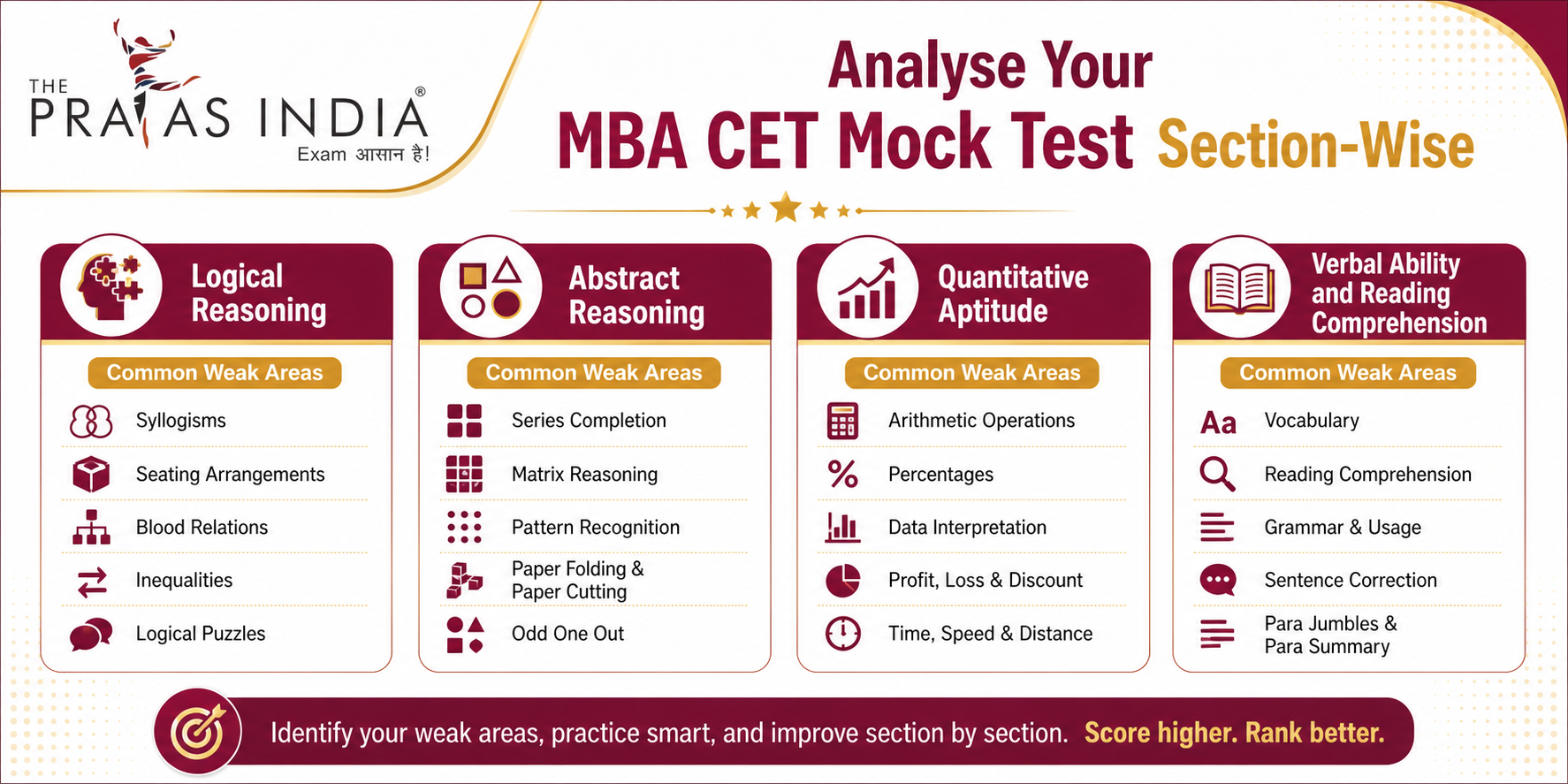
MBA CET preparation involves different sections that test different abilities. Analysing each section separately helps students identify where they need additional practice.
A. Logical Reasoning
Logical Reasoning is an important part of MAH MBA CET. It tests the ability to understand relationships, analyse information and solve reasoning-based problems.
While analysing your mock test, check whether you face difficulty with:
Seating arrangement questions
Blood relations
Direction-based problems
Coding and decoding
Syllogisms
Puzzles
Input-output questions
Statement-based reasoning
How to identify your weakness:
Suppose you consistently take too much time to solve seating arrangement questions. This may indicate that you need more practice with arrangement patterns and systematic information organisation.
Similarly, if you frequently select incorrect options in syllogism questions, revisit the underlying concepts and practise different question formats.
Improvement strategy:
Practise topic-wise reasoning questions.
Revise the concepts behind incorrect answers.
Solve questions with a time limit.
Learn different approaches to solving puzzles.
Track accuracy for individual topics.
B. Abstract Reasoning
Abstract Reasoning evaluates the ability to identify patterns, understand visual relationships and recognise logical sequences.
Students should review their performance in:
Figure series
Pattern identification
Figure completion
Mirror images
Analogy-based questions
Visual sequences
Odd-one-out questions
How to identify your weakness:
If you regularly struggle to recognise patterns or take excessive time to identify the correct figure, you may need more visual reasoning practice.
Improvement strategy:
Practise different figure patterns.
Observe changes in shape, direction and position.
Solve timed visual reasoning exercises.
Review incorrect questions to understand the pattern.
Practise different levels of difficulty.
C. Quantitative Aptitude
Quantitative Aptitude requires conceptual clarity, calculation speed and the ability to select suitable methods for solving numerical problems.
Check your performance in topics such as:
Arithmetic
Percentages
Profit and Loss
Ratio and Proportion
Time and Work
Time, Speed and Distance
Probability
Permutation and Combination
Number Systems
Geometry
Data Interpretation
How to identify your weakness:
If you repeatedly make mistakes in percentage calculations, ratio-based questions or data interpretation, revise those concepts before attempting more difficult questions.
You should also check whether your mistakes occur because of incorrect formulas, calculation errors or a lack of understanding.
Improvement strategy:
Revise important formulas.
Practise basic concepts before advanced questions.
Improve mental calculation skills.
Solve topic-wise questions regularly.
Track the time taken for each question.
D. Verbal Ability and Reading Comprehension
Verbal Ability and Reading Comprehension assess language comprehension, vocabulary, grammar and the ability to interpret written information.
Review your performance in:
Reading comprehension
Vocabulary
Sentence correction
Para jumbles
Grammar
Fill in the blanks
Verbal reasoning
How to identify your weakness:
If you regularly select incorrect answers in reading comprehension, check whether you are misunderstanding the passage, overlooking important information or making assumptions beyond the given text.
If grammar questions are difficult, identify the specific grammatical concepts that require revision.
Improvement strategy:
- Read quality English articles regularly.
- Practise comprehension passages.
- Revise essential grammar rules.
- Build vocabulary through consistent reading.
- Review the explanation for every incorrect answer.
3. Maintain a Mock Test Error Analysis Notebook
One of the most useful habits during MBA CET preparation is maintaining an error analysis notebook.
Instead of simply checking the correct answers after a mock test, record the mistakes and understand why they occurred.
Create separate sections for different types of errors.
| Error Category | What It Means | Improvement Action |
|---|---|---|
| Conceptual Error | The concept was not understood properly | Revise the topic |
| Calculation Error | Incorrect calculations or arithmetic | Practise calculations |
| Time Management Error | Too much time spent on a question | Practise timed questions |
| Misreading Error | Important information was overlooked | Improve question-reading habits |
| Guesswork Error | Answer selected without sufficient reasoning | Improve accuracy |
| Question Selection Error | Time spent on unsuitable questions | Develop question-selection strategy |
For every incorrect question, write:
Topic or chapter name.
Question type.
Reason for the mistake.
Correct method of solving it.
Action required to avoid repeating the mistake.
This notebook becomes a useful revision resource before the actual examination.
4. Compare Accuracy and Attempts
A common mistake among MBA CET aspirants is trying to attempt as many questions as possible without considering accuracy.
A high number of attempts is useful only when supported by an effective solving strategy.
You should compare the following indicators:
Total questions attempted.
Correct answers.
Incorrect answers.
Accuracy percentage.
Time spent on questions.
For practice analysis, you can calculate accuracy using this formula:

Example:
Suppose you attempted 80 questions in a mock test and answered 60 correctly.

Your accuracy is 75%.
Now compare this result with your previous mock tests. If your attempts are increasing but accuracy is declining, you may be attempting questions too quickly or selecting questions without sufficient confidence.
The objective should be to develop a balanced approach that supports both speed and accuracy.
5. Identify Questions That Consume Too Much Time
Time management plays an important role in competitive entrance examinations.
Some students understand the concepts but struggle to complete questions within the available time.
During mock test analysis, identify questions that took unusually long to solve.
For example:
A puzzle that took five minutes.
A calculation question that required repeated working.
A reading comprehension passage that consumed excessive time.
A reasoning question that could have been skipped in favour of easier questions.
Ask yourself:
Was the question genuinely difficult?
Did I use the correct solving method?
Could I have solved it using a shorter approach?
Should I have skipped it and attempted another question first?
This analysis helps improve question selection and time allocation.
Do not assume that every question must be attempted. Learning when to move on is also an important examination skill.
6. Distinguish Between Conceptual Mistakes and Silly Mistakes
Not every incorrect answer indicates a lack of preparation.
Sometimes students understand the concept but make avoidable mistakes while solving questions.
It is important to identify the difference.
Conceptual mistakes include:
Applying an incorrect formula.
Misunderstanding a reasoning pattern.
Using the wrong method.
Lack of clarity about a topic.
Silly mistakes include:
Reading the question incorrectly.
Selecting the wrong option accidentally.
Making basic calculation errors.
Missing important information.
Marking an answer without checking it.
The improvement strategy should depend on the type of mistake.
For conceptual mistakes, revise the relevant topic and practise similar questions.
For silly mistakes, slow down slightly while reading questions, improve calculation discipline and review your working steps.
7. Track Your Performance Across Multiple Mock Tests
Analysing a single mock test may not provide a complete picture of your preparation.
A student may perform poorly in one test because of unfamiliar questions, distractions or time pressure.
Therefore, compare performance across multiple mock tests to identify recurring patterns.
Maintain a simple performance tracker.
| Mock Test | Main Weak Area | Accuracy | Improvement Required |
|---|---|---|---|
| Test 1 | Quantitative Aptitude | 65% | Formula revision |
| Test 2 | Logical Reasoning | 68% | Puzzle practice |
| Test 3 | Verbal Ability | 70% | Reading practice |
| Test 4 | Time Management | 72% | Timed practice |
The figures are illustrative examples, not actual examination results.
After several mock tests, identify the topics where mistakes continue to occur.
If you repeatedly struggle with the same topic, prioritise it in your study schedule.
Also note improvements. If your accuracy is increasing and time taken is decreasing, your practice strategy may be working effectively.
8. Create a Weekly Improvement Plan Based on Mock Test Analysis
Identifying weak areas is only the first step. The next step is taking action.
Create a weekly preparation plan that gives sufficient time to your weaker topics while maintaining practice in stronger areas.
Here is an example:
| Day | Preparation Activity |
|---|---|
| Monday | Revise weak Quantitative Aptitude topics |
| Tuesday | Practise Logical Reasoning puzzles |
| Wednesday | Reading comprehension and Verbal Ability |
| Thursday | Abstract Reasoning practice |
| Friday | Revise previously incorrect questions |
| Saturday | Attempt a full-length mock test |
| Sunday | Analyse the mock test and plan improvements |
You can adjust this schedule according to your preparation level and available study time.
Avoid spending all your time on weak areas. Continue practising your stronger sections so that your overall performance remains balanced.
9. Common Mistakes Students Make During Mock Test Analysis
Many students know that mock test analysis is important but do not perform it effectively.
Here are some common mistakes to avoid.
1. Checking Only the Final Score
Your score does not explain why you lost marks. Review individual questions and identify recurring mistakes.
2. Ignoring Incorrect Questions
Every incorrect answer provides an opportunity to understand a concept or improve your solving approach.
3. Not Reviewing Unattempted Questions
Some unattempted questions may have been easy. Review whether you skipped them because of poor time management or a lack of confidence.
4. Attempting Too Many Mock Tests Without Analysis
Attempting one mock test after another without reviewing mistakes can lead to repeated errors.
5. Not Practising Weak Topics Separately
After identifying weak areas, practise them through topic-wise exercises rather than depending entirely on full-length tests.
6. Comparing Scores Without Considering Difficulty
Mock tests may vary in difficulty. Compare your accuracy, question selection and topic-wise performance instead of judging progress through scores alone.
10. How MBA CET Coaching Can Help Improve Mock Test Performance
Structured preparation and proper guidance can help students understand their mistakes and improve their examination strategy.
When choosing MBA CET coaching, students should consider whether the institute provides:
Regular mock test practice.
Section-wise performance evaluation.
Topic-wise doubt-solving support.
Guidance on speed and accuracy.
Concept revision sessions.
Practice material for different question types.
Guidance on time management.
Students looking for MBA CET coaching in Nerul and Navi Mumbai can enquire with The Prayas India about currently available preparation programmes.
For aspirants from Nerul, Seawoods, CBD Belapur, Vashi, Juinagar and Sanpada, choosing a convenient preparation centre can also help maintain a consistent study routine.
Conclusion: Make Every Mock Test a Learning Opportunity
Mock tests are not just a way to evaluate your preparation. They are an opportunity to understand your strengths, recognise weaknesses and improve your approach towards the MBA CET examination.
By analysing section-wise performance, maintaining an error notebook, tracking accuracy and practising weak topics regularly, students can make their preparation more focused.
Remember that improvement does not happen simply by attempting more tests. It comes from understanding mistakes and taking corrective action.
If you are preparing for MAH MBA CET and looking for structured guidance, connect with The Prayas India, Nerul, to enquire about available MBA CET preparation programmes.
Frequently Asked Questions – How to Identify Weak Areas Through Mock Test Analysis
Why is mock test analysis important for MBA CET preparation?
Mock test analysis helps students identify weak topics, understand mistakes, evaluate accuracy and improve time management. It also helps aspirants create a preparation plan based on their actual performance.
How can I identify my weak areas through mock tests?
Review your section-wise scores, incorrect answers, unattempted questions and time spent on individual questions. Repeated mistakes in particular topics can indicate areas that require additional practice.
How much time should I spend analysing an MBA CET mock test?
The time required depends on the length of the test and the number of mistakes. Students should reserve sufficient time to review incorrect answers, understand missed questions and revise weak concepts instead of moving immediately to another mock test.
Should I analyse every incorrect question after a mock test?
Yes. Reviewing incorrect questions helps students understand whether mistakes occurred due to conceptual gaps, calculation errors, misreading or poor question selection. It also reduces the chances of repeating similar mistakes.
How can I improve my accuracy in MBA CET mock tests?
Improve accuracy by revising basic concepts, practising topic-wise questions, reviewing incorrect answers and avoiding unnecessary guesswork. Regular timed practice can also help develop better question-selection skills.
Should I attempt another mock test immediately after analysing one?
It is better to revise important mistakes and practise weak topics before attempting the next full-length mock test. This gives you an opportunity to apply what you learned from the previous test.
How many mock tests should I attempt for MAH MBA CET?
There is no fixed number suitable for every student. The number depends on preparation level, available time and individual learning needs. Focus on regular practice and detailed analysis rather than attempting tests without reviewing performance.
Where can I enquire about MBA CET coaching in Nerul?
Students can visit The Prayas India at F-105, 1st Floor, Nerul West, Nerul, Maharashtra 400706, or call +91-77100 13217 to enquire about currently available MBA CET preparation programmes.
Improve Your MBA CET Preparation with The Prayas India Nerul
Want to improve your mock test performance and identify your weak areas? Connect with The Prayas India, Nerul, to enquire about available MBA CET preparation programmes, classroom guidance and practice support. Take a more structured approach towards improving your speed, accuracy and examination strategy.
Address:
F-105, 1st Floor, Nerul West, Nerul, Maharashtra 400706
Serving MBA CET Aspirants From:
Nerul | Seawoods | CBD Belapur | Juinagar | Sanpada | Vashi | Navi Mumbai