How to Manage Speed and Accuracy in MBA CET | Best MBA CET Coaching in Mumbai | The Prayas India
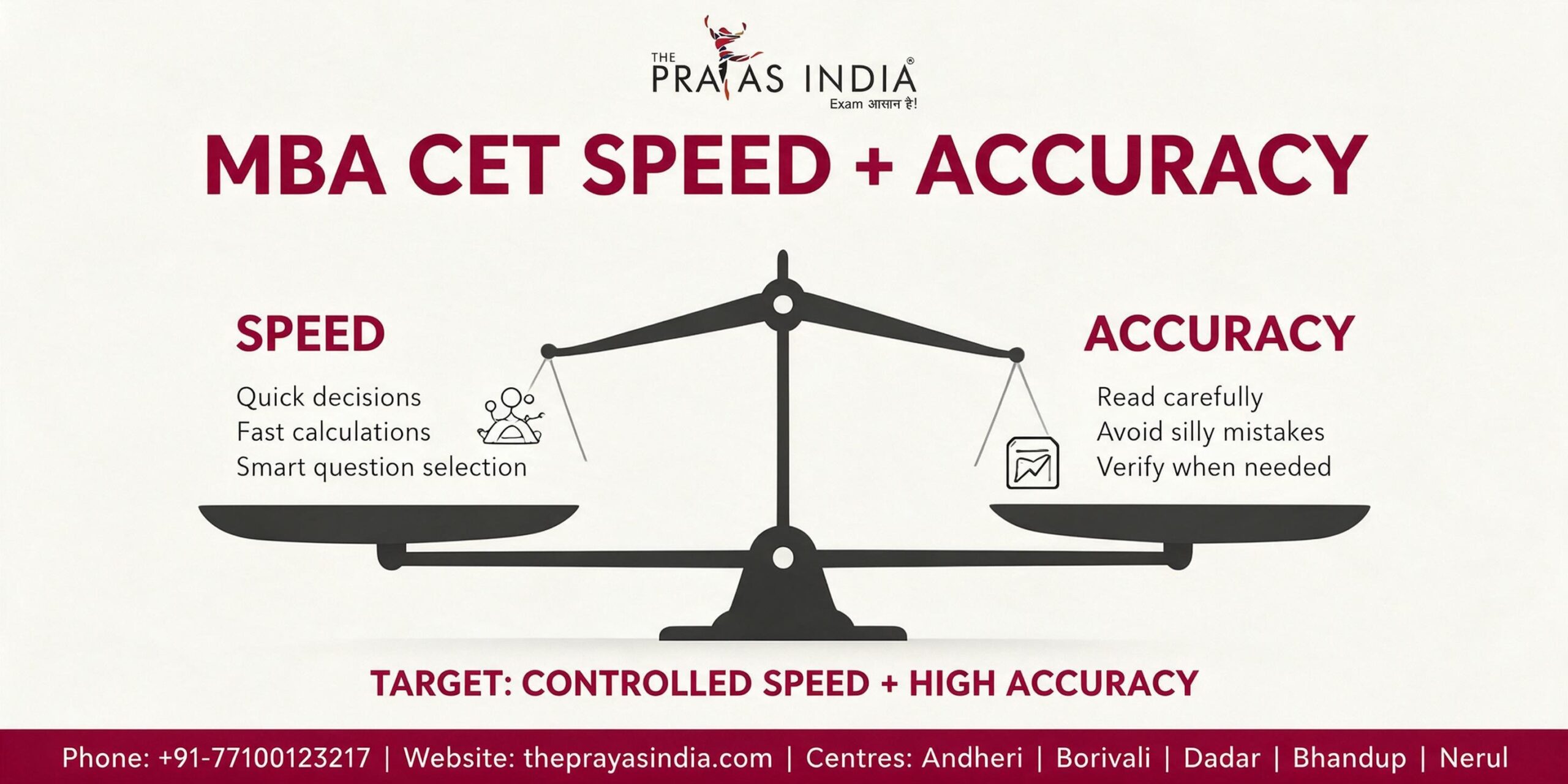
MBA CET is an exam where knowing the concepts is only one part of the preparation. The other major challenge is solving questions quickly without allowing your accuracy to drop. Since the exam requires candidates to handle a large number of questions within a limited time, speed and accuracy have to improve together.
Many students make the mistake of treating speed as the ability to solve every question as quickly as possible. In reality, effective speed comes from recognising question types, selecting the right questions, avoiding unnecessary calculations, and making quick but controlled decisions. Similarly, accuracy does not mean spending several minutes on every question. It means reaching the correct answer within a reasonable amount of time.
For MBA CET aspirants, the goal should therefore be controlled speed—solving easy and familiar questions rapidly, spending appropriate time on moderate questions, and moving away from questions that are consuming too much time.
For students preparing for MBA CET 2027, developing this balance early can make mock tests more productive and reduce the pressure of trying to increase attempts at the last moment.
Why Speed and Accuracy Both Matter in MBA CET
A candidate may know how to solve most questions but still struggle to perform well if the exam is approached without time awareness. Spending too much time on one difficult question can reduce the number of questions attempted later. On the other hand, rushing through the paper can increase calculation mistakes, misreading, and incorrect option selection.
This creates a simple relationship:
More Speed + Poor Accuracy = Unstable Performance
High Accuracy + Very Low Speed = Incomplete Attempts
Controlled Speed + High Accuracy = Better Attempt Management
The objective is not to maximise speed at any cost. Instead, candidates should gradually develop the ability to identify which questions deserve immediate attention, which require calculation, and which should be skipped temporarily.
Understand Your Current Speed and Accuracy Before Changing Your Strategy
Before trying to solve questions faster, you need to understand your current performance. Simply deciding to “increase speed” is not enough. You need measurable information from your practice sessions and mock tests.
For example, suppose you solve 30 questions from a section in a practice session. You should not record only how many questions you got right. Also note how much time you spent, how many questions were guessed, how many errors were caused by calculation, and how many questions took significantly longer than expected.
This gives you a more useful picture of your preparation.
A candidate with 24 correct answers after spending excessive time may have a different problem from someone who attempts 35 questions but gets several wrong due to rushing. Both students need improvement, but their strategies should not be identical.
Create a simple record after every serious practice session:
| Metric | What to Track |
|---|---|
| Questions Attempted | Total attempts |
| Correct Answers | Accurate attempts |
| Incorrect Answers | Errors |
| Time Taken | Total solving time |
| Difficult Questions | Questions requiring excessive time |
| Silly Mistakes | Errors despite knowing the concept |
| Calculation Errors | Mistakes during calculations |
| Time Lost | Questions that consumed disproportionate time |
After maintaining this record for multiple tests, patterns will start becoming visible.
Identify Whether Your Problem Is Speed or Accuracy
One of the most important parts of MBA CET preparation is identifying the actual problem instead of applying the wrong solution.
If you are accurate but slow, your preparation should focus on question recognition, shortcuts, calculation practice, and timed solving.
If you are fast but inaccurate, increasing speed further is unlikely to solve the problem. You need to work on reading questions properly, reducing impulsive attempts, improving calculation accuracy, and checking the reason behind repeated mistakes.
If both speed and accuracy are weak, return to fundamentals first. Trying to solve questions under extreme time pressure before understanding the concepts can create bad habits.
A simple diagnostic approach
High Accuracy + Low Speed:
Work on timed practice and faster methods.
Low Accuracy + High Speed:
Slow down slightly and focus on precision.
Low Accuracy + Low Speed:
Strengthen concepts before increasing time pressure.
High Accuracy + Good Speed:
Focus on consistency through mocks and revision.
This diagnosis should be repeated periodically because your preparation profile can change as you improve.
Build Speed Through Question Recognition
Speed in MBA CET does not come only from performing calculations faster. A major part of speed comes from recognising what type of question you are looking at.
Experienced candidates often appear faster because they can quickly identify familiar patterns. They know when a question requires a particular method, when an approximation can be used, and when a problem is likely to consume unnecessary time.
For example, in Quantitative Aptitude, a candidate who immediately recognises the underlying concept can begin solving while another candidate is still deciding which formula to use.
Similarly, in Logical Reasoning, recognising a familiar arrangement or question structure can reduce the time required to understand the problem.
The same principle applies to Verbal Ability and Reading Comprehension. You can improve speed by becoming familiar with common question patterns and learning to distinguish direct questions from those requiring deeper analysis.
Practise in Three Stages
Instead of immediately attempting every practice set with a strict time limit, use a progressive approach.
Stage 1: Conceptual Practice
Initially, focus on understanding the method. Solve questions without worrying excessively about speed. Your objective is to learn the correct approach.
Stage 2: Timed Practice
Once you understand the concepts, introduce a time limit. Try to solve similar questions repeatedly and observe how your solving time changes.
Stage 3: Exam-Level Practice
Finally, combine different question types under realistic time pressure. This is where question selection and switching decisions become important.
This gradual progression prevents speed practice from damaging accuracy.
Improve Calculation Speed Without Becoming Careless
For many MBA CET aspirants, calculation time can become a hidden reason for slow performance. Even when the underlying concept is simple, lengthy calculations can consume valuable seconds.
The solution is not to rush calculations blindly. Instead, build familiarity with common arithmetic operations and calculation patterns.
Regularly practise:
- Percentages
- Fractions
- Ratios
- Multiplication
- Division
- Squares and cubes
- Approximation
- Basic algebraic manipulation
- Data interpretation calculations
You should also become comfortable with converting common fractions and percentages mentally. The more familiar these relationships become, the less time you spend performing basic calculations.
However, speed should never come at the cost of accuracy. A shortcut that you repeatedly apply incorrectly is not a useful shortcut.
The best approach is to first learn the correct method, then practise it repeatedly until the method becomes natural.
Use Question Selection as a Speed Strategy
Question selection is one of the most powerful ways to improve effective speed.
Imagine two candidates. Candidate A tries to solve every question sequentially, regardless of difficulty. Candidate B quickly identifies easier questions, solves them first, and returns to more demanding questions later.
Even if both candidates have similar conceptual knowledge, Candidate B may use the available time more efficiently.
This is why you should not interpret “speed” simply as solving each question faster.
Sometimes the fastest decision is to skip a question temporarily.
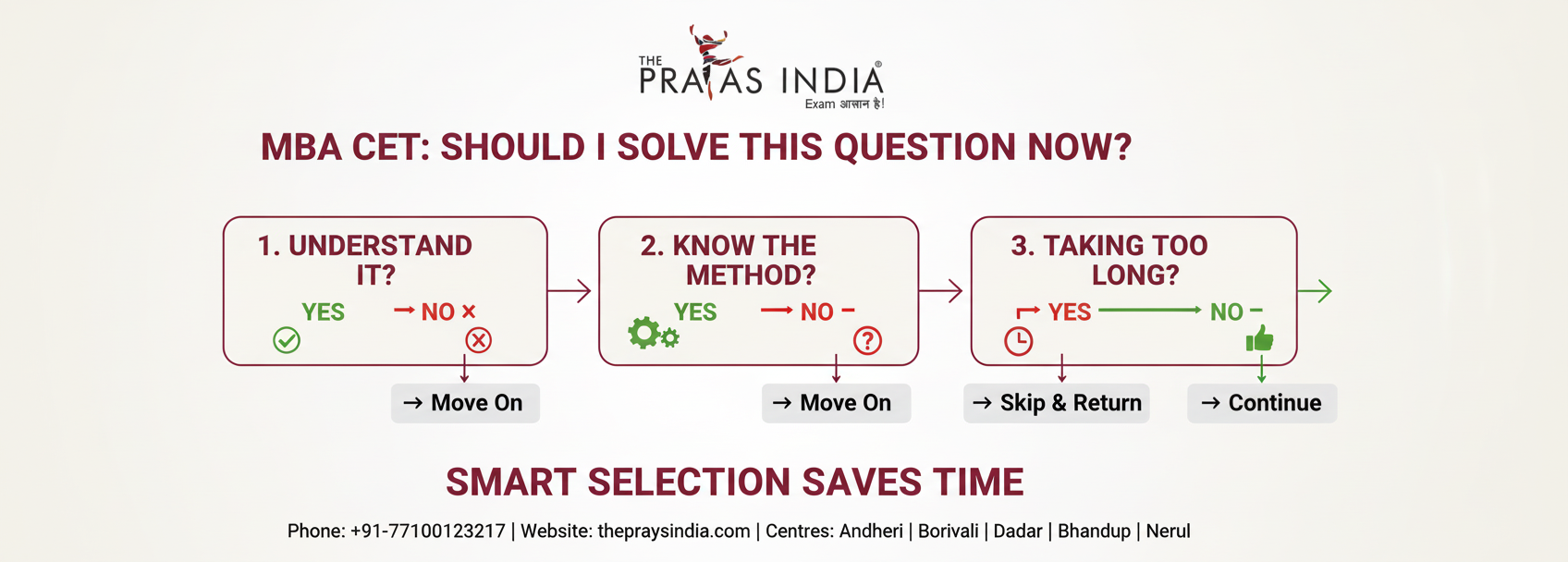
Ask yourself three questions while practising:
1. Do I understand what the question is asking?
If the question itself is unclear, avoid spending too much time trying to force a solution.
2. Do I know the appropriate method?
If you cannot identify the approach after a reasonable amount of thought, move on and return later if time permits.
3. Is the calculation becoming disproportionately long?
If a supposedly manageable question is consuming too much time, reassess whether it is worth continuing immediately.
Learning when to move on is an important part of exam speed.
Develop a Section-Wise Time Management Habit
Speed and accuracy become easier to manage when you have a clear approach to the different sections of the exam.
Instead of entering the exam with a rigid mindset that every question must be solved, develop a section-wise strategy based on your strengths and weaknesses.
A candidate who is strong in a particular section may naturally solve those questions faster. Another candidate may need more time for that section. Therefore, your strategy should be developed from mock-test data rather than copied blindly from someone else’s preparation.
During practice, observe:
- Which section gives you the highest accuracy?
- Which section consumes the most time?
- Where do you make the most silly mistakes?
- Which question types repeatedly slow you down?
- Where are you losing time without improving your score?
Once you have these answers, you can adjust your practice accordingly.
The purpose of time management is not to divide your preparation into fixed numbers of minutes simply because someone else follows that plan. It is to understand how you personally use time and gradually make that usage more efficient.
Practise With Micro-Timers
Full-length mock tests are essential, but they should not be your only timed practice.
Micro-timed practice can be extremely useful when you are specifically working on speed.
For example, take a small set of questions and give yourself a controlled time limit. After completing it, analyse not only the score but also the questions where you exceeded the expected solving time.
This allows you to isolate the problem.
If you repeatedly take too long on percentages, practise percentages separately. If arrangement-based reasoning questions consume excessive time, create focused sets for those question types.
This is much more effective than simply taking another mock test and hoping that speed will automatically improve.
The 30–60–90 Method for Practice
You can structure selected practice sessions around increasing time pressure.
- 30-second zone: Identify and solve questions that are straightforward and familiar.
- 60-second zone: Practise moderate questions requiring a few logical or calculation steps.
- 90-second zone: Practise questions that require more analysis while learning when to stop.
The exact time limits do not need to become rigid exam rules. They are training tools designed to improve your awareness of time.
Learn to Control the Urge to Attempt Everything Immediately
A common reason for poor speed management is the belief that every question must be attempted as soon as it appears.
This can create a chain reaction. A candidate encounters a difficult question, spends too much time on it, becomes aware of the clock, starts rushing, and then makes avoidable mistakes on questions that would otherwise have been easy.
A better approach is to stay flexible.
If a question is taking longer than expected, moving ahead is not a failure. It is a time-management decision.
Your objective should be to maximise the value of the available exam time, not to prove that you can solve every question in sequence.
Accuracy: Reduce the Mistakes You Can Control
Not every incorrect answer indicates a conceptual weakness.
Some mistakes happen because the candidate reads “not” as “is”, misses a condition, calculates incorrectly, marks the wrong option, or changes a correct answer without sufficient reason.
These are controllable errors.
Maintain a separate mistake log during your preparation. Whenever you make an error, identify the reason rather than simply writing down the correct answer.
For example:
| Mistake Type | What to Do |
|---|---|
| Conceptual Error | Revise the concept |
| Calculation Error | Practise calculations |
| Misread Question | Improve reading discipline |
| Wrong Question Selection | Review decision-making |
| Time Pressure Error | Practise timed sets |
| Guess-Based Error | Improve elimination and restraint |
After several mocks, your mistake log can become one of the most useful preparation resources because it shows where marks are being lost repeatedly.
Analyse Time Per Question, Not Just Your Overall Score
A mock-test score tells you what happened. Detailed analysis helps you understand why it happened.
After each mock, identify questions that consumed significantly more time than expected.
You may discover that a particular question type repeatedly takes you several minutes even when you eventually solve it correctly. This is important because a correct answer is not always an efficient answer.
Suppose you spend three minutes solving a question correctly while another similar question could have been solved in under a minute. In an exam with heavy time pressure, this difference matters.
During analysis, classify questions into four groups:
- Fast + Correct: Your ideal question type.
- Slow + Correct: Improve method or calculation speed.
- Fast + Wrong: Improve accuracy and reading discipline.
- Slow + Wrong: Reconsider whether and when you should attempt such questions.
This four-category analysis can reveal much more than simply looking at your final score.
Do Not Confuse Speed With Rushing
There is an important difference between solving quickly and rushing.
Speed means you know what to do and execute the process efficiently.
Rushing means you are trying to finish quickly without giving sufficient attention to the question.
Speed generally comes from preparation.
Rushing generally comes from poor time awareness or pressure.
For example, an aspirant who has practised hundreds of similar questions may solve a familiar problem quickly because the method is already established. Another aspirant may read the same question rapidly but misunderstand a condition and choose the wrong answer.
Therefore, whenever you try to improve speed, ask:
“Can I make my process more efficient?”
instead of:
“Can I solve this faster by rushing?”
That small change in mindset can significantly improve the quality of timed practice.
Build a Personal Speed–Accuracy Tracker
A simple spreadsheet or notebook can help you monitor progress over time.
After every mock or major timed test, record:
- Total attempts
- Correct attempts
- Incorrect attempts
- Accuracy percentage
- Total time
- Average time per attempt
- Questions skipped
- Questions taking excessive time
- Major mistake categories
Do not judge your preparation from a single mock. Look for trends across several tests.
For example, if your accuracy remains stable while your solving time gradually decreases, that is useful progress. If your speed improves but accuracy consistently falls, your practice strategy needs adjustment.
How Mock Tests Can Improve MBA CET Speed and Accuracy
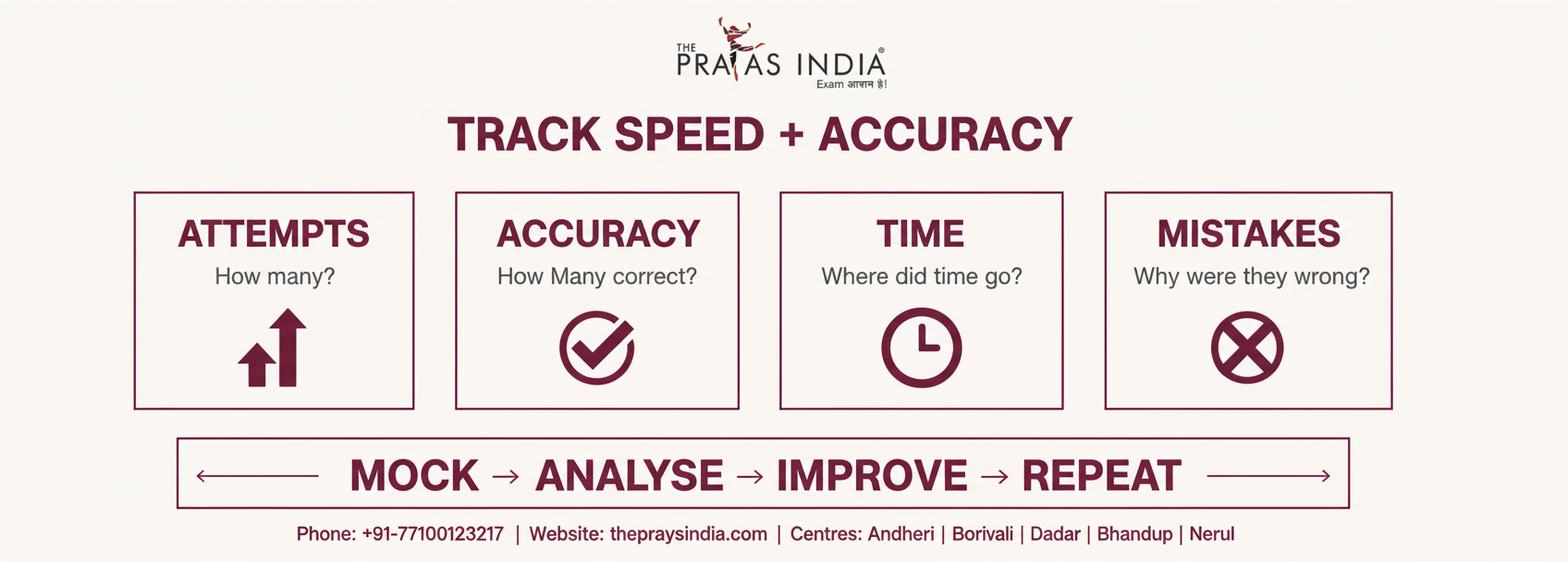
Mock tests should not be treated simply as score-generating exercises. Their real value comes from the analysis that follows.
Take the mock under realistic conditions. Avoid unnecessary pauses, distractions, or checking solutions while the test is underway.
Once the mock is finished, analyse it carefully.
Start with the questions you got wrong. Then look at questions that took too long. Finally, review questions you skipped and determine whether they were genuinely difficult or whether you lacked familiarity with the question type.
A good mock-analysis session can sometimes teach you more about your exam strategy than immediately taking another mock.
Use the “Why Did I Lose Time?” Question
For every question that consumed excessive time, ask why.
Was the concept unclear?
Did you spend too long calculating?
Did you fail to recognise the question type?
Did you refuse to leave a difficult question?
Did you misread the information?
Did you return to the same question multiple times?
This process converts vague frustration into specific improvement areas.
How to Improve Speed Without Reducing Accuracy
The safest way to improve speed is to make small changes instead of trying to dramatically increase your solving rate overnight.
Start by improving the easiest areas.
If your calculations are slow, practise calculations.
If reading is slow, work on comprehension and question interpretation.
If you spend too much time deciding which question to attempt, practise question-selection drills.
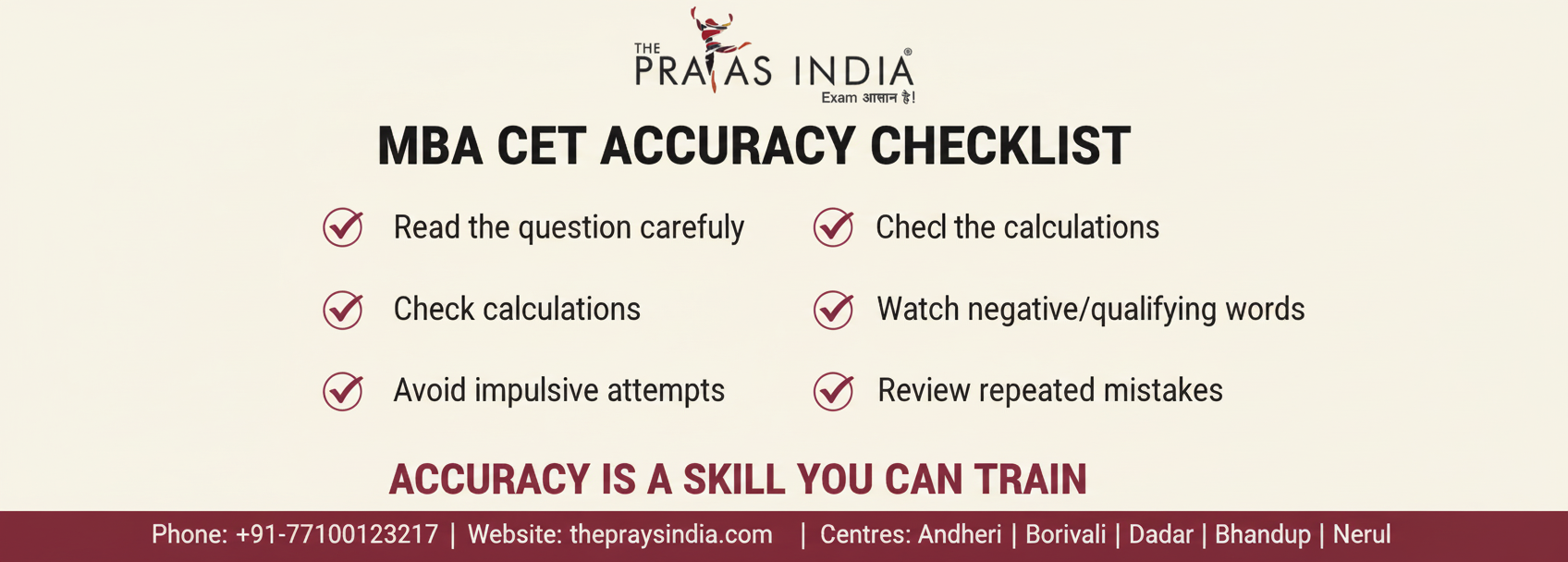
If you make frequent silly mistakes, create an accuracy checklist.
Once these improvements become consistent, speed generally starts improving naturally.
A practical progression
Week 1–2: Focus on accuracy and correct methods.
Week 3–4: Introduce timed topic-wise sets.
Next Stage: Add mixed timed sets.
After That: Take full-length mocks regularly.
Throughout Preparation: Maintain mistake and time-analysis records.
The exact timeline can be adjusted according to your preparation level. The important principle is to increase time pressure gradually.
Common Mistakes That Hurt Speed and Accuracy in MBA CET
Many candidates unknowingly create speed problems through their preparation habits.
Trying to Solve Every Question
Attempting everything sequentially can result in excessive time spent on difficult questions.
Taking Too Many Untimed Tests
Untimed practice is useful for learning concepts, but eventually you must introduce time pressure.
Ignoring Calculation Practice
Knowing the concept is not enough if basic calculations repeatedly consume excessive time.
Changing Answers Without a Reason
Second-guessing can introduce errors. Change an answer when you identify a specific reason, not simply because you become nervous.
Comparing Your Speed With Other Students
Someone else’s solving speed does not automatically represent the right target for you. Your strategy should be based on your own accuracy, strengths, weaknesses, and mock-test performance.
Focusing Only on Attempts
A high number of attempts without sufficient accuracy does not necessarily indicate efficient preparation. Track both attempts and correctness.
How The Prayas India Can Help With MBA CET Preparation
Managing speed and accuracy becomes easier when preparation includes structured practice, regular testing, analysis, and guidance.
At The Prayas India, MBA CET aspirants can work on the different components of exam preparation through systematic learning and practice. Instead of focusing only on completing the syllabus, candidates can develop the practical skills required for a competitive entrance examination—such as question selection, time management, accuracy, mock-test analysis, and revision.
The advantage of structured preparation is that you have a defined process for identifying weaknesses and working on them instead of repeatedly making the same mistakes.
For students targeting MBA CET 2027, starting preparation early can also provide enough time to move through the stages of concept building, practice, timed tests, mock tests, analysis, and final revision without unnecessary last-minute pressure.
The Prayas India has centres across Andheri, Borivali, Dadar, Bhandup and Nerul, making structured MBA entrance preparation accessible to students across Mumbai.
A Simple Daily Routine for Speed and Accuracy
A balanced daily practice routine can include different types of work rather than solving hundreds of questions without analysis.
Concept Revision
Spend time strengthening concepts that are still unclear.
Calculation Practice
Practise basic arithmetic and common calculation patterns regularly.
Timed Question Set
Take a small set of questions under a controlled time limit.
Mistake Analysis
Review incorrect answers and identify the actual reason behind each mistake.
Question Selection Practice
Practise deciding which questions to solve immediately and which to leave for later.
Weekly Mock
Take a full-length mock under realistic conditions and analyse it thoroughly.
This type of routine helps develop both knowledge and execution.
The Final Goal: Efficient Attempts, Not Maximum Attempts
MBA CET preparation should ultimately move towards efficient decision-making.
You want to reach a stage where you can look at a question and quickly estimate whether it deserves your attention. You should be able to solve familiar questions efficiently while maintaining sufficient concentration to avoid avoidable mistakes.
The ideal approach is not:
“Attempt everything as fast as possible.”
It is:
“Identify → Decide → Solve → Move.”
If the question is suitable, solve it confidently.
If it is consuming too much time, move ahead.
If you make an error, understand why it happened.
If a particular question type repeatedly slows you down, practise it separately.
This creates a preparation cycle where every mock and practice session contributes to improvement.
Speed and Accuracy in MBA CET: Final Strategy
Managing speed and accuracy is not something that can be fixed through one shortcut or one last-minute technique. It develops through repeated practice, analysis, and controlled exposure to time pressure.
Focus on understanding concepts first. Then introduce timed practice. Improve calculation speed without sacrificing precision. Develop question-selection skills. Maintain a mistake log. Analyse time spent on individual questions. Finally, use regular mock tests to bring all these skills together.
Most importantly, do not treat speed and accuracy as two separate goals. They should develop together.
The objective is not simply to solve more questions. The objective is to make better decisions with the time available.
For MBA CET aspirants looking for structured preparation, expert guidance and regular practice, The Prayas India provides MBA entrance coaching support across its Mumbai centres.
Centres: Andheri | Borivali | Dadar | Bhandup | Nerul
Frequently Asked Questions
1. How can I improve my speed in MBA CET?
Improve speed through regular timed practice, calculation drills, question-type recognition and better question selection. Start with accuracy and gradually increase time pressure.
2. How do I improve accuracy while solving MBA CET questions quickly?
Avoid rushing. Read questions carefully, practise common question types, maintain a mistake log, and analyse the reasons behind incorrect answers after every mock.
3. Should I attempt every question in MBA CET?
Your preparation should focus on efficient question selection rather than blindly attempting every question. Practise identifying questions that can be solved efficiently and move away from questions that consume disproportionate time.
4. How many mock tests should I take for MBA CET?
The number should depend on your preparation stage and available time. More important than the raw number of mocks is taking them seriously and analysing your mistakes, time usage and question-selection decisions afterward.
5. Why am I slow even when I know the concepts?
You may need more practice with question recognition, calculations, application of concepts or timed solving. Mock analysis can help identify the specific reason.
6. How can I reduce silly mistakes in MBA CET?
Maintain an error log and classify mistakes into categories such as misreading, calculation errors, conceptual gaps and rushed decisions. Then practise specifically on the recurring categories.
7. When should I start timed practice for MBA CET?
Once your basic concepts are reasonably clear, introduce timed practice gradually. You do not need to wait until the entire syllabus is completed.
8. Is speed more important than accuracy in MBA CET?
Both matter. Excessive focus on speed can lead to avoidable errors, while excessive time spent on individual questions can reduce overall efficiency. The goal is controlled speed with reliable accuracy.
⚡ Master MBA CET Speed & Accuracy with The Prayas India!
Knowing the concepts is only 30% of the battle. The remaining 70% of MBA CET is about solving 200 questions in 150 minutes with absolute precision. At The Prayas India, we train your mind to think and execute at lightning-fast speeds!
How We Build Your 99.99+ Percentile Strategy:
- 🕒 Vedic Math & Visual Reasoning Shortcuts: Crack high-scoring Abstract and Logical Reasoning puzzles in under 45 seconds.
- 📊 Simulated CET Timer Mock Series: Train your nervous system in our real-time computer-based testing labs to eliminate exam anxiety.
- 🎯 1-on-1 Personalized Error Analysis: Our expert mentors break down your mock test patterns to identify exactly where you are losing accuracy.
Admissions Open for Premium CET 2027 Batches
📞 Call Us: +91-77100 13217
🌐 Official Website: theprayasindia.com