MBA CET 2027: 5 Mistakes That Can Cost You Your Dream College
MBA CET 2027 5 Mistakes to Avoid: Preparing for MAH MBA/MMS CET 2027 is not only about completing the syllabus. The way you practise, manage time, analyse mock tests, select questions and set your target can significantly influence your preparation journey. Many MBA CET aspirants spend months studying but still struggle to convert their preparation into a strong percentile because they make avoidable mistakes along the way.
For students targeting reputed Maharashtra MBA colleges, including JBIMS, the preparation needs to go beyond basic syllabus completion. MBA CET is a speed-intensive examination, and candidates need to become comfortable solving questions accurately within a highly competitive testing environment. This makes preparation strategy just as important as the concepts themselves.
A common problem among aspirants is that they focus heavily on what they need to study but pay less attention to how they should prepare. They may postpone mock tests, practise questions randomly, underestimate Logical Reasoning, or start serious speed practice too late. These mistakes can gradually affect performance even when the candidate has studied the relevant topics.
If you are preparing for MBA CET 2027 and aiming for a very high percentile, understanding these mistakes early can help you build a more structured preparation plan.
Why Avoiding Mistakes Matters in MBA CET 2027
MAH MBA/MMS CET requires candidates to balance multiple skills at the same time. You need conceptual understanding, quick calculation ability, logical thinking, reading comprehension, question-selection skills and time management.
Unlike an examination where candidates can comfortably spend several minutes on individual questions, MBA CET preparation requires you to develop the ability to identify the right approach quickly. That means your preparation cannot remain limited to reading concepts or solving a few questions from each chapter.
A strong preparation strategy should gradually move through three stages: understanding, practice and performance optimisation. In the beginning, the focus should be on building fundamentals. As preparation progresses, practice should become more structured, and eventually the focus should shift towards speed, accuracy, mock-test performance and strategic question selection.
This is where avoiding common preparation mistakes becomes important.
5 Common MBA CET 2027 Preparation Mistakes to Avoid
Mistake 1: Focusing Only on Syllabus Completion and Ignoring Speed
One of the biggest mistakes MBA CET aspirants can make is treating syllabus completion as the final objective.
Completing the syllabus is certainly important. You need to understand the concepts and become familiar with the different question types. However, simply reaching the end of the syllabus does not automatically mean that you are ready for the actual examination.
MBA CET demands quick decision-making and efficient question solving. Once you have developed sufficient conceptual familiarity, your preparation needs to increasingly focus on how quickly and accurately you can apply those concepts.
For example, a candidate may know how to solve a particular Quantitative Aptitude question but spend too much time identifying the method or performing calculations. Similarly, a student may understand a Logical Reasoning concept but take too long to analyse the arrangement.
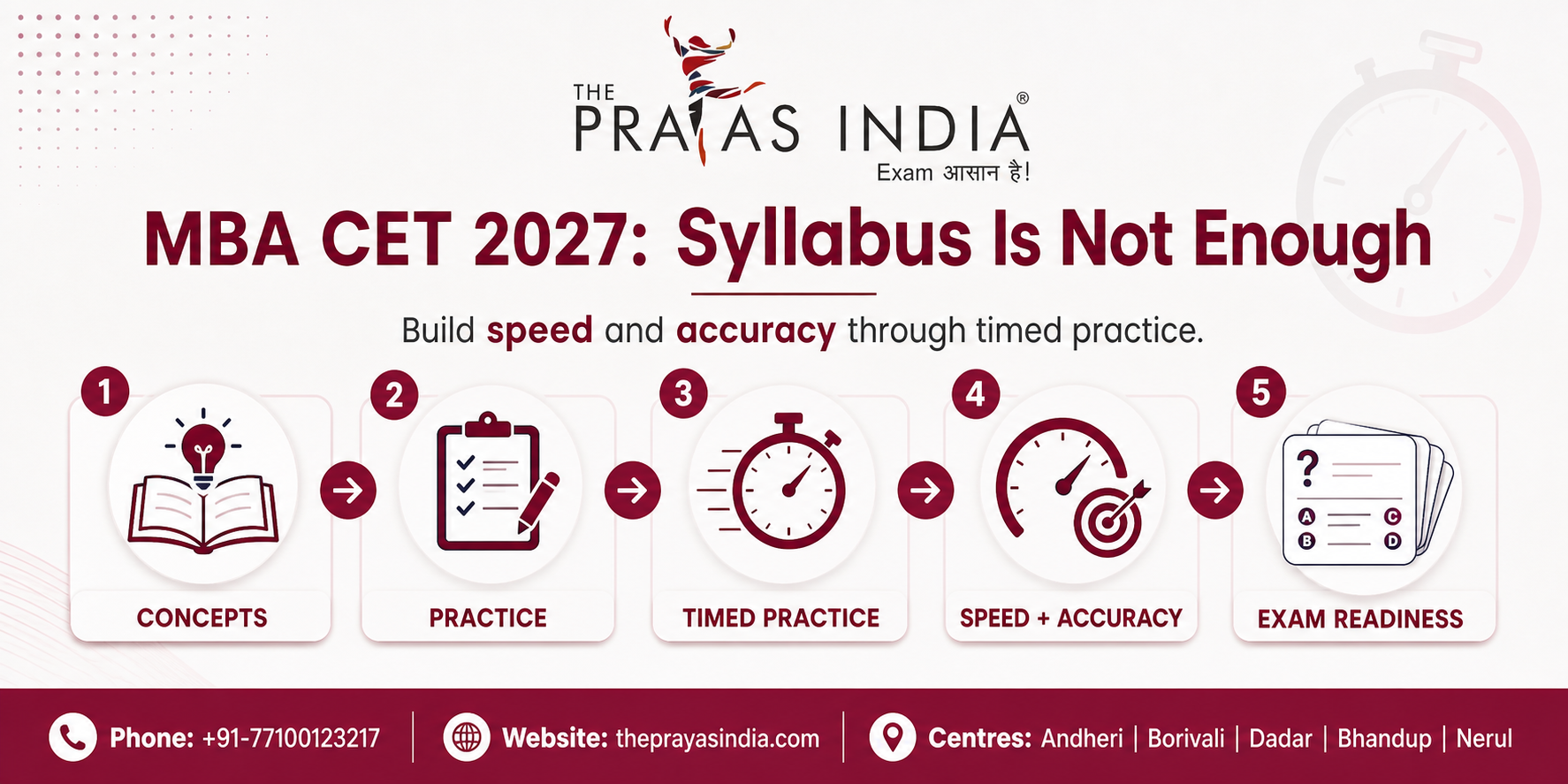
The solution is to introduce speed practice gradually rather than waiting until the final few weeks.
How to Improve Your Speed
Start by measuring the time you take to solve different question types. You do not need to rush through every question from the beginning. Instead, first develop accuracy and then gradually reduce the time required.
You can use timed practice sessions for:
- Quantitative Aptitude calculations
- Logical Reasoning sets
- Abstract Reasoning questions
- Verbal Ability questions
- Reading Comprehension
- Mixed-section question sets
The objective should not be blind speed. Speed without accuracy can increase mistakes. Your real target should be efficient solving, where you quickly recognise familiar patterns, eliminate unsuitable options and move away from questions that are consuming excessive time.
A useful preparation cycle is:
Learn → Practise → Time Yourself → Analyse → Improve
Repeat this cycle consistently instead of waiting for the complete syllabus to finish.
Mistake 2: Starting the Test Series Too Late
Another common mistake is postponing mock tests until the syllabus is completely finished.
Many students think that they should first complete every topic and only then begin taking full-length tests. While topic-wise learning is important, delaying tests for too long can create another problem: you may know the concepts but remain unfamiliar with the pressure and decision-making required during an actual examination.
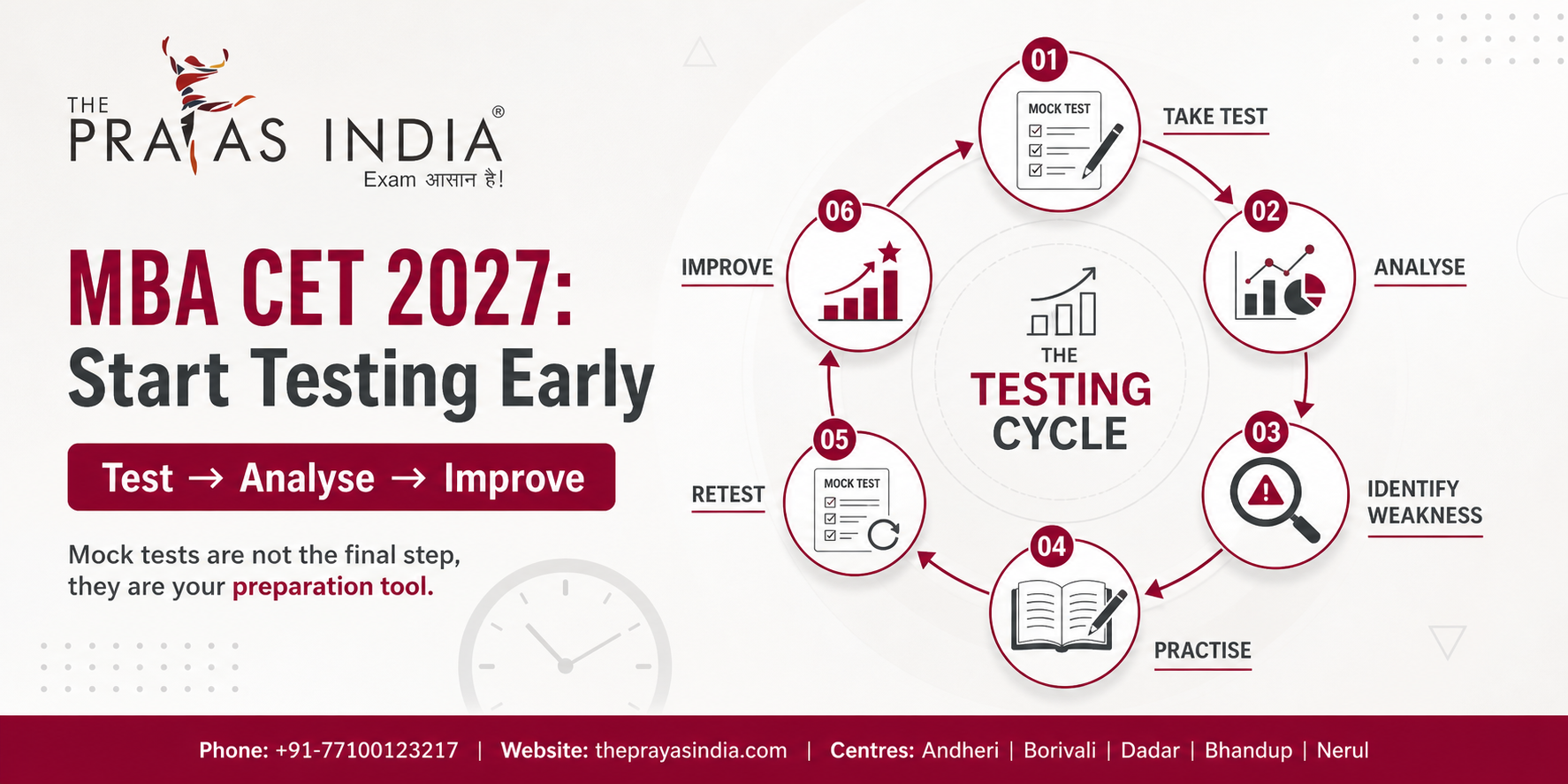
Mock tests are not only tools for measuring preparation. They are also practice environments where you learn how to manage time, select questions, handle difficult sections and maintain concentration.
Starting a test series earlier gives you more time to identify weaknesses.
For example, your first few mocks may reveal that you are spending too much time on certain Logical Reasoning sets. Another test may show that your Quantitative Aptitude accuracy decreases when you attempt questions too quickly. These observations can then be converted into specific improvement targets.
What Should You Do After Every Mock?
Taking a mock test is only one part of the process. The real learning often happens during analysis.
After every test, examine:
- Questions you got wrong
- Questions you guessed
- Questions you left despite knowing the concept
- Questions that consumed excessive time
- Topics where accuracy was consistently low
- Sections where your time management was inefficient
- Questions that you could have solved faster
Maintain a mock-test analysis record so that recurring patterns become visible.
If you repeatedly make the same type of mistake, simply taking more tests will not automatically solve the problem. You need to identify why the mistake is happening and modify your practice accordingly.
Place the MBA CET 2027 video “5 Mistakes That Can Cost You Your Dream College” at this point, immediately after the discussion on mock-test strategy. The video can serve as an additional engagement point for students before they continue with the remaining preparation mistakes.
Mistake 3: Ignoring Logical Reasoning
Logical Reasoning deserves serious attention in MBA CET preparation because of the substantial number of questions associated with the section.
Students sometimes spend disproportionate time on Quantitative Aptitude and Verbal Ability while treating Logical Reasoning as something they can prepare later. This can create a major gap in preparation.
Logical Reasoning is not a section that should be approached only through last-minute practice. Students need to become familiar with different question structures and develop the ability to identify relationships, patterns and logical conditions quickly.
Depending on the question type, solving may require:
- Understanding given conditions
- Identifying relationships
- Building arrangements
- Analysing statements
- Recognising patterns
- Eliminating options
- Applying logical deductions
- Managing lengthy question sets
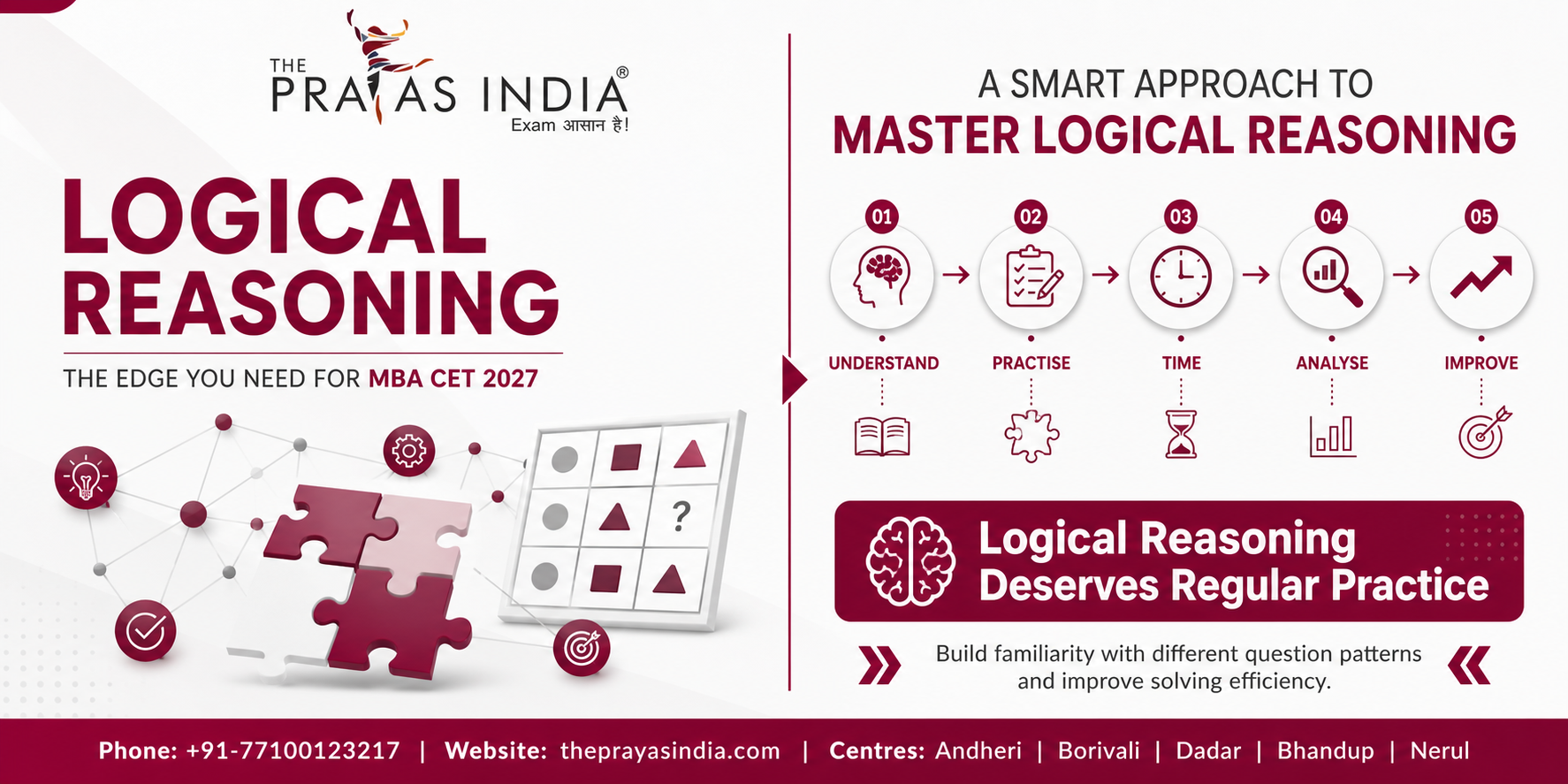
The important point is that Logical Reasoning preparation should become a regular part of your weekly schedule.
How to Prepare Logical Reasoning Effectively
Instead of solving random LR questions whenever you have free time, divide your preparation into identifiable question types and practise them systematically.
Start with concept familiarity, move to untimed practice and then introduce timed sets. Once you become comfortable, combine different types of questions so that your brain learns to identify the appropriate approach without being told which concept is being tested.
You should also track the difference between questions you can solve and questions you can solve quickly.
That distinction matters greatly in a speed-oriented examination.
Mistake 4: Solving Random Questions Without a Structured Practice Plan
Solving a large number of questions does not necessarily mean that you are preparing effectively.
A common preparation pattern is to open a question bank, solve whatever appears on the screen and move from one question to another without recording the topic, difficulty level or mistakes. This can create the feeling of being productive while leaving important weaknesses unidentified.
Structured practice is more useful because it tells you exactly what you are working on and why.
For example, instead of randomly solving 50 questions, you could divide them into:
Quantitative Aptitude
- 15 arithmetic questions
- 10 algebra questions
- 10 number-based questions
- 15 mixed questions
Logical Reasoning
- 10 arrangement questions
- 10 selection questions
- 10 blood relation/direction-based questions
- 10 statement-based questions
- 10 mixed questions
The exact distribution can change according to your strengths and weaknesses. The important part is having a reason behind the practice.
Maintain a Mistake Log
A mistake notebook or digital error log can become one of the most useful resources during preparation.
Whenever you make an error, record:
- The topic
- The question type
- What went wrong
- Whether it was a conceptual mistake
- Whether it was a calculation mistake
- Whether you misunderstood the question
- Whether you spent too much time
- The correct approach
After several weeks, this record can reveal patterns that are difficult to notice during normal practice.
If most of your errors are calculation-based, you need calculation practice. If you repeatedly misread conditions in LR questions, you need to improve question interpretation. If you know the concept but cannot solve within the desired time, you need timed practice.
This makes preparation more targeted.
Mistake 5: Setting a Target Percentile That Is Too Low
Your preparation strategy should be connected to the level of college you want to target.
Students sometimes prepare with a general objective such as “I just want to clear the exam” or “I want a good percentile.” While having a broad objective is better than having no objective, a highly competitive college requires a much more ambitious preparation benchmark.
For aspirants targeting JBIMS, a commonly discussed preparation target is 99.9+ percentile. This should be treated as a preparation benchmark rather than a guarantee of admission, because actual admission outcomes depend on the applicable admission process, category, eligibility, seat availability and other factors.
The practical lesson is that your target should influence the quality of your preparation.
If you set a high target, you are more likely to pay attention to:
- Mock-test performance
- Accuracy
- Speed
- Question selection
- Section-wise weaknesses
- Revision
- Consistency
- Time management
Instead of preparing merely to cross an arbitrary minimum score, build your strategy around the level of performance required for your desired colleges.

How to Build a Smarter MBA CET 2027 Preparation Strategy
Avoiding these five mistakes is only the first step. The next step is to convert the lessons into a daily and weekly preparation system.
A good MBA CET preparation plan should balance concept learning, question practice, speed development, revision and testing.
1. Build Your Foundation First
Start by understanding the examination structure and the major areas you need to prepare. Identify your strong and weak areas through initial practice rather than making assumptions about them.
Students often believe they are good at a section because they understand its concepts. A timed test can reveal a different picture.
Therefore, assess yourself based on actual performance.
2. Make Speed Practice a Regular Habit
Do not reserve speed practice for the final stage.
Begin with comfortable time limits and gradually make them more demanding. Your objective is to develop familiarity with common question patterns so that you spend less time deciding how to begin solving.
With consistent practice, many questions become easier to recognise and approach.
3. Start Mocks Early and Increase Their Importance Gradually
You do not have to begin with an intense full-length mock schedule on day one. But you should introduce testing early enough to learn from your performance.
Initially, you can use sectional and topic-wise tests. As your preparation progresses, increase the role of full-length mocks.
The closer you get to the examination, the more important it becomes to simulate actual test conditions.
4. Analyse More Than Your Score
A mock score tells you what happened. Analysis helps explain why it happened.
Suppose your score decreases in one test. Instead of simply taking another mock, identify the reason.
Was it:
- Poor time allocation?
- Too many difficult questions?
- Low accuracy?
- Slow calculations?
- Weak LR sets?
- Excessive time spent on one question?
- Lack of revision?
Once you identify the reason, the next practice session can address it directly.
5. Develop Question Selection Skills
MBA CET preparation is not only about solving questions. It is also about deciding which questions deserve your time.
A question may be solvable but still not be the right question to attempt immediately if it is consuming disproportionate time.
During mock analysis, identify questions that:
- You solved quickly
- You solved correctly but slowly
- You should have skipped
- You skipped unnecessarily
- You attempted despite low confidence
Over time, this can help develop a more effective question-selection strategy.
A Practical Daily Routine for MBA CET 2027 Aspirants
A preparation routine should be realistic enough to follow consistently.
For a student preparing alongside college or work, a balanced day could include:
Session 1: Concept Building
Spend the first study block learning or revising one specific concept. Avoid jumping between too many topics in one session.
Session 2: Structured Practice
Solve questions related specifically to the concept you studied. Focus on understanding the method and identifying common patterns.
Session 3: Timed Practice
Take a short timed set. This is where you start converting conceptual understanding into exam-oriented performance.
Session 4: Logical Reasoning
Keep Logical Reasoning in your regular routine instead of postponing it.
Session 5: Revision and Error Analysis
Review mistakes from previous practice sessions and update your mistake log.
Session 6: Test or Sectional Practice
Depending on your preparation stage, take a sectional test or mock and analyse the results afterwards.
The number of hours will vary from student to student. Consistency matters more than creating an unrealistic timetable that cannot be maintained.
MBA CET 2027: What Your Preparation Should Look Like Over Time
Early Preparation Phase
The initial stage should focus on fundamentals, familiarisation with question types and identifying strengths and weaknesses.
Do not become obsessed with speed before understanding the concepts.
Development Phase
Once your fundamentals are reasonably strong, increase question practice and introduce regular timed sessions.
This is also the stage where you should become more serious about sectional tests and mock-test analysis.
Performance Phase
As the examination approaches, preparation should increasingly resemble the actual testing environment.
Your focus should move towards:
- Full-length mocks
- Speed
- Accuracy
- Question selection
- Revision
- Error reduction
- Consistent performance
At this stage, repeatedly learning completely new concepts without analysing existing weaknesses can become inefficient.
Common Signs That Your MBA CET Preparation Needs Improvement
Sometimes students do not realise they are making preparation mistakes until very late. Watch for these warning signs:
You Know the Concepts but Cannot Finish on Time
This usually indicates that conceptual preparation needs to be supplemented with timed practice.
Your Mock Scores Fluctuate Heavily
Large variations may indicate inconsistent accuracy, question selection or section management.
You Take Mocks but Do Not Analyse Them
A mock without analysis provides limited learning value.
You Avoid Logical Reasoning
If LR repeatedly gets pushed to “later,” it may eventually become one of your biggest preparation gaps.
You Solve Hundreds of Questions but Repeat the Same Mistakes
This is a sign that quantity of practice needs to be replaced with more targeted analysis.
You Have No Clear Target
Without a performance benchmark, it becomes difficult to evaluate whether your preparation is progressing at the required level.
How Coaching Can Help With MBA CET Preparation
Self-study can be effective when a student has a clear strategy, reliable resources and the discipline to follow a structured schedule. However, many aspirants struggle with consistency, test analysis and knowing what to prioritise.
A structured MBA CET coaching programme can provide a framework covering concept building, practice, testing and performance analysis.
For students looking for MBA CET coaching in Mumbai, The Prayas India provides preparation support through online and offline classes, allowing students to choose a learning format that fits their schedule.
The preparation approach can include:
- Concept-oriented classes
- Regular practice
- Logical Reasoning preparation
- Quantitative Aptitude practice
- Verbal Ability and Reading Comprehension
- Mock tests and test analysis
- Revision support
- Performance tracking
- Online and offline learning options
Students can explore the format that suits their preparation style and schedule rather than relying on a one-size-fits-all approach.
Preparing for JBIMS Through MBA CET 2027
JBIMS is one of the major names that attracts MBA/MMS aspirants through the Maharashtra admission ecosystem. Consequently, students targeting the institute should approach MBA CET preparation with a high-performance mindset.
The important point is not simply to say that you want JBIMS. Your preparation should reflect the competitiveness of the target.
That means setting an ambitious percentile benchmark, developing strong speed and accuracy, taking regular mocks and continuously improving your question-selection strategy.
A target such as 99.9+ percentile can be used as a preparation benchmark for aspirants targeting highly competitive options, but it should not be interpreted as a guaranteed admission threshold. Candidates should always check the applicable admission rules and current official information for the relevant admission year.
30-Day Improvement Framework for MBA CET Aspirants
If you feel that your preparation has become unstructured, use the next 30 days to rebuild your process.
Days 1–7: Identify Your Weaknesses
Take sectional tests and analyse your performance. Identify the topics where you lose marks or time.
Days 8–15: Target Weak Areas
Focus on specific concepts and question types instead of solving random mixed questions throughout the day.
Days 16–22: Increase Timed Practice
Introduce more timed sets and work on reducing unnecessary solving time without compromising accuracy.
Days 23–27: Increase Mock Exposure
Take full-length tests and analyse each one carefully.
Days 28–30: Review and Refine
Look at your mistake log, recurring errors, time-management problems and question-selection patterns. Build your next preparation cycle around these findings.
The purpose of this framework is not to create a rigid 30-day crash course. It is a way to demonstrate how preparation can become progressively more structured.
Final Checklist: Are You Preparing for MBA CET 2027 the Right Way?
Before moving into the intensive phase of your preparation, ask yourself:
- Have I completed the important concepts?
- Am I practising under time limits?
- Have I started tests early enough?
- Do I analyse every mock?
- Am I giving Logical Reasoning sufficient attention?
- Is my question practice organised?
- Do I maintain an error log?
- Do I know my recurring mistakes?
- Am I working on speed as well as accuracy?
- Do I have a clear percentile target?
- Am I regularly revising?
- Can I identify which questions to attempt and which to leave?
If several answers are “no,” there is still time to improve your preparation process. The earlier you identify the problem, the more opportunities you have to correct it.
Final Thoughts
Success in MBA CET 2027 preparation is not determined only by how many chapters you complete or how many questions you solve. The quality of your preparation process matters.
Completing the syllabus without developing speed, taking mocks without analysing them, ignoring Logical Reasoning, solving unstructured question sets and setting an insufficiently ambitious target can all limit the effectiveness of your preparation.
Instead, build your preparation around a simple principle:
Learn the concepts. Practise systematically. Build speed. Test yourself early. Analyse mistakes. Improve continuously.
For students targeting competitive MBA/MMS colleges, this approach can make preparation more organised and measurable. If your target includes institutes such as JBIMS, start thinking about preparation in terms of the performance level you need to achieve rather than simply completing the examination syllabus.
With a structured plan, consistent practice and regular performance analysis, MBA CET 2027 preparation can become much more focused and purposeful.
Frequently Asked Questions
1. What are the biggest mistakes to avoid while preparing for MBA CET 2027?
Common mistakes include focusing only on syllabus completion, delaying mock tests, ignoring Logical Reasoning, solving questions without a structured practice plan and setting a target that does not match your desired college goals.
2. Is speed important for MBA CET 2027?
Yes. MBA CET preparation requires candidates to become comfortable solving questions efficiently under time pressure. However, speed should be developed alongside accuracy rather than at the cost of accuracy.
3. When should I start taking MBA CET mock tests?
It is better not to wait until the entire syllabus is completed. Early sectional and topic-wise testing can help identify weaknesses, while full-length mocks can be introduced and increased as preparation progresses.
4. Why is Logical Reasoning important for MBA CET?
Logical Reasoning represents a significant part of MBA CET preparation. Regular practice can help candidates become more familiar with different question structures and improve their ability to solve logical problems efficiently.
5. Should I solve as many MBA CET questions as possible?
Quantity alone is not enough. Structured practice, question analysis and learning from mistakes are more useful than solving large numbers of random questions without reviewing performance.
6. What percentile should I target for JBIMS through MBA CET?
A 99.9+ percentile can be used as an ambitious preparation benchmark by students targeting highly competitive colleges such as JBIMS. It should not be treated as a guaranteed admission cutoff, since admission depends on the applicable admission process and candidate-specific factors.
7. How can I improve my MBA CET speed?
Use timed practice sets, identify slow question types, practise calculations and common patterns, and analyse questions where you spend more time than necessary.
8. How should I analyse MBA CET mock tests?
Review incorrect answers, unanswered questions, slow questions, guessed answers and section-wise performance. Maintain an error log so recurring weaknesses can be addressed systematically.
9. Can I prepare for MBA CET 2027 while studying in college?
Yes. The key is to create a realistic routine with consistent study sessions, structured practice, regular testing and revision rather than relying on long but irregular study sessions.
10. Does The Prayas India provide MBA CET coaching?
The Prayas India provides MBA entrance preparation through online and offline learning options. Students can explore MBA CET preparation support based on their preferred learning format and schedule.