
MBA CET 2027: 90-Day Preparation Strategy | The Prayas India
Preparing for MBA CET 2027 in 90 days requires a very different approach from a long-term preparation plan. With limited time, the focus cannot be on studying everything available. The priority has to be understanding the exam, identifying high-value topics, building speed, improving accuracy, practising the right questions and taking enough mocks to become comfortable with the actual test environment.
MBA CET is particularly demanding because candidates have to solve a large number of questions within a limited time. This means that conceptual knowledge alone is not enough. A student also needs to develop quick decision-making, question selection, calculation speed, pattern recognition and time management.
For an aspirant targeting MBA CET 2027, a 90-day preparation plan can provide a clear framework for converting available study time into measurable improvement.
The most effective approach is not to treat all 90 days identically. Instead, divide the preparation into phases:
Foundation & Diagnosis → Intensive Practice → Mock Tests & Optimisation → Final Revision
This allows students to gradually move from learning concepts to applying them under exam conditions.
For students preparing for MBA CET in Mumbai, a structured learning environment through online or offline MBA CET coaching can also help bring together classes, practice, mock tests, analysis and academic guidance in a systematic manner.
What Makes a 90-Day MBA CET Preparation Plan Different?
A 90-day strategy has one major advantage: it creates urgency.
There is little room for unnecessary experimentation. Students cannot spend several weeks repeatedly changing books, watching multiple explanations of the same topic or postponing mock tests until the final month.
At the same time, 90 days is enough to make substantial progress if preparation is organised properly.
The key is to divide the available time according to the skills MBA CET actually tests.
A useful preparation cycle looks like this:
Learn → Practise → Time Yourself → Analyse → Correct → Repeat
Every phase should gradually increase the amount of timed practice.
During the first few weeks, learning and concept building receive greater attention. As preparation progresses, practice becomes more important. In the final phase, mock tests, revision and question-selection strategy dominate the schedule.
Understand the MBA CET Exam Before Starting the 90-Day Plan
Before beginning preparation, students should understand the examination structure and the demands of each section. Candidates should always verify the latest official notification and information brochure for the applicable year because examination rules and details can change.
MBA CET preparation broadly requires attention to:
- Logical Reasoning
- Abstract Reasoning
- Quantitative Aptitude
- Verbal Ability and Reading Comprehension
The examination rewards candidates who can combine speed and accuracy.
A student may know how to solve a particular question but still lose valuable time by using a lengthy approach. Similarly, attempting too quickly without sufficient accuracy can reduce the benefit of high attempt numbers.
Therefore, your preparation should measure more than marks.
Track:
Attempts + Accuracy + Time + Question Selection + Repeated Errors
These indicators provide a much clearer picture of readiness.
Your 90-Day MBA CET 2027 Roadmap
A practical 90-day preparation plan can be divided into four stages.
| Phase | Days | Primary Focus |
|---|---|---|
| Phase 1 | Day 1–30 | Fundamentals + Diagnosis |
| Phase 2 | Day 31–60 | Intensive Practice + Speed |
| Phase 3 | Day 61–80 | Mocks + Analysis |
| Phase 4 | Day 81–90 | Final Revision + Exam Strategy |
The exact distribution can be adjusted according to the student’s starting level.
A candidate with strong fundamentals may move faster through Phase 1, while a beginner may need additional concept-building time.
Days 1–30: Build the Foundation and Identify Your Baseline
The first 30 days should not be treated as a race to complete every topic.
The purpose of this phase is to establish fundamentals, understand the question patterns and identify where the largest improvement opportunities exist.
Start with a diagnostic test or a suitable mock to understand your current position.
Do not worry if the first score is lower than expected. Its primary purpose is to answer questions such as:
- Which section is currently strongest?
- Which topics create the most difficulty?
- How quickly are questions being solved?
- Where are careless mistakes happening?
- Which question types consume too much time?
- Are you leaving easy questions because of poor selection?
- Is your calculation speed sufficient?
This information should influence the next 30 days.
Logical Reasoning: Build Pattern Recognition
Logical Reasoning is one of the most important areas for MBA CET preparation because many questions require quick interpretation rather than lengthy calculations.
During the first month, focus on understanding common question types and developing a systematic approach.
Depending on the syllabus and latest exam pattern, preparation can include areas such as:
- Arrangements
- Puzzles
- Blood relations
- Direction-based questions
- Coding-decoding
- Series
- Syllogisms
- Statements and conclusions
- Input-output
- Ranking and ordering
- Data-based reasoning
The objective should not be to memorise formulas for every question type. Instead, students should learn to recognise the underlying structure quickly.
After learning a concept, immediately solve several questions of increasing difficulty.
Abstract Reasoning: Train Your Eyes to Recognise Patterns
Abstract Reasoning can become a scoring opportunity when students learn to identify visual patterns quickly.
The challenge is that the question often requires observation rather than lengthy calculation.
During the first 30 days, practise patterns involving:
- Series
- Analogies
- Odd-one-out
- Visual relationships
- Rotations
- Reflections
- Shape movement
- Figure-based sequences
The most important skill here is pattern recognition under time pressure.
Instead of solving only a few questions and moving on, practise sets of similar questions together. This allows your brain to recognise recurring structures more quickly.
Quantitative Aptitude: Strengthen the High-Value Fundamentals
Quant preparation should begin with fundamentals rather than immediately jumping into difficult questions.
Important areas can include:
- Arithmetic
- Percentages
- Profit and loss
- Ratio and proportion
- Averages
- Time, speed and distance
- Time and work
- Simple and compound interest
- Number system
- Algebra
- Geometry
- Mensuration
- Data interpretation
The priority during the first month should be understanding the concepts and developing efficient solving methods.
For every topic, follow:
Concept → Basic Questions → Moderate Questions → Timed Set
This gradually converts knowledge into speed.
A student who knows the formula but takes too long to apply it has not yet completed the learning process. MBA CET requires the ability to reach the correct answer efficiently.
Verbal Ability and Reading Comprehension: Build Consistency
VARC preparation should not be restricted to occasional practice.
Reading comprehension requires regular exposure to passages, while verbal ability benefits from repeated practice.
During the first month, work on:
- Reading comprehension
- Vocabulary
- Grammar
- Sentence correction
- Para jumbles
- Sentence completion
- Synonyms and antonyms
- Basic verbal reasoning
A daily reading habit can improve comprehension speed and help students become more comfortable with unfamiliar passages.
The goal is not simply to increase reading speed. The student must be able to understand the author’s argument, identify important information and answer questions accurately.

Days 31–60: Move From Learning to Intensive Practice
The second month should mark a clear change in preparation style.
By now, you should have a basic understanding of the major topics. The emphasis should shift towards question volume, timed practice and error reduction.
This is the phase where many students make an important mistake: they continue learning new concepts but do not spend enough time applying what they already know.
MBA CET preparation requires repeated exposure to questions.
The more familiar you become with recurring patterns, the less time you need to understand the structure of a question during the actual examination.
Build Section-Wise Speed
Speed should not mean rushing.
A faster student is not necessarily the one who reads everything quickly. Often, speed comes from making decisions quickly:
Solve → Skip → Return → Move On
During Days 31–60, start solving timed sectional sets regularly.
For each set, record:
- Number of questions attempted
- Number correct
- Number incorrect
- Time taken
- Questions left
- Questions that consumed excessive time
Then ask:
Which questions should I have solved faster?
Which questions should I have skipped?
Which mistakes were avoidable?
These questions are more useful than simply checking your score.
Develop Question Selection Skills
MBA CET preparation is not only about solving questions. It is also about recognising which questions deserve your time.
Consider three broad categories:
Immediate Questions
Questions where the method is obvious and the solution can be reached quickly.
Think-and-Solve Questions
Questions that require some calculation or reasoning but remain manageable.
Time-Consuming Questions
Questions that appear complicated, require multiple steps or may consume disproportionate time.
During practice, learn to recognise these categories quickly.
The objective is to prevent one difficult question from taking away the time required to solve several easier questions.
Quant: Introduce Shortcuts Only After Understanding Concepts
Once fundamentals are comfortable, the second month is the right time to develop calculation efficiency.
Practise:
- Faster percentage calculations
- Fraction-to-percentage conversions
- Approximation
- Mental calculations
- Ratio comparisons
- Common arithmetic relationships
- Efficient algebraic manipulation
Shortcuts are useful when they improve efficiency without increasing error rates.
Do not use a shortcut simply because it appears faster in theory. Test it against your accuracy.
A method that saves ten seconds but creates frequent mistakes is not necessarily an improvement.
Logical and Abstract Reasoning: Increase Question Variety
In LR and Abstract Reasoning, move from topic-wise practice towards mixed sets.
This is important because the actual examination does not announce which question type is coming next.
A mixed set forces the brain to identify the pattern before deciding how to solve the question.
This develops an important exam skill:
Recognition before execution.
With regular timed practice, students can gradually reduce the time required to identify familiar structures.
VARC: Combine Reading With Timed Practice
During Days 31–60, continue daily reading while increasing timed VARC practice.
For Reading Comprehension, focus on understanding:
- Main idea
- Author’s tone
- Supporting arguments
- Inference
- Context
- Specific details
For verbal questions, maintain a running record of recurring errors.
For example, if sentence arrangement questions repeatedly create difficulty, they should receive targeted practice rather than simply being included in general revision.
Days 61–80: Enter the Mock-Test Phase
The third phase is where preparation begins to resemble the actual examination.
At this point, full-length mocks should become a regular part of the schedule.
However, taking more mocks is not automatically better.
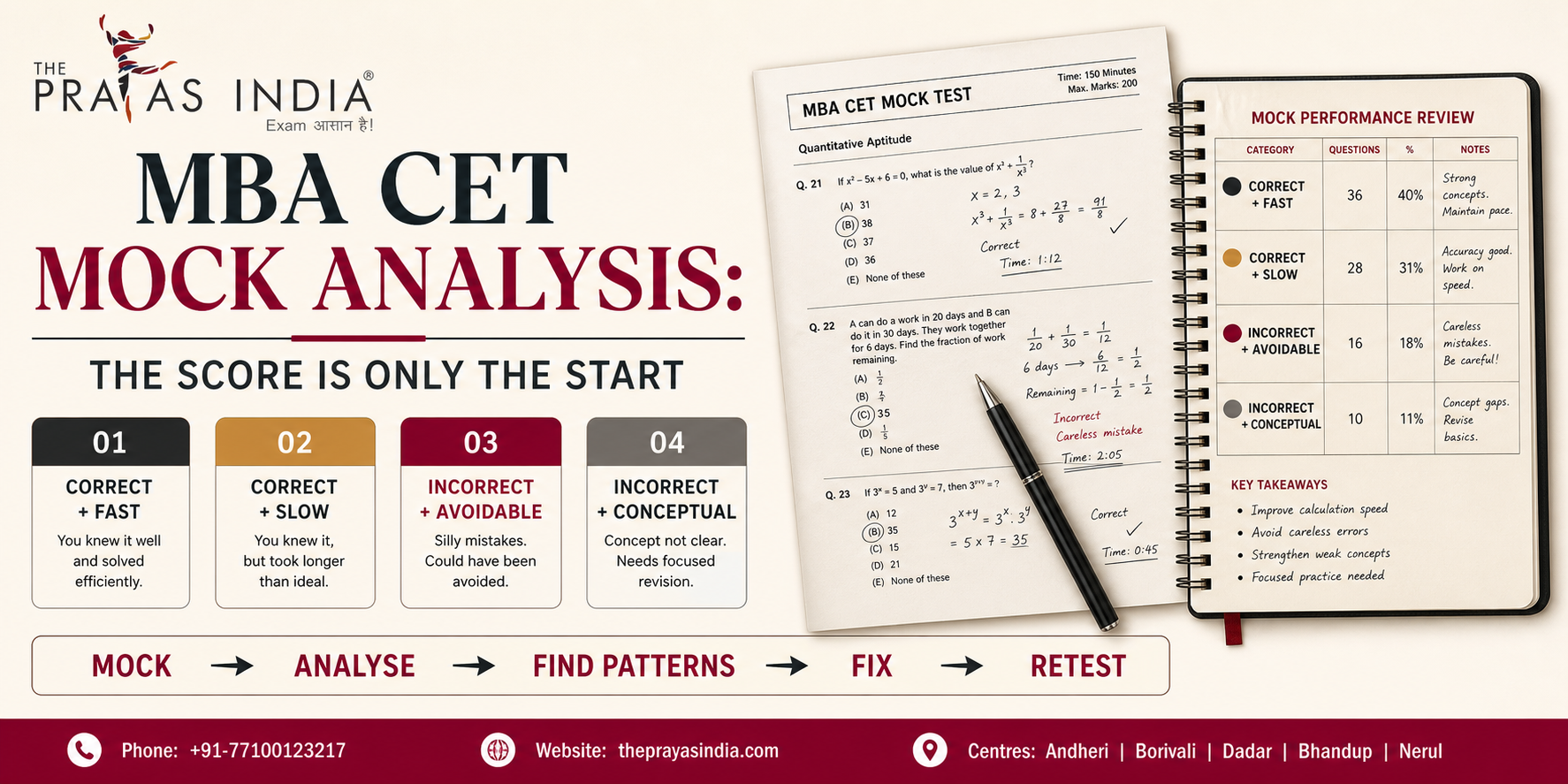
The value of a mock comes from what happens after the test.
After every mock, analyse:
Score → Attempts → Accuracy → Time → Errors → Question Selection
Do not immediately start another mock without understanding the previous one.
The 3-Step Mock Analysis System
Step 1: Analyse Incorrect Questions
For every incorrect answer, determine the reason.
Was it:
- A conceptual mistake?
- A calculation error?
- A reading mistake?
- A pattern-recognition issue?
- A guess?
- A time-pressure mistake?
Step 2: Analyse Correct Questions
Correct answers also deserve attention.
If you solved a question correctly but took twice as long as necessary, that is still a potential weakness.
Mark questions that were:
Correct + Fast
Correct + Slow
Incorrect + Avoidable
Incorrect + Conceptual
This provides a deeper understanding of your performance.
Step 3: Analyse Unattempted Questions
This is often ignored.
Go back to questions you skipped and ask whether they were genuinely difficult or simply appeared difficult under pressure.
This can reveal whether your question-selection strategy needs improvement.
Create Your Personal MBA CET Error Log
By Day 60, you should have enough practice data to identify recurring mistakes.
Maintain an error log divided into categories such as:
| Error Type | Example | Corrective Action |
|---|---|---|
| Concept | Formula not understood | Relearn concept |
| Calculation | Arithmetic mistake | Calculation practice |
| Interpretation | Misread question | Slow reading |
| Selection | Spent too long | Skip strategy |
| Recall | Forgot method | Revision |
| Pattern | Missed visual relationship | More AR practice |
The purpose of this notebook is not to record every single wrong answer forever.
Its purpose is to identify repeated mistakes.
If the same error appears five times, it deserves more attention than five unrelated mistakes.
Days 81–90: Final Revision and Exam Optimisation
The last ten days should not become a period of panic-driven learning.
Avoid trying to complete entirely new resources at this stage.
The focus should be:
Revision + Mock Analysis + Weak Areas + Strategy
Revise your short notes, formulas, important concepts, vocabulary and recurring errors.
Continue mock practice according to your preparation level, but give sufficient time to analyse each test.
The Final 10-Day Priority List
Quantitative Aptitude
Revise formulas, frequently tested concepts, calculation methods and personal weak areas.
Logical Reasoning
Revise common patterns and practise mixed sets.
Abstract Reasoning
Continue short, timed practice sessions to maintain pattern-recognition speed.
VARC
Maintain reading and revise recurring verbal errors.
Mock Tests
Use mocks to confirm strategy rather than simply chase scores.
Error Log
Revise the mistakes you have repeatedly made.
Question Selection
Practise deciding quickly which questions deserve immediate attention.
Build a 90-Day Study Schedule That You Can Actually Follow
A preparation schedule should be realistic.
If you can study four hours per day, do not create a timetable designed for ten hours. Consistency matters more than an impressive schedule that collapses after one week.
A sample daily framework could look like:
| Study Area | Approximate Focus |
|---|---|
| Quantitative Aptitude | Concept/Practice |
| Logical Reasoning | Practice |
| Abstract Reasoning | Timed Sets |
| VARC | Reading + Questions |
| Revision | Error Log/Weak Topics |
| Test Practice | Short Timed Set |
The exact time allocation should depend on your strengths and weaknesses.
If Quant is your weakest section, it may require additional time. If VARC is already strong, you may maintain it through shorter but consistent practice.
A Practical Weekly Cycle
A useful weekly routine could follow:
Monday: Concepts + topic-wise practice
Tuesday: LR/AR practice + Quant
Wednesday: VARC + Quant + timed set
Thursday: Mixed practice
Friday: Sectional test
Saturday: Full-length mock or extended test practice
Sunday: Mock analysis + revision
Again, this is a framework, not a rigid formula.
The important part is that each week should contain:
Learning + Practice + Testing + Analysis + Revision
If one of these is missing for several weeks, preparation becomes unbalanced.
How to Balance Speed and Accuracy
One of the biggest questions during MBA CET preparation is:
Should I focus on speed or accuracy?
The answer should not be either-or.
Speed without accuracy creates avoidable mistakes.
Accuracy without sufficient speed can prevent you from attempting enough questions.
The better progression is:
Accuracy → Controlled Speed → Exam-Speed Execution
First learn to solve correctly.
Then learn to solve efficiently.
Finally practise solving under realistic time pressure.
This progression is especially important during a 90-day preparation cycle because students may be tempted to chase speed too early.
Use Previous-Year Questions as a Preparation Tool
Previous-year questions should not be treated merely as questions to solve before the examination.
They can help students understand:
- Recurring concepts
- Question formats
- Difficulty patterns
- Sectional tendencies
- Question framing
- Common traps
- Time requirements
After completing a topic, solve relevant previous-year questions and identify whether you can apply the concept in an exam-like format.
This helps bridge the gap between studying a topic and being ready to answer questions on it.
How Coaching and Mentorship Can Fit Into a 90-Day Plan
Self-study can work for many students, but a compressed 90-day preparation schedule leaves little room for prolonged trial and error.
A structured MBA CET coaching programme can provide a framework through which students can access organised classes, practice material, mock tests, performance analysis and academic guidance.
Mentorship can add another layer by helping students understand how their individual preparation is progressing.
For example, two students may take the same mock test and receive the same score, but their problems could be completely different.
One may need Quant practice.
Another may need better question selection.
Another may know the concepts but lose marks through careless errors.
Personalised academic guidance can help direct practice towards the actual weakness instead of asking every student to follow exactly the same improvement plan.
Online vs Offline MBA CET Preparation
Students preparing for MBA CET 2027 can choose between online and offline learning depending on their circumstances and preferred study environment.
Online preparation can offer flexibility and may be suitable for students managing college, internships or other commitments. Live classes, recorded lectures, digital study material and online tests can make it easier to maintain continuity.
Offline preparation provides a structured classroom environment and direct interaction with faculty and peers. For students who benefit from physical classroom discipline and face-to-face academic interaction, this can be useful.
The important factor is not simply the mode of learning. Students should evaluate the complete preparation system, including:
- Faculty support
- Study material
- Mock tests
- Performance analysis
- Doubt resolution
- Mentorship
- Revision support
- Accessibility of classes
The Prayas India and MBA CET 2027 Preparation
For students preparing for MBA CET 2027, The Prayas India offers a structured preparation environment focused on building concepts, practising questions and developing exam-oriented skills.
The preparation process can combine classes, study material, practice, mock tests, analysis and academic guidance so that students can work systematically towards their examination goals.
Students can explore both online and offline MBA CET preparation options depending on their preferred learning format.
For aspirants preparing in Mumbai, The Prayas India has centres at Andheri, Borivali, Dadar, Bhandup and Nerul, providing students with offline learning options alongside online preparation.
The goal of structured preparation is not to guarantee a particular score or percentile. Instead, it is to help students create a disciplined preparation process in which performance is regularly evaluated and weaknesses are addressed.
Admissions for MBA CET 2027 preparation are open at The Prayas India.
Students planning to begin or strengthen their preparation can enquire about the available programmes, course structure, learning modes, mock tests and academic support.
What to Do If You Are Starting MBA CET Preparation Late
Starting late does not mean preparation should become chaotic.
If you have only 90 days, begin with diagnosis rather than panic.
Take a baseline test, analyse your performance and identify the topics that can produce the most meaningful improvement.
Then prioritise:
High-Value Topics → Frequent Practice → Timed Tests → Error Correction → Revision
Avoid spending the first few weeks creating elaborate notes or collecting resources.
Your objective should be to maximise exam-relevant practice.
If your fundamentals are weak, strengthen them. If your concepts are already strong, spend more time practising. If your mock scores are stagnant, investigate the reasons instead of simply taking more tests.
Common Mistakes During a 90-Day MBA CET Preparation
Trying to Complete Everything
The syllabus and available study material can feel endless. Prioritisation becomes essential when time is limited.
Starting Full-Length Mocks Too Late
Waiting until the final week to experience the full exam environment can make time management more difficult.
Taking Mocks Without Analysis
A mock without analysis provides a score but limited learning.
Chasing Speed Too Early
Accuracy should come before aggressive speed-building.
Ignoring Abstract Reasoning
Because AR may look different from traditional aptitude sections, some students under-practise it.
Avoiding Weak Topics
Repeatedly practising favourite topics can create the illusion of progress.
Changing Resources Frequently
Every resource change creates a new learning curve. Stay with focused material unless there is a genuine reason to change.
Neglecting Revision
New learning without revision often results in poor retention.
Following Someone Else’s Timetable
A preparation schedule should reflect your own starting level, available time and weaknesses.

The Last 24 Hours Before MBA CET
The final day should be about staying composed rather than attempting to learn large amounts of new material.
Review only your concise revision material.
Avoid:
- Starting a completely new topic
- Taking multiple exhausting mocks
- Comparing scores with other students
- Changing your entire strategy
- Staying awake unnecessarily late
Instead, ensure that you know your examination strategy, have your required documents and materials ready and understand how you intend to approach the test.
A calm and familiar process is more useful than last-minute experimentation.
The 90-Day MBA CET 2027 Strategy at a Glance
The complete plan can be simplified into four stages:
Days 1–30: Build
Strengthen fundamentals, understand question patterns and establish your baseline.
Days 31–60: Practise
Increase question volume, introduce timed sets, improve calculation speed and work on question selection.
Days 61–80: Test
Take regular mocks, analyse performance and identify recurring errors.
Days 81–90: Optimise
Revise, strengthen weak areas, refine time management and finalise your examination approach.
The most important point is that these phases should not exist in isolation.
Even during the foundation phase, you should practise.
Even during the mock phase, you should revise.
Even during the final phase, you should continue correcting mistakes.
The proportion changes; the complete preparation cycle remains.
Final Takeaway
A 90-day MBA CET 2027 preparation plan can be demanding, but it can also bring clarity to an otherwise overwhelming preparation process.
The objective is not to study everything. It is to identify what matters, practise consistently, improve speed without sacrificing accuracy and use every test as feedback.
A strong 90-day preparation cycle looks like:
Understand → Build → Practise → Test → Analyse → Correct → Revise → Repeat
If you are starting from scratch, use the first month to establish your foundation. If your concepts are already strong, move more quickly towards practice and testing. If your mock scores have plateaued, investigate the reasons behind the plateau rather than simply increasing the number of mocks.
For students who prefer structured academic support, MBA CET coaching can provide an organised environment for classes, practice, tests, feedback and mentorship.
The Prayas India offers online and offline MBA CET preparation options for aspirants looking for a structured approach to their 2027 entrance preparation.
If MBA CET 2027 is your target, the most important step is to begin with a realistic plan and execute it consistently for the next 90 days.
Admissions Open for MBA CET 2027 at The Prayas India.
Frequently Asked Questions (FAQs) – 90-Day MBA CET 2027 Strategy
1. Is 90 days enough to prepare for MBA CET 2027?
Ninety days can provide a highly focused preparation window, but the outcome heavily depends on the student’s starting baseline, daily available study hours, consistency, practice quality, and familiarity with the exam metrics. A highly structured strategic plan helps students utilize the available time with maximum efficiency.
2. What should I study first for MBA CET 2027?
Always begin your journey by thoroughly understanding the latest exam pattern and detailed syllabus. Take an initial diagnostic test to clearly identify your baseline strengths and structural weaknesses. Build your core fundamentals across basic topics before jumping heavily into competitive timed practice.
3. How should I divide 90 days for MBA CET preparation?
A highly practical and result-oriented operational framework is: First 30 Days for standard fundamentals and continuous diagnosis; Next 30 Days for intensive application practice and speed-building drills; Following 20 Days exclusively for full-length mocks and deep analysis; and the Final 10 Days dedicated completely to high-yield revision and exam day optimization.
4. When should I start taking MBA CET mock tests?
You should introduce exam-level evaluation early in your roadmap through micro topic-wise matrices and sectional tests. Full-length mock papers should become increasingly regular and structured as your preparation progresses, rather than being dangerously postponed until the final few days before the real test.
5. Is mock analysis more important than taking many mocks?
Absolutely. The raw number of mock papers alone does not determine preparation quality. Meticulously analyzing your calculations, identifying recurring error patterns, and implementing definitive corrective actions are the actual pillars of mock-based success.
6. How can I improve speed for MBA CET?
Improve execution speeds gradually by strengthening your core conceptual roots, mastering efficient Vedic math solving techniques, practicing timed modular question sets, and developing lightning-fast question-selection boundaries. Crucially, speed should never be developed at the cost of your scoring accuracy.
7. Should I focus more on Quant, LR, AR or VARC?
Your dedicated study allocation should tightly depend on your unique individual strengths and weak areas. Dominant conceptual modules should be safely maintained through routine practice intervals, while weaker, low-scoring areas require highly targeted core preparation support.
8. Can I prepare for MBA CET 2027 through online coaching?
Yes, comprehensive online preparation modules provide incredible structural flexibility through highly interactive live streaming blocks, instantly accessible recorded libraries, curated digital reference study resources, simulation testing panels, and prompt doubt-clearing support.
9. Is offline MBA CET coaching available in Mumbai?
Yes, The Prayas India provides highly premium, comprehensive offline classroom preparation options across its verified hubs in Mumbai, integrated seamlessly alongside our advanced online ecosystem frameworks.
10. Does The Prayas India provide MBA CET 2027 preparation?
Yes, The Prayas India provides elite, highly structured MBA CET target batch programs complete with dedicated speed-drill metrics, thorough testing matrices, and 1-on-1 strategic profile mentorship. Admissions for our **Premium MBA CET 2027 Courses** are officially open!
⚡
Cracking MBA CET 2027 in 90 Days? Join The Prayas India!
When time is limited, random preparation fails. Your 90-day window demands a hyper-focused strategy, shortcut formula matrices, and intense speed drills. Secure your target business school with Mumbai’s top mentors!
Our 90-Day Accelerator Batch Benefits:
- 🕒 Vedic Math & Logic Shortcuts: Master the art of solving complex reasoning puzzles in under 45 seconds.
- 📊 Simulated CBT Mock Panels: Overcome real exam anxiety with regular timed computer-based mock series.
- 🎯 1-on-1 Personalized Error Analysis: Identify exactly where you are losing marks to optimize your accuracy boundaries.
Connect With Our Admission Experts
📞 Call Now: +91-77100 13217
🌐 Official Portal: theprayasindia.com