MBA CET 2027 Logical Reasoning Preparation: How to Improve Speed and Accuracy
Logical Reasoning is one of the most important areas for students preparing for the MBA CET 2027 exam, particularly because the section demands much more than simply knowing how to solve a particular question type. An aspirant may understand arrangements, puzzles, coding-decoding, blood relations, syllogisms, statement-based questions and other reasoning concepts, yet still struggle to perform effectively in a timed test.
The real challenge is converting logical understanding into fast, accurate decision-making.
The latest available MAH-MBA/MMS CET framework provides a useful indication of this requirement. In the 2026 official brochure, Logical Reasoning was described as testing how quickly and accurately candidates can think, including verbal reasoning as well as questions based on figures and diagrams. The 2026 structure included 75 Logical Reasoning questions, with 1 mark per question, within a 150-minute overall test. The official framework also stated that candidates could attempt questions in any order and that there was no negative marking.
However, MBA CET 2027-specific examination details should be verified from the official State CET Cell notification when released. The preparation principles discussed in this article focus on the skills required to become faster, more accurate and more strategically efficient in Logical Reasoning.
For aspirants, this means that simply completing the LR syllabus is not enough. You need a preparation system that takes you through concept learning → topic-wise practice → timed practice → sectional tests → mock analysis → strategy improvement.
Why Logical Reasoning Can Become a Scoring Opportunity
Logical Reasoning often appears intimidating because questions can look unfamiliar at first. A seating arrangement, puzzle or logical situation may contain several conditions that need to be processed simultaneously. But with sufficient exposure, many of these questions begin to follow recognizable structures.
The objective is therefore not to memorize hundreds of solutions. It is to develop the ability to quickly identify:
- What information is given?
- What information is actually relevant?
- What can be directly inferred?
- Which conditions should be represented visually?
- Which options can be eliminated immediately?
- How much time should be spent on the question?
- When should you move to another question?
This is why timed practice is so important for MBA CET Logical Reasoning preparation.
The Prayas India’s existing MBA CET preparation guidance also emphasizes that speed should be developed alongside conceptual clarity, question selection, timed practice and mock-test analysis.
A student who spends ten minutes solving a difficult puzzle correctly during untimed practice may still need significant improvement if the same puzzle takes too long in an exam environment.
The goal is to reach a stage where you can quickly recognize the structure of a question, select an appropriate approach and make a reliable decision about whether to solve, postpone or skip it.
Step 1: Build Your Logical Reasoning Foundation Before Chasing Speed
One of the biggest mistakes students make is trying to increase speed before they have developed conceptual clarity.
Suppose you are solving seating arrangement questions. If you are still confused about how to interpret terms such as “immediate left”, “second to the right”, “facing north”, “facing south”, “between” or “opposite”, increasing the timer will not make you faster. It will simply make you commit mistakes more quickly.
The first stage should therefore be accuracy without excessive time pressure.
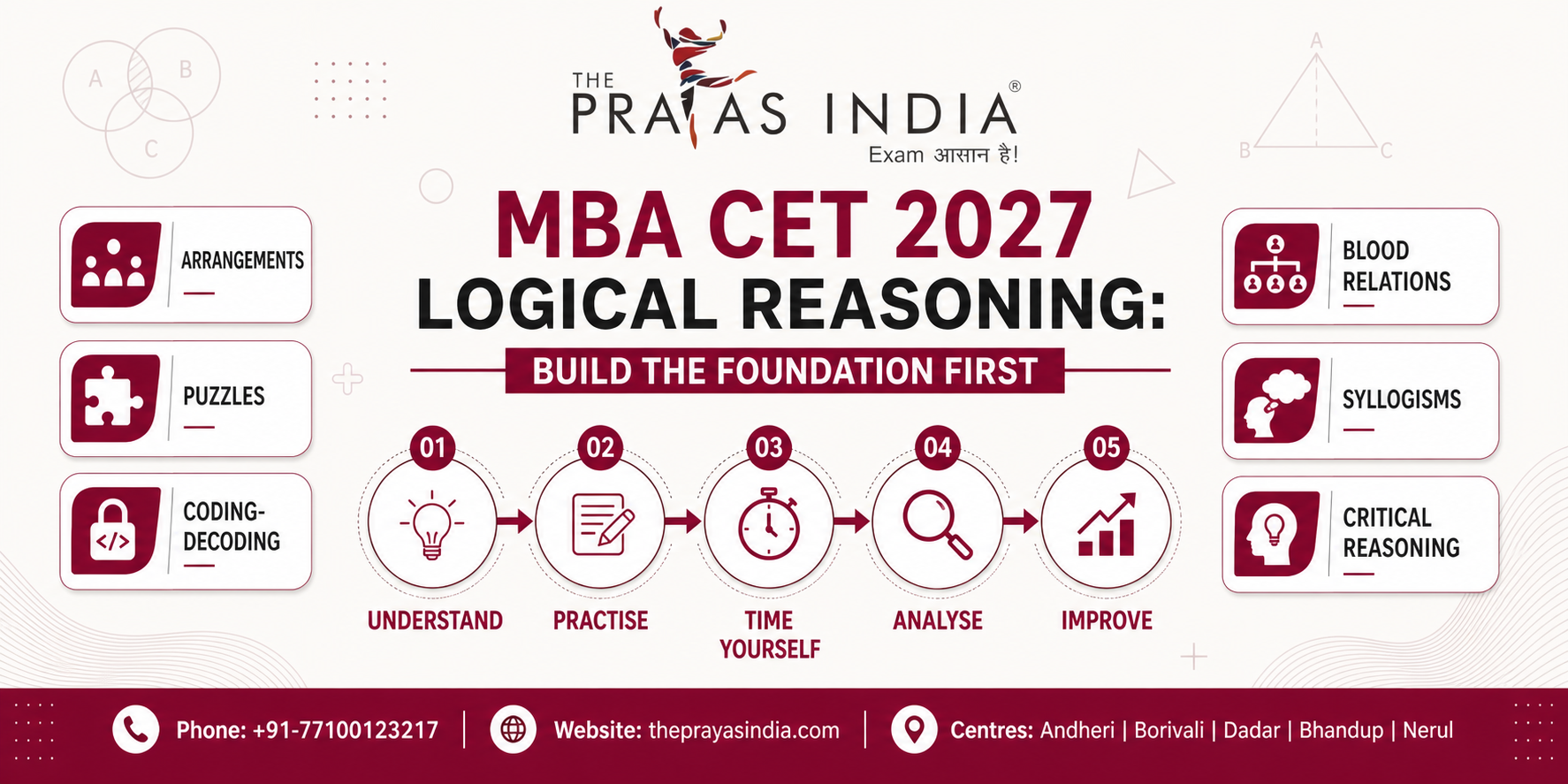
Start by learning the fundamental approach for different LR categories. Depending on the final MBA CET 2027 syllabus and notification, your preparation can include areas such as:
- Seating arrangements
- Linear arrangements
- Circular arrangements
- Floor-based arrangements
- Blood relations
- Direction sense
- Coding-decoding
- Syllogisms
- Inequalities
- Input-output
- Statement-based reasoning
- Critical reasoning
- Logical deductions
- Data-based logical situations
- Puzzles
- Selection and distribution problems
- Ranking and ordering
The objective at this stage is not to solve everything at maximum speed.
It is to understand why the solution works.
Once the method becomes familiar, speed can be developed through repetition.
Step 2: Divide LR Preparation Into Question Families
Instead of randomly solving reasoning questions every day, create groups of related question types.
For example, arrangements and puzzles require a different thought process from coding-decoding or blood relations. If you mix everything from the beginning, it becomes difficult to identify exactly where your weakness lies.
A better approach is to spend a few days developing competence in one family before moving to another.
Arrangement-Based Questions
Start with linear arrangements and then move toward circular and more complex arrangements.
Learn how to convert verbal information into a diagram. This is an extremely important skill because a well-constructed diagram can reduce the amount of information you need to mentally process.
Puzzles
Puzzles can involve people, objects, days, floors, professions, categories or multiple conditions.
Do not immediately try to solve the entire puzzle mentally. Convert the information into a table, grid, diagram or sequence wherever appropriate.
Blood Relations
These questions reward clarity rather than complicated calculation. Practice building family trees quickly and avoid relying on assumptions.
Coding-Decoding
Focus on recognizing the underlying transformation instead of memorizing patterns from individual questions.
Syllogisms and Logical Deductions
These questions require careful interpretation of statements. The major danger is introducing information that was not actually provided.
Statement-Based Questions
The key skill here is separating what is explicitly stated from what you personally believe to be reasonable.
This distinction becomes increasingly important as difficulty rises.
Step 3: Use the Three-Level Practice System
A strong MBA CET 2027 LR preparation strategy should not rely on only one type of practice.
Use three levels.
Level 1: Untimed Concept Practice
At the beginning, focus on understanding.
Take sufficient time to determine:
- What type of question is this?
- Which method should be used?
- What information matters?
- What mistake did I make?
Do not become obsessed with seconds at this stage.
Level 2: Topic-Wise Timed Practice
Once you understand the concept, introduce a timer.
For example, solve a small set of arrangement questions within a defined time limit.
The purpose is to gradually reduce the gap between knowing the method and executing the method quickly.
Level 3: Mixed Timed Practice
This is where actual exam-style decision-making starts developing.
Instead of knowing beforehand that every question is a blood-relation question or arrangement question, mix different types.
Now you have to identify the question type yourself.
That recognition process is an important part of speed.
Step 4: Don’t Confuse Speed With Rushing
This is one of the most important principles for MBA CET Logical Reasoning.
Speed is not the same as rushing.
Rushing means:
- Reading conditions incompletely
- Misinterpreting directions
- Making unnecessary assumptions
- Skipping important information
- Marking an option without checking
- Drawing an incorrect diagram
- Spending too much time correcting avoidable mistakes
Real speed comes from efficient processing.
A fast student does not necessarily read everything faster. Instead, the student learns to identify what deserves attention.
For example, if a question contains five conditions, you do not necessarily need to process them in the order in which they are written. You can begin with the condition that provides the strongest restriction and use it to structure the rest of the problem.
This is a skill developed through practice.
Step 5: Develop a Question-Selection Strategy
Because MBA CET allows candidates to navigate among questions, preparation should not be based on the assumption that every question must be solved immediately. The official 2026 brochure specifically stated that candidates could attempt questions at any point during the 150-minute test.
This makes question selection an important preparation skill.
During practice, classify questions into three categories:
Category A: Immediate Questions
These are questions where:
- The method is familiar.
- Conditions are straightforward.
- You can see the solution path quickly.
- The expected time is reasonable.
Attempt these confidently.
Category B: Manageable Questions
These may require some calculation, diagramming or multiple steps.
Attempt them when your first pass is complete or when your strategy indicates sufficient time.
Category C: Time-Consuming Questions
These are questions where:
- The setup is complicated.
- You cannot identify the approach.
- You are repeatedly restarting.
- You are spending too much time for uncertain progress.
Learning to move away from such questions is not weakness.
It is exam strategy.
Step 6: Create a Personal Time Benchmark
Do not compare your speed with someone else’s.
Instead, create your own baseline.
Suppose you initially solve a particular category with:
Accuracy: 72%
Average time: 95 seconds
Your objective is not to suddenly reduce the time to 40 seconds.
First improve accuracy.
Then gradually bring the average time down.
For example:
Stage 1: 72% accuracy — 95 seconds
Stage 2: 82% accuracy — 90 seconds
Stage 3: 88% accuracy — 80 seconds
Stage 4: 90%+ accuracy — 70 seconds
The exact numbers will differ by student and question type. The important idea is to measure improvement through both accuracy and time.
A student who reduces time from 90 seconds to 65 seconds but sees accuracy collapse has not actually improved the skill.
Step 7: Maintain an LR Error Log
This is one of the simplest techniques that can produce meaningful improvement.
After every practice session, record your mistakes.
But don’t simply write:
“Wrong answer — revise topic.”
That is too vague.
Instead, classify the mistake.
Concept Error
You did not understand the method.
Interpretation Error
You misunderstood what the question was asking.
Calculation or Execution Error
You knew what to do but made a mistake while executing.
Diagram Error
Your representation of the information was incorrect.
Assumption Error
You introduced information that was not given.
Time-Management Error
You spent too long on a question.
Careless Error
You knew the answer but marked or read something incorrectly.
This classification tells you what kind of improvement you actually need.
If most errors are conceptual, revise the topic.
If most errors are careless, slow down slightly and improve checking discipline.
If most errors are time-related, introduce more timed sets.
If most errors happen because you choose the wrong questions, work on question selection.
Step 8: Use Timed Sets Before Full-Length Mocks
Students sometimes make the mistake of jumping directly from topic practice to full-length mocks.
There is an important intermediate stage: timed sectional practice.
A timed LR set can train:
- Speed
- Concentration
- Question selection
- Pressure handling
- Switching between question types
- Decision-making
Start with manageable time limits.
As your accuracy improves, increase the number of questions and reduce the available time.
The purpose is to make timed solving feel normal before you enter full mock-test conditions.
Step 9: Practice the Same Question Type Repeatedly
Many students solve one or two questions from a topic and then move on.
That is rarely enough to build speed.
Suppose you learn circular arrangements today. The first few questions may take considerable time because you are still thinking about the process.
After repeated practice, the basic structure becomes familiar.
Eventually, you begin recognizing patterns before consciously analysing every detail.
This is similar to learning any skill: repetition reduces cognitive load.
For MBA CET 2027, build repeated practice into your weekly routine rather than treating LR as an occasional subject.
Step 10: Learn Shortcuts Only After Understanding the Logic
Shortcuts can be useful, but they should not replace conceptual understanding.
A shortcut that you do not understand can become dangerous when the question is modified.
For example, memorizing a particular approach for a standard arrangement may work on familiar questions but fail when the same concept is presented differently.
A better sequence is:
Concept → Standard Method → Repeated Practice → Pattern Recognition → Shortcut
This approach helps you develop speed without becoming dependent on memorized tricks.
The Prayas India’s MBA CET preparation material similarly emphasizes shortcut techniques only as part of a broader system involving conceptual clarity, continuous practice, question selection and mock analysis.
Step 11: Start Mock Tests Before You Feel “Fully Prepared”
Waiting until the entire syllabus is complete before taking mocks can delay one of the most important aspects of MBA CET preparation: performance diagnosis.
You do not need to wait for perfection.
Early tests can reveal:
- Which LR topics are slowing you down
- Whether your accuracy drops under pressure
- Which questions you tend to over-attempt
- Whether you spend too long on puzzles
- Whether your reading speed affects reasoning
- Whether your strategy changes under timed conditions
The mock is not simply a score-producing exercise.
It is a feedback mechanism.
Step 12: Analyse Every Mock Properly
Taking a mock without analysing it is one of the biggest missed opportunities in MBA CET preparation.
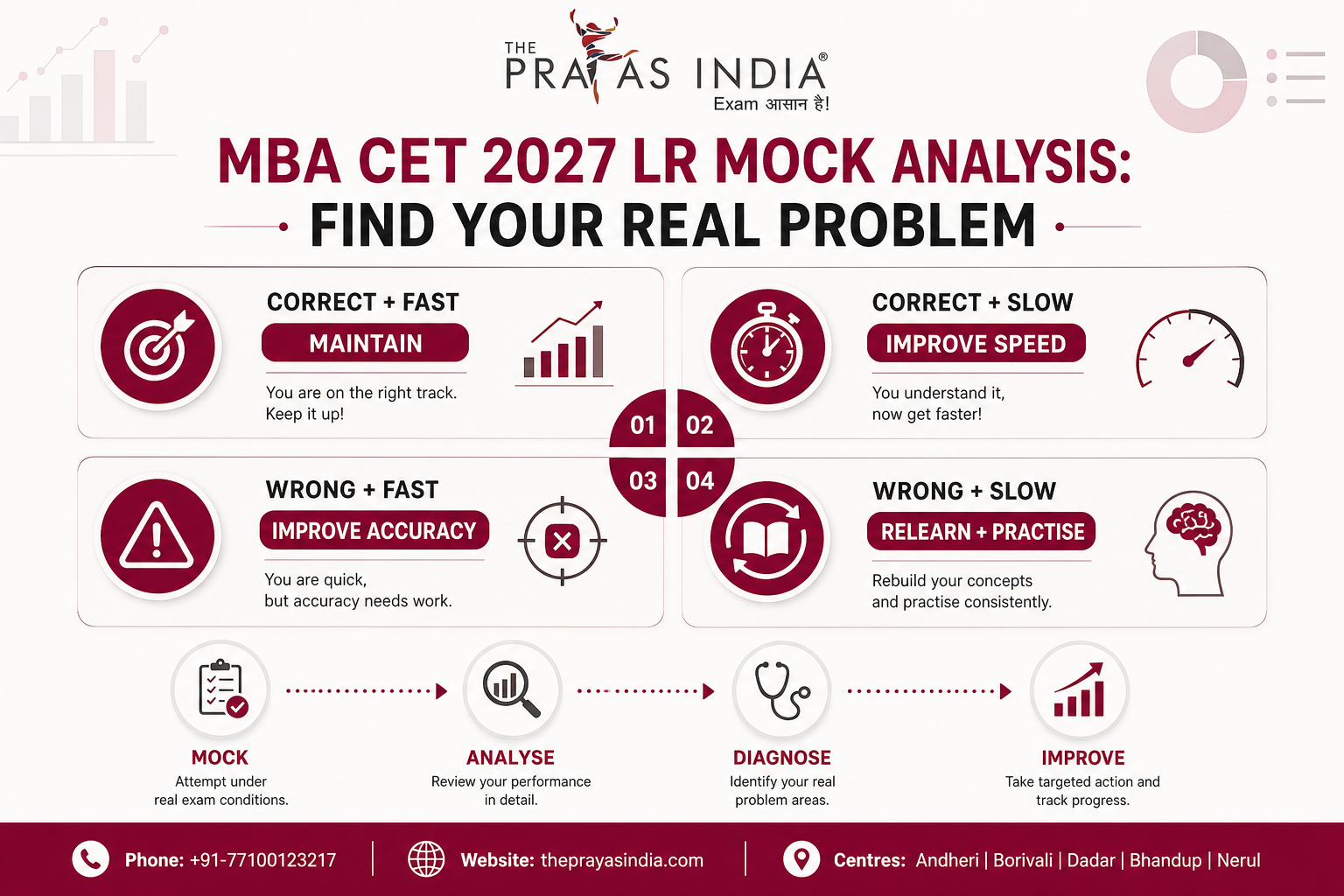
After every mock, divide LR questions into four groups:
| Category | What It Means | What To Do |
|---|---|---|
| Correct + Fast | Strong performance | Maintain |
| Correct + Slow | Concept understood but inefficient | Practise speed |
| Wrong + Fast | Risk of careless/weak understanding | Analyse accuracy |
| Wrong + Slow | Major improvement area | Relearn + practise |
This simple classification can reveal much more than your overall mock score.
Suppose your LR accuracy is 85%, but half of your correct answers take too long.
Your problem is not primarily knowledge.
Your problem is execution speed.
On the other hand, if you solve questions quickly but accuracy is only 65%, increasing speed should not be your immediate priority.
You need accuracy first.
Step 13: Build an LR Speed Ladder
Speed should be developed progressively.
A useful practice ladder can look like this:
Stage 1: Accuracy First
Solve without strict timing.
Objective: understand the method.
Stage 2: Comfortable Timing
Introduce a generous time limit.
Objective: become comfortable solving under a clock.
Stage 3: Competitive Timing
Reduce the time gradually.
Objective: increase efficiency.
Stage 4: Mixed Sets
Combine multiple LR topics.
Objective: develop question recognition.
Stage 5: Exam Simulation
Solve LR as part of a complete mock.
Objective: develop real exam decision-making.
This progression is much more effective than suddenly forcing yourself to solve everything at maximum speed.
Step 14: Practice Question Selection Every Week
Question selection should itself become a trainable skill.
Once a week, take a mixed LR set and give yourself a short scanning window.
Before solving, identify:
- Easy-looking questions
- Familiar structures
- Questions requiring lengthy setups
- Questions that appear ambiguous
- Questions you should postpone
Then compare your initial decisions with your actual solving experience.
Over time, you will develop a personal understanding of which question types tend to consume too much time.
This can become one of your biggest advantages during the actual examination.
Step 15: Improve Your Reading of Logical Conditions
Speed in LR is not only about solving.
It is also about reading efficiently.
When a question contains multiple conditions, highlight or mentally identify:
People → Positions → Restrictions → Relationships → Exceptions
For example, instead of repeatedly rereading:
“P sits immediately to the left of Q, while R cannot sit next to S…”
convert it into a simple representation.
The less often you need to reread the original statement, the faster you become.
This is why drawing diagrams and tables is not a sign of slow solving. A good representation can actually increase speed.
Step 16: Don’t Spend Your Entire Practice Time on Difficult Puzzles
Difficult questions are useful, but they should not dominate your preparation.
If you spend two hours solving three extremely difficult puzzles, you may feel productive but receive limited exposure to the range of question types you need to handle.
Your practice should include:
- Basic questions
- Moderate questions
- Exam-level questions
- Mixed questions
- Timed questions
- Previous-style questions
- Difficult questions
The objective is to build breadth + accuracy + speed, not simply to prove that you can solve the hardest puzzle you find.
Step 17: Create a Weekly MBA CET 2027 LR Routine
A practical routine might look like this:
Monday: Concept Building
Learn one LR topic and solve basic questions.
Tuesday: Topic Practice
Solve a larger set from the same topic.
Wednesday: Timed Practice
Solve the topic under a time limit.
Thursday: Second Topic
Learn and practise another LR area.
Friday: Mixed Practice
Combine previously studied topics.
Saturday: Sectional Test
Attempt a timed LR test.
Sunday: Analysis + Revision
Review mistakes, update your error log and revisit weak concepts.
The exact schedule can be adjusted according to your academic commitments, but the important point is to include timed practice and analysis every week.
Step 18: Combine Speed and Accuracy Instead of Treating Them as Separate Goals
A common mistake is to think:
First I will become accurate. Then I will become fast.
There is some truth in this progression, but the two skills eventually need to be developed together.
Consider these two students:
Student A:
90% accuracy, but extremely slow.
Student B:
Attempts very quickly, but accuracy is inconsistent.
Neither has developed complete exam readiness.
The target is a third stage:
Student C:
Good conceptual clarity + reliable accuracy + efficient execution + intelligent question selection.
That is the combination you should work toward.
How to Know Whether Your LR Speed Is Actually Improving
Do not judge your progress only by the number of questions you solve.
Track at least four metrics:
1. Accuracy Rate
How many attempted questions are correct?
2. Average Time
How much time are you spending?
3. Unnecessary Time
Which questions consume disproportionate time?
4. Repeat Errors
Which mistakes keep appearing?
A simple weekly tracking sheet can include:
| Week | LR Questions | Accuracy | Avg. Time | Major Error |
|---|---|---|---|---|
| Week 1 | 150 | 70% | High | Interpretation |
| Week 2 | 180 | 76% | Improving | Diagram |
| Week 3 | 200 | 82% | Better | Careless |
| Week 4 | 220 | 86% | Better | Time traps |
The numbers here are illustrative. Your personal targets should be based on your current level and mock performance.
Common Mistakes That Reduce MBA CET LR Speed
1. Solving Without a Timer
Untimed practice is useful initially, but it cannot be your entire preparation.
2. Chasing Attempts Instead of Accuracy
More questions do not automatically mean better performance.
3. Spending Too Long on One Puzzle
A difficult question can become a time trap.
4. Ignoring Error Analysis
If you make the same mistake repeatedly, additional practice without diagnosis may not solve the problem.
5. Using Too Many Resources
Jumping between multiple books, websites, videos and question banks can create fragmented preparation.
6. Memorizing Tricks Without Understanding Them
Shortcuts are useful only when you know when and why they work.
7. Avoiding Mock Tests
You need exposure to actual timed decision-making.
8. Comparing Your Speed With Other Students
Your improvement should be measured against your own previous performance.
Can Coaching Help With MBA CET Logical Reasoning?
Self-study can certainly play an important role in MBA CET preparation. However, some students struggle not because they lack study material but because they lack a structured system for improving performance.
This becomes particularly relevant for LR because speed improvement requires continuous feedback.
A structured coaching environment can potentially help students with:
- Topic sequencing
- Concept clarification
- Question-solving approaches
- Timed practice
- Doubt resolution
- Mock tests
- Performance analysis
- Question selection strategies
- Revision planning
- Accountability
The Prayas India’s MBA CET preparation content highlights these same components, including mock tests, performance analysis, shortcut techniques, speed-building practice and mentorship.
The decision to join coaching should ultimately depend on your learning style, current preparation level, consistency and ability to build and follow a reliable preparation system.
When Should You Consider Joining MBA CET 2027 Coaching?
You may want to explore structured coaching if you frequently experience problems such as:
- You understand concepts but remain slow.
- Your mock performance fluctuates significantly.
- You do not know which topics to prioritise.
- You struggle to analyse your mistakes.
- You keep repeating the same errors.
- You find it difficult to maintain a study schedule.
- You need regular doubt-solving support.
- You want structured mock-test practice.
- You need external accountability.
- You are preparing alongside college or work and need a defined roadmap.
The purpose of coaching should not simply be to attend classes.
The real value should come from having a system that helps you learn, practise, test, analyse and improve.

How The Prayas India Can Support MBA CET 2027 Preparation
For students considering structured preparation, the important question is not simply whether an institute offers classes. The more useful question is whether its preparation system addresses the complete journey from learning to performance.
For MBA CET, this can include conceptual classes, topic-wise practice, timed exercises, mock tests, performance analysis and guidance on improving speed and accuracy.
The Prayas India’s published MBA CET preparation resources describe a structured approach involving expert guidance, practice, mock tests, performance tracking, speed-building and personalised mentorship.
For an aspirant struggling specifically with Logical Reasoning, the important thing is to identify why performance is not improving.
If the problem is conceptual, you need concept building.
If the problem is speed, you need timed practice.
If the problem is accuracy, you need error analysis.
If the problem is question selection, you need mock-based strategy development.
If the problem is consistency, you may benefit from a structured preparation schedule.
That is why students should evaluate their own preparation before choosing a course.
A Practical MBA CET 2027 LR Improvement Framework
Use this five-step framework throughout your preparation:
1. Learn
Understand the concept and question structure.
2. Practise
Solve enough questions to develop familiarity.
3. Time
Introduce a timer and track your solving speed.
4. Analyse
Identify conceptual, execution, accuracy and time-management errors.
5. Improve
Revise the specific weakness and test again.
Then repeat the cycle.
Learn → Practise → Time → Analyse → Improve
This is much more effective than repeatedly solving random questions without understanding why your performance changes.
What to Do If Your LR Speed Is Not Improving
If you have been practising for several weeks but your speed remains almost unchanged, don’t simply increase the number of questions.
First diagnose the problem.
If You Read Slowly
Work on identifying key information and reducing unnecessary rereading.
If You Understand but Execute Slowly
Increase timed topic-wise practice.
If You Solve Quickly but Make Mistakes
Prioritise accuracy and careful interpretation.
If Puzzles Consume Too Much Time
Practise identifying when a puzzle should be postponed.
If You Don’t Know Which Method to Use
Revisit concepts and solve guided examples.
If Your Mock Scores Are Stagnant
Analyse your attempts rather than simply taking more mocks.
This distinction is important because more practice is useful only when it is correcting the right problem.
MBA CET 2027 Preparation Should Start Before the Final Revision Phase
Students sometimes postpone serious preparation because the official notification is still some distance away.
But speed-based skills are not developed overnight.
Logical Reasoning requires repeated exposure to different structures, timed practice and gradual improvement.
Starting earlier gives you the opportunity to move through several stages:
Foundation → Topic Practice → Timed Sets → Sectional Tests → Full Mocks → Strategy Refinement
This is especially useful for students who currently take much longer than expected to solve LR questions.
Instead of trying to become fast immediately, you can build speed progressively.
The official State CET Cell continues to publish examination and admission information through its official portals, so candidates should use those sources for the final 2027 pattern, schedule and rules once released.
Final Takeaway
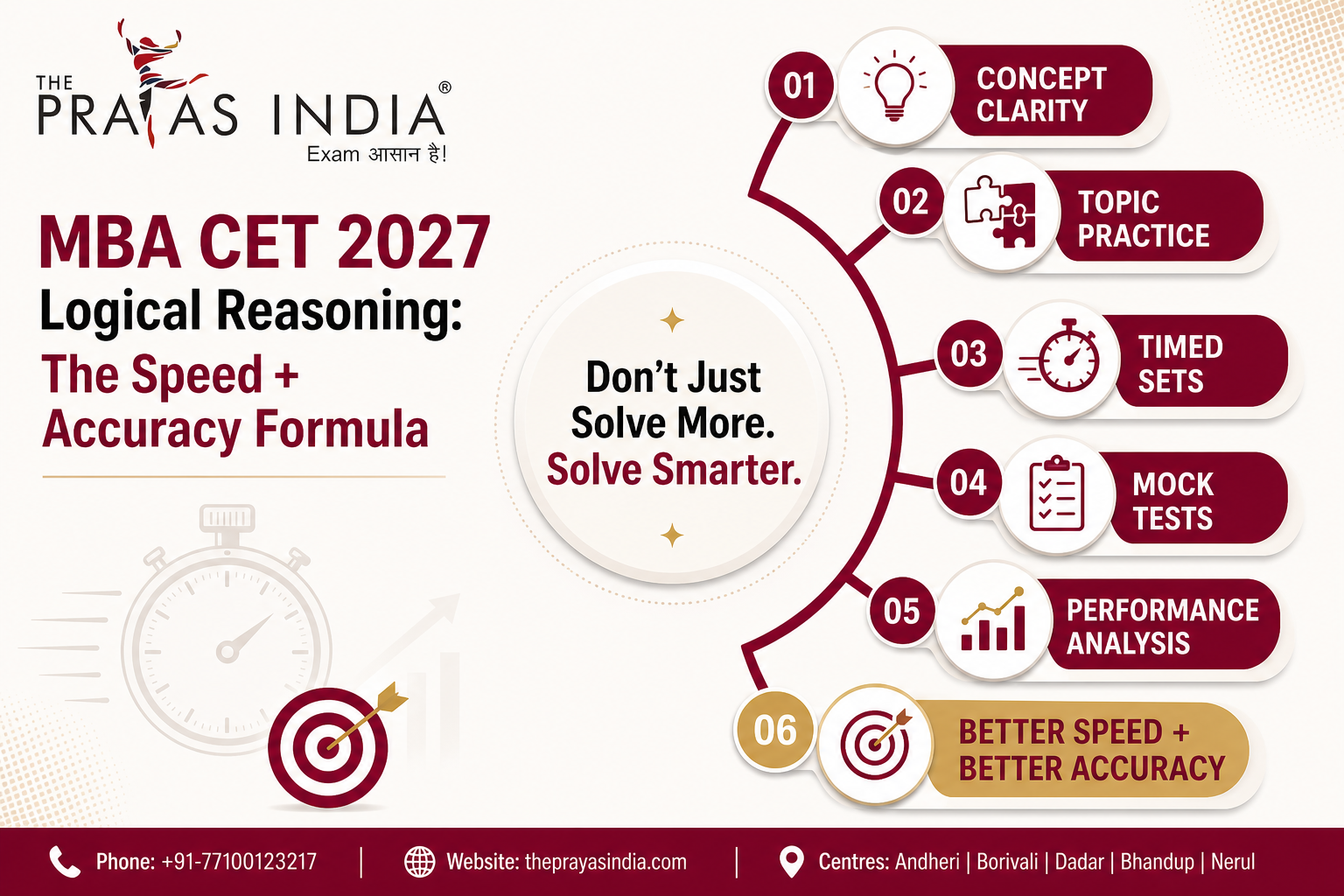
MBA CET 2027 Logical Reasoning preparation should not be reduced to solving a large number of questions. The real objective is to develop the ability to understand a logical situation quickly, identify the correct approach, solve efficiently, avoid unnecessary errors and make smart decisions under time pressure.
For most aspirants, speed improves gradually. It comes from strong fundamentals, repeated topic-wise practice, timed exercises, mixed sets and consistent mock analysis.
If your current LR performance is slow, don’t assume that you need to solve hundreds of additional questions immediately. First identify whether your real weakness is conceptual understanding, interpretation, execution, accuracy, question selection or time management.
Once you know the problem, your practice becomes much more targeted.
For students preparing seriously for MBA CET 2027, this is also where structured guidance can become useful. A well-planned preparation program can provide a consistent sequence of learning, practice, testing and analysis instead of leaving students to figure out every stage independently.
If you are unsure about your current Logical Reasoning level, course requirements or the right preparation approach, speaking with the academic team before enrolling can help you understand which kind of MBA CET preparation structure fits your needs.
MBA CET 2027 preparation is not only about solving more questions. It is about becoming faster, more accurate and more strategic with every practice session.
MBA CET 2027 Logical Reasoning – FAQs
How can I improve my Logical Reasoning speed for MBA CET 2027?
Start with concept clarity, followed by topic-wise practice, timed sets, mixed practice and mock-test analysis. Speed improves gradually when you repeatedly practise under controlled time limits.
Should I focus on speed or accuracy first in Logical Reasoning?
Build reliable accuracy first and then gradually increase speed. Fast solving is useful only when the answers remain dependable.
Which Logical Reasoning topics should I practise for MBA CET?
Preparation can include arrangements, puzzles, blood relations, coding-decoding, syllogisms, inequalities, input-output, statement-based reasoning, critical reasoning and other logical question types relevant to the latest official syllabus.
Are timed practice sets important for MBA CET Logical Reasoning?
Yes. Timed sets help you develop faster execution, better question selection and comfort with exam pressure. They should be introduced gradually after basic concepts are clear.
How many LR questions should I solve every day?
There is no universal number. Quality matters more than a fixed target. Set a practice volume based on your preparation level and make sure you analyse your mistakes instead of only counting attempts.
Why am I accurate in practice but slow in mocks?
This usually indicates an execution or time-management issue rather than a basic conceptual problem. Analyse the questions taking excessive time and introduce more timed mixed practice.
Should I take MBA CET mock tests while preparing Logical Reasoning?
Yes. Mocks help you understand your speed, accuracy, question selection and performance under pressure. Their value increases significantly when you analyse them properly afterward.
What should I record in an LR error log?
Record the question type, mistake category, time taken and the correct approach. Track whether the error was conceptual, interpretational, careless, execution-related or caused by poor time management.
Can coaching help me improve MBA CET Logical Reasoning speed?
Structured coaching can provide guided concept learning, timed practice, mock tests, performance analysis, doubt support and strategy guidance. Whether coaching is useful depends on your current preparation level and learning requirements.
Does The Prayas India provide MBA CET preparation?
The Prayas India offers structured MBA CET preparation support covering concepts, practice, mock tests, performance analysis and mentorship. Students can enquire about the current course structure, batches and admission options before enrolling.
Ready to Improve Your MBA CET 2027 Preparation?
If Logical Reasoning speed, accuracy, mock performance or question selection is holding you back, the right preparation structure can help you work on these areas systematically.
Explore structured MBA CET preparation with concept building, regular practice, timed exercises, mock tests, performance analysis and guidance designed to help you improve your overall exam strategy.
📍 Centres: Andheri | Borivali | Dadar | Nerul | Bhandup
Enquire today to understand the right MBA CET 2027 course, batch and preparation plan for your goals.