
MBA CET 2027 Mock Analysis: How Top Scorers Improve After Every Test | Best MBA CET Coaching in Mumbai | The Prayas India
Preparing for MBA CET 2027 is not simply about completing the syllabus, solving thousands of questions, or taking mock tests every weekend. For serious aspirants, the real improvement begins after the mock test ends.
A mock test gives you a score, but the score itself does not tell you everything. It does not automatically explain why you lost marks, where you spent too much time, which questions you should have skipped, or which concepts are repeatedly causing mistakes. That information comes from proper mock-test analysis.
This is one of the major differences between candidates who take mocks casually and candidates who use every mock as a preparation tool. Top-performing aspirants do not treat a mock as a final judgment of their ability. They treat it as a performance report that tells them what needs to change before the next test.
For MBA CET aspirants, this approach becomes particularly important because the examination is highly speed-oriented. The latest official MAH-MBA/MMS-CET information brochure available from the Maharashtra State CET Cell specifies a 150-minute test duration and states that candidates can attempt questions at any point during the test, with no negative marking for incorrect answers. Recent 2026 exam analyses also highlighted the importance of speed, time management and smart question selection.
Therefore, your mock-test strategy should not end with checking your marks.
It should continue with a simple question:
“What will I do differently in my next test?”
For MBA CET 2027 aspirants preparing for a competitive MBA/MMS admission, this habit can become one of the most valuable parts of the preparation journey.
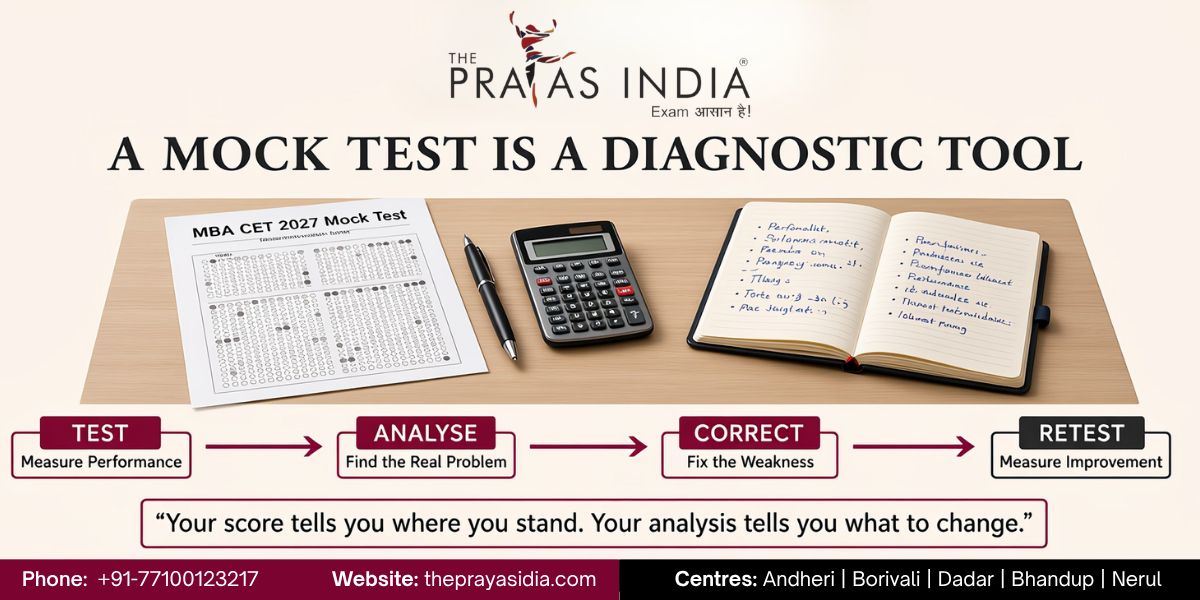
A Mock Test Is a Diagnostic Tool, Not Just a Scorecard
Many students finish a mock test, look at the score, compare it with their friends, and immediately move on to the next chapter.
This approach misses the most valuable part of the exercise.
A mock test exposes your actual exam behaviour. While studying, you may believe that you are good at Logical Reasoning, comfortable with Quantitative Aptitude, or fast enough in Verbal Ability. But a timed mock reveals how you actually perform when several decisions have to be made continuously.
You may discover that you understand a concept but take too long to solve questions from it. You may find that you attempt many questions but lose marks because of careless errors. You may also realise that you spend too much time trying to solve difficult questions while leaving easier questions for later.
These observations are more useful than the score alone.
A strong mock-analysis process therefore examines:
- Questions attempted
- Correct answers
- Incorrect answers
- Unattempted questions
- Accuracy
- Time spent
- Questions that consumed excessive time
- Questions that should have been skipped
- Conceptual mistakes
- Calculation mistakes
- Reading or interpretation mistakes
- Guessing errors
- Repeated topic-wise weaknesses
- Section-wise performance
- Changes from previous mocks
The goal is to convert this information into a better strategy for the next test.
The First Step After Every Mock: Stop Looking Only at the Score
Your first reaction after a mock test may naturally be to look at the score.
That is fine, but it should only be the beginning.
Suppose two students score exactly the same marks. Student A attempted more questions but made several avoidable errors. Student B attempted fewer questions but maintained excellent accuracy. Their scores may be similar, but their problems are completely different.
Student A may need better question selection and accuracy.
Student B may need greater speed and a higher number of attempts.
This is why mock analysis should go beyond the headline score.
Start by recording your basic performance after every test:
| Performance Area | Questions to Ask |
|---|---|
| Attempts | How many questions did I attempt? |
| Accuracy | How many attempts were correct? |
| Time | Where did I spend the most time? |
| Errors | What caused my wrong answers? |
| Unattempted | Did I leave easy questions because of time pressure? |
| Selection | Did I spend too long on difficult questions? |
| Section | Which section affected my performance most? |
| Trend | Am I improving compared with earlier mocks? |
This creates a performance record instead of isolated test scores.
Over time, the record becomes extremely valuable because you can identify patterns.
If you repeatedly lose time in Quant, that is not a one-time problem.
If you repeatedly make errors in arrangements, that is not bad luck.
If your attempts consistently drop toward the end of the test, your time allocation needs attention.
Top scorers learn to recognise these patterns early.
Step 1: Categorise Every Wrong Answer
One of the most useful habits in mock analysis is to stop treating every wrong answer as the same type of mistake.
A wrong answer can happen for several reasons.
Conceptual Error
You did not understand the underlying concept.
For example, you may have forgotten a rule in arithmetic, misunderstood a logical reasoning principle, or applied an incorrect method in a Quant question.
The solution is not simply to solve ten more questions.
You need to revisit the concept first.
Calculation Error
You understood the method but made a mathematical or calculation mistake.
This is especially important because calculation errors can continue even when conceptual preparation is strong.
The solution may involve slower initial calculations, checking steps, improving mental calculation or practising the same type of question under time pressure.
Interpretation Error
You misunderstood what the question was asking.
This can happen in Logical Reasoning, Reading Comprehension and Quantitative Aptitude.
The solution is to improve reading discipline and identify exactly where your interpretation went wrong.
Selection Error
You chose a question that was not worth the time you invested.
This is a particularly important category for MBA CET preparation.
A question may be solvable, but that does not necessarily mean it is the right question to solve at that moment.
Careless Error
You knew the answer but marked the wrong option, missed a word, made a sign error or overlooked a condition.
These mistakes can be frustrating, but they should not simply be dismissed as “silly mistakes.”
Repeated careless errors usually indicate a process problem.
Guessing Error
You attempted a question without sufficient confidence and lost time or accuracy.
Because the official 2026 MAH MBA/MMS CET brochure states that there is no negative marking for wrong answers, candidates should understand the implications of the exam’s marking structure while still developing disciplined question selection rather than relying on random guessing.
The important point is to identify the reason behind the error.
Step 2: Analyse Correct Answers Too
This is an overlooked part of mock analysis.
Students generally review questions they got wrong and ignore questions they got right.
Top-level preparation requires a more careful approach.
A correct answer can still represent a problem if:
- You took too long to solve it.
- You guessed correctly.
- You used an unnecessarily complicated method.
- You were uncertain between two options.
- You reached the answer through a method that cannot be repeated reliably.
For example, suppose you solve a Quant question correctly in three minutes.
Technically, it is a correct answer.
From an exam-strategy perspective, however, it may still be inefficient if another candidate could solve the same question in under a minute.
Similarly, if you guessed a vocabulary question correctly, you should not automatically consider the topic mastered.
The objective of mock analysis is not simply:
Correct = Good
It is:
Correct + Efficient + Repeatable = Exam-ready
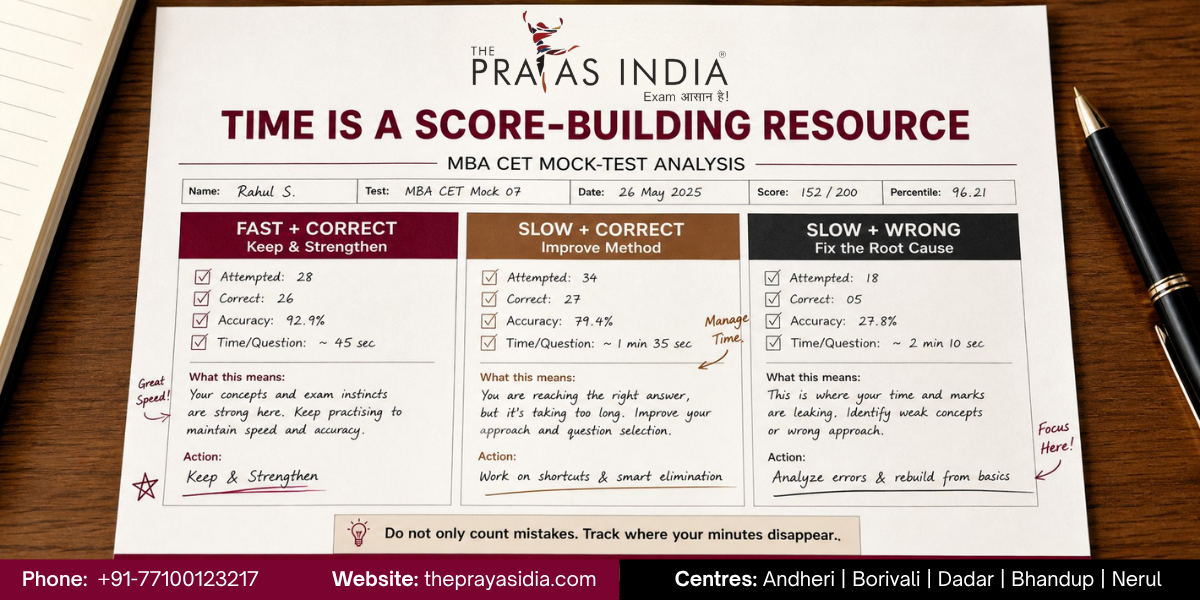
Step 3: Identify Time-Consuming Questions
Time is one of the most valuable resources in MBA CET.
Recent MAH MBA CET exam analyses have repeatedly highlighted the role of speed, time management and question selection, with some shifts described as manageable but lengthy.
Therefore, after every mock, identify the questions that consumed disproportionate time.
Create three categories:
Fast and Correct
These are high-value questions.
You should continue strengthening these areas because they contribute positively to both attempts and accuracy.
Slow but Correct
These require attention.
Ask:
Can I solve this type faster?
If yes, practise similar questions with a timer.
Slow and Wrong
These deserve the most scrutiny.
They may indicate:
- Weak concepts
- Poor question selection
- Inefficient solving methods
- Lack of familiarity
- Overthinking
These questions should become part of your correction plan.
A mock analysis should therefore help you answer:
“Where did my time go?”
rather than simply:
“How many marks did I get?”
Section-Wise Mock Analysis for MBA CET 2027
Mock analysis becomes much more effective when you examine each section separately.
A single overall score can hide important differences between Logical Reasoning, Abstract Reasoning, Quantitative Aptitude and Verbal Ability & Reading Comprehension.
The latest available preparation guidance for MAH MBA CET continues to emphasise consistent practice across these areas, along with speed, accuracy and mock analysis.
Logical Reasoning: Analyse Decisions, Not Just Answers
Logical Reasoning can contain a wide variety of question types. Recent 2026 analyses reported a mix of standalone reasoning questions and different logical structures, with time management and question selection playing an important role.
After your LR mock performance, ask:
- Which topics produced the most errors?
- Did I spend too much time understanding the question?
- Did I get trapped in lengthy questions?
- Were my mistakes conceptual or interpretational?
- Which question types can I solve quickly?
- Which question types repeatedly consume time?
For arrangement-based questions, analyse whether you created an efficient structure.
For coding, series or syllogism questions, check whether you recognised the pattern quickly.
For longer reasoning questions, evaluate whether you should have attempted them at all.
The objective is to improve decision quality.
Abstract Reasoning: Review Pattern Recognition
Abstract Reasoning rewards familiarity with recurring visual patterns.
A student may understand the basic logic behind a question but still take too long because the pattern does not become visible quickly enough.
After your mock, revisit every incorrect and time-consuming abstract reasoning question.
Ask:
- What pattern did I miss?
- Did I check rotation?
- Did I check movement?
- Did I check counting?
- Did I overlook position changes?
- Could I have rejected options faster?
Create a small “pattern notebook” containing recurring logic types.
The purpose is not to memorise individual questions.
It is to train your eyes to recognise structures faster.
Quantitative Aptitude: Separate Knowledge From Execution
Quant analysis should go beyond saying:
“I am weak in Quant.”
That statement is too broad to be useful.
Instead, identify exactly what is happening.
For example:
Arithmetic concepts are strong, but calculations are slow.
Or:
Percentages are comfortable, but Time and Work questions create confusion.
Or:
I understand the method but make frequent calculation mistakes.
Or:
I spend too long trying to complete difficult DI questions.
These are actionable findings.
Recent MAH MBA CET analyses have noted that Quant can become time-consuming because of calculation-heavy questions, making efficient solving and time management important.
Your correction plan should therefore be specific.
If the issue is concepts, revise.
If the issue is calculation, practise.
If the issue is speed, use timed sets.
If the issue is selection, analyse question difficulty and opportunity cost.
VARC: Analyse Reading Behaviour and Accuracy
VARC analysis should not stop at the number of correct answers.
If you performed poorly in Reading Comprehension, ask whether the issue was:
- Reading speed
- Passage understanding
- Question interpretation
- Option elimination
- Vocabulary
- Concentration
- Excessive time spent on one passage
Recent MAH MBA CET exam analyses have noted that RC can contribute significant reading time, reinforcing the importance of deciding which questions or passages deserve attention first.
If vocabulary is your weakness, build vocabulary.
If RC accuracy is low, analyse why the wrong option appeared attractive.
If you are spending too long on passages, practise timed reading and question selection.
Again, the goal is to identify the specific problem behind the score.
The Error Log: Your Most Valuable Mock-Analysis Tool
If there is one habit that every MBA CET 2027 aspirant should build, it is maintaining an error log.
An error log does not have to be complicated.
A simple notebook or spreadsheet is enough.
Record:
| Date | Section | Topic | Error Type | Reason | Corrective Action |
|---|---|---|---|---|---|
| Mock 1 | Quant | Percentages | Concept | Formula confusion | Revise concept |
| Mock 1 | LR | Arrangement | Time | Took too long | Timed practice |
| Mock 2 | VARC | RC | Interpretation | Misread question | Review options |
| Mock 2 | Abstract | Figure pattern | Concept | Missed rotation | Pattern practice |
The key is to record the reason, not simply the question.
Over several mocks, the error log starts revealing patterns.
You may discover that the same three topics appear repeatedly.
That is a much more useful insight than knowing that your score increased by five marks.

The 24-Hour Rule After a Mock
One useful discipline is to analyse your mock while the experience is still fresh.
Do not wait for a week.
The longer you wait, the more difficult it becomes to remember why you selected a particular question, why you skipped another, or where you started losing time.
A practical routine can be:
Immediately After the Mock
Record:
- Score
- Attempts
- Accuracy
- Section-wise performance
- Overall feeling about the paper
During Detailed Analysis
Review:
- Incorrect questions
- Unattempted questions
- Slow questions
- Guessed questions
- Conceptual gaps
- Careless mistakes
Before the Next Mock
Create a short correction plan.
For example:
Quant: 30 timed arithmetic questions
LR: 3 sets on the weak topic
VARC: 2 timed RC passages
Abstract: 25 pattern-recognition questions
Revision: Review previous error-log entries
This transforms mock analysis into an actual study plan.
Top Scorers Do Not Try to Fix Everything at Once
One common mistake is to discover ten weaknesses after a mock and attempt to correct all ten immediately.
That creates another problem: scattered preparation.
Instead, prioritise.
Use three levels:
Priority 1: Repeated Weaknesses
These are issues appearing across multiple tests.
They require immediate attention.
Priority 2: High-Time-Cost Mistakes
These may not happen frequently, but when they happen they consume significant time.
Work on these through timed practice and better selection.
Priority 3: Isolated Errors
If a mistake happened once and does not represent a pattern, review it but do not allow it to dominate your preparation.
This is where disciplined guidance can make preparation more efficient.
A structured coaching environment can help students review performance, identify recurring weaknesses and convert test results into targeted practice rather than simply taking one mock after another.
Score Improvement Should Be Measured Across Multiple Parameters
A higher mock score is obviously encouraging, but it is not the only measure of improvement.
Suppose your score changes like this:
Mock 1: 92
Mock 2: 98
Mock 3: 101
The upward movement is useful, but the deeper questions are:
- Did accuracy improve?
- Did attempts increase?
- Did time management improve?
- Did careless errors decrease?
- Did one weak section improve?
- Did your question selection become better?
Consider another example.
Your score may remain at 100, but your accuracy improves from 70% to 82%.
That can represent meaningful progress.
Similarly, if your attempts remain similar but your average time per question decreases, your preparation may be moving in the right direction.
Track:
Score + Attempts + Accuracy + Time + Errors + Section Performance
This gives you a much clearer picture of your preparation.
The Mock-to-Mock Improvement Cycle
The most effective approach is to create a continuous cycle:
MOCK → ANALYSE → IDENTIFY → PRACTISE → RETEST
The cycle should never stop.
Taking a mock without analysis creates limited learning.
Analysing without practice creates limited improvement.
Practising without retesting makes it difficult to know whether the correction worked.
The full cycle brings all three together.
For example:
You repeatedly make mistakes in a specific Quant topic.
You identify the problem.
You revise the concept.
You solve targeted questions.
You take another mock.
You check whether the error frequency and solving time have reduced.
If they have improved, the correction worked.
If they have not, your strategy needs another adjustment.
That is how mock tests become a learning system.

How The Prayas India Can Make Mock Analysis More Effective
For an MBA CET aspirant, taking a mock is easy.
Understanding the result correctly and converting it into a preparation plan is more difficult.
This is where structured guidance can become useful.
At The Prayas India, MBA CET preparation can be approached as a continuous process involving concept building, question practice, mock tests, performance review, revision and strategy refinement.
The objective is not simply to increase the number of tests you take.
It is to ensure that each test contributes to the next stage of preparation.
A structured preparation environment can help aspirants focus on areas such as:
- Topic-wise practice
- Sectional tests
- Full-length MBA CET mocks
- Speed and accuracy development
- Question-selection strategy
- Mock-test analysis
- Error identification
- Revision planning
- Performance tracking
- Exam-oriented preparation
This becomes particularly valuable for students who are preparing alongside college, work or other entrance examinations and need a more organised approach.
For students looking for MBA CET Coaching in Mumbai, the right coaching environment should therefore be evaluated not only by classroom teaching but also by how systematically it supports practice, testing, analysis and improvement.
A Practical MBA CET 2027 Mock Analysis Routine
A student does not need to spend an entire day analysing every mock.
The analysis can be structured.
Phase 1: Score Review
Spend a few minutes checking:
- Overall score
- Attempts
- Accuracy
- Section-wise performance
Phase 2: Wrong Answer Review
Review every incorrect question.
Classify it as:
Concept | Calculation | Interpretation | Selection | Careless | Guess
Phase 3: Time Review
Mark questions that took unusually long.
Ask whether they were worth the time.
Phase 4: Unattempted Review
Check whether unattempted questions were genuinely difficult or simply missed because of poor time management.
Phase 5: Action Plan
Choose a small number of corrections for the next preparation cycle.
For example:
One concept to revise
One topic to practise
One speed issue to address
One selection mistake to avoid
This makes the process manageable.
A Simple 7-Day Cycle Between Two Mocks
Students can also use a weekly cycle to connect analysis with preparation.
Day 1: Take the full-length mock.
Day 2: Complete detailed analysis and update the error log.
Day 3: Revise conceptual weaknesses.
Day 4: Practise questions from weak areas.
Day 5: Take timed sectional tests.
Day 6: Review errors and practise speed-based questions.
Day 7: Take the next mock or a targeted test, depending on your preparation stage.
The exact schedule can change depending on how close you are to the examination, but the principle remains the same:
Test → Learn → Correct → Test Again
Common Mock-Test Mistakes MBA CET Aspirants Should Avoid
Taking Too Many Mocks Without Analysis
More tests do not automatically mean better preparation.
If the same mistakes appear repeatedly, taking another mock without correction simply reproduces the same problem.
Obsessing Over Percentile Too Early
Early mocks are primarily diagnostic.
Use them to understand your preparation rather than allowing one score to determine your confidence.
Ignoring Correct but Slow Questions
A correct answer can still be inefficient.
Speed is part of performance.
Calling Every Error a “Silly Mistake”
If the same “silly mistake” happens five times, it is no longer an isolated incident.
It is a pattern that needs correction.
Not Reviewing Unattempted Questions
Some unattempted questions may have been easier than questions you spent several minutes solving.
That is a question-selection issue.
Changing the Entire Strategy After One Bad Mock
Mock difficulty can vary.
Do not redesign your complete preparation plan based on one result.
Look for patterns across multiple tests.
Solving Questions Without Tracking Progress
Without performance records, it becomes difficult to know whether your speed, accuracy and weak areas are actually improving.
How to Know Whether Your Mock Analysis Is Working
Your mock analysis is working when the next test reflects the corrections from the previous one.
Look for signs such as:
- Fewer repeated mistakes
- Better accuracy
- Reduced time on familiar question types
- Better question selection
- More confidence in strong areas
- Improved performance in previously weak topics
- Fewer careless errors
- More consistent section-wise performance
Your score should eventually reflect these improvements, but the process comes first.
The aim is not to chase a better score after every single test.
The aim is to build a preparation system in which your mistakes become less frequent and your decisions become better.
Admission-Focused Preparation for MBA CET 2027
MBA CET preparation ultimately connects to an important objective: securing admission to a good MBA/MMS programme.
That means preparation should not be treated as an isolated academic exercise.
Aspirants should build their preparation around the actual demands of the entrance examination while keeping their admission goals in mind.
For students planning to pursue MBA/MMS through MAH MBA CET, starting structured preparation early can create more room for concept building, practice, mock testing and correction.
The official Maharashtra State CET Cell is the authority responsible for the MAH MBA/MMS CET process and related examination/admission information, so candidates should always verify official dates and notifications when the 2027 cycle is announced.
For aspirants looking for MBA CET Coaching in Mumbai, this is also the right stage to compare preparation options based on factors such as:
- Faculty guidance
- Quality of study material
- Mock-test quality
- Mock analysis support
- Doubt-solving
- Personalised feedback
- Batch structure
- Practice schedule
- Revision support
- Admission guidance
A coaching programme should not simply help you finish chapters.
It should help you understand your performance and improve it systematically.
Final Takeaway: Your Next Mock Should Be Better Because of the Last One
A mock test becomes valuable only when you learn from it.
The score tells you what happened.
The analysis tells you why it happened.
The correction plan tells you what to do next.
And the next mock tells you whether your correction worked.
That is the real cycle behind consistent improvement.
For MBA CET 2027 aspirants, the goal should therefore not be to take mock tests simply to increase the number of tests completed. The goal should be to make every mock a source of useful information.
Analyse the wrong answers.
Review the correct but slow answers.
Track your time.
Study your unattempted questions.
Maintain an error log.
Identify repeated weaknesses.
Practise specifically.
Then test yourself again.
With a structured preparation approach, expert guidance and regular performance analysis, mock tests can become much more than practice papers. They can become a personalised roadmap for improving speed, accuracy, question selection and exam readiness.
If you are planning your MBA CET 2027 preparation and looking for structured MBA CET Coaching in Mumbai, The Prayas India can support your preparation with focused learning, regular practice, mock tests and performance-oriented guidance.
🚀 Admissions Open for MBA CET 2027 Preparation!
Cracking the MBA CET requires intense speed, accurate short-tricks, and simulated mock drills. Join The Prayas India ecosystem and clear your dream business school thresholds!
Contact Us
📞 Call Now: +91-77100 13217
🌐 Website: theprayasindia.com
💬 WhatsApp Us: Book a Free Demo Session
FAQs on MBA CET 2027 Mock Analysis
1. Why is mock analysis important for MBA CET 2027?
Mock analysis helps you identify the actual reasons behind incorrect answers, low attempts, excessive time consumption and repeated weaknesses. It allows you to convert a mock-test result into a specific improvement plan.
2. Should I analyse every MBA CET mock test?
Yes. Every full-length mock should ideally be analysed. Even when your score is good, reviewing time usage, accuracy, question selection and slow questions can reveal opportunities for improvement.
3. How long should I spend analysing an MBA CET mock?
The exact duration depends on the length and complexity of the test. The important point is to spend enough time to understand your mistakes and decisions rather than rushing immediately into another mock.
4. Should I analyse questions that I answered correctly?
Yes. Particularly review correct questions that took too long, involved guessing or required an inefficient approach. A correct answer is not necessarily an efficient answer.
5. What should I maintain in an MBA CET error log?
Record the section, topic, question type, mistake category, reason for the mistake and corrective action. You can also track repeated errors across multiple mocks.
6. How can mock analysis improve MBA CET speed?
It helps identify where you are losing time. You can then practise specific question types, improve calculation speed, change solving methods or improve question selection.
7. What should I do if my mock score does not improve?
Do not immediately increase the number of mocks. First check whether the same mistakes are recurring. Review your accuracy, attempts, time allocation and weak topics, then modify your preparation accordingly.
8. Are unattempted questions important during mock analysis?
Yes. Some unattempted questions may reveal knowledge gaps, while others may show that you spent too much time elsewhere. Reviewing them helps improve question selection and time management.
9. When should I start taking MBA CET 2027 mock tests?
The frequency should increase as your preparation develops. Initially, sectional and topic-based tests can help build skills. As your syllabus and fundamentals become stronger, full-length mocks can be used more systematically for exam simulation and performance analysis.
10. Can coaching help with MBA CET mock-test analysis?
A structured coaching programme can provide test schedules, performance feedback, solutions, targeted practice and guidance on improving speed, accuracy and question selection. The effectiveness ultimately depends on how consistently the student uses that feedback.