MBA CET Preparation Mistakes That Aspirants Should Avoid | Best MBA CET Coaching in Mumbai | The Prayas India
MBA CET preparation often looks straightforward on paper. The syllabus is familiar, the questions are generally manageable, and the exam rewards speed and accuracy. Yet many aspirants struggle to convert their preparation into a competitive score because the problem is not always a lack of effort. In many cases, it is the way that effort is being used.
A student may spend months solving questions but still repeat the same mistakes in mocks. Another may collect multiple books, PDFs and online resources but never develop a consistent revision system. Some aspirants focus heavily on difficult questions while losing marks on questions that they should have solved quickly. Others start taking mocks without understanding how to analyse them.
These preparation mistakes can become particularly costly in an exam where speed, question selection, accuracy and time management work together. MBA CET is not simply about knowing concepts; it is about using those concepts efficiently under intense time pressure.
For aspirants targeting a strong MBA CET score and competitive management institutes, preparation needs to be structured from the beginning. This is where the right guidance can make a significant difference. The Prayas India focuses on building exam-oriented preparation through structured learning, regular practice, doubt resolution, mock tests and performance analysis, helping students avoid the common traps that can slow down their progress.
This article examines the major MBA CET preparation mistakes aspirants should avoid and explains how a more organised approach can make preparation more effective.
Mistake 1: Starting Preparation Without Understanding the Exam
One of the first mistakes aspirants make is beginning preparation immediately without understanding how MBA CET actually tests them.
Students often start collecting books or solving questions because they believe that more practice automatically means better preparation. But before increasing practice volume, an aspirant needs to understand the nature of the examination, the different sections, the level of questions, the importance of speed and the role of question selection.
MBA CET preparation should therefore begin with an examination-oriented assessment of your current level.
You should know:
- Which areas are already strong?
- Which topics require conceptual work?
- Which sections consume too much time?
- Where are careless mistakes happening?
- How comfortable are you with solving questions under time pressure?
- Are you able to identify easy questions quickly?
This initial understanding allows preparation to become measurable rather than random.
The Prayas India Approach
At The Prayas India, preparation is not limited to simply completing a syllabus. The objective is to develop an exam-oriented system in which students understand concepts, practise different question types and gradually learn to apply those concepts under test conditions.
For an aspirant looking for MBA CET coaching in Mumbai, this structured approach can be particularly useful because it creates a defined preparation path instead of leaving the student to decide every aspect of preparation independently.
Mistake 2: Treating Every Topic as Equally Important
The MBA CET syllabus can appear extensive, and beginners often respond by giving every topic exactly the same amount of time.
That sounds disciplined, but it is not always efficient.
Aspirants should distinguish between topics that require significant conceptual development, topics that can become scoring areas through practice and topics where they repeatedly make mistakes. The objective is not to spend the same number of hours on every chapter. The objective is to maximise improvement from the available preparation time.
For example, a student may already be comfortable with basic arithmetic but struggle with data interpretation under time pressure. Another may understand logical reasoning concepts but take too long to solve arrangements. A third may know vocabulary but struggle with reading comprehension because of poor passage selection.
The preparation strategy should respond to these differences.
A useful way to divide topics is:
Strong Areas → Maintain through Practice
Average Areas → Improve through Targeted Practice
Weak Areas → Build through Concepts + Practice + Revision
This prevents preparation from becoming a simple checklist exercise.
Mistake 3: Focusing Only on Concepts and Ignoring Speed
Conceptual clarity is important, but MBA CET preparation cannot stop there.
A student can understand a question perfectly and still lose marks because the solution takes too long. In a speed-driven examination, this becomes a serious problem.
Once the basic concept is clear, the next stage should involve developing familiarity with question patterns. Repeated exposure helps students recognise the structure of questions faster and decide which approach is most efficient.
However, speed should not be forced from the first day.
A better progression is:
Understand → Practise → Improve Accuracy → Reduce Time → Apply Under Pressure
Trying to solve everything quickly before accuracy has stabilised can actually create careless errors. Students start rushing through calculations, misread conditions and select options without sufficient verification.
The goal is not simply to become fast. The goal is to become fast without becoming careless.
Mistake 4: Solving Questions Without Analysing Mistakes
One of the most common MBA CET preparation mistakes is measuring progress by the number of questions solved.
A student might proudly say, “I solved 100 questions today.” But the more important question is: What happened after those 100 questions?
If the same mistakes continue appearing, simply increasing the number of questions will not necessarily improve performance.
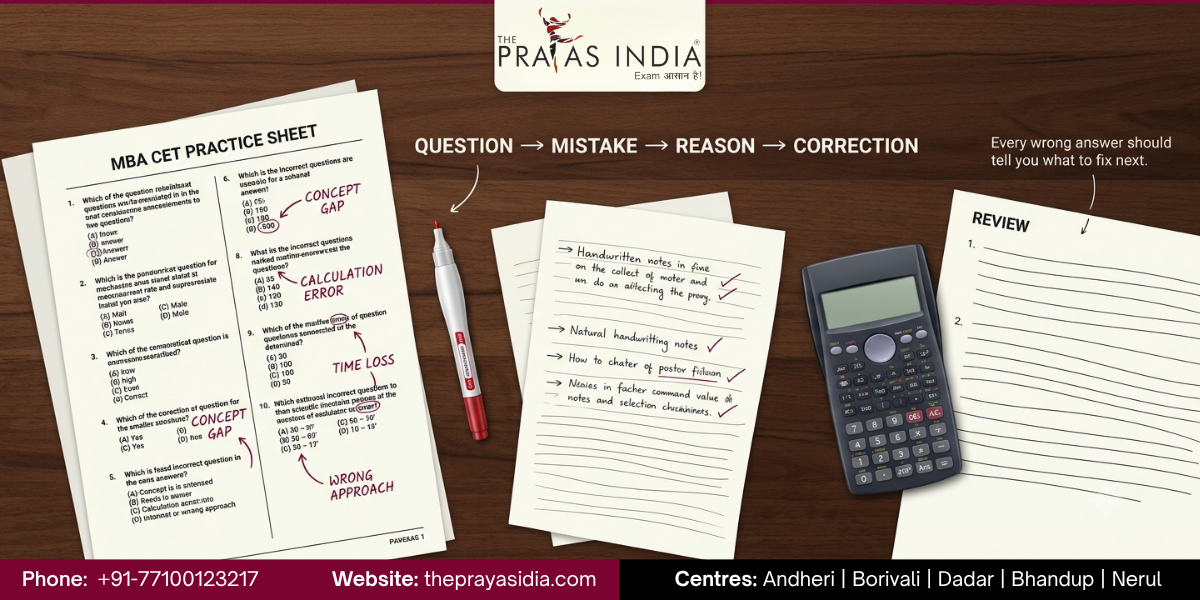
Every incorrect question should provide information.
Was the mistake caused by:
- Lack of conceptual clarity?
- Misreading the question?
- Incorrect calculation?
- Choosing the wrong method?
- Spending too much time?
- Confusion between two options?
- Guessing without sufficient elimination?
- Losing concentration?
This distinction is critical because different mistakes require different solutions.
A Better Review Habit
After a practice session, do not only check the answer key. Spend time reviewing the questions that were:
- Incorrect
- Correct but took too long
- Correct but involved guessing
- Skipped despite being solvable
- Solved using an unnecessarily complicated method
This type of review turns practice into learning.
Mistake 5: Taking Too Many Mocks Without Proper Analysis
Mock tests are essential for MBA CET preparation, but taking a large number of mocks does not automatically guarantee improvement.
Some aspirants take a mock, look at their score, compare it with their previous score and immediately start another test. This creates the illusion of preparation while ignoring the most valuable part of the process: analysis.
A mock test should function as a diagnostic tool.
If your score falls, you need to understand why. If your score increases, you need to identify which changes helped. Without this analysis, mock tests become repeated examinations rather than learning opportunities.
A proper mock review should examine:
- Attempts
- Correct answers
- Incorrect answers
- Unattempted questions
- Time spent
- Section-wise performance
- Questions that consumed excessive time
- Questions that could have been skipped
- Accuracy under pressure
- Repeated mistake patterns
The objective should be to enter the next mock with a correction plan.
Mistake 6: Ignoring Question Selection
MBA CET rewards candidates who can identify opportunities quickly.
Many students assume that every question must be solved because leaving questions unanswered feels like wasting an opportunity. This mindset can lead to significant time loss.
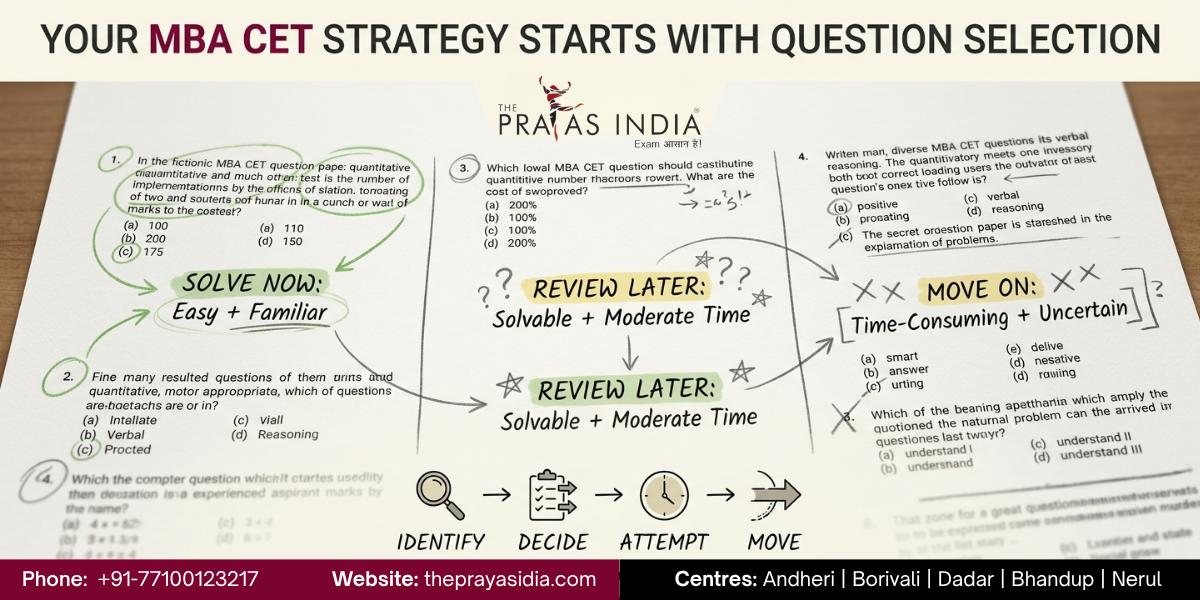
Strong preparation teaches students to distinguish between:
Easy and direct questions
Solvable questions requiring moderate effort
Time-consuming or uncertain questions
The ability to move away from an inefficient question is not a weakness. It is an important examination skill.
During practice, aspirants should consciously ask themselves:
“Is this question worth the time I am about to spend on it?”
Developing this habit before the examination makes decision-making more natural during the actual test.
Mistake 7: Using Too Many Study Resources
Another common problem is resource overload.
Students often move between multiple books, Telegram materials, YouTube videos, PDFs, question banks and mock-test platforms. Instead of improving preparation, this can create inconsistency.
Different sources may use different approaches, shortcuts and difficulty levels. Constantly switching between them can make it difficult to identify which method actually works for the student.
A more productive system is to maintain a limited and reliable preparation ecosystem.
Ideally, an aspirant should have:
- One structured source for concepts
- A dependable practice source
- Previous-year or exam-oriented questions
- A quality mock-test series
- A personal error log
- A revision system
This is one area where structured coaching can save significant preparation time. With The Prayas India, students can work within a guided preparation framework instead of continuously searching for disconnected resources.
The value of coaching is not merely having another set of study materials. It is having a structured system that tells you what to study, how to practise, where you are going wrong and what should be improved next.
Mistake 8: Neglecting the Analysis of Time-Consuming Questions
Aspirants usually pay attention to questions they get wrong. But questions they get right can also reveal preparation problems.
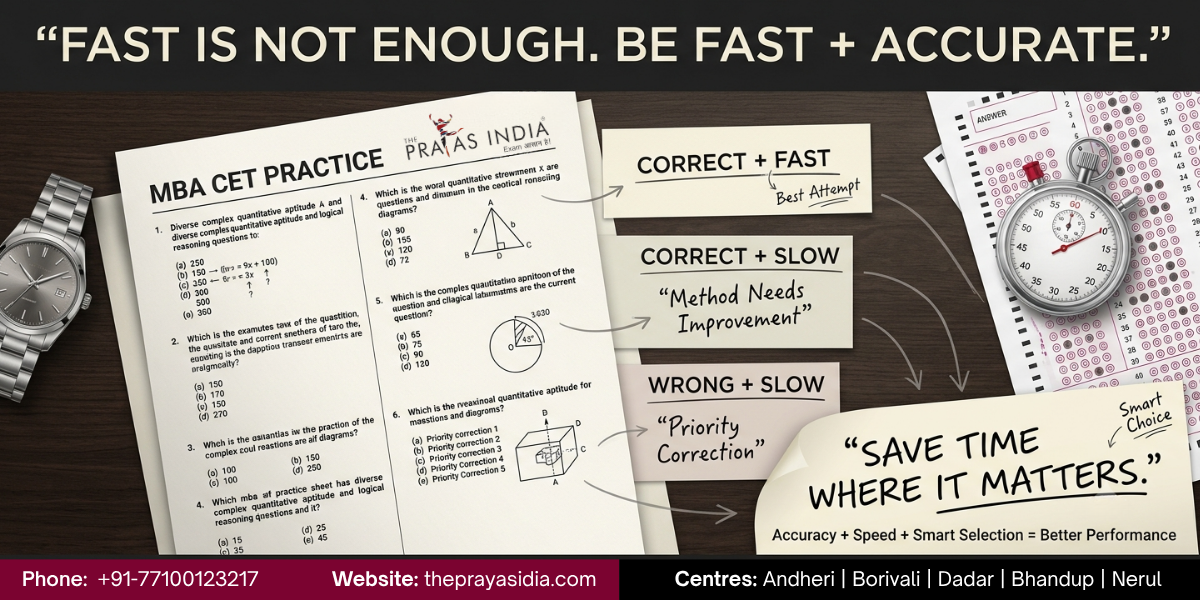
Suppose you solve a question correctly but spend three minutes on it. In isolation, that looks like success. In a competitive speed-based exam, however, the time cost may be too high.
This is why mock analysis should include time efficiency, not just accuracy.
Create three categories during your review:
| Performance | Meaning |
|---|---|
| Correct + Fast | Ideal performance |
| Correct + Slow | Method needs improvement |
| Incorrect + Slow | Priority area for correction |
Over time, this analysis can reveal whether your problem is knowledge, technique or decision-making.
For students preparing through The Prayas India, regular practice and test analysis can help turn these observations into a more structured improvement cycle rather than leaving students to interpret their performance on their own.
Mistake 9: Preparing Without a Revision System
Preparation often starts with enthusiasm but becomes difficult when the syllabus expands.
Students continue learning new topics while older concepts gradually disappear from memory. By the time they return to an earlier chapter, they may need to relearn much of it.
Revision should therefore be integrated into preparation from the beginning.
A simple cycle can be:
Learn → Practise → Revise → Test → Analyse → Revisit
Revision should not mean reading the entire chapter again every time. It can involve reviewing formulas, solving selected questions, revisiting error-log entries and practising previously difficult question types.
The closer the exam gets, the more important this cycle becomes.
Building a Better MBA CET Preparation System
Avoiding mistakes is only one side of effective preparation. The larger objective is to create a system in which mistakes are identified early enough to be corrected.
A strong MBA CET preparation structure can combine:
- Concept building
- Topic-wise practice
- Timed question sets
- Previous-question practice
- Sectional tests
- Full-length mocks
- Detailed mock analysis
- Error-log revision
- Strategy refinement
This is also where The Prayas India can play a stronger role in an aspirant’s preparation journey.
Instead of treating coaching as simply classroom teaching, students should look for an institute that supports the complete preparation cycle. The Prayas India’s MBA CET preparation approach is designed around structured learning, regular practice, test exposure, performance analysis and targeted improvement, helping aspirants build preparation habits that are aligned with the demands of the examination.
For students searching for the Best MBA CET Coaching in Mumbai, the right institute should therefore be evaluated not only by faculty or study material but by the complete academic ecosystem it provides.
Key Takeaway
MBA CET preparation mistakes are often small at the beginning, but repeated mistakes can have a significant impact on final performance. Preparing without a strategy, solving questions without analysis, chasing speed too early, taking mocks without reviewing them and using too many resources can all reduce the effectiveness of preparation.
The better approach is to make preparation structured, measurable and correction-driven.
At The Prayas India, aspirants can focus on a guided preparation process that combines learning, practice, testing and analysis. For students targeting MBA admissions through MBA CET and looking for MBA CET Coaching in Mumbai, this structured approach can help turn preparation time into more meaningful progress.
The bigger lesson is that MBA CET preparation is not simply about studying more. It is about creating a preparation system that produces measurable improvement. As the examination approaches, this becomes even more important because students have less time to experiment with ineffective methods.
The final phase of preparation should therefore focus on refining strategy, improving consistency, analysing performance and eliminating avoidable mistakes. For aspirants preparing for MBA admissions in Mumbai, having structured guidance can make this process considerably more organised. The Prayas India focuses on exam-oriented preparation that brings together concepts, practice, mock tests, analysis and continuous improvement.
Mistake 10: Treating Mock-Test Scores as the Final Measure of Preparation
A mock-test score is useful, but it is not the complete picture.
Some students become overconfident after scoring well in one mock, while others become discouraged after a poor performance. Both reactions can be misleading because mock difficulty, question selection and individual performance can vary from test to test.
Instead of asking only, “What score did I get?”, ask:
- How many questions did I attempt?
- How accurate were my attempts?
- Where did I lose time?
- Which questions should I have skipped?
- Which questions did I leave despite being capable of solving them?
- Which mistakes have appeared repeatedly?
- Did my strategy work under pressure?
This changes the purpose of a mock from score checking to performance diagnosis.
At The Prayas India, mock-test practice should be viewed as part of a broader preparation cycle. A test becomes significantly more valuable when the student understands the reasons behind the result and uses that information to modify the next stage of preparation.
Mistake 11: Not Developing a Section-Wise Strategy
Another common mistake is entering every section with the same approach.
Different areas demand different kinds of decision-making. Some questions can be solved almost immediately, while others require more calculation, reading or logical processing. A student who uses the same pace and attempt strategy throughout the paper may waste valuable time.
Your preparation should therefore identify:
Your strongest scoring areas: where you can collect marks quickly and confidently.
Your manageable areas: questions that require moderate effort but offer good returns.
Your time-consuming areas: question types that need careful selection.
This does not mean completely avoiding difficult topics. It means understanding how they fit into your overall examination strategy.
A good mock-analysis system should gradually help you answer questions such as:
Which questions should I attack first?
Which questions should I postpone?
When should I move away from a time-consuming problem?
Which areas provide the best return for my preparation?
These decisions become much easier when they are practised repeatedly before the actual examination.
Mistake 12: Ignoring Previous-Year Questions
Previous-year questions are among the most useful tools available to an MBA CET aspirant, yet some students postpone them until the final stages.
That is a mistake.
Exam-oriented questions help students understand the practical level and structure of the questions they are preparing for. They also help identify recurring concepts, common question formats and areas where the student is still uncomfortable.
However, previous-year questions should not be treated merely as another question bank.
After solving them, examine:
- What concept was tested?
- Was the question easy, moderate or time-consuming?
- Could there have been a faster approach?
- Was the difficulty created by the concept or by the way the question was framed?
- Did you select the correct option through logic or guesswork?
This turns previous-year practice into strategy-building.
Mistake 13: Leaving Revision Until the Last Few Days
One of the most damaging habits is postponing revision.
Students often spend most of their preparation period learning new concepts and assume that revision can be completed during the final week. This creates unnecessary pressure and reduces the time available for mock analysis.
Revision should happen continuously.
A practical cycle is:
Daily: revise important formulas, concepts or error-log entries.
Weekly: revisit difficult topics and incorrect questions.
After every mock: revise the concepts behind recurring mistakes.
Final phase: focus primarily on consolidation rather than learning everything from scratch.
This approach reduces the burden of last-minute revision and allows the final weeks to be used for strategy refinement.
Mistake 14: Trying to Improve Everything at Once
Aspirants sometimes identify ten weaknesses and attempt to correct all of them simultaneously.
This usually creates an overloaded schedule.
Suppose your mock analysis shows problems with calculation speed, reasoning arrangements, vocabulary, reading comprehension, question selection and time management. Trying to completely fix all six areas in one week may result in shallow improvement everywhere.
Instead, prioritise.
Use a Three-Level Correction System
Priority 1 — High-impact weakness
A weakness that repeatedly costs marks or significant time.
Priority 2 — Manageable weakness
An area where targeted practice can produce relatively quick improvement.
Priority 3 — Maintenance area
A strong area that only requires regular practice to remain stable.
This creates a more realistic preparation schedule.

Mistake 15: Preparing Without a Final-Phase Strategy
The final weeks of MBA CET preparation should not look identical to the first weeks.
Early preparation is primarily about learning. Later preparation should increasingly focus on application, speed, accuracy, selection and consistency.
A useful progression is:
Foundation Phase
Concept building and topic-wise practice.
Development Phase
Mixed practice, sectional tests and timed sets.
Testing Phase
Full-length mocks and detailed analysis.
Final Phase
Revision, strategy refinement and elimination of recurring mistakes.
Trying to learn every remaining topic right before the exam can create unnecessary anxiety. The final phase should instead focus on strengthening the areas that can realistically improve your performance.
Mistake 16: Ignoring Exam-Day Decision Making During Preparation
Exam-day strategy should not be invented on exam day.
Students should use mocks to experiment with different approaches before deciding what works best.
For example, one student may perform better by starting with highly familiar question types. Another may prefer moving systematically through sections. Someone else may need to be particularly careful about spending too much time on reasoning sets.
There is no single strategy that works identically for every aspirant.
The objective of mock practice is to discover your most efficient approach.
By the final phase, you should have a clear understanding of your preferred attempt sequence, time allocation, question-selection habits and recovery strategy if a section feels unexpectedly difficult.
Mistake 17: Allowing One Bad Mock to Affect the Entire Preparation
A poor mock is feedback, not a final verdict.
One difficult test can result from several factors: unusual question selection, fatigue, poor concentration, an unfamiliar pattern or simply a bad day. The important thing is to identify the reason instead of emotionally reacting to the score.
After a poor mock, review it objectively.
Ask:
- Was my accuracy lower than usual?
- Did I waste time on difficult questions?
- Did I panic after encountering unfamiliar questions?
- Were the mistakes conceptual or careless?
- Did I follow my planned strategy?
- What specific correction will I carry into the next mock?
This approach converts a disappointing performance into useful preparation data.
Mistake 18: Ignoring Consistency
MBA CET preparation is often disrupted not because students lack ability but because their study schedule keeps changing.
Aspirants may study for six hours one day and almost nothing the next. They may create ambitious timetables that are impossible to sustain and then feel guilty when they cannot follow them.
Consistency is more useful than occasional extreme study sessions.
A sustainable routine can include:
- Daily concept or revision work
- Regular timed practice
- Weekly sectional testing
- Full-length mocks at appropriate intervals
- Dedicated mock-analysis sessions
- Error-log revision
- Periodic strategy review
The objective is to create a rhythm that can be maintained for months.
A Practical MBA CET Preparation Framework
Once the major mistakes are removed, preparation becomes much easier to organise.
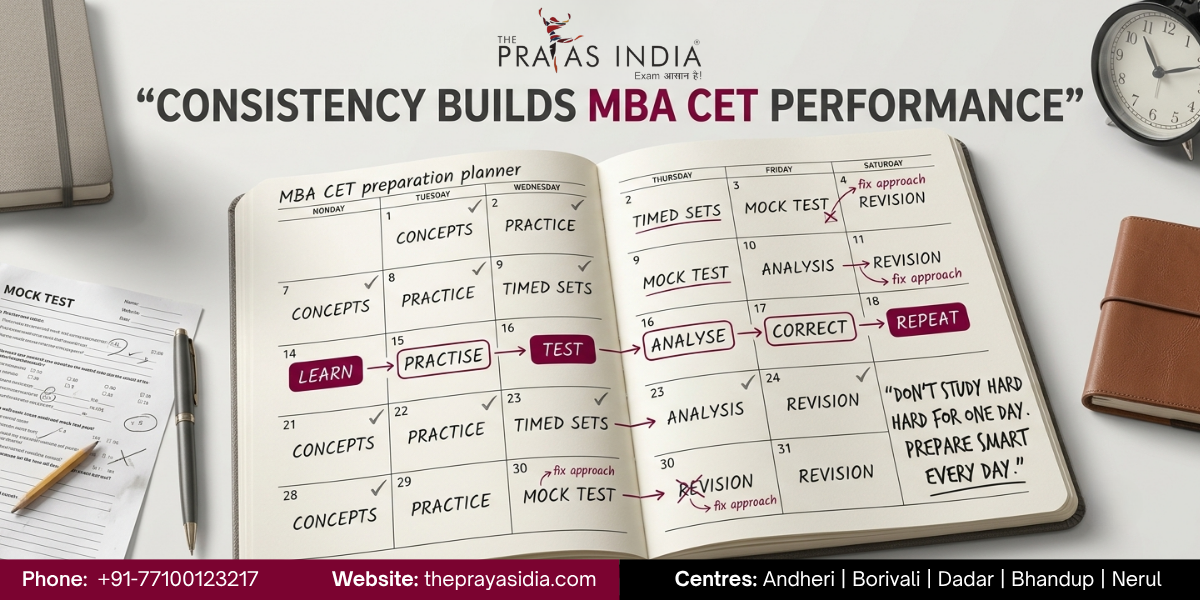
Aspirants can structure their preparation around the following cycle:
1. Learn
Build conceptual understanding through structured classes and reliable study material.
2. Practise
Solve questions topic-wise and gradually move toward mixed sets.
3. Time
Introduce timed practice after accuracy becomes stable.
4. Test
Use sectional tests and full-length mocks to simulate examination pressure.
5. Analyse
Identify conceptual errors, careless mistakes, time losses and poor question selection.
6. Correct
Work specifically on the weaknesses revealed through analysis.
7. Retest
Return to similar questions and check whether the correction actually worked.
This cycle should continue throughout the preparation period.
How The Prayas India Can Strengthen Your MBA CET Preparation
For many aspirants, the biggest challenge is not finding information. It is creating a system that connects everything together.
This is where The Prayas India becomes particularly relevant.
A structured MBA CET preparation programme can help students avoid the common problem of studying in isolation. Instead of independently deciding which topic to study, which questions to practise and when to take a mock, students can follow a more organised preparation pathway.
The Prayas India’s MBA CET coaching approach focuses on the complete preparation journey — concept clarity, practice, exam-oriented question solving, mock tests, performance analysis and continuous improvement.
For an aspirant searching for Best MBA CET Coaching in Mumbai, these factors matter because effective preparation requires more than classroom instruction.
The right coaching environment should provide:
- Structured topic-wise preparation
- Experienced faculty guidance
- Regular practice
- Doubt-solving support
- Exam-oriented study material
- Sectional and full-length tests
- Mock-test analysis
- Performance tracking
- Strategy guidance
- Consistent academic support
At The Prayas India, the focus should be on helping students become progressively more efficient rather than simply completing the syllabus.
This distinction is important. Completing chapters does not guarantee a strong MBA CET score. The real objective is to develop the ability to recognise questions, choose efficiently, solve accurately and manage time under pressure.
For students preparing for MBA admissions in Mumbai, joining a structured programme at The Prayas India can provide a more organised environment for developing these skills.
A 30-Day Mistake-Correction Plan for MBA CET Aspirants
Students who are already preparing can use the final month to focus on correction rather than completely rebuilding their preparation.
| Period | Main Focus | Priority |
|---|---|---|
| Days 1–7 | Identify recurring mistakes | Accuracy + Concepts |
| Days 8–14 | Targeted topic practice | Weak Areas |
| Days 15–21 | Timed sectional practice | Speed + Selection |
| Days 22–26 | Full-length mocks | Exam Strategy |
| Days 27–30 | Revision + strategy refinement | Consistency |
The most important point is to avoid constantly changing the plan. Once the weaknesses have been identified, the student should stay focused on correcting them.
Final MBA CET Preparation Checklist
Before entering the final stage of preparation, ask yourself:
- Do I understand the examination requirements?
- Have I identified my strongest and weakest areas?
- Am I practising with sufficient time pressure?
- Do I analyse every mock properly?
- Do I maintain an error log?
- Can I identify time-consuming questions quickly?
- Do I have a clear question-selection strategy?
- Am I revising regularly?
- Am I relying on too many resources?
- Do I know which mistakes repeatedly affect my score?
- Have I tested my exam strategy through mocks?
- Am I maintaining a sustainable study routine?
If several answers are “no”, these areas should become part of your immediate preparation plan.
Final Takeaway
MBA CET preparation mistakes are rarely dramatic. Most of them are small habits that are repeated for weeks or months: solving without analysing, taking mocks without learning from them, chasing speed without accuracy, collecting too many resources, ignoring revision or spending too much time on questions that do not justify the effort.
The good news is that these mistakes can be corrected.
The strongest preparation approach is one that continuously moves through learning, practice, testing, analysis and correction. Every mock should reveal something. Every mistake should lead to a correction. Every correction should be tested again.
For aspirants targeting MBA admissions and looking for MBA CET Coaching in Mumbai, structured guidance can make this process more systematic.
The Prayas India can be a valuable preparation partner for students who want a structured, exam-oriented approach to MBA CET preparation, supported by learning, practice, mock tests, analysis and strategic guidance.
The goal is not simply to prepare more.
It is to prepare smarter, eliminate avoidable mistakes and enter the MBA CET with a strategy that has already been tested.
Contact Us
- Call Now: +91-77100 13217
- Website: theprayasindia.com
- Centres: Andheri | Borivali | Dadar | Nerul | Bhandup
Frequently Asked Questions
1. What are the most common MBA CET preparation mistakes?
Common mistakes include studying without a strategy, ignoring mock-test analysis, using too many resources, focusing only on concepts, neglecting speed and accuracy, avoiding previous-year questions and postponing revision.
2. Is solving a large number of questions enough for MBA CET preparation?
No. Question quality and analysis are equally important. Aspirants should understand why they made mistakes and identify patterns in their performance.
3. When should I start taking MBA CET mock tests?
Mock tests should be introduced once you have developed a reasonable understanding of the major topics. They should then become increasingly regular as the examination approaches.
4. How should I analyse an MBA CET mock test?
Review incorrect answers, slow correct answers, guessed answers, unattempted solvable questions, time allocation and recurring mistakes. Use this information to create a correction plan.
5. Should I focus more on speed or accuracy?
Start with accuracy and gradually develop speed. The ideal MBA CET performance combines both because solving quickly is useful only when the answers are reliable.
6. Is coaching necessary for MBA CET preparation?
Self-study can work for some aspirants, but structured coaching can provide a defined preparation schedule, faculty guidance, practice material, mock tests and performance analysis. The right choice depends on the student's preparation needs.
7. How can The Prayas India help with MBA CET preparation?
The Prayas India provides a structured preparation environment focused on concepts, practice, test-taking, analysis and strategic improvement. Students looking for MBA CET coaching in Mumbai can explore its guided preparation approach.
8. How should I choose the Best MBA CET Coaching in Mumbai?
Consider faculty quality, teaching methodology, study material, practice support, mock tests, doubt resolution, performance analysis and the overall structure of the programme. A coaching institute should support the complete preparation cycle rather than only classroom teaching.
9. How important is mock-test analysis for MBA CET?
It is extremely important. A mock score tells you the result of one test, while detailed analysis tells you which behaviours and weaknesses are affecting your performance.
10. Can avoiding preparation mistakes improve my MBA CET score?
Yes. Eliminating repeated errors, improving question selection, reducing time wastage and maintaining accuracy can significantly improve the efficiency of your preparation.