
MBA CET Quant Preparation for Non-Maths Students | Best MBA CET Coaching in Mumbai | The Prayas India
For students from commerce, arts, humanities, management or other non-mathematics backgrounds, Quantitative Aptitude can often appear to be the most intimidating part of MBA CET preparation. The difficulty is not always that the mathematics itself is advanced. In many cases, the real problem is that students have spent several years away from mathematical problem-solving and therefore feel uncomfortable with calculations, formulas and unfamiliar question patterns.
This creates a psychological barrier even before preparation begins. A student may see a percentage, ratio or algebra question and immediately assume that it will be difficult. Another student may spend too much time trying to remember formulas without understanding how they are used. Some candidates avoid Quant altogether and concentrate heavily on Verbal Ability or Logical Reasoning because those sections feel more familiar.
That approach can become a serious disadvantage.
For an MBA CET aspirant, Quantitative Aptitude should not be treated as a subject reserved for students who studied Mathematics in higher classes. It is a skill that can be rebuilt through systematic practice. A non-maths student may initially require more time to develop calculation comfort, but with the right sequence of concepts, regular practice and proper analysis of mistakes, Quant can become a manageable and potentially high-scoring part of the preparation.
This is also where structured MBA CET coaching in Mumbai can make a meaningful difference. Instead of asking students to immediately solve difficult questions, a well-designed preparation programme can help them rebuild fundamentals, develop calculation confidence and gradually move towards exam-level practice.
The Real Challenge Is Often Confidence, Not Mathematics
One of the biggest misconceptions among non-maths students is that they are inherently weak at Quant. In reality, many students have simply lost touch with mathematical problem-solving.
There is an important difference between “I cannot solve Quant questions” and “I have not practised Quant questions consistently.”
The first statement creates a fixed mindset. The second identifies a preparation gap that can be addressed.
When students repeatedly avoid a section, their fear of it usually increases. When they start with manageable questions and experience small improvements, their confidence begins to change. A question that initially looked complicated can become familiar after the underlying concept has been explained and practised several times.
This is why non-maths students should not begin MBA CET Quant preparation by measuring themselves against candidates who have been practising mathematics regularly for years. The starting point should be their own current level.
Start by Rebuilding the Foundation
A non-maths student should resist the temptation to jump directly into advanced MBA entrance-level questions. If basic calculations are uncomfortable, difficult questions will only increase frustration.
The first stage should focus on rebuilding the mathematical foundation required for common Quant topics. This does not mean going back and studying every chapter of school mathematics. It means identifying the fundamental concepts that repeatedly appear in aptitude-based questions.
The initial focus can include:
- Basic arithmetic operations
- Fractions and decimals
- Percentages
- Ratio and proportion
- Averages
- Profit, loss and discount
- Simple and compound interest
- Time, speed and distance
- Time and work
- Basic algebra
- Geometry and mensuration
- Data interpretation fundamentals
The purpose of this stage is to make basic mathematical relationships familiar again. Once the foundation becomes comfortable, higher-level questions become considerably less intimidating.
Don’t Try to Learn Every Formula at Once
Formula memorisation is another area where non-maths students often struggle. They may collect pages of formulas and attempt to memorise everything before solving questions.
This usually produces limited results because formulas become meaningful only when students understand when and how to apply them.
Instead of memorising a large formula list in one sitting, learn formulas alongside questions. When you encounter a concept, understand the relationship first and then observe how the formula is used in different situations.
For example, when studying percentages, don’t focus only on remembering a formula. Understand how percentage change works, how successive changes interact and how percentages can be converted into fractions for faster calculations.
Once the underlying idea becomes clear, the formula becomes easier to remember.
Build Calculation Comfort Before Chasing Speed
Speed is important in MBA CET, but trying to become extremely fast before becoming accurate can create bad habits.
Non-maths students should initially prioritise correct calculation. If a question takes longer but the method is correct, that is useful progress. Once accuracy becomes stable, speed can be improved through repetition.
Calculation practice can gradually focus on areas such as:
- Fraction-to-percentage conversions
- Percentage calculations
- Ratio calculations
- Approximation
- Basic multiplication and division
- Squares and common numerical values
- Mental arithmetic
- Simplification
The objective is not to perform complicated calculations mentally. It is to reduce the unnecessary time spent on routine calculations.
As these operations become familiar, the student can devote more attention to understanding the actual question.
Learn Through Question Types, Not Just Chapters
Traditional mathematics preparation often follows a chapter-by-chapter approach. Aptitude preparation requires another layer of understanding: recognising question types.
Suppose you study percentages. The chapter may contain several different applications involving increase, decrease, comparison, successive changes and percentage-based quantities.
Your preparation should eventually help you recognise these patterns quickly.
When a new question appears, you should gradually develop the ability to ask:
What concept is being tested here?
What information has been provided?
What is the question actually asking me to calculate?
Is there a faster method available?
This pattern-recognition ability is particularly valuable for non-maths students because it reduces the feeling that every question is completely new.
Use an Easy-to-Difficult Progression
A common mistake is to use difficult questions as a measure of whether you are “good at Quant.” That is not a productive way to build confidence.
Your practice should progress through levels.
Begin with questions that test basic concepts. Once you can solve those consistently, move to moderate questions that require multiple steps. Only after that should you spend significant time on difficult or time-consuming problems.
This progression gives your brain repeated evidence that improvement is possible.
A practical sequence can be:
Concept → Basic Questions → Moderate Questions → Timed Practice → Mixed Sets → Mock Tests
Skipping the middle stages can make the preparation unnecessarily difficult.

Previous-Year Questions Are Essential
MBA CET preparation should not rely entirely on generic Quant practice. Previous-year questions help students understand the style, difficulty and recurring concepts associated with the examination.
For a non-maths student, this is especially useful because it provides context. Instead of wondering whether every mathematical topic is equally important, you can examine the types of questions that actually appear in the examination environment.
Previous-year questions can also reveal an important truth: not every question needs to be approached as a difficult mathematics problem. Many aptitude questions reward familiarity with basic concepts, logical interpretation and efficient calculation.
Use previous-year questions after learning a topic rather than waiting until the end of preparation.
Don’t Solve Every Question Using the Longest Method
One of the first things non-maths students should learn is that aptitude mathematics is not necessarily about reproducing textbook methods.
A long method may produce the correct answer, but it can consume valuable examination time.
As your preparation develops, start comparing different approaches. Ask whether a question can be solved through estimation, substitution, options, ratios or another shortcut.
However, shortcuts should not be memorised blindly. A shortcut is useful when you understand why it works and know when to apply it.
This is where experienced faculty guidance can be valuable. A good instructor can show students multiple approaches and explain the situations in which each method is appropriate.
Learn to Identify the Right Questions
MBA CET Quant preparation is not only about solving questions. It is also about making decisions.
During an actual examination, you may encounter a question that is technically solvable but requires too much time. Spending several minutes on it may prevent you from attempting multiple questions that you could have answered more efficiently.
Therefore, your practice should gradually develop question-selection skills.
When solving a mixed set, classify questions mentally:
- Questions you can solve immediately
- Questions that require moderate calculation
- Questions that appear time-consuming
- Questions where you are uncertain about the concept
This classification helps you understand your own solving behaviour.
Over time, you should become better at identifying where your time will produce the greatest return.
Quant Preparation Should Not Consume Your Entire Day
Non-maths students sometimes react to their fear of Quant by spending almost all their preparation time on it. This can create another problem: other sections receive insufficient attention.
MBA CET preparation requires balance. Quant should receive enough time to eliminate your weakness, but your overall study plan should continue to develop Logical Reasoning, Abstract Reasoning, Verbal Ability and other relevant areas.
The amount of time required for Quant depends on your starting level.
A student with a strong foundation may need targeted practice and speed improvement. A student returning to mathematics after several years may need a longer foundation-building phase.
The important point is to allocate time based on actual performance rather than fear.
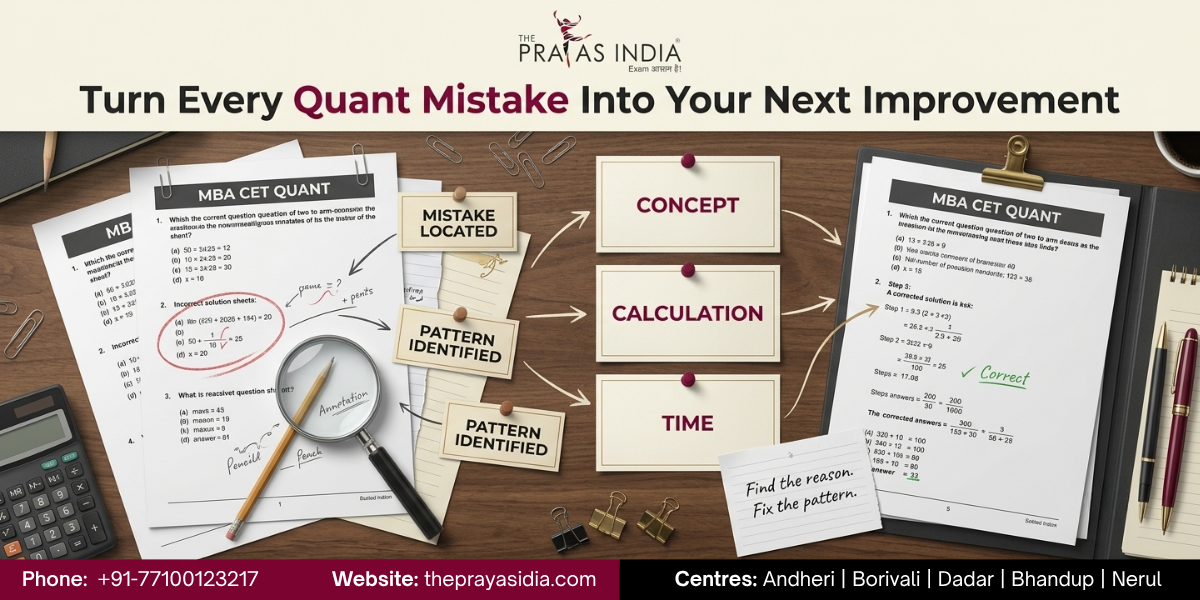
Create a Quant Error Notebook
One of the most effective ways for a non-maths student to improve is to understand exactly why mistakes are happening.
Maintain a small error notebook rather than simply marking wrong answers and moving on.
When you make a mistake, record the reason. Was the concept unclear? Did you calculate incorrectly? Did you misunderstand the question? Did you use an inefficient method? Did you make a careless mistake?
These categories matter because each requires a different solution.
A conceptual error requires learning.
A calculation error requires practice.
A question-reading error requires greater attention.
A time-management issue requires timed sets.
An inefficient approach may require learning an alternative method.
Without this analysis, students often repeat the same mistakes while believing they are practising.
Don’t Let One Difficult Topic Define Your Quant Ability
Every student will have topics that take longer to understand. Non-maths students may find certain areas particularly unfamiliar, but struggling with one topic does not mean the entire Quant section is beyond their ability.
Give difficult topics sufficient time, but do not allow them to dominate your preparation indefinitely.
If a topic continues to consume excessive time with little improvement, discuss it with your faculty or mentor and determine whether your approach needs to change.
At the same time, continue strengthening areas where you are already improving. Building a strong scoring base is often more productive than trying to become perfect at every single concept.
Make Revision a Continuous Process
Quant should not be studied once and then abandoned until the final weeks.
Concepts that are not used regularly can become unfamiliar again, particularly for students who are returning to mathematics after a long gap.
A better cycle is:
Learn → Practise → Revise → Test → Analyse → Revisit
After completing a topic, return to it periodically. Solve a few questions without looking at your notes and check whether you can still identify the appropriate method.
This creates retention and prevents the need to relearn entire topics later.
The Role of Mock Tests in Quant Preparation
Mock tests become increasingly important as your preparation progresses because they reveal the difference between knowing a concept and applying it under pressure.
A non-maths student may be able to solve a percentage question correctly during untimed practice but struggle to recognise it quickly in a mixed mock. Another student may solve questions accurately but spend too much time on calculations.
Mocks expose these differences.
After every test, analyse your Quant performance rather than focusing only on the total score. Identify questions that were easy but left unattempted, questions that consumed too much time and mistakes that could have been avoided.
This analysis should directly influence your next practice cycle.
A Better Way to Think About Quant
The most productive mindset for a non-maths student is not to ask, “How can I become a mathematics expert?”
The better question is:
“How can I become comfortable solving the types of Quant questions that matter for MBA CET?”
This change in perspective makes preparation more realistic.
You do not need to become an advanced mathematician. You need to develop conceptual clarity, calculation comfort, pattern recognition, accuracy and decision-making under time pressure.
That is a much more achievable objective.
How MBA CET Coaching Can Help Non-Maths Students
Structured coaching can be particularly useful for students who do not have a strong mathematical background because the biggest challenge is often knowing where to begin.
A well-structured MBA CET programme can introduce concepts progressively instead of expecting every student to start from the same level. Faculty can identify common misconceptions, demonstrate multiple solving approaches and provide graded practice before students move towards examination-level questions.
Regular classroom interaction also gives students an opportunity to ask questions immediately instead of allowing small conceptual gaps to become larger problems.
For students looking for MBA CET coaching in Mumbai, these factors should be considered carefully before taking admission. The best coaching environment is not necessarily the one that simply provides the largest number of lectures. It is the one that helps you understand concepts, practise intelligently, analyse performance and gradually become more independent.
What Non-Maths Students Should Look for Before Taking Admission
If you are a non-maths student considering MBA CET coaching, don’t evaluate an institute only on its location, advertisements or the number of classes offered.
Look at the complete preparation system.
Important factors include:
- Whether the faculty explains fundamentals clearly
- Whether Quant is taught progressively
- Whether practice material has different difficulty levels
- Whether previous-year questions are discussed
- Whether sectional and full-length mocks are provided
- Whether mock performance is analysed
- Whether students receive doubt-solving support
- Whether revision is incorporated into the programme
- Whether mentors help students improve their individual weaknesses
These factors become especially important when your starting point is different from that of students with a strong mathematical background.
The Prayas India and MBA CET Preparation
The Prayas India provides structured preparation support for aspirants targeting management entrance examinations. For MBA CET candidates, the preparation process should combine conceptual learning with extensive practice, test-taking and performance analysis.
For non-maths students in particular, structured guidance can help transform Quant from a subject that is avoided into one that is approached systematically. Instead of expecting immediate speed, the preparation journey can focus first on understanding, then accuracy, followed by efficiency and examination strategy.
Students exploring the best MBA CET coaching in Mumbai should therefore look beyond the label of “coaching” and examine how the institute supports the complete journey from foundation-building to exam readiness.
Start Where You Are, Not Where Others Are
Every MBA CET aspirant enters preparation with a different academic background. Comparing your starting point with someone else’s preparation can create unnecessary pressure.
If you are a non-maths student, your first objective should be to understand your current level honestly. Take a basic diagnostic test, identify your gaps and start building from there.
You may initially need more time for calculations. You may make more mistakes than students with stronger mathematical backgrounds. That is acceptable during the early stage.
What matters is whether your performance improves from one practice cycle to the next.
Quantitative Aptitude is not a permanent label attached to your academic background. It is a skill that can improve through deliberate practice.
And once the fear begins to disappear, you can start focusing on the more important question: How can I convert my improved Quant ability into a strong MBA CET score?
That transition—from avoiding Quant to strategically attempting it—is one of the most important milestones in preparation for a non-maths student.
Turning Quant Preparation into a Scoring Strategy
Once a non-maths student becomes comfortable with the fundamentals, the next challenge is to convert that understanding into examination performance. This is where preparation needs to become more strategic. Knowing how to solve a question is important, but MBA CET preparation also requires the ability to recognise the right approach quickly, manage time and decide which questions deserve immediate attention.
The transition from foundation-building to exam-oriented preparation should therefore happen gradually. Students should not suddenly replace concept practice with full-length mocks. Instead, they should introduce timed sets, mixed practice and increasingly challenging questions while continuing to revise their fundamentals.
The objective is to make Quant feel familiar enough that you can focus on decision-making rather than anxiety when you encounter a numerical question.
Prioritise Topics Instead of Treating Everything Equally
A common mistake among non-maths students is trying to master every Quant topic simultaneously. This can make preparation feel much larger than it actually is.
A better approach is to identify topics according to three factors: your comfort level, their relevance to your examination preparation and the amount of improvement you can realistically achieve through practice.
For example, if you are already becoming comfortable with percentages, averages and ratios, strengthening these areas can help you create a reliable base. At the same time, topics where you repeatedly make mistakes can be given additional attention rather than being ignored simply because they feel difficult.
Your priority list can broadly contain:
- Topics that you understand but solve slowly
- Topics where your accuracy is inconsistent
- Topics that appear unfamiliar and require conceptual work
- Topics where you are already comfortable and need maintenance practice
This approach prevents your preparation from becoming an endless attempt to achieve perfection everywhere.
Develop a Daily Quant Routine
Consistency matters more than occasional long study sessions. A student who spends five hours on Quant once a week may progress more slowly than someone who practises for a focused period every day.
Your daily routine does not need to be excessively long. What matters is that it contains different types of work.
A productive session can begin with a short calculation drill, followed by concept revision and question practice. Once your fundamentals improve, introduce a timed set and spend a few minutes analysing your errors.
This creates a continuous connection between learning and application.
The routine can gradually move through:
Calculation practice → Concept revision → Question solving → Timed set → Error analysis
The balance can change according to your preparation stage, but maintaining this cycle regularly is more important than following an unnecessarily complicated timetable.
Use Timed Practice Before Full-Length Mocks
Jumping directly from untimed practice to full-length mocks can be uncomfortable, especially for students rebuilding their mathematical confidence.
Timed sectional sets provide a useful middle stage.
Take a small group of questions and give yourself a fixed amount of time. Once the set is complete, check not only how many questions you solved but also how much time each type of question required.
If you are consistently solving correctly but slowly, efficiency needs improvement.
If you are solving quickly but making frequent errors, accuracy needs attention.
If you are unable to begin many questions because you do not recognise the concept, the problem may be conceptual rather than related to speed.
This makes timed practice a diagnostic tool rather than simply another test.
Learn the Difference Between Difficult and Time-Consuming
These two categories are not always the same.
A difficult question may require deeper thinking but still be solvable within a reasonable amount of time. A seemingly simple question can sometimes involve lengthy calculations and become inefficient in a competitive examination.
This distinction should become part of your MBA CET preparation.
During practice, start observing how long different question types take you. Over time, you will develop an internal sense of which questions deserve immediate attention and which should be postponed.
That skill becomes increasingly valuable when every minute of the examination matters.
Build a Question-Selection Habit
Question selection should not be introduced only during the final mock tests. It should become part of your regular practice.
When working through a mixed Quant set, do not automatically solve questions in the order presented. Quickly scan them and identify questions that appear familiar, questions that require moderate work and questions that may consume significant time.
Initially, this process may feel slower. With practice, however, recognition becomes faster.
The goal is not to avoid difficult questions permanently. The goal is to ensure that difficult questions do not prevent you from attempting questions that could have produced marks more efficiently.
Improve Speed Without Sacrificing Accuracy
Speed and accuracy should develop together.
If you attempt to increase speed aggressively, careless calculation errors can increase. If you focus exclusively on accuracy, you may become too slow for the examination environment.
The ideal progression is to establish a reliable method first and then make that method more efficient.
For every frequently practised topic, ask yourself whether you are:
- Using unnecessary calculation steps
- Repeating calculations that could be simplified
- Missing a shorter conceptual approach
- Spending too much time interpreting the question
- Making avoidable calculation errors
The purpose of speed-building is not to rush. It is to remove unnecessary effort.
Make Your Shortcuts Personal
There are numerous Quant shortcuts available online and in preparation material, but memorising every shortcut is not necessary.
A shortcut becomes valuable when you understand it and can recall it naturally during a timed test.
If a particular method consistently saves you time, add it to your personal revision notes. If another shortcut creates confusion, there is no need to force yourself to use it.
Your final strategy should be based on methods that are reliable for you.
This is one area where classroom guidance can make preparation more efficient. Faculty can introduce alternative methods and help students determine which approach suits their solving style.
Analyse Every Quant Mistake Properly
Mock-test analysis should go beyond checking the correct answer.
For every important mistake, determine its category. A useful analysis can ask:
Did I not know the concept?
Did I understand the concept but apply it incorrectly?
Was the calculation wrong?
Did I misunderstand the wording?
Did I spend too much time on the question?
Could I have used a simpler method?
This classification turns mistakes into actionable information.
If ten wrong answers come from ten different causes, you may need broader improvement. If seven mistakes come from the same type of calculation, you have identified a specific weakness that can be addressed directly.
Don’t Ignore Questions You Left Unattempted
Wrong answers are not the only source of lost marks.
During mock analysis, also examine questions you left unanswered. Some may have been genuinely difficult, but others may have been easy questions that you failed to identify quickly.
These missed opportunities can be extremely useful for improving question selection.
Create a separate mental category for “easy but missed” questions. If the number of such questions decreases over time, your examination awareness is improving.
Use Mixed Sets to Develop Flexibility
Chapter-wise practice tells you whether you understand a topic. Mixed practice tells you whether you can identify that topic when it is presented without a label.
This is an important transition.
A mixed set may move from percentages to algebra, then geometry, followed by an arithmetic-based question. You need to shift your thinking quickly.
This flexibility is developed through repeated exposure.
As your preparation advances, gradually increase the proportion of mixed practice in your routine rather than staying dependent on chapter-specific question sets.
Build a Weekly Performance Review
Instead of evaluating yourself every day based on how many questions you completed, conduct a broader review at the end of each week.
Look at the previous week’s practice and identify patterns.
Are you making fewer calculation mistakes? Are you solving familiar questions faster? Are certain topics repeatedly appearing in your error log? Are your timed-set scores improving?
A weekly review prevents you from becoming emotionally attached to individual practice sessions.
One difficult test does not mean your preparation is failing, just as one excellent score does not guarantee complete readiness. The trend is more useful.
Keep Quant Connected to Your Overall MBA CET Strategy
Quant should be treated as one component of your complete MBA CET preparation rather than an isolated battle.
If you spend all your available preparation time trying to eliminate every Quant weakness, your performance in other sections may suffer.
A balanced preparation plan should distribute time according to your strengths, weaknesses and target score.
Students who are weak in Quant may initially give it additional attention, but that additional time should gradually reduce once the weakness becomes manageable.
The ultimate objective is a balanced score, not simply a strong Quant section.
How to Prepare Quant if You Have a Full-Time Schedule
Students managing college, employment or other responsibilities may find it difficult to dedicate several hours to Quant every day. In such cases, consistency becomes even more important.
Short sessions can be distributed across the day. For example, calculation practice can be done during one short session, while concept learning and question practice can be scheduled later.
The exact timetable depends on your schedule, but the principle remains the same: avoid allowing several days to pass without touching Quant.
Regular exposure keeps the concepts active and makes the subject less intimidating.
The Last Stage Should Focus on Consolidation
As the MBA CET examination approaches, your preparation should gradually move towards consolidation.
This is not the ideal stage to collect multiple new books, switch between teachers or start completely unfamiliar resources without a clear reason.
Instead, revise the concepts you have already studied and use your mock-test analysis to determine where additional practice is required.
Your final-stage preparation can focus on:
- Important formulas and concepts
- Frequently repeated question types
- Calculation techniques
- Personal shortcut notes
- Previous-year questions
- Mistakes from mock tests
- Timed Quant sets
- Questions that were previously left unattempted
The closer you get to the examination, the more personalised your revision should become.
What a Non-Maths Student Should Expect From Coaching
A major benefit of structured coaching is that it can reduce the uncertainty surrounding preparation.
For a student with a strong mathematics background, independent preparation may be relatively straightforward. For a non-maths student, the bigger question can be where to start, what to prioritise and how to know whether progress is actually happening.
A structured MBA CET programme can provide a progression from fundamental concepts to examination-level questions. Regular classes, practice assignments, doubt-solving, sectional tests and performance analysis can create an environment in which students are not left to design every aspect of their preparation independently.
However, coaching should complement self-study rather than replace it. The student still needs to practise consistently and analyse individual performance.
Choosing the Right MBA CET Coaching in Mumbai
Students searching for the best MBA CET coaching in Mumbai should evaluate the institute according to their own preparation requirements.
For a non-maths student, the quality of Quant instruction can be particularly important. Ask whether the teaching approach starts from fundamentals, whether different solving methods are explained and whether students receive enough graded practice before moving to difficult questions.
Also consider the broader academic system. A strong preparation programme should ideally provide support for the complete examination journey rather than focusing only on classroom lectures.
Before taking admission, look at:
- Faculty and teaching methodology
- Foundation support for non-maths students
- Quality and structure of study material
- Practice assignments
- Previous-year question coverage
- Sectional and full-length mock tests
- Mock-test analysis
- Doubt-solving support
- Revision planning
- Mentorship and academic guidance
These factors can help you assess whether an institute is genuinely suitable for your preparation level.

The Prayas India: A Structured Approach to MBA CET Preparation
The Prayas India focuses on structured preparation for competitive and management entrance examinations. For MBA CET aspirants, a systematic approach can combine conceptual learning, practice, revision, mock tests and performance analysis.
For non-maths students, this structured environment can be especially useful during the initial stage of preparation when confidence and mathematical familiarity are still developing.
The goal is not to label students according to their academic background. The focus should be on identifying the starting level, strengthening the fundamentals and gradually building examination readiness.
Students considering MBA CET coaching in Mumbai can evaluate The Prayas India based on how its preparation structure aligns with their individual goals, current level and preferred learning approach.
Admission Is the Beginning of the Preparation Journey
Choosing coaching should not be viewed as simply purchasing a set of lectures. It is a decision about the preparation environment in which you will spend a significant part of your MBA entrance journey.
For a non-maths student, the right environment can provide the structure required to move from hesitation to confidence. But the final outcome will still depend on consistent practice, revision and the willingness to analyse mistakes.
If you are considering admission to an MBA CET coaching programme, look for an institute where your weaknesses can be addressed systematically rather than simply being given more material.
The best preparation system is one that helps you understand what to study, how to practise it, how to measure improvement and what to change when progress slows.
Final Takeaway
Being a non-maths student does not automatically put you at a disadvantage in MBA CET Quantitative Aptitude. It may mean that your preparation needs to begin with stronger foundations and more deliberate calculation practice.
Start with concepts. Build accuracy. Introduce timed practice. Learn to identify question types. Analyse mistakes. Gradually improve speed. Then bring these skills together through mixed sets and mock tests.
Most importantly, stop viewing your academic background as a prediction of your final performance.
Your current Quant level is simply your starting point.
With consistent practice and the right preparation structure, a section that once seemed intimidating can become a manageable and strategically useful part of your MBA CET preparation.
For students seeking MBA CET coaching in Mumbai, the right coaching environment can provide the structure, guidance and practice needed to make that transition more systematic.
The goal is not to become a mathematics expert.
The goal is to become an MBA CET aspirant who can recognise the right question, choose the right method, solve it accurately and move forward with confidence.
Contact Us
- Call Now: +91-77100 13217
- Website: theprayasindia.com
- Centres: Andheri | Borivali | Dadar | Nerul | Bhandup
FAQs
1. Can non-maths students crack MBA CET?
Yes. A non-maths background does not prevent a candidate from preparing effectively for MBA CET. The key is to build quantitative fundamentals, practise consistently, improve calculation comfort and develop an examination-oriented approach.
2. How should a non-maths student start MBA CET Quant preparation?
Start with basic arithmetic and calculation skills before moving towards more challenging questions. Build your preparation progressively through concepts, basic practice, timed sets, mixed questions and mock tests.
3. Which Quant topics should non-maths students focus on first?
Topics such as percentages, ratios, averages, profit and loss, time and work, time-speed-distance and basic algebra can form an important foundation. Your exact priorities should ultimately depend on your preparation level and practice performance.
4. How can I improve my Quantitative Aptitude speed?
First establish accuracy and a reliable solving method. Then introduce timed practice, calculation drills and alternative approaches. Speed should come from efficiency and familiarity rather than simply attempting to solve everything faster.
5. Should non-maths students use Quant shortcuts?
Shortcuts can be useful when you understand the underlying concept and know when the method is applicable. Avoid trying to memorise every shortcut available; focus on methods that you can use accurately under time pressure.
6. How many hours should I study Quant every day?
There is no fixed number suitable for every student. Your Quant study time should depend on your current level, target score and overall MBA CET preparation schedule. Consistent daily practice is generally more useful than occasional long sessions.
7. How important are mock tests for MBA CET Quant preparation?
Mock tests help you evaluate your accuracy, speed, question selection and ability to perform under time pressure. However, mock analysis is equally important because it identifies the specific weaknesses that need additional practice.
8. Why do I make mistakes even when I know the Quant concept?
The problem may be calculation accuracy, question interpretation, time pressure or method selection. Analysing the reason behind each mistake can help you identify the actual weakness instead of simply revising the entire chapter again.
9. Can coaching help if I am extremely weak in Mathematics?
A structured coaching programme can help by providing progressive concept-building, guided practice, doubt-solving and regular testing. However, consistent individual practice remains essential for improvement.
10. What should I look for in the best MBA CET coaching in Mumbai?
Look at faculty quality, foundation support, study material, practice structure, mock tests, performance analysis, doubt-solving and mentorship. Non-maths students should pay particular attention to whether the institute supports students from the fundamentals onwards.
11. Should I study Quant separately from the other MBA CET sections?
Quant requires dedicated practice, but it should remain part of a balanced preparation plan. Avoid allowing one weak section to consume so much time that your performance in other areas suffers.
12. Can a non-maths student improve Quant without studying advanced mathematics?
Yes. MBA CET Quant preparation is primarily about developing the skills required to solve aptitude-based questions efficiently. You do not need to become an advanced mathematics student to develop strong examination performance.