SSC CGL Daily Study Plan 2026: How Many Hours Should You Study? | Best SSC Coaching in Mumbai | The Prayas India
Preparing for SSC CGL 2026 can quickly become confusing when every aspirant seems to have a different study schedule.
One student studies for 10 hours a day. Another studies for 6 hours. Someone else manages preparation alongside college or a job with only 3–4 focused hours.
So, the obvious question is:
How many hours should you actually study for SSC CGL 2026?
The answer is not simply “8 hours” or “10 hours.”
For SSC CGL, the quality of your study hours matters more than the number written on your timetable.
A focused 5-hour study session with proper revision, practice and mock analysis can be more productive than 10 hours of distracted preparation.
The right SSC CGL study plan should balance:
- Quantitative Aptitude
- General Intelligence & Reasoning
- English Comprehension
- General Awareness
- Revision
- Previous-year questions
- Mock tests
- Mistake analysis
Most importantly, your daily schedule should be sustainable enough to follow for several months.
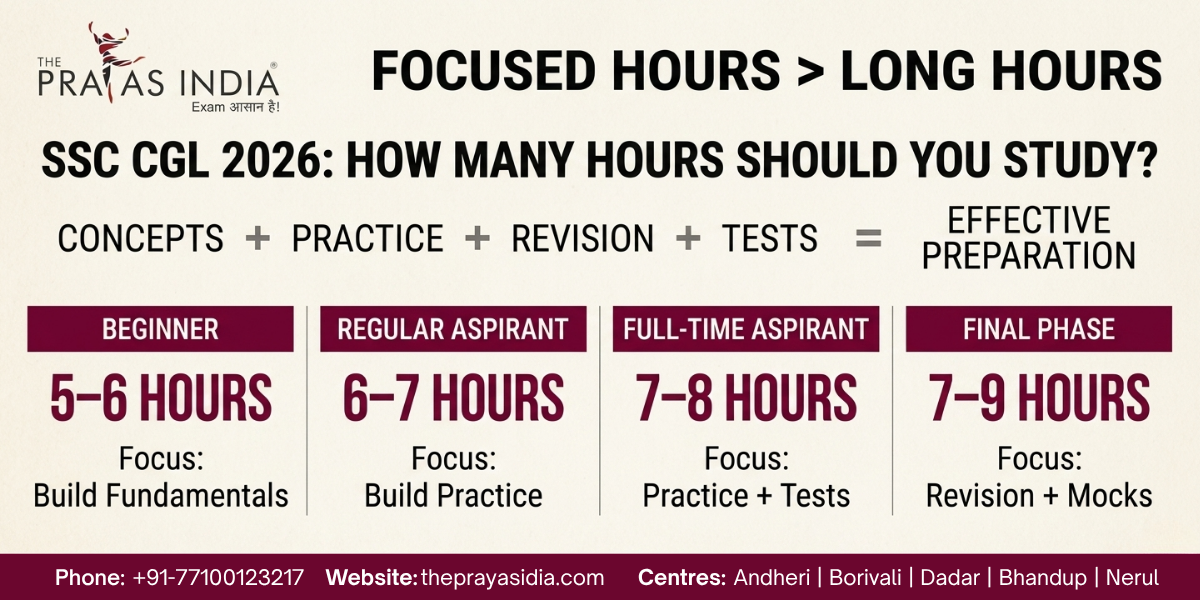
How Many Hours Should You Study for SSC CGL 2026?
There is no fixed number of hours that works for every candidate.
Your ideal study time depends on your current level, preparation stage and daily responsibilities.
A practical range can be:
| Aspirant Type | Focused Study Time |
|---|---|
| Beginner | 5–6 hours/day |
| Regular College Student | 4–6 hours/day |
| Full-Time Aspirant | 6–8 hours/day |
| Working Candidate | 3–5 hours/day |
| Final Preparation Phase | 7–9 hours/day |
These are focused study hours, not the total time spent sitting with books.
For example, if you sit at your desk for 8 hours but spend two hours checking your phone, taking unnecessary breaks and switching between subjects, your actual productive study time may be much lower.
Instead of asking:
“How long did I sit today?”
ask:
“What did I complete today?”
That change in mindset can make your preparation much more effective.
Your Study Plan Should Change With Your Preparation Stage
A common mistake among SSC CGL aspirants is following the same timetable throughout their preparation.
Your requirements change as the examination approaches.
A useful preparation journey can be divided into four stages:
Stage 1: Foundation Building
Understand concepts and identify weak areas.
Stage 2: Intensive Practice
Increase question-solving and PYQ practice.
Stage 3: Testing & Improvement
Introduce regular sectional and full-length mocks.
Stage 4: Final Revision
Focus on speed, accuracy, revision and exam-specific strategy.
Your daily study hours can also increase gradually as you approach the examination.
Stage 1: Building Your SSC CGL Foundation
If you are beginning your SSC CGL preparation, don’t try to complete everything at once.
Your first objective should be to understand the syllabus and build basic concepts.
For example, in Quantitative Aptitude, you may need to strengthen:
- Percentage
- Ratio
- Average
- Profit & Loss
- Simple & Compound Interest
- Time & Work
- Time, Speed & Distance
- Algebra
- Geometry
- Mensuration
- Trigonometry
- Data Interpretation
Similarly, English requires a combination of grammar, vocabulary, comprehension and practice.
Reasoning requires familiarity with different question types and logical patterns.
General Awareness requires a consistent revision system.
Recommended Focus
5–6 focused hours per day
A possible structure:
Quant: 1.5 hours
English: 1 hour
Reasoning: 1 hour
General Awareness: 1 hour
Revision/PYQs: 30–60 minutes
Don’t worry if your speed is initially low.
The foundation stage is about understanding before rushing toward speed.
Stage 2: Increase Practice Intensity
Once your fundamentals become stronger, your study plan should become more practice-oriented.
Now, simply watching lectures or reading notes is not enough.
You need to solve questions.
Your daily preparation should increasingly include:
Concept → Questions → PYQs → Analysis → Revision
At this stage, aim for around:
6–7 focused hours per day
A practical distribution could be:
- Quantitative Aptitude — 2 hours
- Reasoning — 1.5 hours
- English — 1 hour
- General Awareness — 1 hour
- PYQs/Revision — 30–60 minutes
You can adjust this depending on your strengths and weaknesses.
For example, if your Quant is strong but English accuracy is weak, you don’t need to divide your time equally.
Give additional time to the area that is limiting your score.
Don’t Divide Your Time Equally Between Subjects
This is an important point.
A timetable that says:
2 hours Quant + 2 hours Reasoning + 2 hours English + 2 hours GA
may look organised.
But it may not be efficient.
Suppose your current performance looks like this:
- Quant: Strong
- Reasoning: Strong
- English: Average
- GA: Weak
Giving exactly equal time to every subject may not produce the fastest improvement.
Your study plan should be based on score gaps.
A better approach is:
Strong Subject
Maintain performance.
Average Subject
Improve accuracy and speed.
Weak Subject
Build concepts + practise consistently.
This makes your daily study plan more personalised.
The 3-Hour Rule for Difficult Subjects
When you’re struggling with a subject, simply adding more hours doesn’t always solve the problem.
For example, spending three continuous hours doing Quant questions may eventually reduce your concentration.
Instead, use shorter focused blocks.
A useful approach is:
60–90 minutes focused study
↓
Short break
↓
60–90 minutes focused practice
This can help you maintain concentration without making the timetable unnecessarily exhausting.
Remember:
Your brain needs recovery just as your body does.
A sustainable schedule is more valuable than an extreme schedule that lasts only five days.
Build Your Day Around High-Value Tasks
Not all study activities have the same value.
For SSC CGL, you should prioritise activities that directly improve your examination performance.
High-Value Activities
- Solving PYQs
- Practising difficult topics
- Revising mistakes
- Taking timed tests
- Analysing mocks
- Revising vocabulary
- Practising calculations
- Revising important GA topics
Lower-Value Activities
- Repeatedly watching lectures without practice
- Making excessively decorative notes
- Reading the same chapter multiple times
- Solving only easy questions
- Spending too much time organising study material
The purpose of a timetable is not to make your day look busy.
It is to make your preparation measurably better.
Why PYQs Should Have a Fixed Place in Your Daily Plan
Previous-year questions should not be something you start solving only after completing the syllabus.
SSC CGL PYQs can help you understand:
- Frequently tested concepts
- Question patterns
- Difficulty level
- Repeated topics
- Calculation requirements
- Common traps
- Time pressure
Try to include PYQ practice regularly.
For example:
Quant: Topic-wise PYQs
Reasoning: Mixed PYQs
English: Grammar + vocabulary + comprehension PYQs
GA: Topic-wise revision and previous questions
This gives your preparation an exam-oriented direction.
A Daily Study Plan Is Not Complete Without Revision
One of the biggest reasons students forget what they studied is simple:
They don’t revise systematically.
You can study a topic today and remember it well.
After two weeks, much of that information may disappear if you don’t revisit it.
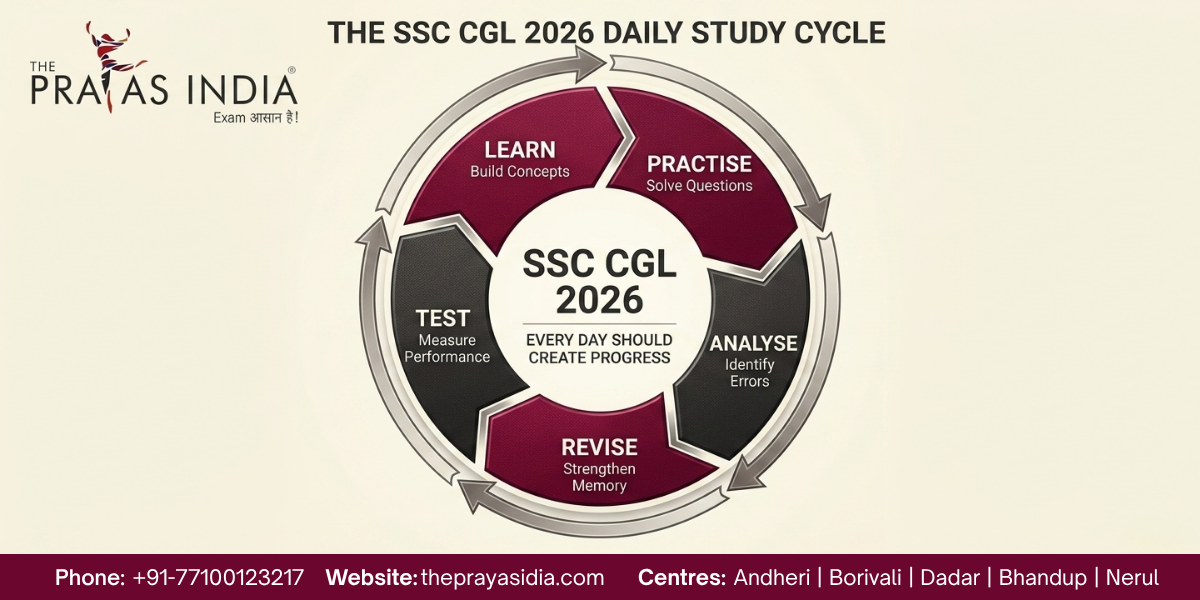
A practical revision structure is:
Daily Revision
Review important mistakes and short notes.
Weekly Revision
Revisit topics studied during the week.
Monthly Revision
Review accumulated weak areas and important facts.
This creates repeated exposure without requiring you to relearn everything from the beginning.
What Should a 6-Hour SSC CGL Study Day Look Like?
If you have approximately six focused hours available, you could structure the day like this:
Session 1 — Quantitative Aptitude
90 minutes
Concept revision + practice questions.
Session 2 — English
60 minutes
Grammar, vocabulary and comprehension.
Session 3 — Reasoning
60 minutes
Topic practice + PYQs.
Session 4 — General Awareness
60 minutes
Static GK/current revision.
Session 5 — PYQs / Weak Area
60 minutes
Target the area where your performance is weakest.
Session 6 — Revision
30 minutes
Review mistakes, formulas, vocabulary or important facts.
This is only a framework.
You can move subjects around according to your concentration levels.
For example, if you are most productive in the morning, use your first session for your weakest or most demanding subject.
Don’t Forget Calculation Practice
For SSC CGL, calculation speed can influence your performance significantly, particularly in Quant.
Instead of treating calculations as a separate long study session, incorporate short practice into your daily routine.
Spend 10–15 minutes regularly on:
- Tables
- Squares
- Cubes
- Fractions
- Percentage conversions
- Approximation
- Mental calculations
The objective isn’t to perform complicated calculations.
It is to make common calculations more automatic.
That can save valuable seconds during the actual examination.
Subject-Wise Timetable, Mock Strategy & Final Preparation
A good daily study plan gives your SSC CGL preparation structure, but the timetable should evolve as your preparation progresses.
Once your basic concepts are reasonably strong, your focus should gradually shift towards PYQs, timed practice, mock tests, revision and mistake analysis.
The objective is simple:
Study → Practise → Test → Analyse → Improve → Repeat
How Should You Divide Your Daily Study Hours?
Instead of spending the same amount of time on every subject, divide your day according to your strengths and weaknesses.
For a candidate studying around 6–7 focused hours daily, a practical distribution can be:
| Subject/Activity | Daily Time |
|---|---|
| Quantitative Aptitude | 1.5–2 hours |
| English | 1–1.25 hours |
| Reasoning | 1–1.25 hours |
| General Awareness | 1 hour |
| PYQs / Weak Area | 45 minutes |
| Revision | 30 minutes |
This doesn’t mean you must follow these timings exactly.
Your schedule should change according to your performance.
For example, if your Reasoning accuracy is already strong, you can reduce its practice time and use those minutes for Quant or English.
The timetable should follow your preparation needs—not the other way around.
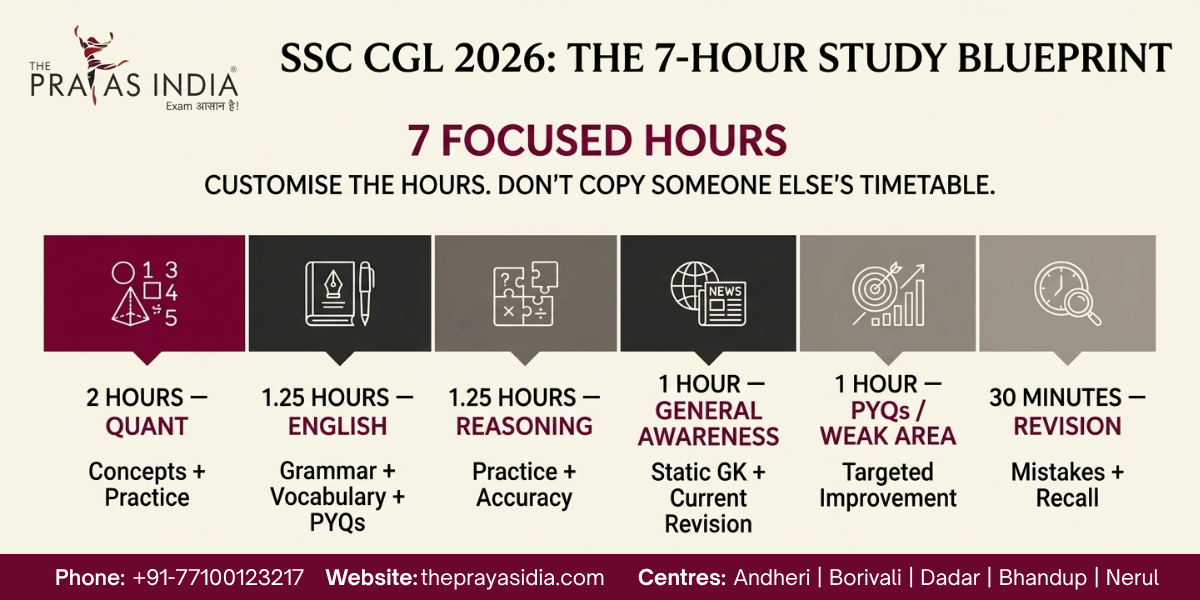
A 7-Hour SSC CGL Daily Study Plan
For a full-time aspirant, a seven-hour focused schedule can work well.
Session 1 — Quantitative Aptitude
2 Hours
Start with the subject that requires the highest concentration.
Use the session for:
- Concept revision
- Topic-wise questions
- PYQs
- Short calculation practice
Session 2 — English
1.25 Hours
Focus on:
- Grammar
- Vocabulary
- Reading comprehension
- Error detection
- Previous-year questions
Session 3 — Reasoning
1.25 Hours
Practise:
- Analogy
- Series
- Coding-decoding
- Classification
- Syllogism
- Statement-based questions
- Other SSC-relevant topics
Session 4 — General Awareness
1 Hour
Combine:
- Static GK
- Current affairs
- Important facts
- Previous-year questions
- Revision
Session 5 — PYQs / Weak Area
1 Hour
Use this flexible session for whichever area needs additional attention.
Session 6 — Daily Revision
30 Minutes
Review:
- Mistakes
- Formulas
- Vocabulary
- Short notes
- Important facts
This gives you approximately 7 focused hours, while still allowing breaks between sessions.
What If You Are a Working Professional?
Not every SSC CGL aspirant can study for 7–8 hours every day.
If you’re working, trying to copy a full-time aspirant’s timetable may actually create unnecessary pressure.
A consistent 3–5 focused hours can still be useful if you manage them properly.
A possible weekday schedule:
Morning — 60 Minutes
English vocabulary + revision.
Evening — 90 Minutes
Quantitative Aptitude or Reasoning.
Night — 60 Minutes
PYQs + General Awareness.
Additional 30 Minutes
Revision or mistake analysis.
On weekends, you can increase your study time and complete:
- Full-length mocks
- Sectional tests
- Detailed analysis
- Longer Quant sessions
- Weekly revision
The key is consistency.
Three focused hours every day are better than ten hours once a week.
Your Weekend Strategy Should Be Different
Weekdays are usually better for consistent subject-wise preparation.
Weekends can be used for testing and deeper analysis.
For example:
Saturday
- Quant revision
- English practice
- Reasoning practice
- GA revision
- Topic-wise PYQs
Sunday
- Full-length SSC CGL mock
- Complete mock analysis
- Mistake classification
- Revision of weak topics
Don’t simply take a mock and check your score.
Spend time understanding why you lost marks.
That analysis should influence your next week’s timetable.
Mock Tests Should Eventually Become Part of Your Routine
Mocks should not be saved exclusively for the final weeks.
Once your basics and some important topics are covered, introduce regular tests.
A gradual approach works better:
Early Stage
Topic tests
↓
Intermediate Stage
Sectional tests
↓
Advanced Stage
Full-length mocks
↓
Final Stage
Regular mocks + intensive analysis
The exact frequency depends on your preparation level.
The important point is that testing should become progressively more exam-like.
The Most Important Part of a Mock Is What Happens After It
Suppose you score:
132/200
The number itself doesn’t tell you what to do next.
You need to understand:
- Which questions were wrong?
- Which questions were guessed?
- Which questions consumed too much time?
- Which easy questions were missed?
- Which topics repeatedly caused mistakes?
- Did you attempt questions outside your comfort zone?
- Was your time distribution efficient?
Divide your mistakes into categories:
Conceptual Mistake
You didn’t know how to solve the question.
Calculation Mistake
You knew the method but made an arithmetic error.
Reading Mistake
You misunderstood the question.
Selection Mistake
You chose a question that consumed too much time.
Guessing Mistake
You attempted without sufficient confidence.
This classification makes mock analysis actionable.
Build Your Timetable Around Your Mistake Log
Your mistake log should influence your daily schedule.
For example:
If you repeatedly make percentage mistakes:
Add 30 minutes of percentage practice.
If your English error detection accuracy is weak:
Add targeted grammar questions.
If Quant calculation speed is slow:
Add daily calculation drills.
If you are losing marks through question selection:
Practise timed mixed sets.
This creates a feedback loop:
Mock → Mistake → Diagnosis → Practice → Retest
That is much more effective than following a timetable blindly.
The Last 60 Days Require a Different Strategy
The final two months should not look like the first two months of your preparation.
By this stage, your focus should shift significantly towards:
Revision
Revisit important concepts and frequently tested topics.
PYQs
Strengthen familiarity with actual SSC patterns.
Mock Tests
Build speed and exam temperament.
Mistake Analysis
Reduce repeated errors.
Weak Areas
Fix high-impact weaknesses rather than trying to master everything.
General Awareness Revision
Focus on systematic recall rather than endlessly adding new material.
The final phase is about consolidation, not endlessly expanding the syllabus.
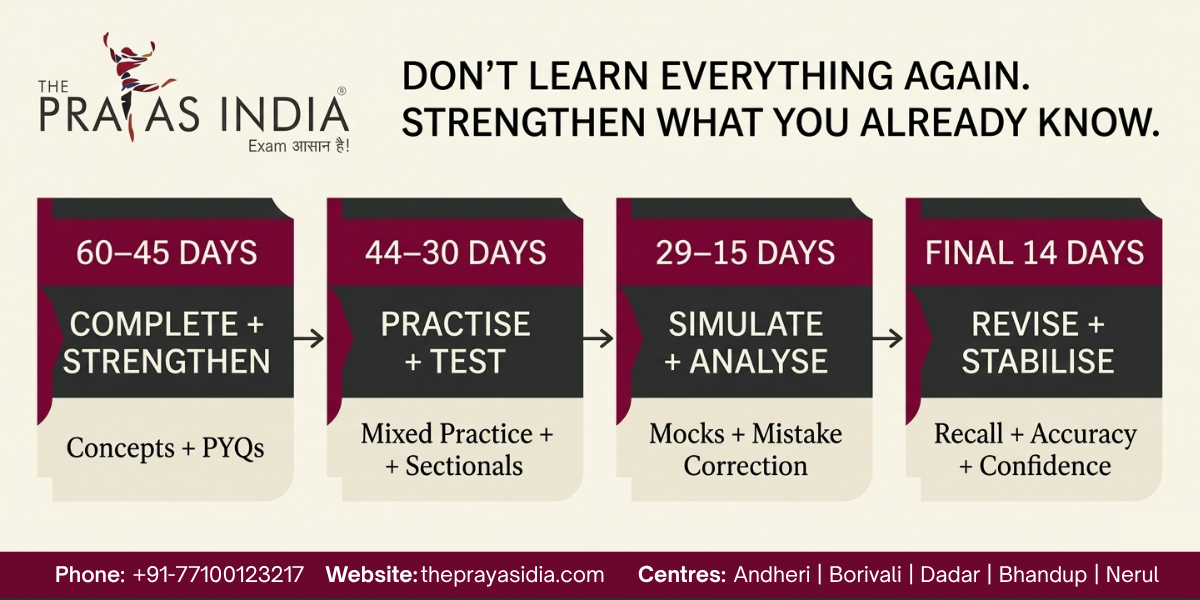
A Practical Last 60-Day Framework
Days 60–45
Focus on:
- Remaining concepts
- Topic-wise PYQs
- Sectional tests
- Weak-area identification
Days 44–30
Increase:
- Mixed practice
- Sectional tests
- Full-length mocks
- Revision
Days 29–15
Prioritise:
- Mock performance
- Speed
- Accuracy
- PYQ revision
- Mistake correction
Final 14 Days
Focus on:
- Revision
- Short notes
- Formulas
- Vocabulary
- Important GA facts
- Mock analysis
- Maintaining a stable routine
Avoid making major changes to your strategy at the last moment.
Common SSC CGL Timetable Mistakes to Avoid
A timetable can look excellent on paper and still fail in practice.
Here are some common mistakes.
1. Studying for Unrealistic Hours
If you normally study four hours, suddenly planning twelve hours isn’t a strategy.
Increase gradually.
2. Making a New Timetable Every Few Days
Constantly changing schedules creates the illusion of preparation without building consistency.
3. Ignoring Revision
Finishing a chapter doesn’t mean you’ve retained it.
4. Avoiding Weak Subjects
Studying only your favourite subject creates comfortable preparation, not balanced preparation.
5. Solving Without Analysing
Question practice without reviewing mistakes can lead to repeated errors.
6. Taking Too Many Mocks Without Analysis
One properly analysed mock can be more useful than several tests taken casually.
7. Sacrificing Sleep
Reducing sleep to increase study hours can hurt concentration, memory and decision-making.
A sustainable timetable must include adequate rest.
Should You Join SSC Coaching in Mumbai?
Self-study can work for many aspirants, but structured guidance can be valuable when you struggle with:
- Creating a realistic timetable
- Understanding the syllabus
- Selecting quality study material
- Maintaining consistency
- Identifying weak topics
- Analysing mock performance
- Finding the right preparation strategy
If you are considering SSC Coaching in Mumbai, don’t choose an institute simply because it promises long study hours or provides a large quantity of material.
Instead, evaluate the overall preparation system.
What to Look for in the Best SSC Coaching in Mumbai
When comparing the Best SSC Coaching in Mumbai, consider:
Experienced Faculty
Can the faculty explain concepts clearly and simplify difficult topics?
Structured Curriculum
Does the programme cover concepts, practice, PYQs, tests and revision systematically?
Quality Study Material
Are the questions aligned with SSC examination patterns?
Regular Testing
Are sectional and full-length tests available?
Detailed Analysis
Does the institute help you understand your mistakes?
Doubt Support
Can you get your doubts resolved without unnecessary delays?
Mentorship
Is there guidance for students who are struggling with specific subjects?
Consistency
Does the institute provide a preparation structure that keeps you on track?
These factors are more meaningful than simply asking:
“How many classes are included?”
Why a Structured Preparation Environment Can Help
One of the biggest challenges in competitive-exam preparation is consistency.
You may start with a highly motivated timetable on Monday.
By Thursday, the schedule may already be falling apart.
A structured coaching environment can provide:
- Fixed learning targets
- Regular practice
- Test schedules
- Faculty support
- Performance tracking
- Peer learning
- Revision planning
For students looking for Top SSC Coaching in Mumbai, these factors should be part of the decision-making process.
The objective isn’t to outsource your preparation.
It is to create a system that makes your self-study more organised and accountable.
The Ideal SSC CGL Daily Study Formula
There is no single perfect timetable.
But a strong daily framework can be:
CONCEPTS
↓
PRACTICE
↓
PYQs
↓
REVISION
↓
TEST
↓
ANALYSIS
↓
TARGETED IMPROVEMENT
If you follow this cycle consistently, your study hours become much more productive.
Whether you study for four hours or eight hours, every session should have a clear purpose.
Final Takeaway
So, how many hours should you study for SSC CGL 2026?
For most serious aspirants, 5–8 focused hours a day can provide a strong preparation framework.
However, the number should depend on your circumstances.
A college student may need a different schedule from a full-time aspirant.
A working professional may have only 3–5 hours.
A candidate in the final preparation phase may need longer, more test-oriented sessions.
What matters most is consistency.
Your daily plan should ensure that you are regularly:
Learning concepts.
Solving questions.
Practising PYQs.
Revising mistakes.
Taking tests.
Analysing performance.
Improving weak areas.
Don’t measure your preparation only by the number of hours you sit at your desk.
Measure it by the progress you make.
If you’re preparing for SSC CGL 2026 and looking for the Top SSC Coaching in Mumbai, look for an institute that complements your self-study with structured classes, quality practice, regular testing, detailed analysis and consistent mentorship.
At The Prayas India, the objective should be to help aspirants turn preparation time into measurable improvement.
The best study plan isn’t the longest one. It’s the one you can follow consistently until exam day.
Contact Us
📞 Call Now: +91-77100 13217
🌐 Website: theprayasindia.com