SSC CGL Revision Strategy: How to Revise Without Losing Momentum | Best SSC Coaching in Mumbai | The Prayas India
SSC CGL preparation often begins with an energetic study routine. Students complete chapters, solve practice questions, take sectional tests and gradually cover the syllabus. But as the examination gets closer, another challenge appears: how to revise everything without feeling that preparation has stopped moving forward.
Revision is sometimes treated as simply reading old notes again. That approach may provide temporary familiarity, but it does not necessarily improve recall, accuracy or question-solving ability. Effective SSC CGL revision needs to be active, selective and connected with regular practice.
For an aspirant, the goal should not be to revise the maximum number of topics every day. The real objective is to retain important concepts, identify weak areas, reduce repeated mistakes and keep exam-level practice going at the same time.
A good revision strategy therefore has to balance three things: what you have already studied, what you still struggle with and what you need to practise under time pressure.
Revision Should Not Feel Like Starting From Zero Again
One of the biggest mistakes students make during revision is attempting to study every chapter from the beginning. This can consume a large amount of time and create the impression that the syllabus is never-ending.
If you have already studied percentages, for example, revision does not necessarily mean reading every explanation again. Instead, you should quickly recall the key concepts, review important formulas or approaches and solve a few representative questions. If you are able to solve them comfortably, you can move forward.
The situation changes when you repeatedly make mistakes. That topic deserves deeper attention.
This creates an important distinction between revision and relearning. Revision should be relatively quick for familiar topics and more detailed for areas where your recall or application is weak.
Start by Dividing the SSC CGL Syllabus Into Three Categories
Before creating a revision timetable, divide your topics into three broad groups.
The first category contains topics that you understand well and can solve with reasonable accuracy. These topics require regular revision but do not need disproportionate study time.
The second category contains topics that you understand but frequently make mistakes in. These are important because they can become score-losing areas despite appearing familiar.
The third category consists of topics where your conceptual understanding is weak or your performance remains inconsistent. These require more deliberate revision, practice and possibly a return to the basic concepts.
This simple classification prevents you from giving equal time to every topic. It also makes revision more practical because your timetable is based on performance rather than just the syllabus.
The Right Revision Cycle: Recall, Practise, Check
A useful SSC CGL revision session can follow a simple three-stage cycle.
Start with recall. Before opening your notes, try to remember the major formulas, concepts, rules or approaches related to the topic. This forces your brain to retrieve information instead of merely recognising it from a page.
Move to practice. Solve a small set of questions based on that topic. The purpose is not to complete hundreds of questions every time you revise. A focused set can reveal whether you can actually apply what you remember.
Finally, check your performance. Look at incorrect answers and identify the reason behind them. If the mistake is conceptual, revisit the relevant part of the topic. If it is a calculation or reading error, your practice needs to address that specific weakness.
This approach makes revision active and measurable.
Don’t Let Revision Replace Question Practice
Another common problem occurs when students enter revision mode and drastically reduce their question-solving practice.
This can create a false sense of preparation. You may remember formulas and concepts while still struggling to apply them quickly.
SSC CGL is ultimately a performance-based examination. Candidates need to understand questions, select appropriate methods, solve accurately and manage time. These skills cannot be developed through reading alone.
Therefore, even during intensive revision, question practice should remain part of the routine. The proportion can change as the exam approaches, but it should not disappear.
A student revising Quantitative Aptitude, for instance, can spend part of the session reviewing concepts and the remaining time solving selected questions. Similarly, English revision can combine grammar rules and vocabulary review with actual practice questions.
Subject-Wise Revision Requires Different Approaches
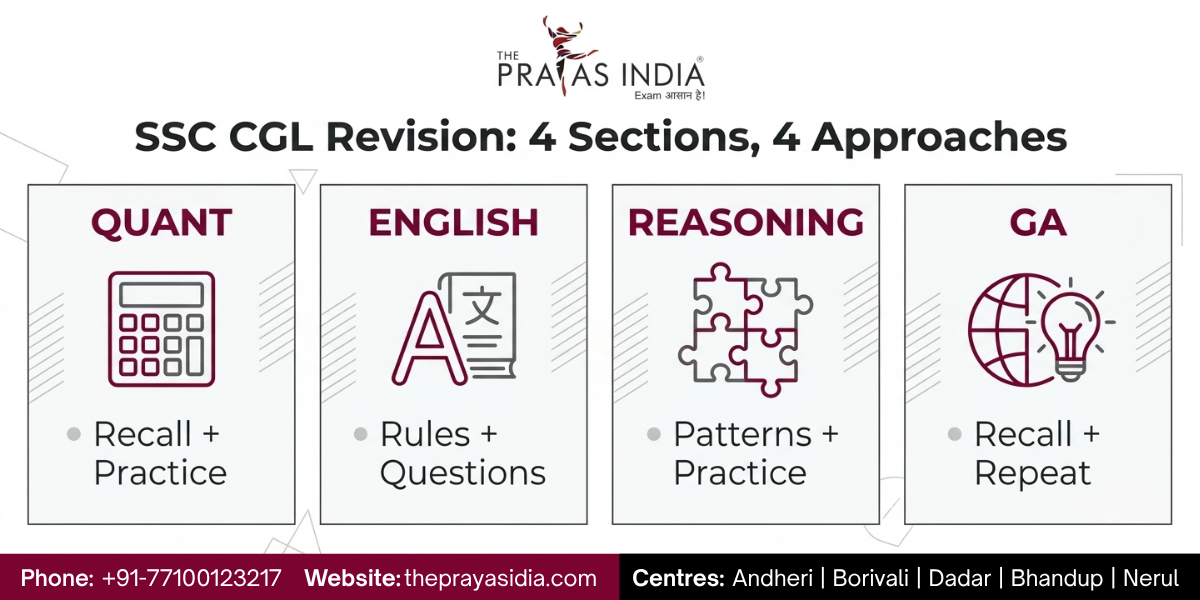
SSC CGL has multiple sections, and each one needs a slightly different revision strategy. Trying to revise all subjects in exactly the same way can make the process inefficient.
Quantitative Aptitude requires a combination of formula recall, conceptual revision and problem-solving practice. Topics that involve calculations should also be revisited through timed questions.
English Language benefits from repeated exposure. Grammar rules, vocabulary and common error patterns can be revised regularly, while Reading Comprehension and other question types should be practised rather than simply read about.
General Intelligence and Reasoning requires familiarity with different question structures and efficient application of logic. Revision should therefore include representative questions rather than only theoretical notes.
General Awareness is different because the volume of information can be extensive. Here, short notes, repeated revision and selective focus become particularly important.
Build a Revision Timetable Around Your Weak Areas
A revision timetable should not simply list subjects against days of the week. It should reflect your actual preparation status.
If Quantitative Aptitude is your strongest section but General Awareness requires considerable revision, your schedule should acknowledge that difference. This does not mean ignoring Quant. It means maintaining it with shorter but regular revision sessions while allocating additional time to weaker areas.
Similarly, if your English accuracy is high but you are losing time in certain Reasoning topics, the revision plan should reflect that.
The purpose of a timetable is not to make every day look balanced on paper. It is to make your overall preparation balanced in terms of performance.
Use Short Revision Sessions for Strong Topics
Strong topics should not disappear from your schedule simply because you are comfortable with them. However, they also should not consume the same amount of time as weak topics.
Short revision sessions can work well here. Review the important formulas, rules or concepts and solve a few questions to confirm that the topic remains under control.
This keeps the topic active in memory without taking away too much time from areas that need greater attention.
For example, a student who is consistently strong in a particular Quant topic might revise it once every few days through a quick formula review and a small question set instead of spending an entire study session on it.
Give More Attention to Repeated Mistakes
Your mistakes contain useful information about your preparation.
If you make the same type of error repeatedly, simply solving more questions may not be enough. You need to understand why the error keeps happening.
Perhaps you are applying the wrong formula. Maybe you are rushing through calculations. You could also be misunderstanding what the question is asking.
Maintain a simple error record and group mistakes according to their cause. Over time, this can show you whether your biggest problem is conceptual understanding, calculation accuracy, question interpretation or time management.
Revision becomes much more effective when it addresses these patterns instead of treating every incorrect answer as an isolated event.
Momentum Comes From Measuring Progress
Many students lose motivation during revision because they feel they are repeatedly studying the same material without seeing visible progress.
One way to avoid this is to measure improvement through small indicators.
Track your accuracy in practice sets. Note how many questions you can solve within a given time. Record recurring mistakes and check whether their frequency is declining. Compare your performance across sectional tests.
These indicators make progress visible.
You may not feel that you have “finished” anything every day, but if your accuracy is increasing and repeated errors are decreasing, your preparation is moving forward.
Revision and Mock Tests Should Work Together
Mock tests should not be postponed until the syllabus is completely revised. Regular testing can actually make revision more targeted.
Suppose a mock test shows that your accuracy in arithmetic is consistently strong but you are losing marks in algebra. That information should influence your revision plan.
Similarly, if your General Awareness performance is weak because you are unable to recall facts quickly, you may need more frequent short revision cycles rather than one long session.
Mocks therefore act as a diagnostic tool.
The objective is not simply to take one test after another. It is to use test performance to determine what should be revised next.
Avoid Changing Your Entire Strategy During Revision
Revision is also the stage when students become vulnerable to unnecessary experimentation. They may discover a new book, a new YouTube strategy or a new shortcut and suddenly decide to change their entire preparation system.
This can be counterproductive.
If a particular method has been working, there is usually no reason to abandon it simply because another strategy looks attractive. New resources should be introduced only when they solve a genuine problem.
The final stages of SSC CGL preparation should be about consolidation rather than constant experimentation.
Your revision notes, practice sources, mock tests and error log should become increasingly familiar. This reduces mental clutter and allows you to concentrate on improving performance.
Key Takeaway
SSC CGL revision should not feel like a pause in preparation. It should be the stage where your existing knowledge becomes faster, more reliable and easier to apply.
The most effective revision strategy combines active recall, selective practice, error analysis, mock tests and targeted improvement. Instead of revising every topic with equal intensity, divide your syllabus according to your performance and give additional attention to areas that continue to create problems.
Most importantly, do not measure revision only by the number of chapters completed. Measure it by what happens to your accuracy, recall, speed and consistency after revision.
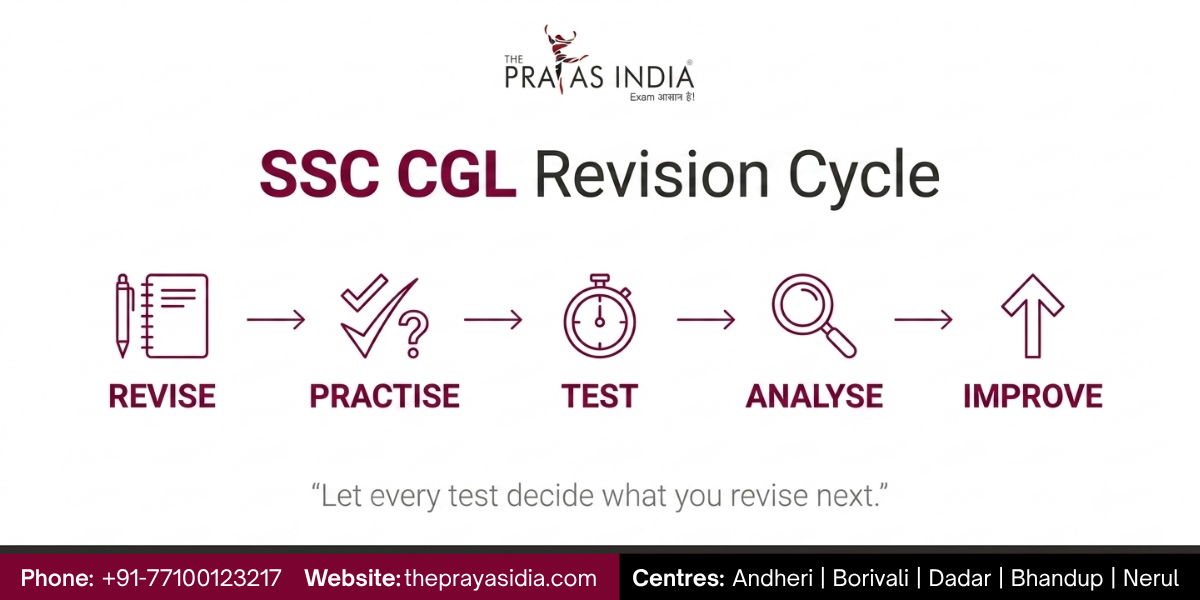
A productive SSC CGL preparation cycle can be kept simple:
Revise → Practise → Test → Analyse → Improve
Revision becomes much more effective when it has a clear structure. Once students understand what needs to be revised, the next challenge is deciding when to revise it, how often to revisit it and how to combine revision with mocks and practice.
A good revision plan should create momentum rather than interrupt it. You should continue solving questions, taking tests and improving your weaker areas while keeping previously studied topics active in memory.
The key is to move away from the idea that revision means “finishing the syllabus again.” Instead, think of revision as a process of strengthening what you already know and repairing what is still weak.
Build a 7-Day Revision Cycle
A seven-day revision cycle can be useful for students who want a manageable short-term structure. Rather than trying to revise the entire SSC CGL syllabus every week, divide the week between strong topics, weak areas, mixed practice and testing.
The first few days can focus on targeted revision of individual sections. The middle of the week can combine topics through mixed practice sets. Towards the end of the cycle, a sectional or full-length test can provide feedback about what needs attention in the following week.
The exact distribution should depend on your current preparation level. A beginner may require more conceptual revision, while a student who has already completed the syllabus may benefit from more questions and mock analysis.
The important point is to create a repeatable weekly rhythm rather than constantly creating a new timetable.
A Practical 7-Day SSC CGL Revision Framework
| Day | Primary Focus | Suggested Activity |
|---|---|---|
| Day 1 | Quantitative Aptitude | Formula revision + targeted questions |
| Day 2 | English | Grammar, vocabulary + practice |
| Day 3 | Reasoning | Topic revision + mixed questions |
| Day 4 | General Awareness | Short-note revision + recall |
| Day 5 | Weak Areas | Focused revision + practice |
| Day 6 | Mixed Practice | Section-wise timed sets |
| Day 7 | Test & Analysis | Mock/sectional test + error analysis |
This framework should not be followed mechanically. If your mock performance shows that a particular subject requires more attention, adjust the following week accordingly.
The purpose of a timetable is to support your preparation, not to become another source of pressure.
How to Build a 30-Day Revision Strategy
A longer revision window allows students to move through different stages rather than repeating the same routine every day.
During the first week, focus on identifying your strongest and weakest areas. Review important concepts and use sectional practice to establish a performance baseline.
During the second week, increase question-solving and timed practice. Your goal should be to convert conceptual knowledge into faster application.
During the third week, introduce more mixed practice and full-length tests. Analyse your performance carefully and revise topics responsible for repeated mistakes.
During the fourth week, shift towards consolidation. Revise formulas, rules, short notes, frequently repeated mistakes and important General Awareness material. Continue taking mocks, but avoid overwhelming yourself with excessive new resources.
This creates a gradual transition from revision to exam readiness.
Revise General Awareness Differently
General Awareness presents a unique revision challenge because the amount of information can be enormous. Trying to revise everything with equal intensity can quickly become inefficient.
Instead, divide your material into manageable categories. Maintain concise notes for important facts, revise them repeatedly and use short recall sessions rather than depending only on long reading sessions.
Repeated exposure is particularly useful for factual subjects. A topic that feels familiar after reading once may still be difficult to recall during an examination.
Therefore, active recall should play an important role. Close your notes and try to reproduce important information from memory. Then check what you missed.
This approach can make General Awareness revision more active and less passive.
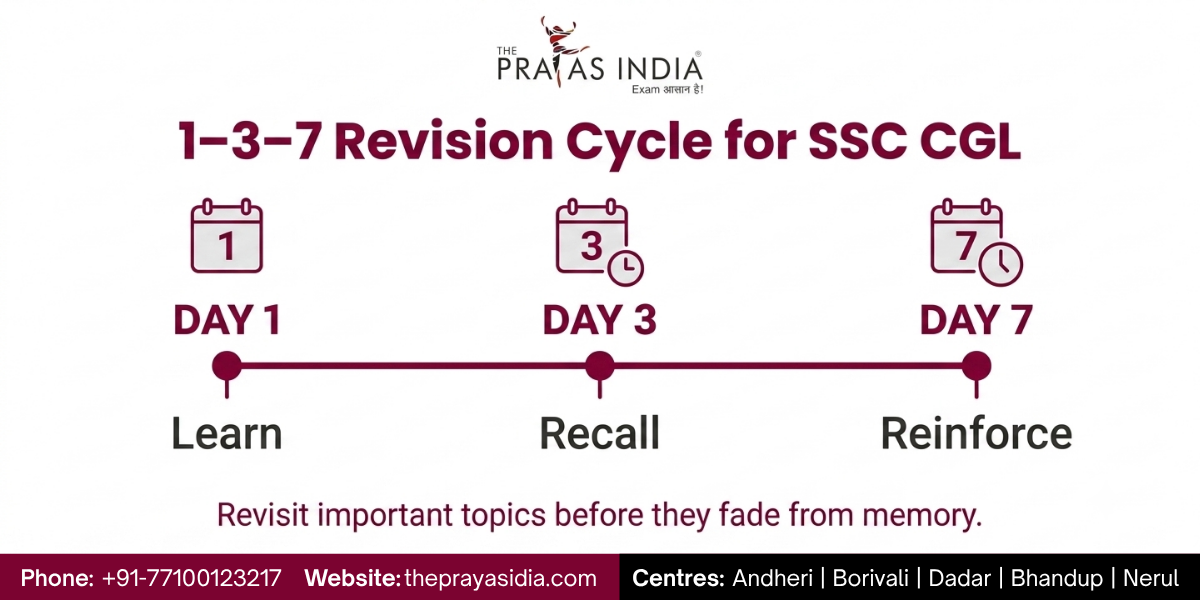
Use the 1-3-7 Revision Principle
Students can also experiment with a simple spaced-revision approach.
After initially studying a topic, revisit it after approximately one day, then again after around three days, and once more after around seven days.
The exact intervals do not need to be rigid. The underlying idea is that information should be recalled multiple times rather than being studied once and forgotten until the final week.
This method can be particularly useful for formulas, vocabulary, grammar rules, factual information and short conceptual notes.
As the examination approaches, frequently tested or repeatedly forgotten areas can be revised more often.
Combine Revision With Full-Length Mocks
As the exam gets closer, full-length mocks should become an important part of preparation. However, taking a mock without analysing it can significantly reduce its value.
After completing a test, divide your performance into different categories. Identify questions you answered correctly with confidence, questions where you made mistakes, questions that consumed excessive time and questions you skipped despite being potentially solvable.
This analysis helps you understand whether your problem is knowledge, speed, accuracy or decision-making.
Suppose your score is low because you attempted too many difficult questions. The solution may not be more concept revision. You may need to improve question selection.
If your accuracy is low in familiar topics, your focus may need to shift towards careful reading and error reduction.
This is why mock analysis should directly influence revision.
Keep a Dedicated Mistake Notebook
A mistake notebook should be concise and useful. Avoid turning it into another large study book.
Record only mistakes that teach you something important. These could include formulas you repeatedly forget, question types you consistently misunderstand, calculation patterns that lead to errors or concepts that require another look.
Before a mock, quickly review relevant mistakes. After the mock, add only genuinely useful observations.
Over time, this notebook becomes a personalised revision resource created from your own performance.
It can be far more valuable than repeatedly reading generic material because it directly reflects the areas that affect your score.
Don’t Overload Your Revision With New Resources
One of the easiest ways to lose momentum is to keep adding study material.
During revision, students sometimes collect new books, PDFs, question banks, videos and short notes because they believe more resources mean better preparation.
In reality, excessive resources can fragment your attention.
Choose reliable material and stay with it. Your revision should become deeper rather than broader as the examination approaches.
If you have already practised a topic thoroughly from one source, there is little benefit in repeatedly restarting it from another source unless you have identified a specific gap.
Balance Revision With Timed Practice
Revision should gradually become more exam-oriented.
Instead of solving every question without a time limit, introduce short timed sets. This allows you to practise not only solving but also making decisions under pressure.
For Quantitative Aptitude and Reasoning, timed practice can help develop speed. For English, it can improve the ability to process questions efficiently. General Awareness can be revised through short timed quizzes that test recall.
The objective is to make your preparation increasingly similar to the conditions you will face during the actual examination.
Protect the Momentum You Have Built
The closer students get to the exam, the more likely they are to feel pressure. They may start comparing their preparation with other aspirants, change their timetable frequently or increase their study hours dramatically.
This can disturb an otherwise productive routine.
A better approach is to maintain consistency. If you have developed a schedule that allows you to study effectively, continue it while making gradual adjustments based on performance.
Revision should provide clarity, not panic.
The final phase is about converting months of preparation into dependable performance. That requires regular sleep, focused practice, meaningful revision and controlled test-taking.
What to Do in the Final 15 Days
The final 15 days should be about consolidation rather than trying to complete an entirely new syllabus.
Prioritise your revision notes, important formulas, grammar rules, frequently repeated mistakes, important General Awareness material and topics identified through mock analysis.
Continue taking tests, but allow sufficient time for analysis. If a particular topic repeatedly appears as a weakness, address it directly.
Avoid making major changes to your preparation strategy at this stage. Your objective should be to enter the examination with a familiar and tested approach.
The Final 7 Days Should Be About Confidence Through Familiarity
During the final week, your preparation should become increasingly focused.
Revise concise notes instead of opening large chapters. Solve selected questions instead of attempting endless practice sets. Review your error notebook and analyse your recent mocks.
This is also the time to understand your preferred attempt strategy.
You should have a reasonable idea of which questions you normally attempt first, which types tend to consume too much time and when you should move on from a difficult question.
The objective is to reduce uncertainty.
Common SSC CGL Revision Mistakes
Revising Everything Every Day
Trying to revise every subject every day often produces superficial revision. A better approach is to rotate subjects while maintaining regular contact with each section.
Reading Without Testing Recall
Simply looking at notes creates familiarity but does not necessarily guarantee recall. Close the material and test yourself.
Ignoring Previous Mistakes
Repeated errors should receive more attention than new questions. Your mistakes show exactly where your preparation needs improvement.
Taking Mocks Without Analysis
A mock score alone cannot tell you how to improve. Analyse the reasons behind your incorrect answers, skipped questions and time losses.
Studying New Material Until the Last Day
New resources can create confusion during the final stage. Consolidate your existing preparation instead.
Focusing Only on Weak Subjects
Weak areas need attention, but strong areas also need maintenance. Completely ignoring your strengths can cause performance to decline.
How The Prayas India Can Support SSC CGL Preparation
A structured coaching environment can help students organise the different components of SSC CGL preparation instead of handling each one separately.
Concept classes provide the foundation. Practice helps students apply those concepts. Tests create performance benchmarks. Mock analysis identifies weaknesses, while revision and targeted practice help address them.
For students preparing for SSC CGL in Mumbai, guidance can be especially useful when they are struggling to decide what to study next or how to balance multiple sections.
The Prayas India can support aspirants through a structured preparation approach designed around learning, practice, testing and improvement.
The objective is not simply to help students complete the SSC CGL syllabus. It is to help them convert preparation into exam performance.
Choosing SSC Coaching in Mumbai
Students looking for SSC coaching should evaluate an institute based on the complete preparation ecosystem rather than a single factor.
Consider the quality of teaching, availability of practice material, frequency of tests, mock-analysis process, doubt support and the overall preparation methodology.
A good coaching programme should help students understand concepts while also teaching them how to apply those concepts under exam conditions.
For an aspirant who struggles with consistency, structured classes and regular testing can provide accountability. For a student who is already comfortable with the basics, performance analysis and targeted practice may become more valuable.
The right preparation environment should therefore complement the student’s individual needs.
FAQs
1. How should I revise for SSC CGL without losing momentum?
Keep revision active by combining concept recall with question practice, sectional tests and mock analysis. Avoid spending the entire day rereading notes.
2. How many hours should I spend on SSC CGL revision?
There is no universal number of hours. The important factor is productive study time. Your daily schedule should balance revision, practice, testing and analysis according to your preparation level.
3. How often should I revise SSC CGL topics?
Strong topics can be revised periodically, while frequently forgotten or weak topics should be revisited more often. A spaced approach such as 1-3-7 revision can help maintain recall.
4. Should I take mock tests during revision?
Yes. Mock tests provide useful feedback about accuracy, speed, time management and question selection. Their analysis should influence your next revision cycle.
5. How should I revise General Awareness for SSC CGL?
Use concise notes, repeated recall and short revision sessions. Focus on retaining important information rather than repeatedly reading large volumes of material.
6. Should I study new topics during the final weeks?
If an important topic is genuinely weak, some targeted learning may be necessary. However, the final stage should primarily focus on consolidation, practice and performance improvement.
7. How can I improve my SSC CGL revision speed?
Use short revision sessions, active recall, concise notes and timed question sets. Avoid rereading complete chapters when only a few concepts need attention.
8. Is an error notebook useful for SSC CGL preparation?
Yes. A concise error notebook can help you identify recurring conceptual, calculation, interpretation and time-management mistakes.
9. How can mock analysis improve SSC CGL scores?
Mock analysis shows where marks are being lost. It can reveal weak concepts, careless errors, inefficient approaches and poor question selection, allowing you to make targeted improvements.
10. Can SSC CGL revision be completed in 30 days?
A 30-day revision plan can be effective if the syllabus has already been studied. The focus should be on revision, practice, mocks and weak-area improvement rather than trying to learn everything from scratch.
11. Should I revise all four SSC CGL sections every day?
Not necessarily. A planned rotation can be more effective, provided every section receives regular revision and practice.
12. Why is consistency important during SSC CGL revision?
Consistent revision keeps concepts active in memory and prevents preparation from becoming dependent on last-minute study. It also gives you more opportunities to identify and correct weaknesses.
Final Takeaway
Effective SSC CGL revision is not about studying everything again. It is about remembering what matters, practising what you know, fixing what you get wrong and maintaining the momentum you have already built.
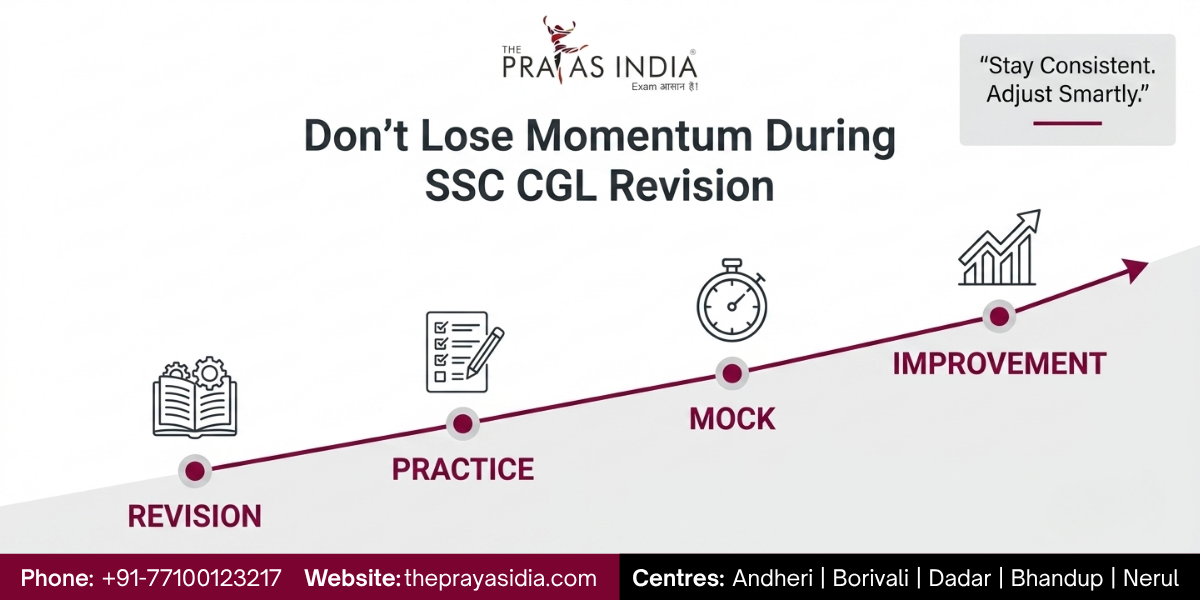
A strong revision strategy should gradually move through four stages:
Recall → Practice → Test → Improve
As the exam approaches, your preparation should become more selective and performance-oriented. Strong areas should be maintained, weak areas should receive targeted attention and mock-test analysis should guide your revision priorities.
Most importantly, avoid measuring preparation only by the number of hours studied. A better measure is whether your accuracy is improving, your mistakes are decreasing and your timed performance is becoming more consistent.
For aspirants preparing for SSC CGL and looking for structured guidance, The Prayas India can provide an organised learning environment where concepts, practice, testing and revision work together.
The aim is simple: keep learning, keep practising and keep moving forward without losing momentum.
Contact Us
- Call Now: +91-77100 13217
- Website: theprayasindia.com
- Centres: Andheri | Borivali | Dadar | Nerul | Bhandup