The Right Way to Analyse MBA CET Mock Tests | Best MBA CET Coaching in Mumbai | The Prayas India
Your Mock Test Score Is Only a Number. Your Analysis Determines Your Percentile.
Every MBA CET aspirant understands the importance of taking mock tests. Almost every preparation strategy recommends attempting regular mocks, improving speed, and practising under examination conditions. While these recommendations are valid, they often leave out the most important part of the process—the analysis that follows.
Many students complete a mock test, check their percentile, compare it with previous scores, and immediately begin preparing for the next test. They assume that attempting a higher number of mocks will automatically improve performance. Unfortunately, this approach rarely produces consistent growth. Repeating the same mistakes across multiple mock tests only reinforces weak habits rather than correcting them.
The purpose of a mock test is not merely to evaluate preparation; it is to reveal exactly where improvement is required. Every incorrect answer, every skipped question, every minute spent on a difficult problem, and every careless mistake provides valuable information about your preparation. Students who learn how to interpret this information improve steadily over time, while those who focus only on scores often remain stuck despite solving dozens of mock papers.
This article explains how to analyse MBA CET mock tests systematically so that every mock contributes to measurable improvement. Instead of treating mock tests as isolated examinations, you will learn how to convert them into one of the most powerful learning tools available during your preparation.
Mock Tests Measure More Than Knowledge
Most aspirants believe mock tests exist to determine how much of the syllabus they have completed. Although conceptual understanding certainly influences performance, MBA CET mock tests evaluate several other factors that are equally important during the actual examination.
The examination rewards candidates who can make quick decisions, identify easy questions, maintain accuracy while working under pressure, and adapt their strategy when faced with unfamiliar question patterns. These skills cannot be measured by simply reading theory or solving chapter-wise practice questions.
A well-analysed mock test helps you evaluate:
- Your decision-making under time pressure.
- Your ability to prioritise easier questions.
- The balance between speed and accuracy.
- Section-wise performance consistency.
- Mental stamina throughout the examination.
Understanding these aspects allows aspirants to improve not only what they know but also how effectively they apply that knowledge during the examination.
Stop Judging Your Preparation by Percentile Alone
One of the biggest mistakes MBA CET aspirants make is allowing a single mock score to define their confidence. A good score creates overconfidence, while a poor score often creates unnecessary anxiety. Neither reaction helps long-term preparation.
A single mock test represents only one performance under one set of questions. It does not define your potential, nor does it accurately predict your final MBA CET result.
Instead of asking, “What percentile did I score?”, begin asking questions that reveal the quality of your performance:
- Which sections consumed the most time?
- Which mistakes could have been avoided?
- Which questions should have been skipped?
- Did I lose marks because of weak concepts or poor decision-making?
- Which section showed the greatest improvement compared to my previous mock?
These questions shift your focus from temporary outcomes to continuous improvement. Over time, this mindset helps aspirants become more objective and less emotionally influenced by individual mock scores.
Every Mock Test Should Produce an Action Plan
A mock test without analysis is simply another practice paper. A mock test followed by structured analysis becomes a roadmap for improvement.
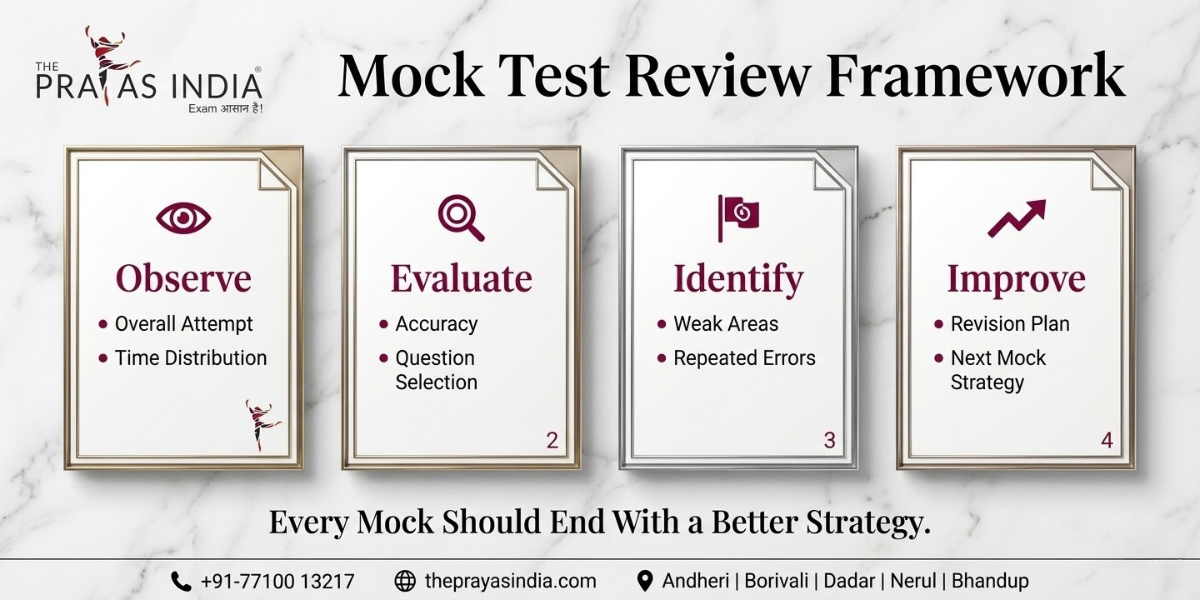
The objective of every review session should be to identify actions that can improve the next mock test. Instead of revisiting the entire paper randomly, organise your observations into practical categories.
For example:
- Questions answered correctly but requiring excessive time.
- Questions attempted incorrectly because of conceptual gaps.
- Easy questions skipped due to hesitation.
- Careless mistakes caused by rushing.
- Difficult questions that should have been avoided.
When every mock ends with a clear improvement plan, preparation becomes more focused. Rather than repeating the same errors, aspirants gradually eliminate them one by one, resulting in consistent performance growth over several weeks.
Expert Guidance Helps You See What Scores Cannot
Many aspirants review mock tests independently but struggle to identify deeper performance patterns. They may notice incorrect answers, yet fail to understand why those mistakes occurred or how to prevent them in future tests. Structured guidance becomes particularly valuable at this stage because experienced mentors can identify recurring habits, recommend targeted improvements, and help students refine their examination strategy.
At The Prayas India, MBA CET preparation goes beyond conducting mock tests. Students receive detailed performance reviews, personalised feedback, section-wise improvement strategies, and continuous academic mentorship. This structured review process enables aspirants to transform every mock test into an opportunity for measurable improvement rather than treating it as a simple scorecard.
Transforming Mock Test Data into Better Decisions
Every Mock Test Leaves Behind Valuable Clues. Learning to Read Them Is What Improves Your Percentile.
Most MBA CET aspirants finish a mock test with only one question in mind—“How much did I score?” While the score certainly provides an indication of your current performance, it is only the beginning of the review process. The real value of a mock test lies in understanding the decisions that produced that score.
Two students may score exactly the same marks, but their preparation needs can be completely different. One student may have excellent conceptual clarity but poor time management, while the other may finish the paper quickly but lose marks because of careless mistakes. Looking only at the final score hides these differences.
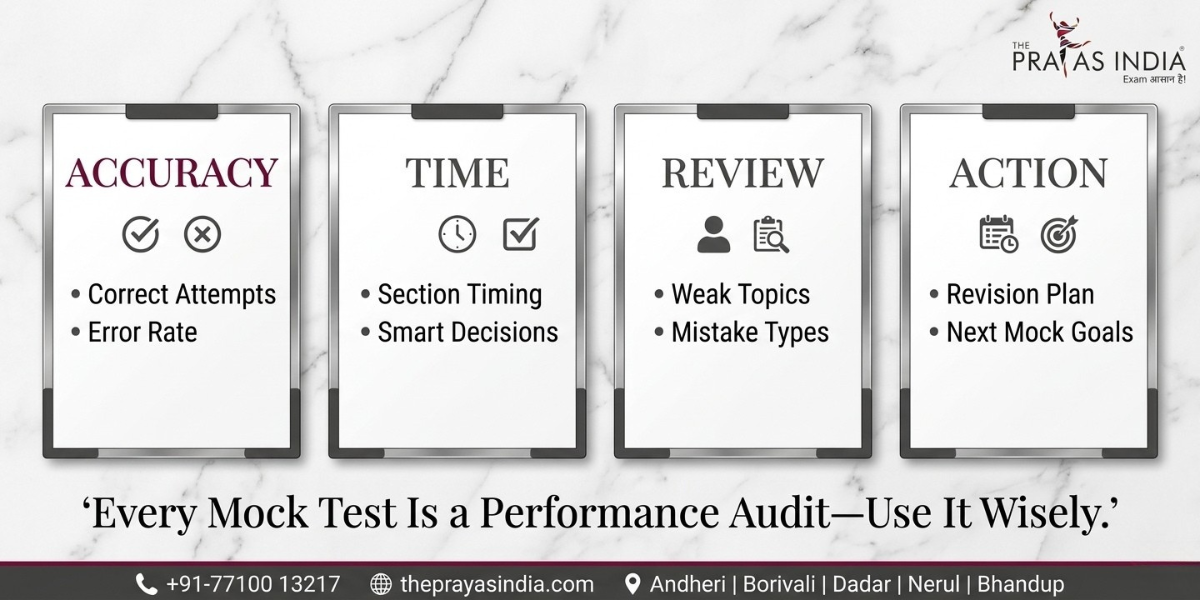
For this reason, every mock test should be treated as a performance report rather than a result sheet. The objective is not to judge yourself but to identify the precise areas where small improvements can create significant gains in the next mock test.
Measure Accuracy Before Chasing Higher Attempts
One of the biggest misconceptions in MBA CET preparation is that attempting more questions automatically leads to a better percentile. Although increasing attempts can improve scores, it becomes beneficial only when accuracy remains consistently high.
Many aspirants become so focused on solving additional questions that they begin making avoidable mistakes. Over several mock tests, this habit creates inconsistent performance and reduces confidence.
Instead of asking how many questions you attempted, analyse how efficiently those attempts were made.
During your review, consider questions such as:
- Was my accuracy consistent across all sections?
- Which incorrect answers were completely avoidable?
- Did I rush through easy questions?
- Were my mistakes caused by weak concepts or poor concentration?
- Which section showed the highest accuracy despite fewer attempts?
This approach shifts your focus from quantity to quality, which is ultimately more valuable in competitive examinations.
Understand Where Your Time Actually Went
MBA CET is as much a test of decision-making as it is of knowledge. Many students believe they lost marks because they lacked preparation, whereas the real issue was inefficient time allocation.
A detailed review of time usage often reveals surprising patterns. Some aspirants spend too much time solving one difficult puzzle, while others repeatedly verify answers they have already solved correctly. Both situations reduce the total number of quality attempts.
Instead of reviewing only your final score, examine your time distribution carefully.
Focus on identifying:
- The section that consumed the maximum time.
- Questions where you remained stuck unnecessarily.
- Easy questions that could have been solved earlier.
- Areas where faster decision-making would have improved overall attempts.
- Whether you completed the paper calmly or rushed through the final minutes.
Improving time management often produces immediate score improvements without requiring additional study hours.
Study Each Section Like a Separate Examination
MBA CET evaluates multiple skills within a single paper. Therefore, analysing only the overall score rarely provides meaningful insights.
Each section should be reviewed independently because every subject presents different strengths and weaknesses.
Logical Reasoning
Evaluate whether complex puzzles delayed your progress or whether question selection affected your score.
Abstract Reasoning
Review whether incorrect answers resulted from hurried observation or misunderstanding visual patterns.
Quantitative Aptitude
Analyse whether conceptual gaps, lengthy calculations, or unnecessary verification slowed your performance.
Verbal Ability & Reading Comprehension
Observe whether vocabulary, grammar, comprehension accuracy, or reading speed influenced your score.
A section-wise review creates a much more targeted improvement strategy than analysing the paper as a whole.
Categorise Mistakes Instead of Simply Correcting Them
Many students check the correct answers after every mock but never investigate why they made those mistakes. As a result, similar errors continue appearing in future tests.
A more productive approach is to classify every incorrect answer into meaningful categories.
Common categories include:
Conceptual Mistakes
The underlying concept was not fully understood.
Careless Mistakes
The concept was correct, but attention to detail was missing.
Calculation Errors
The solving method was accurate, but numerical mistakes reduced the score.
Question Selection Errors
A difficult question was attempted too early while easier questions remained unanswered.
Time Management Errors
Excessive time spent on one problem affected overall performance.
Once mistakes are organised in this manner, revision becomes highly focused. Instead of revisiting the entire syllabus, you begin strengthening the exact areas responsible for score fluctuations.
Maintain a Performance Journal
A single mock test represents only one day’s performance. Long-term improvement becomes visible only when mock test data is recorded consistently.
A simple performance journal allows aspirants to compare progress objectively instead of relying on memory.
Useful parameters include:
- Mock test number.
- Overall score.
- Section-wise score.
- Accuracy percentage.
- Time spent on each section.
- Number of careless mistakes.
- Weakest topic.
- Improvement target for the next mock.
After several weeks, this journal becomes one of the most reliable indicators of progress. It clearly shows whether your preparation strategy is producing measurable improvement or requires adjustment.
Professional Guidance Helps You Interpret Performance Correctly
Mock tests generate valuable information, but interpreting that information correctly is often difficult without experienced guidance. Students frequently recognise where they lost marks but struggle to understand the underlying reasons behind recurring mistakes. Structured mentorship helps bridge this gap by providing objective analysis and practical improvement strategies.
At The Prayas India, MBA CET mock tests are supported by detailed performance reviews, section-wise feedback, personalised mentoring, and strategic guidance from experienced faculty. Students receive actionable recommendations that help improve accuracy, optimise time management, strengthen weak areas, and make every subsequent mock test more productive than the previous one.
Converting Mock Test Analysis into Consistent Improvement
The Best MBA CET Aspirants Do Not Simply Take More Mock Tests—They Learn More from Every Mock Test.
By the middle stage of preparation, most serious MBA CET aspirants have already attempted several mock tests. They have experienced both good and disappointing performances, discovered their stronger sections, and identified topics that require additional effort. However, this is also the stage where many students stop improving despite continuing to take more mock tests.
The reason is surprisingly simple.
They continue collecting scores but stop collecting insights.
A mock test only becomes valuable when its observations are converted into practical improvements before the next test. If the same conceptual mistakes, time management issues, and poor question selection habits continue appearing week after week, the number of mock tests attempted becomes irrelevant.
Progress in MBA CET preparation is not measured by the quantity of mocks you complete but by the number of weaknesses you eliminate after each one.
Create a Weekly Improvement Cycle Instead of a Weekly Mock Target
Many aspirants decide to attempt two or three mock tests every week. While this seems like a productive strategy, it often becomes a race to complete more papers rather than improve performance.
A more effective approach is to build a weekly improvement cycle.
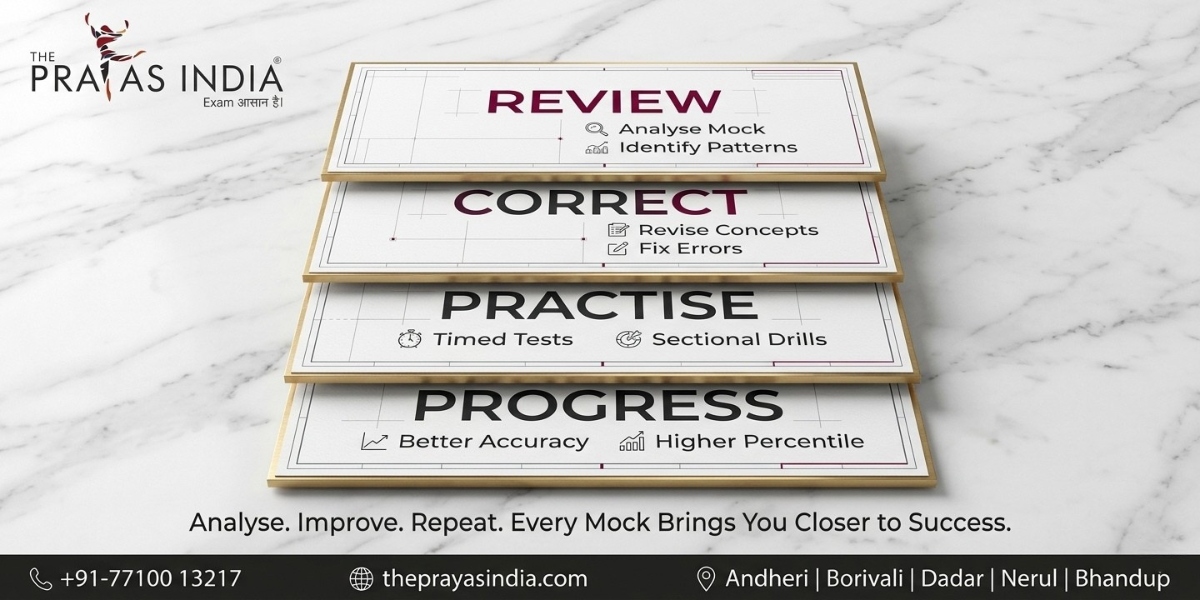
Every week should include four equally important stages:
- Attempt a full-length mock test under examination conditions.
- Analyse every section carefully without rushing.
- Revise concepts responsible for repeated mistakes.
- Apply those improvements in the following mock.
This cycle transforms preparation into a continuous learning process.
Rather than hoping your score improves automatically, you actively create the conditions that make improvement possible.
Identify Patterns Instead of Isolated Mistakes
Every incorrect answer deserves attention, but individual mistakes rarely tell the complete story.
The real objective of mock analysis is identifying patterns.
For example, if Logical Reasoning scores fluctuate while Quantitative Aptitude remains stable, the issue may not be conceptual understanding but inconsistent question selection.
Similarly, repeated calculation mistakes may indicate hurried solving rather than weak mathematical ability.
Look for recurring trends such as:
- Frequently losing marks in one specific topic.
- Spending excessive time on similar question types.
- Repeating the same careless mistakes.
- Beginning strongly but slowing down during the later stages of the paper.
- Consistently avoiding certain sections despite adequate preparation.
Patterns provide direction.
Isolated mistakes provide temporary corrections.
The more accurately you recognise these trends, the easier it becomes to design an effective improvement strategy.
Convert Every Weakness into a Specific Action Plan
One of the most common reasons aspirants remain stuck at the same score range is that they identify weaknesses without deciding how those weaknesses will be corrected.
Knowing that your accuracy is low is not an improvement strategy.
Knowing exactly what you will do before the next mock is.
Every observation should lead to a practical action.
For example:
| Observation | Action Plan |
|---|---|
| Low Quant accuracy | Revise arithmetic concepts and solve timed practice sets. |
| Slow Logical Reasoning | Practise puzzle selection and skip lengthy sets earlier. |
| Weak Verbal performance | Improve reading speed and revise grammar rules daily. |
| Careless mistakes | Slow down during final verification and improve concentration. |
| Running out of time | Practise sectional tests with stricter time limits. |
This approach ensures that every mock contributes directly to better performance in the next examination.
Avoid Becoming Emotionally Attached to Mock Scores
One of the biggest obstacles during MBA CET preparation is emotional decision-making.
Many aspirants become overconfident after one exceptional mock test and begin reducing their revision efforts. Others become discouraged after one poor performance and immediately change study resources, preparation strategy, or timetable.
Neither reaction supports long-term improvement.
Mock test scores naturally fluctuate because every paper differs in difficulty level, question distribution, and individual performance on that particular day.
Instead of reacting emotionally, evaluate every score objectively.
Ask yourself:
- Did my decision-making improve?
- Was my accuracy better than last week?
- Have careless mistakes reduced?
- Did I manage time more efficiently?
- Am I becoming more confident under examination pressure?
When improvement is measured through performance quality rather than isolated scores, confidence becomes far more stable throughout preparation.
Track Progress Across Multiple Mock Tests
Improvement in MBA CET is rarely visible after one mock test.
Meaningful progress appears only when several tests are analysed together.
Maintain a simple review record that tracks:
- Overall Score
- Accuracy Percentage
- Section-wise Performance
- Number of Attempts
- Careless Mistakes
- Time Management Rating
- Strongest Section
- Weakest Section
- Improvement Goal
Reviewing this information every month allows you to recognise long-term growth rather than reacting to temporary fluctuations.
Students who monitor trends instead of individual scores usually make more balanced academic decisions throughout their preparation.
Mock Analysis Becomes More Effective with Expert Feedback
Independent analysis helps aspirants recognise obvious mistakes, but identifying deeper behavioural patterns often requires experienced academic guidance. Students frequently know where they lost marks but remain uncertain about why those mistakes continue to occur. Professional mentoring helps bridge this gap by providing structured feedback, objective performance evaluation, and practical strategies for improvement.
At The Prayas India, MBA CET preparation extends beyond conducting regular mock tests. Every mock is followed by detailed performance reviews, section-wise analysis, personalised mentoring, strategy discussions, and targeted academic support. Students receive guidance that helps them improve question selection, optimise time management, strengthen weak concepts, and steadily increase their percentile through a structured improvement process.
Making Every Mock Test Count
A Mock Test Improves Your MBA CET Score Only When It Changes the Way You Prepare.
As the MBA CET examination approaches, preparation naturally shifts from learning new concepts to refining existing skills. This final phase is where mock test analysis becomes one of the most valuable components of your preparation strategy. Students who consistently review their performance begin making smarter decisions, selecting questions more effectively, and managing examination pressure with greater confidence.
At this stage, success is no longer determined by the number of chapters completed or the quantity of mock tests attempted. Instead, it depends on how efficiently you identify weaknesses, correct them, and ensure they do not appear again.
Every mock test should answer one important question:
“What should I do differently before my next mock?”
If every practice test provides a clear answer to that question, your preparation will continue moving in the right direction.
Frequently Asked Questions About MBA CET Mock Test Analysis
Should I attempt mock tests even if my syllabus is incomplete?
Yes. Waiting until the syllabus is completely finished often delays one of the most valuable learning opportunities during preparation. Early mock tests help you understand the examination pattern, identify weak concepts, improve time management, and become comfortable with examination pressure. Even if your scores are initially low, the insights gained from proper analysis significantly strengthen future preparation.
How many mock tests should I attempt every week?
The ideal number depends on your preparation stage, but quality should always take priority over quantity.
Attempting one or two carefully analysed mock tests every week usually contributes more to improvement than attempting several tests without reviewing them properly. A mock test should always be followed by detailed analysis and focused revision before moving to the next one.
Should I analyse only incorrect answers?
No.
Incorrect answers certainly deserve attention, but analysing only mistakes provides an incomplete picture.
You should also review:
- Questions answered correctly but taking excessive time.
- Easy questions skipped unnecessarily.
- Lucky guesses that may not work in the actual examination.
- Efficient solving methods that can be applied again.
Learning from successful decisions is just as valuable as correcting unsuccessful ones.
My mock scores keep fluctuating. Should I be worried?
Not necessarily.
Mock test scores naturally vary because every paper differs in difficulty level, question distribution, and your own performance on a particular day.
Instead of becoming concerned about one score, observe your performance across several mock tests.
If your accuracy, decision-making, and time management continue improving, your preparation is moving in the right direction even if individual scores fluctuate.
When should I stop learning new topics?
As the examination approaches, gradually reduce the time spent on completely new concepts and increase your focus on revision, sectional practice, previous year questions, and mock test analysis.
The final weeks should emphasise strengthening existing preparation rather than expanding the syllabus unnecessarily.
MBA CET Mock Analysis Checklist
Before beginning your next mock test, ensure that you have completed the review of your previous one.
Performance Review
✓ Overall score recorded.
✓ Accuracy percentage calculated.
✓ Section-wise performance analysed.
✓ Time distribution reviewed.
Mistake Analysis
✓ Conceptual mistakes identified.
✓ Careless errors recorded.
✓ Question selection reviewed.
✓ Time management problems noted.
Improvement Plan
✓ Weak topics selected for revision.
✓ Practice exercises completed.
✓ Strategy updated for the next mock.
✓ Previous mistakes revised before attempting another paper.
Progress Tracking
✓ Mock history maintained.
✓ Weekly performance compared.
✓ Accuracy trend improving.
✓ Confidence increasing through consistent practice.
A simple checklist like this prevents random preparation and ensures that every mock contributes towards long-term improvement.
Why Expert Review Creates Faster Improvement
Independent mock analysis certainly helps students recognise obvious mistakes, but the difference between a good score and an excellent percentile often lies in identifying subtle performance patterns. Experienced mentors can recognise inefficient solving habits, poor question selection, inconsistent section strategies, and recurring behavioural mistakes that students themselves may overlook.
At The Prayas India, MBA CET preparation is designed around continuous performance improvement rather than simply completing mock tests. Students receive detailed mock analysis, personalised performance reviews, section-wise strategy discussions, comprehensive doubt-solving support, and one-to-one academic mentoring from experienced faculty. This structured review process ensures that every mock test becomes a learning opportunity, helping aspirants steadily improve their accuracy, speed, confidence, and overall percentile.

Conclusion
Mock tests are not the final measure of your MBA CET preparation—they are the most reliable guide for improving it. Every test provides valuable information about your concepts, decision-making, speed, accuracy, and examination strategy. Aspirants who consistently analyse these insights develop stronger preparation habits, eliminate recurring mistakes, and steadily improve their percentile over time.
Rather than treating mock tests as scorecards, use them as performance review sessions. Record your observations, identify recurring patterns, revise weak areas, and apply those improvements in your next mock. This disciplined approach transforms preparation into measurable progress and builds the confidence required to perform under actual examination conditions.
A high MBA CET percentile is rarely the result of a single exceptional mock test. It is achieved through continuous analysis, structured improvement, and consistent execution. When every mock test ends with a better strategy than the previous one, success becomes a predictable outcome rather than a matter of chance.
Contact Us
📞 Call: +91-77100 13217
🌐 Website: https://theprayasindia.com