Why Expert Mentorship Can Improve Your MBA CET Score | Best MBA CET Coaching in Mumbai – The Prayas India
The Right Guidance Can Change How You Prepare
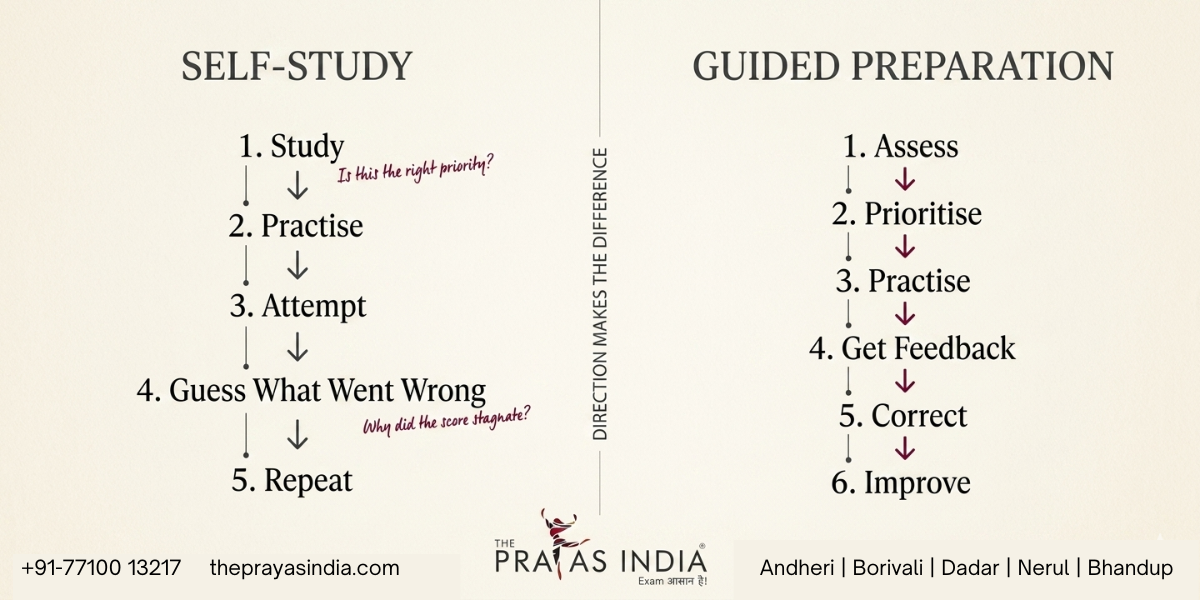
You can study for six hours a day and still feel like you’re not moving forward.
You may complete chapters, solve hundreds of questions, take mock tests and revise regularly—but your MBA CET performance may still refuse to improve at the pace you expect.
At that point, the natural reaction is to study even more.
But sometimes, the problem isn’t how much you study.
It’s where your preparation is going.
For a competitive exam like MBA CET, preparation isn’t only about knowing concepts. You also need to make quick decisions, manage time across sections, recognise scoring opportunities and understand which weaknesses are actually affecting your performance.
This is where expert mentorship can make a meaningful difference.
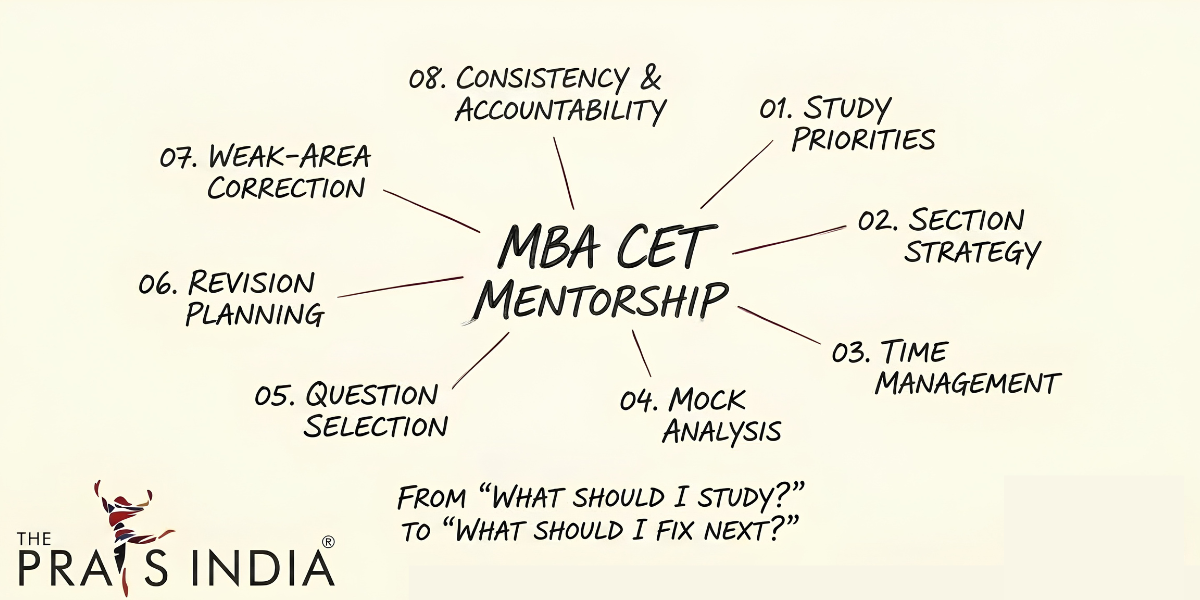
A good mentor doesn’t simply tell you what to study. They help you understand what deserves your attention, what is holding back your score, and what you should change next.
The Problem Isn’t Always Preparation
Imagine two students preparing for MBA CET.
Both study for four hours every day.
Both complete their syllabus.
Both solve practice questions.
Both take mocks.
Yet after several weeks, one student’s performance keeps improving while the other’s remains almost unchanged.
The difference may not be effort.
It could be direction.
One student may be spending additional hours practising areas they are already comfortable with, while the other is working systematically on the weaknesses affecting their score.
One may take a mock and simply look at the final score.
The other may analyse:
- Which questions were left unattempted
- Where time was lost
- Which topics caused repeated errors
- Which questions could have been solved faster
- Whether attempts were distributed effectively
That difference in approach can gradually create a difference in results.
MBA CET Rewards More Than Subject Knowledge
MBA CET is a speed-oriented entrance examination.
Knowing the concepts is important, but it is only one part of the equation.
You also need to develop the ability to:
- Read questions efficiently
- Recognise familiar patterns quickly
- Decide which questions deserve immediate attention
- Avoid spending excessive time on one problem
- Maintain accuracy while working quickly
- Move between questions confidently
- Use mock-test experience to refine your approach
This is why two students with similar academic knowledge can sometimes perform very differently in a competitive entrance exam.
The difference often lies in execution.
And execution can be improved through the right feedback.
Where Self-Study Starts Losing Direction
Self-study has obvious advantages.
It gives you flexibility, independence and the ability to work according to your own schedule.
But it can also create a problem that students don’t notice immediately:
You become the planner, teacher, evaluator and student at the same time.
You decide:
What should I study?
Then:
How much should I practise?
Then:
Was my performance good enough?
Then:
What should I change?
Without an external perspective, it is possible to spend considerable time making the same mistakes.
For example, a student may believe that Quantitative Aptitude is their biggest weakness because their overall score is low.
After detailed analysis, however, the real issue may be that they are spending too much time on difficult questions and leaving easier scoring opportunities.
The solution isn’t necessarily more Quant preparation.
It could be better question selection and time management.
That distinction is difficult to identify when you’re looking only at your final score.
A Mentor Changes the Questions You Ask
The biggest value of mentorship isn’t always receiving more study material.
It is learning to ask better questions about your preparation.
Instead of asking:
“How many hours should I study?”
you begin asking:
“Which area deserves the next two hours?”
Instead of:
“How many questions should I solve?”
you ask:
“Which question types are actually improving my performance?”
Instead of:
“Why is my score not increasing?”
you ask:
“Where exactly am I losing marks?”
These questions lead to more useful decisions.
A mentor can help you examine your preparation from outside your own assumptions and identify areas that may otherwise remain hidden.
Strategy Before More Study Hours
More study hours are not automatically productive.
Suppose an aspirant has three hours available for preparation.
They could spend all three hours randomly solving questions.
Or they could divide the time based on their current performance:
1 Hour — Weak Area
Work on a specific topic causing repeated errors.
45 Minutes — Timed Practice
Build speed and decision-making.
45 Minutes — Revision
Strengthen concepts that are already familiar but need reinforcement.
30 Minutes — Error Review
Analyse previous mistakes and record recurring patterns.
The second approach may produce more meaningful improvement because the study time is connected to an actual performance need.
Mentorship helps create that connection.
What Personalised Guidance Actually Looks Like
Expert mentorship should not mean giving every student the same timetable.
A student who is already strong in Quant but struggles with speed may need a different strategy from someone who has conceptual gaps.
Similarly, a student with strong accuracy but slow execution may need different guidance from someone who attempts quickly but makes frequent errors.
Personalised guidance can focus on:
- Current preparation level
- Section-wise strengths
- Weak topics
- Mock-test performance
- Accuracy
- Speed
- Question selection
- Revision priorities
- Practice requirements
- Exam strategy
The objective is simple:
Put the right effort into the right problem.
The Value of an External Perspective
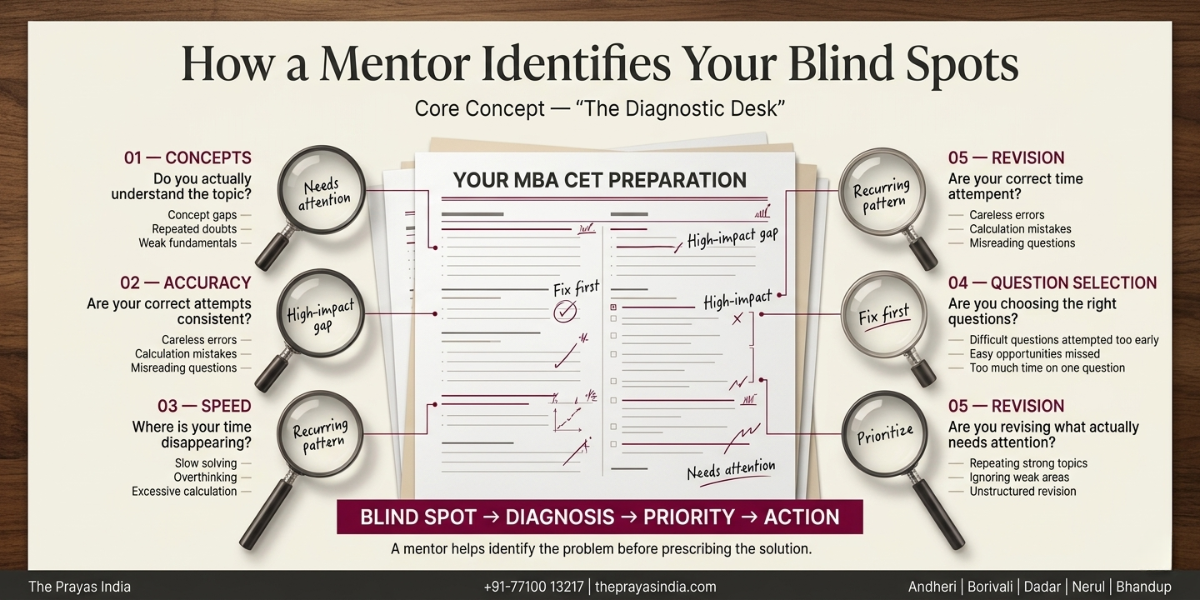
One of the hardest things about self-preparation is recognising your own blind spots.
You may become comfortable with a particular study method simply because you’ve been using it for months.
A mentor can challenge that assumption.
For example:
“You’re practising enough, but are you analysing your mistakes?”
“You’re attempting more questions, but has your accuracy improved?”
“You’re spending time on this topic, but is it actually affecting your score?”
“Could this section be approached differently?”
These questions can lead to small changes.
And in a competitive exam, small improvements repeated consistently can have a significant cumulative effect.
Mentorship Is About Correction, Not Dependence
The purpose of expert guidance should not be to make a student dependent on someone else for every decision.
Good mentorship should gradually help students become better decision-makers themselves.
Over time, you should begin to recognise:
- Which questions to prioritise
- Which mistakes are recurring
- Which topics need revision
- When to move on from a difficult question
- How much time to allocate to practice
- When your preparation strategy needs adjustment
The mentor provides the perspective.
The student develops the skill.
That combination is what makes mentorship valuable.
From Studying Harder to Preparing Smarter
Expert mentorship isn’t about replacing your effort.
It is about making that effort more purposeful.
You still need to study.
You still need to practise.
You still need to take tests.
But with the right guidance, you can become more aware of what you’re doing, why you’re doing it and whether it’s actually working.
For an MBA CET aspirant, that shift—from simply studying to strategically preparing—can become one of the most important steps towards better performance.
And this is only the beginning.
A Mentor Changes the Questions You Ask
The biggest advantage of expert guidance is not having someone tell you what to study—it is knowing what deserves your attention next.
MBA CET preparation can become overwhelming because there is always something more to do.
Another chapter can be revised.
Another set of questions can be solved.
Another mock can be attempted.
Another strategy can be watched online.
The problem is that more options don’t necessarily create better preparation.
At some point, an aspirant needs clarity about priorities.
What should be studied today?
Which weakness deserves attention first?
Is the problem conceptual knowledge, speed, accuracy or question selection?
Should more time be spent on Quant, or is Logical Reasoning actually limiting the score?
This is where expert mentorship can provide an outside perspective.
Where Preparation Blind Spots Begin
A preparation blind spot is an area of weakness that you don’t fully recognise yourself.
For example, a student may believe:
“My Quant is weak.”
But detailed analysis may reveal something different.
The student may actually know the concepts but spend too much time on difficult questions.
Another student may think:
“I need to solve more questions.”
But their mock analysis may show that the bigger problem is careless errors.
Someone else may be studying consistently but revising without a clear priority.
These differences matter because the solution depends on the actual problem.
A Mentor Helps You Separate the Problem From the Symptom
Consider a student whose MBA CET mock score has remained almost unchanged for several weeks.
The obvious reaction might be:
Study more.
But a mentor may look deeper.
Is the syllabus incomplete?
If yes, concept building should receive more attention.
Is accuracy poor?
Then precision-focused practice may be required.
Is speed limiting attempts?
Timed drills may be more useful.
Is question selection inefficient?
The student needs to work on recognising scoring opportunities.
Is revision inconsistent?
A structured revision cycle may be necessary.
The score is the symptom.
The mentor helps investigate the cause.
Personalised Planning Beats Generic Timetables
There is no universal MBA CET timetable that will work equally well for every student.
Consider two aspirants.
Student A
- Strong Quant
- Moderate Logical Reasoning
- Weak Verbal Ability
- Good accuracy
- Slow execution
Student B
- Moderate Quant
- Strong Logical Reasoning
- Strong Verbal Ability
- Fast attempts
- Frequent careless errors
Giving both students the same schedule may not be the most efficient approach.
Student A may need more emphasis on:
Verbal Ability + speed-building
while Student B may benefit more from:
accuracy + controlled practice
This is the value of personalised planning.
The preparation plan responds to the student’s actual performance, rather than an imaginary average student.
Strategy Should Change With Your Preparation Stage
Your priorities shouldn’t remain identical throughout the preparation journey.
Early Stage
The emphasis can be on:
- Understanding fundamentals
- Building familiarity
- Identifying strengths and weaknesses
- Developing regular study habits
Middle Stage
The focus can gradually move towards:
- Timed practice
- Sectional performance
- Question selection
- Accuracy
- Speed
Test-Focused Stage
The emphasis becomes:
- Mock-test strategy
- Time allocation
- Performance analysis
- Revision
- Weak-area correction
- Exam temperament
A mentor can help students recognise when it is time to move from one stage to another.
Feedback Makes Practice More Valuable
Practice without feedback can sometimes reinforce the same mistakes.
Imagine solving 50 questions and getting 15 wrong.
If you simply check the answers and move forward, you may know which questions were incorrect—but not necessarily why the mistakes happened.
A stronger review asks:
- Did I misunderstand the question?
- Did I use the wrong method?
- Did I make a calculation error?
- Did I spend too much time?
- Could I have solved it differently?
- Is this mistake appearing repeatedly?
This is where feedback becomes useful.
It transforms:
Practice → Learning
into:
Practice → Feedback → Correction → Improvement
Small Corrections Can Create Bigger Improvements
Mentorship doesn’t always involve dramatic changes.
Sometimes the most useful correction is surprisingly small.
For example:
Before
Student spends too long on difficult Quant questions.
Correction
Set a time limit and move when the approach isn’t developing.
Before
Student attempts questions randomly.
Correction
Use a quick difficulty and effort assessment before committing time.
Before
Student takes mocks but rarely reviews them.
Correction
Introduce a mandatory post-mock analysis session.
Before
Student keeps revising strong topics.
Correction
Shift a portion of revision time towards weaker scoring areas.
These changes may look minor.
But repeated across weeks of preparation, they can improve overall efficiency.
Question Selection Is a Skill
MBA CET preparation isn’t simply about being able to solve questions.
It is also about recognising which questions deserve your time.
Suppose you encounter three questions:
Question A
Familiar concept
Low calculation
High confidence
Question B
Unfamiliar structure
Long calculation
Uncertain approach
Question C
Moderate difficulty
Familiar approach
Reasonable time requirement
A student who treats all three equally may lose valuable time.
A strategically prepared student learns to prioritise opportunities.
This is particularly important in a speed-oriented exam.
Time Management Is More Than Watching the Clock
Many students think time management means constantly checking how many minutes are left.
That isn’t enough.
Effective time management involves:
- Choosing questions efficiently
- Avoiding unnecessary calculations
- Knowing when to move on
- Maintaining momentum
- Allocating time according to scoring opportunities
- Avoiding over-investment in one question
A mentor can help identify where your time is actually disappearing.
Sometimes students don’t need to solve faster.
They need to choose better.
The Power of Reviewing Your Mock With Someone Else
A mock-test score tells you what happened.
A detailed discussion can help explore why it happened.
For example:
Student: “I couldn’t complete the section.”
Mentor: “Where did you lose the most time?”
Student: “I spent a lot of time on two questions.”
Mentor: “Why didn’t you leave them?”
Student: “I thought I was close to solving them.”
That conversation can uncover a decision-making pattern that a scorecard alone may not reveal.
This is one of the strongest arguments for expert mentorship.
You don’t just receive a result.
You get a different perspective on your decision-making process.
Accountability Creates Consistency
Preparation often looks easy when motivation is high.
The difficult part is maintaining consistency when:
- A mock goes badly
- A topic feels difficult
- Progress seems slow
- Other commitments interfere
- You don’t know what to study next
A mentor can provide an external structure that helps students remain accountable to their preparation goals.
This doesn’t mean someone needs to monitor every hour of your day.
It means your preparation has:
A target → A review → A correction → A next step
That structure can reduce the tendency to restart preparation repeatedly.
Mentorship Should Give You Clarity, Not More Confusion
With endless online resources available today, students can easily receive too much advice.
One video recommends one strategy.
Another suggests something completely different.
One says to attempt more questions.
Another says to focus on accuracy.
One recommends taking frequent mocks.
Another suggests spending more time on concepts.
The result can be strategy overload.
Expert mentorship can help filter information through the lens of your actual preparation.
Instead of asking:
“Which strategy is popular?”
you ask:
“Which strategy is suitable for my current performance?”
That is a much more useful question.
What Should an MBA CET Mentor Help You Track?
A meaningful mentorship system should go beyond simply checking whether you’ve completed the syllabus.
It should ideally look at:
Preparation
- Topic completion
- Concept clarity
- Practice consistency
Performance
- Accuracy
- Speed
- Attempts
- Sectional performance
Strategy
- Question selection
- Time allocation
- Mock approach
Improvement
- Repeated mistakes
- Weak areas
- Progress over time
This gives the student a much more complete picture of preparation.
The Goal Is Not to Study More—It’s to Waste Less
Expert mentorship doesn’t magically replace hard work.
You still need to put in the hours.
You still need to practise.
You still need to revise.
You still need to take tests.
The difference is that those efforts can become more targeted and measurable when someone experienced helps you identify what deserves attention.
Instead of spending another week wondering why your performance isn’t improving, you can start asking better questions:
What is actually holding me back?
What should I fix first?
How will I know that I’ve improved?
And most importantly:
What should I do next?
That clarity can make the preparation journey far more structured.
Mentorship Becomes More Valuable as the Exam Approaches
As MBA CET preparation progresses, the number of decisions increases.
You have to decide:
- What to revise
- What to practise
- Which topics to prioritise
- How frequently to take tests
- How to analyse performance
- How to manage time
- How to improve speed without losing accuracy
Without a clear system, students can spend their final preparation phase simply trying to do everything.
A mentor can help narrow that focus.
Because near the exam, the question is no longer:
“What else can I study?”
It becomes:
“What will give me the highest improvement from here?”
That is where strategic guidance becomes particularly valuable.
Strategy Before More Study Hours
The right mentor doesn’t simply add more work to your schedule—they help you make every hour count.
Once you understand the value of guidance, the next question is practical:
What does expert mentorship actually change in your MBA CET preparation?
The answer lies in the everyday decisions that determine whether your preparation is moving forward.
A mentor can help convert a broad goal—“I want a high MBA CET score”—into a series of measurable actions:
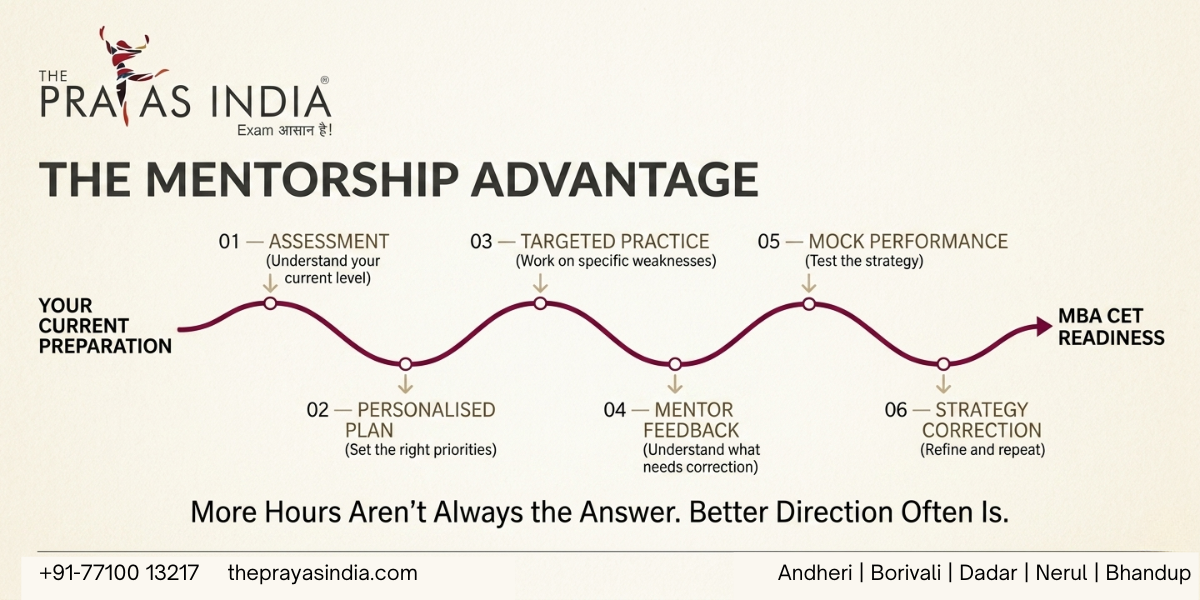
Assess → Prioritise → Practise → Review → Correct → Retest
That process can make preparation more structured and prevent students from repeatedly spending time on low-impact activities.
1. Your Study Plan Should Follow Your Performance
A timetable can tell you what to study.
A good strategy tells you why you are studying it now.
Suppose your weekly performance shows:
- Strong performance in Logical Reasoning
- Moderate Quantitative Aptitude
- Weak Verbal Ability
- Good accuracy
- Slow overall execution
A generic timetable might distribute equal time across all areas.
A performance-based plan could instead increase focus on:
Verbal Ability → Speed-building → Timed mixed practice
while maintaining Logical Reasoning through shorter revision sessions.
This is a fundamental difference.
Your study plan should respond to your performance—not just the calendar.
2. Personalised Planning Prevents Preparation Overload
MBA CET aspirants often try to do everything simultaneously.
They want to:
- Complete the syllabus
- Revise every chapter
- Solve large question sets
- Take mocks
- Analyse mocks
- Watch strategy videos
- Improve speed
- Improve accuracy
- Follow current preparation trends
The result can be a schedule that looks productive but becomes difficult to sustain.
Mentorship can help prioritise.
Instead of asking:
“What can I add to my schedule?”
the better question is:
“What can I remove because it isn’t helping enough?”
Effective preparation is not about continuously adding tasks.
Sometimes, it is about eliminating unnecessary ones.
3. Mock Tests Should Become Feedback Sessions
A mock test should not end when you see your score.
The real learning can begin after the test.
A mentor can help you review:
Attempts
Did you attempt enough questions?
Accuracy
Were your attempts reliable?
Time
Where did you spend too much time?
Selection
Did you choose the right questions?
Patterns
Which mistakes keep appearing?
This makes mock analysis much more useful.
Instead of:
Mock → Score → Next Mock
the process becomes:
Mock → Analyse → Discuss → Correct → Practise → Retest
4. The Right Feedback Is Specific
“Improve your Quant.”
“Work on speed.”
“Practise more.”
These statements may be true, but they aren’t very actionable.
Useful feedback should answer:
What is wrong?
For example:
“Your Quant accuracy drops in calculation-heavy questions.”
Why is it happening?
“You are rushing through intermediate calculations.”
What should change?
“Use timed calculation drills and verify intermediate steps.”
How will improvement be measured?
“Track accuracy across the next three sectional tests.”
Now feedback becomes a process rather than a generic instruction.
5. Targeted Practice Is More Efficient Than Random Practice
Suppose your mock analysis shows that you repeatedly struggle with a particular type of Logical Reasoning question.
You could solve 100 random LR questions.
Or you could structure the practice:
Step 1 — Understand
Review the underlying approach.
Step 2 — Basic Practice
Solve easier examples to establish the method.
Step 3 — MBA CET-Level Questions
Increase complexity.
Step 4 — Timed Practice
Introduce exam pressure.
Step 5 — Reattempt
Return to questions you previously got wrong.
This approach gives your practice a clear purpose.
6. Speed Should Be Built Without Destroying Accuracy
One of the biggest challenges in MBA CET preparation is balancing speed and accuracy.
If you try to increase speed too quickly, mistakes can increase.
If you focus exclusively on accuracy, you may become too slow.
A mentor can help identify your current position.
If Accuracy Is Low
Focus first on:
Concept clarity → Precision → Consistency
If Accuracy Is Strong but Speed Is Low
Focus on:
Pattern recognition → Timed practice → Question selection
If Both Are Weak
Return to fundamentals before aggressively increasing test speed.
The correct strategy depends on the starting point.
7. Question Selection Can Be Trained
Question selection is sometimes treated as an instinct.
It doesn’t have to be.
You can deliberately train yourself to recognise:
- Familiar question structures
- High-confidence opportunities
- Questions requiring excessive calculations
- Questions with uncertain approaches
- Questions worth postponing
- Questions worth leaving
During practice, don’t only record whether you solved a question.
Also ask:
“Was this the right question for me to attempt at that moment?”
That single question can change how you approach a speed-based examination.
8. Accountability Helps Protect Consistency
A preparation plan can look perfect on paper and still fail in execution.
One week you’re highly motivated.
The next week your schedule becomes irregular.
Then you miss revision.
Then you postpone the mock.
Then you decide to “restart properly” next Monday.
This cycle is common among competitive-exam aspirants.
Mentorship can introduce an element of accountability.
Not pressure for the sake of pressure.
Rather, a simple structure:
Target → Action → Review → Feedback → Next Target
When progress is reviewed regularly, it becomes easier to identify when preparation is drifting.
9. A Mentor Can Help You Decide What NOT to Do
This is one of the underrated benefits of guidance.
MBA CET preparation is surrounded by endless resources.
You can find:
- Different books
- Multiple mock series
- Strategy videos
- Shortcuts
- Preparation plans
- Online communities
- New techniques
The availability of information can become a distraction.
A mentor can help you determine:
Which resource is relevant?
Which strategy suits your level?
Which practice is redundant?
Which topic should receive priority?
This can reduce unnecessary experimentation.
10. Preparation Should Have Measurable Checkpoints
Instead of simply saying:
“I want to improve my MBA CET score.”
Create smaller checkpoints.
Checkpoint 1 — Accuracy
Reduce avoidable errors.
Checkpoint 2 — Speed
Improve average solving time.
Checkpoint 3 — Selection
Identify better scoring opportunities.
Checkpoint 4 — Sectional Performance
Strengthen weaker areas.
Checkpoint 5 — Full-Length Performance
Apply the strategy under realistic conditions.
Each checkpoint gives you something specific to work towards.
11. Mentorship Can Help During Plateaus
Almost every serious aspirant eventually experiences a plateau.
You work consistently.
You practise.
You take tests.
Yet your scores seem stuck.
This is often the stage where students make impulsive changes.
They switch resources.
They completely change their timetable.
They abandon one strategy and start another.
Before doing that, investigate the plateau.
Ask:
- Has accuracy improved?
- Are attempts increasing?
- Are repeated mistakes reducing?
- Are you choosing better questions?
- Is the syllabus actually complete?
- Are you analysing mocks properly?
- Are you practising your weakest areas sufficiently?
A mentor can help distinguish between a temporary plateau and a strategy problem.
12. Mentorship Becomes Especially Valuable During the Final Phase
As the exam approaches, preparation needs to become more selective.
There is less value in trying to learn everything from scratch.
The focus increasingly shifts towards:
- Revision
- Mock tests
- Weak-area correction
- Speed
- Accuracy
- Question selection
- Time allocation
- Exam strategy
At this stage, the question changes from:
“What haven’t I studied?”
to:
“What can improve my performance from here?”
That shift is important.
13. What Should You Expect From Good Mentorship?
Not every coaching experience provides the same level of guidance.
If you’re considering MBA CET coaching in Mumbai, look beyond advertisements and ask practical questions.
Does the institute provide individual feedback?
Or are students expected to interpret every test themselves?
Are mock tests analysed properly?
Taking a test is only one part of the process.
Is the study plan flexible?
Students with different strengths should not necessarily follow identical strategies.
Is there access to mentors?
Regular interaction can be valuable when students face preparation roadblocks.
Is performance tracked over time?
Improvement becomes easier to measure when there is a consistent record.
Is the focus on the actual examination?
The preparation should ultimately help students perform under real MBA CET conditions.
These questions can help you evaluate whether a coaching programme offers genuine mentorship or simply additional study material.
From a Timetable to a Strategy
The difference between a timetable and a strategy is simple.
A timetable tells you:
“Study Quant from 7–9 PM.”
A strategy tells you:
“Your Quant accuracy has improved, but calculation-heavy questions are consuming too much time. Use this session for timed practice and review the errors afterward.”
The second approach is connected to performance.
That’s what makes mentorship valuable.
You are not simply following a schedule.
You understand why the schedule exists.
Why The Prayas India Can Be a Strategic Choice
For students looking for MBA CET coaching in Mumbai, the right preparation ecosystem should offer more than classes.
At The Prayas India, the focus can extend across the complete preparation journey—from concept building and practice to mock tests, performance evaluation and strategic guidance.
An effective preparation ecosystem should help students:
- Build strong fundamentals
- Practise MBA CET-oriented questions
- Develop speed and accuracy
- Understand mock-test performance
- Identify weak areas
- Improve question selection
- Receive faculty guidance
- Maintain preparation consistency
- Refine their strategy as the exam approaches
For an aspirant serious about MBA admissions, this kind of structured environment can make preparation more organised and measurable.
A Better Question to Ask Before Choosing Coaching
Instead of asking only:
“Which coaching has the most material?”
ask:
“Which coaching will help me understand how to use that material effectively?”
Because more books don’t automatically create better preparation.
More questions don’t automatically create better scores.
More mocks don’t automatically create better performance.
What matters is the quality of the learning loop:
Learn → Practise → Test → Analyse → Correct → Improve
Expert mentorship strengthens that loop by helping you identify what to do next.
The Real Advantage Is Direction
MBA CET preparation requires effort.
There is no shortcut around that.
But effort becomes more valuable when it is directed towards the right problems.
A mentor can help you identify those problems, create priorities, interpret your performance and make corrections before small mistakes become long-term habits.
The result isn’t simply a better timetable.
It is a better preparation strategy.
And when the exam is highly competitive, knowing where to focus can be just as important as how hard you work.
Choosing the Right Mentorship Can Change Your Preparation
Not every coaching programme offers the same kind of guidance.
When you’re searching for the best MBA CET coaching in Mumbai, it is easy to compare institutes based on faculty names, study material, fees or the number of mock tests offered.
These factors matter.
But there is another question that deserves equal attention:
Will this preparation system actually help me understand and improve my performance?
Because MBA CET preparation isn’t simply about attending classes.
It is about knowing what to learn, what to practise, what to correct and what to prioritise next.
That is where a strong mentorship ecosystem can make a difference.
What Should You Look for in MBA CET Mentorship?
Before joining a coaching institute, look beyond the basic promise of “complete preparation.”
Evaluate the quality of the overall learning system.
1. Conceptual Guidance
The foundation should be strong.
Faculty should help you understand concepts instead of simply teaching shortcuts or answer patterns.
Strong fundamentals make it easier to handle questions that appear in unfamiliar forms.
2. Personalised Feedback
A student shouldn’t have to interpret every performance issue alone.
Look for a system where your preparation can be reviewed through:
- Mock-test performance
- Accuracy
- Speed
- Sectional strengths
- Weak areas
- Repeated mistakes
- Question-selection patterns
The purpose of feedback is to answer:
“What should I improve next?”
3. Quality Mock-Test Practice
Mocks are an important part of MBA CET preparation.
But the value of a mock depends heavily on what happens after it.
A useful system should encourage students to examine:
What went right?
What went wrong?
Where was time lost?
Which questions were missed?
Which mistakes are repeating?
This turns testing into learning.
4. Strategy Guidance
MBA CET is a speed-intensive examination.
Therefore, students need more than conceptual knowledge.
They need a strategy for:
- Time allocation
- Question selection
- Attempt sequencing
- Speed
- Accuracy
- Revision
- Mock-test execution
The right strategy may also change as preparation progresses.
Early preparation may require more concept building.
Later preparation may require greater emphasis on mocks, speed and execution.
5. Doubt Resolution
A small conceptual doubt can become a repeated mistake if it isn’t addressed.
An effective preparation environment should make it easy for students to clarify:
- Difficult concepts
- Alternative approaches
- Calculation methods
- Question interpretation
- Mock-test mistakes
The objective isn’t simply to provide an answer.
It is to ensure that the same confusion doesn’t continue appearing.
6. Mentoring That Builds Accountability
Preparation becomes much easier to manage when there is a clear structure.
You know:
What you need to complete.
What you need to practise.
What needs improvement.
When your performance will be reviewed.
This creates accountability without turning preparation into unnecessary pressure.
7. A Preparation System That Supports MBA Admissions
For many students, MBA CET isn’t the final destination.
It is a pathway towards securing admission into a strong management programme.
That means preparation should ultimately be connected to the larger objective:
Score → Percentile → College Options → MBA Admission
A good preparation strategy therefore keeps the admission goal in view while helping students focus on what they can control—their preparation and performance.
Why Self-Study and Mentorship Can Work Together
Expert mentorship doesn’t mean that self-study becomes unnecessary.
In fact, the strongest preparation often combines both.
Mentorship Provides
Direction
Feedback
Strategy
Accountability
Self-Study Provides
Practice
Revision
Repetition
Independent problem-solving
Neither replaces the other.
The mentor helps you understand where to go.
Your self-study determines how consistently you get there.
The Final Phase Needs a Different Mindset
As MBA CET gets closer, students often become anxious about unfinished portions.
They start trying to cover everything.
But the final phase isn’t necessarily about adding more and more content.
It should increasingly focus on:
- Revising high-priority concepts
- Practising efficiently
- Improving speed
- Protecting accuracy
- Analysing mocks
- Refining question selection
- Building exam confidence
At this stage, expert guidance can help students distinguish between:
“I haven’t done this yet.”
and
“This is important enough to spend time on now.”
That distinction can save valuable preparation time.
The Mentorship Difference: A Simple Example
Consider an aspirant who is scoring around the same range in multiple mocks.
Without structured feedback
The student thinks:
“I need to study more.”
They add more questions to their schedule.
The score remains similar.
With performance-based mentorship
The mock is analysed.
The student discovers:
- Accuracy is already reasonable.
- Several easy questions were missed.
- Too much time was spent on difficult questions.
- Revision time is being spent disproportionately on strong topics.
The strategy changes.
The student now works on:
Question selection + speed + targeted revision
The preparation hasn’t necessarily become longer.
It has become more focused.
That is the real value of mentorship.
From Confusion to Clarity
At different stages of MBA CET preparation, students can have very different questions.
Beginning
“Where should I start?”
Middle
“What should I prioritise?”
Mock Phase
“Why isn’t my score improving?”
Final Phase
“What should I revise and what should I leave?”
A strong mentor should help you answer these questions based on your actual preparation rather than giving a generic response.
Why Consider The Prayas India for MBA CET Preparation?
Students looking for MBA CET coaching in Mumbai should ideally choose an institute based on the complete preparation experience rather than a single feature.
At The Prayas India, students can approach MBA CET preparation through a structured ecosystem that combines learning, practice, testing and guidance.
The preparation journey can include:
Concept Building
Develop a strong foundation across the key areas required for MBA CET.
Practice
Apply concepts through examination-oriented questions and regular practice.
Mock Tests
Experience exam-like conditions and understand performance under time pressure.
Performance Analysis
Identify areas that require attention instead of relying only on an overall score.
Faculty Guidance
Get expert support when concepts, strategies or preparation decisions become challenging.
Doubt Resolution
Clarify questions and strengthen areas where repeated confusion occurs.
Mentorship
Build a more structured approach towards preparation, performance improvement and exam strategy.
For students who are serious about MBA admissions, having a structured preparation environment can make the journey more focused and manageable.
The Right Coaching Is About More Than Classes
A classroom can teach you a concept.
A book can give you questions.
A mock can give you a score.
But mentorship connects all three.
It helps you understand:
What you learned.
How well you applied it.
Where you made mistakes.
What you should change.
What you should do next.
That is why expert mentorship can become an important part of serious MBA CET preparation.
Frequently Asked Questions
Can expert mentorship really improve my MBA CET score?
Mentorship cannot guarantee a particular score, but structured guidance can help students identify preparation gaps, improve strategy, analyse performance and use their study time more effectively.
Is mentorship useful for students who already self-study?
Yes. Self-study and mentorship can complement each other. You can continue independent practice while using expert guidance for planning, feedback, mock analysis and strategy correction.
When should I join MBA CET coaching?
Ideally, students should give themselves enough time to build concepts, practise consistently and take multiple mocks. However, the appropriate timeline depends on your existing preparation level and target.
Can a mentor help with time management?
Yes. Time-management problems can often be identified through mock performance. A mentor can help students work on question selection, prioritisation, timed practice and section strategy.
What is more important—speed or accuracy?
Both matter. High speed without accuracy can lead to unnecessary mistakes, while excellent accuracy with very low speed can limit attempts. The objective is to build an effective balance between the two.
How do I choose the best MBA CET coaching in Mumbai?
Look beyond marketing claims. Evaluate faculty quality, study material, mock tests, doubt support, performance analysis, mentoring, student feedback and how well the overall programme matches your preparation needs.
Your MBA CET Preparation Needs Direction
Preparing for MBA CET is not about finding a magical shortcut.
It is about making hundreds of small decisions correctly over an extended period.
What should you study?
What should you revise?
Which questions should you practise?
Which mistakes should you fix?
When should you take a mock?
Why did your score stagnate?
What should change before the next test?
You can answer these questions alone through experience and experimentation.
But expert mentorship can help you reach those answers more systematically.
And that is the real advantage.
From Preparation to Performance
A strong MBA CET preparation journey can be represented in one simple progression:
LEARN
↓
PRACTISE
↓
TEST
↓
ANALYSE
↓
GET GUIDANCE
↓
CORRECT
↓
RETEST
↓
IMPROVE
The objective isn’t simply to spend more hours preparing.
It is to make those hours more purposeful.
If you are preparing for MBA CET and looking for structured MBA CET coaching in Mumbai, The Prayas India can help you build a preparation system around concepts, practice, mock tests, performance analysis and expert mentorship.
🎓 Admissions-focused MBA CET preparation is about more than clearing an exam—it is about creating better opportunities for your MBA journey.
Contact Us
- 📞 Call: +91-77100 13217
- 🌐 Website: https://theprayasindia.com
- 📍 Centres: Andheri | Borivali | Dadar | Nerul | Bhandup
Final Takeaway
You don’t always need another book.
You don’t always need another strategy video.
You don’t always need to study for another hour.
Sometimes, you need someone experienced to look at your preparation and tell you:
“This is where you’re losing marks. This is what you should fix next.”
That clarity can change the way you prepare.
Because when the goal is a strong MBA CET score, working hard matters—but knowing where to put that hard work matters too.