
Why Your CAT Score Is Not Improving | Best CAT Coaching in Mumbai | The Prayas India
Introduction
You completed another mock test.
You expected improvement.
Instead, your score remained almost the same.
Or perhaps it even dropped.
This is one of the most frustrating experiences for CAT aspirants.
You are studying every day, solving questions, attending classes, and spending hours on preparation—yet your percentile refuses to improve.
If this sounds familiar, you are not alone.
Many serious CAT aspirants reach a stage where their performance stops improving. They begin to wonder whether they lack aptitude or whether CAT is simply too difficult.
In reality, the problem is rarely your potential.
More often, it is your preparation strategy.
A Higher Study Time Doesn’t Always Mean a Higher Score
Many students believe that studying longer automatically improves performance.
Unfortunately, CAT doesn’t work that way.
Two aspirants may study for the same number of hours every day.
One gradually moves from the 70th percentile to the 95th percentile.
The other remains stuck despite putting in equal effort.
The difference isn’t the effort.
The difference is how that effort is directed.
CAT rewards intelligent preparation far more than endless practice.
The “Score Plateau” Is Completely Normal
Almost every serious CAT aspirant experiences a stage where mock scores stop increasing.
Initially, scores improve quickly because basic concepts are being learned.
Later, improvement slows down.
This stage is called a performance plateau.
Many students panic here.
Some change coaching institutes repeatedly.
Some purchase new books.
Others completely redesign their study plan every week.
Ironically, these reactions often make the situation worse.
A plateau is not a sign that you cannot improve.
It usually means your preparation now requires a different approach.
Studying More Isn’t the Same as Improving
Suppose you solve fifty Quant questions every day.
If you continue making the same mistakes repeatedly, your score may never increase.
Similarly,
- Reading more formulas doesn’t automatically improve speed.
- Solving more RC passages doesn’t guarantee better accuracy.
- Taking more mock tests doesn’t improve performance unless you analyse them properly.
Improvement happens only when preparation becomes intentional.
Every study session should answer one question:
“What skill am I improving today?”
The Comfort Zone Trap
Many aspirants unknowingly spend most of their time practising topics they already enjoy.
For example:
- Strong in Arithmetic? They solve more Arithmetic.
- Comfortable with Reading Comprehension? They attempt additional RCs.
- Good at Logical Reasoning? They keep solving familiar puzzle types.
Meanwhile,
their weaker sections receive very little attention.
As a result,
confidence increases,
but the CAT score doesn’t.
Real improvement begins when you spend more time strengthening weak areas instead of repeatedly practising comfortable ones.
CAT Measures Decision-Making, Not Just Knowledge
Many students think CAT is simply a test of concepts.
Actually,
CAT also evaluates:
- Question selection
- Time management
- Accuracy under pressure
- Decision-making
- Mental adaptability
Two students with similar conceptual knowledge often receive very different percentiles because one manages the examination more intelligently.
Preparing only for concepts means preparing for half the examination.
Are You Measuring Progress Correctly?
Many aspirants judge themselves using only one number:
Mock Score
That number tells only part of the story.
Better questions include:
- Is my accuracy improving?
- Am I spending less time per question?
- Have my silly mistakes reduced?
- Is my VARC performance becoming more consistent?
- Am I identifying easier questions faster?
When these indicators improve, percentile usually follows naturally.
The Hidden Cost of Random Preparation
One common mistake is preparing without a defined system.
For example:
Monday
- Random Quant practice.
Tuesday
- Watch YouTube strategy videos.
Wednesday
- Attempt a mock.
Thursday
- Start a new book.
Friday
- Switch to another resource.
- This creates activity—but not progress.
- Preparation should follow a sequence.
- Concepts.
- Practice.
- Analysis.
- Revision.
- Performance review.
- Without this cycle, improvement becomes unpredictable.
Stop Comparing Your Journey with Others
CAT preparation often becomes stressful because students constantly compare mock scores.
Someone shares a 99 percentile mock.
Another posts a perfect DI-LR attempt.
Social media creates unrealistic expectations.
Remember:
You do not know:
- Their preparation timeline.
- Their academic background.
- The number of mocks they’ve attempted.
- Their consistency over several months.
The only meaningful comparison is between your current performance and last month’s performance.
Improvement Begins with Honest Analysis
The fastest way to improve is not by solving more questions.
It is by understanding why you are losing marks.
Ask yourself after every mock:
- Which section consumed unnecessary time?
- Which questions should I have skipped?
- Where did accuracy drop?
- Which concepts require revision?
- What pattern appears repeatedly?
Every incorrect answer contains valuable information.
Students who analyse these patterns improve much faster than students who simply attempt more mocks.
Small Improvements Create Big Percentile Jumps
Many aspirants believe they need dramatic improvement.
Actually,
even small gains can create significant percentile growth.
For example:
- Two additional correct answers.
- Three fewer negative marks.
- Better question selection.
- Slightly faster calculations.
- Improved reading efficiency.
These seemingly minor changes often produce substantial improvements in the final percentile.
Success in CAT is built through continuous refinement rather than sudden breakthroughs.
The Right Preparation System Matters
Once students understand why their scores have stopped improving, the next step is creating a preparation system that addresses those specific issues.
Instead of guessing what to study next, aspirants benefit from a structured approach that identifies weak areas, prioritises improvement, and measures progress objectively.
This is where the quality of academic guidance becomes important.
Rather than focusing only on syllabus completion, a well-designed preparation framework helps students improve their performance step by step.
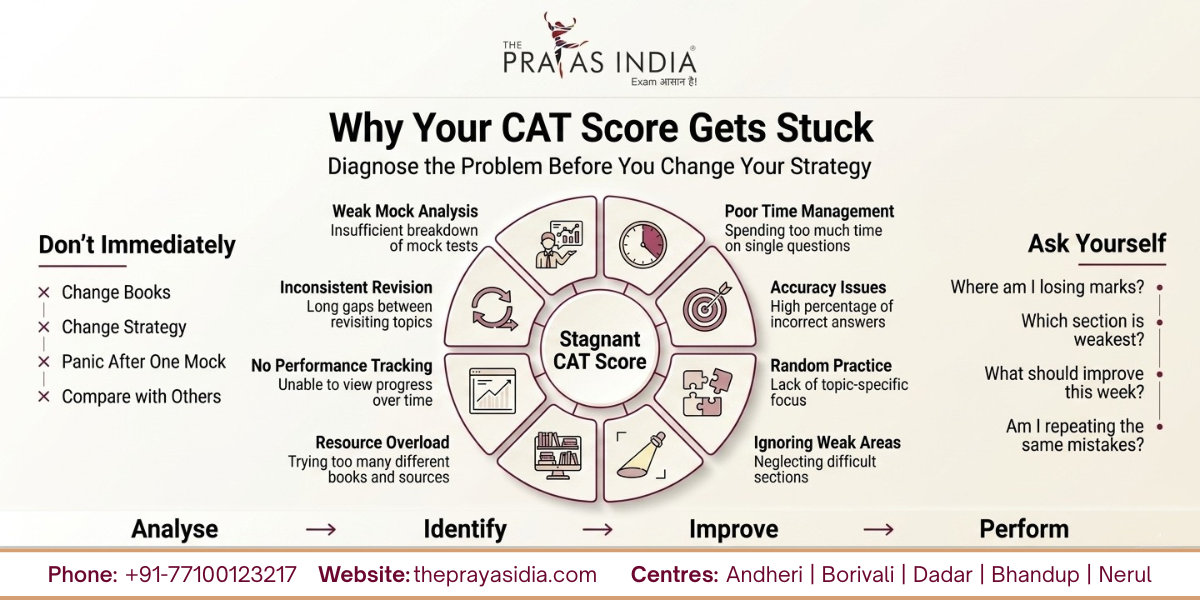
10 Reasons Your CAT Score Has Stopped Improving
If your CAT mock scores have remained unchanged for several weeks, don’t assume you’ve reached your limit.
More often than not, a stagnant score is the result of a few preparation mistakes that keep repeating in every mock test.
The good news?
Once you identify these mistakes, improvement becomes much easier.
Let’s examine the most common reasons why CAT aspirants struggle to increase their scores.
1. You Take Mock Tests but Rarely Analyse Them
Many students complete a mock test, check their percentile, and immediately move on to the next one.
Unfortunately, this approach wastes one of the most valuable learning opportunities.
A mock test should answer questions such as:
- Which questions consumed the most time?
- Where did accuracy decline?
- Which questions should have been skipped?
- Which concepts need revision?
The real improvement happens after the mock, not during it.
2. You Keep Solving Questions Without Fixing Mistakes
Imagine solving hundreds of Quant questions while making the same calculation errors repeatedly.
Practice alone doesn’t improve performance.
Correct practice does.
Every recurring mistake should be identified, understood, and eliminated before moving forward.
Otherwise, the same errors continue appearing in future mocks.
3. You Spend Too Much Time on Strong Areas
Most students naturally prefer subjects they already enjoy.
For example:
- Strong in Arithmetic? More Arithmetic.
- Comfortable with Reading Comprehension? More RCs.
- Confident in Logical Reasoning? More LR sets.
While confidence grows, weaker sections remain neglected.
Since CAT evaluates overall performance, sectional imbalance often limits the final percentile.
Balanced preparation produces better long-term results than selective preparation.
4. Your Preparation Has Become Resource-Centred
Some aspirants believe success depends on collecting more books, courses, PDFs, or online resources.
Instead of mastering one reliable source, they keep switching between multiple materials.
This creates confusion rather than clarity.
Depth is far more valuable than variety.
Completing fewer resources thoroughly often produces better results than partially studying many.
5. You Ignore Accuracy While Chasing Attempts
Attempting more questions does not automatically improve your score.
In CAT, every incorrect answer carries a penalty.
Many students focus only on increasing attempts while ignoring accuracy.
A student attempting 18 questions accurately may outperform someone attempting 24 with frequent negative marking.
The objective is not maximum attempts.
The objective is maximum effective attempts.
6. You Never Review Your Time Distribution
After every mock, ask:
- Which section consumed unnecessary time?
- Where did I hesitate?
- Which questions should I have left earlier?
Many aspirants lose valuable minutes on difficult questions while easier opportunities remain unanswered.
Better time allocation often improves scores without learning a single new concept.
7. You Change Strategy Too Frequently
One disappointing mock often leads students to redesign their entire preparation plan.
New books.
New timetable.
New YouTube strategy.
New coaching advice.
Constant change prevents consistency.
A strategy should be evaluated over several weeks—not after one difficult mock.
Continuous refinement is better than continuous replacement.
8. You Prepare Without Measuring Improvement
Many students ask:
“Did I study today?”
A better question is:
“What improved today?”
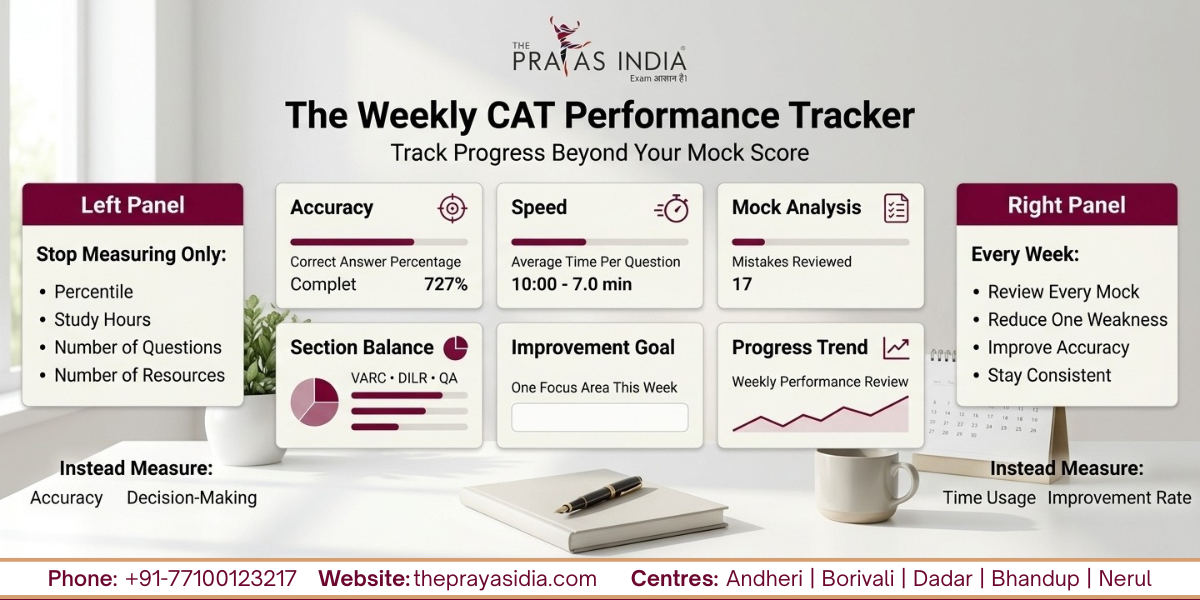
Track measurable indicators such as:
- Accuracy percentage
- Average solving time
- Section-wise performance
- Number of silly mistakes
- Reading speed
- Mock score trend
When progress becomes measurable, improvement becomes easier to manage.
9. You Avoid Difficult Topics
Every aspirant has chapters they postpone repeatedly.
For some, it is Geometry.
For others, DI-LR.
Some avoid Reading Comprehension because it feels unpredictable.
Ignoring difficult topics creates permanent scoring gaps.
Improvement begins where comfort ends.
The topics you postpone today often become the questions you regret tomorrow.
10. You’re Studying Hard but Not Studying Strategically
This is perhaps the biggest reason scores remain stagnant.
Many aspirants work sincerely.
They study daily.
They solve questions.
They revise.
Yet they never stop to ask:
- Is my approach actually working?
- Which activities produce the biggest improvement?
- What should I change?
Preparation should evolve based on performance.
Without regular review, even sincere effort can become repetitive rather than productive.
Every Low Score Is Feedback
Instead of treating a disappointing mock as failure, treat it as a performance report.
A mock test tells you:
- Which concepts need strengthening.
- Which habits require correction.
- Which section needs more attention.
- Which strategy is working—and which isn’t.
Students who view mocks as learning opportunities usually improve faster than those who focus only on percentile.
Build a Performance Improvement System
Rather than asking,
“How many mocks should I attempt?”
Ask,
“How much did I learn from my last mock?”
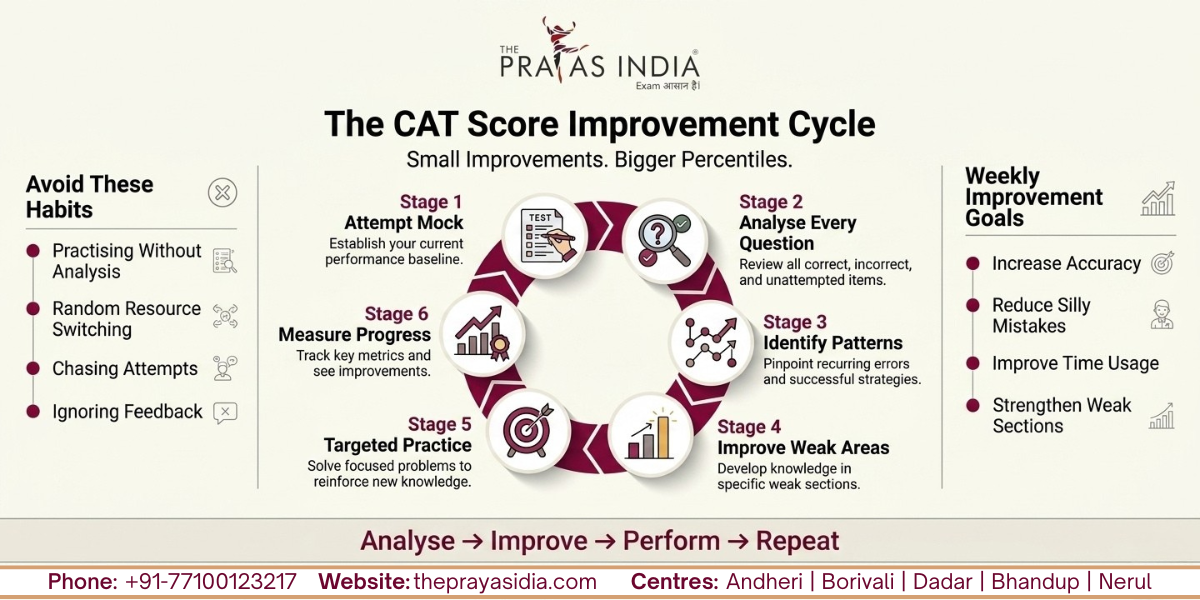
An effective improvement cycle looks like this:
Attempt Mock → Analyse Every Mistake → Identify Weak Areas → Improve Concepts → Practise Again → Re-test
Repeating this cycle consistently leads to steady score growth.
Why Personalised Guidance Matters
Many students know that their scores are not improving—but they don’t know why.
Some struggle with accuracy.
Others lose marks because of poor question selection.
Some face time management issues, while others have conceptual gaps.
Without proper diagnosis, students often spend weeks trying to solve the wrong problem.
At The Prayas India, preparation is designed around continuous performance evaluation. Instead of treating every student the same, academic guidance focuses on identifying individual improvement areas and helping aspirants build smarter strategies for consistent score growth.
When preparation becomes personalised, progress becomes measurable.
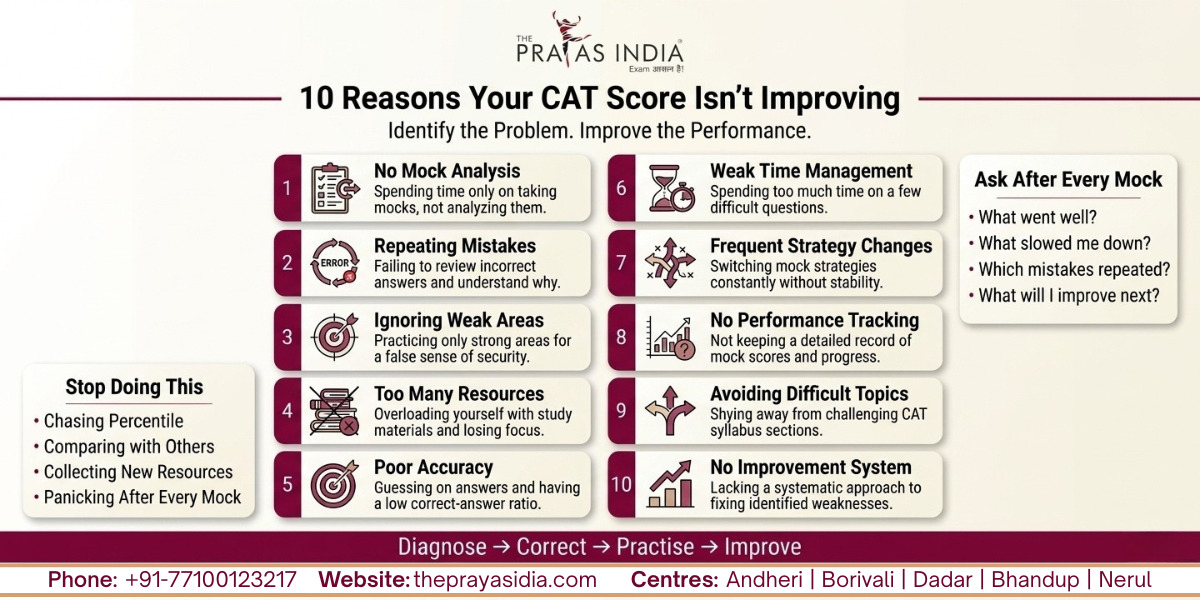
How High-Scoring CAT Aspirants Break the Score Plateau
Once you identify why your CAT score has stopped improving, the next challenge is knowing how to improve it.
Interestingly, students who consistently move from the 70th percentile to the 90th percentile—or from the 90th to the 99th percentile—do not necessarily study longer than everyone else.
Instead, they follow a structured improvement system.
Rather than asking,
“How much did I study today?”
they ask,
“What became better today?”
That small change in mindset creates a significant difference in long-term performance.
Build an Error Log Instead of Collecting More Questions
Every incorrect answer tells you something valuable.
Yet many students forget their mistakes immediately after checking the solution.
A better approach is maintaining an Error Log.
After every practice session or mock, record:
- The topic.
- The type of mistake.
- Why the mistake happened.
- What should have been done differently.
Most mistakes usually fall into one of these categories:
- Conceptual misunderstanding.
- Calculation error.
- Wrong question selection.
- Time pressure.
- Careless reading.
When patterns become visible, improvement becomes much easier.
Spend More Time Reviewing Than Attempting
Many aspirants proudly say,
“I solved 300 questions this week.”
A better question is,
“How many of those questions actually improved my performance?”
A one-hour mock analysis often contributes more to your score than solving another fifty random questions.
During analysis:
- Reattempt incorrect questions.
- Understand alternative methods.
- Identify avoidable mistakes.
- Review skipped questions.
- Compare your approach with the optimal solution.
Learning happens during reflection—not just during practice.
Track Accuracy Like a Performance Metric
Most students monitor only one number:
Mock Score.
Top performers monitor several indicators.
For example:
- Accuracy percentage.
- Time per question.
- Correct-to-incorrect ratio.
- Section-wise performance.
- Number of guesses.
- Questions left unanswered.
These metrics reveal hidden improvement long before percentile increases.
Small improvements in accuracy often produce major gains in overall performance.
Strengthen Weak Areas Without Ignoring Strengths
Many aspirants either:
- Focus only on weaknesses,
or
- Study only their favourite topics.
Neither approach is ideal.
A balanced strategy works better.
For example:
- Continue improving strong areas.
- Allocate dedicated time every week to weaker sections.
- Measure progress regularly.
Weak sections should gradually become dependable—not necessarily perfect.
Balanced performance generally produces higher percentiles than excellence in only one section.
Learn the Art of Question Selection
One of the biggest differences between average and high-scoring CAT aspirants is their decision-making during the examination.
Successful candidates do not attempt every question.
They identify:
- Which questions deserve time.
- Which questions should be postponed.
- Which questions should be skipped completely.
Good question selection improves:
- Accuracy.
- Time management.
- Confidence.
Remember,
CAT rewards smart decisions—not maximum attempts.
Use Weekly Performance Reviews
Improvement becomes difficult without regular review.
Instead of evaluating yourself only after every mock, conduct a weekly review.
Ask yourself:
- Which section improved this week?
- Which mistakes repeated?
- Which concepts still require attention?
- Did my accuracy increase?
- What should be my priority next week?
This keeps preparation focused on continuous improvement rather than random activity.
Don’t Let One Bad Mock Define Your Confidence
Every serious CAT aspirant experiences disappointing mock scores.
The important question is:
How do you respond?
Avoid reactions such as:
- Changing your complete strategy.
- Ignoring future mocks.
- Comparing yourself with others.
- Losing confidence.
Instead:
- Analyse calmly.
- Correct mistakes.
- Continue practising.
One poor mock does not define your final CAT percentile.
Your response to that mock often matters more than the score itself.
Improve Decision-Making Under Exam Pressure
Many students perform well while practising at home but struggle during actual mock tests.
The reason is not lack of knowledge.
It is pressure.
To improve decision-making:
- Attempt mocks under strict exam conditions.
- Avoid unnecessary breaks.
- Follow the actual CAT time limits.
- Practise section-wise strategy consistently.
The more familiar your brain becomes with examination conditions, the more confident your decisions become.
Consistency Creates Compound Improvement
CAT preparation rarely improves in dramatic leaps.
Instead, small improvements accumulate over time.
Imagine improving just one aspect every week:
Week 1
Better Reading Speed.
Week 2
Improved Quant Accuracy.
Week 3
Faster DI-LR Selection.
Week 4
Better Mock Analysis.
Individually these changes appear small.
Together they produce substantial percentile improvement over several months.
Preparation Needs Feedback, Not Guesswork
One common mistake among CAT aspirants is trying to solve every problem independently without evaluating whether their preparation strategy is actually working.
Objective feedback plays an important role in performance improvement.
It helps students understand:
- Whether their current approach is effective.
- Which habits are slowing their progress.
- Which sections deserve immediate attention.
Preparation becomes much more efficient when improvement is based on measurable performance instead of assumptions.
Why Structured Mentoring Accelerates Score Improvement
Many aspirants know they are working hard.
Few know whether they are working on the right problems.
This is where structured mentoring becomes valuable.
At The Prayas India, preparation goes beyond syllabus completion. Students regularly evaluate their performance, identify recurring patterns, and refine their preparation strategy through systematic academic planning.
Instead of repeatedly wondering why scores remain unchanged, aspirants receive a structured framework that helps them improve gradually, monitor their progress objectively, and prepare with greater clarity and confidence.
Turn Every Mock into Measurable Progress
A stagnant CAT score does not mean you have reached your maximum potential.
In most cases, it simply means your preparation now needs better direction, not necessarily more effort.
Every mock test, every practice session, and every mistake contains valuable information. Students who learn to interpret that information improve steadily, while those who ignore it often remain stuck at the same score level.
The goal is not to become perfect overnight.
The goal is to become slightly better every single week.
The CAT Score Improvement Checklist
Before attempting your next mock, review this checklist.
Preparation
- Am I following one structured study plan?
- Am I focusing on concepts instead of collecting resources?
- Have I revised recently studied topics?
Practice
- Am I solving quality questions consistently?
- Have I practised all three sections this week?
- Am I working on weak topics instead of avoiding them?
Mock Analysis
- Did I analyse every incorrect answer?
- Did I identify why I lost marks?
- Did I record recurring mistakes?
Performance
- Is my accuracy improving?
- Am I selecting questions more intelligently?
- Has my time management become better?
Review
- Did I compare this mock with previous mocks?
- Did I identify one improvement goal for next week?
- Am I tracking progress instead of only percentile?
If you regularly answer “Yes” to these questions, your preparation is moving in the right direction.
A Weekly Self-Audit That Actually Works
Instead of judging yourself after every mock, conduct a structured review once a week.
Ask yourself:
What improved this week?
Perhaps your RC accuracy increased or you reduced calculation mistakes.
What still needs attention?
Identify one or two focus areas instead of trying to improve everything simultaneously.
What should change next week?
Small adjustments are often more effective than completely changing your strategy.
A weekly review transforms preparation from random effort into continuous improvement.
What Successful CAT Aspirants Do Differently
Students who consistently improve their percentile usually share a few common habits.
They:
- Analyse every mock thoroughly.
- Learn from mistakes instead of repeating them.
- Focus on progress rather than comparison.
- Improve one weakness at a time.
- Stay consistent even when scores fluctuate.
- Trust a structured preparation process.
These habits may appear simple, but over several months they create a significant difference in performance.
Frequently Asked Questions
1. My CAT score has been stuck for weeks. Should I change my study material?
Not immediately.
Before changing resources, analyse whether the issue lies in concepts, accuracy, time management, or mock strategy. In many cases, the problem is not the study material but how it is being used.
2. How many mock tests should I attempt?
Quality matters more than quantity.
Attempt mocks regularly, but dedicate enough time to analysing each one. A carefully reviewed mock contributes far more than several mocks taken without analysis.
3. Is it normal for mock scores to fluctuate?
Yes.
Mock scores often vary depending on difficulty level, question selection, and test conditions. Focus on long-term trends instead of individual scores.
4. How can I improve my accuracy?
Read questions carefully, avoid unnecessary guesses, review recurring mistakes, and practise under timed conditions. Accuracy improves through conscious correction, not simply by attempting more questions.
5. Can coaching help improve CAT scores?
A structured coaching environment can help students identify weaknesses, develop an organised preparation strategy, and receive objective feedback on their progress. Ultimately, improvement depends on consistent effort and effective implementation.
Why Many Aspirants Choose The Prayas India for CAT Preparation
Scoring well in CAT requires more than completing the syllabus. It requires continuous performance improvement, strategic preparation, and the ability to learn from every mock test.
At The Prayas India, the focus is on helping students prepare with clarity and purpose rather than simply increasing study hours.
Structured Preparation Roadmap
Students follow a well-planned academic sequence that balances concept building, practice, revision, and performance tracking.
Data-Driven Performance Improvement
Regular assessments and mock analysis help students identify recurring mistakes, monitor progress, and make informed adjustments to their preparation strategy.
Strategic Learning Approach
Preparation is designed to improve decision-making, accuracy, and time utilisation—three factors that significantly influence CAT performance.
Consistent Academic Environment
A focused learning atmosphere encourages discipline, regular practice, and continuous improvement throughout the preparation journey.
Long-Term Progress Monitoring
Instead of measuring success only by mock scores, students are encouraged to track meaningful performance indicators that contribute to sustained percentile growth over time.
Ready to Improve Your CAT Score?
A higher CAT percentile is rarely the result of studying longer hours alone. It comes from identifying mistakes, refining your strategy, and consistently improving your performance over time.
If you are looking for the Best CAT Coaching in Mumbai, choose an institute that helps you understand why your score has plateaued and provides a structured path to overcome it.
At The Prayas India, students prepare through an organised academic framework that emphasises performance analysis, strategic planning, and continuous improvement. The objective is not just to complete the syllabus, but to help aspirants maximise their potential and perform confidently on exam day.
Admissions are now open for CAT preparation. Start building a smarter preparation strategy and move closer to your MBA dream.
Contact Us
📞 Call: +91-77100 13217
🌐 Website: theprayasindia.com
Our Centres:
Conclusion
If your CAT score has stopped improving, don’t interpret it as failure. Treat it as feedback.
Every plateau is an opportunity to reassess your preparation, eliminate recurring mistakes, and build a more effective strategy. The students who achieve top percentiles are not necessarily those who study the longest—they are the ones who analyse better, adapt faster, and remain consistent.
Focus on steady improvement instead of instant results. With the right preparation system, regular self-evaluation, and disciplined execution, your next mock can become the beginning of a much stronger performance trajectory.